
Self Storage Franchise Economics in 2026: Costs, Multiples, Real Estate Math
Anyone searching for a self storage franchise in 2026 runs into the same surprise within ten minutes of research: the self storage industry is one of the few large commercial real estate categories where the franchise model never really took over, and the operators that dominate the category, including Public Storage, Extra Space Storage, and CubeSmart, are publicly traded real estate investment trusts rather than franchisors. This guide walks through the entire economic picture for buyers, builders, and sellers in the category, including the few actual franchise brands, the third-party REIT management model that has replaced franchising for most owners, cap rates and acquisition multiples in the current 2026 market, the real estate math behind ground-up development, and the financing routes most likely to close.
The category sells search intent for two very different buyers. One group wants a turn-key franchise license with a brand, a playbook, and a marketing engine. The other group has heard “self storage cash-flows like clockwork” and wants to know how to enter the business, with franchise being one of several models on the table. Both buyers are right that the category is attractive, and both are about to learn that the answer in 2026 is not what they expected.
The Reality of Self Storage Franchise Opportunities in 2026
The universe of legitimate self storage franchise brands is small. Storage Authority markets itself as the only U.S. self storage franchise focused on traditional drive-up and climate-controlled warehouse-style facilities, with a $69,000 franchise fee, a 6% monthly royalty, and a 2.5% marketing fee on top of that, according to its 2024 Franchise Disclosure Document summarized by Franchise Payback and Sharpsheets. Item 7 of the FDD reports a total ground-up project cost of roughly $7.5 million to $9.5 million for a new outlet, with conversions of existing buildings landing between $298,000 and $610,000 plus the cost of the underlying real estate.
Outside of Storage Authority, the rest of the “franchise” universe is overwhelmingly portable storage rather than traditional self storage. Brands such as Go Mini’s, UNITS Portable Storage, 1-800-PACK-RAT, and myway Mobile Storage sell containers and on-demand storage, not climate-controlled fixed real estate. Portable storage and traditional drive-up self storage compete for some of the same customer at the margin, but the unit economics, real estate exposure, and exit multiples are different categories and should not be conflated.
The result, after stripping out portable storage and small regional plays, is that buyers searching for a U.S. self storage franchise in the traditional drive-up or climate-controlled format have one well-known franchisor on the table and a long list of REIT-affiliated third-party management programs that look and behave like a franchise without using that legal label. The SBA Franchise Directory lists a thin universe of self storage franchises eligible for SBA financing, and the absence of more brands is itself a signal about how the category prefers to scale.
Why Self Storage Is Mostly Independent or REIT-Owned, Not Franchised
The reason self storage never became a franchise category looks obvious once you separate the operating business from the real estate. A drive-up self storage facility on five acres of commercial land at the right corner of a growing metro is mostly a real estate play wrapped in a thin operating business. The land and the building drive the value. The operating business, once stabilized, is largely automated through software, gate codes, kiosks, online rentals, and a single part-time manager. The Self Storage Association has tracked this shift for two decades, and the Inside Self-Storage industry coverage documents the same conclusion repeatedly: the value lives in the dirt, not the brand.
That fact destroys the franchise economics. A traditional franchisor like a quick-service restaurant or a home services brand takes a small slice of an operating business with thin real estate exposure, and the franchisee gets a brand, a playbook, and customer demand they could not generate on their own. In self storage, the brand drives a much smaller share of customer acquisition because tenants choose facilities almost entirely on proximity, price, and online reviews. The Self Storage Association’s annual demand survey has shown for years that the typical tenant rents within three to five miles of their home or office, and search behavior is dominated by Google Maps and aggregator listings rather than national brand recall.
When the brand contributes less, the royalty stream that justifies a franchise model gets harder to defend. A 6% top-line royalty on a stabilized self storage facility represents a meaningful chunk of net operating income, and most sophisticated self storage owners, especially those with prior commercial real estate experience, conclude they can replicate the operating playbook in-house and keep the royalty for themselves. That is why the category consolidated into REITs and large private operators rather than national franchise systems.
The Few Actual Self Storage Franchise Brands
The shortlist of real franchise brands serving the U.S. self storage market in 2026 is narrow enough to fit in a single table. Storage Authority is the only U.S. franchisor focused on traditional warehouse-style self storage at scale, charging the fees noted above. TopFranchise.com and Franchise Gator list a handful of additional brands, but most are either portable storage operators or wine and document storage variants that solve a different customer problem.
Smaller franchisors and licensors come and go in the category. PRO-Stor International appears on occasional lists of self storage franchise programs and has historically marketed a lower-cost license model aimed at independent owners who want training and operational support without the full royalty load of a traditional franchise. The brand has had a limited national footprint compared to the REIT third-party management programs covered below, and prospective licensees should always pull a current FDD, verify state registration, and check the SBA Franchise Directory before signing anything.
Portable storage franchises, by contrast, are a large and growing category and frequently get pulled into “self storage franchise” search results. Go Mini’s, UNITS Portable Storage, 1-800-PACK-RAT, myway Mobile Storage, and a handful of smaller players represent a different business: a fleet of containers, a yard or warehouse for storing them between rentals, a small operations team, and a delivery model that competes with moving companies and on-demand storage tech platforms more than with traditional self storage facilities. Buyers researching a self storage franchise should be clear about which version of the business they actually want before they fill out an inquiry form.
PRO-Stor International and Other Small Self Storage Franchisors
The smaller franchisors in self storage typically pitch a lower royalty load and a focus on operational support for owners who already control the real estate. The value proposition is, in effect, “you bring the dirt and the building, we bring the operating playbook, software stack, marketing systems, and back-office support, for a fraction of what a full franchise costs.” That pitch competes head-on with the third-party management programs from the public REITs and with independent self storage management companies such as Absolute Storage Management, Copper Storage Management, and others that show up in Inside Self-Storage’s annual list of independent management firms.
For an owner trying to compare offers, the right way to read each program is to map the all-in cost as a percentage of effective gross income (EGI) and compare apples to apples. A traditional franchise with a 6% royalty plus 2.5% marketing fee can easily run 8 to 9% of top line on a stabilized facility. A REIT third-party management contract typically charges 5 to 6% of gross revenue plus pass-through marketing and call-center fees. A regional independent management firm might charge 5 to 7% with more customization. Once the all-in operating cost is normalized, the decision starts to look less like “franchise versus independent” and more like “which platform delivers the highest stabilized net operating income, after all platform fees, on my specific asset.”
REIT Third-Party Management as the Self Storage Franchise Alternative
The most important development in the category over the last 15 years is that the public REITs built third-party management programs that scaled far beyond any franchise system. Extra Space Storage’s third-party management platform reported managing 2,263 stores for third parties and joint ventures as of year-end 2025, making it the largest third-party self storage manager in the country. CubeSmart’s program, launched in 2010, managed 902 stores across 39 states as of recent disclosures. Public Storage’s third-party management services have grown alongside both of those programs, and National Storage Affiliates (NYSE: NSA) built its entire business around a participating regional operator structure that functions, in practice, as a hybrid between franchise and partnership. Our companion piece on Self Storage Valuation: 2026 Cap Rates & Buyer Data dives deeper into this topic.
For most owners who would have considered a self storage franchise a generation ago, REIT third-party management is now the default answer. The owner keeps the real estate, keeps the deed, keeps the depreciation, and outsources operations to a national platform that delivers the technology stack, revenue management algorithms, call center, online rental flow, and brand presence on Google Maps. The fee is in the same range as franchise royalties, but the contract is typically a management agreement rather than a long-term franchise license, which gives the owner more flexibility to exit, swap managers, or sell the facility to a strategic buyer.
The strategic side of REIT third-party management is also worth naming directly. When a REIT manages a facility for an independent owner, the REIT gets first look at the asset when the owner decides to sell. That single-buyer pipeline is one of the reasons the REITs grew their management platforms so aggressively, and it is also one of the reasons cap rates in the category compressed during the 2010s and early 2020s. Owners who do not want to feed an acquirer pipeline often prefer an independent management firm or a smaller franchise license precisely for this reason.
Self Storage Industry Economics: Occupancy, Rate per Square Foot, NOI
The economic picture for self storage in 2026 is more nuanced than the cheerleading you see on most franchise sites. National occupancy averages are in the low 90s for institutional operators and roughly 82% across the broader market when smaller and non-institutional facilities are included. Public Storage reported same-store square foot occupancy of 91.0% at December 31, 2025, up from 90.5% a year earlier, in its 2025 Form 10-K filed on SEC EDGAR. REIT industry data through Q1 2026 shows same-store period-end occupancy of approximately 84.5% across the sector, an increase of 70 basis points year-over-year.
Rate per square foot varies wildly by metro, climate control, and unit size. Class A climate-controlled facilities in primary metros typically command $1.50 to $2.50 per square foot per month or more, while drive-up units in secondary and tertiary markets often sit at $0.75 to $1.25 per square foot per month. The RentCafe Self Storage monthly report tracks national and metro-level street rates, and the Multi-Housing News national self storage report publishes broader benchmarks. Both data series have shown soft street rates in 2025 and into 2026 as the category absorbed a wave of 2021-2023 supply, even as in-place customers continued to pay higher renewal rates with limited move-out elasticity.
The result is that the 2026 self storage operating model rests on two pillars. First, in-place customers stay longer than most other commercial real estate tenants and absorb annual rent increases of 6 to 10% with relatively low move-out rates, a dynamic Public Storage and Extra Space both call out in their 10-K filings. Second, lease-up of new street rentals is harder than it was during the 2021-2022 surge, which means underwriting that assumed straight-line ramp to 92% occupancy at full street rate is increasingly being repriced. Net operating income margins for stabilized institutional facilities still run 65 to 75% of effective gross income, which is unusually high for a real estate category and is the primary reason capital keeps flowing in.
Cap Rates and Acquisition Multiples for Self Storage in 2026
Cap rates in self storage in 2026 typically run from 5.0% on premium climate-controlled assets in top metros to 7.5% and higher on Class C non-climate facilities in tertiary markets. Class A climate-controlled facilities in primary markets trade between 5.0 and 6.0%. Class B facilities in secondary metros generally trade between 6.0 and 7.0%. Class C and non-climate facilities in tertiary markets trade at 7.0 to 7.5% or higher. Marcus & Millichap’s national self storage research, Newmark Self Storage Group’s market reports, and Argus Self Storage Advisors all publish quarterly cap rate ranges that confirm this band.
Translated into multiples, that means stabilized self storage facilities are trading at roughly 13 to 20 times in-place net operating income depending on quality and market. Buyers should expect to underwrite at the higher cap rate (lower multiple) for the actual in-place numbers and stress-test their pro forma occupancy, rate growth, expense ratio, and capital expenditures before committing. Sellers who price off best-case underwriting are increasingly seeing buyers walk in 2026 as debt costs and lease-up risk remain elevated relative to the 2020-2022 environment.
For owners thinking about the exit side of this equation, the basic valuation math should be familiar from how investment bankers value a business, and the underlying logic of pricing a facility is the same as how to price a business for sale in any cash-flowing category. The cap rate is just a real estate version of the EBITDA multiple, and the same rules about quality of earnings, recurring revenue, and customer concentration apply.
Initial Investment Comparison: Franchise vs Independent vs REIT-Managed
A side-by-side comparison of the three main routes into self storage ownership clarifies the trade-offs better than any sales pitch. A Storage Authority franchise for a new ground-up outlet runs roughly $7.5 million to $9.5 million all-in, per the most recent FDD summaries, with a $69,000 franchise fee, a 6% royalty, and a 2.5% marketing fee on top. A Storage Authority conversion of an existing building runs $298,000 to $610,000 in franchise-related costs exclusive of the real estate purchase price, which can be a meaningful entry point for an experienced commercial owner who already controls the dirt.
The independent route involves the same underlying ground-up cost (land, construction, soft costs, lease-up reserve, working capital) without the franchise fee or royalty stream, but with the owner taking full responsibility for design, vendor selection, management hiring, software stack, and marketing. Typical ground-up project costs for a 75,000 to 100,000 net rentable square foot facility in a U.S. metro run $9 to $14 million depending on land cost, climate control share, and construction labor.
The REIT third-party management route splits the difference. The owner buys or builds the facility, signs a management agreement with Extra Space, CubeSmart, Public Storage, or another platform, and pays an ongoing management fee plus pass-throughs in the 5 to 7% of gross revenue range. The owner avoids the upfront franchise fee but accepts a management agreement that typically gives the REIT a meaningful information advantage at exit.
The decision is rarely about which model has the lowest stated fee. It is about which platform delivers the highest stabilized net operating income on the specific asset after all platform costs, and which one the owner trusts to handle 24/7 operations without eroding margin. For owners new to commercial real estate, the comparison looks similar to other franchise decisions covered in how to buy a franchise step by step, and the basic royalty fee definition still applies.
Real Estate Math: Land Cost, Construction Cost, Lease-Up Period
The math behind a new self storage facility is more sensitive to four variables than to anything else: land cost per buildable square foot, construction cost per net rentable square foot, the lease-up curve (how fast the facility fills), and the stabilized rate per square foot. Get those four right and the project pencils. Get any one of them meaningfully wrong and the project either fails to refinance or sells at a loss.
Land cost for self storage in 2026 ranges from $5 to $35 or more per buildable square foot in U.S. metros, with primary infill sites in coastal metros pushing well above that range. Vertical construction cost for a single-story drive-up facility runs roughly $65 to $95 per net rentable square foot, while a multi-story climate-controlled facility typically lands at $110 to $160 per net rentable square foot. Soft costs (architecture, engineering, permits, financing, marketing) generally add 10 to 18% on top of hard costs.
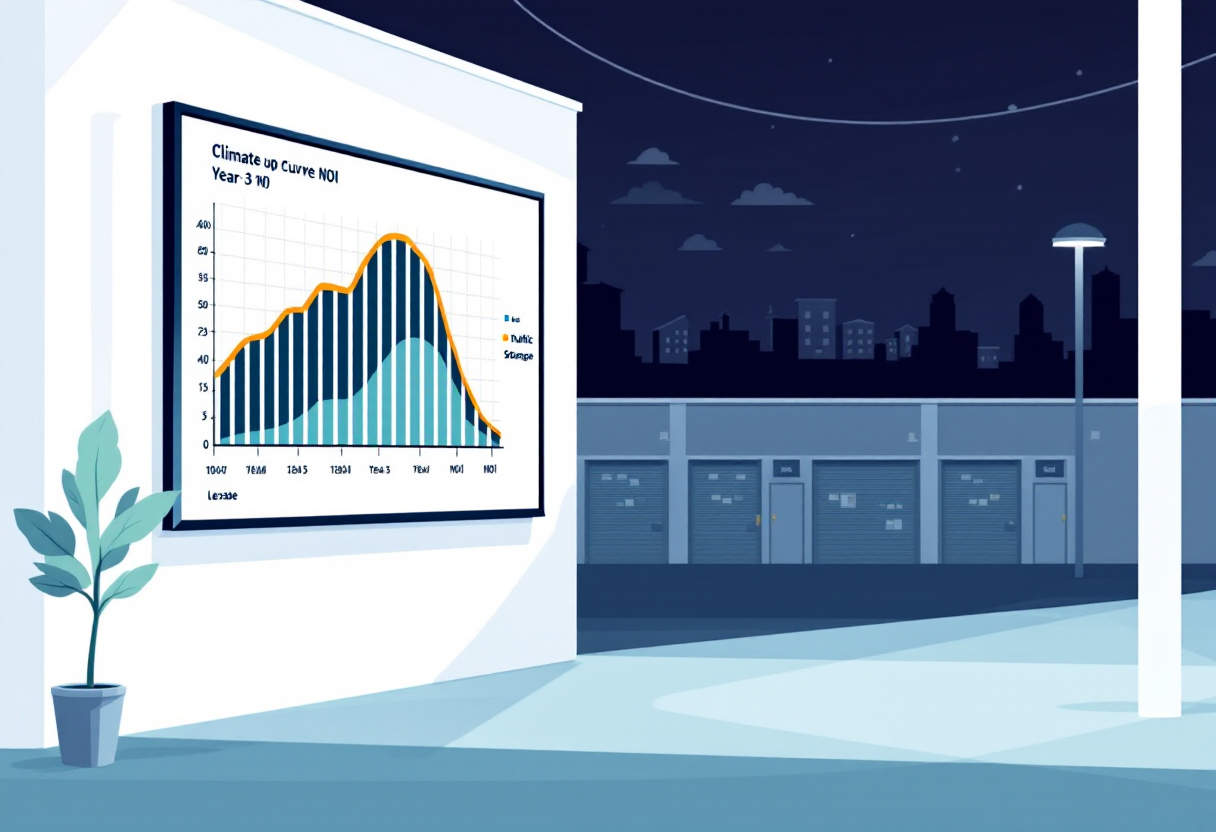
The lease-up period is where most ground-up projects either prove or destroy the underwriting. A typical Class A climate-controlled facility in a stable market reaches 80% physical occupancy in 24 to 36 months, with rate at street rent compression along the way. Underwriting that assumes 18-month lease-up in a market with three other facilities under construction is exactly the kind of pro forma that 2026 lenders are no longer accepting at face value. PropRise’s self storage underwriting primer walks through the standard lender stress tests, and the same logic shows up in nearly every institutional acquisition memo.
Stabilized net operating income, divided by the appropriate cap rate, gives the exit value. A $12 million ground-up project that stabilizes at $1.2 million of NOI and sells at a 6.0% cap rate exits at $20 million, an $8 million gain before debt and transaction costs. The same project that stabilizes at $900,000 of NOI and exits at a 6.75% cap rate sells for $13.3 million, less than the cost basis. Self storage is a category where small underwriting errors compound dramatically across a five to seven year hold.
Public Storage, Extra Space, CubeSmart: The REIT Comparison Set
The institutional comparison set for self storage starts with Public Storage (NYSE: PSA), Extra Space Storage (NYSE: EXR), CubeSmart (NYSE: CUBE), and National Storage Affiliates (NYSE: NSA). Together they own or manage roughly a quarter of all U.S. self storage square footage, and their 10-K filings on SEC EDGAR give buyers, sellers, and operators the most reliable benchmark data available for the category.
Public Storage’s same-store pool of 2,565 facilities (175.3 million net rentable square feet) reported essentially flat year-over-year revenue in 2025, with same-store cost of operations rising 1.8% ($16.6 million), per its Fourth Quarter and Full Year 2025 Results. The company acquired 87 facilities with 6.1 million net rentable square feet during 2025 for $942.2 million in aggregate purchase price, an implied price of roughly $154 per net rentable square foot.
Extra Space Storage reported a same-store pool of more than 2,000 wholly owned facilities and managed 2,263 stores for third parties and joint ventures at year-end 2025. CubeSmart managed 902 stores for third parties across 39 states. National Storage Affiliates, structured around a participating regional operator model, owned or had ownership interests in more than 1,000 facilities at year-end 2025. The four REITs together act as both the price-setter for institutional cap rates and the most active acquirer of stabilized facilities from independent and franchise-affiliated owners.
For sellers, the practical takeaway is that the REIT bid is real, well-funded, and disciplined. Sellers who run a structured process with a self storage broker like Marcus & Millichap, Newmark, or Argus typically get a tighter outcome than sellers who take a one-off inbound offer from a REIT regional acquisitions team. The dynamics are the same as in any other category where a few well-funded strategic buyers control the bid, and the importance of a real process is one of the reasons understanding what a business acquisition actually means matters before the seller engages.
Why Private Equity and REITs Are Consolidating the Industry
The consolidation story in self storage is not subtle. The four big REITs and a long tail of private equity-backed regional platforms have been buying independent facilities at scale for more than a decade. Private equity sponsors active in the category include Heitman, Harrison Street, Prologis (peripherally), KKR, Blackstone, and dozens of mid-market sponsors who specialize in the asset class. The reason is straightforward: the category has high recurring revenue, low working capital, low customer concentration, predictable lease-up curves once the supply pipeline normalizes, and a clear consolidation path because the operator universe is still highly fragmented.
The Self Storage Association’s industry data shows that more than 75% of U.S. self storage facilities are still owned by independents and smaller operators with fewer than ten facilities. That ratio has barely budged in 20 years, which means the consolidation runway is long. For a private equity buyer or a REIT, every independent facility represents both a potential acquisition and a potential third-party management contract. The compounding effect on a platform that does both is significant.
The implication for prospective franchisees is that the franchise route is, in many cases, a slower and more expensive path to the same outcome (own a self storage facility) than simply buying an existing facility outright and signing a REIT or independent management agreement. The franchise brand contributes far less to customer acquisition than it would in restaurants or home services, and the royalty is real money over a ten-year hold.
SBA 7(a) Financing for Self Storage Acquisitions (2026 Reality)
SBA financing is the workhorse for sub-$10 million self storage transactions in 2026. The SBA 7(a) program supports self storage acquisitions, expansions, refinances, and ground-up construction. With Prime at 7.5%, effective rates in 2026 run roughly 7.75 to 10.5% depending on lender, transaction size, and risk profile, per industry data from SBA7a.Loans and GoSBA Loans. The Self Storage Facilities sector received approximately $183 million in SBA 7(a) loans across 120 businesses in 2025, with 33 lenders actively funding the industry, and average loan size around $1.5 million.
Down payment for a first self storage acquisition under the SBA 7(a) program is generally 10% of total project costs, including land, construction, contingency, interest reserves, lease-up reserves, working capital, the SBA guaranty fee, and closing costs. Borrowers can get to 5% down if the seller is willing to hold the remaining 5% on full standby for the life of the SBA loan, meaning no payments until the SBA debt is retired. Existing self storage operators who want to buy a competing facility or open a new location can sometimes structure 100% financing with no down payment, depending on the lender and the global cash flow coverage of the existing portfolio.
Loan amounts under SBA 7(a) cap at $5 million per borrower, with the recent SBA change doubling the cumulative 7(a) and 504 limit to $10 million giving experienced operators more aggregate firepower across multiple deals. Terms extend to 25 years when real estate is more than 50% of the loan proceeds, which is almost always the case in self storage. For buyers comparing financing routes, the CT Acquisitions 2026 SBA 7(a) lender rankings for acquisitions walks through which lenders are actually closing deals and at what speed.
The SBA 504 program is the other common route, particularly for owner-occupied real estate-heavy projects. The structure (50% bank, 40% SBA debenture, 10% borrower) typically produces a blended rate slightly better than 7(a) but with a more cumbersome closing process and lower lender flexibility on lease-up reserves. For self storage specifically, many borrowers end up with 7(a) for the operational flexibility, even at a slightly higher headline rate.
The Single Best Self Storage Operator Strategy in 2026
The best operator strategy in self storage in 2026 is not a franchise. It is acquiring an existing under-managed facility in a secondary or tertiary market at a fair cap rate, raising street rates and renewing in-place tenants to market over 12 to 18 months, capturing the operating expense savings that come from professional revenue management, and either holding for cash flow or selling to a REIT or PE platform at a tighter cap rate three to five years later.
The reason this strategy works is the combination of high in-place tenant inertia, the existence of large institutional buyers willing to pay tight cap rates for stabilized assets, and the simplicity of self storage operations once a competent management platform is plugged in. The strategy can be executed with a REIT third-party management agreement (which gives the operator institutional pricing power immediately) or with an independent management firm or a small in-house team if the operator has prior commercial real estate experience.
For new entrants without a real estate background, the franchise route through Storage Authority or a similar brand is a reasonable training-wheels alternative, particularly for ground-up construction where the franchisor’s site selection support, design templates, and lender relationships can offset some of the learning curve. For experienced commercial real estate operators, the franchise route almost never pencils against the alternatives. This is the same logic that drives a lot of category-specific franchise decisions covered in best franchises to own in 2026 and home services franchise opportunities, where the brand’s contribution to customer acquisition is the variable that determines whether the royalty is worth paying.
An adjacent strategy worth naming is the resale market. Buying an existing facility from an aging independent owner is, in many cases, a better deal than building new, particularly in markets where the supply pipeline has finally normalized. The same dynamics that drive opportunities in the resale market for other franchises (covered in the CT guide to best franchises to buy in the resale market) apply with extra force in self storage because the underlying real estate is the dominant value driver.
How CT Acquisitions Helps Self Storage Buyers and Sellers
CT Acquisitions advises buyers and sellers across the self storage spectrum, including independent owner-operators selling to REITs or private equity, family-office and search-fund buyers acquiring their first facility, multi-facility platform owners running structured processes for portfolio sales, and ground-up developers refinancing into permanent debt at stabilization. The team works alongside specialist self storage brokers like Marcus & Millichap, Newmark Self Storage Group, and Argus Self Storage Advisors when those firms are the right run-process partner, and handles direct negotiations when a single-buyer transaction is the better outcome.
For sellers, the value of a structured process is the same in self storage as in any other category. Bringing more than one credible buyer to the table almost always produces a meaningfully better outcome than negotiating directly with a single REIT regional acquisitions team. For buyers, the value is in finding off-market facilities before they hit the institutional market and in negotiating SBA-friendly seller-financed structures that put more capital to work per dollar of equity.
If you are considering selling a self storage facility, buying your first or next facility, or evaluating a self storage franchise opportunity against the REIT third-party management alternative, schedule a call with the CT Acquisitions team and we will walk through the specifics of your situation, the realistic exit math, and the financing options available in the current 2026 market.
Self Storage Franchise: Frequently Asked Questions
Is a self storage franchise a good investment in 2026?
A self storage franchise can be a reasonable investment for a new operator who values the franchisor’s playbook, site selection support, and lender relationships, particularly on a ground-up project. For experienced commercial real estate owners, the royalty and marketing fees typically do not justify the brand value relative to alternatives like REIT third-party management or independent operation. The decision depends heavily on the operator’s existing experience and on the specific market and asset.
How much does a self storage franchise cost?
Storage Authority, the largest U.S. self storage franchisor, charges a $69,000 franchise fee plus a 6% royalty and a 2.5% marketing fee. Total ground-up project costs for a Storage Authority outlet run $7.5 million to $9.5 million. Conversions of existing buildings run $298,000 to $610,000 in franchise-related costs, exclusive of the real estate purchase price. Portable storage franchises like Go Mini’s and UNITS Portable Storage have much lower entry costs, typically $225,000 to $1.0 million in total investment.
What is the best self storage franchise?
Storage Authority is the dominant U.S. franchise focused on traditional drive-up and climate-controlled self storage. Portable storage franchises (Go Mini’s, UNITS Portable Storage, 1-800-PACK-RAT, myway Mobile Storage) are a separate category but show up in the same search results. The “best” choice depends on whether the buyer wants fixed real estate with long lease-up curves or a containerized fleet with a delivery model.
How profitable is a self storage facility?
A stabilized self storage facility typically operates at a 65 to 75% net operating income margin on effective gross income, which is high for a real estate category. Stabilized institutional facilities trade at cap rates of 5.0 to 7.5%, implying multiples of roughly 13 to 20 times in-place NOI. A $1 million NOI facility in a secondary market might sell at a 6.5% cap rate for $15.4 million.
Can you finance a self storage facility with an SBA loan?
Yes. The SBA 7(a) program is the primary route for self storage acquisitions and construction under $5 million per borrower (and up to $10 million in aggregate across multiple SBA loans as of the 2026 SBA limit change). Down payment is typically 10% of total project cost, with 5% possible if the seller holds the remaining 5% on standby. The Self Storage Facilities sector received $183 million in SBA 7(a) loans across 120 businesses in 2025.
Do self storage REITs franchise their brands?
No. Public Storage, Extra Space Storage, CubeSmart, and National Storage Affiliates do not franchise their brands in the traditional legal sense. They run third-party management programs that look and behave like a franchise (national brand presence on Google Maps, technology stack, revenue management, call center, online rentals) but operate under management agreements rather than long-term franchise licenses. Extra Space manages 2,263 third-party stores; CubeSmart manages 902. This is the dominant alternative to a traditional self storage franchise for owners who control their own real estate.
What is the average occupancy of a self storage facility?
National occupancy averages roughly 92% for institutional REIT operators and approximately 82% across the broader market including smaller and non-institutional facilities. Public Storage reported same-store occupancy of 91.0% at year-end 2025. REIT industry data through Q1 2026 showed same-store period-end occupancy of 84.5%, up 70 basis points year-over-year.
What cap rate does self storage trade at in 2026?
Class A climate-controlled facilities in primary metros trade at 5.0 to 6.0% cap rates. Class B facilities in secondary metros trade at 6.0 to 7.0%. Class C and non-climate facilities in tertiary markets trade at 7.0 to 7.5% or higher. These ranges are confirmed across reports from Marcus & Millichap, Newmark Self Storage Group, and Argus Self Storage Advisors.
How long is the lease-up period for a new self storage facility?
A typical Class A climate-controlled facility in a stable market reaches 80% physical occupancy in 24 to 36 months. Markets with elevated new supply or weaker demographics can take longer. Underwriting that assumed 18-month lease-up during the 2021-2022 surge is being repriced in 2026 as lenders demand more conservative ramp assumptions.
Should I buy an existing self storage facility or build new?
For most new entrants in 2026, buying an existing under-managed facility in a secondary or tertiary market is the better risk-adjusted strategy. The strategy avoids lease-up risk, takes advantage of the high in-place tenant inertia in self storage, and lets the new owner capture value by raising rates to market and improving operations. Ground-up development still works for experienced operators with the right site, but the lease-up curve and cost-of-capital headwinds in 2026 make it a harder path than the resale route.