
Forward Integration: 10 Real Examples, Strategy and Risks (2026)
Forward Integration Strategy And Examples in 2026 depends on scale, sector, and recurring revenue percentage. Named PE-backed and strategic acquirers pursue this vertical actively, and multiples clear meaningful ranges depending on platform readiness and market cycle timing. This page covers the operational specifics that matter to owner-operators considering a sale.
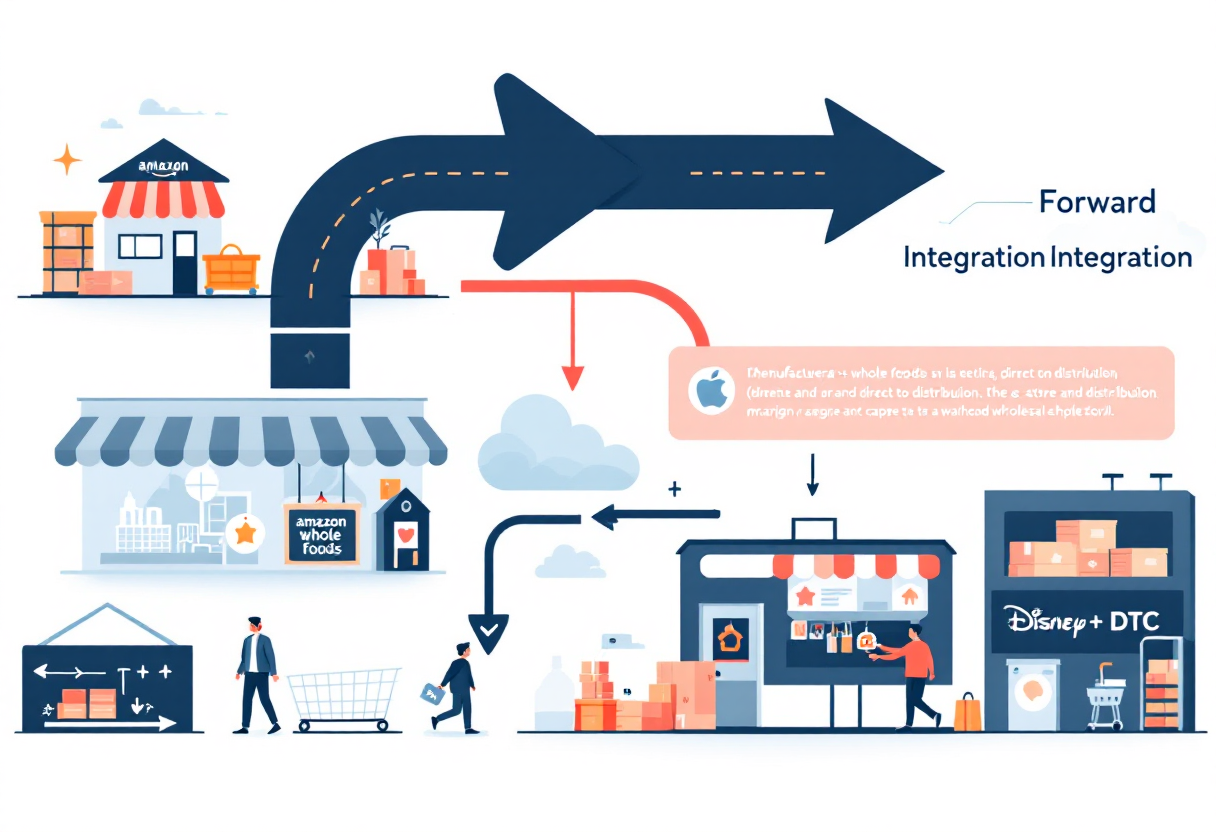
Forward integration is the corporate strategy where a company moves down its own value chain by acquiring (or building) a distributor, retailer, or direct customer, taking ownership of the path between its product and the end user. Tesla running its own stores, Amazon buying Whole Foods in 2017, Apple opening retail in 2001, and Disney launching Disney+ in 2019 are all forward integration plays. This guide explains forward integration with ten named real-world cases sourced to SEC filings, FTC statements, and DOJ court records, lays out the M&A premium math and the working capital mechanics that make the deals pencil, and shows when it creates durable value versus when it ends in an expensive unwind like AT&T-Time Warner.
What Is Forward Integration?
Forward integration happens when a producer takes ownership of the next step in its own value chain on the path to the end customer. If you make widgets and buy the warehouse-and-truck network that delivers widgets to stores, that is forward integration. If you buy the stores themselves, that is also forward integration. If you stand up a direct-to-consumer website that ships boxes to households, that too is forward integration, even with no acquisition.
The structural test is simple. Draw the chain from raw inputs to the consumer who pays cash for the finished product. Every box to the right of where the company sits today is a forward integration target; every box to the left is backward integration. Forward integration is a direction of travel along the value chain, and a company can take that direction one step or several.
The academic anchor for the concept is Michael Porter’s Competitive Strategy (Free Press, 1980), specifically Chapter 14, “A Strategic Analysis of Vertical Integration.” Porter framed forward integration as one of two directions a firm can take to internalize transactions that would otherwise happen at arm’s length. The underlying economic theory traces to Klein, Crawford and Alchian’s foundational 1978 paper, “Vertical Integration, Appropriable Rents, and the Competitive Contracting Process,” in the Journal of Law and Economics (JSTOR, vol. 21 no. 2, pp. 297-326), which argued that asset specificity and the threat of contractual hold-up are the conditions under which firms integrate rather than contract. A 2010 supply-chain paper in the International Journal of Production Economics updated the framework with empirical evidence on when vertical integration improves operational performance (ScienceDirect). Porter’s original 1979 framing of the Five Forces was set out in his Harvard Business Review article (HBR, March 1979), with forward integration treated as a defensive response to buyer-side bargaining power.
Most forward integration in 2026 falls into three patterns: acquiring a distributor that sells the product to retail accounts, acquiring or building a retail footprint (physical, e-commerce, or both), or acquiring a downstream user that consumes the product as an input (common in chemicals, paper, and packaging). Each shifts a different set of margins, working capital, and operating risks onto the integrating company. For a broader definitional treatment, see our explainer on what is a vertical merger.
Forward Integration vs Backward Integration vs Horizontal Integration
The three terms get bundled together because they all describe M&A directions, but they capture different margin pools and require different operating capabilities. The table below sets out the crisp differences.
| Strategy | Direction | What it captures | Typical financial profile | Canonical example |
|---|---|---|---|---|
| Forward integration | Downstream toward customers | Distributor and retailer margin, customer data, brand control | Higher working capital intensity, margin expansion | Amazon-Whole Foods, 2017 |
| Backward integration | Upstream toward suppliers | Supplier margin, supply continuity, input cost stability | Higher fixed asset intensity, gross margin protection | Boeing-Spirit AeroSystems, 2024 |
| Horizontal integration | Sideways at the same value-chain step | Market share, scale economies, redundant overhead removal | Variable; often goodwill-heavy | Disney-21st Century Fox, 2019 |
Backward integration targets cost stability and supply security. A steel mill buying iron ore mines is hedging input cost volatility; a coffee chain buying Colombian farms is securing supply against weather and political risk. Backward integration almost always increases capital intensity because upstream assets (mines, mills, plantations) carry heavy fixed asset bases.
Forward integration targets margin capture and customer access. A consumer brand opening its own stores is taking back the retailer markup and gaining direct access to first-party purchase data. Forward integration almost always increases working capital intensity because retail and distribution carry heavy inventory and receivables.
Horizontal integration is a different animal. A producer buying a competing producer is not changing direction along the value chain, it is consolidating share at the same step. The antitrust treatment is different (horizontal mergers are evaluated primarily on market concentration, vertical on foreclosure), the synergy thesis is different (cost takeout vs margin capture), and the integration risks are different. For a fuller side-by-side, see our companion guide on horizontal vs vertical integration explained and the focused piece on what is a horizontal merger.
How Forward Integration Works: The Value Chain Mechanics
Porter’s value-chain model places primary activities in sequence: inbound logistics, operations, outbound logistics, marketing and sales, and service. Forward integration internalizes one or more activities to the right of where the firm sits. A producer that only runs operations and outbound logistics integrates forward by absorbing marketing and sales (a DTC e-commerce stack), service (a service network), or both (a full retail footprint with after-sale support).
The strategic gain shows up in two places. The firm captures the gross margin the downstream player was earning, less operating drag. The firm acquires direct end-customer information that the prior arm’s length structure obscured. Both gains are conditional: margin capture only sticks if channel conflict does not erode wholesale revenue by more than the captured retail margin, and data capture only matters if the firm can convert raw customer data into operating decisions.
Forward integration also reshapes the firm’s exposure to Porter’s Five Forces. The supplier-side threat is unchanged. The buyer-side threat decreases because the firm now sells directly to fragmented consumers rather than concentrated retail accounts. The threat of new entrants increases for the firm’s prior wholesale customers, since the firm just became a competitor. Rivalry at the new downstream level is now a direct concern.
10 Forward Integration Examples From Real Companies
The ten cases below cover the most cited and most instructive forward integration moves of the past 25 years. Every numeric claim is sourced to a primary filing (SEC EDGAR, FTC, DOJ, or company press release).
1. Amazon and Whole Foods Market (June 2017, $13.7B)
Amazon announced its acquisition of Whole Foods Market on June 16, 2017, for $42 per share in cash, valuing the deal at approximately $13.7 billion (Amazon 8-K exhibit 99.1, June 16, 2017). The Federal Trade Commission closed its Section 7 Clayton Act review without action on August 28, 2017. In the closing statement, then-Acting Director of the Bureau of Competition Bruce Hoffman wrote that the FTC had “conducted an investigation of this proposed acquisition” and “decided not to pursue the investigation further” (FTC press release, August 28, 2017). The deal closed the same day. The acquisition gave Amazon an immediate refrigerated and ambient grocery footprint of about 460 stores (Whole Foods Market company info), a premium customer base that overlapped with Prime demographics, and a network of physical nodes for Prime delivery, returns, and Amazon Lockers.
2. Tesla’s company-owned dealership network (continuous since 2008)
Tesla has never used franchised dealers. From the launch of the Roadster in 2008 and especially after the Model S launch in June 2012, Tesla has sold and serviced cars exclusively through company-owned stores, galleries, and a direct online configurator. The company’s most recent annual report, the FY2024 Form 10-K filed January 30, 2025, describes the model directly: “Our customers deal directly with Tesla-employed sales and service staff… operating efficiencies and capturing sales and service revenues that traditional automobile manufacturers do not enjoy” (Tesla 10-K, December 31, 2024). By 2026 Tesla operates more than 250 retail locations globally plus a service network of similar size. The forward integration cost is regulatory: most US states have franchise protection laws written between 1937 and 1955 that prohibit a manufacturer from owning sales outlets that compete with franchised dealers, and Tesla has been legislated or litigated against in roughly half of US states (background coverage at National Conference of State Legislatures, motor vehicle franchise laws).
3. Apple Retail Stores (greenfield from May 2001)
Apple announced its first 25 retail stores on May 15, 2001, with the first opening at Tysons Corner Center in Virginia on May 19, 2001. Apple’s press release at the time said the stores would “provide an unprecedented buying experience” and would carry the full Apple line plus selected third-party products (Apple Newsroom, May 15, 2001). The financial context, drawn from Apple’s FY2001 Form 10-K (SEC EDGAR, Apple CIK 0000320193 10-K filings), was that Apple had decided independent computer retailers could not adequately merchandise the brand or deliver the in-store experience Apple required. The greenfield build became a defining forward integration plays in corporate history, with more than 530 stores operating globally by 2026 and a retail-segment revenue line that has been one of the highest grossing per square foot in retail.
4. Nike Direct-to-Consumer pivot (2017-2024)
Nike’s Consumer Direct Acceleration strategy, formalized under CEO John Donahoe in 2020, expanded the share of revenue Nike captured directly versus through wholesale partners. Nike’s Q2 FY2024 earnings release, filed as an 8-K exhibit on December 21, 2023, reported Nike Direct revenues of $5.7 billion for the quarter, or roughly 44 percent of total Nike Brand revenue (Nike Q2 FY2024 8-K exhibit 99.1). That share had risen from 16 percent in FY2011 and 35 percent in FY2020 (per Nike’s FY2020 10-K, SEC EDGAR, Nike CIK 0000320187). The strategy worked on the direct margin line but generated channel conflict, and Nike publicly partly reversed course in 2024 by re-engaging with wholesale partners including DSW and Macy’s (Retail Dive, June 2024 coverage). Nike Direct is the cleanest contemporary case of the trade-off between captured direct margin and lost wholesale shelf space.
5. Disney+ direct-to-consumer launch (November 12, 2019)
Walt Disney launched its Disney+ streaming service on November 12, 2019, taking distribution of its film and television content directly to consumers rather than licensing to aggregators such as Netflix. Disney filed a Form 8-K in November 2019 disclosing material events related to the launch and its direct-to-consumer reorganization (Walt Disney 8-K, November 2019). Disney+ reached 10 million sign-ups within 24 hours of launch (Walt Disney Company press release, November 13, 2019) and crossed 100 million subscribers by March 2021. The Direct-to-Consumer segment reached operating profitability in Q4 of fiscal 2024 (per Disney’s Q4 FY2024 8-K earnings release, Walt Disney Q4 FY2024 earnings, November 14, 2024), validating the thesis on a five-year timeline. The Disney+ build is the marquee content-side forward integration case of the streaming era.
6. Netflix originals and platform integration (2013 onward)
Netflix is the inverse case: a distribution platform that integrated backward into content production while remaining the canonical example of cutting out aggregators. Beginning with House of Cards in February 2013, Netflix invested at scale in original programming, internalizing the studio function that traditional networks had outsourced for decades. By 2024 Netflix was spending more than $17 billion annually on content (per Netflix’s FY2023 10-K, SEC EDGAR, Netflix CIK 0001065280), much of it produced or co-produced internally, and was operating production facilities at scale. The Netflix path illustrates how forward integration (Netflix sells subscriptions directly to consumers) and backward integration (Netflix now produces much of its own content) can stack inside a single company over time.
7. PepsiCo acquires SodaStream (August 2018, $3.2B)
PepsiCo announced its acquisition of SodaStream on August 20, 2018, for $144 per share in cash, valuing the deal at approximately $3.2 billion (PepsiCo 8-K exhibit 99.1, August 20, 2018). The transaction closed on December 5, 2018. The deal extended PepsiCo’s beverage portfolio into the in-home preparation segment, with SodaStream’s installed base of more than 12 million households at the time of announcement. The premium over SodaStream’s prior thirty-day average share price was approximately 32 percent, a typical control-premium range for a forward integration deal into a strategically aligned consumer category. The acquisition has generally been viewed as reasonable in execution, giving PepsiCo a beachhead in at-home beverage formats that complement the company’s bottled and canned offerings.
8. McDonald’s acquires Dynamic Yield (March 2019)
McDonald’s announced its acquisition of personalization-engine company Dynamic Yield on March 25, 2019 (McDonald’s Corporate, March 25, 2019), for a reported $300 million, the largest McDonald’s technology acquisition to that point. The deal integrated personalization technology directly into drive-thru menu boards and digital ordering channels, capturing the data and decision-engine layer that had previously sat with third-party vendors. McDonald’s later sold Dynamic Yield to Mastercard in April 2022 after extracting the core integration (Mastercard press release, April 4, 2022), a pattern of buy-integrate-divest that has become more common in technology-driven forward integration.
9. Boeing re-acquires Spirit AeroSystems (announced July 1, 2024)
Boeing announced its acquisition of Spirit AeroSystems on July 1, 2024, at $37.25 per share in stock, valuing the equity at approximately $4.7 billion and the enterprise value at approximately $8.3 billion including assumed debt. Boeing filed two 8-K exhibits the same day disclosing the merger agreement (Boeing 8-K exhibit 99.1, July 1, 2024) and the strategic rationale (Boeing 8-K exhibit 99.2, July 1, 2024). Spirit had been spun out of Boeing in 2005, so the 2024 deal is technically backward integration (Boeing re-acquiring its largest supplier), but the strategic logic mirrors the forward integration lesson exactly: a vertical-integration choice made in one strategic context (the 2005 spin to reduce capital intensity) had to be reversed in a different context (the 2024 quality and production crisis around the 737 MAX). The Boeing-Spirit case is the canonical reminder that vertical integration decisions are not permanent and need to be re-examined when underlying conditions change.
10. Starbucks vertical integration: roasting plus retail (continuous)
Starbucks runs a top-tier complete vertical integrations in consumer products, operating its own roasting plants in the United States, the Netherlands, and China, and selling almost entirely through more than 38,000 company-operated and licensed stores (per Starbucks FY2024 10-K, SEC EDGAR, Starbucks CIK 0000829224) rather than wholesale to grocery (apart from the Nestle licensing partnership disclosed in the Starbucks 8-K of May 7, 2018, Starbucks 8-K, May 7, 2018). The forward leg of that integration, the company-operated store network, gave Starbucks direct control over the cafe experience, the labor model, the loyalty program, and the data flow that competitor coffee brands selling through grocery have never been able to match. Starbucks is rarely discussed as a forward integration case because the structure was built in from the founding, but the strategic logic is the same.
Build vs Buy: Two Paths to Forward Integration
Forward integration is one of the few corporate strategies where buy versus build is a genuinely live debate, because both paths get used at roughly comparable frequency. The decision usually turns on three factors: speed, scarcity, and cultural distance.
Speed favors acquisition. If a competitor is about to lock up the only viable distributor in a region, waiting two years to build greenfield is not a real option. Boeing’s 2024 re-acquisition of Spirit AeroSystems was driven in part by speed: Boeing concluded it could not rebuild the fuselage manufacturing capability fast enough through any greenfield route against the backdrop of the 737 MAX production quality issues (per the Boeing 8-K cited above).
Scarcity also favors acquisition. If the downstream asset is irreplaceable (a unique location, a regulated license, a long-tenured customer relationship), the only way to integrate forward is to buy. Amazon’s 2017 Whole Foods acquisition was partly a scarcity play because building a 460-store premium grocery footprint from scratch would have taken 15 to 20 years.
Cultural distance favors greenfield. Apple did not buy a retailer in 2001 because no existing retailer had the design discipline, employee training model, or merchandising philosophy Apple required (per the Apple Newsroom announcement above). Disney built Disney+ rather than buying a smaller streaming service for the same reason: brand standards and family-positioning required a blank sheet.
The four-quadrant summary: Apple and Disney built (cultural distance), Amazon and PepsiCo bought (speed and scarcity), Tesla built (no acquirable target existed in 2008), Boeing bought (Spirit’s certification asset). For more on how acquirers structure these decisions financially, see how investment bankers value a business.
Benefits of Forward Integration
Five repeatable benefits drive most forward integration deals.
Margin capture. If a distributor earns 10 percent EBITDA on revenue and you capture that margin without losing more than 3 to 4 points of producer margin to channel conflict, the deal pencils on margin alone. Nike’s Q2 FY2024 results show direct revenues at roughly 44 percent of brand revenue (per the Nike 8-K cited above).
Customer data ownership. A producer selling through retailers gets aggregated weekly POS data. A producer selling direct gets every transaction, every basket, and the ability to build first-party identity over time. In privacy-restricted environments where third-party identifiers are increasingly unavailable, first-party data has become a top-tier asset a consumer brand can hold.
Brand and experience control. A franchised dealer or third-party retailer is in business to maximize its own margin and to merchandise competing brands. When the producer owns the touchpoint, the producer controls the layout, staff training, after-sale service, and brand impression. For products where the in-store experience is part of the value, this is the moat.
Channel access and shelf certainty. When retailers consolidate (as they have in grocery, consumer electronics, and sporting goods over the past 20 years), the producer’s bargaining power erodes. Owning a direct path to the consumer hedges against being squeezed by private label or slotting fees. PepsiCo’s SodaStream acquisition has elements of this logic (per the August 2018 PepsiCo 8-K).
Switching-cost moat. A direct subscription, loyalty membership, or in-app payment relationship creates a switching-cost moat intermediated sales cannot match. Disney+ at 100 million-plus subscribers is also 100 million-plus billing relationships and content-personalization profiles competitors cannot replicate.
The five benefits stack. Disney+ was simultaneously a margin capture move (skip the Netflix licensing fees), a customer data move (own the household relationship), and a defensive move (avoid permanent dependence on a single distribution platform). When two or three rationales stack, the deal logic is durable; when only margin capture supports the thesis, it tends to underperform. For a broader framework, see advantages of mergers and acquisitions with examples.
Risks and Costs of Forward Integration
Three failure patterns explain most forward integration value destruction.
Failure pattern one: channel conflict that costs more than the captured margin. When a producer integrates forward into retail, existing wholesale customers (now competitors) often retaliate by reducing shelf space or switching to private label. Nike’s 2020-2024 DTC push triggered exactly this response (per the Retail Dive coverage above), and Nike partly walked back the strategy in 2024.
Failure pattern two: strategic incoherence at scale. Some deals combine two businesses whose unit economics, talent models, and competitive dynamics differ fundamentally. The AT&T-Time Warner combination is the textbook case (covered in the next section).
Failure pattern three: the bottler-style unwind, right at first and wrong later. Coca-Cola acquired Coca-Cola Enterprises in October 2010 for $12.3 billion (per the Coca-Cola 8-K of February 25, 2010, Coca-Cola 8-K), integrating forward into bottling and account-servicing. By 2014 the capital intensity had become a drag on return on invested capital, and from 2015 to 2017 Coca-Cola refranchised its company-owned bottling territories back to independent partners. The integration was not wrong in 2010; the world changed.
Beyond these three patterns, four operational costs apply to almost every forward integration deal: capital intensity rises, focus dilutes, regulatory scrutiny intensifies, and execution risk compounds because the producer must run a business it has never run before.
When Forward Integration Fails: The AT&T-WarnerMedia Unwind
The AT&T-Time Warner deal is the largest and most public forward integration failure of the past decade, and it deserves its own case study because every element of the pattern is documented in SEC filings and court rulings.
AT&T announced its $85.4 billion acquisition of Time Warner in October 2016, structured as $107.50 per share in cash and stock. The Department of Justice sued to block the deal in November 2017 on vertical foreclosure grounds, arguing that combining AT&T’s distribution (DirecTV satellite, U-verse, mobile broadband) with Time Warner’s content (HBO, Warner Bros., CNN, Turner) would give AT&T the ability and incentive to raise prices to competing distributors. On June 12, 2018, Judge Richard J. Leon of the U.S. District Court for the District of Columbia ruled against the government and cleared the merger to proceed (Crowell summary of the June 12, 2018 ruling). The deal closed days later, and AT&T disclosed the consolidation in its FY2018 Form 10-Q (AT&T 10-Q, Q2 FY2018).
The integration thesis did not survive contact with operating reality. AT&T sold off a 30 percent stake in DirecTV to TPG in February 2021. Then on April 8, 2022, AT&T spun off WarnerMedia and merged it with Discovery Inc. to form Warner Bros. Discovery, disclosed in an AT&T 8-K filed the same day (AT&T 8-K exhibit 99.1, April 8, 2022) and a WBD 8-K (WBD 8-K, April 11, 2022). Warner Bros. Discovery began trading on Nasdaq under “WBD” on April 11, 2022.
Total value destroyed across the cycle is measured in tens of billions of dollars. AT&T’s 2018 outlays totaled roughly $108.7 billion including assumed debt; the value AT&T retained from the spin was a small fraction of that. The lesson: a federal judge clearing a merger on antitrust grounds is no protection against an operating-model mismatch. AT&T won the antitrust trial in 2018 and lost the integration in 2022. The questions to ask before signing are operating questions, not regulatory questions.
Antitrust and Regulatory Considerations
Antitrust treatment of forward integration shifted meaningfully in the United States during the early 2020s, and the deal logic in 2026 cannot rely on the same assumptions that applied a decade ago. Four regulatory events define the current landscape.
First, on September 15, 2021, the Federal Trade Commission formally withdrew the 2020 Vertical Merger Guidelines (FTC press release, September 15, 2021), the joint FTC and DOJ document that had laid out the analytical framework for evaluating vertical deals. The withdrawal was not accompanied by a replacement, signaling that the agencies considered the 2020 framework too permissive and intended to scrutinize vertical combinations more skeptically.
Second, the Amazon-Whole Foods closing statement from August 28, 2017 remains the benchmark for a smooth vertical clearance (per the FTC press release cited above). The review was substantive but completed in roughly two months, with no divestitures or behavioral remedies. Acquirers in 2026 should not expect a similar timeline for any vertical deal where the foreclosure analysis is non-trivial.
Third, the AT&T-Time Warner ruling of June 12, 2018 is the high-water mark for vertical-merger defenses on antitrust grounds. Judge Leon’s opinion concluded the DOJ had not met its burden of showing the merger would substantially lessen competition under Section 7 of the Clayton Act. The case established that vertical-foreclosure theories require concrete evidence of likely anticompetitive effect.
Fourth, the Illumina-Grail unwind is the defining counter-example. Illumina completed its $7.1 billion acquisition of Grail in August 2021 without waiting for European Commission clearance. The European Commission blocked the deal in September 2022, the FTC ordered divestiture (FTC order, April 3, 2023), and Illumina announced in December 2023 it would divest. The transaction completed in June 2024. Even forward integration deals between formally separate markets can be unwound if agencies conclude the combined entity would foreclose downstream competition.
The 2023 Merger Guidelines issued jointly by the FTC and DOJ on December 18, 2023 (FTC/DOJ 2023 Merger Guidelines PDF) explicitly address vertical and forward integration concerns, with a stated focus on foreclosure of access to inputs or distribution. They have influenced remedy structures in vertical deals during 2024 and 2025.
The practical implication: budget for a longer regulatory review timeline, engage antitrust counsel early, and prepare a credible foreclosure analysis. Deals that close cleanly tend to be those where the acquirer can document that downstream competitors will retain genuine alternative access to the integrated input.
M&A Premium Math: What Forward Integration Deals Cost
Forward integration deals tend to command higher control premiums than horizontal deals at comparable scale, because the strategic logic requires the acquirer to outbid both other strategic acquirers and any financial sponsors that might want the target on its own merits. Three reference points illustrate the range.
Amazon-Whole Foods (June 2017): $42 per share, a premium of roughly 27 percent over the unaffected Whole Foods share price of about $33 before bid speculation. Cash-funded (per the Amazon 8-K cited above). Implied EV/EBITDA was roughly 10.5x trailing, above the natural-grocery peer range of 8x to 9x.
PepsiCo-SodaStream (August 2018): $144 per share, a premium of approximately 32 percent over SodaStream’s prior 30-day average (per the August 20, 2018 PepsiCo 8-K). Implied EV/EBITDA approximately 21x trailing.
Boeing-Spirit (July 2024): $37.25 per share in stock, premium of approximately 30 percent, enterprise value approximately $8.3 billion including assumed debt (per the Boeing 8-K cited above). Stock consideration reflected Boeing’s preference to preserve cash given 737 MAX production demands.
The three points triangulate a typical control-premium range for forward integration deals of roughly 25 to 35 percent. The upper end appears when the target has a uniquely strategic asset (SodaStream’s installed base) or when competitive bidding emerges. In the lower middle market, where most CT Acquisitions transactions live, a regional manufacturer acquiring a regional distributor at $10 to $50 million in enterprise value typically pays 25 to 35 percent over a standalone valuation, funded through senior debt, seller notes, and earn-out structures keyed to retention of key customer accounts. For more, see our guide on business acquisition meaning explained.
How Forward Integration Affects Working Capital and Cash Conversion
The least discussed financial impact of forward integration is on working capital. The producer who buys a retailer takes on a different working capital profile, and the change can absorb the bulk of the margin capture if not modeled carefully.
A B2B manufacturer typically operates with 30 to 60 days of inventory and 45 to 75 days of receivables. A retailer typically operates with 60 to 120 days of inventory (higher SKU count, slow movers accumulate) and 0 to 5 days of receivables (consumers pay at point of sale). The consolidated balance sheet adds the retailer’s inventory load but loses very little receivables.
The net effect for a manufacturer-acquires-retail deal is roughly 30 to 90 days of additional inventory, partially offset by a small DSO reduction. Year one often consumes incremental working capital equal to 4 to 9 percent of incremental revenue, absorbing 25 to 60 percent of the captured retail margin. The investment is recovered if the business grows, but the upfront draw is a real cost. For manufacturer-acquires-distributor deals in industrial categories, the math is friendlier: a distributor typically runs 45 to 90 days of inventory and 30 to 60 days of receivables, much closer to the manufacturer’s existing profile.
Decision Framework: Should You Forward Integrate?
The five-question matrix below collapses two decades of forward integration case experience into a quick screen. Score each question 1 to 5, with 5 indicating strong support for the integration thesis. A total of 18 or higher signals a deal worth underwriting in detail; below 14 signals the deal is more likely to fall into the value-destruction pattern.
| Question | What you are testing | Strong-thesis signal |
|---|---|---|
| 1. Is the downstream margin pool large enough? | Capturable distributor or retailer EBITDA margin as a percent of revenue | Pool greater than 8 percent of producer revenue after dis-synergy |
| 2. Is there visible channel dysfunction? | Distributor or retailer service issues, shelf loss, or price destruction | Multiple wholesale accounts mishandling the product or losing share |
| 3. Can the producer fund the working capital draw? | Incremental WC investment over first 12 to 18 months | Liquidity headroom greater than 9 percent of incremental revenue |
| 4. Is the regulatory risk manageable? | HSR clearance probability and any state franchise law exposure | Concentration metrics and foreclosure analysis support clean clearance |
| 5. Does the producer have operating bandwidth? | Management depth to run a second operating model | Dedicated integration leader plus retained downstream management |
The matrix is weighted toward operational and financial questions rather than strategic-vision questions because the failure cases (AT&T-Time Warner, Coca-Cola bottlers) almost always show strong scores on strategic vision and weak scores on at least two of the five operational tests. Forward integration succeeds when the operating bandwidth and financial structure can absorb the integration cost, not when the strategic thesis is the most compelling.
Forward Integration in Porter’s Five Forces
Porter’s Five Forces (1979 HBR article, expanded in Competitive Strategy in 1980) treats forward integration as a strategic response to the buyer-side force. When concentrated downstream buyers can extract margin from a producer, the producer can defend itself by integrating forward and removing the buyer’s bargaining position.
The same logic applies to the threat-of-substitutes dimension. If a downstream platform can substitute the producer’s brand for a competing brand or private label, the producer can defend itself by becoming the downstream platform. Disney’s decision to launch Disney+ rather than continue licensing to Netflix (per the November 2019 8-K cited above) is the textbook contemporary example.
The framework also flags when forward integration is the wrong defensive move. If the dominant threat is supplier bargaining power, the producer should integrate backward. If the dominant threat is rivalry among existing competitors, the producer should consolidate horizontally. Klein, Crawford and Alchian’s 1978 paper (cited above) adds a complementary lens: forward integration is most justified when the downstream relationship involves significant asset specificity that would otherwise create contractual hold-up risk.
How to Execute a Forward Integration Strategy
The five-step playbook below covers standard practice on the buy-side of forward integration deals at both lower middle market and large strategic scale.
Step one: write the thesis. A one-page thesis covering the downstream margin pool, the strategic risk being addressed, the working capital implication, the regulatory posture, and the operating capability the acquirer brings. Testable against the five-question decision framework above.
Step two: screen targets. Build a long list of acquirable downstream players (or, for greenfield, locations or platforms to build). Score each on strategic fit, financial accretion, cultural compatibility, and regulatory friction. Shortlist no more than five names.
Step three: run substantive diligence. Forward integration diligence is heavier than horizontal-deal diligence because the acquirer is buying a business it does not run. Commercial diligence (customer and channel interviews), operational diligence (working capital, inventory, fulfillment), and cultural diligence (talent retention) all need dedicated workstreams. Antitrust counsel engaged before signing.
Step four: build the integration plan before signing. The single biggest predictor of post-close success is a detailed integration plan at signing, owned by a named integration leader with day-one accountability. Plans built before signing reveal hidden costs that often change the price the acquirer is willing to pay.
Step five: track KPIs against the original deal model. Forward integration deals routinely underperform their day-one model. The acquirers that recover are the ones that report monthly against the original model rather than a revised post-close baseline.
How CT Acquisitions Sees Forward Integration in the Lower Middle Market
Most public conversation about forward integration centers on multi-billion dollar consumer and media deals, but the strategy shows up regularly in the lower middle market, where CT Acquisitions does most of its sell-side advisory work. The patterns at $5M to $75M EBITDA are different in shape and somewhat more reliable in outcome than headline-grabbing strategic transactions.
The most common LMM forward integration pattern is a regional manufacturer acquiring its largest distributor partner. We have seen this in HVAC equipment, specialty chemicals, building products, and electrical components. The deal logic combines margin capture (distributors earning 10 to 14 percent EBITDA) and customer concentration relief. When the cultural fit is reasonable and the producer has sales leadership capable of running distribution, these deals work out well.
A second pattern is private equity rolling up regional distributors under a producer platform. The sponsor builds a national distribution footprint, captures the distributor margin pool, and exits at a higher multiple than either component would attract standalone. A third pattern, growing fast, is service businesses acquiring their largest end-customer accounts: a managed services provider acquires a customer wanting to bring IT in-house; a commercial cleaning company acquires a multi-location customer rolling facilities into a single P&L.
The pattern we counsel against is the founder-led producer who wants to greenfield a retail operation without operating experience. The capital required is larger than expected, the timeline to profitability longer, and the management bandwidth to run two operating models simultaneously is routinely underestimated. When forward integration is the right direction for an LMM company, an acquisition of an existing operator is almost always the better path than a greenfield build.
Frequently Asked Questions
What is a forward integration example?
The most cited modern example is Amazon’s $13.7 billion acquisition of Whole Foods Market, announced June 16, 2017 and closed August 28, 2017 after the FTC closed its review. Other defining cases: Tesla’s company-owned dealership network (per Tesla’s FY2024 10-K), Apple launching its first retail store on May 19, 2001, Disney+ launching November 12, 2019, and PepsiCo’s $3.2 billion acquisition of SodaStream in August 2018.
What is forward and backward integration?
Forward integration moves a company down its value chain toward distribution and end customers (a manufacturer acquiring a retailer). Backward integration moves the same company up its value chain toward suppliers and raw materials (a steel mill acquiring iron ore mines, or Boeing re-acquiring Spirit AeroSystems per the July 1, 2024 8-K). Both are vertical integration. Forward usually targets margin capture and customer access; backward targets cost stability and supply security.
What is an example of a forward integration brand?
Apple is the textbook forward integration brand. Apple opened its first 25 retail stores in 2001 (per the Apple Newsroom press release cited above) and now operates more than 530 stores globally. Tesla is the other defining example, operating more than 250 company-owned stores globally without franchised dealers (per Tesla’s FY2024 10-K).
What is the difference between upstream and forward integration?
Upstream and backward integration are the same direction: toward raw materials and inputs. Forward integration is the opposite direction, toward the end customer. Forward is sometimes called downstream integration.
Why do companies use forward integration?
The five most common reasons are margin capture (taking back the markup that distributors and retailers were earning), customer data ownership (getting first-party purchase data rather than aggregated POS reports), brand and experience control (preventing dilution by third-party retailers), channel access and shelf certainty (hedging against retail consolidation), and defensive moats against powerful downstream platforms (the Disney+ rationale per the November 2019 8-K cited above). The strongest forward integration cases stack two or three of these reasons rather than relying on margin capture alone.
When should businesses implement forward integration?
Forward integration makes sense when the downstream margin pool is large enough to cover integration costs, when the working capital and capex required to operate the downstream asset is manageable for the producer’s balance sheet, when the producer has the operating competence to run the new activity, when channel conflict with existing wholesale partners is unlikely to cost more than the captured direct margin, and when the regulatory posture supports clean clearance. The five-question decision framework above operationalizes the test.
What factors are to be considered when deciding on forward integration?
Five factors: the size of the downstream margin pool, the visible level of channel dysfunction, the working capital draw the producer can fund, the regulatory risk profile (HSR clearance probability and any state franchise law exposure), and the producer’s operating bandwidth to run a second operating model. Scoring each factor 1 to 5 and totaling produces a quick screen; totals at 18 or higher signal deals worth underwriting in detail.
What is the impact of forward integration?
Forward integration expands gross margin (capturing distributor and retailer markup), changes the working capital profile (adding 30 to 90 days of inventory and reducing DSO), increases capital intensity, and shifts exposure to Porter’s Five Forces (reduces buyer-side bargaining power, increases rivalry at the new downstream level). The net impact depends on whether the producer can recover the upfront working capital and integration cost within a reasonable horizon. For more, see how investment bankers value a business.
What is the difference between forward integration and horizontal integration?
Forward integration moves a company along its value chain toward customers (manufacturer buys retailer). Horizontal integration consolidates the company with competitors at the same value-chain step (manufacturer buys another manufacturer). The two differ in financial profile (forward integration captures distributor margin; horizontal integration captures scale economies and overhead cost takeout), in antitrust treatment (vertical is evaluated on foreclosure; horizontal on market concentration), and in operating risk (forward integration requires running a new kind of business; horizontal integration requires merging two of the same kind of business).
Is Apple a forward integration company?
Yes. Apple’s launch of the Apple Store retail format in May 2001 (per the Apple Newsroom press release cited above) was a direct forward integration into retail, taking Apple from a producer that sold through third-party retailers (CompUSA, Sears, regional Mac specialists) to a producer that operates its own retail network alongside continuing third-party distribution. The retail segment has been a defining forward integration moves in corporate history, with more than 530 stores globally by 2026 and high revenue per square foot.
Is Amazon’s Whole Foods acquisition forward integration?
Yes. Amazon’s $13.7 billion acquisition of Whole Foods, announced June 16, 2017 and cleared by the FTC on August 28, 2017 (per the FTC closing statement cited above), was a forward integration from Amazon’s existing online retail and logistics platform into physical grocery retail and last-mile fulfillment. The deal extended Amazon’s reach from the customer’s screen to a 460-store physical footprint, capturing both grocery retail margin and the broader strategic value of physical nodes for Prime delivery, returns, and Amazon Lockers.
What are the risks of forward integration?
Four main risks: channel conflict (wholesale customers retaliate, as Nike saw across 2020 to 2024), strategic incoherence (the AT&T-Time Warner pattern, ending in the April 2022 spin to Warner Bros. Discovery per the AT&T 8-K cited above), regulatory unwinds (the Illumina-Grail divestiture completed June 2024 after the FTC order), and the bottler-style cycle reversal (Coca-Cola refranchising bottling territories acquired in 2010). Every deal also carries the operational risks of capital intensity, focus dilution, and working capital draw covered above.