How Investment Bankers Run a Sell-Side Auction: The 2026 Process Playbook
Understanding how investment bankers run a sell-side auction is the single biggest information gap between a founder selling their business once and a buyer who has closed forty deals. A competitive auction process generates a 15 to 25 percent price premium over single-buyer negotiation, according to the SRS Acquiom 2025 Deal Terms Study, and the entire premium comes from how the banker controls information, pacing, and parallel negotiation across a curated buyer pool.
Thinking about selling? Talk to a sell-side advisor first.
A 30 minute call will tell you whether a full auction process is worth running for your business, what your realistic buyer pool looks like, and what timing makes sense. No fee to you on buy-side introductions; sell-side mandates are paid on success at closing.
Book a Free ConsultationWhat This Actually Means
A sell-side auction is a structured, time-bound competitive process where an investment bank or M&A advisor markets a company to a pre-qualified pool of 30 to 100 buyers, then narrows that pool through staged information releases until 3 to 5 finalists submit binding offers. The seller picks the winner. Done right, the process runs 5 to 7 months from CIM release to close.
The word “auction” is slightly misleading. There is no live bidding room. What actually happens is a series of formal rounds where the banker controls who sees what document, when, and under what restrictions. Each round narrows the field and forces buyers to commit more time, more analysis, and ultimately more price to stay in. The price premium does not come from one buyer waving a paddle. It comes from each buyer believing, at every stage, that three or four equally serious parties are right behind them.
Owners often confuse a sell-side auction with a broker process. A business broker typically lists the company on a marketplace, fields inbound inquiries, and negotiates with whoever shows up. A sell-side auction is the opposite: the banker reaches out to a hand-built list, controls all communication, and never lets a buyer believe they are the only one at the table. The output difference shows up in price. Capstone Partners’ 2026 Lower Middle Market Survey reports median multiples of 5.8x EBITDA for full-auction processes versus 4.6x for broker-led single-buyer deals in the $3M to $10M EBITDA band.
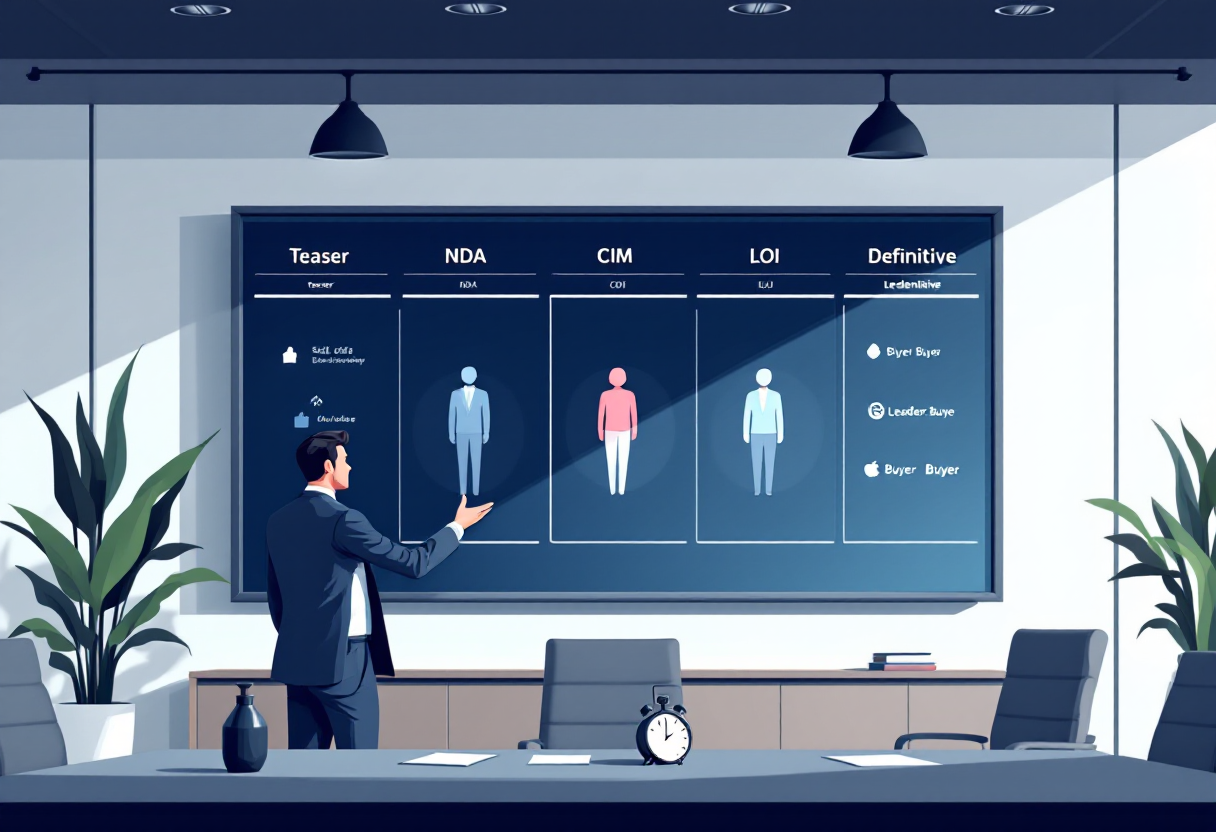
The 10 Stages of a Sell-Side Auction
Stage 1: Buyer Universe Build
Before any document goes out, the banker spends 2 to 4 weeks building a target list of 30 to 100 buyers. The list is not generic. It is segmented across four buyer types: private equity platforms that target the company’s sector and EBITDA band, strategic acquirers (direct competitors plus adjacencies), family offices with relevant sector exposure, and search funds or independent sponsors with committed capital. Each name on the list has a documented reason for being there. Capstone Partners’ 2026 process benchmarks show top-quartile bankers maintain proprietary databases of 8,000 to 15,000 active buyers indexed by sector, check size, and recent activity.
The quality of this list determines almost everything that follows. A list of 5 buyers produces no premium because no buyer feels competitive pressure. A list of 200 buyers produces noise, leaks, and an unmanageable Q&A volume. The sweet spot for a $3M to $15M EBITDA business is 40 to 70 targeted names.
Stage 2: Staged Release with the Teaser
The first document released is a one-page anonymized teaser. It describes the company without naming it: industry, geography, revenue and EBITDA ranges, growth rate, customer concentration profile, and the basic investment thesis. The teaser goes to every name on the buyer list. Of the 30 to 100 buyers contacted, typical response rates run 40 to 60 percent according to Refinitiv 2025 process benchmarks, meaning 12 to 60 buyers sign the NDA.
The NDA is a real gating mechanism, not a formality. It restricts the buyer from contacting customers, employees, or suppliers directly, prohibits sharing the information with co-investors without consent, and binds them to a no-hire clause for 18 to 24 months. Buyers who refuse to sign or who try to redline the NDA aggressively get filtered out at this stage.
Stage 3: CIM Distribution
The Confidential Information Memorandum, or CIM, is the central document of the entire process. It runs 40 to 80 pages and includes company history, products and services, market opportunity, customer analysis, organizational chart, financial statements with adjustments, projections, and a “process letter” describing what the banker expects from buyers next. The CIM goes to 15 to 30 buyers who have signed the NDA and demonstrated genuine interest.
The CIM does heavy lifting. A well-built CIM shows three years of audited financials with EBITDA adjustments (owner compensation normalization, non-recurring expenses, related-party rent at market), a customer concentration table, churn metrics, and 5-year projections with explicit assumptions. A weak CIM forces buyers to ask hundreds of questions, slows the process, and signals amateurism.
Stage 4: Initial Indications of Interest (IOI Round)
Buyers receive the CIM and have 2 to 4 weeks to submit a non-binding Indication of Interest. The IOI is a 2 to 5 page letter that includes a price range (not a single number), proposed deal structure (cash, rollover equity, seller note, earnout), key assumptions and contingencies, financing source, due diligence requirements, and proposed timeline. Of the 15 to 30 buyers who received the CIM, typical IOI response rates run 5 to 15 according to SRS Acquiom 2025 data.
The banker grades each IOI on price, structure quality, certainty of close, and strategic fit. Price alone is not the filter. A $35M IOI from a buyer with no committed financing and a 90-day diligence requirement may rank below a $32M IOI from a PE firm with fund money in place and a 60-day commitment. The banker presents the IOI grid to the seller and recommends which 8 to 15 buyers should advance.
Stage 5: Management Presentations
Advancing buyers get 90 to 120 minutes of direct access to the founder and senior management, usually on-site at the company’s facility. The agenda is structured: company overview, product or service demonstration, financial walk-through, growth strategy, Q&A. The on-site tour is critical. It lets buyers see the operation, meet key managers, and form their own view of cultural fit. Refinitiv 2025 data shows management presentation conversion rates (presentation to LOI) of 35 to 50 percent for well-prepared management teams versus 10 to 20 percent for unprepared teams.
The banker prepares the management team intensively. A typical prep cycle is 2 to 3 mock presentations with the banker playing buyer, plus a rehearsal of the tough questions: customer concentration, key-person dependency, declining segment, employee retention risk. Founders who freelance answers without prep routinely tank the process.
Stage 6: Process Letter and LOI Phase
After management presentations, the banker sends a formal process letter to the 8 to 15 active buyers. The process letter sets the bid deadline (typically 14 to 21 days out), the required format of the bid, deliverables required (markup of the draft purchase agreement, financing commitment letters, equity commitment letters for PE buyers), and the standard the banker will use to evaluate bids. Buyers know that 3 to 5 will advance to the final round and the rest will be released.
The bid responses are the Letter of Intent or LOI. The LOI is binding on exclusivity but not on price (until executed as a definitive agreement). Typical LOI quality varies wildly: a top-tier PE firm sends a fully marked purchase agreement with financing commitments attached; a less prepared strategic sends a 2-page price-and-terms summary. The banker grades each LOI on price, certainty, structure, and timeline.
Stage 7: Best and Final
The banker narrows from 8 to 15 LOI submissions down to 3 to 5 finalists. Each finalist receives a “best and final” letter signaling that one more round of negotiation will happen and the winner will be selected immediately after. This is where parallel negotiation happens. The banker runs 3 to 5 simultaneous conversations, pushing each buyer to improve price, structure, or close certainty without revealing the others’ positions.
Price improvement in this round is significant. SRS Acquiom 2025 data shows median price improvement from IOI to executed LOI of 10 to 25 percent for full-auction processes. The 25 percent end of that range comes from situations where two strategic buyers see each other in the data and bid against perceived competitive threat. The 10 percent end is more common when the finalist pool is all PE.
Stage 8: Winner Selection
Highest price does not always win. The banker presents a finalist comparison to the seller weighing five factors: price, buyer certainty of close (committed financing, board approval status, regulatory clearance), structure quality (cash at close versus rollover versus earnout), cultural fit and management retention plan, and the founder’s role and timeline post-close. A $34M offer from a PE firm requiring a 3-year founder commitment may rank below a $32M offer from a strategic willing to close in 60 days with a 6-month transition.
The selected buyer gets an exclusive 60 to 90 day exclusivity window. The other 2 to 4 finalists are released and notified within 24 hours. The banker maintains warm relationships with the runners-up in case the deal falls through and the process needs to restart with the next-best buyer.
Stage 9: Confirmatory Due Diligence
The selected buyer runs full confirmatory due diligence: quality of earnings analysis from an accounting firm, legal diligence, commercial diligence including customer calls, IT and cybersecurity review, environmental (if applicable), insurance, HR, and tax. The banker manages the Virtual Data Room (VDR), tracks the Q&A log, and runs weekly status calls. Typical diligence duration is 60 to 90 days for a clean business and 90 to 120 days where issues surface.
Diligence is where deals die or get repriced. The 2025 SRS Acquiom study reports that 22 percent of executed LOIs experience a “price chip” during diligence (median chip: 5 to 8 percent of headline price). The banker’s job is to anticipate diligence issues before the buyer finds them (through a pre-marketing quality of earnings, customer reference prep, and management interview prep) so that surprises do not give the buyer grounds for repricing.
Stage 10: Definitive Agreement and Close
The final stage is the negotiation of the definitive purchase agreement, the disclosure schedules, and ancillary documents (employment agreements, non-competes, escrow agreement, transition services agreement if applicable). This typically runs 30 to 45 days in parallel with the final weeks of diligence. The banker stays in the room for final price negotiations, indemnification caps and baskets, escrow size and duration, and earnout terms if present. Close happens 5 to 7 months after CIM release for a clean process.
Worked Example: $5M EBITDA HVAC Auction
Consider a fictional but realistic case. Capstone Heating & Air is a residential HVAC company in the Phoenix metro with $24M revenue, $5M adjusted EBITDA, 65 employees, and a founder who is 62 and wants to retire within 18 months. The banker prices the business at 6 to 7x EBITDA based on comps (BizBuySell Q1 2026 reports median 5.5x for HVAC SDE-band $3M-$8M; PE-relevant deals trade at premium).
| Stage | Buyers Active | Timing | Output |
|---|---|---|---|
| Buyer universe build | 0 | Month 0 | 45 targets identified |
| Teaser sent | 45 | Month 1 | 22 NDAs signed |
| CIM distributed | 22 | Month 1-2 | 16 active buyers |
| IOIs received | 16 | Month 2-3 | 12 IOIs, range $25M-$32M |
| Management presentations | 12 | Month 3-4 | 8 buyers advanced |
| LOIs received | 8 | Month 4 | 4 LOIs, range $29M-$33M |
| Best and final | 4 | Month 4-5 | Winner at $32.5M (6.5x EBITDA) |
| Diligence + close | 1 | Month 5-8 | Closed at $32.5M, no price chip |
The final price of $32.5M represents a 6.5x EBITDA multiple. Without an auction, this same business would likely have sold to a single PE platform for $25M to $28M (5.0x to 5.6x), the multiple typical of negotiated bilateral processes per Capstone Partners’ 2026 LMM Survey. The auction generated $4.5M to $7.5M of incremental value, against a banker fee of roughly $1.5M (Lehman scale on $32.5M). Net to the seller: $3M to $6M of additional proceeds.
For HVAC owners specifically, our team has documented the full sell-side process at sell your HVAC business and the pre-marketing prep checklist at prepare your HVAC business for sale.
The Skills That Actually Drive Price
Information Control
The banker decides who sees what document, when, and with what restrictions. The teaser is anonymous. The CIM names the company but not customers. The VDR redacts customer names until late in diligence. Employee names are masked. The banker’s job is to give each buyer enough to underwrite the deal but never so much that they have less reason to keep paying for access. Buyers who try to skip stages (asking for customer lists at IOI stage, demanding employee interviews before LOI) get filtered out.
Parallel Negotiation
From the IOI round through best and final, the banker is running 5 to 15 simultaneous conversations. Each buyer needs to believe they have a real chance and that the field is real. The banker uses information asymmetry deliberately. A buyer asks “where am I in the field” and the banker says “you are competitive but not the highest, the structure of your bid is the issue” without naming numbers. The buyer goes back, improves the bid, and the banker uses that improvement in conversation with the next buyer. This is the mechanical source of the auction premium.
Buyer Pool Management
Buyers lose interest if the process feels stale. The banker rotates attention, sets bid deadlines that create urgency, and signals competitive pressure at every step. A common technique: when the banker calls a buyer for a status update, they mention that “we just had two follow-up requests from other parties this morning” without naming them. This is true (a 22-buyer process generates daily activity) but the buyer hears it as competitive pressure.
Seller Emotional Management
Founders get exhausted by month 5. They have done 12 management presentations, answered 800 Q&A items, sat through 15 conference calls, and watched their banker turn down what looked like a real offer. The banker’s job in the final two months is to keep the founder in the chair: managing expectations on diligence findings, framing buyer pushback as normal, and steering the founder away from emotional decisions (accepting a lower offer because they liked the buyer’s CEO personally). The deals that close at the top of the range are deals where the founder trusted the banker through the dip.
Common Mistakes Sellers Make
Picking the Banker on Fee Alone
The 1 to 2 percent difference in success fee between two banks is irrelevant against the 15 to 25 percent price difference between a well-run and a poorly-run auction. A discount banker who quotes 3 percent and runs the process with 8 buyers will net the seller less than a 5 percent banker who builds a 45-buyer pool. Owners should evaluate bankers on buyer-list quality, recent comparable transactions, sector depth, and references from prior sellers, not on fee percentage.
Starting the Process Too Early
Founders often want to go to market before the business is ready. A business with two months of weak earnings, an unresolved customer concentration issue, or a key-person dependency that has not been mitigated will get repriced in diligence even if it survives the IOI round. The right sequence is 6 to 12 months of pre-marketing prep, then a clean process. Premarketing diligence catches the issues a buyer would catch and lets the seller fix them on their own timeline.
Not Insisting on Process Letter Discipline
Some buyers push for direct founder access outside the formal process: side calls, casual meetings, requests to skip the IOI and “just give us a price.” A weak banker accepts. A strong banker refuses and tells the buyer to participate in the process or drop out. Side channels destroy the auction premium because the side-channel buyer now has information no one else has and the banker has lost control of the process.
Choosing the Wrong Buyer Type Mix
An all-PE buyer pool produces predictable multiples (5.0x to 6.5x for the lower middle market per Capstone Partners 2026 data) but no strategic premium. An all-strategic pool risks slow timing and information leaks to competitors. The right mix for a $5M EBITDA company is typically 60 to 70 percent PE platforms, 20 to 30 percent strategics, and 10 to 20 percent family offices and independent sponsors. The strategic minority creates the upside; the PE majority creates the floor.
Releasing Too Much in the Teaser
A teaser that names the company, lists key customers, or describes proprietary processes lets buyers do enough analysis without signing the NDA. The teaser should be specific enough to attract serious interest but anonymous enough that buyers must engage to learn more. The discipline is to make the buyer ask for what they want next.
Accepting the First Strong LOI Early
A common failure mode: a PE firm comes in with an aggressive LOI ($32M on a business the banker has priced at $28M to $32M), demands 90-day exclusivity, and threatens to walk if not granted within 48 hours. Inexperienced sellers and weak bankers accept. The result is that the rest of the auction collapses (no other buyer will continue when one has exclusivity), and the buyer then chips the price by 8 to 12 percent in diligence. The strong-LOI-early move is almost always a strategy to short-circuit the auction. Discipline is to finish the process.
Failure Modes That Sink the Process
Process failure shows up in four patterns. First, the narrow buyer pool: when the banker contacts 5 to 15 buyers instead of 30 to 100, no buyer feels competitive pressure and the price reverts to bilateral-negotiation levels. Second, information leakage: the banker informally favors a relationship buyer and shares information ahead of the process, which destroys the parallel-negotiation premium and exposes the banker to fiduciary breach claims. Third, slow process: when the timeline drifts past 9 months from CIM, buyers lose engagement, the seller’s recent financials become stale, and momentum dies. Fourth, seller expectations too high: when the banker prices the business at 8x EBITDA in a sector where comps trade at 5x to 6x, no LOIs come in at the asking range and the process restarts with damaged credibility.
The narrow-buyer-pool failure is the most common. According to Refinitiv 2025 process benchmarks, 38 percent of “failed” sell-side processes (defined as processes where the seller did not transact within 12 months of CIM release) trace back to a buyer pool of fewer than 20 named targets. This is almost always a banker resource problem: the bank does not have the database depth to assemble a 40-plus target list in the seller’s sector and substitutes a shorter list of generic PE platforms.
Process Timeline and Milestones
- Month 0: Engagement letter signed. Banker begins pre-marketing prep: financial adjustments, CIM drafting, buyer-list build.
- Month 1: CIM and teaser finalized. Teaser sent to 30 to 100 buyers. NDAs collected.
- Month 1-2: CIM distributed to 15 to 30 NDA-signed buyers. Initial Q&A managed via banker.
- Month 2-3: IOI submission deadline. Banker grades IOIs, presents to seller, picks 8 to 15 advancers.
- Month 3-4: Management presentations and facility tours conducted. Process letter sent.
- Month 4: LOI submission deadline. Banker narrows to 3 to 5 finalists.
- Month 4-5: Best and final round. Winner selected. Exclusivity granted.
- Month 5-7: Confirmatory diligence by selected buyer. VDR Q&A managed by banker.
- Month 6-8: Definitive purchase agreement negotiated.
- Month 7-8: Close. Funds wired. Transition begins.
A clean process runs 5 to 7 months. A complex process (regulatory approvals, financing contingencies, integration planning, multi-jurisdiction tax structuring) runs 8 to 12 months. A process that goes past 12 months without closing is usually dead and will need to be restarted with a fresh CIM, refreshed financials, and a new buyer outreach.
How CT Acquisitions Approaches This
No fee to you on buy-side introductions; sell-side mandates are paid on success at closing. That means sellers get full auction-process representation without paying the 3 to 5 percent success fee that traditional sell-side banks charge. Our process follows the same 10-stage structure used by middle-market investment banks: real buyer-universe build (40 to 70 named targets per process), CIM development, staged release, IOI grading, management presentation prep, best-and-final negotiation, and diligence management.
Where we differ from larger investment banks is sector focus and size band. Most middle-market banks will not run a full auction for a business under $3M EBITDA because their fee economics do not work. We run full auctions in the $1M to $15M EBITDA band where the price-improvement-per-process is highest relative to seller alternatives. If your business does not fit a full auction (fewer than 10 plausible buyers, undifferentiated SDE-band business, urgent timeline), we will tell you on the first call and recommend an alternative path.
Frequently Asked Questions
How long does a sell-side auction take from start to close?
A clean auction runs 5 to 7 months from CIM release to close. Add 2 to 4 months of pre-marketing prep before that (financial adjustments, CIM drafting, buyer-list build). End to end, plan on 7 to 11 months from the day you sign the engagement letter. Complex deals with regulatory approval, financing contingencies, or multi-entity structures run 9 to 12 months.
What size business justifies a full auction process?
Full auctions work best for businesses with $1M+ EBITDA where at least 30 plausible buyers can be identified. Below $1M EBITDA, the buyer pool is usually limited to local strategics and individual buyers, and a broker process is more economical. Above $25M EBITDA, the process is the same but the buyer pool expands to include larger PE platforms and the price-improvement math gets even more favorable. The $3M to $15M EBITDA band is the sweet spot for sell-side auction economics.
What is the difference between an IOI and an LOI?
An Indication of Interest (IOI) is a non-binding letter submitted after the buyer reviews the CIM, stating a price range and proposed structure with assumptions and contingencies. An LOI (Letter of Intent) is submitted after management presentations and is binding on exclusivity (the seller cannot talk to other buyers during the exclusivity window) but not on price until executed as a definitive agreement. IOI is “we are interested at roughly this price”; LOI is “this is our actual offer, give us 60 to 90 days to close.”
Can I run a sell-side auction without an investment banker?
Technically yes. Practically, the auction premium comes from the process discipline a banker brings: buyer-pool depth, staged information release, parallel negotiation, and emotional separation from the seller. A founder running their own auction will struggle to keep 30 to 100 buyers engaged, manage 800 diligence Q&A items, and negotiate price against 4 finalists simultaneously while still running the business. No fee to you on buy-side introductions; sell-side mandates are paid on success at closing.
What happens if no one bids?
If the IOI round produces fewer than 3 bids in the seller’s expected range, the banker has three choices: lower the price expectation and continue to LOI with the bids in hand, pause the process and address the issue (financial restatement, customer concentration mitigation, market timing), or terminate the process and restart in 12 to 18 months with refreshed financials and a different angle. A “failed” auction is recoverable if handled discreetly. A leaked failed auction (where the market knows the business went out and could not transact) damages future-process credibility for 18 to 24 months.
How does a banker get paid in a sell-side auction?
Traditional sell-side banks charge a retainer (often $25K to $100K credited against the success fee) plus a success fee at close. Success fees follow a Lehman-style structure: roughly 5 percent on the first $1M, 4 percent on the second $1M, 3 percent on the third, and so on, with a floor (often $250K to $500K). On a $30M deal, that is roughly $750K to $1.2M total. No fee to you on buy-side introductions; sell-side mandates are paid on success at closing.
What to Do Next
If you are within 12 to 24 months of wanting to sell, the right move now is a 30 minute call to understand whether your business fits a full auction process, what your realistic buyer pool looks like, and what pre-marketing prep needs to happen first. We will be honest about whether the auction premium is worth it for your specific business. If it is not, we will tell you that and recommend an alternative path.
Get an honest read on your sale process.
A free 30 minute call covers your buyer pool, realistic price range, timing, and whether a full auction is the right move. No fee to you on buy-side introductions; sell-side mandates are paid on success at closing.
Book a Free ConsultationRelated reading: how to sell a business, what is a confidential information memorandum, sell your business overview.