
How to Prepare Your Chimney Sweep Business for a Sale or Exit in 2026: The 36-Month PE Buyer Playbook
Preparing your chimney sweep business for exit in 2026 works best as a 36-month process, and the value levers matter more than they do in most B2C service categories because the buyer set is smaller. The first 12 months tighten the operating story around recurring inspection revenue, the middle 12 fix diligence-killer gaps, and the final 12 turn what would have been a single lowball offer into a real competitive process.
Selling a chimney sweep company means handing a buyer three things they cannot easily build themselves: a book of homeowners who expect a yearly visit, a crew whose credentials can be checked against public registries, and a safety record on steep residential roofs. This page walks through how each of those gets examined, which records matter, and how to sequence the work across the three years before a sale.
Updated October 2026 · CT Acquisitions
A chimney company is judged on paperwork that most owners keep in their heads. Who on the crew holds a current Chimney Safety Institute of America credential, and when does it lapse? Which customers come back every autumn without being chased, and which ones only call after smoke backs into the living room? Where is the written fall prevention plan for last Tuesday’s job on a steep two-story roof? A buyer will ask all of that, usually within the first few weeks of serious talks, and the answers decide whether the offer holds or gets cut during diligence. The sections below cover the buyer types that look at sweep and hearth companies, the certification and inspection standards that shape value in this trade, the safety rules that changed for chimney work in late 2023, the operating fixes that move price, the data room a buyer expects, the issues that most often reprice a deal, and a month-by-month calendar.
One honest framing before the detail. The group of buyers who know chimney economics well is narrow. Private equity has only recently formed a platform built specifically around chimney and hearth service, and most other institutional buyers see a sweep company as an add-on to heating, cooling or plumbing. That narrowness cuts both ways. A company that arrives with clean credential files, a measurable repeat-inspection base and documented roof safety stands out sharply, because few of its peers can show the same. A company that arrives without them is easy for a buyer to discount, because the buyer has few comparable deals to argue against.
Planning a sale of your sweep or hearth company?
CT Acquisitions advises founders of chimney, hearth and masonry service companies on sell-side processes, buy-side searches and longer exit plans, with a network of 500+ buyers and operating partners. If you need a year or two of operational work before a sale, we can introduce home services specialists who handle that preparation. No fee to you on buy-side introductions; sell-side mandates are paid on success at closing.
Who Is Buying Chimney and Hearth Service Companies
The clearest institutional signal in this trade is Endura Services. Preqin’s profile describes Endura as a Nashville, Tennessee provider of chimney and hearth maintenance, repair and installation that Argosy Private Equity formed in December 2024, with A Merrie Sweepe and Chim Chimney, Inc. listed as its add-ons. PitchBook records Chim Chimney, a cleaning and repair company in Hermitage, Tennessee, as acquired by Endura on March 14, 2025. For a sweep owner, the point is less about one buyer and more about what the formation says: a sponsor decided that chimney service, on its own, could support a platform thesis.
Argosy also knows the supply side of the trade. Capstone Partners reported that Olympia Chimney Supply, a Scranton, Pennsylvania maker of venting systems and liners held by Argosy, used a senior secured credit facility from Deerpath Capital Management that closed on January 3, 2019 to help acquire Copperfield Chimney Supply, a national chimney supply distributor based in Fairfield, Iowa. A sponsor that has owned liner manufacturing and distribution understands relining economics, product warranties and installer quality in a way a generalist buyer does not, and that shows up in the diligence questions.
Beyond the dedicated platform, the realistic universe for most sweep companies is a mix of the groups in the table below. Which of them shows up depends mostly on size, geography and how much of revenue repeats.
Buyer types and what each one looks at first
| Buyer type | Why they buy a sweep company | First thing they check |
|---|---|---|
| Chimney and hearth platform backed by private equity | Adds route density, crews and a customer list in a new metro; repair and relining work feeds the platform’s margin story | Credential roster with expiration dates, repeat-inspection counts, written fall protection program |
| Multi-trade home services platform (heating, cooling, plumbing, electrical) | Cross-sells chimney work into an existing homeowner base and fills autumn and winter schedules | Overlap between your customer addresses and theirs; whether your field software can migrate |
| Regional chimney competitor | Removes a rival, adds technicians who are hard to hire, absorbs your phone number and reviews | Technician retention after close and any non-solicit protection on key sweeps |
| Masonry, roofing or restoration contractor | Gains a steady inspection funnel that generates crown, flashing and rebuild leads | Share of revenue from repairs versus sweeping, and warranty history on masonry jobs |
| Hearth retailer or stove installer | Adds service and inspection capacity behind product sales | NFI certifications on installers and records showing appliance compliance |
| Search fund or individual operator using bank or SBA financing | Buys a cash-generating service company with a clear owner role to step into | Owner hours, lender-ready financials, and how much of the work the owner performs personally |
| Family member or senior employee | Continuity for customers and crew, often with seller financing | Whether the successor can qualify for credentials and insurance in their own name |
The table is a map of motives, not a ranking. A small single-truck operation in a cold-winter town will mostly hear from regional competitors and individual buyers. A multi-crew company with commercial accounts, relining capability and a few hundred households on an annual schedule can draw interest from platforms. The preparation work in the rest of this page is about moving a company from the first group toward the second.
What a platform-grade sweep company looks like
- Credentials held by several people. More than one technician holds a current CSIA Certified Chimney Sweep credential, and installers who touch gas, wood or pellet appliances carry National Fireplace Institute certification. The owner is not the only name on the roster.
- A repeat-visit base you can count. Households that book every year are tracked in software, with renewal history by season, not remembered by the owner or kept on index cards.
- Revenue beyond the sweep. Relining, crown and flashing repair, rebuilds above the roofline, dryer vents and commercial work give the company a margin profile that a pure cleaning business lacks.
- Documented roof safety. A written fall protection program and per-job fall prevention plans exist and are filed, in line with the 2023 settlement between the National Chimney Sweep Guild and OSHA covered below.
- No single dominant account. No one property manager, homeowners association or restaurant group carries a share of revenue that would hurt badly if it left.
- A manager between the owner and the trucks. Someone other than the owner dispatches, prices and handles callbacks, and has done so through at least one full heating season.
How Buyers Put a Price on a Sweep Company
Chimney companies are priced on earnings, and the earnings measure depends on size. Owner-run shops are usually valued on seller’s discretionary earnings, which add the owner’s pay and personal expenses back to profit. Larger companies with a manager in place are priced on adjusted EBITDA, because a buyer assumes it will pay someone market wages to run the business. The multiple applied to either number is where preparation shows up.
Published comparables for chimney deals are thin. Most transactions are private, terms are rarely disclosed, and the few named platform deals in this trade came without prices. CT’s working view, which matches what we described on earlier versions of this page, is that chimney companies tend to trade below heating and cooling companies of similar size, because annual service plans are less common in chimney work and fewer institutional buyers compete for each deal. We would rather describe what moves the number than quote a precise band nobody can source.
| Factor | Pulls the price down | Pushes the price up |
|---|---|---|
| Repeat inspections | Customers call only when something goes wrong; no reminder system | A tracked base of households on an annual schedule with renewal history by year |
| Service mix | Almost all revenue from sweeping at a low ticket | Meaningful relining, masonry, rebuild and install revenue with documented gross margin by line |
| Seasonality | Trucks idle from late spring through summer | Dryer vent, masonry and commercial work that keeps crews billing in warm months |
| Credentials | Owner holds the only CSIA credential | Several current CCS holders plus NFI-certified installers, with renewal dates tracked |
| Roof safety | No written program; harness inspections undocumented | Written fall protection program, per-job plans and training records on file |
| Records | Cash-basis books and a spreadsheet of jobs | Accrual books, monthly close, and job histories in field service software |
| Customer base | One large account carries a big share of sales | Revenue spread across many households and several commercial clients |
Size matters too, but less than owners expect. A buyer will pay more per dollar of earnings for a smaller company with clean files and repeat revenue than for a larger one where every answer runs through the owner. The rest of this page is organized around the factors in that table.
The Credential File: CSIA, NFI and Apprenticeship Records
Many states have no dedicated chimney sweep license, so buyers lean on private credentials as a proxy for competence. Homeowners, insurers and real estate agents do the same. That makes the credential file one of the first exhibits a buyer opens, and one of the easiest places to lose credibility if dates have lapsed.
CSIA Certified Chimney Sweep
According to the Chimney Safety Institute of America, the Certified Chimney Sweep credential runs on a three-year cycle, with an annual payment of $249 due in the first two years of the cycle. CSIA lists three ways to earn it at the outset: a six-day course at the CSIA National Training Academy in Plainfield, Indiana with the exam on the final day, a one-day CCS review followed by the exam, or a self-paced online review that gives candidates 28 days of access and then up to a year to sit the exam.
Renewal is where small companies slip. CSIA’s renewal rules call for 48 continuing education units across set categories: 12 technical, 8 in codes and standards, 6 in communication and liability, 6 in health and safety, and 16 in any category including business. A technician who falls short can earn between 9 and 47 units and retest, or take a CCS review and retest without units. In practice, that means every certified sweep on your crew needs a running transcript, and somebody in the office needs to watch the calendar. CSIA notes that technicians can view their transcript in their CSIA profile, which makes it straightforward to export a status report for a data room.
What a buyer does with this: they compare your marketing claims (“CSIA certified technicians”) against the CSIA public referral directory and the roster you provide. If your website says the crew is certified and the directory shows one name, the gap becomes a negotiating point. If the only active credential belongs to the owner, the buyer treats it as a key-person risk and will either ask the owner to stay on through a transition period or reduce price to fund new certifications after closing.
National Fireplace Institute specialists
For companies that install or service appliances, the National Fireplace Institute credential carries similar weight. NFI says it certifies planners and installers in four categories: Gas Specialist, Woodburning Specialist, Pellet Specialist and Hearth Design Specialist, and that specialists who hold all three fuel-specific certifications are recognized as Master Hearth Professionals. NFI describes itself as the national certification agency for the hearth industry since 2001. Its policy handbook states that a specialist is certified for three years from the end of the month the exam was passed, and must renew by retesting or through continuing education.
The diligence question here is about matching. A buyer will line up your install invoices for gas inserts, wood stoves and pellet units against the NFI status of the technician who did each job. An install by an uncertified tech is not automatically a problem, but a pattern of them invites questions about callbacks and liability, especially if a manufacturer warranty or a local permit referenced a certified installer.
Apprenticeship and the training pipeline
Hiring is the constraint that every chimney buyer worries about, so a working apprenticeship program is a real asset. The U.S. Department of Labor’s Office of Apprenticeship recognized Chimney Sweep as a new apprenticeable occupation in Bulletin 2014-01, dated December 18, 2013, with a 4,000-hour, time-based training term submitted by the National Chimney Sweep Guild. A follow-up bulletin, 2014-09, records that the Guild’s National Guidelines for Apprenticeship Standards were approved on March 21, 2014 as a model for local programs registered with the Office of Apprenticeship or a State Apprenticeship Agency.
The NCSG describes the current program as a two-year, Department of Labor-recognized apprenticeship with 4,000 hours of on-the-job training and 288 hours of classroom instruction. Apprentices start at a share of the journeyman rate and step up to the full rate on completion, and the Guild says the program may open access to training grants in some states. If you sponsor apprentices, keep their hour logs, classroom completions and wage steps in one folder. A buyer sees that file as evidence that you can grow headcount instead of competing for the same small pool of experienced sweeps.
Credential summary for the data room
| Record | Issued by | Renewal pattern | What the buyer asks for |
|---|---|---|---|
| Certified Chimney Sweep | Chimney Safety Institute of America | Three-year cycle; 48 CEUs or retest | Names, credential numbers, expiration dates, CEU transcripts |
| Gas, Woodburning, Pellet or Hearth Design Specialist | National Fireplace Institute | Three years from the end of the exam month; retest or CEUs | Which installers hold which category; install jobs matched to certified techs |
| Registered apprenticeship | Program registered with DOL Office of Apprenticeship or a state agency, using NCSG standards | Two-year program; 4,000 field hours and 288 classroom hours | Apprentice list, hour logs, wage progression, completion dates |
| Local contractor or business registrations | City, county or state agencies where you operate | Varies by jurisdiction | Current certificates and the name of the qualifying individual on each |
A note on state licensing. Rules for chimney work differ widely: many states have no sweep-specific license, while masonry, rebuild and some appliance work can fall under general contractor, home improvement or fuel-gas rules depending on the state and the dollar value of the job. We do not try to summarize every state here, because the thresholds change and a summary would go stale. Have counsel confirm, for each state you work in, which of your services require a registration and whose name the registration sits under. If the qualifying person is the owner, plan a replacement before the sale.
NFPA 211 Inspection Levels and Why They Shape Your Revenue
NFPA 211, the National Fire Protection Association’s Standard on Chimneys, Fireplaces, Vents, and Solid Fuel-Burning Appliances, is the reason a sweep company can sell a yearly visit as a safety requirement rather than a nice-to-have. CSIA quotes the standard directly on its homeowner pages: chimneys, fireplaces and vents “shall be inspected at least once a year,” and cleaning, maintenance and repairs “shall be done if necessary.” CSIA also notes that the Level 1 inspection is defined in NFPA 211.
The three inspection levels matter commercially because each one drives a different kind of job:
- Level 1. The baseline visit for a system whose use has not changed. It is the backbone of an annual program and the job most likely to repeat every year at the same address.
- Level 2. CSIA’s standard operating procedure for a masonry chimney says a Level 2 is recommended when conditions of use change (a new appliance, or one with a different fuel or type), when a Level 1 cannot establish whether the system is serviceable, when the property is being sold, before lining or relining, and after a building or chimney fire, a weather or seismic event, or a malfunction likely to have caused damage. The SOP says a Level 2 should cover every flue in the chimney and its connected appliances and requires going onto the roof and into accessible attics, basements and crawl spaces.
- Level 3. Reserved for situations where a hidden hazard is suspected and cannot be confirmed without removing parts of the structure. It is less frequent but often leads to the largest repair tickets.
Two things follow for a seller. First, the Level 2 trigger at property sale means real estate transactions are a lead source. If you have referral relationships with listing agents or home inspectors, document them: which offices send work, how many Level 2 jobs came from them last year, and how many of those turned into relining or masonry work. A buyer values a referral channel it can see in the numbers. Second, the Level 2 trigger after a chimney fire or storm ties your company to insurance claims. CSIA advises homeowners after a chimney fire to keep using the chimney on hold until a qualified professional has swept and evaluated it, to have the sweep photograph damaged sections for the adjuster, and to get a video inspection that checks flue tiles for cracks and mortar joints for overheating. Companies that do this work well tend to keep a library of photo and video reports, and that library is both a sales asset and a liability record.
That liability side is worth planning for. Inspection reports are written opinions about whether a chimney is safe. A buyer will want to know how reports are produced, who signs them, whether the language limits the scope to what was accessible, and how long they are retained. If your reports are handwritten or inconsistent, standardize them now, ideally inside your field service software, so the buyer inherits a defensible archive.
What Federal Fire Data Says About Demand
Buyers in this trade like to see that demand rests on something sturdier than homeowner habit. Federal fire statistics provide that. The U.S. Fire Administration’s report on heating fires in residential buildings for 2017 to 2019 estimated an annual average of 34,200 such fires reported to fire departments, causing about 165 deaths and 600 injuries per year, and found heating to be the second leading cause of residential building fires after cooking.
The same USFA report breaks those fires down by type. Confined fires made up 77% of residential building heating fires, and fires confined to a chimney or flue alone accounted for 49.43% of the total, roughly half. USFA also found that incidence peaked in January at 20% and fell to its lowest point in June, July and August. That seasonal curve is the same one that shapes a sweep company’s revenue, and it is why buyers look so closely at what the business does in summer.
The National Fire Protection Association’s more recent heating report, released in February 2025, estimated an annual average of 38,881 home heating equipment fires from 2019 to 2023, with 432 civilian deaths, 1,352 injuries and $1.1 billion in property damage. Different methods and scopes explain why the USFA and NFPA figures do not match, and a careful CIM should cite each source by name rather than blending them.
How to use this in a sale: not as fear marketing, but as context. A short section in your offering memorandum that explains the code basis for annual inspection (NFPA 211), the scale of chimney and flue fires (USFA) and the seasonal pattern gives a generalist buyer, such as a multi-trade platform, the framework it needs to believe your repeat revenue will persist after you leave.
Roof Safety After the 2023 NCSG and OSHA Settlement
Fall protection is the compliance topic most specific to this trade, and it changed recently. On December 1, 2023, the National Chimney Sweep Guild and OSHA settled the Guild’s challenge to OSHA’s 2016 Final Rule amending fall protection standards for general industry. Keller and Heckman, writing about the agreement, summarized what chimney service employers must do: set up a written fall protection program, give employees the required training and equipment, assign appropriate personnel to each covered task, and prepare and carry out a written fall prevention plan for each job. The settlement’s Appendices A and B list safe harbor anchorage options that a Competent Person may use; any other anchorage alternative must be selected by a Qualified Person. OSHA agreed to a one-year implementation schedule.
Bloomberg Law reported that the parties filed the settlement with the U.S. Court of Appeals for the Seventh Circuit, which dismissed the case, and that the deal lets sweeps secure lifelines to ground-based objects such as trees, structures or parked vehicles, because most residential roofs have no built-in anchor points and homeowners do not want sweeps cutting into their roofs.
For a seller, the settlement turned an ambiguous area into a checklist that a buyer can audit. Expect requests for:
- The written fall protection program, with its date and the name of whoever wrote or approved it.
- A sample of per-job fall prevention plans from recent months, ideally attached to the job record in your software.
- Training records for each technician, including who was designated a Competent Person and on what basis.
- Harness, lanyard and rope inspection logs, plus a list of anchorage equipment in each truck.
- Any OSHA inspections, citations or injury reports in the past several years, and workers’ compensation claims tied to falls.
If those documents do not exist, building them is a modest project compared with the price impact of their absence. Many companies use an outside safety consultant for the initial program and then embed the per-job plan into their dispatch workflow so technicians complete it on a phone before climbing. The aim is to show twelve or more months of consistent plans before you go to market, so the buyer sees a habit rather than a binder assembled for the sale.
Operating Changes That Raise a Sweep Company’s Value

The changes below are listed roughly in the order we see them affect price for chimney companies. None is quick. Most need at least a full heating season of results before a buyer will give credit, which is why the calendar later on this page starts three years out.
Turn the yearly visit into a tracked program
The single most persuasive exhibit in a chimney sale is a list of households that book every year, with the history to prove it. Many sweep companies have these customers but cannot show them, because reminders go out from a paper file or not at all. Start by tagging every customer in your field service software with the date of each visit, the service performed and whether they booked the next one. Then build an annual plan: a named program with a fixed scope (sweep, Level 1 inspection, written report, reminder), a renewal date and stored payment details where the customer agrees.
Price the plan so that it is attractive to the customer but does not discount the repair work that follows. Train technicians to offer it at the end of every service call, and pay a small bonus on sign-ups. Track three numbers monthly: households enrolled, renewals as a share of those due, and revenue per enrolled household including repairs. NFPA 211’s annual inspection language, as quoted by CSIA, gives the program a code basis rather than a sales pitch. After two seasons, the renewal history is something a buyer can model, and that changes how they think about your revenue.
Grow repair, relining and masonry work
Sweeping is the entry point; the margin sits in what the inspection finds. Relining, crown rebuilds, flashing, tuckpointing and rebuilds above the roofline carry larger tickets and require skills that a buyer cannot hire overnight. The CSIA Level 2 procedure explicitly lists planned lining or relining as a reason for a Level 2 inspection, so a company that sells relining is also generating higher-level inspection revenue.
To build this line, make sure every service call ends with a written report and photos, and that recommended repairs are quoted on the spot from a set price book. Track quote-to-close rates by technician. Separate repair revenue from sweep revenue in your accounting so a buyer can see gross margin by line instead of guessing. If you buy liners and caps from a distributor, keep the supplier invoices tidy; a buyer with supply-side experience, such as a sponsor that has owned a liner manufacturer, will look at product costs and warranty terms closely.
Fill the summer schedule
USFA’s data shows residential heating fires peaking in January and bottoming out in June through August, and chimney demand follows the same shape. A company whose trucks sit from late spring to late summer has a cash flow problem and a staffing problem: experienced sweeps drift to other trades if hours disappear. Buyers notice both.
The usual fixes are dryer vent cleaning (CSIA offers a separate dryer exhaust credential, the C-DET), masonry and waterproofing work that is easier in warm weather, fireplace and insert installs ahead of the season, animal removal and exclusion work in spring, and commercial kitchen exhaust or multi-family work that runs year round. Pick two that fit your crew and market, launch them early in the preparation window, and report their revenue as a separate line so a buyer can see the summer trough getting shallower year over year.
Build commercial and multi-family accounts without creating concentration
Property managers, homeowners associations with shared chimneys, apartment owners and restaurants can provide scheduled work outside the residential cycle. They also introduce concentration risk. If one management company or association becomes a large share of revenue, a buyer will ask what happens if that board changes vendors, and will check the contract for termination and assignment terms.
The practical approach is to grow commercial work across several clients rather than one, to sign written service agreements with defined scopes and renewal dates, and to confirm that those agreements can be assigned to a new owner or do not terminate on a change of control. Keep a client list showing revenue by account for each of the last three years. If one account has grown too large, let the rest of the business catch up rather than walking away from good work.
Take the owner out of the credential and the schedule
In a chimney company the owner is often the most experienced sweep, the estimator, the safety lead and the name on the credentials. That combination is the largest single discount we see. A buyer will ask what happens to repair sales, customer trust and certification coverage the day the owner stops climbing.
Work on this from several directions. Sponsor additional technicians through the CSIA Certified Chimney Sweep process, using whichever of CSIA’s routes fits your season. Put NFI certification on the installers. Promote or hire a manager who handles dispatch, pricing exceptions and callbacks, and give that person at least one full heating season in the role before a sale. Write down the processes the owner currently carries in their head, from how to quote a reline to how a fall prevention plan is completed. A useful test is a two-week stretch with the owner unreachable during a busy month: whatever breaks is the next thing to fix.
Move jobs, reports and reminders into field service software
A buyer’s integration team will want to export your customer list, job history, inspection reports and plan renewals into its own system. If those live in paper files, personal email and a desktop spreadsheet, the buyer prices in the risk of losing customer history in the move. Field service platforms built for home services handle scheduling, reminders, photo reports and invoicing in one record per address.
Whatever you choose, aim for two years of clean data before a sale: every job closed, every address correct, every enrolled household flagged, every technician record showing credential status. Run a monthly close in your accounting system that ties to the software’s revenue figures. When a buyer asks for revenue by service line by month for the last three years, you should be able to answer in an afternoon.
Set prices deliberately
Many chimney companies have not raised prices in years, let technicians discount freely, and quote repairs from memory. A buyer reads that as both an opportunity and a sign of weak controls. Build a flat-rate price book for common jobs, review it at least once a year, and remove technician discretion on discounts except through a defined approval path. Offer tiered repair options so customers choose a scope instead of a yes or no. Document each price change with its effective date, so the buyer can see the effect in the monthly numbers rather than taking your word for it.
Keep technicians and show it
Because experienced sweeps are scarce, retention is a value driver in its own right. Track turnover by year and tenure by technician. Build a visible career path, from apprentice through certified sweep, lead technician and manager, and tie it to the NCSG apprenticeship structure if you sponsor apprentices. Pay certification and renewal costs for staff, and record that you do. A buyer reading a roster with long tenures, several current credentials and a pipeline of apprentices sees a company that can grow; a roster with high churn and one certified name reads as fragile.
Document add-backs as they happen
Adjusted earnings are where a seller can gain or lose real money. Every legitimate add-back, such as the owner’s pay above what a manager would cost, family members on payroll who do not work in the business, personal vehicle and phone costs, and one-time expenses like a software migration or the initial build of a fall protection program, should be logged with its invoice at the time it occurs. Undocumented add-backs get rejected in a buyer’s quality of earnings review, and rejected add-backs reduce price at the full multiple. If you rent a building you own to the company, get a market rent opinion and adjust the lease so the buyer is not left to argue about it.
Get the seasonal balance sheet right
Chimney companies have lopsided working capital: receivables and cash spike in autumn and winter, and drop in summer. Prepaid annual plans add a further complication, because cash collected for a visit that has not happened yet is a liability, not income. A buyer’s accountants will reverse any prepaid plan revenue recognized at the moment of payment and treat the unearned portion as a debt-like item that reduces price.
Fix this before going to market. Record plan prepayments as deferred revenue and recognize them as visits are performed or over the plan term. Track working capital monthly for at least two years so that the target level negotiated in the purchase agreement reflects a real average rather than a single favorable month. Tighten collections in peak season, ideally by taking card payment at the time of service, and get control of truck stock such as caps, liner parts and masonry materials.
Clear the compliance list early
Beyond fall protection, a few compliance areas are particular to chimney work. If you sell or install wood or pellet stoves, check that every unit meets the EPA standards for residential wood heaters; the EPA’s summary of the Step 2 (2020) limits for woodstoves and pellet stoves sets particulate emissions at 2.0 grams per hour when tested with cribs, or 2.5 grams per hour with cordwood. Keep model numbers and certification labels on each install record. If your crews remove birds or animals from chimneys, confirm what your state wildlife agency requires and remember that some chimney-nesting birds, such as chimney swifts, are covered by the federal Migratory Bird Treaty Act. Review worker classification for helpers and seasonal masons, insurance limits and completed operations coverage for masonry work, and any registrations required in the states where you operate.
Need more time to get the company ready?
For owners with a longer horizon, we can connect you with home services operators in our network who run one- to three-year preparation projects covering software, pricing, safety programs and management depth, so the company is ready when you are.
The Data Room a Chimney Buyer Expects Before an Offer
Before a buyer commits to a letter of intent, it will ask for a core set of documents. The general categories are the same across home services, but in a sweep company each one has a chimney-specific angle. Preparing them in advance shortens the process and signals that the company is run with discipline.
1. Monthly profit and loss for three years plus the trailing twelve months
What the buyer is testing: growth, margin trend and how sharply revenue swings by season. In chimney work the swing is severe, so the buyer wants months, not years.
How to prepare: accrual-basis statements by month, reconciled to tax returns, with revenue split by sweeping and inspection, repairs and relining, installs, dryer vents and commercial work. Add a short note explaining any unusual month, such as a storm that drove a spike in Level 2 work.
2. Current balance sheet with deferred revenue shown separately
What the buyer is testing: net debt and the working capital level to set in the purchase agreement. Prepaid annual plans, deposits on scheduled masonry jobs, vehicle loans and accrued bonuses all reduce what the buyer will pay.
How to prepare: tie the balance sheet to the trial balance, put deferred plan revenue on its own line with a schedule showing how it will be earned, and list every vehicle and equipment loan.
3. Bridge from reported profit to adjusted earnings
What the buyer is testing: whether your adjustments are reasonable and documented. Aggressive or unsupported add-backs make a buyer skeptical of every other number.
How to prepare: a line-by-line schedule with invoices or payroll records behind each item, and a market-rate estimate for the manager role that replaces the owner.
4. Technician roster with credentials
What the buyer is testing: tenure, pay structure and how concentrated your credentials are.
How to prepare: anonymized names, role, hire date, pay basis, employee or contractor status with the reasoning, CSIA credential status and expiration, NFI categories held, apprenticeship status, and any non-solicit agreements.
5. Revenue, job count and average ticket by service line
What the buyer is testing: whether the company is a cleaning business or a repair and installation business, and which direction the mix is moving.
How to prepare: export from your field service software by year and by service line. Include quote-to-close rates on repair recommendations and the share of Level 2 inspections that led to relining or masonry work.
6. Annual plan and repeat-customer history
What the buyer is testing: how much revenue repeats without marketing spend.
How to prepare: enrolled households by month for three years, renewal rate by season, revenue per enrolled household, and the deferred revenue tied to the plan. If you do not run a formal plan, show repeat-visit counts by address.
7. Inspection report samples and retention policy
What the buyer is testing: the quality and defensibility of your written opinions on chimney safety.
How to prepare: a handful of anonymized Level 1 and Level 2 reports, your report template, how photos and video are stored, and how long reports are kept.
8. Roof safety file
What the buyer is testing: compliance with the fall protection obligations set out in the 2023 NCSG and OSHA settlement.
How to prepare: the written fall protection program, recent per-job fall prevention plans, training records, Competent and Qualified Person designations, and equipment inspection logs.
9. Vehicle and equipment list
What the buyer is testing: how much it must spend on trucks and gear after closing.
How to prepare: each truck’s year, mileage, ownership or lease status and condition, plus inventories of video inspection cameras, vacuum systems, ladders, harnesses and roof anchorage equipment with inspection dates.
10. Forward plan
What the buyer is testing: whether there is a credible path to growth under new ownership.
How to prepare: a simple five-year model with revenue by service line, hiring, truck additions, pricing changes and the summer programs you intend to expand.
After the Letter of Intent: What Gets Examined
Once a letter of intent is signed and exclusivity begins, the buyer runs several reviews at once. Anything you did not disclose earlier will surface here, which is why disclosure up front protects price.
- Quality of earnings. An outside accounting firm tests revenue timing, rebuilds deferred revenue on prepaid plans, normalizes expenses and checks each add-back. Its adjusted earnings figure becomes the basis for the final price.
- Customers and contracts. Revenue by account, calls with larger commercial clients and association boards, and a review of assignment and change-of-control clauses in service agreements.
- Systems and data. A test export of customer and job records, a check that enrolled households are flagged correctly, and a review of how inspection reports and photos are stored.
- Legal and registrations. Good standing in each state, registrations held for masonry or appliance work, credential status of technicians, litigation and warranty claims, and real estate leases.
- People and payroll. Classification of helpers and seasonal workers, overtime treatment for commission or piece-rate pay, benefits and accrued time off, and the enforceability of any restrictive covenants under state law. The FTC’s attempt at a national rule is no longer a factor: the FTC says a district court stopped enforcement on August 20, 2024, the agency moved to dismiss its appeal on September 5, 2025, and a Federal Register notice dated February 12, 2026 removed the rule. State law and individual FTC enforcement now govern.
- Safety. The written fall protection program, per-job plans, training and equipment logs, injury history and any OSHA activity.
- Insurance. General liability, umbrella, professional liability for inspection opinions, workers’ compensation history, completed operations coverage for masonry and relining, and claims history.
Commissioning Your Own Quality of Earnings Review
A sell-side quality of earnings review is an independent accounting analysis that you commission before going to market. In chimney sales it does more work than in some other trades, because many buyers are generalists who do not know what normal looks like for a sweep company. A credible outside report that explains seasonality, plan revenue and add-backs in plain terms answers questions before they are asked.
The review also finds problems while you still control the timing. Typical findings in chimney companies include plan revenue booked as cash arrives rather than as visits occur, add-backs without paperwork, and repair revenue lumped together with sweeping so that gross margin by line cannot be shown. Fixing those before buyers see the numbers is far cheaper than conceding them in a renegotiation.
Costs depend on the size of the company, the number of entities and the state of the books. For most owner-run sweep companies the review is a meaningful but modest expense relative to the price at stake, and a single well-documented add-back can cover it when multiplied by the sale multiple. Ask two or three firms with home services experience to quote, and choose one whose reports buyers in this space recognize.
Issues That Most Often Reprice a Chimney Deal
These are the problems we see come up during diligence on sweep and hearth companies. Most can be fixed with a year or two of attention. Very few can be fixed in the weeks between a letter of intent and closing.
The owner holds the only active credential
If the owner is the sole current CSIA Certified Chimney Sweep, the buyer will treat it as a key-person risk. Expect a request that the owner stay through a transition period, a price reduction to fund new certifications, or both. Sponsoring additional technicians well before the sale is the direct fix, and CSIA’s three-year cycle means you should check every renewal date before the data room opens.
Gaps in fall protection records
Since the 2023 settlement, buyers know exactly which documents should exist. A missing written program, irregular per-job plans or undocumented training leads to remediation costs, special indemnities or escrow. Build the program early and run it for at least a year so the records are consistent.
Helpers and masons paid as contractors
Seasonal helpers, junior sweeps and masonry crews are often paid as independent contractors. If they work your schedule, use your trucks and wear your shirts, a buyer’s counsel will flag misclassification risk and ask for an indemnity or escrow. Review classification with an employment adviser and convert where needed, well before the sale.
Water intrusion claims from caps, crowns and flashing
Poorly installed caps, crowns, crickets and flashing can lead to leaks that surface months later as ceiling stains or mold, with the contractor blamed. Buyers will ask for a callback and warranty log, open claims and completed operations coverage. Keep a written warranty policy and a log of every callback with its resolution.
Insurance that fits a small shop, not a platform
Many small chimney companies carry minimum limits. An institutional buyer will expect higher general liability and umbrella limits, professional liability for inspection opinions and completed operations coverage. Review limits with your broker in the year before the sale so the history shows adequate cover, not a last-minute upgrade.
Animal removal without the right permissions
Removing raccoons, squirrels, birds or bats from chimneys is regulated by state wildlife agencies, and chimney swifts are protected under the Migratory Bird Treaty Act. If your crews handle wildlife, confirm what permits your state requires and that your insurance covers the work.
Stove installs without compliance records
For companies that sell and install wood or pellet appliances, missing records of EPA certification on installed units create questions. Keep model, serial and certification details on each install job, and match each install to an NFI-certified technician where possible.
Worn trucks and equipment
High-mileage trucks without service records, out-of-date harness inspections, broken cameras and old vacuum systems all become post-closing spending the buyer subtracts from price, often close to dollar for dollar. Replace or repair the worst items on a planned schedule and keep the receipts.
Untidy software data
Wrong addresses, unclosed jobs, missing plan flags and technician records without credential dates make integration harder. A buyer’s systems review will find them, and the cost of cleaning the data lands in the price.
Covenants that will not hold
If key technicians have no non-solicit agreements, or agreements that are unenforceable under your state’s law, a buyer worries about crews and customers walking out after closing. Review agreements with counsel, focusing on what your state allows, and consider retention bonuses tied to the sale as an alternative.
A Three-Year Calendar for Selling a Sweep Company
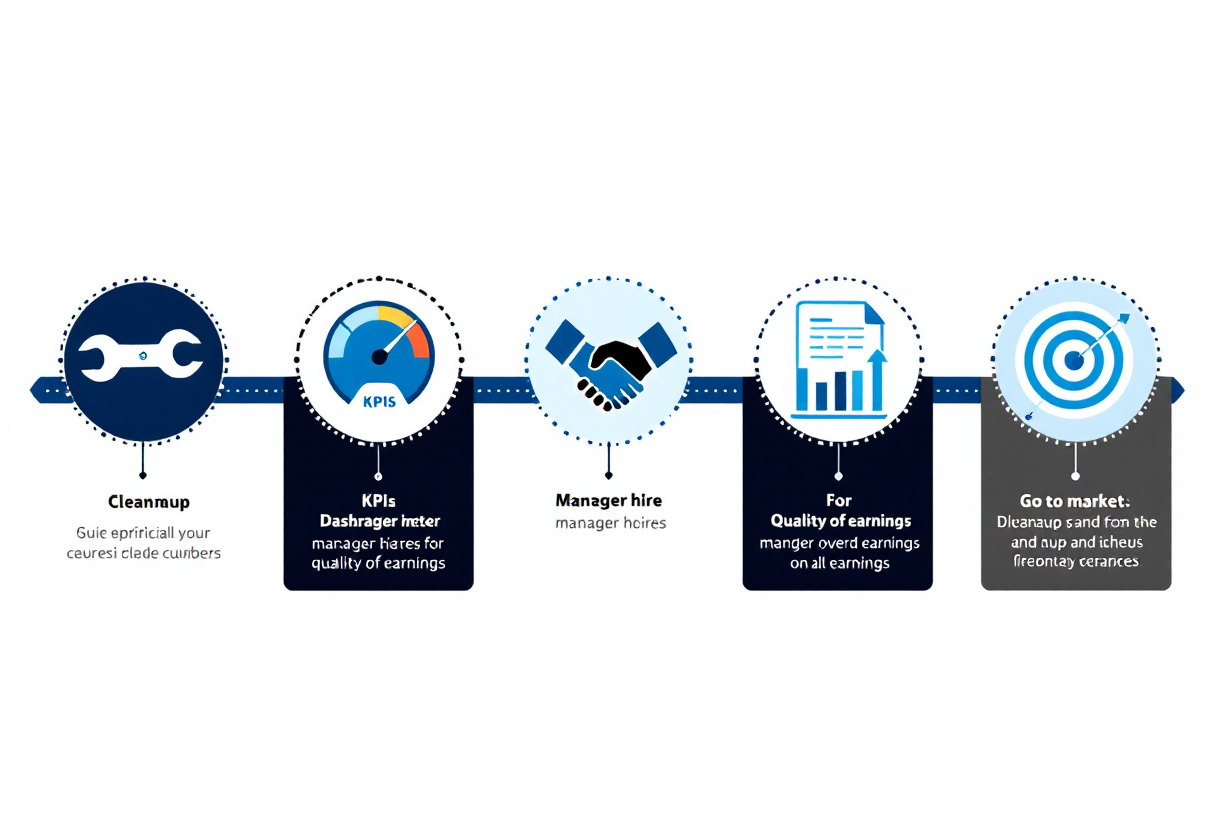
The calendar below assumes you want buyers to see two full heating seasons of improved results. Because chimney revenue is concentrated in autumn and winter, the timing of each step relative to the season matters more than in most trades. Changes made in spring show up in the numbers the following winter.
Three years out: foundations
- Move the books to accrual accounting and set up revenue lines for sweeping, repairs, installs, dryer vents and commercial work
- Choose field service software and migrate customer, job and inspection history into it
- Start an add-back log with invoices attached
- Review worker classification for helpers, junior sweeps and seasonal masons
- Write the fall protection program and begin completing per-job fall prevention plans
- Enroll at least two technicians in a CSIA Certified Chimney Sweep route and map every existing credential’s renewal date
- Confirm which registrations each state requires for your masonry and appliance work, and whose name each one sits under
- Register an apprenticeship program using the NCSG standards if you plan to grow headcount
- Identify the person who will become manager, whether an internal promotion or an outside hire
Two years out: measurement
- Manager takes over dispatch, pricing exceptions and callbacks
- Close the books monthly and review revenue and margin by service line
- Launch or formalize the annual inspection plan and track enrollment and renewals
- Start two summer revenue programs and report them as separate lines
- Introduce a flat-rate price book and a documented annual price review
- Standardize inspection reports with photos inside the software
- Spread commercial revenue across several accounts and put written agreements in place
- Review insurance limits and completed operations coverage with your broker
One year out: proof
- Owner steps back from daily operations and tests a two-week absence in a busy month
- Several technicians hold current CSIA credentials; installers hold NFI categories that match the work they do
- Commission the sell-side quality of earnings review
- Record prepaid plan revenue as deferred and recognize it as visits happen
- Run a final compliance review covering fall protection records, wildlife permissions, stove install records and classification
- Replace or repair the worst vehicles and equipment on a planned schedule
- Assemble twelve months of clean monthly results by service line
Six months out: materials
- Engage an M&A adviser with home services experience
- Prepare the confidential information memorandum around repeat inspections, service mix, summer programs, credential depth and roof safety
- Draft an anonymous one-page teaser
- Build a buyer list that matches your size and region: the dedicated chimney platform where relevant, multi-trade home services groups, regional competitors, masonry and hearth businesses, and qualified individual buyers
- Load the data room with every document from the pre-offer list above
- Rehearse a management presentation that the manager, not only the owner, can deliver
Three months out: market
- Send the teaser, collect confidentiality agreements and release the memorandum
- Gather indications of interest and narrow to a shortlist
- Hold management meetings and request letters of intent
- Choose a letter of intent and enter exclusivity
- Support confirmatory diligence, negotiate the purchase agreement and close
Two timing points specific to chimney companies. First, try to go to market with a completed heating season in the trailing results, so buyers see the peak rather than projecting it. Second, avoid running the busiest part of diligence during your own peak months if you can; the manager and owner will be stretched, and service quality during a sale process is something buyers watch.
How CT Acquisitions Runs a Chimney Company Sale
CT Acquisitions is an M&A advisory firm for founder-owned businesses. We work on the sell side, on buy-side searches and on longer exit plans, with a network of 500+ buyers and operating partners. In a chimney engagement, our work falls into a few stages.
- Readiness review. We start with your credentials file, repeat-customer data, safety records and financials, and tell you plainly which gaps a buyer will price. Sometimes the right answer is to wait a season or two.
- Positioning. We write the story around what is distinctive about your company, whether that is relining capability, a strong annual plan, commercial accounts or a trained bench of technicians, and back it with the federal fire data and the NFPA 211 code basis that a generalist buyer needs.
- Buyer outreach. We approach a targeted list that fits your size, region and service mix, rather than a mass mailing, and we run a competitive process among the buyers who engage.
- Diligence management. We organize the data room, prepare you for the questions in the sections above, and keep the process moving through the letter of intent, confirmatory review and purchase agreement.
- Closing and transition. We help structure the transition period, any retained equity or seller financing, and the handover of credentials, registrations and customer relationships.
No fee to you on buy-side introductions; sell-side mandates are paid on success at closing. If you are two or three heating seasons from a sale, the most useful step is usually an early conversation about which of the items on this page will matter most for your company.
Frequently Asked Questions
How long should I plan for before selling my chimney sweep business to a private equity buyer?
The owners who get top-quartile pricing start preparing 24 to 36 months before going to market. The minimum useful prep window is 12 months, because most of the high-leverage levers (lifting annual inspection membership penetration from under 20% to 40%+, installing a GM, getting on ServiceTitan or Successware, getting 2+ additional techs CSIA CCS-certified, building the OSHA Fall Protection Program documentation per the NCSG-OSHA December 2023 settlement, and running a sell-side QoE) need 12+ months of clean trailing-twelve-months data to be credible to a buyer. Chimney sellers who try to go to market in under 6 months typically leave 20% to 30% of enterprise value on the table.
What is a realistic EBITDA multiple for a $1M EBITDA chimney sweep business in 2026?
For a residential chimney sweep business at $1M EBITDA in 2026, the synthesized range is 4x to 6x. The bottom of that range applies to demand-only shops with under 20% recurring inspection revenue, owner-dependence on CSIA certification, and a concentrated customer base. The top applies to shops with 40%+ annual inspection membership recurring revenue, a GM in place, ServiceTitan or Successware running, multiple CCS-certified techs, and customer concentration under 10%. This range is synthesized from HedgeStone’s home services SDE benchmark, Endura’s published buy-box ($500K+ EBITDA, $2M+ revenue), IBBA Q4 2025 Market Pulse blended LMM data, and a 1x discount applied to comparable HVAC bands. Published chimney-specific EBITDA multiples are sparse, so a chimney seller’s recurring revenue mix and platform-fit narrative move the multiple more than the band itself.
What percentage of annual inspection membership revenue do PE buyers want to see?
40% or higher is the threshold that moves your business from a demand-only commodity profile into a recurring-revenue premium profile. Industry baseline penetration is estimated under 20% (cross-source estimate), so even modest improvement looks differentiated to a buyer. NFPA 211 Section 14.2.1 requires annual chimney inspection, and many homeowner insurance policies reference NFPA 211 compliance for claims defense, so the recurring program sells a code-mandated service rather than a discretionary upgrade. On a $750K EBITDA shop, trading at 3.5x vs. 5x is $1.1M of price from this single lever (estimate, synthesized from HedgeStone, ServiceTitan chimney content, and the Endura platform thesis).
Should I get a quality of earnings report done before going to market?
For chimney sweep businesses at $500K+ EBITDA, yes. A sell-side QoE costs $25K to $35K if revenue is below $5M, $35K to $75K typical for a healthy chimney shop with multiple service lines and 200+ active inspection members, and up to $150K for businesses with complex add-backs or messy books on the prepaid membership deferred revenue line (Eton Venture Services 2025; Morgan & Westfield QoE guide; Kahn Litwin Renza 2025). The ROI is leverage. If your QoE supports a 1x multiple uplift on a $750K EBITDA business at a 3.5x baseline, that is $750K of additional sale price for a $50K investment. More importantly, a pre-market QoE surfaces revenue recognition issues on prepaid memberships, working capital seasonality, and add-back weaknesses while you can still fix them rather than during exclusivity when the buyer re-trades the deal.
Is Endura Services the only real PE buyer for a chimney sweep business?
Endura is the only pure-play chimney and hearth PE roll-up of meaningful scale in 2026. They were formed by Argosy Private Equity in December 2024, launched publicly in March 2025, and have completed two disclosed add-ons (Chim Chimney Inc in Hermitage TN, March 14, 2025; A Merrie Sweepe in Portsmouth NH, 2025). Their published buy-box is $500K+ EBITDA and $2M+ revenue. But Endura is not the only realistic buyer. The multi-trade home services platforms (Apex Service Partners, Wrench Group, Heartland Home Services, Champions Group, Authority Brands at the franchise layer) all have HVAC, plumbing, or electrical footprint that can absorb chimney as a cross-sell add-on in the same metro. Below $500K SDE, search funds and BizBuySell, Murphy Business, and Sunbelt broker channels are the realistic buyer pool. A well-run process for a $500K to $2M EBITDA chimney shop should target 10 to 15 names total, vs. the 25+ typical for HVAC.
Do I need to stay on as the licensed or CSIA-certified chimney sweep after I sell?
If you are the only CCS-certified tech in the shop or the sole qualifier on a state-required license (PA registration, any state contractor license), almost always yes. The buyer prices CSIA cert concentrated in the owner the same way they price a master HVAC license held only by the owner: as a key-person risk that requires either an immediate post-close certified hire or a transition services agreement keeping the owner on for 12+ months. Estimate impact of the concentration: 0.5x to 1.0x multiple haircut. The fix is to get 2+ additional techs CSIA CCS-certified 12 to 24 months before going to market (1-week online course plus 100-question exam at 70% passing, $249/yr maintenance per CSIA.org), and to confirm a backup qualifier in any state where you hold the company’s standing. That work moves you from a 12-month seller-stays earn-out into a 3-month clean exit at a higher multiple.
What to Do Next
The chimney sweep owners who get the top-quartile multiple all do the same four things. They start preparing 24 to 36 months before they want to be out. They get 2+ additional techs CSIA CCS-certified so the owner is no longer the constraint. They put a GM in place 12+ months pre-sale. And they invest in a sell-side QoE before any buyer sees a CIM.
The chimney market in 2026 is one platform thin on the pure-play side and a thinner buyer pool overall than HVAC, which means two things. First, a clean, defensible adjusted EBITDA story and a documented annual inspection membership engine do more of the convincing work than they would in HVAC, because the buyer often does not have a deep mental model of what “good” looks like in chimney. Second, with fewer buyers in the room, every credible name matters more. The work in this playbook is what gets credible buyers to the table.
If you are 12+ months from a potential exit and want a structured pre-sale optimization roadmap, CT Acquisitions has home services operations specialists in our partner network who run multi-quarter prep engagements. If you are 6 to 12 months out and ready to start the sell-side process, our M&A advisory team runs the buyer outreach. No fee to you on buy-side introductions; sell-side mandates are paid on success at closing. Either way, the first 30 minutes are free.
Ready to talk?
Schedule a 30-minute exit-readiness call
Or read more: Sell Your Chimney Sweep Business (active sale guide) | How to Prepare Your HVAC Business for a Sale or Exit | Private Equity in HVAC 2026: Active Buyers + Multiples
Ready to Explore Your Options?
A 30-minute confidential conversation is all it takes.