
How to Prepare Your Pool Service Business for a Sale or Exit in 2026: The 36-Month PE-Buyer Playbook
Preparing your pool service business for exit in 2026 is a 36-month playbook, and the active PE roll-up (SPS PoolCare, Vermana, ASP) means the buyer set changes every 6-12 months. The first 12 months tighten the operating story around route density and weekly recurring revenue, the middle 12 fix pre-LOI diligence gaps around technician retention and chemical licensing, and the final 12 turn one offer into a real competitive process.
Exiting your pool service business is the single largest financial event most owners will ever face. This guide is the no-fluff playbook for pool service business owners who are 12-36 months from sale, covering how PE-backed buyers actually value your business in 2026, the 12 levers that move your multiple, pre-LOI diligence, deal-killers to fix before going to market, and the full 36-month exit prep timeline.
Updated April 2026 · CT Acquisitions
Most pool service owners decide to sell, hire a broker, and find out 90 days later that their business is worth 35% to 45% less than they thought. The owners who get top-quartile pricing start preparing 24 to 36 months before they ever talk to a buyer. This guide is the 36-month playbook for how to prepare your pool service business for a sale or exit. It covers what private equity actually buys in 2026, the 12 levers that move multiples, the documents PE will ask for before they send an indication of interest, and the deal-killers that re-trade pool service transactions during confirmatory diligence. Every number cites its source. Every recommendation comes from how the most active pool service buyers in 2026 actually behave.
If you are 6 to 36 months from a possible exit, this is the work that turns a 3x EBITDA outcome into a 6x EBITDA outcome. On a $1.5M EBITDA pool service business that delta is the difference between a $4.5M sale and a $9M sale. Whether you want to prepare your pool service business for a sale to private equity, prepare your pool service business for an exit to a strategic acquirer, or simply maximize value over the next 1 to 3 years before going to market, the work below applies. Pool service has become one of the fastest-consolidating home-services lanes in PE: the SPS PoolCare acquisition of Pool Troopers on January 23, 2026 ($144M plus $157M combined revenue) and the CERTUS Pest acquisition of National Pool Partners on January 26, 2026 are the freshest anchors of a market that closed 50 to 80 PE-driven pool service add-ons in 2024 and 2025 alone.
Building toward an exit in 12 to 36 months?
CT Acquisitions runs sell-side advisory for pool service owners at $1M+ EBITDA. We also have pool service operations specialists in our partner network who run pre-sale optimization engagements when the timeline is longer. No fee to you on buy-side introductions; sell-side mandates are paid on success at closing.
What Private Equity Actually Buys in Pool Service (2026)
For 2026 foundation repair sale playbook with 500+ vetted PE / family office / search fund buyers, Groundworks (Cerberus) thesis, see our reference.
The US pool, hot tub, and spa industry is a $62 billion market serving more than 14 million pools and spas, with 10.4 million residential pools and 309,000 public or commercial pools (PoolDial, “Pool Industry Statistics 2026”). Four states (Florida, California, Texas, Arizona) account for 54% of all pool industry sales, and that Sun Belt concentration is exactly where 2026 sponsor demand sits. PE platforms are at the integration phase of multi-year roll-up arcs: SPS PoolCare crossed 175 acquisitions in 2025, Lightview Capital launched the Vermana platform in mid-2025, and CERTUS Pest opened a cross-vertical pest-to-pool lane in January 2026. Pool service is essentially a route-density business, structurally similar to pest control. Recurring weekly maintenance is the single most valued revenue stream, and the profile you build determines the multiple you get.
The PE-attractive pool service profile
- EBITDA threshold for a platform-quality deal: $1M to $3M is the entry band where sponsor-backed platforms run a competitive process. Below that, you are an add-on inside a roll-up at route or service-area level. Above $5M EBITDA you are an attractive bolt-on for the larger platforms (SPS PoolCare, Pool Service Partners, Vermana). Above $10M EBITDA, you are a platform candidate yourself.
- Recurring weekly maintenance revenue: 70% or higher is the line between commodity and premium. Demand-only and break-fix-heavy shops trade at 2x to 3x SDE. Shops with 70%+ recurring weekly trade at 4x to 6x EBITDA at sub-$3M EBITDA scale, and 5x to 8x at $3M+ (Brentwood Growth; Rapt Business Brokers; IndustryPro pool valuation guide, 2026).
- Geography: Florida, Texas, Arizona, California, Nevada, and other Sun Belt year-round metros are where 2026 sponsor demand concentrates. SPS PoolCare operates in 19 markets across 5 Sun Belt states. Snowbelt geographies trade at a discount unless they have compensating winter revenue lines.
- Customer concentration: No single commercial customer above 10% of revenue. Top 5 commercial below 25%. Concentration above 20% triggers buyer pushback; above 25% triggers 15% to 30% valuation discount or buyer withdrawal (Beancount.io, 2026; Strategex; Eagle Rock CFO; Morgan & Westfield).
- Route density: 12 to 18 pools per tech per day clustered in 1 to 2 zip codes per route. Sealey Business notes that 10 pools in one zip code beats 20 across the county for both margin and valuation.
- Owner role: Owner is in management, not running a route personally. GM or route manager in place 12+ months pre-sale. CPO certifications redundant across at least 3 techs.
Active pool service PE platforms in 2026
The list below covers the most active sponsor-backed pool service platforms in the 2024 to 2026 cycle. This is who will see your teaser. Add-on counts are point-in-time; sources include SPS PoolCare and Storr Group press (January 2026), Shoreline Equity Partners, Imperial Capital, PrivSource, AQUA Magazine, PoolPro Magazine, Lightview Capital, and Bow River Capital filings and press.
| Platform | Sponsor | Profile |
|---|---|---|
| SPS PoolCare | Storr Group (founded 2021 by Fraser Ramseyer) | 191 add-ons since 2021 including Pool Troopers in Jan 2026; 42,000+ weekly recurring residential and commercial customers across 19 markets in 5 states; ~$157M combined 2025 service revenue; Sun Belt focus (FL, TX, AZ, CA, NV) |
| Pool Troopers (now SPS PoolCare) | Previously Shoreline Equity Partners (Oct 2020); Shoreline retains minority stake post-merger | 25+ add-ons under Shoreline ownership; $57M service revenue 2024; 16,182 accounts at sale; FL, TX, AZ |
| National Pool Partners (NPP) | Imperial Capital (launched late 2020 with $200M); CERTUS Pest acquired NPP Jan 26, 2026 | 30+ add-ons cumulative; brands include Patriot Pool & Spa (TX, FL), Aquaman Pools (AZ); 10,000+ pools in Florida; combined 1,000+ employees post-CERTUS merger |
| Vermana / Pulexa / nV Pools | Lightview Capital majority July 2025; Patriot Capital and Aldine Capital co-investors | Three-company platform launch; commercial pool maintenance, renovation, construction; Florida and Southeast US focus |
| Pool Service Partners (PSP) | Tamarix Equity Partners (founded 2022) | 13 add-ons cumulative through Feb 2025 (B&B Swimming Pool Jan 2025, USA Pools Avalon Feb 2025); on track to service 8,000+ pools in 2025; Northeast and Mid-Atlantic |
| Landmark Aquatic | Bow River Capital (formed via Westport Pools + Progressive Commercial Aquatics, Oct 2023) | 7 locations; work in 16+ states; design/build/maintenance/renovation; added Spear Corporation (Mar 2024), CEM Aquatics (2024); national commercial focus, municipal, education, private-club clients |
| Riverbend Sandler Pools | Concentric Equity Partners (April 2021 recap) | Added Pulliam Pools (Nov 2021), Claffey Pools (Jan 2022), Backyard Paradise Luxury Pools (2022); 170+ employees; Texas-focused luxury build + service |
| ASP (America’s Swimming Pool Company) | Authority Brands (Apax Partners majority + BCI minority) | Franchise model; signed 15 franchise deals in 2025; 380+ franchise locations across 26 states; national via franchise territories |
| Pool Scouts | Buzz Franchise Brands (not Authority Brands) | Franchise; 81 locations (79 franchised, 2 company-owned); $20M system-wide revenue in 2023; added repairs, vinyl liners, safety covers as services in 2024 |
| Poolwerx | Norwest Venture Partners (partnered 2022) | 100+ US territories as of 2024; added 22 US territories in 2024; entered NC, CO, IN, KY, AR, OH; target 300 US territories by 2027 |
| Premier Pools & Spas / Premier Pool Service | Private (Porter family ownership) | Franchise; expansion plans to 350-400 franchises in 5 years; build + service; added Fresno CA, Panama City FL, Charlotte NC franchises March 2026 |
| American Pool / The Amenity Collective | The Amenity Collective parent (NYC HQ) | Multiple residential and commercial add-ons including Swim Club Management Group, All Pool Service & Supply (Orlando), Blue Water Pools & Spas (Jacksonville); national commercial focus on HOA, municipal, multifamily |
| HASA Inc. (chemicals adjacency) | Wind Point Partners (acquired from GHK Capital, Jan 2023) | Acquired Orenda Technologies March 2023, Pool Chemistry Training Institute assets; manufactures and distributes specialty pool chemicals; national |
| CERTUS Pest (strategic, entered pool Jan 2026) | Strategic platform | Top 20 pest control platform; acquired National Pool Partners Jan 26, 2026; signals pest-to-pool cross-vertical buyer entry |
Add to that list the strategic acquirers. Pool Corporation (NASDAQ: POOL) acquired Porpoise Pool & Patio, the parent of the Pinch A Penny franchise system, for $788.7M in December 2021. Pinch A Penny had $387.3M revenue in 2020 and 2,775 employees at the time of the transaction, implying roughly 2.0x revenue (POOLCORP 8-K, December 16, 2021; SEC filings). POOLCORP is primarily a distribution growth story today (10 new sales centers plus 2 small acquisitions in 2024), but it controls the Pinch A Penny franchise growth channel. Latham Group (NYSE: SWIM) is a pool equipment manufacturer that has been acquisitive on the dealer side: Coverstar Central in August 2024, two smaller Coverstar dealers in Feb 2025, and Freedom Pools in 2025 (~$17M deal, $20M net sales, $4M EBITDA contribution). Latham is not a service buyer, but its acquisition pace signals premium multiples on equipment installer roll-ups in the same end markets as pool service. CERTUS Pest is the headline strategic story of 2026: a pest control platform now openly bidding on pool routes for the same route-density reasons that drew Imperial Capital, Tamarix, and Lightview into the lane. Note that Leslie’s Inc. (NASDAQ: LESL) is not a credible strategic buyer for service routes today. The retailer closed 80 stores plus a distribution center in two weeks during December 2025, reported a $237M FY2025 net loss, executed a 20-for-1 reverse stock split to maintain Nasdaq listing, and sat at #3 on National Law Review’s 2026 retail bankruptcy watch list. Sellers should treat Leslie’s as a distressed retailer, not an exit channel.
Pool Service Valuation Multiples in 2026 (What You Are Actually Worth)
The multiple a buyer pays comes down to your size, your service mix, your recurring weekly maintenance penetration, your route density, and your geographic fit. Here is the 2026 range, cross-referenced from PoolDial pool route valuation, Tupelo SMB, KMF Business Advisors, DealStream, Brentwood Growth, IndustryPro, AQUA Magazine, Rapt Business Brokers, and IBBA Q4 2025 Market Pulse.
SDE multiples (smaller, owner-operated, typically under $3M revenue and under $1M SDE)
| SDE band | SDE multiple | Profile fit |
|---|---|---|
| Under $250K SDE (single-tech owner-operator) | 1.5x to 2.5x | Tupelo SMB pool valuation guide, 2025; KMF Business Advisors pool profitability 2026 |
| $250K to $500K | 2.0x to 3.0x | Natalie McMullen pool service worth guide; DealStream pool service rules of thumb |
| $500K to $1M SDE | 2.5x to 3.5x SDE | DealStream; Surge Law SDE primer; AQUA Magazine pool valuation 2026 |
| Demand-only with weak recurring base | 1.6x to 2.8x | DealStream; Rapt Business Brokers pool valuation 2026 |
| Service-heavy 60%+ recurring, dense routes, low owner dependence | 3.5x to 4.5x SDE | Tupelo SMB; PoolDial route valuation guide; IndustryPro pool valuation |
Pool route MRR multiples (the most common small-deal structure)
The pool industry has a unique sub-market: route sales, where the asset being sold is a portfolio of recurring maintenance accounts rather than an operating company. Route multiples are quoted off monthly recurring revenue (MRR), not EBITDA or SDE. Example math: a $5,000 MRR route at 10x multiple equals $50,000 of route value. A 300-account Phoenix route at $185 average monthly equals $55,500 MRR; at 10x that is $555,000 of route value (PoolFounder route valuation, 2026; PoolDial route calculator).
| Route profile | MRR multiple | Source |
|---|---|---|
| Small starter route (under 20 accounts) | 6x to 9x MRR | PoolDial pool route valuation guide 2026; PoolFounder; Pool Routes for Sale |
| Average residential route (20 to 80 accounts) | 8x to 12x MRR; industry rule of thumb is 10x MRR | PoolDial; Tower Business Brokers route ownership economics |
| Premium turnkey route (90%+ retention, tight density, transferable contracts) | 12x to 15x MRR; occasionally 13x to 18x | PoolFounder route valuation 2026; PoolDial route calculator |
| Brokered transaction structure | Seller nets ~10 months revenue, buyer pays ~12 months, broker keeps 2 months | National Pool Route Sales / Pool Magazine broker primer |
EBITDA multiples (PE-attractive size, $1M EBITDA and above)
| EBITDA band | Residential route | Commercial / management |
|---|---|---|
| Under $500K EBITDA | 2.5x to 4x | 3x to 5x |
| $500K to $1M | 3x to 5x | 4x to 6x |
| $1M to $3M EBITDA | 4x to 7x | 5x to 8x |
| $3M to $10M EBITDA | 6x to 10x (estimate) | 7x to 11x (estimate) |
| $10M+ EBITDA platform-quality (Sun Belt, 70%+ recurring, software-enabled) | 9x to 13x (estimate) | 10x to 14x (estimate) |
Sources: Brentwood Growth pool sale page; KMF Business Advisors 2026; DealFlowAgent 2025-2026 exit guide; IndustryPro pool valuation; DealStream pool rules of thumb; Rapt Business Brokers 2026; AQUA Magazine pool valuation 2026. Estimate bands at $3M+ EBITDA cross-reference SPS PoolCare add-on activity, Lightview Capital Vermana platform formation, and comparable pest control platform multiples (Rollins, Anticimex). IBBA Q4 2025 Market Pulse baseline: $1M to $2M deals print 3.0x to 3.3x SDE/EBITDA across all industries; $2M to $5M print 4.1x; $5M to $50M print 5.5x. Pool service multiples sit above blended IBBA numbers because the recurring weekly maintenance contract is one of the highest-quality revenue streams in lower middle market home services.
Recent disclosed pool service transactions (2021 to 2026)
| Acquirer | Target | Date | Value / scale | Implied multiple |
|---|---|---|---|---|
| Pool Corporation (POOL) | Porpoise Pool & Patio (parent of Pinch A Penny) | Dec 16, 2021 | $788.7M; $387.3M 2020 revenue; 2,775 employees | Approx 2.0x revenue (only deal with disclosed revenue multiple) |
| SPS PoolCare / Storr Group | Pool Troopers (Shoreline Equity Partners) | Jan 23, 2026 | $57M Pool Troopers service revenue 2024 + $87M SPS revenue 2024 = $144M combined; $157M combined 2025 | Not disclosed; SPS PoolCare’s 191st add-on |
| CERTUS Pest | National Pool Partners (Imperial Capital) | Jan 26, 2026 | Combined 1,000+ employees post-close; NPP had $200M of Imperial Capital backing at launch | Not disclosed |
| Lightview Capital (with Patriot Capital, Aldine Capital) | Vermana + Pulexa + nV Pools | July 15, 2025 | Three-company commercial pool platform launch | Not disclosed |
| Bow River Capital | Westport Pools + Progressive Commercial Aquatics (formed Landmark Aquatic) | Oct 2023 | Platform formation | Not disclosed |
| Pool Service Partners (Tamarix Capital) | USA Pools Avalon, NJ + B&B Swimming Pool Service, NY | Feb 3, 2025 + Jan 23, 2025 | 12th and 13th PSP add-ons; 8,000+ pools serviced by PSP in 2025 | Not disclosed |
| HASA Inc. (Wind Point Partners) | Orenda Technologies | March 2023 | Specialty pool chemistry; first HASA add-on under Wind Point | Not disclosed |
| Latham Group | Coverstar Central + Freedom Pools | Aug 2024 + 2025 | Coverstar all-cash, immediately accretive; Freedom Pools ~$17M deal, $20M net sales, $4M EBITDA contribution | Freedom Pools approx 4.25x revenue |
Sources: POOLCORP 8-K Dec 16, 2021; SPS PoolCare press release Jan 23, 2026; Storr Group press; AQUA Magazine; Pool & Spa News; PoolPro Magazine Jan 2026; Lightview Capital press; PRNewswire July 15, 2025; PrivSource; Bow River Capital press; PSP press releases; HASA press; Latham Group 8-K filings; StockTitan SWIM news. Note that pool service deal multiples are rarely disclosed in press releases. The most defensible benchmarks come from cross-source synthesis of broker rules of thumb, BizBuySell aggregate service category data, and inference from disclosed strategic transactions.
The 12 Value Levers That Move Your Multiple (Ranked by Impact)

These are the levers that move pool service multiples in the 24 months before a sale. Each one has a current state, a target state, and an estimated financial impact. The ordering is by dollar impact per unit of effort, based on cross-source synthesis from Brentwood Growth, Rapt Business Brokers, IndustryPro, Sealey Business, PoolDial, Skimmer State of Pool Service 2025, and SPS PoolCare integration commentary.
Lever 1: Lift recurring weekly maintenance penetration to 70%+
Current: Mixed business with 30% to 50% recurring weekly maintenance; the rest is break-fix, one-off cleanings, and equipment installs. Target: 70%+ recurring weekly maintenance with 85%+ annual retention. Impact: Pool service businesses with under 40% recurring trade at 2x to 3x SDE; 70%+ recurring trades at 4x to 6x EBITDA at sub-$3M EBITDA scale (Brentwood Growth; Rapt Business Brokers; IndustryPro pool valuation guide). On a $1.5M EBITDA business that delta is the difference between a $3M to $4.5M sale and a $6M to $9M sale. Buyers also assign a 1.0x to 1.5x annualized contract revenue premium on top of the EBITDA multiple for the contract base itself (Sheets.Market; DealStream). How: Convert demand calls to weekly plans via tech incentives; price chemical-only plans at $99 to $149 per month and full-service at $199 to $299; auto-renew with stored payment on file; introduce a premium tier (priority service, included filter cleans, included chemicals) at $299 to $399.
Lever 2: Densify routes to 15+ pools per tech per day in tight zip codes
Current: 8 to 12 pools per tech per day, scattered across 3 to 5 zip codes per route. Target: 15 to 18 pools per tech per day clustered in 1 to 2 zip codes per route, with strategic route sequencing. Impact: 20% to 30% efficiency gain at the route level (Sealey Business 2026); strategic sequencing adds 25% to 40% daily stop capacity (Zeo Route Planner 2026). On a $5M revenue, $1M EBITDA business with 8 techs, lifting average stops/day from 10 to 14 absorbs $60K to $90K of incremental annual revenue per tech at high marginal margin, adding $250K to $500K of EBITDA before further hiring. At a 5x to 7x multiple that is $1.25M to $3.5M of additional sale price. Route density is also a stand-alone valuation premium: tight routes resell at 12x to 15x MRR vs scattered routes at 8x to 9x MRR (PoolDial route valuation guide 2026). How: Pause new account intake in low-density zips; offer route swaps with neighboring operators; trade geographically scattered accounts for in-cluster accounts; price scattered outliers above market to either densify or shed.
Lever 3: Move the owner out of the chair and install a route manager or GM
Current: Owner runs 1 or 2 routes personally, signs every chemical PO, approves every quote above $1,000, is the only licensed CPO, holds the C-53 or CPC qualifier. Target: GM or route manager in place 12+ months before going to market. Owner doing under 30 hours per week of operational work. CPO certifications redundant across 3+ techs. Qualifier license held by an employed manager, not the selling owner. Impact: Owner-dependence is the single most-cited multiple haircut in pool service valuation literature (Brentwood Growth; IndustryPro pool valuation; Rapt Business Brokers). On a $1M to $3M EBITDA business, removing key-person risk moves the multiple from the 3x to 5x band into the 5x to 7x band, worth $2M to $6M of price. How: GM hire 18 to 24 months pre-sale (typical pool service GM comp $90K to $150K plus bonus); document SOPs for every operational role; build a leadership scorecard; transition customer relationships to the route managers; take a 2-week unplugged vacation as the stress test. Get 3+ techs CPO certified at company cost. Identify the employed CPC qualifier path well in advance.
Lever 4: Migrate to Skimmer, Pool Brain, or ServiceTitan and run real KPIs
Current: QuickBooks plus spreadsheets plus paper route sheets; no service-line P&L; no chemical-log audit trail; technician productivity is anecdotal. Target: Skimmer or Pool Brain (or for $5M+ revenue or commercial-heavy businesses, ServiceTitan) in place 18+ months; monthly close within 15 days; KPI dashboard tracking stops/day, miles/day, revenue/route, average ticket, chemical cost per pool, member churn, first-time-fix rate. Impact: Estimate +0.5x to 1.0x EBITDA multiple uplift, driven by data-room speed and KPI defensibility. SPS PoolCare’s enterprise migration to ServiceTitan in March 2026 was framed explicitly as the foundation for next-phase growth and acquisition integration (ServiceTitan / SPS PoolCare announcement, March 17, 2026). PE platform buyers strongly prefer acquired companies that already run on Skimmer or Pool Brain because data migration is faster. How: Budget $5K to $50K depending on platform and route count. Skimmer starts at $49/month, Pool Brain at $10/month, Service Autopilot mid-tier, ServiceTitan enterprise. Force tech adoption with payroll-tied compliance: no service ticket logged means no pay for that stop.
Lever 5: Drive average ticket and pricing discipline
Current: Residential weekly maintenance priced at $80 to $130 per month; no annual price review; service technicians have discretion to discount. Target: Residential weekly maintenance priced at $150 to $250 per month in Sun Belt, $175 to $300 per month in CA; annual 5% to 8% price increase across the book; tech discretion on pricing eliminated. Impact: Direct EBITDA growth. A $3M revenue shop with 1,000 weekly accounts lifting average monthly fee from $120 to $145 (a $25 uplift) generates $300K of incremental revenue with 70% to 80% dropping to EBITDA. At a 5x multiple that is $1.05M to $1.2M of additional sale price (KMF Business Advisors 2026; Sheets.Market 2026; FieldCamp pricing approach applied to pool). How: Quarterly price-book updates; a chemical surcharge line item that auto-adjusts with chlorine wholesale price (chlorine prices spiked 100%+ during the 2020 to 2022 BioLab fire era and have remained volatile); options-based presentations during account onboarding (Basic, Standard, Premium tier presentation); eliminate tech-level discount authority.
Lever 6: De-concentrate the commercial customer base
Current: Top commercial customer (country club, large HOA, hotel) above 15% of total revenue, or top 3 commercial above 30%. Target: Top customer below 10%; top 5 below 25%. Impact: Concentration above 20% triggers buyer pushback; above 25% triggers 15% to 30% valuation discount or buyer withdrawal (Beancount.io 2026; Eagle Rock CFO; Strategex; Morgan & Westfield). For pool service the dynamic is amplified because losing a single 100-pool HOA contract is a single phone call from one board member, and HOA boards rotate every 1 to 3 years. How: Diversify into new HOA verticals (apartment complexes, condo associations, municipal pools); expand residential geographic footprint; raise prices on the biggest accounts to either fund alternative growth or shrink the concentration ratio naturally. Our companion piece on Maximize Value When Selling Your Pool Service Firm dives deeper into this topic. Our companion piece on Maximize Your Pool Service Business Valuation dives deeper into this topic.
Lever 7: Tighten revenue mix toward maintenance plus equipment install combo
Current: 50% maintenance, 50% break-fix repair; minimal equipment install revenue. Target: 60% to 70% recurring maintenance, 15% to 20% equipment install (heaters, pumps, automation, salt cells), 10% to 25% repair. Impact: Equipment install carries the highest per-job revenue and best one-time margin in pool service (variable pump replacement $1,500 to $3,500, heater install $3,500 to $7,000, salt chlorinator $1,800 to $3,500); chemical-only and basic maintenance carry recurring revenue value (PoolFounder; Tower Business Brokers 2026 pricing guides). The blend lifts both top-line and per-account economics. Estimate: shifting mix from 50/50 to 65/20/15 lifts blended gross margin by 4 to 8 points. How: Train route techs to identify and quote equipment replacement opportunities; commission techs on referred installs; partner with one preferred equipment distributor (POOLCORP / SCP, Heritage, Pinch A Penny) for warranty pricing; offer financing through Synchrony or GreenSky for $5K+ jobs.
Lever 8: Technician retention and CPO depth
Current: 30%+ annual tech turnover; only 1 to 2 CPO certifications in the company (one of which is the owner); no formal training program. Target: Under 20% turnover; CPO certification on 3+ technicians (5-year renewal cycle, $300 to $500 per CPO, ~16 hours of training time per PHTA CPO program); written training program from new hire through senior tech. Impact: Documented industry pain point (Skimmer State of Pool Service 2025; PoolPro hiring headaches survey; Workyard pool tech statistics). Pool tech shortage is acute in CPO-required commercial states (TX, SC, FL, and 25+ states explicitly require CPO for public/commercial pool operators per PHTA and PoolDial CPO state guide). Replacement cost of a skilled pool tech runs 30% to 50% of annual comp. Tech retention is also a defensible-asset narrative in the QoE. How: Pay above-market for senior route techs (target 75th percentile of local market); pay for CPO certification plus 5-year renewal; invest in the PHTA Certified Pool Service Professional pathway; truck-as-an-office investment (clean truck, branded uniform, take-home truck policy); first-time-fix bonus.
Lever 9: Sun Belt geography premium (year-round revenue)
Current: Snowbelt geography with bimodal seasonality and a winter trough; no compensating winter revenue lines. Target: Sun Belt year-round route concentration (FL, CA, AZ, TX, NV) or, if locked into a Snowbelt market, compensating winter revenue lines (pool closing/opening packages, equipment install in shoulder seasons, snowplow or lawn care cross-sell). Impact: Year-round geographies command an estimated 0.5x to 1.5x multiple premium because revenue does not collapse in winter months. FL, TX, and AZ are 100% of SPS PoolCare’s footprint per the January 2026 press release, and Lightview Capital’s Vermana platform is Florida and Southeast-focused. A Florida route at $200K annual revenue trades 0.5x to 1.5x higher than the identical Indianapolis route. How: If you operate in a Snowbelt geography, build the winter revenue line into the trailing-twelve-months data 18+ months before going to market; if you operate across both Sun Belt and Snowbelt, prepare the data so a buyer can underwrite the Sun Belt routes separately at a premium.
Lever 10: EBITDA add-back hygiene
Current: Owner runs personal expenses through the business with no documentation; related-party rent on the shop above FMV; owner-family on payroll. Target: Every add-back documented as it happens; related-party rent restruck to FMV with an appraisal on file; clean payroll for owner-family. Impact: Every defensible dollar of adjusted EBITDA is multiplied. At a 5x multiple, $100K of clean add-backs equals $500K of sale price (Morgan & Westfield QoE guide; Eton Venture Services). Buyers discount poorly documented add-backs at 50% to 100%. How: Monthly add-back log starting today; document the business purpose of every charge; FMV rent appraisal if the owner owns the real estate the shop sits on. If the owner is also the licensed C-53 or CPC qualifier, structure a market-rate qualifier consulting fee for the post-close transition period.
Lever 11: Working capital and real estate decision
Current: Wildly seasonal A/R (high in pool service, especially outside the Sun Belt); chemical inventory swings; prepaid annual maintenance liability not isolated on the balance sheet. Owner-occupied yard or warehouse held in the same entity as the operating business, or in an LLC at above-FMV rent. Target: TTM-average working capital is stable; deferred revenue on prepaid plans separately tracked; chemical inventory targets defined per truck and per warehouse. Real estate in a separate LLC at FMV NNN lease with a clear path for the buyer to assume the lease or buy the real estate. Impact: Working capital peg is set off the trailing 6 to 12 months (BDO; Morgan & Westfield NWC guide). Volatile working capital lets the buyer set a higher peg, which subtracts from purchase price. Estimate: poorly managed working capital costs 2% to 5% of enterprise value at close. Separating real estate often lifts the implied EBITDA multiple on the operating business by 0.5x to 1.0x (Plante Moran sale-leaseback primer; Northmarq). A sale-leaseback can release up to 100% of property market value as cash vs. 70% to 80% LTV via traditional financing. How: Auto-bill all routes via stored payment; tighten 30-day A/R cycle on commercial accounts; cap truck chemical inventory at 5 days of stock; isolate prepaid annual plan deferred revenue as a separate balance sheet line; get an FMV market rent study now and restruck rent to FMV.
Lever 12: Compliance scrub (licensing, CPO, chemical storage, DOT)
Current: State contractor license in the owner’s name (FL CPC, CA C-53, TX RAIL); CPO certifications on paper in a binder; chemical storage layout casual; chemical-rig trucks above the 440 lb hazmat threshold without DOT placarding. Target: Licensing transferable or with a documented post-close qualifier hire path; CPO certifications in a digital system with renewal calendar (5-year cycle); chemical storage compliant with EPA SPALERT and OSHA Hazard Communication (oxidizers separated from corrosives by 3+ feet or by a physical barrier); DOT placarding status documented per 49 CFR Part 172. Impact: Each item can kill or re-trade the deal at confirmatory. See the deal-killer section below for specifics. How: Cover this in months 24 to 12 of the run-up, before the QoE.
Want to grow your business to maximize value before exiting?
We connect pool service owners with operations experts in our partner network who run 12 to 24 month pre-sale optimization engagements. The engagement pays for itself in incremental sale price, and the playbook tracks the levers above.
What PE Asks Before They Send an LOI (The Pre-LOI Diligence Stack)
Before a PE firm commits to a letter of intent, they ask for a focused diligence package. The list below is the real ask from a 2026 sponsor-backed pool service platform targeting a Sun Belt route business in CT Acquisitions’ pipeline. The “why” and “how to prepare” expand each item to what is typical across the industry.
1. Income statements for 2024, 2025, and the latest trailing twelve months
Why PE asks: They are building the LTM EBITDA they will multiply. They want to see year-over-year revenue growth, gross margin trajectory, the seasonality curve, and any one-time movers. For pool service, the seasonality curve is the diagnostic exhibit: a Florida route has a relatively flat monthly chart, an Indianapolis route is bimodal with a winter trough.
How to prepare: Accrual-basis P&L by month, mapped to a clean chart of accounts. Service-line P&L: weekly maintenance, repair/break-fix, equipment install, chemical-only, commercial management, retail (if any). Reconcile to tax returns so there are no surprises in confirmatory.
2. Balance sheet at the latest month
Why PE asks: Sizes the working capital peg they will set in the SPA. Identifies net debt (cash minus interest-bearing debt minus debt-like items including prepaid maintenance liability, chemical inventory financing, truck loans, and equipment financing). For pool service, the prepaid annual maintenance plan deferred revenue is the most commonly disputed balance sheet item.
How to prepare: Tie the balance sheet to the trial balance. Identify and isolate debt-like items: unfunded prepaid maintenance, chemical inventory above operating need, truck loans, equipment financing, capital lease balances on chemical-rig trucks.
3. Adjusted EBITDA bridge with add-back documentation
Why PE asks: They want a sneak peek at the adjusted EBITDA story before sinking diligence cost into the file. If add-backs are aggressive or undocumented, the rest of the numbers get discounted.
How to prepare: Build the bridge from book EBITDA to adjusted EBITDA, line by line, with the underlying invoice or payroll record. Common pool service add-backs that hold up: owner compensation above market (if owner takes $300K but a route manager would cost $125K, $175K adds back), one-time legal fees, owner vehicle and personal travel, owner health insurance, owner family-member payroll for unclear duties, software conversion one-time costs, related-party rent above fair market value, ERC credits, and one-time hurricane or freeze remediation costs in FL/TX. Pool-specific add-back to watch: if the owner is also the licensed C-53 or CPC qualifier and is being paid only for that qualifier function above market, that portion is partially defensible but the buyer needs assurance the qualifier role will be filled post-close.
4. Anonymized employee roster (titles, start dates, pay, classification)
Why PE asks: Stress-tests two risks. First, technician tenure vs. industry churn (pool service has documented high turnover driven by seasonality in non-Sun-Belt geographies; Zippia 2025 lists 95,497 active pool tech openings nationally, indicating significant labor demand against supply). Second, CPO concentration: if all CPO certifications are held by 1 or 2 people including the owner, that is key-person risk.
How to prepare: Roster columns: role, hire date, full-time vs. part-time, W-2 vs. 1099 (with classification rationale), comp structure (hourly, route-based, commission), active CPO/CPI/state license, active non-compete or non-solicit. Calculate and disclose 12-month and 24-month rolling tech retention. Above 80% retention is considered satisfactory in pool service per industry surveys (Skimmer State of Pool Service 2025; PoolPro hiring headaches survey).
5. Revenue breakdown and average ticket by service line
Why PE asks: The single most diagnostic exhibit. Shows whether the business is recurring-weekly-heavy or break-fix-heavy, whether average ticket is growing or declining, the commercial vs residential split, and the chemical/equipment install/renovation mix.
How to prepare: Pull directly from Skimmer, Pool Brain, Service Autopilot, Pool Pulse, or ServiceTitan. Three columns at minimum: total revenue by service line, number of jobs/accounts by service line, average ticket per service line, year over year. Benchmark against industry norms: residential weekly maintenance averages $150 to $300 per month nationally; Sun Belt averages $120 to $180 (Las Vegas); Texas $150 to $300; San Diego $150 to $250; basic nationwide range $80 to $200 (Angi 2026; HomeGuide 2026; Bluewater Pools 2026). Per-visit cleaning rates run $75 to $200 (Pool Pros National 2026).
6. Recurring customer counts (active service agreements, plan mix)
Why PE asks: Recurring weekly maintenance is the valuation lever in pool service. They want absolute count of active weekly accounts, annual growth rate, renewal rate (target 85%+, premium at 90%+), plan mix (chemical-only vs full-service vs premium), average revenue per account, and the prepaid annual plan liability on the balance sheet.
How to prepare: Account count by month for the last 36 months. Renewal rate calculation. Revenue per account. Plan-mix breakdown. ARR snapshot. If the business sells prepaid annual maintenance, isolate that deferred revenue on the balance sheet.
7. Five-year business plan
Why PE asks: PE underwrites a forward case (years 1 through 5 post-close). For pool platforms, the model usually assumes 10% to 20% same-store growth from pricing and route densification, plus 2 to 4 add-on acquisitions per year.
How to prepare: Operating model: revenue by service line, gross margin assumptions, overhead growth, EBITDA. Include capacity build (techs and trucks), planned route expansion territories, pricing actions, and commercial pipeline.
8. Route map with density analysis
Why PE asks: This is the pool-specific exhibit that mirrors what fleet density is for HVAC. A platform buyer wants to see homes-per-day per tech, route length in miles, average drive time between stops, and geographic clustering. Tight routes are a defensible asset; scattered shotgun routes are a liability the buyer will discount.
How to prepare: Export route data from Skimmer or Pool Brain. Map account density by zip code. Calculate stops/day, miles/day, and drive time/day per tech. Benchmark: well-managed routes service 12 to 18 pools per day per tech, with premium tight routes hitting 20+ (Superior Pool Routes 2026; PoolFounder pool service staffing guide; KMF Business Advisors 2026).
9. Vehicle and fleet list with chemical rig inventory
Why PE asks: CapEx forecast (trucks have a 7 to 10 year useful life), capital lease vs owned vs financed status (leased trucks come out of purchase price), and chemical-storage rig compliance. Pool service rigs commonly carry 50 to 100 gallon chlorine tanks (a 100-gallon chlorine tank weighs 1,100+ lbs), placing them above the 440 lb hazmat placarding threshold under 49 CFR Part 172 (Pool & Spa News DOT guidance).
How to prepare: Spreadsheet: vehicle number, make/model/year, mileage, ownership status, monthly payment if any, chemical-rig configuration, hazmat capacity, DOT placarding status, title issues, and wrap/brand condition for the eventual roll-up rebrand.
10. Top customer list (commercial concentration detail)
Why PE asks: If you have commercial accounts (HOAs, hotels, country clubs, gyms), they want to see contract terms, renewal dates, change-of-control assignment clauses, and length of relationship. Any single commercial account above 10% of revenue triggers concentration questions.
How to prepare: Top 10 commercial accounts: account name, annual revenue, contract length and renewal date, assignment clause status, length of relationship, primary contact at the customer, and the decision-making committee structure for HOAs.
Confirmatory Diligence (After You Sign the LOI)
Once an LOI is signed and exclusivity starts (45 to 90 days typical), the buyer runs five to seven parallel workstreams. This is the depth of inspection your business will undergo. If anything was hiding, it surfaces here.
- Quality of Earnings (QoE). Outside accounting firm runs revenue cut-off testing, prepaid maintenance deferred revenue analysis (significant for pool because of prepaid annual plans), expense normalization, add-back validation, working capital trends. Buyer’s QoE cost: $50K to $200K typical for $1M to $10M EBITDA pool service. Output: an adjusted EBITDA number the buyer locks into the model.
- Customer concentration and commercial DD. Customer-by-customer revenue analysis, calls with top commercial accounts, contract review (assignment clauses, change-of-control triggers, renewal dates, RFP cycles for HOAs).
- IT systems audit. Skimmer, Pool Brain, Service Autopilot, Pool Pulse, or ServiceTitan. Data quality (every account flagged for service plan, chemical readings logged per visit, photo proof of service, billing reconciliation). PE platforms typically migrate acquired companies to a single platform; SPS PoolCare standardized on ServiceTitan in March 2026.
- Legal. Entity good standing in every operating state, contractor licenses (FL CPC, CA C-53, TX RAIL), CPO certifications by individual with renewal dates, contracts assignment, IP, litigation history (chemical-burn cases and slip-and-fall claims at serviced pools are the recurring exposures), warranty and callback liability on equipment installs, real estate leases.
- HR / Payroll. W-2 vs 1099 classification audit (route techs are frequently misclassified as 1099 in the pool industry, this is one of the most common confirmatory findings), I-9 compliance, wage-and-hour exposure, benefits, any pending EEOC or DOL claims, non-compete enforceability in operating states.
- Environmental. Chemical storage compliance (chlorine, muriatic acid storage requirements per EPA SPALERT guidance; OSHA Hazard Communication; OSHA HAZWOPER training records if any chemical incident response history), DOT placarding status on chemical-carrying trucks, SDS records for every chemical handled, chemical spill incident history.
- Tax. Federal income, payroll, sales/use, property. Sales tax on pool service revenue is taxable in many states (especially when bundled with parts or equipment); pool service shops frequently under-collect on equipment install revenue. Florida and Texas both tax certain pool services and parts; California taxes parts but not labor.
Why You Should Pay for Your Own Quality of Earnings Before Going to Market
A sell-side QoE is your own outside accountant’s QoE, paid for by you, before going to market. It does three things: pre-empts the buyer’s QoE by getting to the adjusted EBITDA number first with documentation; surfaces issues you can fix before the buyer sees them (revenue recognition on prepaid plans, working capital, chemical inventory swings, add-back documentation); tightens the EBITDA number you take to market, which directly drives the headline price. For pool service specifically, the QoE catches three vertical-specific issues that recur in confirmatory: prepaid annual maintenance plan revenue recognition (a customer paid $2,400 in January for the year, how much hits 2025 revenue vs deferred?), chemical inventory valuation (truck stock counted vs not counted, bulk chlorine inventory pricing assumption when chlorine wholesale moved 100% in 2020 to 2022), and equipment install revenue recognition (percentage-of-completion vs at-install for multi-day projects).
Cost
- $25K to $40K for QoE if revenue is below $5M and accounting is clean (Eton Venture Services 2025; Morgan & Westfield QoE guide).
- $35K to $75K typical range for sell-side QoE on a pool business with multiple service lines (residential maintenance + commercial + equipment install) and 2 to 4 entities (Kahn Litwin & Renza; Eton 2025).
- Up to $150K for businesses with complex add-backs, multiple entities, or messy books (Eton 2025).
ROI
Example cited across QoE provider content: $15M revenue, $2.5M EBITDA pool business. Moving the multiple from 5x to 6x equals $2.5M of additional sale price. A $50K QoE investment that supports the 1x lift equals a 50x return (Eton “Quality of Earnings Report Cost” 2025; AQUA Magazine pool valuation 2026; KMCO 7 benefits of sell-side QoE). Pool-specific example: it is common for owners to claim $1M EBITDA based on tax returns plus owner add-backs. A sell-side QoE in this band frequently lands at $700K to $900K of defensible adjusted EBITDA. Better to get that delta exposed by your own accountant than re-traded at confirmatory after you have already signed an LOI with a price tied to the $1M assumption (DAK Group QoE article; KMCO QoE benefits; Midstreet QoE guide).
Deal-Killers That Re-Trade Pool Service Transactions (Avoid These)
These are the recurring kill-shots cited across pool service M&A advisory content and confirmatory diligence checklists. Most are fixable in 12 to 24 months. None are fixable in 30 days.
1. State contractor license tied to the owner personally
Florida CILB-issued Certified Pool Contractor (CPC) license is required for commercial pool work; Registered Pool Contractor (RPC) for some residential; Service license (CPSL) for service-only operations; 4 years of experience required with 1 year as supervisor (Florida Swimming Pool Association). California C-53 Swimming Pool Contractor license from CSLB requires 4 years of journey-level experience in the last 10 years (CSLB C-53 page). Texas RAIL (Residential Appliance Installation Contractor) license from TDLR is required for electrical pool work (pumps, lights, heaters, automation), though pool cleaning alone does not require a TDLR license. If the qualifier is the selling owner, the buyer needs the owner to stay post-close in a qualifier role (6 to 24 months typical) or needs to identify a new qualifier employee on day one. This is the most common pool-specific deal-killer.
2. CPO (Certified Pool Operator) concentration
The Certified Pool & Spa Operator (CPO) certification from the Pool & Hot Tub Alliance (PHTA) is the universal credential; 25+ states explicitly require it for public or commercial pool operators (PHTA CPO page; PoolDial CPO state guide 2025). Texas and South Carolina require CPO statewide for any operator of a public or commercial pool. CPO is valid 5 years; renewal requires re-taking an updated course (~$300 to $500, 14 to 16 hours plus exam). If only the owner and one tech hold CPO certifications and either leaves at closing, the buyer cannot legally operate the commercial book. Buyers want 3+ CPOs in a $3M+ revenue commercial pool business.
3. W-2 vs 1099 misclassification on route techs
Pool service shops frequently classify route techs as 1099 to dodge payroll tax. IRS settlements range $10K to $100K+ per misclassified worker once back taxes, penalties, interest, and legal cost aggregate (Tax1099 guide; ADP SPARK 2023; IRS Worker Classification 101; IRIS 2025). One SS-8 filing by a former route tech opens a workforce-wide audit. Pool service is one of the most-flagged industries for misclassification per IRS and DOL coordinated enforcement priorities.
4. OSHA chemical handling and storage violations
Chlorine and muriatic acid are the two highest-risk chemicals in pool service. OSHA Hazard Communication Standard requires manufacturer labels on every container, SDS available for every chemical handled, employee training, and provided PPE (OSHA Chemical Data on chlorine; Pool & Spa News OSHA compliance; PoolPro safety guides). Real OSHA enforcement: Beck Aluminum was hit with up to $77,472 in fines for 13 serious violations following an inspection after a worker was sickened by chlorine gas exposure. Common compliance failures: liquid chlorine stored over solid dichlor (chemical reaction risk if spilled); oxidizers (chlorine) within 3 feet of corrosives (muriatic acid) without physical separation.
5. DOT hazmat compliance gaps on chemical-rig trucks
Vehicles cannot carry more than 440 lbs total hazmat without DOT placarding under 49 CFR Part 172 (Pool & Spa News; GPS Trackit pool chemical regulations). Pool service rigs commonly carry 50 to 100 gallon chlorine tanks (a 100-gallon chlorine tank weighs 1,100+ lbs), placing them above the placarding threshold. Many pool service operators are out of compliance and do not know it. A buyer’s environmental DD will surface non-compliant rigs and price remediation cost ($5K to $15K per truck for proper hazmat storage plus placarding plus driver hazmat endorsement) into the deal.
6. Chemical spill liability and pollution exclusion gaps
Standard commercial general liability policies contain an absolute pollution exclusion that excludes chemical-burn, chemical-release, and chemical-spill incidents (Florida Risk Partners; Wexford Insurance; Millennial Pools commercial pool insurance). Pool service operators need separate pollution liability (cleanup costs from a ruptured chlorine container in a truck crash can run $15K+). A buyer’s confirmatory insurance DD checks for separately written pollution liability with adequate limits ($1M per occurrence minimum, $5M+ for $3M+ EBITDA businesses); absence is a red flag.
7. Customer concentration on commercial accounts
A single HOA or hotel above 10% of total revenue gets attention; above 15% triggers price discount; above 20% triggers walk-or-restructure (Beancount.io 2026; Strategex; Eagle Rock CFO; Morgan & Westfield customer concentration glossary). HOAs are particularly risky because the entire account rides on 1 or 2 board member relationships, and HOA boards rotate every 1 to 3 years.
8. Route tech non-competes (or lack thereof)
Route techs in pool service own the day-to-day customer relationship. A senior route tech who leaves with a list of accounts can take 30 to 50 customers with them inside 6 months. Buyers want documented non-compete and non-solicit on all route techs with 12 to 24 month geographic scope. Many small pool service operators have never put non-competes in place. California’s general non-compete unenforceability (Cal. Bus. & Prof. Code Section 16600) creates additional structural risk for CA operators; buyers may price a 0.25x to 0.5x discount on CA-based businesses without alternative protections.
9. Equipment financing and truck-mounted chemical rig debt
Pool service trucks are typically financed at $35K to $65K each; chemical rigs add $5K to $15K per truck. Equipment financing balances are debt-like at close and come out of purchase price. Buyers want to see a truck-by-truck financing schedule and any title issues.
10. Sales/use tax exposure on equipment installs and parts
Most states tax tangible personal property sold and installed in pool service (variable pumps, heaters, salt chlorinators). Many pool service shops under-collect or fail to remit. Florida and Texas both audit construction trades for service-related sales tax; California taxes pool parts but not labor. Buyer confirmatory tax DD surfaces multi-year exposure that comes out of purchase price as a holdback or escrow.
11. Chemical inventory theft and shrinkage
Chlorine (especially trichlor tablets) has resale value and is easily resold; chemical theft from open truck beds is a documented industry problem (Superior Pool Routes vehicle blog). Inventory shrinkage above 3% to 5% is a finding the buyer prices in. Routes without truck-stock controls are also harder to underwrite for working capital normalization.
12. Skimmer / Pool Brain / Pool Pulse data quality issues
If the data in the route management tool is dirty (chemical readings missing per visit, photo proof of service inconsistent, recurring vs one-time billing flag wrong, accounts marked active that are actually canceled), the buyer’s IT diligence surfaces it and integration risk gets priced into the deal. Snowbelt seasonality without compensating winter revenue lines (pool closing/opening packages, equipment install in shoulder seasons, snowplow or lawn care cross-sell) is the related data-quality issue: a buyer will pull the seasonality curve first and discount any business that collapses in Q4 and Q1.
The 36-Month Exit Prep Timeline
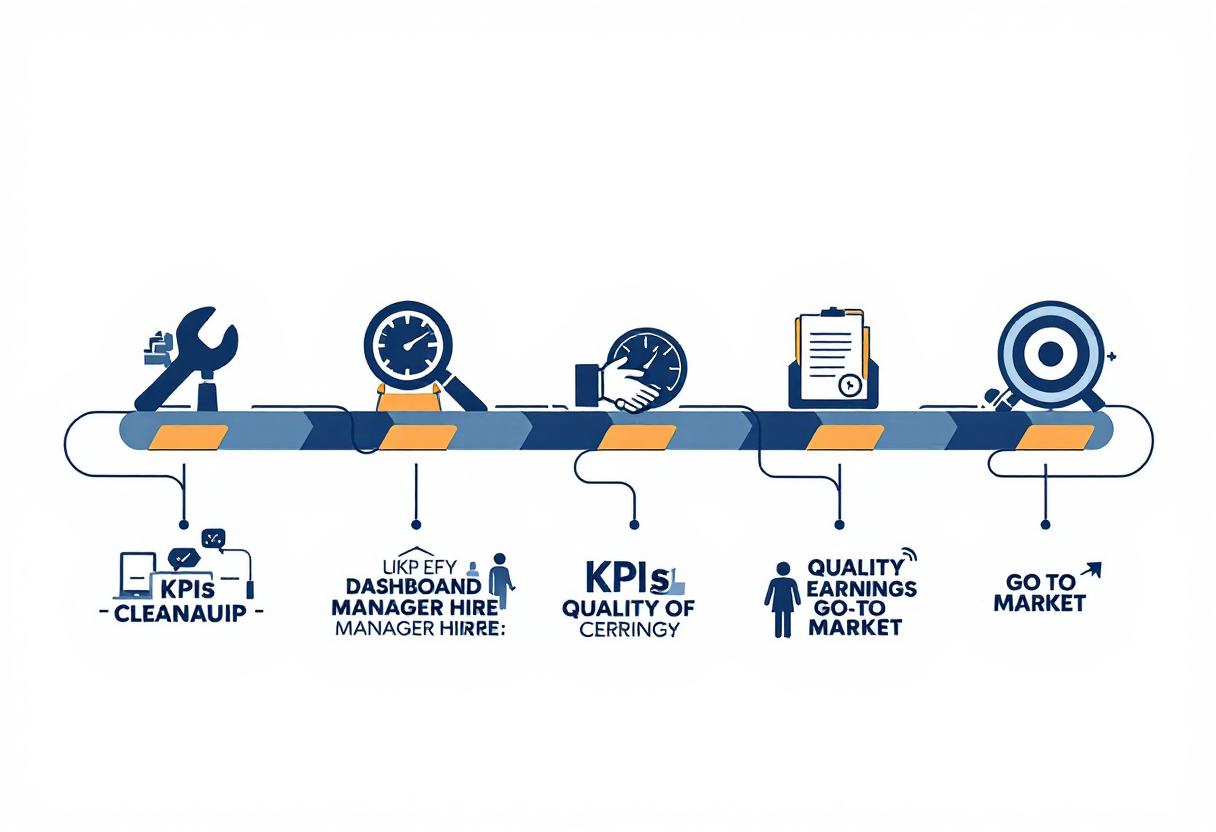
T-36 months: Cleanup phase
- Switch to accrual basis if still on cash
- Pick a route management platform (Skimmer for sub-$3M revenue, Pool Brain for mid-tier, ServiceTitan for $5M+ revenue or commercial-heavy mix) and migrate
- Start tagging every potential EBITDA add-back as it happens
- W-2 / 1099 audit; reclassify route techs to W-2 if currently 1099 (settle exposure now while it is small)
- Restruck related-party rent to FMV with appraisal
- Build the org chart; identify the GM hire (internal route manager promotion or external recruit)
- Begin CPO certification program: target 3+ CPO-certified techs by T-12 months
- State contractor license review: confirm CPC / C-53 / RAIL is transferable or document successor qualifier path
- DOT placarding compliance review on chemical-rig trucks
- OSHA chemical storage audit at the shop
- Pollution liability insurance review
T-24 months: Financial discipline and KPI infrastructure
- GM or route manager hired and taking operational load
- Monthly close in 15 days; service-line P&L every month (residential maintenance, commercial maintenance, equipment install, repair)
- KPI dashboard: stops/day, miles/day, revenue/route, average ticket per service line, weekly maintenance penetration %, annual retention rate, chemical cost per pool, first-time-fix rate
- Launch recurring weekly maintenance push if penetration is under 60%
- Pricing review: 5% to 8% list increase on residential weekly; chemical surcharge formalized; tech-level discount authority eliminated
- Begin de-concentration of commercial book if any single commercial account is above 12%
- Document SOPs for every operational role
- Build the add-back bridge as a living document
T-12 months: QoE-ready close discipline, eliminate owner dependence
- Owner steps out of daily operations; GM runs the shop
- Owner takes a 2-week unplugged vacation as the stress test
- Run the sell-side QoE (budget $35K to $75K)
- Tighten balance sheet: clean A/R, kill dormant chemical inventory, isolate prepaid maintenance deferred revenue
- Final org-chart review; backfill any gaps
- Final compliance scrub: license transferability, CPO renewals, W-2 / 1099, sales/use tax, environmental, DOT
- Lock in 12 months of clean service-line P&L for the CIM
T-6 months: Pre-marketing prep
- Engage M&A advisor (sell-side investment bank or M&A advisory firm with home services or pool experience). Typical fee structure: $15K to $50K monthly retainer credited against success fee of 4% to 8% of enterprise value (Lehman or modified Lehman scaling)
- CIM drafted from the QoE and operating model
- Teaser drafted (anonymized 1-pager)
- Buyer list finalized. The high-conviction pool service PE buyer list as of mid-2026 includes SPS PoolCare (Storr Group), Pool Service Partners (Tamarix Capital), Vermana (Lightview Capital plus Patriot Capital plus Aldine Capital), Landmark Aquatic (Bow River Capital), Riverbend Sandler (Concentric Equity Partners), American Pool (The Amenity Collective), CERTUS Pest (post-NPP acquisition), Authority Brands (Apax / BCI) via the ASP franchise channel, Poolwerx (Norwest Venture Partners), Buzz Franchise Brands (Pool Scouts), and Premier Pools & Spas. Add adjacency buyers: HASA (Wind Point Partners) on chemicals, POOLCORP on distribution and franchise, Latham Group on equipment
- Virtual data room populated with everything from the pre-LOI and confirmatory sections above
- Management presentation deck built and rehearsed
T-3 months: Go to market
- Teaser distributed; NDAs collected; CIMs distributed
- IOIs collected 2 to 3 weeks after CIM goes out
- Narrow to 4 to 6 finalists for management meetings
- Management meetings; LOIs solicited
- Select LOI; sign with exclusivity (45 to 90 days typical)
- Enter confirmatory diligence; close
End-to-end from engagement to close: 9 to 12 months in a well-run process (Auxo Capital Advisors sell-side process guide 2025; Wall Street Prep sell-side primer; Brentwood Growth pool service M&A page).
Frequently Asked Questions
How long should I plan for before selling my pool service business to a private equity buyer?
The owners who get top-quartile pricing start preparing 24 to 36 months before going to market. The minimum useful prep window is 12 months, because most of the high-leverage levers (lifting recurring weekly maintenance penetration from 40% to 70%+, installing a GM or route manager, getting on Skimmer or Pool Brain, running a sell-side QoE, getting 3+ techs CPO certified) need 12+ months of clean trailing-twelve-months data to be credible to a buyer. Owners who try to sell in under 6 months typically leave 20% to 35% of enterprise value on the table.
What is a realistic EBITDA multiple for a $1M EBITDA pool service business in 2026?
For a residential pool service business at $1M EBITDA in 2026, the range is 3x to 5x; for commercial, 4x to 6x. The bottom of that range applies to demand-only or repair-heavy shops with under 40% recurring weekly revenue, owner-dependence, and concentrated customer base. The top applies to shops with 70%+ recurring weekly maintenance, a GM in place, Skimmer or Pool Brain running, route density above 14 pools per tech per day, and customer concentration under 10% (Brentwood Growth; KMF Business Advisors 2026; DealFlowAgent 2025-2026 exit guide; Rapt Business Brokers 2026). The 36-month prep playbook moves you from the bottom of the band to the top, and Sun Belt geography adds an estimated 0.5x to 1.5x premium on top.
What percentage of recurring weekly maintenance revenue do PE buyers want to see?
70% or higher is the threshold that moves your business from commodity pricing into platform-quality pricing. Demand-only and repair-heavy shops with under 40% recurring weekly trade at 2x to 3x SDE. Shops with 70%+ recurring weekly trade at 4x to 6x EBITDA at sub-$3M EBITDA scale, and 5x to 8x at $3M+ (Brentwood Growth; Rapt Business Brokers; IndustryPro pool valuation guide). Buyers also assign a 1.0x to 1.5x annualized contract revenue premium on top of the EBITDA multiple for the contract base itself (Sheets.Market; DealStream). For a pool service business with 800 weekly accounts at $200 monthly average, that is an additional $1.9M to $2.9M of premium on the contract book alone.
How does route density affect my pool service business valuation?
Route density is the most pool-specific valuation driver after recurring weekly maintenance penetration. Tight routes (15 to 18 pools per tech per day clustered in 1 to 2 zip codes) resell at 12x to 15x MRR, while scattered routes (8 to 12 pools across 3 to 5 zip codes) resell at 8x to 9x MRR (PoolDial pool route valuation guide 2026). On a $5,000 MRR route, that is the difference between $40K to $45K and $60K to $75K of route value. At the operating company level, route densification produces a 20% to 30% efficiency gain (Sealey Business 2026), and strategic sequencing adds 25% to 40% daily stop capacity (Zeo Route Planner). For an $5M revenue, $1M EBITDA shop with 8 techs, lifting stops/day from 10 to 14 can add $250K to $500K of EBITDA, worth $1.25M to $3.5M of sale price at a 5x to 7x multiple.
Do I need a general manager or route manager in place before I sell my pool service company?
If your goal is to maximize price, yes, ideally 12+ months pre-sale. Owner-dependence is the single most-cited multiple haircut in pool service valuation literature (Brentwood Growth; IndustryPro; Rapt Business Brokers). On a $1M to $3M EBITDA business, removing key-person risk moves the multiple from the 3x to 5x band into the 5x to 7x band, worth $2M to $6M of price. A pool service GM or route manager hire runs $90K to $150K plus bonus and needs 12 to 18 months to fully take operational load before the buyer’s diligence team will believe the transition. The owner should also get 3+ techs CPO certified at company cost and identify a path to transfer the C-53 / CPC qualifier role to an employed manager.
Will my Florida CPC, California C-53, or Texas RAIL license transfer to the new owner?
Not automatically. State contractor licenses in pool service are tied to a named qualifier, who is typically the owner. Florida CPC requires 4 years of experience with 1 year as supervisor; California C-53 requires 4 years of journey-level experience in the last 10 years (CSLB); Texas RAIL is required for any electrical pool work (pumps, lights, heaters, automation) per TDLR (pool cleaning alone does not require a TDLR license). If the qualifier is the selling owner, the buyer needs the owner to stay post-close in a qualifier role (typically 6 to 24 months) or needs to identify a new qualifier employee on day one. This is the most common pool-specific deal-killer at confirmatory. The fix is to build a documented post-close qualifier hire path 18+ months before going to market and, where possible, transfer the qualifier role to an employed manager before sale.
What to Do Next
The pool service owners who get the top-quartile multiple all do the same three things. They start preparing 24 to 36 months before they want to be out. They put a GM or route manager in place 12+ months pre-sale, with 3+ CPO-certified techs and a documented C-53 / CPC qualifier successor path. And they invest in a sell-side QoE before any buyer sees a CIM.
The 2026 pool service buyer market is the most active it has been in a decade. SPS PoolCare and Pool Troopers combined to ~$157M of 2025 service revenue in a single January transaction. CERTUS Pest opened a pest-to-pool cross-vertical lane in the same week. Lightview Capital, Tamarix Equity, Bow River, Imperial Capital, and Norwest Venture Partners are all actively bidding. The window for owners with clean books, dense routes, and 70%+ recurring weekly maintenance is wide open. The window for owner-dependent, demand-heavy, geographically scattered route businesses is narrowing because the platforms now have so many higher-quality alternatives.
If you are 12+ months from a potential exit and want a structured pre-sale optimization roadmap, CT Acquisitions has pool service operations specialists in our partner network who run multi-quarter prep engagements. If you are 6 to 12 months out and ready to start the sell-side process, our M&A advisory team runs the buyer outreach. No fee to you on buy-side introductions; sell-side mandates are paid on success at closing. Either way, the first 30 minutes are free.
Ready to talk?
Schedule a 30-minute exit-readiness call
Or read more: Sell Your Pool Service Business (active sale guide) | Buying a Pool Service Business (buyer’s playbook) | Private Equity in Pool Service 2026: Active Buyers + Multiples
Ready to Explore Your Options?
A 30-minute confidential conversation is all it takes.
