
Gym Business Valuation (2026): How to Value a Gym Business, Multiples & Calculator
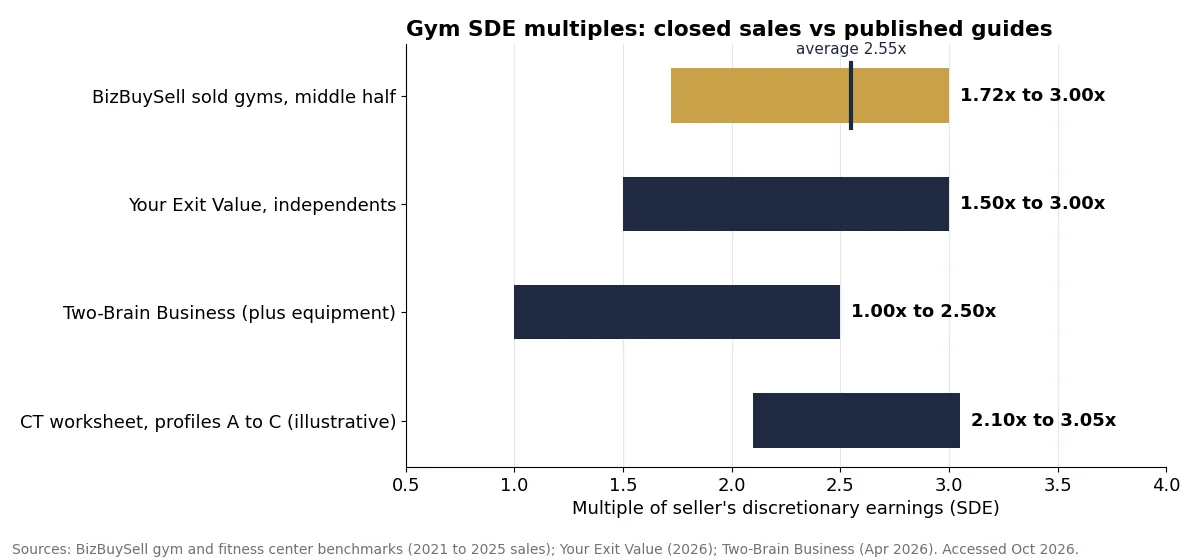
Gym business valuation in 2026: most owner-run gyms sell for 1.72x to 3.00x seller’s discretionary earnings (SDE), the middle half of BizBuySell closed sales; churn, EFT share, lease term and equipment age decide where yours lands.
Thinking about selling your gym?
Skip the formulas. A 15-minute confidential call gives you a real valuation range and tells you which buyers would compete for your business. No cost, no obligation.

Key takeaways
- Sold gyms and fitness centers priced at 1.72x to 3.00x SDE for the middle half, with a 2.55x average and a $210,500 median sale price, per BizBuySell sales from 2021 to 2025.
- Planet Fitness agreed to pay $800 million for Sunshine Fitness’s 114 clubs in January 2022, about $7.0 million per club, per its press release: 33 times the BizBuySell median sold gym.
- A Florida studio that bills monthly is exempt from the $25,000 health studio bond under Fla. Stat. 501.016(5); the separate 5-year exemption in 501.016(8) requires the same ownership, so a sale can bring the bond back for prepaid plans.
- Published guides disagree: Two-Brain Business uses 1x to 2.5x SDE plus equipment at 50% of cost new, while Your Exit Value values used equipment at 20 to 40 cents per dollar.
How much is a gym business worth in 2026?
A gym business is worth a multiple of its seller’s discretionary earnings. In BizBuySell’s 2021 to 2025 sold listings, the middle half of gyms priced at 1.72x to 3.00x SDE, the average was 2.55x, and the median gym sold for $210,500 on $400,000 of revenue and $99,389 of SDE. Multi-club franchise groups trade on a different scale, as the Planet Fitness purchase of Sunshine Fitness shows.
| Figure | Value | What it measures | Source |
|---|---|---|---|
| SDE multiple, middle half of sold gyms | 1.72x to 3.00x | Closed sales, 2021 to 2025 | BizBuySell |
| Average SDE multiple | 2.55x | Closed sales, 2021 to 2025 | BizBuySell |
| Median sale price | $210,500 | Closed sales | BizBuySell |
| Median revenue / median SDE | $400,000 / $99,389 | Sold gyms; ratio of medians 24.8% | BizBuySell; CT arithmetic |
| Price per club, Sunshine Fitness | About $7.0 million | $800 million for 114 Planet Fitness clubs, Jan 2022 | Planet Fitness |
| Big-box dues benchmark | $15 a month (Classic), $24.99 (Black Card) | Planet Fitness new-member pricing | Planet Fitness Form 10-K, FY2025 |
| SBA 7(a) loan ceiling | $5 million | Most single-gym buyers finance with 7(a) | SBA |
SDE adds the owner’s salary and perks back to profit, so it suits a gym the owner runs. A manager-run group with several clubs is priced on EBITDA, which deducts a market wage for every role. Our explainer on SDE vs EBITDA for a business sale shows the conversion.
How do you value a gym business, step by step?
To value a gym business, rebuild 24 months of earnings into SDE, pick a starting multiple from closed sales (2.55x is the BizBuySell average), adjust it for churn, recurring billing, owner coaching load and lease runway, then subtract dollar items a buyer will net out: equipment due for refresh and prepaid memberships the buyer must still serve. The five steps below carry the numbers each one needs.
- Rebuild SDE. Start from net income on the tax return and add interest, depreciation, the owner’s salary and personal expenses run through the gym. Our guide to what SDE means in business valuation lists the standard add-backs.
- Pull 24 months of member data. Export starting members, joins, cancellations and dues by month from the club software (ABC Fitness, Mindbody, Glofox or Wodify) and tie the dues to bank deposits.
- Set the multiple. Start at 2.55x and apply the worksheet adjustments in the calculator section below.
- Net out dollar items. Subtract a written quote for equipment due within 24 months of closing and the unearned balance of paid-in-full memberships.
- Cross-check. Compare the result with the per-member and revenue rules of thumb; a gap of more than 2 times means the SDE needs a second look.
| Item in a gym’s books | Add back to SDE? | Why a buyer accepts or rejects it |
|---|---|---|
| Owner salary and payroll taxes | Yes | SDE is earnings to one owner-operator |
| Depreciation on cardio and strength equipment | Yes, then net out refresh capex | Non-cash, but the equipment still wears out |
| Owner-delivered personal training revenue | No, unless trainers already deliver it | Revenue leaves with the owner |
| Owner teaching classes unpaid | Deduct a market instructor wage | The buyer must pay someone to teach |
| One-time remodel or flooring | Yes, with invoices | Not repeated in a normal year |
| Equipment lease payments | No | The buyer assumes or pays off the lease |
| Cash memberships not deposited | No | Cannot be verified; it stops most SBA loans |
Gym valuation calculator: how do you run your own numbers?
The gym valuation calculator below is a worksheet you can run on paper: start at 2.55x SDE, add or subtract the four adjustments for your gym, multiply by SDE, then subtract equipment refresh and prepaid memberships. The adjustment sizes are CT Acquisitions estimates, labeled illustrative, anchored to the BizBuySell closed-sale band. For an interactive range, use our business valuation calculator.
| Input | Add to 2.55x | No change | Subtract |
|---|---|---|---|
| Monthly member churn | Under 3%: +0.30x | 3% to 5% | 5% to 7%: minus 0.25x; over 7%: minus 0.50x |
| Recurring dues (EFT) as share of revenue | Over 80%: +0.20x | 60% to 80% | Under 60%: minus 0.30x |
| Share of classes the owner coaches | None | Under 10% | 10% to 40%: minus 0.20x; over 40%: minus 0.50x |
| Lease years left including options | None | 10 years or more | 5 to 10 years: minus 0.15x; under 5 years: minus 0.40x |
| Equipment due for refresh within 24 months | Subtract the vendor quote in dollars after multiplying | ||
| Paid-in-full memberships not yet served | Subtract the unearned balance in dollars (a working capital item at closing) | ||
Three illustrative gyms, not clients, run through the worksheet:
| Input or result | A: boutique Pilates studio | B: independent strength gym | C: 24-hour franchise unit |
|---|---|---|---|
| SDE | $140,000 | $172,000 | $210,000 |
| Monthly churn | 4.5% (0) | 3.6% (0) | 2.8% (+0.30x) |
| Recurring share | 88% (+0.20x) | 77.0% (0) | 92% (+0.20x) |
| Owner coaches | 45% (minus 0.50x) | 25% (minus 0.20x) | 0% (0) |
| Lease left with options | 9 years (minus 0.15x) | 7 years (minus 0.15x) | 12 years (0) |
| Multiple | 2.10x | 2.20x | 3.05x |
| Earnings value | $294,000 | $378,400 | $640,500 |
| Equipment refresh due | None | minus $85,000 | minus $40,000 |
| Prepaid memberships | minus $6,000 | minus $18,000 | None |
| Cash-equivalent value | $288,000 | $275,400 | $600,500 |
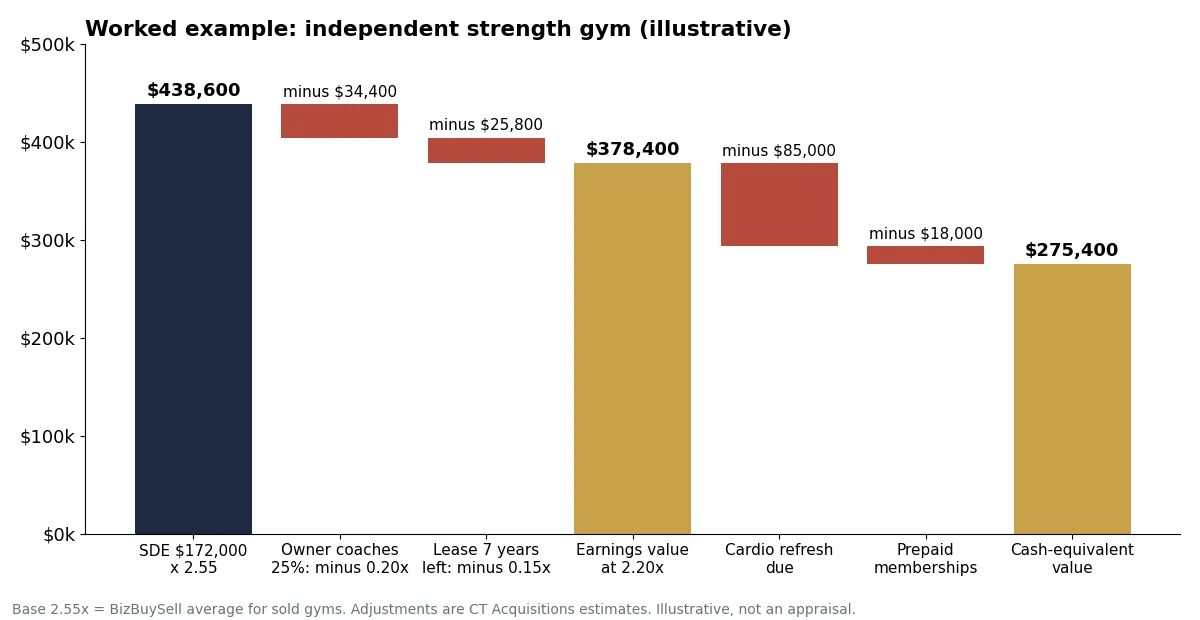
Profile B shows why the per-member rule misleads. Its 520 members paying $79 a month produce $492,960 of dues on $640,000 of revenue. The WOD Guru rule of $200 to $500 per member gives $104,000 to $260,000, and its 0.5x to 1x revenue rule gives $320,000 to $640,000, against $378,400 on earnings. If the owner hands classes to a hired coach before listing, the multiple rises to 2.40x and the earnings value to $412,800.
How do member churn and EFT share change a gym’s value?
Churn sets how long today’s dues keep arriving, so it moves the multiple more than any other gym input. Monthly churn compounds: at 5% a month a gym keeps 54.0% of its members after 12 months and the average member stays 20 months. Recurring dues collected by EFT (automatic bank or card draft) are the revenue a buyer can underwrite; paid-in-full plans and day passes are not.
| Monthly churn | Members left after 12 months | “Churn times 12” shortcut | Average member life | Lifetime dues at $50 a month |
|---|---|---|---|---|
| 2% | 78.5% | 76% | 50 months | $2,500 |
| 3% | 69.4% | 64% | 33.3 months | $1,667 |
| 4% | 61.3% | 52% | 25 months | $1,250 |
| 5% | 54.0% | 40% | 20 months | $1,000 |
| 6% | 47.6% | 28% | 16.7 months | $833 |
| 7% | 41.9% | 16% | 14.3 months | $714 |
| 8% | 36.8% | 4% | 12.5 months | $625 |
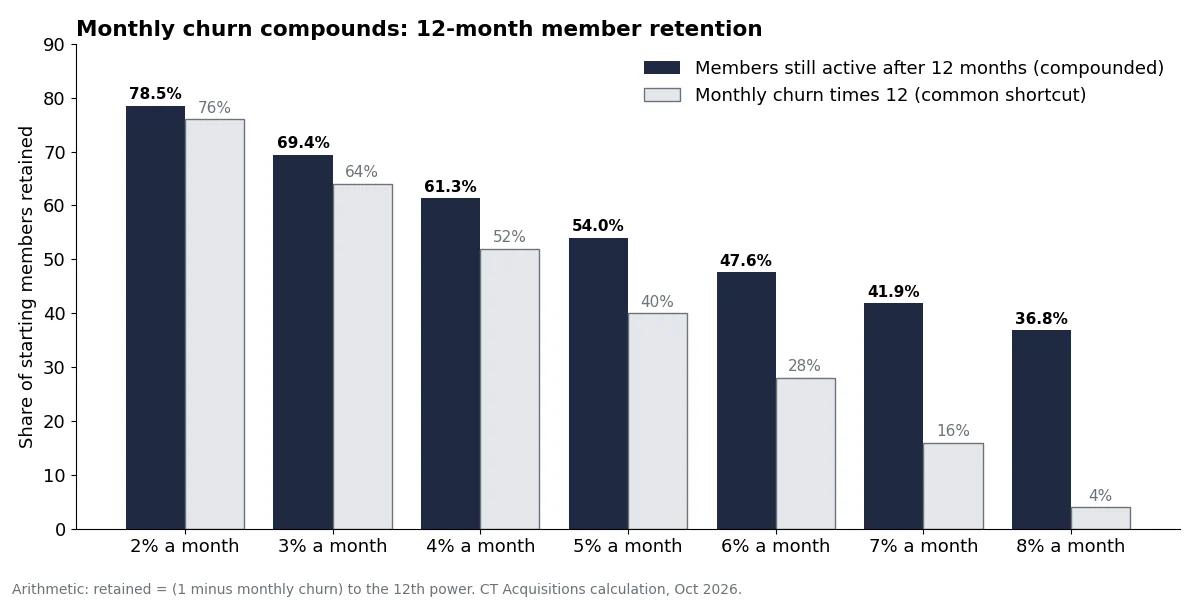
Compute churn as cancellations in a month divided by members at the start of that month, and report all 24 months, so a buyer sees the trend and not a single good quarter.
EFT share also changes compliance cost in some states. Under Fla. Stat. 501.016(5), a Florida health studio that collects payment monthly is exempt from the $25,000 security requirement, while a studio selling prepaid future services must post it unless another exemption applies. A gym with more than 80% of revenue on monthly EFT earns +0.20x in the worksheet above for that reason and for cash-flow visibility.
Lease term vs equipment age: which one costs a gym seller more?
A short lease usually costs more than old equipment, because equipment is a dollar deduction while a short lease can stop the buyer’s financing. Under SBA SOP 50 10 8, a buyer needs at least 10% equity on a complete change of ownership (Live Oak Bank summary); ask the buyer’s lender how many lease years, including options, it requires. Old cardio is priced at its refresh quote.

| Situation | Effect on price | What to do before listing |
|---|---|---|
| Lease plus options under 5 years | Minus 0.40x in the worksheet; SBA buyers may not close | Negotiate an extension or new options with the landlord |
| Lease plus options 5 to 10 years | Minus 0.15x | Confirm the assignment clause and landlord consent terms |
| Cardio refresh due within 24 months | Minus the vendor quote, dollar for dollar | Get a written quote; refresh only if the quote is below the price cut you expect |
| Equipment on a lease or finance agreement | Paid from proceeds or assumed | Get payoff letters and the lender’s assignment terms |
Equipment value also changes your tax. In an asset sale both sides file IRS Form 8594; equipment falls in Class V, and price allocated to it can recapture prior depreciation as ordinary income under 26 U.S.C. 1245. Goodwill sits in Class VII, which the buyer amortizes over 15 years under 26 U.S.C. 197. Ask your CPA to model two allocations before the LOI; our article on purchase price allocation and your taxes walks through the classes.
Franchise vs independent, boutique vs big box: what changes the price?
Format changes who buys and on what earnings measure. An independent or boutique studio sells to an SBA-financed individual on SDE; a single franchise unit sells to an existing franchisee or an individual, subject to franchisor approval; a multi-club franchise group sells on EBITDA to a franchisor or private equity buyer, which is how Sunshine Fitness reached about $7.0 million per club.
| Format | Typical dues signal | Earnings basis | Main buyer | Gym-specific check | Source |
|---|---|---|---|---|---|
| Big-box value club | $15 to $24.99 a month (Planet Fitness) | SDE for one club, EBITDA for groups | Franchisees, franchisor, PE | Member count and churn carry the price | Planet Fitness 10-K |
| Independent gym | Set by owner | SDE | SBA-financed individual, local operator | Owner coaching load and lease runway | BizBuySell band |
| Boutique studio (Pilates, cycle, HIIT) | Higher dues, fewer members | SDE | Individual, studio operator | Instructor retention; class packs vs memberships | CT Acquisitions estimate |
| Franchise unit | Set by brand | SDE | Existing franchisee, individual | Transfer fee (FDD Item 6), transfer terms and right of first refusal (Item 17) | 16 CFR 436.5 |
| Multi-club franchise group | Set by brand | EBITDA | Franchisor, PE platform | Price per club; Sunshine Fitness about $7.0 million | Planet Fitness press release |
For a franchise unit, read Items 6 and 17 of your current franchise disclosure document before you price: the transfer fee comes off your proceeds, and a right of first refusal lets the franchisor match any offer. Our guide to franchise business valuation covers royalty load and territory rights in more detail.
What do gym valuation guides say vs closed-sale data?
Gym valuation guides published in 2025 and 2026 quote ranges on both sides of the closed-sale data, and none cites a transaction source. The BizBuySell middle half of 1.72x to 3.00x SDE is the only range here built from closed sales, so use it as the anchor and test the others against it.
| Claim | What the guide says | What the data or arithmetic shows | Gap |
|---|---|---|---|
| SDE multiple | Two-Brain Business: 1x to 2.5x SDE (Apr 2026) | BizBuySell sold gyms: 1.72x to 3.00x, average 2.55x | Two-Brain’s top sits below the sold average |
| SDE multiple | Your Exit Value: 1.5x to 3.0x SDE | Same BizBuySell band | Floor 0.22x lower; no source given |
| Equipment value | Two-Brain: 50% of cost new | Your Exit Value: 20 to 40 cents per dollar | Guides differ by up to 2.5 times; use a written quote |
| Annual churn | Your Exit Value: 30% to 50% a year | Compounded, 2.9% to 5.6% a month | No source for the range |
| Monthly to annual churn | Shortcut: monthly churn times 12 | 4% a month loses 38.7% a year, not 48% | Shortcut overstates losses |
| Per-member value | WOD Guru: $200 to $500 per member | Profile B: $104,000 to $260,000 vs $378,400 on SDE | Ignores dues level and churn |
Which state health club laws affect a gym sale?
State health club laws decide which member contracts a buyer inherits, how long members can cancel, and whether a bond is due. New York caps contracts at 36 months and $3,600 a year, California caps terms at three years, Florida requires $25,000 of security for many prepaid studios, and Texas requires $20,000 to $50,000. Check your state’s rules before the buyer’s counsel does.
| State | Section | Rule | Why it matters in a sale |
|---|---|---|---|
| California | Civ. Code 1812.84 | Contract term may not exceed three years; members may cancel in person, by email or by first-class mail | Terms over three years are a diligence finding |
| California | Civ. Code 1812.85 | Cancel by midnight of the 5th business day; refund within 10 days; 20, 30 or 45 days for fees of $1,500 or more | High-fee contracts sold near closing can unwind |
| New York | GBL 623 | Term up to 36 months; no more than $3,600 a year | Contracts over the caps are a red flag |
| New York | GBL 624, 625, 627 | 3 business days to cancel, refund in 10 business days; assignee must notify members in writing; noncompliant contracts are void | Plan the member notice letter into the closing checklist |
| Florida | Stat. 501.016 | $25,000 bond, letter of credit or CD guaranty; monthly-billing studios exempt; 5-year same-ownership exemption | A new owner may need to post security for prepaid plans |
| Texas | Occ. Code 702.101, 702.151 | Certificate of registration; security of $20,000 to $50,000 | Ask counsel whether the buyer files its own registration and security |
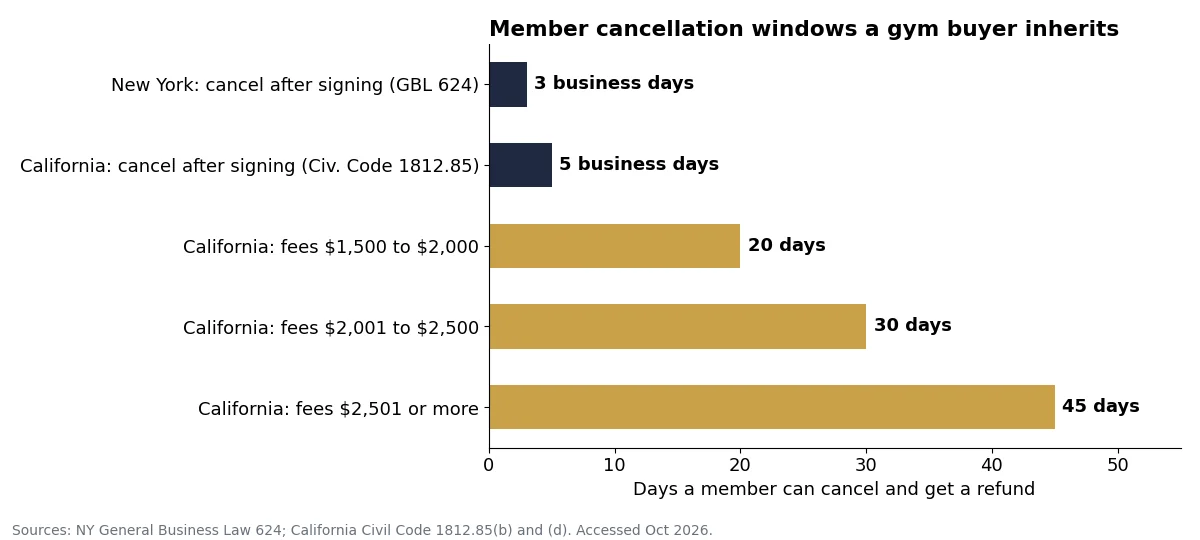
Prepaid memberships also change the cash you receive. A buyer who must serve months a member has already paid for will ask for the unearned balance as a credit at closing; our explainer on working capital adjustments at closing shows how that credit is calculated.
Selling a gym? Talk to an advisor who knows the consolidators.
We’re an M&A advisory firm working for owners on the sell side. Our fee is success only: nothing upfront, and you pay nothing unless the business sells. A 15-minute call gets you three things: an estimate of what your gym is worth in today’s market, a sense of which buyer types fit your concept, and the option to meet one of them. If none of it is useful, you’ve lost 15 minutes.
What should a gym owner do before selling?
Fix the item that costs the most first. If churn is above 5% a month or recurring dues are under 60% of revenue, spend 12 months on retention and EFT conversion; if the owner coaches more than 40% of classes, hand them over; if the lease runs out before the buyer’s loan, extend it. Our fitness exit preparation guide sets out the timeline.
| If your situation is | Do this | Expected effect (CT estimate) |
|---|---|---|
| Monthly churn above 5% | Run 12 months of retention work before listing | Removes a 0.25x to 0.50x deduction |
| Recurring dues under 60% of revenue | Convert paid-in-full and class packs to monthly EFT memberships | Removes a 0.30x deduction |
| Owner coaches over 40% of classes | Hire and hand over classes; show 6 months of stable churn after | Up to 0.50x back |
| Lease plus options under 5 years | Extend before marketing; confirm assignment terms | Up to 0.40x back and wider SBA buyer pool |
| Cardio refresh due within 24 months | Get a written quote; refresh only if cheaper than the deduction | Dollar for dollar |
| Franchise unit | Read FDD Items 6 and 17; ask the franchisor for its list of franchisees seeking units | Avoids a fee or first-refusal surprise |
| None of the above | Price on SDE x your band and go to market | Use the worksheet result as your asking range |
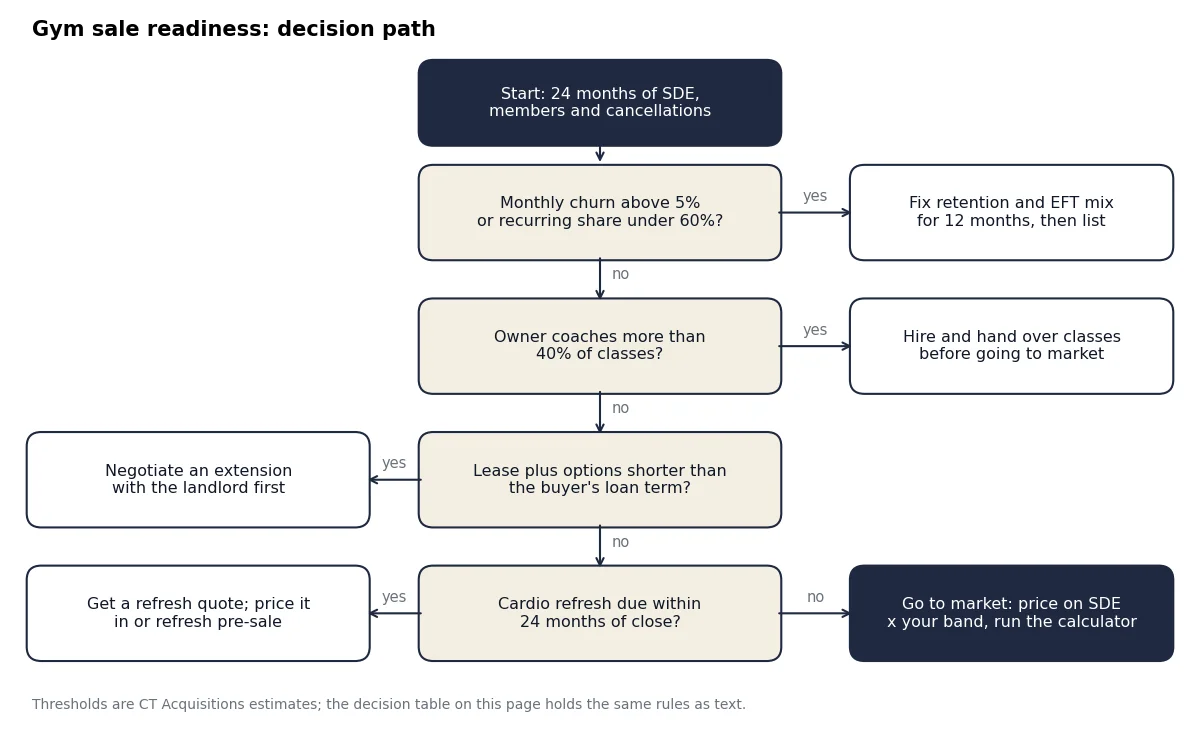
Our page on how to sell a gym covers the sale process, and the gym and fitness business broker guide covers representation. Our fee is success only: nothing upfront, and you pay nothing unless the business sells.
Want to know what your gym is worth?
Benchmarks give you a range. A 15-minute confidential call gives you a real number, based on what active buyers are paying right now and which ones would compete for your business. No cost, no obligation.
How we compiled this
We compiled this page in October 2026 from 17 primary documents: the BizBuySell gym benchmark, the Planet Fitness press release and FY2025 Form 10-K, nine state statute sections in California, New York, Florida and Texas, the FTC Franchise Rule, IRS Form 8594 guidance, 26 U.S.C. 197 and 1245, and the SBA 7(a) page, plus a Live Oak Bank summary of SBA SOP 50 10 8. Three competitor guides were read for comparison only. We excluded forum posts. Calculator adjustments are CT Acquisitions estimates, not survey data.
Frequently asked questions
How much is a gym business worth that makes $300,000 a year?
If $300,000 is the gym’s SDE, the BizBuySell middle half of 1.72x to 3.00x puts it at $516,000 to $900,000, and the 2.55x average gives $765,000. Churn under 3% a month and over 80% recurring dues push toward the top; an owner who coaches most classes pulls toward the floor. If $300,000 is revenue, use the sales method in the next answer.
How much is a gym business worth with $500,000 in sales?
At the 24.8% ratio of BizBuySell median SDE to median revenue, $500,000 of sales implies about $124,000 of SDE, worth $213,000 to $372,000 at 1.72x to 3.00x. At $1,000,000 of sales the same math gives $248,000 of SDE and $427,000 to $744,000. Replace the 24.8% with your own SDE margin before relying on either figure.
What is a good profit margin for a gym?
The median sold gym in BizBuySell’s 2021 to 2025 data had $99,389 of SDE on $400,000 of revenue, a 24.8% ratio of medians. SDE includes the owner’s pay, so a gym that pays a general manager shows a lower EBITDA margin. As a CT Acquisitions estimate, a margin above 24.8% with churn under 5% a month supports the upper half of the band.
How much is a gym worth per member?
WOD Guru cites $200 to $500 per member, but buyers rarely pay on member count. In the illustrative strength gym on this page, 520 members at that rate give $104,000 to $260,000, while 2.20x its $172,000 SDE gives $378,400. Use per-member value only as a check on very small or loss-making studios, and price a profitable gym on SDE.
What is the exit or resale value of a gym franchise?
A single franchise unit is priced on SDE like an independent gym, less the transfer fee in Item 6 of the franchise disclosure document and subject to the transfer and first-refusal terms in Item 17. Multi-club groups sell on EBITDA at a different scale: Planet Fitness agreed to pay $800 million for Sunshine Fitness’s 114 clubs in 2022, about $7.0 million per club.
Do prepaid memberships lower what I receive at closing?
Usually yes. A buyer who must serve months a member already paid for will ask for the unearned balance as a credit, so $18,000 of prepaid plans cuts cash at closing by $18,000. In Florida, studios selling prepaid future services may also need $25,000 of security under Fla. Stat. 501.016, while studios billing monthly are exempt.
Sources
All sources accessed October 2026.
- BizBuySell, Gym and Fitness Center Valuation Benchmarks (sales 2021 to 2025)
- Planet Fitness, acquisition of Sunshine Fitness Growth Holdings, January 11, 2022
- Planet Fitness, Form 10-K for fiscal 2025
- California Civil Code 1812.84 and 1812.85
- New York General Business Law 623, 624, 625 and 627
- Florida Statutes 501.016
- Texas Occupations Code 702.101 and 702.151
- FTC Franchise Rule, 16 CFR 436.5
- IRS, About Form 8594; 26 U.S.C. 197; 26 U.S.C. 1245
- SBA, 7(a) loans; Live Oak Bank, SOP 50 10 8 summary
- Compared only: Two-Brain Business (April 2026), Your Exit Value (2026), WOD Guru (September 2025)

About the Author
Christoph Totter is the founder of CT Acquisitions, an M&A advisory firm that helps owners make the most of their exit, headquartered in Sheridan, Wyoming. We work directly with 500+ buyers, search funders, family offices, lower middle-market PE, and strategic consolidators, including direct mandates with the largest consolidators that other intermediaries cannot access. Our fee is success only: nothing upfront, and you pay nothing unless the business sells. Connect on LinkedIn · Get in touch
Want a Specific Read on Your Business?
15 minutes, confidential, no contract, no cost. You leave with a read on your local buyer market and a likely valuation range.
The next practical step for owners inside this range is sell-side runway resource, which shows what to fix before going to market.