
How to Prepare Your Fencing Business for a Sale or Exit (2026)
Updated April 2026 · CT Acquisitions

Most fencing owners decide to sell, hire a broker, and find out 90 days later that their business is worth 30% to 40% less than they thought. The owners who get the top-quartile price start preparing 24 to 36 months before they ever talk to a buyer. Fencing private equity is materially less mature than HVAC or roofing, but it accelerated hard in 2024 to 2026 with five new sponsor-backed platforms forming in roughly 18 months, every one of them explicitly chasing commercial mix and automated-gate recurring revenue. This guide is the 36-month playbook for how to prepare your fencing business for a sale or exit. It covers what private equity actually buys, the 12 levers that move multiples, the documents PE asks for before they send an indication of interest, and the deal-killers that re-trade fencing transactions during confirmatory diligence. Every number cites its source. Where a number is an estimate cross-built from comparable trades, it is labeled as an estimate.
If you are 6 to 36 months from a possible exit, this is the work that turns a 3x EBITDA outcome into a 6x EBITDA outcome. On a $2M EBITDA fence business, that is the difference between a $6M sale and a $12M sale. Whether you want to prepare your fencing business for a sale to private equity, prepare your fencing business for an exit to a strategic acquirer, or simply maximize value over the next 1 to 3 years before going to market, the work below applies.
Building toward an exit in 12 to 36 months?
CT Acquisitions runs sell-side advisory for fence company owners $1M+ EBITDA. We also have fence-industry operations specialists in our partner network who run pre-sale optimization engagements when the timeline is longer. Buyers pay our fee, not you.
What Private Equity Actually Buys in Fencing (2026)
Five sponsor-backed fencing platforms formed between April 2024 and December 2025: Argosy / Federal Rent-A-Fence (April 2024), Saw Mill Capital / Pro Max Fence Systems (June 2024), Bertram Capital / Perimeter Solutions Group (October 2024), Watchtower Capital / Fence Builders + Green Hill (July 2025), Harkness Capital Partners / Premier Fence (September 2025), and Kian Capital + Bochi + Skyline / Perimeter Holdings USA (December 2025). Add Gemspring’s Fenceworks platform (November 2023) still aggressively adding, and Aurora Capital’s IronSite (commercial gate / access control) still cadencing add-ons. The sponsor money flowing into fencing is not random. PE buys specific profiles, and the profile you build determines the multiple you get.
The PE-attractive fencing profile
- EBITDA threshold for a platform-quality deal: $1.5M to $3M is the entry band where sponsor-backed platforms run a competitive process. Below that you are an add-on inside a roll-up. Above $5M EBITDA, you are an attractive bolt-on for any of the commercial platforms. Above $15M EBITDA, you are a platform candidate yourself.
- Commercial and specialty mix: This is the single largest value driver in fencing. Every 2024-2026 PE platform formation explicitly targeted commercial customers with recurring service: PSG (Tampa commercial perimeter), Premier Fence (New England commercial / guardrail / access control), Pro Max (PA commercial fencing and access control), IronSite (national commercial gate maintenance). 40%+ commercial with named accounts is the cutoff that triggers competitive process pricing.
- Recurring maintenance revenue: 15% to 25% from recurring contracts (automated-gate UL 325 annual PMs, perimeter security inspections, electric fence monitoring, chain-link repair retainers) is the cleanest premium driver. Federal Rent-A-Fence attracted Argosy specifically with 90% repeat-customer revenue (PR Newswire, April 17, 2024).
- Geography: Sun Belt, Florida, Texas, the Carolinas, Georgia, Arizona, and growth Mountain West metros are where 2026 sponsor demand concentrates. Watchtower deliberately built a Southeast platform; Premier Fence chose New England; Perimeter Holdings USA chose New York, Connecticut, and New Jersey. Stranded geographies discount.
- Customer concentration: No single customer above 10% of revenue. Top 5 below 30%. The Businessesforsale.com fence-listing analysis explicitly flags “40% from one HOA or commercial contract” as a red flag.
- Installer depth and W-2 classification: 12-month rolling crew retention above 75%, lead installers on W-2 (not per-foot 1099 piece rate), and a credible career ladder. Watchtower’s July 2025 platform launch release explicitly cited “talent recruitment and retention” as a key fragmentation pain point.
- Owner role: Owner is in management, not running estimates or running install crews. GM in place 12+ months pre-sale.
Active fencing PE platforms in 2026
The list below covers the most active sponsor-backed fence platforms in the 2024-2026 cycle. This is who will see your teaser. Add-on counts are point-in-time. Sources include sponsor press releases, PR Newswire, PrivSource, Greenberg Traurig (counsel), Lincoln International (advisor), Kian Capital portfolio pages, Bertram Capital news pages, and Three Sixty Seven Advisors’ March 2024 fencing services M&A report.
| Platform | Sponsor | Profile |
|---|---|---|
| Perimeter Solutions Group (PSG) | Bertram Capital (partnered Oct 2024) | 9 total since 2021, 4 since the Bertram partnership (Tusco, Strategic Fence & Wall, Econo Fence, C&C Fence); national commercial / industrial perimeter; $3M to $15M revenue per add-on |
| Fenceworks | Gemspring Capital (platform Nov 2023) | Riverside CA HQ; Kansas Fencing (Feb 2025) and Accurate Fence GA (Jan 2026) added; ~500 employees at acquisition; $5M to $25M revenue per add-on |
| Fence Builders + Green Hill Fence | Watchtower Capital (platform July 2025) | Simultaneous 2-company launch (NC + SC); Southeast bias (NC, SC, VA, TN, FL, GA); $5M to $30M revenue per add-on |
| Premier Fence | Harkness Capital Partners (platform Sept 29, 2025) | Canton MA, founded 1998; SecurityWorks added March 2026; New England commercial fencing / guardrail / access control; $5M to $25M revenue per add-on |
| Perimeter Holdings USA | Kian Capital + Bochi Investments + Skyline Global Partners (Dec 10, 2025) | Formed by combining Salem Westchester + Riverside Fence; portfolio includes Salem Fence, Westchester Automated Gate, Salem Iron Works, Riverside Fence, Silvestri Fencing, Westchester Fences, Fence Source; NY / CT / NJ; $3M to $15M revenue per add-on |
| Federal Rent-A-Fence | Argosy Private Equity (April 17, 2024) | Standalone temporary-fence rental platform; 15 East Coast and Midwest branches at acquisition; 90% revenue is repeat customer; national rental rollup focus |
| Pro Max Fence Systems | Saw Mill Capital (June 26, 2024) | Reading PA, founded 2006; standalone commercial fencing / access control platform; 3rd investment of Saw Mill Capital Partners III; Mid-Atlantic |
| IronSite (incl. Westcoast Gate, Automated Gate Services) | Aurora Capital Partners (Westcoast Gate acquired from Kian Nov 16, 2021) | Multiple gate / access-control add-ons; under Kian’s 4.5 years revenue and EBITDA more than tripled; national commercial gate and critical-infrastructure perimeter; $3M to $25M EBITDA |
| Sloan Security Group | Now an IronSite company (Aurora Capital portfolio) | Crash-rated bollards, retractable barriers, access control; federal government and critical infrastructure; high-security perimeter |
| Fencing Supply Group (FSG) | The Sterling Group (platform 2021) | 70+ branches across 30+ states; brands include Binford Supply, Cedar Supply, Fence Supply, Hartford Fence, Merchants Metals, Pro Access Systems, Sharon Fence Distributors; national distribution side (not installer); $5M to $50M+ distribution targets |
| U.S. Fence Solutions | Building Industry Partners (BIP), platform May 2016 | Holding company for independent fence installers and distributors; historical portfolio includes Split Rail (CO), Ideal Fencing (CO), Binford Supply, Western Access Controls (Denver); $3M to $25M revenue |
| ReVamp Companies | Calera Capital (acquired from Bertram May 2025) | 14 brands across 60+ locations in ~20 states; fence and decking division includes The Vinyl Outlet (Western NY) and Backyard Vinyl; residential coatings + vinyl fencing + decking; $2M to $10M residential add-ons |
| Superior Fence & Rail | Empower Brands (Outdoor Living Brands + Lynx Franchising, rebranded Nov 2022), backed by MidOcean Partners | 242 franchise units by year-end 2023 (up 572% from 2021); $210M system sales in 2023; franchise model not asset acquisitions; national; $200K to $500K total franchise investment |
| American Fence Partnerships (fka American Fence Company) | Privately held; pursues asset acquisitions | 17 Midwest locations; top-10 US fence contractor; Midwest residential + commercial + manufacturing / distribution |
Add to that list the strategic acquirers. Master-Halco, a wholly owned subsidiary of ITOCHU Building Products Holdings, is North America’s largest full-line fence products distributor (6 factories, 71 distribution branches across North America) and acquired The Deck Superstore in Colorado on November 1, 2024 to expand into outdoor living alongside fence (Master-Halco press release Nov 21, 2024; ITOCHU press release Jan 17, 2025; TrueNorth advisory release). Master-Halco is primarily distribution, however, so do not over-index on bidding pressure from Master-Halco on installer-service exits; their channel-partner role for thousands of professional fence and security contractors is what makes their commercial relationships valuable to sellers, not direct M&A interest. Ameristar Fence Products (subsidiary of Assa Abloy) is the largest US domestic manufacturer of ornamental fence. Betafence NV/SA is the global perimeter-security manufacturer that named Master-Halco its exclusive North American distributor for Prism 3-D welded wire in 2021. Empower Brands (MidOcean) holds Superior Fence & Rail as a franchise platform. Trex Fencing distributes through FDS to the dealer channel. Note that Builders FirstSource, ABC Supply, and 84 Lumber did not announce any US fence-installer acquisitions in the 2024-2026 period reviewed; PE remains the dominant exit channel for sub-$25M EBITDA fence installers.
Fencing Valuation Multiples in 2026 (What You Are Actually Worth)
The multiple a buyer pays comes down to your size, your service mix, your commercial weighting, and your geographic fit. Disclosed multiples in fence services M&A are essentially nonexistent in 2024 to 2026; the bands below are estimated from IBBA Market Pulse Q1 to Q4 2025 lower middle market data, Peak Business Valuation fence-specific publications, BizBuySell service-business benchmarks, and cross-trade pattern recognition against landscape, garage door, painting, and perimeter security comparables. The 2024-2026 platform-formation pricing has been demonstrably above the appraisal-grade Peak ranges for $2M+ EBITDA commercial-mix targets, but specific add-on multiples are almost never disclosed.
SDE multiples (smaller, owner-operated)
| SDE band | SDE multiple | Profile fit |
|---|---|---|
| Under $200K SDE | 1.2x to 2.4x | Demand-only, owner-operator, no recurring service (BizBuySell service-business benchmarks 2025; Peak Business Valuation) |
| $200K to $500K SDE | 2.14x to 3.23x | Peak Business Valuation fence-construction 2025 (appraisal-grade range) |
| $500K to $1M SDE, residential demand-only | 2.5x to 3.5x | Peak Business Valuation; cross-check with BizBuySell service-business median |
| $500K to $1M SDE, with recurring service and brand strength | 3.5x to 4.0x | Peak Business Valuation 2025 (recurring contract premium); BizBuySell service-business benchmarks |
EBITDA multiples (PE-attractive size)
| EBITDA band | Residential multiple | Commercial / specialty multiple |
|---|---|---|
| Under $500K EBITDA | 2x to 3x (often SDE-priced) | 3x to 4x |
| $500K to $1M EBITDA | 3x to 4x | 4x to 5x |
| $1M to $2M EBITDA | 3.5x to 5x | 5x to 7x |
| $2M to $5M EBITDA | 5x to 7x | 6x to 9x |
| $5M to $15M EBITDA | 6x to 9x | 8x to 11x |
| $15M+ commercial platform | 9x to 12x+ (estimate) | 10x to 13x+ (estimate per HVAC and roofing platform comparables) |
Source: IBBA Market Pulse Q1, Q2, Q3 2025 lower middle market bands ($5M+ averaged 6.0x EBITDA in Q1 2025, 5.5x across all LMM in Q2 2025); Peak Business Valuation fence-construction multiples 2025 (generic EBITDA at 3.27x to 4.36x with revenue at 0.38x to 0.81x); cross-trade estimates for commercial-with-recurring premium per 2024-2026 platform deal pattern. PE platform pricing for $2M+ EBITDA targets with the right buy-box fit has demonstrably exceeded these appraisal bands per the Watchtower, Bertram, and Harkness platform-formation activity.
Recent fencing transactions (2024-2026)
| Acquirer | Target | Date | Value / multiple |
|---|---|---|---|
| Bertram Capital | Perimeter Solutions Group (Tampa commercial perimeter) | October 2024 | Terms not disclosed (Bertram Capital press release; PE Professional) |
| PSG (Bertram) | Tusco (high-security crash-rated, data centers, federal) | 2025 | Terms not disclosed (Bertram Capital press release; PrivSource) |
| PSG (Bertram) | Strategic Fence & Wall (Colorado) | January 2026 | Terms not disclosed (PR Newswire; Bertram Capital) |
| PSG (Bertram) | Econo Fence (CA commercial / industrial) | 2026 | Terms not disclosed; PSG’s 9th add-on since 2021 (PR Newswire) |
| Watchtower Capital | Fence Builders (Winston-Salem NC, founded 1955) + Green Hill Fence (SC Upstate) | July 16, 2025 | Terms not disclosed; simultaneous platform launch (PR Newswire; Greenberg Traurig; Watchtower Capital) |
| Harkness Capital Partners | Premier Fence (Canton MA, founded 1998) | September 29, 2025 | Terms not disclosed; funded from Harkness Capital Partners II LP (Harkness press release; Businesswire; PE Professional) |
| Premier Fence (Harkness) | SecurityWorks (East Bridgewater MA, legacy to 1876) | March 6, 2026 | Terms not disclosed (Businesswire; Mann Report; Premier Fence press release) |
| Kian Capital + Bochi + Skyline | Salem Westchester + Riverside Fence (forming Perimeter Holdings USA) | December 10, 2025 | Terms not disclosed (PRWeb; PrivSource; Kian Capital) |
| Argosy Private Equity | Federal Rent-A-Fence (West Berlin NJ, 15 branches, 90% repeat customer revenue) | April 17, 2024 | Terms not disclosed; controlling interest (Argosy press release; PR Newswire) |
| Saw Mill Capital | Pro Max Fence Systems (Reading PA, commercial fencing / access control) | June 26, 2024 | Terms not disclosed (Saw Mill Capital press release; PrivSource) |
| Fenceworks (Gemspring) | Accurate Fence (Lawrenceville GA, residential aluminum / wood / vinyl / chain-link) | January 8, 2026 | Terms not disclosed (PR Newswire; Mergr; PE Hub) |
| Calera Capital | ReVamp Companies (from Bertram, 14 brands, 60+ locations, includes vinyl fence and deck division) | May 2025 | Terms not disclosed; first exit from Bertram Capital Fund IV (Calera; Bertram; Pulse 2.0) |
The takeaway for sellers: there is no public ticker for what your competitor sold for. Almost every fence services M&A transaction in the period reviewed closed with terms undisclosed. Use the IBBA Market Pulse bands as a floor and watch for sponsor buy-box fit (commercial mix, recurring contracts, growth geography, specialty capability) as the multiple-expansion driver.
The 12 Value Levers That Move Your Multiple (Ranked by Impact)

These are the levers that move fencing multiples in the 24 months before a sale. Each one has a current state, a target state, and an estimated financial impact. The ordering is by dollar impact per unit of effort, based on cross-source synthesis from Peak Business Valuation, Three Sixty Seven Advisors fencing services M&A report (March 2024), sponsor press releases describing target criteria (Bertram, Gemspring, Watchtower, Harkness, Kian, Saw Mill, Argosy), Nationwide Industries fence-maintenance pricing benchmarks, ArcSite industry data, and Field Camp fence margin benchmarks.
Lever 1: Shift mix toward commercial and add recurring service contracts
Current: 80%+ residential install, demand-only. Target: 40% to 60% commercial with a named recurring maintenance book (automated-gate UL 325 annual PMs, perimeter security inspections, electric fence monitoring, chain-link repair contracts on industrial sites). Impact: Every 2024-2026 fencing PE platform formation explicitly targeted commercial mix with recurring service. PSG (Tampa commercial perimeter), Premier Fence (New England commercial / guardrail / access control), Pro Max (PA commercial fencing / access control), and IronSite (national commercial gate maintenance) all built buy-boxes around it. Estimated +1.0x to 3.0x EBITDA multiple uplift moving from residential-demand-only to commercial-with-recurring-book (estimate per 2024-2026 platform deal pattern and Watchtower, Bertram, and Harkness target-criteria language). How: Hire a commercial estimator and BD rep 24+ months pre-sale; target property managers, school districts, data centers, municipalities, HOAs, industrial parks. Pitch annual UL 325 PM contracts on every existing automated-gate install. Price recurring contracts at 10% to 20% of original installation cost annually per the Nationwide Industries fencing-maintenance benchmark.
Lever 2: Build the UL 325 automated-gate maintenance book
Current: All revenue is project-based; no active gate maintenance contracts; automated-gate install base is “ship and forget”. Target: 10% to 25% of revenue from recurring contracts, anchored on automated-gate UL 325 annual safety inspections and 24/7 emergency repair retainers. Impact: UL 325 mandates annual safety inspections on automated vehicular gates (PSI Security, USAutomatic Gate Openers Resources, Miller Edge TDS 352, Automatic Gate Masters UL 325 2026 guide). That creates a compliance-driven, annually recurring service line that maps cleanly to the cleanest premium driver in fence M&A. IronSite (Aurora), PSG (Bertram), and Premier Fence (Harkness) were all built around this exact revenue line. Estimated 1.0x to 2.0x EBITDA multiple uplift per material recurring book (estimate per fence and landscape platform comps). How: Sell every new automated-gate install with a bundled 3-year PM contract. Email-blitz the existing automated-gate customer base. Train one technician in UL 325 compliance inspection and certify against LiftMaster, FAAC, HySecurity, DKS, Doorking, Linear, or Elite.
Lever 3: Move the owner out of the chair
Current: Owner runs sales, runs install crews, signs every check, is on every commercial estimate above $25K, and customers ask for the owner by name. Target: GM in place 12 to 18+ months before going to market. Owner doing under 30 hours/week of operational work. Sales and field operations have promoted-from-within leadership. Owner can take a 14-day vacation with no contact. Impact: Owner-dependent businesses are valued at 3x to 4x yearly profits; owner-independent businesses command significantly higher multiples (Website Closers 2024; Calder Capital 2025; BisValue 2024). Calder cites one example where an owner who built a handover plan and hired a second-in-command achieved a 20% higher valuation. On a $1M to $3M EBITDA fence business, removing key-person risk typically moves the multiple from the 3x to 4x band into the 5x to 6x band, worth $1M to $6M of price. How: GM hire 18 to 24 months pre-sale at $150K to $225K plus bonus. Document SOPs for every operational role. Transition customer relationships to the sales team. Take a 2-week unplugged vacation as the stress test.
Lever 4: Get on a real FSM / ERP and run a monthly close
Current: Spreadsheets + QuickBooks + paper takeoffs; no service-line P&L; monthly close (if any) takes 45+ days; crew productivity is anecdotal. Target: ArcSite for in-home estimates (CAD-level drawings, tied price book, e-signature proposals); JobNimbus, Buildertrend, FenceCloud, or FenceTrac for project management. Monthly close within 15 days. KPI dashboard covering jobs booked, average linear feet per crew per day, average ticket by material, gross margin by service line, AR aging by customer segment. Impact: Estimated +0.5x to 1.0x multiple uplift, driven primarily by the speed and credibility of data-room responses during diligence. The same logic that drives the ServiceTitan premium for HVAC and AccuLynx premium for roofing applies to fence platforms underwriting clean JobNimbus, Buildertrend, FenceCloud, FenceTrac, and ArcSite data (cross-trade synthesis). FenceTrac plans run $99 to $199/month; JobNimbus prices per seat; ArcSite per user. Total tech investment to get diligence-ready typically $25K to $75K depending on size. How: Budget 24 months for migration and adoption. Force crew compliance by tying job-completion data in the system to payroll. Run monthly KPI reviews so the buyer sees a consistent operating cadence.
Lever 5: Pricing discipline and average ticket growth
Current: Quote-on-call with no price book; tech-discretion discounting; no annual list-price review; average residential ticket below $5,000; commercial bids at “what we did last year plus 3%”. Target: Flat-rate price book updated quarterly; annual 5% to 8% list-price increase across residential standard installs; commercial bids margined to a target gross-margin floor (35% residential, 25% commercial per Field Camp 2026 fence margin benchmarks). Impact: Residential fence install gross margin typically 25% to 35% per project; custom or specialty work 35% to 45%; commercial 20% to 30%; most fencing businesses earn 35% to 50% gross profit overall (Field Camp 2026; ArcSite). A $5M revenue fence company with 30% blended gross margin moving to 35% adds $250K of revenue dropping mostly to EBITDA at incremental margin. At a 5x EBITDA multiple, that is $1.25M of additional price. How: Price book in ArcSite tied to the proposal flow; dispatch and trip-charge held; sales-rep comp tied to gross margin, not just revenue.
Lever 6: De-concentrate the customer base
Current: One HOA, one commercial property manager, or one builder represents 25%+ of revenue. Target: Top customer below 10%; top 5 below 30%. Impact: Concentration above 20% triggers buyer pushback; above 25% triggers a 15% to 30% discount or buyer withdrawal (Beancount.io May 2026; Eagle Rock CFO; Strategex; Morgan & Westfield). The Businessesforsale.com fence-listing analysis specifically flags “40% from one HOA or commercial contract” as a red flag. On a 5x multiple, dropping a 30% account from 30% to 10% over 18 months by growing the rest of the book typically adds 0.5x to 1.0x to the multiple. How: Diversify into new commercial verticals (data center, school district, agricultural / deer fence, sound-barrier on DOT projects), expand residential geographic footprint, raise pricing on the concentrated account so the relative weighting shrinks naturally.
Lever 7: Develop one verified specialty capability
Current: Generic wood / vinyl / chain-link residential install only. Target: Verified specialty capability with project portfolio in at least one of: automated gate operators (UL 325 trained, certified for LiftMaster, FAAC, HySecurity, DKS, Doorking, Linear, Elite); high-security crash-rated perimeter (ASTM F2656 K4 / K8 / K12 for federal, data center, critical infrastructure); 358 anti-climb mesh for data centers; deer / agricultural high-tensile fence; sound-barrier fence on DOT and highway projects (FHWA reports state DOTs spend more than $108M/year on highway traffic noise barriers, 45 states have constructed them). Impact: Sloan Security Group (federal and critical infrastructure crash-rated work) and Tusco (data-center crash-rated) both attracted Aurora and Bertram respectively as premium-priced platform / add-on targets. Estimated +1.0x to 2.0x multiple uplift for verified specialty capability with portfolio (estimate per Bertram press release language and ASTM K-rating premium pricing). How: Pick one specialty 24+ months pre-sale. Get formal manufacturer training (LiftMaster Certified Dealer or HySecurity High Tower distributor for gates; ASTM-rated installs for high-security). Build a portfolio of 5+ named projects with photos and references.
Lever 8: Installer crew retention and W-2 conversion
Current: 1099 install crews paid per linear foot; high churn; classification ambiguity; no benefits. Target: W-2 lead installers and helpers with the bench tied to a career ladder (helper, junior installer, lead installer, foreman, GM); paid CDL training where applicable; benefits, take-home truck for foreman level; 12-month rolling retention disclosed and trending above 75%. Impact: Per-foot piece-rate 1099 crews are industry-common practice in fencing, which makes this category the single most acute deal-killer in fence M&A, more so than in HVAC or roofing. W-2 conversion eliminates the DOL / IRS misclassification exposure. Federal misclassification penalties typically run $5,000 to $15,000 per worker per year before state penalties stack (1099Protect.com 2026; cross-source synthesis from PaydayHR, DOL Fact Sheets, Klasing-Associates 2024-2025 contractor compliance guides). On a 25-person crew, undisclosed exposure can be $125K to $375K per year, multiplied by the look-back window, which the buyer prices into a holdback or escrow. Conversion to W-2 also improves the diligence narrative on whether your installer base is a defensible asset. How: Run a classification audit 24+ months pre-sale (any worker who works only for you, follows daily instruction, uses your equipment, and is paid hourly or piece-rate without their own business license is at highest reclassification risk per the DOL economic-reality factors effective March 11, 2024). Reclassify in waves to manage payroll-tax cash flow.
Lever 9: EBITDA add-back hygiene and related-party rent
Current: Owner mixes personal expenses through the business with no documentation; owner owns the fence yard or shop real estate in a separate LLC and charges rent at well-above FMV; no add-back schedule. Target: Every potential add-back is documented as it happens with the underlying invoice; related-party rent restruck to FMV with appraisal on file; clean payroll for owner-family members with defined duties. Impact: Every defensible dollar of adjusted EBITDA is multiplied by the buyer’s multiple. On a 5x multiple, $100K of clean add-backs equals $500K of sale price. On a $1M to $3M EBITDA fence business, typical clean-up adds $150K to $400K of defensible adjusted EBITDA (cross-trade synthesis from Morgan & Westfield QoE guide; BMI Mergers add-back guide; Windes EBITDA normalization 2025; Keene Advisors). How: Adopt a monthly add-back log starting today. Document the business purpose of every charge. Get an FMV rent appraisal if the owner owns the yard real estate.
Lever 10: Working capital normalization and WIP discipline
Current: Wildly seasonal AR; commercial jobs that straddle reporting periods are not on percent-complete; deposit liability is not isolated; WIP and retainage are mixed into AR and AP. Target: TTM-average working capital is stable and predictable; deferred revenue on deposits and prepaid maintenance is separately tracked; WIP and retainage are on dedicated balance-sheet lines; AR aging trends improving. Impact: The working capital peg is set off the trailing 6 to 24 months (most commonly the 12-month TTM average per BDO, Morgan & Westfield NWC guides, Auxo Capital Advisors AEC peg guide 2025). A volatile pattern lets the buyer set a higher peg, which subtracts from purchase price. Auxo’s AEC peg guide specifically calls out WIP, retainage, unbilled revenue, billings in excess of costs, and percent-complete accounting as the contested items in construction-services NWC. Estimated: poorly managed working capital can cost 2% to 5% of enterprise value at close. How: Tighten AR collection cycle, isolate deposit and deferred revenue lines, get on percent-complete revenue recognition for any commercial jobs straddling month-end.
Lever 11: Real estate decision and the sale-leaseback option
Current: Owner-occupied fence yard, material storage, and vehicle shop held in the same entity as the operating business, or in an LLC at above-FMV rent. Target: Real estate in a separate LLC at FMV NNN lease to operating company, with a clear path for the buyer to either assume the lease or buy the real estate. Impact: Separating real estate often lifts the implied EBITDA multiple on the operating business because the buyer is not forced to underwrite real-estate exposure (Plante Moran sale-leaseback primer 2023; Northmarq owner’s guide; W. P. Carey content). For fence companies the yard often holds 1 to 4 acres of material inventory (chain-link rolls, wood panels, vinyl panels, posts, gates), so the property carries real value if separated. Estimated impact: holding real estate separately at FMV typically adds 0.5x to 1.0x to the operating-company multiple. How: Order an FMV market rent study now. Restruck rent to FMV. Decide before going to market whether the real estate is part of the deal or held back.
Lever 12: Marketing diversification, review base, and consumer financing
Current: 60%+ of leads come from owner relationships and word of mouth; under 4.0 Google rating; under 100 reviews; no consumer financing offered. Target: Under 30% from owner relationships; 4.5+ Google rating with 250+ reviews; mix of paid search, SEO, LSA, direct mail, and referral; consumer financing program in place (Synchrony or GreenSky are the standard fence-industry options per Pierce Fence’s Synchrony page and GreenSky’s home-improvement merchant network). Impact: Concentrated lead source through the owner is key-person risk by another name. Diversified, trackable marketing makes the demand engine transferable in the buyer’s underwriting. Consumer financing materially expands the addressable residential customer base (typical fence financing offers 0% APR promotional terms or reduced-rate fixed-payment plans). Estimated +0.25x to 0.75x multiple uplift in residential mix; financing also lifts close rate by 15% to 25% in cross-trade benchmarks. How: Branded post-job review request flow inside JobNimbus or ArcSite; LSA and Google Ads under a marketing manager (not the owner); SEO investment 12+ months pre-sale; enroll in Synchrony or GreenSky.
Want to grow your business to maximize value before exiting?
We connect fence company owners with operations specialists in our partner network who run 12 to 24 month pre-sale optimization engagements. The engagement pays for itself in incremental sale price.
What PE Asks Before They Send an LOI (The Pre-LOI Diligence Stack)
Before a PE firm commits to a letter of intent, they ask for a focused diligence package. The list below is the typical pre-LOI ask from a 2026 sponsor targeting a $1M to $5M EBITDA fence business. The “why” and “how to prepare” expand each item to what is typical across the industry.
1. Income statements for 2023, 2024, 2025, and the latest trailing twelve months
Why PE asks: They are building the LTM EBITDA they will multiply. They want trend, seasonality (fence install is heavily weather-driven, peaking March through October in most metros), and any one-time movers. LTM bridges most recent year-end to “today” so price reflects current run-rate, not stale data.
How to prepare: Accrual-basis P&L by month, mapped to a clean chart of accounts. Service-line P&L (install vs. service / repair vs. recurring commercial maintenance) where possible. Reconcile to tax returns to avoid surprises in confirmatory. Isolate weather impact on Q1 and Q4 against a multi-year average.
2. Balance sheet at the latest month
Why PE asks: Sizing the working capital peg (they will set in the SPA off a 12 to 24 month TTM average per Auxo Capital Advisors and Lutz NWC guides) and identifying net debt and debt-like items. For fence companies, debt-like items typically include: customer deposits on incomplete jobs, deferred revenue on prepaid recurring service plans, accrued payroll for contract crews, capital-lease balances on trucks and trailers, warranty reserves, and project retainage owed to subcontractors. Each of these comes out of the headline price.
How to prepare: Tie balance sheet to trial balance. Identify which liabilities are debt-like (deferred revenue on prepaid maintenance is the most commonly disputed item per Morgan & Westfield NWC guide and Riveron NWC content).
3. EBITDA add-back schedule
Why PE asks: They want a preview of your adjusted EBITDA story before sinking diligence cost into the file. Aggressive or undocumented add-backs cause buyers to discount the rest of the numbers (Kahn Litwin Renza buy-side vs. sell-side QoE; Brentwood Growth valuation guides; Morgan & Westfield QoE).
How to prepare: Build the bridge from book EBITDA to adjusted EBITDA, line by line. Document every add-back with the underlying invoice or payroll record. Common fence-business add-backs that hold up: owner compensation above market (if owner takes $400K but replacement GM costs $175K, $225K adds back), one-time legal fees, owner-family payroll without defined duties, owner truck and personal vehicle, owner cell phones, owner health insurance, owner country club or hunting lease, COVID-era ERC, one-time software conversion costs (ArcSite or JobNimbus migration), related-party rent above FMV (added back only to the delta vs. FMV).
4. Anonymized employee roster (titles, start dates, pay, classification)
Why PE asks: Stress-testing two risks. First, installer crew retention vs. trade churn. Watchtower’s platform launch release specifically cited “talent recruitment and retention” as a key fragmentation pain point (July 2025). Second, W-2 vs. 1099 classification: fence install crews commonly run as 1099 to dodge payroll tax and overtime, which is a major DOL and IRS exposure (DOL final rule on independent contractor classification effective March 11, 2024; DOL Wage and Hour Division release May 1, 2025 reaffirming enforcement focus).
How to prepare: Roster columns: role, hire date, full-time vs. part-time, W-2 vs. 1099 (with classification rationale), comp structure (hourly, salary, per-foot piece rate, commission), and any active non-compete or non-solicit. Calculate and disclose 12-month and 24-month rolling installer retention. Where you classify a crew as 1099, document the multi-customer, business-license, equipment-ownership test against the DOL’s economic-reality factors.
5. Revenue breakdown by service mix and average ticket (2022 to 2025 plus LTM)
Why PE asks: The single most diagnostic exhibit. It tells them install-heavy vs. service-heavy vs. recurring-maintenance mix, residential vs. commercial split, material mix (wood, vinyl, chain-link, aluminum / ornamental, automated gates, sound-barrier, agricultural / deer), whether average ticket is growing, flat, or declining (flat or declining ticket is a pricing-discipline red flag), and whether jobs are growing through capacity expansion or just pricing.
How to prepare: Pull from ArcSite, JobNimbus, Buildertrend, FenceCloud, FenceTrac, or whatever you run. Columns at minimum: revenue by service line, number of jobs by service line, average ticket per service line, year over year. Benchmark against ArcSite 2025 industry data: typical residential job 150 to 300 linear feet, $4,000 to $12,000; chain-link install $32 to $71 per linear foot in 2026 (average $44/ft per Ergeon 2026 data); wood $25 to $50/ft installed; vinyl $30 to $60/ft. Commercial chain-link runs about 85% more per linear foot than residential per Ergeon 2026 data.
6. Commercial customer list and active maintenance contracts
Why PE asks: Commercial repeat revenue is the single biggest multiple driver for fence platforms (PSG, IronSite, Premier Fence, Pro Max all built buy boxes around it). They want top 10 commercial customers with annual spend; named recurring maintenance accounts (automated-gate PM under UL 325, perimeter security inspections, electric fence monitoring, chain-link repair contracts); contract terms (auto-renew, change-of-control assignment, termination notice); average annual contract value; renewal rate. UL 325 mandates annual safety inspections on automated vehicular gates, the underlying compliance driver for the gate-maintenance recurring book (PSI Security; USAutomatic Gate Openers; Miller Edge; Automatic Gate Masters UL 325 references 2024-2026).
How to prepare: Customer-by-customer revenue analysis, last 36 months. Calculate top-10 concentration. Pull contract files into the data room. Note assignment and change-of-control clauses (especially municipal and HOA contracts that may require board re-approval on ownership change).
7. Five-year business plan
Why PE asks: PE underwrites a forward case (years 1 through 5 post-close). They overlay their own model on top, but your plan tells them whether you understand your levers.
How to prepare: Operating model: revenue by service line and customer segment, gross margin assumptions, overhead growth, EBITDA. Include crew capacity build (number of crews and trucks), planned expansion territories or service lines (e.g., adding automated-gate service to a wood / vinyl install business), pricing actions (annual 5% to 8% list increase is standard per cross-trade benchmarks), and any commercial pipeline including named municipal, data-center, or critical-infrastructure prospects.
8. Vehicle and fleet list and heavy-equipment schedule
Why PE asks: Three reasons. CapEx forecast: trucks have 7 to 10 year useful life; auger trucks, mini-excavators (often Kubota KX or Bobcat E-series), trailers, and post-pounders. The buyer wants to see fleet age so they can model replacement capex post-close. Capital lease vs. owned vs. financed: leased trucks and equipment are debt-like and come out of price. Wrap and brand condition for eventual roll-up rebrand.
How to prepare: Spreadsheet: asset number, make / model / year, mileage or hours, ownership status (owned, financed, leased, residual), monthly payment if any, condition. Wrapped vs. unwrapped. Flag any vehicles or equipment with title issues.
9. Permit, license, and 811 call history
Why PE asks: Specific to fence businesses. They want to verify state contractor licenses (California C-13, plus state-level mandatory registrations in AZ, GA, OR, WA, FL DBPR, NC, VA general or residential as applicable per the Fence Installation Authority state guide and CSLB C-13 detail); local permit history on commercial jobs over the last 24 months; and 811 / Call Before You Dig records (OSHA 1926.651(b)(1) and 1926.651(b)(2) require utility location determination prior to opening any excavation; non-compliance creates damage liability and is the leading cause of fence-contractor insurance claims per Bess Utility Solutions, Weekly Safety, USA North 811, and 811beforeyoudig.com). The buyer wants to confirm the 811 ticket trail exists.
How to prepare: License copies, expiration dates, qualifier name. 811 ticket numbers logged in the FSM system. Permit history pulled from each municipality.
Confirmatory Diligence (After You Sign the LOI)
Once an LOI is signed and exclusivity starts (typically 45 to 90 days per Colonnade Advisors podcast 020), the buyer runs parallel workstreams. This is the depth of inspection your fence business will undergo. If anything was hiding, it surfaces here.
- Quality of Earnings (QoE). Outside accounting firm runs revenue cut-off testing, deferred revenue analysis (for any prepaid maintenance and customer deposits on incomplete projects), WIP and percent-complete review (critical for fence companies running large commercial jobs that straddle reporting periods per Auxo Capital Advisors AEC Working Capital Peg guide), expense normalization, add-back validation, working capital trends. Buy-side QoE typically $50K to $150K on a $1M to $5M EBITDA fence business (Eton Venture Services QoE cost guide 2025; SC&H Group sell-side QoE).
- Customer concentration and commercial DD. Customer-by-customer revenue analysis, calls with top accounts (municipal, HOA, data-center, school district), contract review (assignment clauses, change-of-control triggers, renewal dates, prevailing-wage requirements on public-works fencing).
- IT systems audit. ArcSite, JobNimbus, Buildertrend, FenceCloud, FenceTrac, or whatever ERP and FSM. Data quality, integration capability with the platform’s stack, license counts, master data hygiene. ArcSite is the clear in-home estimating leader for fence per industry adoption signals; JobNimbus and Buildertrend dominate project management with FenceCloud and FenceTrac as fence-specific entrants.
- Legal. Entity good standing in every operating state, licenses (the critical fence item, see the deal-killer section below), contracts assignment, IP, litigation history, warranty and callback liability, 811 damage-claim history, mechanic’s-lien exposure on incomplete projects.
- HR / Payroll. W-2 vs. 1099 classification audit, I-9 compliance, wage-and-hour (overtime for installers and helpers, piece-rate compliance under FLSA), benefits, PTO accrual, any pending EEOC or DOL claims, non-compete enforceability in operating states (California bans non-competes; Florida and Texas broadly enforceable; New York enforceable with limits).
- Environmental and Safety. OSHA 300 logs (fence install has trenching and excavation exposure under OSHA 1926.651 and .652, fall hazards under OSHA 1926.501 at trenches 6+ feet, and manual-handling exposure for posts and panels); 811 records per state; CDL records for any heavy-truck drivers; Phase I ESA on owned real estate, especially for vehicle-shop floors and material yards.
- Tax. Federal income, payroll, sales / use, property. Critical for fence: sales tax treatment varies by state and contract type. Texas: residential fence install labor not taxable on lump-sum; commercial / nonresidential is fully taxable on the total charge (Texas Comptroller Publications 94-116 and 94-157). Pennsylvania: contractors pay sales / use tax on materials and supplies they consume (Sales Tax Helper PA contractor guide 2023; Pennsylvania DOR Bureau of Audits Sales and Use Tax Manual). Misapplication of state-specific rules is a recurring tax-DD finding that becomes a multi-year purchase-price holdback or escrow.
Why You Should Pay for Your Own Quality of Earnings Before Going to Market
A sell-side QoE is your own outside accountant’s QoE, paid for by you, before you go to market. It does three things: it pre-empts the buyer’s QoE by getting to the adjusted EBITDA number first with documentation; it surfaces issues you can fix before the buyer sees them (revenue recognition, working capital, add-back documentation, WIP and percent-complete posture); and it tightens the EBITDA number you take to market, which directly drives the headline price.
Cost
- $10K to $25K for QoE on a smaller fence company (under $5M revenue) per Midwest CPA QoE cost factors guide 2024 and Insero Advisors QoE shaping content.
- $25K to $75K typical range for sell-side QoE on a healthy fence company with multiple service lines per Eton Venture Services QoE cost guide 2025; Kahn Litwin Renza buy-side vs. sell-side QoE 2025; Brady Ware QoE guide.
- $75K to $150K for fence businesses with complex multi-state operations, multiple entities, material commercial-contract WIP, or messy books (Eton 2025; SC&H Group sell-side QoE).
ROI
Example cited across QoE provider content: a $5M EBITDA business. Moving the multiple from 5x to 6x equals $5M of additional sale price. A $50K QoE investment supporting that 1x lift is a 100x return (Eton, “Quality of Earnings Report Cost”, 2025; SC&H Group; warrenaverett.com sell-side QoE). Another commonly cited general ROI is 4-to-1 (Brady Ware; Insero Advisors). For fence specifically, the most valuable QoE outputs are the WIP and percent-complete posture on any commercial jobs straddling month-end, the deferred-revenue isolation on customer deposits and prepaid UL 325 maintenance plans, and the add-back documentation on owner expenses that would otherwise be re-traded during exclusivity.
Deal-Killers That Re-Trade Fencing Transactions (Avoid These)
These are the recurring kill-shots cited across fence M&A advisory content, cross-trade construction-services DD checklists, and sponsor target-criteria language. Most are fixable in 12 to 24 months. None are fixable in 30 days.
1. Customer concentration above 20%
Top customer above 15% gets buyers nervous; above 20% they price the discount; above 25% they walk or restructure. The Businessesforsale.com fence-listing analysis explicitly flags “40% from one HOA or commercial contract” as a red flag. Cross-trade benchmarks: Beancount.io 10% rule 2026; Eagle Rock CFO; Strategex; Morgan & Westfield. SBA lenders financing much of the lower middle market get uncomfortable at 20% (Wall Street Prep 2025).
2. State contractor license tied to the owner personally
State licensing for fence contractors is wildly inconsistent and creates one of the most acute transferability headaches in the trade. California requires the C-13 Fencing Contractor license administered by CSLB with 4+ years of journey-level fencing experience; if the C-13 qualifier is the owner, the license does not transfer to a new owner, and the buyer either finds a new qualifier on day one or restructures the deal (C-13 is mandatory for any fence work over $500 in combined labor and materials in CA per CSLB classification detail; Contractor Campus C-13 guide; Digital Constructive 2023 C-13 guide). Florida HB 735 (2021) preempted local fence-specialty licenses statewide, so as of 2026 there is no mandatory state-level fence license in Florida, but permits remain required at the municipal level (Florida CILB; Fence Install Company 2024; WSVN 7News reporting on the law confusion). Texas has no state-level fence contractor license under TDLR; municipal permits and registration apply (TDLR licenses page; OneHampton Insurance Texas fence permits guide). Arizona, Oregon, Washington, and Georgia require state-level mandatory registration but no dedicated fence classification (Fence Installation Authority state-by-state guide). Address 18 to 24 months pre-sale by adding a second qualifier on the license who is not the owner.
3. W-2 vs. 1099 misclassification of install crews
Fence install crews paid per linear foot or per job as 1099 contractors is the dominant deal-killer in this trade and is more acute in fencing than in HVAC because per-foot piece rate is industry-common practice. DOL final rule on independent contractor classification under FLSA effective March 11, 2024 narrowed the test using a totality-of-the-circumstances economic-reality framework; DOL Wage and Hour Division release May 1, 2025 reaffirmed enforcement focus (DOL.gov FLSA misclassification page; Pillsbury Law DOL FLSA contractor analysis; Klasing-Associates 2024-2025 contractor audit guide; PaydayHR contractor playbook). Federal misclassification penalties combine unpaid employer FICA (7.65%), unpaid FUTA (0.6% on first $7,000 per worker), unpaid income tax withholding (1.5% if no 1099-NEC; 0.5% if 1099 filed), interest at federal short-term plus 3%, and either 20% accuracy-related penalty or 75% civil fraud penalty (per 1099Protect.com 2026 guide). Per worker per year, this typically runs $5,000 to $15,000 for genuine misclassification before state penalties stack. Any single SS-8 filing by a former crew member can open a workforce-wide audit. For fence companies running 1099 crews this is typically the single largest contingent liability in confirmatory diligence and frequently lands in escrow.
4. 811 and underground-utility damage history
OSHA 1926.651(b)(1) and 1926.651(b)(2) require utility location determination prior to opening excavation; failure creates damage liability and is the leading cause of fence-contractor insurance claims per Bess Utility Solutions and Weekly Safety 2024-2025. Most insurance policies require 811 ticket documentation before coverage applies. Fence install also involves trenching for posts, often at depths that trigger OSHA fall-protection requirements at trenches 6+ feet under 1926.501. In confirmatory DD, buyers pull 811 ticket history for the last 24 months and any incident reports. Gaps lead to a holdback or escrow.
5. Sales / use tax exposure (state-by-state)
Texas: residential fence install labor not taxable on lump-sum; on commercial / nonresidential the total charge (labor and materials) is fully taxable regardless of contract type (Texas Comptroller Publications 94-116 and 94-157; Freeman Law Texas Sales and Use Tax Rules for Construction-Related Services). Pennsylvania: contractors do not charge sales tax on construction activities but must pay sales / use tax on materials and supplies (Sales Tax Helper PA construction contractor guide 2023; Pennsylvania DOR Bureau of Audits Sales and Use Tax Manual). Many other states (Wolters Kluwer state-by-state; Avalara state-by-state) have idiosyncratic rules for repair vs. installation, commercial vs. residential, and materials vs. labor. Misapplication is a frequent multi-year DD finding that becomes purchase-price holdback or escrow.
6. Mechanic’s lien exposure on incomplete projects
Fence contractors hold lien rights against the underlying property for unpaid work. Buyers want a clean lien-status report at close. Open jobs with unbilled WIP, unsigned change orders, or disputed retainage create lien exposure that the buyer prices into the deal. Confirmatory legal DD pulls every open project and verifies invoicing, change-order documentation, and lien-release execution.
7. Undisclosed warranty and callback liability
Most fence installers warranty install workmanship for 1 to 5 years; manufacturers warranty material (Trex Fencing 25-year residential limited warranty is the upper-end example). Unrecorded warranty liability on recent install jobs (especially deck-style vinyl with rebate-tied extended warranties) is a re-trade item. Cross-trade benchmark: Sunbelt Atlanta “Red Flags That Scare Off Buyers” 2024 explicitly calls out unrecorded warranty exposure as a kill-shot.
8. UL 325 non-compliance on automated gate installations
For fence shops with an automated-gate division, UL 325 compliance is non-negotiable on vehicular gate operators (per PSI Security UL 325 guide; USAutomatic Gate Openers Resources; Miller Edge TDS 352 Gate Guidelines; Industrial Door Company UL 325 explainer; Automatic Gate Masters UL 325 2026 guide). Gaps in entrapment-protection devices (photo eyes, safety edges), missing annual safety inspections, and undisclosed re-call history on past installs create liability exposure that surfaces in confirmatory diligence. ADA accessibility on commercial gates is a parallel exposure surface for any swing gate or pedestrian gate on a public-accommodation property.
9. Undocumented related-party transactions
Above-FMV rent paid to owner-owned LLC for the fence yard; owner-family members on payroll for unclear duties; related-party vendor contracts. Each becomes a QoE adjustment, but unless they are clean, they erode buyer trust in the broader numbers (Morgan & Westfield QoE 2024; Brentwood Growth valuation guides; Calder Capital broker mistakes content).
10. Deferred maintenance on the fleet and yard equipment
Trucks with 200K+ miles, post-hole auger trucks with hydraulic leaks, trailers with expired DOT inspections, mini-excavators past useful life. Buyer models replacement capex against post-close cash flow. A fleet that needs $300K of immediate replacement reduces purchase price by close to $300K (general M&A practice; cross-trade synthesis from CT Acquisitions fleet-age guidance in HVAC).
11. Phase I ESA findings on owned real estate
Fence yards historically store treated wood (older arsenic-treated CCA lumber), galvanized chain-link with zinc residue, and vehicle-shop fluids. Phase I ESA findings can trigger Phase II if anything is discovered. Common on properties that previously hosted lumber-yard or auto-service uses.
12. FSM data quality issues
If the data in your FSM (JobNimbus, Buildertrend, FenceCloud, FenceTrac, ArcSite) is dirty (wrong service codes, missing customer addresses, jobs not closed, no recurring-revenue flag, no project margin), the buyer’s IT diligence surfaces it and integration risk gets priced into the deal.
The 36-Month Exit Prep Timeline
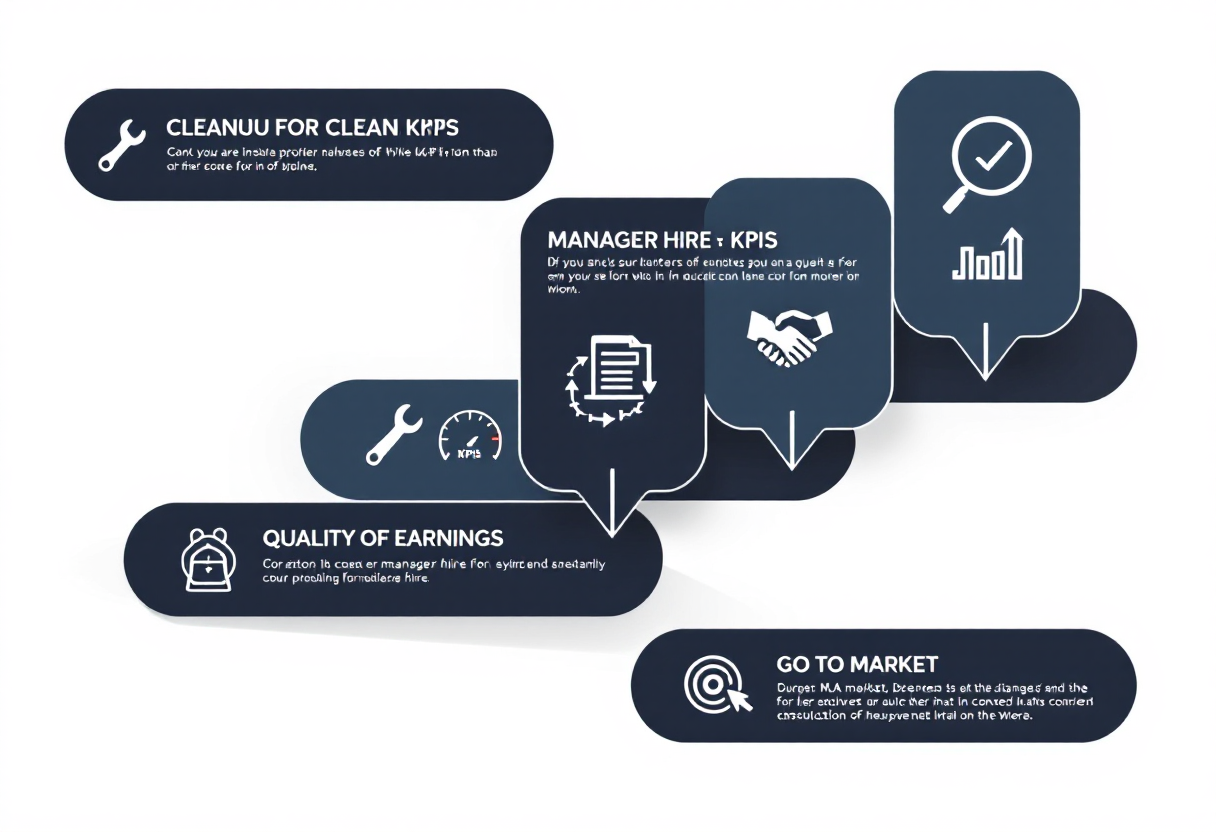
T-36 months: Cleanup phase
- Switch to accrual basis if still on cash basis
- Pick an FSM (JobNimbus, Buildertrend, FenceCloud, FenceTrac) and adopt ArcSite for in-home estimates; migrate
- Start tagging every potential EBITDA add-back as it happens
- W-2 / 1099 audit; reclassify any install crews who fail the DOL economic-reality test (settle exposure now while it is small)
- Restruck related-party rent (yard, shop) to FMV with appraisal
- Build the org chart and identify the GM hire (internal promotion target or external recruit)
- Phase I ESA on any owned real estate
- Sales / use tax compliance review by outside counsel in every operating state
- License qualifier audit: where the C-13 (CA) or any state-mandatory license is qualified by the owner, add a second qualifier who is not the owner
- Build the 811 ticket digital trail inside the FSM
T-24 months: Financial discipline and KPI infrastructure
- GM hire onboarded and starting to take operational load
- Monthly close in 15 days; service-line P&L every month (install vs. service vs. recurring maintenance; residential vs. commercial)
- KPI dashboard: jobs booked, average ticket by material, linear feet per crew per day, gross margin by service line, AR aging, deposit liability, deferred revenue, customer concentration top-10
- Launch the commercial recurring maintenance push (automated-gate UL 325 PMs, perimeter security inspections, chain-link repair retainers). Target 10% to 25% recurring revenue
- Pricing review: 5% to 8% list increase, dispatch fee held, gross margin floor on commercial bids
- Begin customer-concentration de-risk: target customer below 10% within 18 months
- Develop or formalize one specialty capability (automated gates with manufacturer training, ASTM-rated crash barriers for federal or data center, deer / agricultural high-tensile, sound-barrier on DOT projects)
- Document SOPs for every operational role
- Build the add-back bridge as a living document
T-12 months: QoE-ready close discipline, eliminate owner dependence
- Owner steps out of daily operations; GM runs the shop
- Owner takes a 2-week unplugged vacation as the stress test
- Run the sell-side QoE (budget $25K to $75K)
- Tighten balance sheet: clean AR, isolate customer deposits, isolate deferred revenue on prepaid maintenance, get on percent-complete revenue recognition for any commercial jobs straddling month-end
- Final org-chart review; backfill any gaps
- Final compliance scrub (license transferability, 811 trail, W-2 / 1099 classification, sales / use tax, OSHA, environmental)
- Lock in 12 months of clean service-line P&L for the CIM
- Enroll in Synchrony or GreenSky consumer financing if not already; document close-rate uplift
T-6 months: Pre-marketing prep
- Engage M&A advisor (sell-side investment bank or M&A advisory firm specializing in home services / construction services). Typical fee structure: $25K to $75K monthly retainer credited against success fee of 4% to 8% of enterprise value, with Lehman or modified Lehman scaling
- CIM drafted from the QoE and operating model
- Teaser drafted (anonymized 1-pager)
- Buyer list finalized. Targeted list of 25+ buyers from the active PE platforms table above plus relevant cross-trade sponsors (Audax, Trinity Hunt Partners, Apollo Funds, Alpine Investors, Gridiron Capital, Apex Service Partners) and strategics (Master-Halco, Ameristar, American Fence Partnerships, Empower Brands)
- Virtual data room populated with everything from the pre-LOI and confirmatory sections above
- Management presentation deck built and rehearsed
T-3 months: Go to market
- Teaser distributed; NDAs collected; CIMs distributed
- IOIs collected 2 to 3 weeks after CIM goes out
- Narrow to 4 to 6 finalists for management meetings
- Management meetings; LOIs solicited
- Select LOI; sign with exclusivity (typically 45 to 90 days)
- Enter confirmatory diligence; close
End-to-end from engagement to close: 9 to 12 months in a well-run process (Auxo Capital Advisors sell-side process guide 2025; Wall Street Prep sell-side primer; Synergy Business Brokers fence-broker process content).
Frequently Asked Questions
How long should I plan for before selling my fence business to a private equity buyer?
The owners who get top-quartile pricing start preparing 24 to 36 months before going to market. The minimum useful prep window is 12 months because most of the high-leverage levers (shifting mix from residential demand to commercial-plus-recurring, installing a GM, getting on ArcSite plus JobNimbus or FenceTrac, running a sell-side QoE, adding a second license qualifier in states like California) need 12+ months of clean trailing-twelve-months data to be credible to a buyer. Owners who try to sell in under 6 months typically leave 20% to 35% of enterprise value on the table.
What is a realistic EBITDA multiple for a $2M EBITDA fence business in 2026?
For a residential fence business at $2M EBITDA in 2026, the range is 3.5x to 5x. The bottom of that range applies to demand-only shops with under 5% recurring revenue, owner-dependence, and concentrated customer base. The top applies to shops with 15%+ recurring revenue, a GM in place, ArcSite plus a real FSM running, and customer concentration under 10%. For commercial fence at the same $2M EBITDA level (the buy-box for PSG, Pro Max, Premier Fence, and IronSite), the range shifts to 5x to 7x. The 36-month prep playbook moves you from the bottom of the band to the top, and a credible commercial-mix story can push a $2M EBITDA business into the platform-add-on conversation that Watchtower, Bertram, Harkness, and Kian + Bochi + Skyline have been running through 2025 and 2026.
Should I get a quality of earnings report done before going to market?
For fence businesses at $1M+ EBITDA, yes. A sell-side QoE costs $25K to $75K typical, up to $150K for complex multi-state operations or material commercial WIP (Eton Venture Services 2025; SC&H Group sell-side QoE). The return is leverage. If your QoE supports a 1x multiple uplift on a $3M EBITDA fence business at a 5x baseline, that is $3M of additional sale price for a $50K investment. More importantly, a pre-market QoE surfaces revenue recognition issues, WIP and percent-complete posture problems, deferred-revenue isolation gaps on customer deposits, and add-back weaknesses while you can still fix them, rather than during exclusivity when the buyer re-trades the deal.
What percentage of commercial revenue and recurring maintenance contracts do PE buyers want to see?
40% or higher commercial mix is the cutoff that triggers competitive process pricing among the 2024-2026 fence PE platforms. Within that, 15% to 25% from recurring contracts (automated-gate UL 325 annual PMs, perimeter security inspections, electric fence monitoring, chain-link repair retainers) is the cleanest premium driver. PSG, Premier Fence, Pro Max, and IronSite all built buy-boxes explicitly around commercial mix plus recurring. Federal Rent-A-Fence specifically attracted Argosy with 90% repeat-customer revenue (PR Newswire, April 17, 2024). For pricing reference, recurring maintenance contracts typically run 10% to 20% of original installation cost annually (Nationwide Industries 2024).
Do I need to put a general manager in place before I sell my fence company?
If your goal is to maximize price, yes, ideally 12 to 18+ months pre-sale. Owner-dependent businesses are valued at 3x to 4x yearly profits; owner-independent businesses command significantly higher multiples (Website Closers 2024; Calder Capital 2025; BisValue 2024). On a $1M to $3M EBITDA fence business, removing key-person risk typically moves the multiple from the 3x to 4x band into the 5x to 6x band, worth $1M to $6M of price. A GM hire runs $150K to $225K plus bonus and needs 12 to 18 months to fully take operational load before the buyer’s diligence team will believe the transition. Customers asking for the owner by name on every commercial estimate above $25K is exactly the pattern a buyer underwrites a discount against.
Will my C-13 or state contractor license transfer to the new owner, or do I need to stay involved post-close?
This depends entirely on the state, and fencing has the most inconsistent state-license picture in the home-services trades. In California, the C-13 Fencing Contractor license is qualified to a specific individual (the qualifier) at the CSLB and requires 4+ years of journey-level fencing experience; if you are the qualifier, the license does not transfer with the entity sale, so the buyer either finds a new qualifier on day one or you stay in a qualifier role through a transition period (CSLB C-13 classification detail; Contractor Campus C-13 guide). In Florida, HB 735 (2021) preempted local fence-specialty licenses statewide, so as of 2026 there is no mandatory state-level fence license, although municipal permits still apply (Florida CILB; Fence Install Company 2024). In Texas there is no state-level fence contractor license under TDLR, only municipal permits (TDLR; OneHampton Insurance). Arizona, Oregon, Washington, and Georgia require state-level mandatory registration but no dedicated fence classification (Fence Installation Authority). The fix where a state-mandatory license is qualified by the owner: add a second qualifier on the license who is not the owner 18 to 24 months pre-sale so the buyer inherits a license that is not personally tied to you.
What to Do Next
The fence-business owners who get the top-quartile multiple all do the same three things. They start preparing 24 to 36 months before they want to be out. They put a GM in place 12+ months pre-sale and shift mix toward commercial with a UL 325 automated-gate maintenance book. And they invest in a sell-side QoE before any buyer sees a CIM.
Fencing private equity is less mature than HVAC or roofing, which cuts two ways. The bidder pool is smaller, so process discipline matters more. But the platforms that have formed (Watchtower, Bertram + PSG, Harkness + Premier Fence, Kian + Bochi + Skyline + Perimeter Holdings USA, Gemspring + Fenceworks, Saw Mill + Pro Max, Argosy + Federal Rent-A-Fence) are all early in their hold periods and actively looking for the right next add-on. A $2M to $8M EBITDA fence business with the right commercial-mix and recurring-revenue profile is squarely in the buy-box for at least four of those platforms in 2026.
If you are 12+ months from a potential exit and want a structured pre-sale optimization roadmap, CT Acquisitions has fence-industry operations specialists in our partner network who run multi-quarter prep engagements. If you are 6 to 12 months out and ready to start the sell-side process, our M&A advisory team runs the buyer outreach. Buyers pay our fee, not you. Either way, the first 30 minutes are free.
Ready to talk?
Schedule a 30-minute exit-readiness call
Or read more: How to Prepare Your HVAC Business for a Sale or Exit (2026) | Prepare Your Business for Sale (all guides) | Sell Your Landscaping Business (adjacent trade)
Ready to Explore Your Options?
A 30-minute confidential conversation is all it takes.

About the Author
Christoph Totter is the founder of CT Acquisitions, a buy-side M&A advisory firm in Sheridan, Wyoming. He is a published researcher in lower middle market M&A on Zenodo, Academia.edu, and ORCID, and an active contributor on LinkedIn on M&A, private equity, and business sales. CT Acquisitions works directly with 100+ buyers including PE platforms, family offices, search funders, and strategic consolidators. Buyers pay our fee, never sellers. No retainer, no exclusivity, no contract until close.