Architecture Firm Valuation: What’s Your A&E Firm Worth in 2026?
Architecture firm valuation in 2026 starts from Zweig Group’s median: 4.28x EBITDA or 0.63x net service revenue. Internal transitions price lower, often 1 to 1.5x book value; outside buyers pay 2 to 3x (AIA).
Key takeaways
- Zweig Group’s 2025 Valuation Report of AEC Firms put the median firm at 4.28x EBITDA, 0.63x net service revenue (NSR) and 0.63x backlog; its February 2026 report lifted value to NSR to a record 0.66.
- Applied to Zweig’s median firm ($7.7M NSR, $1,357,946 EBITDA), the published rules of thumb return $2.6M to $8.28M: a 3.2 times spread driven by the method, not the firm.
- AIA Best Practices cites 1 to 1.5 times adjusted net worth for internal transitions and 2 to 3 times for external sales.
- New York requires design professionals to hold more than 75% of a design professional corporation’s shares (BCL §1507(b)); Michigan requires two-thirds of principals to be licensees (MCL 339.2010).
- PE-backed acquirers made 47% of U.S. design and environmental deals in 2025 through mid-September, per Morrissey Goodale in ACEC’s Engineering Inc.
Thinking about selling your A&E firm?
Skip the formulas. A 15-minute confidential call gives you a real valuation range and tells you which buyers would compete for your firm. No cost, no obligation.
How much is an architecture firm worth in 2026?
An architecture firm is worth a multiple of normalized earnings measured on net service revenue. Zweig Group’s 2025 median was 4.28x EBITDA and 0.63x NSR. Small studios sold through brokers clear 1.83x to 3.15x seller’s discretionary earnings on BizBuySell, and engineering firms with $1M to $10M of EBITDA price at 3.8x to 8.5x in First Page Sage’s Q1 2025 data, depending on discipline.
| Source | What it measures | Multiple | Basis | Date |
|---|---|---|---|---|
| Zweig Group 2025 Valuation Report | Median AEC firm, all valuation purposes | 4.28x EBITDA; 0.63x NSR; 0.63x backlog; 3.8x equity value to profit | Firm survey | Mar 2025 |
| Zweig Group 2026 Valuation Report | Median AEC firm | 0.66x NSR, highest on record | Firm survey | Feb 2026 |
| AIA Best Practices (Michael Strogoff, FAIA) | Internal transition vs external sale | 1x to 1.5x vs 2x to 3x adjusted net worth; 3x to 5x weighted net income | Consultant practice | 2025 edition |
| CliftonLarsonAllen | Rules of thumb | 1.5x book value; 3x to 4x EBITDA; 40% to 50% of NSR | Rule of thumb | Aug 2017 |
| BizBuySell | Broker-sold A/E firms, middle half | 1.83x to 3.15x | SDE | Current benchmark page |
| First Page Sage | Private engineering firms, $1M to $10M EBITDA | Civil and structural 6.1x to 8.5x; environmental 3.8x to 6.7x | EBITDA | Q1 2025 |
| Auxo Capital Advisors | Engineering firms by profile | 3.5x to 5.5x founder-led; 5.5x to 7.5x established; 8.5x to 12x platform | EBITDA | Jul 2026 |
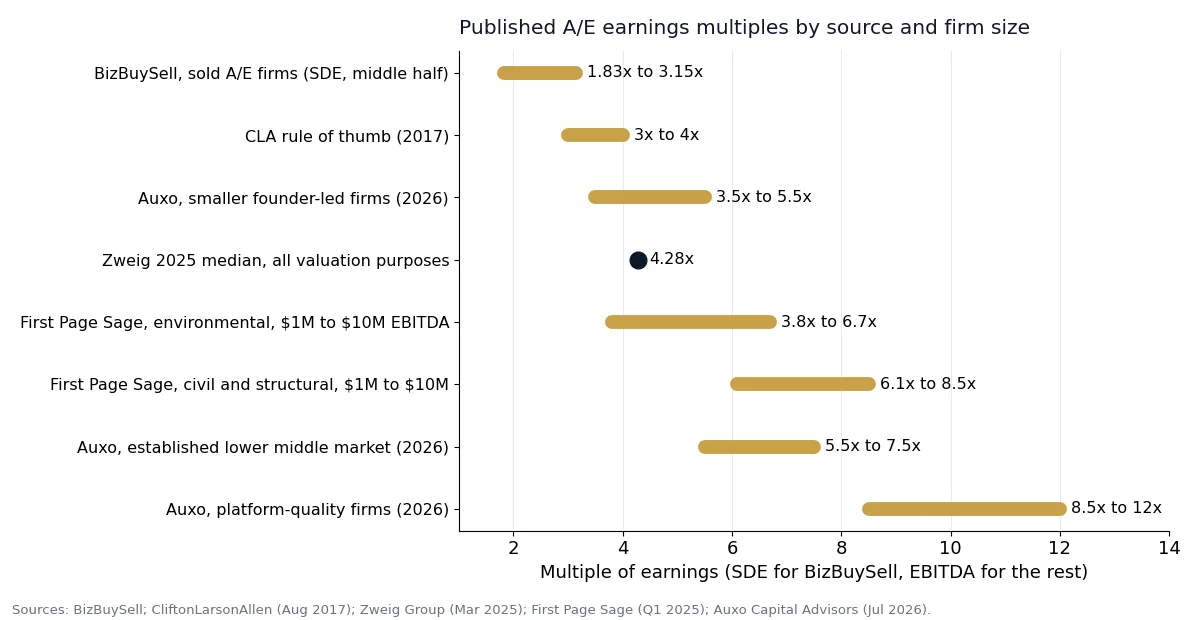
Size and discipline explain most of the spread. About 75% of the more than 19,000 U.S. architecture firms have fewer than 10 employees, per the AIA 2024 Firm Survey Report, so most architecture practices sell on SDE in the BizBuySell band. First Page Sage publishes no architecture-only multiples; its engineering table puts an environmental firm with $1M to $3M of EBITDA at 3.8x and a civil and structural firm of the same size at 6.1x.
| Firm profile (CT Acquisitions estimates, illustrative) | Typical multiple | Dominant buyer type |
|---|---|---|
| Owner-run studio under $500K SDE, principal seals everything | 1.5x to 2.5x SDE | Individual licensed buyers, local competitors |
| $500K to $1M SDE or EBITDA, small licensed bench | 2.5x to 3.5x | Search funds, regional strategics |
| $1M to $3M EBITDA, department heads, contracted backlog | 3.5x to 5.5x EBITDA | PE-backed AEC platforms, strategics, ESOP alternative |
| $3M+ EBITDA, second-tier leadership, book-to-bill of 1.0 or higher | 6x to 9x EBITDA | PE platforms, national consolidators |
How do you value an architecture firm, step by step?
Value an architecture firm in six steps: normalize earnings, restate revenue to net service revenue, grade signed backlog, test the labor engine, check who can legally seal and own the work, then apply and cross-check a multiple. CliftonLarsonAllen notes the asset approach is almost never used for A/E firms, so the work sits in the income and market approaches.
- Normalize earnings. Under roughly $700K of earnings, buyers use seller’s discretionary earnings (SDE): pre-tax profit plus one owner’s pay and personal costs. Above roughly $1M, they use adjusted EBITDA with a market salary for every working principal. Many A/E firms sweep profit into year-end bonuses, so rebuild pre-bonus profit first; Zweig’s 2025 median firm reported $1,204,104 of pre-bonus profit. Our guide to normalized EBITDA lists the add-backs buyers accept.
- Restate revenue to NSR. Subtract subconsultants and direct reimbursable expenses from gross fees for three years.
- Grade the backlog. Count signed contracts only. AIA Best Practices treats six months of contracted work as healthy; Zweig’s 2025 median firm carried $7.6M of backlog on $7.7M of NSR, about 11.8 months.
- Test the labor engine. Pull chargeability by staff tier, net multiplier (NSR divided by direct labor cost) and the average collection period, which Morrissey Goodale puts at 70 to 75 days for A/E firms, with anything above 75 days a warning sign.
- Check licensure and transferability. List who seals drawings in which states, who qualifies the firm with each board, and which on-call contracts survive a change of control.
- Apply and cross-check the multiple. Price on SDE or EBITDA, then test the result against NSR and backlog ratios from Zweig Group. A football field valuation chart shows the methods side by side.
Why does net service revenue matter more than gross fees?
Buyers price net service revenue: gross fees minus subconsultants and reimbursable expenses. Pass-through dollars carry little margin and no staff, so every multiple and ratio is rebuilt on NSR. In the illustrative bridge below, $10.0M of gross fees becomes $7.7M of NSR, and the EBITDA margin rises from 13.6% to 17.7% on the same $1.36M of EBITDA.
| Line (CT Acquisitions estimates, illustrative) | Amount | Share of gross fees | What the buyer does with it |
|---|---|---|---|
| Gross fees | $10.00M | 100% | Starting point only; never multiplied |
| Subconsultants (structural, MEP, geotech, survey) | minus $1.90M | 19% | Removed; checks markup and reliance on one sub |
| Direct reimbursables | minus $400K | 4% | Removed |
| Net service revenue | $7.70M | 77% | Base for 0.63x to 0.66x NSR ratios (Zweig) |
| Labor, overhead and bonuses | minus $6.34M | 63% | Rebuilt with market salaries for principals |
| EBITDA | $1.36M | 13.6% of gross; 17.7% of NSR | Base for the earnings multiple |
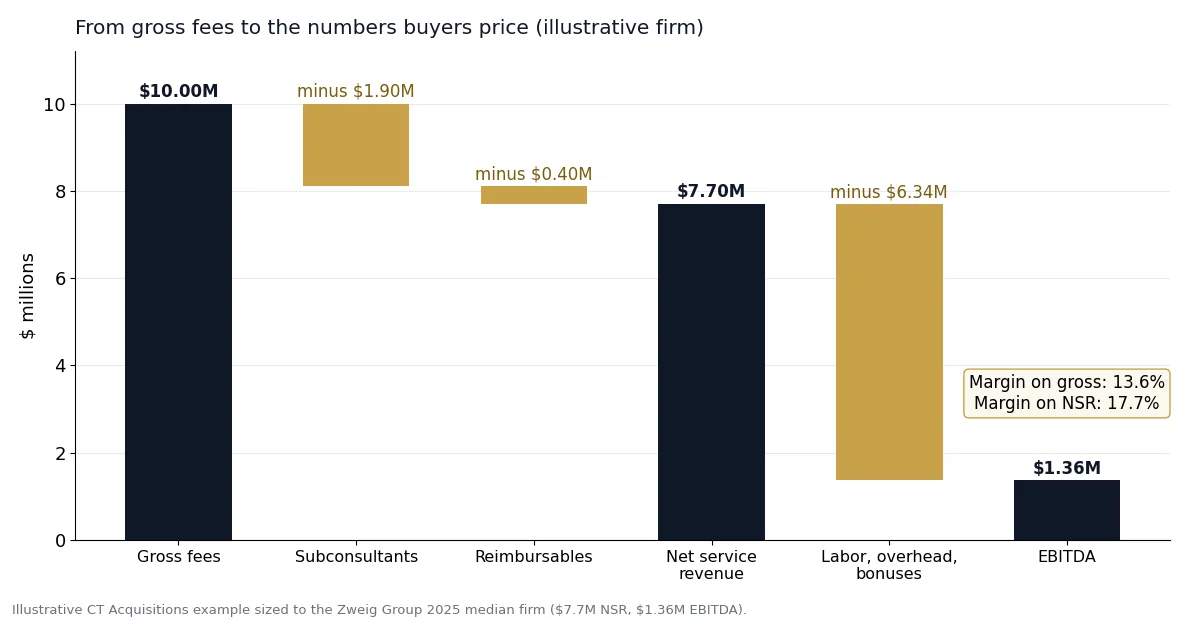
The restatement cuts both ways. A firm billing $12M gross with $4M of subconsultants is an $8M NSR firm in diligence, so growth that came from sub-heavy prime contracts disappears. The same firm’s margin looks better on NSR, which helps the multiple. CliftonLarsonAllen’s two revenue rules show the gap: 30% to 40% of gross services revenue against 40% to 50% of NSR.
How CT Acquisitions Works
- How we are paid. We work for owners on the sell side. Our fee is success only: nothing upfront, and you pay nothing unless the business sells.
- Confidential. No public listing, and nothing moves without your approval. We have zero claim on you.
- Vetted buyers only, no leaks. We introduce you only to vetted buyers whose mandates fit. Your business is never publicly listed.
- Top-of-market price and the right buyer. Matched on fit, not just the highest check.
- Buyer fit first. We already know our buyers’ mandates before we pick up the phone with you.
What do the rules of thumb say when applied to one firm?
Applied to the same firm, published rules of thumb disagree by a factor of 3.2. Zweig Group’s 2025 median firm, with $2.6M of book value, $7.7M of NSR and $1,357,946 of EBITDA, is worth $2.6M at AIA’s internal-transition floor and $8.28M at First Page Sage’s 6.1x civil and structural multiple. The rule you pick encodes the buyer you expect.
| Rule | Source | Formula on the Zweig 2025 median firm | Indicated value | Who uses it |
|---|---|---|---|---|
| Adjusted net worth, internal | AIA Best Practices | 1.0x to 1.5x of $2.6M book value | $2.60M to $3.90M | Internal buyouts |
| Percent of NSR | CliftonLarsonAllen | 40% to 50% of $7.7M | $3.08M to $3.85M | Quick screens |
| Book value formula | CliftonLarsonAllen | 1.5x of $2.6M | $3.90M | Shareholder agreements |
| Weighted net income | AIA Best Practices | 3x to 5x of $1,204,104 pre-bonus profit | $3.61M to $6.02M | Transition consultants |
| EBITDA rule of thumb | CliftonLarsonAllen | 3x to 4x of $1,357,946 | $4.07M to $5.43M | Rough fair value |
| Backlog ratio | Zweig 2025 | 0.63x of $7.6M | $4.79M | Cross-check |
| NSR ratio | Zweig 2025 | 0.63x of $7.7M | $4.85M | Cross-check |
| NSR ratio | Zweig 2026 | 0.66x of $7.7M | $5.08M | Cross-check |
| Adjusted net worth, external | AIA Best Practices | 2x to 3x of $2.6M | $5.20M to $7.80M | Outside sales |
| EBITDA median | Zweig 2025 | 4.28x of $1,357,946 | $5.81M | Appraisers, all purposes |
| EBITDA, civil and structural, $1M to $3M | First Page Sage Q1 2025 | 6.1x of $1,357,946 | $8.28M | Outside buyers of engineering firms |
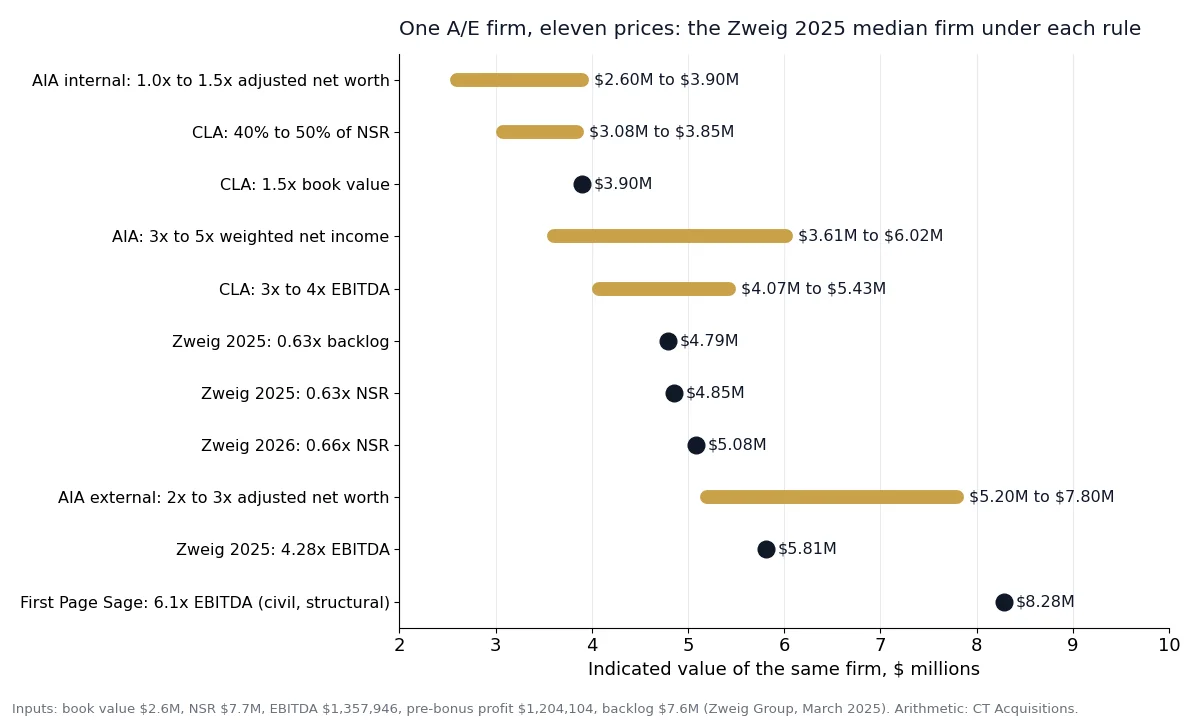
The rules disagree because they answer different questions. Book value formulas such as CliftonLarsonAllen’s 1.5x keep a buyout affordable for junior principals, so they sit at the bottom. AIA Best Practices states that strategic external acquisitions are typically valued higher than internal ones. Zweig’s 4.28x blends every valuation purpose in its survey, and First Page Sage covers engineering firms with at least $1M of EBITDA only.
The practical rule: use book value only where your shareholder agreement requires it, use the Zweig NSR and backlog ratios as a sanity check, and expect an outside buyer to price on normalized earnings. A founder about to sign a buy-sell agreement at $3.90M on the Zweig median profile is accepting 33% less than the $5.81M Zweig EBITDA median, so get a market read first.
How do backlog, chargeability and client mix move the multiple?
Backlog is the A/E firm’s closest thing to recurring revenue. AIA Best Practices treats six months of contracted work as healthy, and Zweig’s 2025 median firm carried $7.6M of backlog against $7.7M of NSR, about 11.8 months. Signed work counts; verbal awards and work awaiting notice to proceed get discounted, and AIA notes the same for work not yet under contract.
| Driver | Threshold buyers test | If you miss it | Source |
|---|---|---|---|
| Signed backlog | 6 months of work or more; Zweig median about 11.8 months of NSR | Staffing and earnings risk priced into the multiple | AIA; Zweig 2025 |
| Book-to-bill, trailing 12 months | 1.0 or higher | Backlog is shrinking; buyer adds an earnout | Definition |
| Average collection period | 70 to 75 days typical | Above 75 days reads as weak billing control and a larger working capital peg | Morrissey Goodale, 2021 |
| Litigation and claims | Clean loss runs | AIA says firms with a claims history are discounted | AIA Best Practices |
| Top five clients | Under 40% of NSR | Concentration discount or retention terms | CT Acquisitions estimate |
| Repeat revenue over five years | Above 70% | Goodwill treated as personal to the founder | CT Acquisitions estimate |
Chargeability and net multiplier
Two ratios show whether the labor engine works: chargeability (direct hours over total hours) and net multiplier (NSR over direct labor cost). In the illustrative worked example below, 61% chargeability and a 2.95 net multiplier earn +0.2x only because the firm also has clean timesheet data in Deltek; a buyer prices the fix for weak ratios into the offer instead of paying you for it.
Client mix: public programs vs private development
Funded public work with on-call or IDIQ contracts reads as durable, because the contract vehicle survives an ownership change better than a relationship does. Private developer work is priced as cyclical. An inventory of on-call contracts with expiry dates and three years of task-order volume is one of the most useful documents to bring to a first buyer meeting.
Who may own an A/E firm? State rules that shape your buyer pool
State licensure law decides who can legally buy your firm. New York requires design professionals to hold more than 75% of a design professional corporation’s shares under BCL §1507(b); Michigan requires two-thirds of principals to be licensees under MCL 339.2010. Texas and Florida set no ownership cap but require a licensed engineer to supervise or qualify the firm.
| State | Statute | Ownership rule | Key-person rule | What it means for a sale |
|---|---|---|---|---|
| New York | BCL §1507(b) | More than 75% of shares held by design professionals or a qualifying ESOP; largest shareholder licensed | President, chair, CEO and more than 75% of directors and officers licensed | A non-licensed buyer cannot control the licensed corporation directly; the structure needs licensed owners of record |
| Michigan | MCL 339.2010 | At least two-thirds of principals licensees; a non-licensed principal needs department approval | A person in responsible charge at each place of business | HB 4914 would lower the share to a majority; it passed the House on Dec 17, 2025 and was in committee as of Jan 14, 2026 (BillTrack50) |
| California | B&P Code §6738 | Non-licensed persons may be partners or officers, but not the sole owner | A licensed civil, electrical or mechanical engineer is an owner, partner or officer in charge | Outside owners are possible if a California PE stays in charge; the section runs to Jan 1, 2034 |
| Texas | Occupations Code §1001.405 | No ownership restriction in the TBPELS firm FAQ | Work performed or directly supervised by a Texas PE who is a regular, full-time employee | Widest buyer pool; the full-time PE is the key person |
| Florida, engineering | F.S. 471.023 | No ownership restriction | Firm qualified by a licensed engineer (qualifying agent); board notice within 30 days of a change | If the sole qualifying agent leaves, a new one is needed within 60 days |
| Florida, architecture | F.S. 481.219 | No ownership share requirement | Qualifying agent is a registered architect; one or more principal officers registered | Name a second registered architect before closing |
Run this check for every state where the firm holds a registration, not only the home state. Morrissey Goodale reports that California, Florida and Texas account for 30% of A/E and environmental deals over two decades, and the three states differ on whether an outside owner is allowed at all. Our guide on how to sell an architecture firm covers how ownership rules change deal structure.
How much does key-person risk cut the price?
Key-person risk is the gap between who signs the drawings and who stays after closing. AIA Best Practices says firms dependent on a handful of leaders command lower prices than firms with staff depth and next-generation owners in place. Buyers price that gap through a lower multiple, a longer seller transition, or an earnout tied to backlog conversion, as in the 0.5x deduction in the worked example below.
| If your situation is | Expect the buyer to | Fix before a sale |
|---|---|---|
| One principal seals most work and holds the only license in a state | Cut the multiple or tie part of the price to an earnout | License two more staff as professionals of record, 24 months out |
| You are the sole Florida qualifying agent (F.S. 471.023) | Require a replacement within the 60-day window | Qualify a second licensed engineer with the board |
| You hold the New York president or CEO seat (BCL §1507(b)) | Ask who holds the seat after closing | Name a licensed successor officer |
| Top client relationships sit with one founder | Ask for retention terms or a longer transition | Put two senior staff on every key account |
| The firm has open claims or a litigation history | Discount the price (AIA) or hold back escrow | Assemble five years of loss runs |
The cheapest value lever in the industry is succession. In the illustrative example below, licensing two second-tier engineers moves the multiple by +0.4x, worth more than a year of utilization gains. Our guide to key-person succession before a sale sets out the 24-month sequence.
How would a $1.4M EBITDA civil and structural firm be valued?
This illustrative firm, with $5.8M of NSR and $1.4M of normalized EBITDA, lands near $6.6M at 4.7x. The build starts from 4.5x, the middle of the 3.5x to 5.5x band for $1M to $3M EBITDA firms, adds for public on-call work and 10 months of backlog, and subtracts 0.5x because two founders aged 58 and 61 seal most structural work.
| Step (hypothetical firm, illustrative) | Amount or multiple |
|---|---|
| Gross fees / subconsultants and reimbursables / NSR | $7.2M / $1.4M / $5.8M |
| Reported EBITDA | $1.25M |
| Principal pay above market replacement cost | +$110K |
| Personal vehicles, family payroll, one-time legal fees | +$65K |
| Market salary for a successor managing principal, net | minus $25K |
| Normalized EBITDA | $1.4M |
| Starting multiple, $1M to $3M EBITDA band | 4.5x |
| 65% public work with DOT on-call and two municipal IDIQs | +0.4x |
| Backlog of 10 months of NSR, book-to-bill 1.05 | +0.3x |
| Clean Deltek data, 74% repeat revenue | +0.2x |
| Principal dependence: founders aged 58 and 61, four PEs | minus 0.5x |
| Private work concentrated with two developers | minus 0.2x |
| Concluding multiple and value | 4.7x, about $6.6M |
| Cross-check at Zweig 4.28x / First Page Sage 6.1x | $5.99M / $8.54M |
| After 24 months: two more licensed engineers, EBITDA $1.6M, 5.2x | about $8.3M |
The $1.7M gap between $6.6M today and $8.3M in 24 months comes mostly from succession work that costs little cash. The deal would likely close as majority cash with a component tied to backlog conversion and a 2 to 3 year principal transition.
Who is buying A/E firms in 2026?
PE-backed platforms are now the largest buyer group. Morrissey Goodale counted 350 U.S. design and environmental deals by mid-September 2025, with PE-backed acquirers at 47%, employee-owned firms at 45% and public companies at 8%, per Nick Belitz in ACEC’s Engineering Inc. in November 2025.
| Buyer type | Share of 2025 deals (through mid-Sep) | What it pays for | Source |
|---|---|---|---|
| PE-backed acquirers | 47% | Licensed teams, backlog, new states or disciplines | Morrissey Goodale, Nov 2025 |
| Employee-owned firms | 45% (down from 80% in 2016) | Staff and clients that fit their culture | Morrissey Goodale, Nov 2025 |
| Publicly traded firms | 8% | Scale, specialty capability | Morrissey Goodale, Nov 2025 |
PE and PE-backed deals rose from 27 in 2016 to 197 in 2024, and one in four ENR 100 firms is now PE-backed, up from 4% in 2017. The median seller in 2025 was a near-record $4.0 million firm, so this is a small-firm market. In MEP, the largest firms completed 69 acquisitions in 2024, up 28%, per Consulting-Specifying Engineer. Our professional services M&A multiples report compares A/E with accounting and consulting.
Internal transition, ESOP or outside sale: which fits your firm?
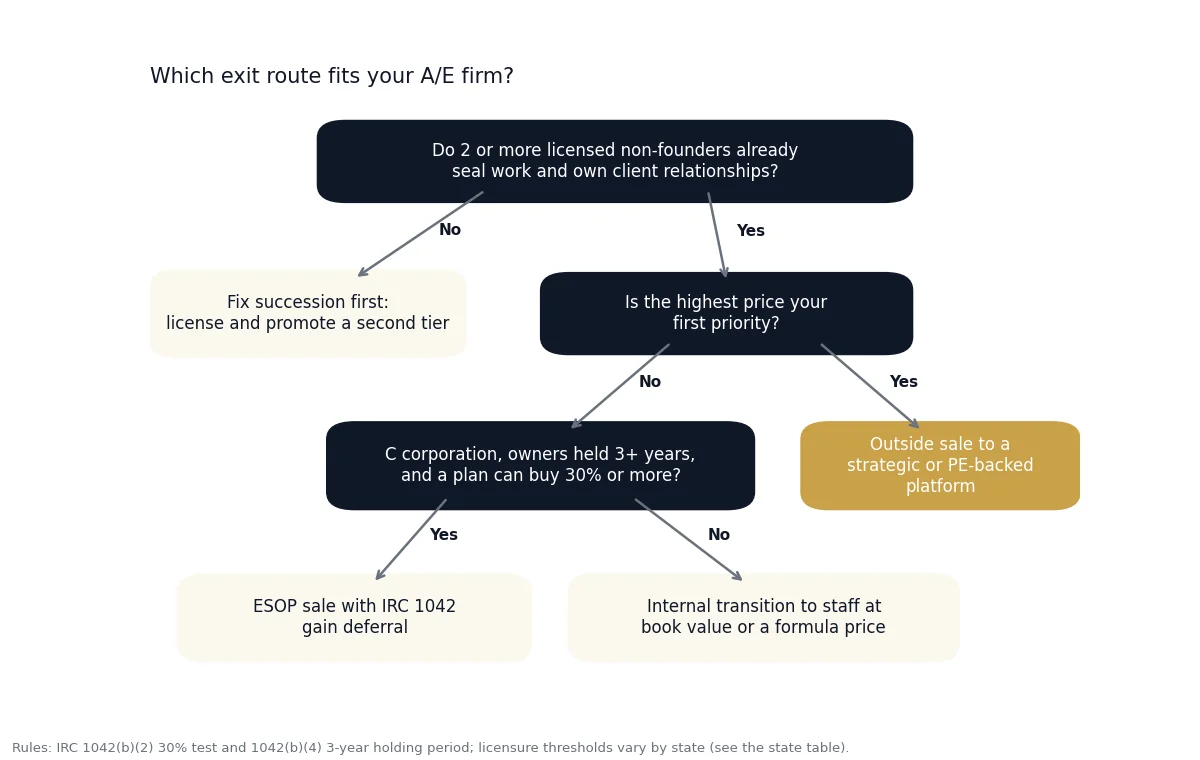
Choose by priority. An outside sale to a strategic or PE-backed platform usually yields the highest price: AIA Best Practices puts external sales at 2 to 3 times adjusted net worth against 1 to 1.5 times for internal transitions. An ESOP trades some price for continuity and, for C corporation owners, gain deferral under IRC §1042.
| If your situation is | Choose | Rule or threshold behind it |
|---|---|---|
| Fewer than 2 licensed non-founders seal work | Fix succession first, then sell | Key-person discount (AIA); state rules above |
| Price is the priority and the firm has $1M+ EBITDA | Outside sale to a strategic or PE-backed platform | 2x to 3x vs 1x to 1.5x adjusted net worth (AIA) |
| C corporation, shares held 3+ years, continuity first | ESOP sale | IRC §1042: plan holds 30%+ after the sale |
| S corporation owner wanting §1042 deferral | Wait or convert | §1042 covers sales of non-C stock only after Dec 31, 2027 |
| Licensed staff ready to buy over time | Internal transition at book value or formula price | Start about 10 years out (Morrissey Goodale) |
| New York firm and a non-licensed buyer | Structure with licensed owners of record | BCL §1507(b) 75% test |
What does IRC §1042 require for an ESOP sale?
Under 26 U.S.C. §1042, a seller can defer gain on stock sold to an ESOP if four tests hold. The rules are conditional, so confirm them with your transaction CPA before signing a letter of intent.
- The ESOP holds at least 30% of the stock immediately after the sale (§1042(b)(2)).
- The seller held the shares at least 3 years (§1042(b)(4)).
- Proceeds go into qualified replacement property between 3 months before and 12 months after the sale (§1042(c)(3)).
- The stock is issued by a domestic C corporation with no readily tradable stock; that C corporation limit falls away for sales after December 31, 2027.
New York allows ESOP ownership of design professional corporations only where more than 75% of the plan’s voting trustees or committee members are design professionals (BCL §1507(b)). Compare the ESOP appraisal with an outside market read; our ESOP vs private equity comparison walks through both.
How long does an internal ownership transition take?
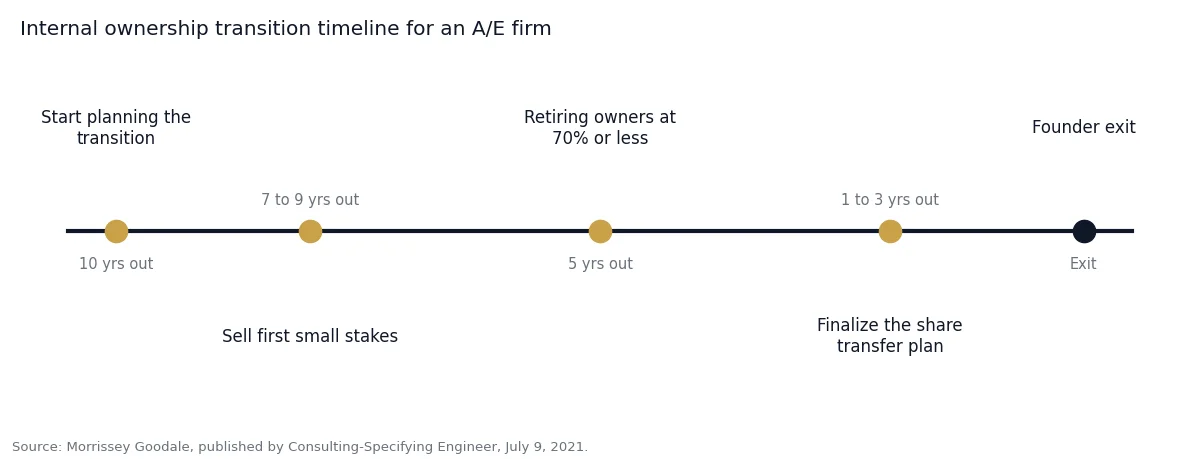
An internal transition takes about 10 years when done the Morrissey Goodale way, published by Consulting-Specifying Engineer in July 2021. The steps:
- About 10 years out: start the transition plan.
- 7 to 9 years out: sell small stakes to the next generation.
- About 5 years out: reduce retiring owners to 70% or less.
- 1 to 3 years out: finalize the share transfer plan.
An outside sale needs a shorter runway: 12 to 24 months to license a second tier, restate NSR and build eight quarters of backlog reports. Start with our exit planning page, or compare routes on a call. CT Acquisitions provides confidential architecture firm valuation reads for founders weighing exit timing, an ESOP or an unsolicited offer. We work for owners on the sell side. Our fee is success only: nothing upfront, and you pay nothing unless the business sells.
Want to know what your A&E firm is worth?
Benchmarks give you a range. A 15-minute confidential call gives you a real number, based on what active buyers are paying right now and which ones would compete for your firm. No cost, no obligation.
How we compiled this
We compiled 20 named sources in November 2026: Zweig Group’s 2025 and 2026 valuation report releases, the AIA Best Practices PDF and 2024 Firm Survey article, CliftonLarsonAllen, First Page Sage, Auxo Capital Advisors, Morrissey Goodale in ACEC’s Engineering Inc. and Consulting-Specifying Engineer, statute text from New York, Michigan, California, Texas and Florida, and 26 U.S.C. §1042. BizBuySell and the Michigan Legislature site blocked automated access, so those figures come from the official pages’ search-result text. Forum posts and paid reports we did not read were excluded. Licensure rules change; confirm them with counsel before you structure a deal.
Frequently asked questions
How do you value an architecture firm?
Normalize earnings, restate revenue to net service revenue, then apply a multiple. Zweig Group’s 2025 median AEC firm was worth 4.28x EBITDA and 0.63x NSR. Internal transitions often use 1 to 1.5 times adjusted net worth and outside sales 2 to 3 times, per AIA Best Practices. Cross-check with backlog: Zweig’s median value was 0.63x backlog.
How much is an engineering firm worth?
First Page Sage’s Q1 2025 data puts private engineering firms with $1M to $3M of EBITDA at 3.8x for environmental firms to 6.7x for chemical consultants, rising to 6.7x to 9x at $5M to $10M of EBITDA. Civil and structural firms sit at 6.1x to 8.5x. Zweig Group’s 2025 median across AEC firms was 4.28x EBITDA.
How much is a business worth that makes $300,000 a year?
If the $300,000 is seller’s discretionary earnings, the middle half of A/E firms sold on BizBuySell (1.83x to 3.15x SDE) puts the firm at $549,000 to $945,000. If it is EBITDA after a market salary for every principal, EBITDA multiples apply, but First Page Sage’s engineering tables start at $1M of EBITDA, so most small firms are priced on SDE.
How much is a business worth with $1,000,000 in sales?
For an A/E firm with $1,000,000 of net service revenue, Zweig Group’s 0.63x to 0.66x NSR ratios give $630,000 to $660,000, and CliftonLarsonAllen’s 40% to 50% of NSR rule gives $400,000 to $500,000. If the $1,000,000 is gross fees including subconsultants, CliftonLarsonAllen’s 30% to 40% of gross rule gives $300,000 to $400,000.
Can private equity buy my firm if my state restricts ownership to licensed professionals?
Sometimes, with structure. New York’s BCL §1507(b) requires design professionals to own more than 75% of a design professional corporation, so outside investors need licensed owners of record. Michigan requires two-thirds of principals to be licensees under MCL 339.2010. Texas and Florida set no ownership cap but require a licensed engineer to supervise or qualify the firm.
Is an ESOP better than selling to a third party?
An ESOP is better when continuity matters more than price. AIA Best Practices puts external sales at 2 to 3 times adjusted net worth against 1 to 1.5 times for internal transitions. For C corporation owners who held their shares at least 3 years, IRC §1042 defers gain if the ESOP holds at least 30% of the stock after the sale.
Sources
- Zweig Group, 2025 Valuation Report of AEC Firms release (Mar 7, 2025), accessed Nov 2026.
- Zweig Group, AEC valuations remain strong, Kyle Ahern (Mar 16, 2025), accessed Nov 2026.
- Zweig Group, 2026 Valuation Report release (Feb 11, 2026), accessed Nov 2026.
- AIA Best Practices 05.06, How much is your firm really worth?, Michael Strogoff, FAIA, accessed Nov 2026.
- AIA Architect, Latest insights from the 2024 Firm Survey Report (Nov 4, 2024), accessed Nov 2026.
- CliftonLarsonAllen, Determining Fair Value of an Architecture and Engineering Firm (Aug 17, 2017), accessed Nov 2026.
- First Page Sage, EBITDA Multiples for Engineering Companies, 2025 Report, accessed Nov 2026.
- Auxo Capital Advisors, Engineering Firm Valuation Multiples: 2026 Guide (updated Jul 2026), accessed Nov 2026.
- BizBuySell, Architecture and Engineering Valuation Benchmarks, search-result text, Nov 2026.
- ACEC Engineering Inc., Big Buyers, Sellers Reshape Industry M&A, Nick Belitz, Morrissey Goodale (Nov 12, 2025), accessed Nov 2026.
- Consulting-Specifying Engineer, MEP Giants deals (Sep 2, 2025), accessed Nov 2026.
- Consulting-Specifying Engineer, Morrissey Goodale, Considerations on A/E firm valuations (Jul 9, 2021), accessed Nov 2026.
- New York Business Corporation Law §1507, accessed Nov 2026.
- Michigan Compiled Laws 339.2010, official text via search result, and BillTrack50, Michigan HB 4914 status, accessed Nov 2026.
- California Business and Professions Code §6738, accessed Nov 2026.
- Texas Board of Professional Engineers and Land Surveyors, Firm FAQ (Occupations Code §1001.405), accessed Nov 2026.
- Florida Statutes 471.023 and 481.219 (2025), accessed Nov 2026.
- 26 U.S.C. §1042, Cornell LII, accessed Nov 2026.
Want a Specific Read on Your A&E Firm?
15 minutes, confidential, no cost. You leave with a read on your buyer market and a likely valuation range.
Prefer to start in writing? The Free Valuation Form takes five minutes and comes back with a range within 24 hours.