How to Prepare Your Urgent Care Practice for Sale in 2026: The 36-Month PE-Buyer Playbook
Preparing your urgent care center for exit in 2026 is a 36-month playbook. The first 12 months tighten the operating story around visit volume per site and payer mix (the two levers urgent care consolidators underwrite hardest), the middle 12 fix pre-LOI diligence gaps around provider retention and telemedicine integration, and the final 12 turn one offer into a real competitive process.
Exiting your urgent care practice business is the single largest financial event most owners will ever face. This guide is the no-fluff playbook for urgent care practice owners who are 12-36 months from sale, covering how PE-backed buyers actually value your business in 2026, the 12 levers that move your multiple, pre-LOI diligence, deal-killers to fix before going to market, and the full 36-month exit prep timeline.
Updated April 2026 · CT Acquisitions

Most urgent care owners decide to sell, hire a broker, and find out 90 days later that the buyer's coding audit just repriced their EBITDA down 15% to 25%. The owners who get the top-quartile multiple start preparing 24 to 36 months before they ever talk to a buyer. This guide is the 36-month playbook for how to prepare your urgent care clinic for a sale or exit. It covers what private equity actually buys in urgent care, the 12 levers that move multiples, the documents PE will ask for before they send an indication of interest, and the deal-killers that re-trade urgent care transactions during confirmatory diligence. Every number cites its source. Every recommendation comes from how the most active urgent care buyers in 2026 actually behave.
If you are 6 to 36 months from a possible exit, this is the work that turns a 5x EBITDA outcome into an 8x EBITDA outcome. On a $2M EBITDA urgent care platform, that is the difference between a $10M sale and a $16M sale. Whether you want to prepare your urgent care for a sale to private equity, prepare your urgent care for an exit to a hospital system or strategic acquirer, or simply maximize value over the next 1 to 3 years before going to market, the work below applies. Owners searching for how to prepare your urgent care business for a sale or how to prepare your urgent care business for an exit land on the same playbook in this guide. Healthcare is the most diligence-heavy sector in the lower middle market, so most of this guide is about getting the regulatory, coding, and payer file clean enough to defend the price.
Building toward an exit in 12 to 36 months?
CT Acquisitions runs sell-side advisory for urgent care and occupational health owners at $1M+ EBITDA. We also have healthcare operations specialists in our partner network who run pre-sale optimization engagements when the timeline is longer. No fee to you on buy-side introductions; sell-side mandates are paid on success at closing.
What Private Equity Actually Buys in Urgent Care (2026)
Urgent care is one of the most active healthcare PE lanes in 2026. 31+ named PE-backed urgent care platforms are buying in the market today, and PE-backed rooftops grew 11% in the 12 months from April 2024 to May 2025, from 2,359 centers to 2,622 centers, now roughly 18% of all US urgent care (Journal of Urgent Care Medicine, “Private Equity Investment In Urgent Care, By Number Of Centers, 2025”, Alan Ayers, May 2025). Total US urgent care center count is 14,423 as of May 2025, up from 7,220 a decade earlier (Trilliant Health, May 2024; JUCM, May 2025). Announced M&A deal count moderated from the 44-deal 2021 peak to 27 deals in 2024 and roughly 29 in 2025 (Scope Research, April 2025), but PE rooftop growth continued through bolt-ons that sit below the $119.5M HSR antitrust reporting threshold. The sponsor money flowing in is not random. PE buys specific profiles, and the profile you build determines the multiple you get.
The PE-attractive urgent care profile
- EBITDA threshold for a platform-quality deal: $1M to $3M EBITDA from a 3 to 10 clinic group is the entry band where sponsor-backed platforms run a competitive process. Below $1M EBITDA and you are an add-on tuck-in inside a roll-up. Above $3M to $8M from a 10 to 30 clinic regional group, you become an attractive bolt-on for the larger platforms. Above $8M EBITDA from 30+ clinics, you are a platform candidate yourself (CT Acquisitions; FOCUS Investment Banking; Scope Research, April 2025).
- Payer mix: Commercial above 50%, Medicare 15% to 25%, Medicaid below 25%, no single payer above 20% of revenue. Commercial reimbursement runs 1.6x to 3x of Medicare for E/M codes, and that gap is the entire valuation thesis (MD Clarity; Serif Health; ibinterviewquestions.com). The UCAOA 2017 Benchmarking Survey (the most recent comprehensive UC payer-mix benchmark published) reported industry average at roughly 67% commercial, 17% Medicare and Medicaid, 12% cash. The underlying data is now somewhat stale but the relative tier rules still hold.
- Occupational health revenue: 15% to 25% of total revenue from employer contracts, workers comp, DOT physicals, drug screening, and on-site clinics is the band buyers reward. Workers comp visits pay $200 to $400 vs. $150 to $200 for a commercial UC visit, and insurers pay 97% of workers comp claims vs. 65% of commercial UC claims (Experity, “Employer Services in Urgent Care: 5-Year Analysis”).
- Geography: Sun Belt, Texas, Florida, Carolinas, Arizona, Nevada, and growth Mountain West metros concentrate 2026 sponsor demand (Kaufman Rossin urgent care PE outlook). Rural Health Clinic certified footprints (Xpress Wellness, Fast Pace Health) are their own premium subcategory because of the Medicare cost-based reimbursement structure.
- Customer / employer concentration: No single employer above 10% of occupational health revenue. Top 5 payers below 60% of total revenue. Concentration above 20% triggers buyer pushback; above 25% triggers a 10% to 25% valuation discount or buyer withdrawal (Beancount.io, May 2026; Strategex; Eagle Rock CFO; Morgan & Westfield).
- Provider and staff retention: Provider tenure above the urgent care mean (APP turnover in urgent care runs higher than primary care per Relias and OnCall Solutions 2025), with a documented mid-level provider supervision model and locum tenens reliance under 5% of provider hours.
- Owner role: Owner is in non-clinical management. Employed medical director of record. Operations leader running daily clinical and business workflow. Owner not the only credentialed supervising physician under state CPOM or APP supervision rules.
Active urgent care PE platforms in 2026
The list below covers the most active sponsor-backed urgent care platforms in the 2024 to 2026 cycle. This is who will see your teaser. Center counts are point-in-time and shift with bolt-on activity. Sources include the JUCM PE ownership list compiled by Alan Ayers (April 2024 and May 2025 editions), PrivSource, PE Hub, sponsor press releases, and SEC filings.
| Platform | Sponsor | Profile |
|---|---|---|
| American Family Care (AFC) / Midwest Express Clinic | Lorient Capital (March 2024) | ~467 centers; national; 1,500+ in-network providers; franchise heavy |
| Fast Pace Health | Revelstoke Capital Partners (2021 single-asset rural healthcare fund) | ~317 centers; rural TN, KY, MS, LA, IN, AL |
| GoHealth Urgent Care | TPG Capital (with health-system JV partners) | ~304 centers; national via hospital JV model |
| WellStreet Urgent Care | FFL Partners + Crane Street Capital (since 2011) | ~170 centers; Atlanta + Southeast; health-system partnerships |
| WellNow Urgent Care | Leonard Green & Partners + Ares Private Equity | ~165 centers; Northeast, Midwest |
| NextCare Urgent Care | Enhanced Healthcare Partners | ~145 centers (down from ~170 after divesting 18 to Ardent Health in 2025); AZ, TX, OK, NM, CO, NC |
| Community Care Partners | Shore Capital Partners | ~111 centers; Southeast + Midwest |
| CRH Healthcare | Freeman Spogli | ~96 centers; Southeast |
| UrgentTeam Holdings | Petra Capital + Crestline + RC Capital + SV Health Investors | ~85 centers; TN, MS, AL, GA, AR rural and exurban |
| PM Pediatric Care | Scopia Capital + Jefferson River Capital (Series E $50M, June 2023; Pediatrix tuck-in July 2024) | 90+ pediatric urgent care centers across 15 states |
| Xpress Wellness Urgent Care | Goldman Sachs Alternatives (May 2024, from Latticework Capital) | ~75 centers; rural OK, KS, TX; 39 Rural Health Clinic certified |
| Urgent Care Group | ICV Partners | ~70 centers; Southeast |
| MainStreet Family Urgent Care | Trinity Hunt Partners | ~66 centers; Southeast rural |
| Exer Urgent Care | Orangewood Partners | ~61 centers; California |
| ConvenientMD | Bain Capital Double Impact | ~47 centers; New England |
| NextLevel Urgent Care | The Catalyst Group | ~47 centers; Texas |
| CareSpot Urgent Care | Onex Falcon + Crestline Capital | ~46 centers; Southeast (FL, GA, TN) |
| AllCare Primary & Immediate Care | Summit Partners | ~40 centers; Mid-Atlantic |
| Intuitive Health (ER + UC combo) | Great Hill Partners | ~36 centers; national via hospital JV (UF Health Jacksonville and others) |
| ChoiceOne Urgent Care | Frontline Healthcare Partners | Multi-state Southeast |
Beyond the PE-backed platforms, the strategic acquirers are increasingly active and now buy regional clusters of 8 to 20 centers from PE platforms pruning their footprint. HCA Healthcare (NYSE: HCA) operates CareNow plus MD Now (acquired from Brentwood Associates in January 2022 with 59 Florida centers and aggressively expanded since). Concentra Group Holdings (NYSE: CON) spun off from Select Medical and IPO'd on July 26, 2024 at $23.50 per share, raising $499.7M net (Concentra 424B4 prospectus). Concentra acquired Nova Medical Centers for $265M effective March 1, 2025 (67 occupational medicine centers, $130.3M LTM revenue, $28.3M LTM EBITDA, 2.0x revenue and 9.4x EBITDA per Concentra press release and Scope Research). Concentra also acquired Pivot Onsite Innovations in the same period. Community Health Systems (NYSE: CYH) Northwest Healthcare arm acquired 10 Carbon Health Arizona centers in December 2024. Ardent Health Services (NYSE: ARDT) acquired 18 NextCare centers across Oklahoma and New Mexico in January 2025 (Fierce Healthcare; Ardent press release). Bon Secours Mercy Health acquired 10 Greater Midwest UC centers in Ohio in 2025. CVS Health (NYSE: CVS) operates roughly 1,100 MinuteClinic walk-in sites and acquired Oak Street Health for $10.6B in May 2023, though it has not made major UC platform acquisitions in the 2024 to 2026 window. Amazon (NASDAQ: AMZN) acquired One Medical for $3.9B in February 2023 (primary care heavy). Optum / UnitedHealth Group (NYSE: UNH) acquired MedExpress in 2015 and continues smaller tuck-ins. Walgreens Boots Alliance (NASDAQ: WBA) / VillageMD acquired Summit Health-CityMD for $8.9B in January 2023, but Walgreens then took a $5.8B writedown on its VillageMD investment in 2024 and is now selling Village Medical, Summit Health, and CityMD as separate brands. The Walgreens unwind is the cautionary tale for retail-pharmacy integration of urgent care, and it tightened buyer underwriting on integration risk across the entire sector.
Regional health systems including Kaiser Permanente, Banner Health, AdventHealth, Atrium, Northwell, UPMC, and BayCare all operate captive UC arms (some via JV with GoHealth or Intuitive Health) and selectively acquire regional clusters to plug geographic gaps. For owner-operators in their footprints, these are the second most common exit channel behind PE platforms.
Urgent Care Valuation Multiples in 2026 (What You Are Actually Worth)
The multiple a buyer pays in urgent care comes down to your size, your payer mix, your occupational health share, your geographic density, and your regulatory and coding cleanliness. Below is the 2026 range, cross-referenced from Scope Research (April 2025), FOCUS Investment Banking (April 2025 and 2026 dashboard), CT Acquisitions, LBMC, Peak Business Valuation, and HealthFMV.
SDE multiples (single-clinic, owner-operator)
| SDE / profile | Multiple range | Source |
|---|---|---|
| Single-location, demand-only | 2.4x to 4.22x average range | Peak Business Valuation, 2025 |
| Single location, $300K to $700K SDE | 3.3x to 5.0x cash flow | CT Acquisitions (citing Scope Research, April 2025); HealthFMV |
| Single-location revenue multiple | 0.7x to 1.3x revenue (25th to 75th percentile) | HealthFMV, “Valuing Urgent Care Centers in 2025” |
EBITDA multiples (PE-attractive size)
| Tier | Centers / EBITDA band | EBITDA multiple range |
|---|---|---|
| Single-site independent | 1 center, $300K to $700K EBITDA | 3.0x to 5.0x |
| Small regional group | 3 to 10 centers, $1M to $3M EBITDA | 5.0x to 8.0x |
| Mid-size platform | 10 to 30 centers, $3M to $8M EBITDA | 8.0x to 11.0x |
| Premium scale platform | 30+ centers, $8M+ EBITDA, in-network, modern EMR, commercial-heavy | 11.0x to 15.0x+ (Scope Research max recorded 16.7x) |
| Public comparable: Concentra (NYSE: CON) | 770+ centers, occupational health heavy | 12.0x to 13.0x EBITDA trading range |
Sources: CT Acquisitions; FOCUS Investment Banking, “Urgent Care Practice Valuation Benchmarks”, April 2025; Scope Research, “Urgent Care Valuation Multiples and M&A Trends 2025”, April 2025; LBMC, “Valuation Considerations for Urgent Care Centers”. Operating margin range for urgent care runs 7% to 25% per LBMC; well-run mature centers run 15% to 25% EBITDA margin per FOCUS Bankers; best-in-class operators exceed 25%. Concentra reported 20.9% adjusted EBITDA margin YTD Q3 2024 (Concentra Q3 2024 release).
Recent disclosed urgent care and occupational medicine transactions
| Acquirer | Target | Date | Value | Implied multiple |
|---|---|---|---|---|
| Concentra (NYSE: CON) | Nova Medical Centers (67 occupational medicine centers) | Closed Mar 1, 2025 | $265M | 2.0x revenue, 9.4x EBITDA ($130.3M LTM revenue, $28.3M LTM EBITDA) |
| VillageMD / Walgreens + Evernorth | Summit Health-CityMD | Jan 3, 2023 | $8.9B | Not disclosed (estimate ~14x to 16x EBITDA); Walgreens later took $5.8B writedown |
| HCA Healthcare | MD Now Urgent Care (from Brentwood Associates) | Closed Jan 2022 | Undisclosed | Not disclosed |
| Concentra Group Holdings (spin and IPO) | IPO on NYSE | Jul 26, 2024 | $499.7M net raise at $23.50 per share | Public trading at 12x to 13x EBITDA |
| Goldman Sachs Alternatives | Xpress Wellness (from Latticework Capital) | May 2024 | Undisclosed | Estimate high single-digit to low double-digit EBITDA |
| Lorient Capital | American Family Care (equity investment) | Mar 2024 | Undisclosed | Not disclosed |
| Ardent Health Services | 18 NextCare centers (OK + NM) | Closed Jan 2025 | Undisclosed | Not disclosed |
| Community Health Systems / Northwest Healthcare | 10 Carbon Health Arizona centers | Closed Dec 2, 2024 | Undisclosed | Not disclosed |
| Bon Secours Mercy Health | 10 Greater Midwest UC centers (Ohio) | 2025 | Undisclosed | Not disclosed |
| American Family Care | 5 Boston-area Physician One Urgent Care centers | Feb 2025 | Undisclosed | Not disclosed |
| CVS Health | Oak Street Health (primary care) | May 2023 | $10.6B | Not disclosed |
| Amazon | One Medical (primary care, modest UC overlap) | Feb 2023 | $3.9B | Estimate ~3x revenue (loss-making target) |
Key takeaway: the Concentra / Nova Medical Centers deal at 9.4x EBITDA and 2.0x revenue is the cleanest disclosed recent comparable for a sub-$30M EBITDA occupational health heavy urgent care platform. Premium scale platforms with commercial-mix and tech-enabled differentiation transact at 11x to 16x EBITDA when they go to market, but those deals are rarer and the buyer pool is narrower (Concentra, Select Medical, Optum, HCA, large regional health systems). The bigger lesson from the 2023 to 2025 cycle is the Walgreens / VillageMD / CityMD unwind: an $8.9B headline acquisition followed by a $5.8B writedown tightened how every retail-adjacent and PE buyer underwrites integration risk on a UC platform going to market today.
The 12 Value Levers That Move Your Multiple (Ranked by Impact)

These are the levers that move urgent care multiples in the 24 months before a sale. Each one has a current state, a target state, and an estimated financial impact. The ordering is by dollar impact per unit of effort, based on cross-source synthesis from Scope Research, FOCUS Bankers, SovDoc, HealthFMV, CT Acquisitions, Experity benchmarks, and LBMC.
Lever 1: Shift payer mix toward commercial, away from Medicaid and out-of-network
Current: Medicaid above 40%, commercial below 40%, single payer concentration above 25%, out-of-network on top regional commercial payers. Target: Commercial above 50%, Medicare 15% to 25%, Medicaid below 25%, no single payer above 20%, in-network with the top 3 to 5 commercial payers in market. Impact: Payer mix is the single biggest valuation driver in healthcare services. Commercial payers reimburse 1.6x to 3x of Medicare for E/M codes; that gap compounds through margins and into multiples (MD Clarity; Serif Health; ibinterviewquestions.com). A shift from Medicaid-heavy to commercial-heavy lifts the multiple 0.5x to 1.0x and lifts EBITDA itself 20% to 40% on the same visit count. On a $2M EBITDA business at a 6x multiple, that is the difference between $12M and $18M of price. How: Marketing and location strategy to attract commercially insured patients (extended hours, signage, demographic targeting); negotiate in-network status with payers you are out-of-network on; renegotiate the worst commercial contracts at renewal; consider exiting Medicaid in metros where the burden outweighs the access value.
Lever 2: Build occupational health and employer book to 15% to 25% of revenue
Current: Below 5% of revenue from occupational health, no dedicated employer-services rep, ad-hoc DOT physical and drug-screen work. Target: 15% to 25% occupational health, workers comp, and employer-direct revenue, with 20+ active employer contracts and a dedicated occ-health coordinator. Impact: Workers comp visits pay $200 to $400 vs. $150 to $200 for commercial UC visits. Insurers pay 97% of workers comp visits vs. 65% of commercial UC visits (Experity 5-year employer services analysis). Occupational health is high-margin, high-predictability revenue that buyers reward disproportionately. The Concentra / Nova Medical deal at 9.4x EBITDA and 2.0x revenue is the benchmark for what an occupational health heavy book transacts at. Estimate: +0.5x to 1.5x multiple uplift plus direct EBITDA growth. How: Hire a B2B employer-services rep at $70K to $100K base plus commission; build a tiered employer service menu (DOT physicals, drug screens, pre-employment, on-site clinic days, return-to-work, workers comp injury care); standardize contract terms; price as bundled retainer plus fee-for-service.
Lever 3: Move the owner-physician out of the chair, install employed medical director
Current: Owner-physician sees patients 30+ hours per week, is the only medical director of record, makes every hiring decision, signs every payer contract. Target: Owner is a non-clinical CEO or out of operations entirely. Employed medical director (full-time, $325K to $400K typical) handles clinical leadership. Director of operations or CFO handles business workflow. Per-clinic medical leads handle daily clinical operations. Impact: Owner-physician dependence is the most-cited multiple haircut across UC valuation literature (SovDoc; Scope Research; FOCUS Bankers; HealthFMV; LBMC). In CPOM-strict states and states with strict APP supervision rules, the buyer needs a credentialed replacement medical director on day one. On a $1M to $5M EBITDA business, getting the owner out of the chair moves the multiple from the 5x to 6x band into the 7x to 9x band, worth $2M to $15M of additional price. How: Hire the medical director 18 to 24 months pre-sale. Document all clinical SOPs. Build a clinical leadership scorecard. Transition payer contract relationships to the operations leader. Take a 2-week unplugged vacation as the stress test.
Lever 4: Get on a UC-purpose-built EMR / PM and run a real monthly close
Current: Practice Fusion (sunset 2020), legacy or home-grown EMR, no service-line or per-clinic P&L, monthly close runs more than 30 days, KPI reporting is anecdotal. Target: Experity (formerly DocuTAP plus Practice Velocity), Athenahealth, Epic, or eClinicalWorks fully implemented 24+ months. Monthly close within 15 days. KPI dashboard live across visits per day per clinic, ARPV, denial rate, AR days, payer mix, provider productivity, conversion rate, and telehealth share. Impact: Estimate +0.5x to 1.0x multiple uplift, primarily because data-room speed and KPI defensibility translate directly into LOI competitiveness. Experity now powers 6,700+ UC clinics, roughly half of US urgent care (SelectHub; OmniMD; Experity 2025 benchmarking). On the throughput side, Experity claims chart times under one minute for 80% of UC visits, which lifts provider capacity by 1 to 2 visits per day per provider. How: Budget $150K to $400K implementation plus per-provider license. Set a hard go-live date 24 months pre-sale. Force adoption with payroll-tied compliance metrics.
Lever 5: Tighten coding accuracy and reduce up-coding exposure
Current: 99214 runs 65% to 80% of established visits, 99204 / 99205 runs 45%+ of new visits, no outside coding audit in the last 24 months. Modifier 25 used reflexively. POS 20 vs. 11 selection inconsistent. Target: Coding distribution within one standard deviation of national norms (Trilliant Health benchmark for UC: 99214 ~45% of established visits, 99204 ~40% of new visits). Annual outside coding audit. Modifier 25 documented per use. POS 20 used consistently for UC services. Impact: This lever protects rather than creates value. Up-coding findings in buy-side diligence routinely cause 10% to 25% EBITDA downward repricing. On a $2M EBITDA business at a 6x multiple, a 20% EBITDA haircut is $2.4M of price wiped out. Pre-emptive coding audit cost: $15K to $40K. Saves potentially $1M+ at sale (HIA Code; ACEP UC E/M FAQ; Trilliant Health upcoding study; SovDoc compliance guide). How: Engage an AAPC-certified outside coding auditor. Run a 200-chart audit per coding level per clinic. Fix documentation gaps. Re-train providers. Implement a quarterly chart-audit cadence.
Lever 6: Drive per-clinic visit volume and ARPV
Current: Below 30 visits per day per clinic, ARPV $130 to $150. Target: 40 to 60 visits per day, ARPV $180 to $250 with ancillary lift. Impact: Direct EBITDA growth. Each additional 5 visits per day at $200 ARPV is $365K of additional annual revenue per clinic, with most dropping to contribution margin. For a 5-clinic platform that is $1.8M of incremental revenue. At a 20% margin, that is $360K of EBITDA. At a 7x multiple, that is $2.5M of additional sale price. How: Marketing diversification (paid search, LSA, retail signage, employer outreach); online scheduling and check-in (15% to 25% volume uplift per FieldCamp benchmarks); ancillary roll-out (in-house x-ray, CLIA-waived rapid tests, vaccines, wound care, IV therapy, behavioral health); occupational health bookings; telehealth bolt-on for low-acuity overflow.
Lever 7: Optimize provider staffing toward a balanced APP and MD model
Current: Physician-only or physician-heavy staffing; locum coverage above 15% of provider hours. Target: Balanced model with 60% to 75% of visits seen by NP or PA under physician medical-director oversight; locum below 5%. Impact: A PA-led visit saves roughly $100K per year vs. physician staffing per provider replaced (Financial Models Lab; Relias). For a 5-clinic shop replacing 5 physician shifts with PA shifts, $500K of annual provider cost savings hits EBITDA directly. At a 7x multiple, that is $3.5M of price. State-by-state supervision rules constrain how aggressive this can go: Florida, North Carolina, and Texas have specific physician-to-APP supervision ratios; NP independent-practice states are easier. How: Hire APPs 12 to 18 months before sale (each new APP takes 3 to 6 months to ramp). Document supervision arrangements. Verify state supervision ratios. Build the bench so no single provider departure breaks the model.
Lever 8: De-concentrate top employer and top payer
Current: Top employer contract above 15% of occupational health revenue, or top payer above 25% of total revenue. Target: Top employer below 10%, top payer below 20%, top 5 payers below 60% of total revenue. Impact: Concentration above 25% triggers buyer pushback and a 10% to 25% enterprise value discount; above 40%, multiple compression of 1.0x to 2.0x is typical (Eagle Rock CFO; Morgan & Westfield; Strategex; Wall Street Prep; Beancount.io, May 2026). SBA lenders, who finance many sub-$10M deals, get uncomfortable at 20%. How: New employer outreach, payer mix diversification, hold concentration in pricing rather than lose volume to it.
Lever 9: EBITDA add-back hygiene
Current: Owner mixes personal expenses through the business with no documentation, related-party rent well above FMV, owner family members on payroll without clinical duty justification. Target: Every add-back documented with the underlying invoice or payroll record. Related-party rent restruck to FMV with appraisal on file. Clean payroll. Impact: Defensible add-backs hold up in QoE; undocumented ones get knocked out. On a 7x multiple, $100K of validated add-backs equals $700K of price (Citrin Cooperman; Warren Averett; Morgan & Westfield; SovDoc EBITDA prep guide). Common urgent care add-backs that hold up: above-market owner-physician compensation (if owner takes $600K but a replacement medical director costs $325K, $275K adds back); one-time legal fees from CON applications or payer disputes; owner family-member payroll without clinical duties; owner vehicle and personal travel; COVID-era Employee Retention Credit; one-time EMR conversion costs; sale-process advisor fees; related-party rent above FMV. How: Adopt a monthly add-back log starting today. Build documentation as you go.
Lever 10: Restructure into the right CPOM and MSO setup for a PE buyer hand-off
Current: PC or LLC owned by physician-operator with no MSO, no MSA, mixed clinical and non-clinical staff under one entity. Or worse: non-physician owner operating in a CPOM-strict state. Target: PC owned by a “friendly physician” (operator or designate), MSO entity holds all non-clinical assets and provides services under an arm's-length Management Services Agreement at fair market value. Structure compliant with state CPOM rules. California SB 351 (effective January 1, 2026) tightened MSA scrutiny in that state. All real estate held in a separate LLC. Impact: An incorrect CPOM structure can kill a deal in a CPOM-strict state. PE buyers will not close into a structure they cannot legally own. Estimated cost of restructuring is $50K to $200K in legal fees; the cost of NOT having it ready can be the deal walking. The states with the most stringent CPOM enforcement include California, Texas, New York, Illinois, North Carolina, Nevada, Colorado, and New Jersey (consensus across Permit Health, LumaLex Law, Guardian Medical Direction, SovDoc CPOM guide, BMD Law). How: Engage healthcare M&A counsel 18 to 24 months pre-sale. Restructure if needed. Get the MSA in place. Document arm's-length pricing.
Lever 11: RCM cleanup, denial rate, and AR days
Current: Denial rate 8% to 15%, AR days 50 to 60+, net collection rate below 90%. Target: Denial rate below 5%, AR days 25 to 35, net collection rate above 95%. Impact: Direct EBITDA. A 10-point denial reduction on $10M of revenue is roughly $400K to $700K of recovered EBITDA. At a 7x multiple, that is $2.8M to $4.9M of additional price (Med USA RCM; MBW RCM; Cosentus; Qualigenix UC RCM 2026). On the multiple side, clean RCM and current AR are signals of operational discipline that buyers price into the multiple (estimate +0.25x to 0.5x). How: RCM platform audit, denial root-cause analysis, eligibility-check at registration (registration errors are the #1 RCM problem per 55% of UC respondents per Exdion Health), credentialing cleanup, AR follow-up cadence.
Lever 12: Multi-site density and de novo pipeline
Current: 1 to 2 clinics in one metro. Target: 3+ clinics clustered in one metro or regional cluster, with a documented de novo pipeline showing the buyer where to scale next. Impact: Multi-site density is the single biggest size-based multiple driver in urgent care. Moving from single-site (3x to 5x EBITDA) to small regional group of 3 to 10 centers (5x to 8x EBITDA) can double or triple enterprise value on the same per-clinic EBITDA (Scope Research; CT Acquisitions; FOCUS Bankers). At 30+ centers and $8M+ EBITDA, multiples jump to 11x to 15x. Multi-site density also creates operating efficiency on shared back-office, marketing, and provider rotation. How: Open de novo or tuck-in 1 to 2 additional clinics 18 to 24 months pre-sale (each de novo costs $750K to $1.5M and takes 9 to 18 months to break even). Document the playbook so the buyer can scale post-close.
Want to grow your business to maximize value before exiting?
We connect urgent care owners with healthcare operations experts in our partner network who run 12 to 24 month pre-sale optimization engagements. The engagement pays for itself many times over in incremental sale price.
What PE Asks Before They Send an LOI (The Pre-LOI Diligence Stack)
Before a PE firm commits to a letter of intent, they ask for a focused diligence package. The list below is the real ask from a 2026 healthcare PE firm targeting an urgent care platform. The “why” and “how to prepare” expand each item to what is typical across the industry. Urgent care diligence runs heavier than home services because of payer-credentialing, PECOS enrollment, state licensure, and coding-audit overlay.
1. Income statements for 2024, 2025, and the latest trailing twelve months (monthly)
Why PE asks: They are building the LTM adjusted EBITDA they will multiply. Trend matters (growth rate, COVID washout, post-COVID normalization), seasonality (flu season Q4 and Q1 spike), and one-time movers (ARPA dollars, vaccine campaign revenue, COVID test and visit windfall). Buyers normalize out COVID-era windfalls aggressively.
How to prepare: Accrual-basis P&L by month and by clinic. Service-line P&L (UC visits, occupational health, workers comp, cash-pay physicals, lab, radiology, vaccines, telehealth). Reconcile to tax returns.
2. Balance sheet at the latest month
Why PE asks: Two reasons. First, to start sizing the working capital peg they will set in the purchase agreement. Second, to identify net debt and debt-like items. For urgent care, the debt-like items that bite include deferred revenue on prepaid occupational health retainers and employer contracts, accrued provider bonuses, unfunded EHR replacement liability, capital lease balances on radiology and lab equipment, claims payable, and occasionally settled or pending payer recoupment liabilities.
How to prepare: Tie the balance sheet to the trial balance. Isolate deferred revenue separately. Build a separate schedule for accrued provider compensation.
3. Adjusted EBITDA bridge with add-back documentation
Why PE asks: PE wants the “real” earnings story before they spend diligence dollars on the file. Aggressive or undocumented add-backs discount the entire file.
How to prepare: Build the bridge from book EBITDA line by line. Document every add-back with the underlying invoice or payroll record. See Lever 9 above for the urgent care add-back set that holds up in QoE.
4. Anonymized provider and employee roster
Why PE asks: Stress-tests two risks. First, provider stability: urgent care APP turnover runs higher than primary care, and locum tenens reliance hits the multiple. Second, owner-physician dependence: if the owner is a top producer or the only credentialed physician of record for medical-director sign-off in states with CPOM or APP supervision requirements, the entire deal restructures around that person.
How to prepare: Roster columns: role (MD, DO, NP, PA, MA, RT, front desk, RCM, manager), hire date, FT/PT, W-2 vs. 1099, base plus productivity comp structure, RVU productivity if tracked, active state license plus DEA registration, active board certification, active non-compete and non-solicit (with state enforceability flag). Calculate 12-month and 24-month provider retention.
5. Revenue by service line, by clinic, by payer (2 to 3 years plus LTM)
Why PE asks: This is the single most diagnostic exhibit in urgent care diligence. It tells PE (a) payer mix and stability (commercial vs. Medicare vs. Medicaid vs. workers comp vs. cash vs. employer-billed), (b) per-clinic revenue and visit volume trend, (c) average revenue per visit (ARPV) trend, (d) service mix (visit revenue, lab, x-ray, EKG, vaccines, occupational health, physicals, behavioral health, telehealth), (e) E/M coding distribution. Industry coding intensity context: 99214 rose from 38.5% to 45.0% of established office visits 2018 to 2023, and 99204 rose from 34.0% to 40.6% in the UC setting (Trilliant Health upcoding study).
How to prepare: Pull straight from Experity, Athenahealth, or whatever EMR / PM you run. Minimum exhibits: revenue by clinic by month for the last 36 months; payer mix by clinic; ARPV trend by clinic; visits per day by clinic; coding distribution (a buyer will benchmark your 99214 and 99215 percentages against national norms and flag anything two standard deviations above the mean).
6. Employer and occupational health contract schedule
Why PE asks: Employer contracts are sticky, predictable revenue that buyers value disproportionately. They also have change-of-control assignment risk. The schedule shows recurring revenue, churn, and assignment cliffs.
How to prepare: Contract by contract: employer name, services covered (drug testing, DOT physicals, pre-employment physicals, workers comp injury care, return-to-work, on-site clinic), term, renewal, change-of-control or assignment clause, FY2024 and LTM revenue, FY2025 budget. Flag any contract that requires written buyer consent for assignment.
7. Payer contract schedule
Why PE asks: Identifies in-network vs. out-of-network status, rate trend, change-of-control clauses, and recoupment exposure. Most commercial payer contracts allow the payer to renegotiate or terminate on change of control with 30 to 180 days notice.
How to prepare: Schedule each commercial payer (UnitedHealthcare, Aetna, Cigna, BCBS, Humana, smaller regional plans), Medicare, Medicaid (state and managed Medicaid plans), workers comp insurers and TPAs (Sedgwick, Travelers, Liberty Mutual). Columns: in-network or out-of-network, rate vs. Medicare benchmark (commercial rates run 1.6x to 3x of Medicare for E/M codes; that gap is the entire valuation thesis), contract term, renewal, change-of-control language, last rate adjustment date.
8. Five-year business plan
Why PE asks: Buyers underwrite a forward case. They want to see if the owner understands their own levers (de novo build pipeline, in-network conversion, occupational health expansion, ancillary roll-out).
How to prepare: Operating model by clinic with visits, ARPV, gross margin, contribution margin, EBITDA. Include capacity (provider headcount, exam rooms), payer-rate uplift assumptions, planned de novo openings, and the occupational health pipeline.
9. Real estate and lease schedule
Why PE asks: Most urgent care operators lease their clinics (typically 1,500 to 4,000 square feet retail or medical condo). Buyers want lease term remaining, renewal options, change-of-control assignment, base rent plus pass-throughs, and FMV vs. contract rent on owner-related real estate.
How to prepare: Lease schedule per clinic. Flag any short-term leases (below 5 years remaining), any leases with owner-related landlord LLCs (need an FMV rent appraisal), and any leases without renewal options or with rare landlord-consent clauses.
10. Legal, regulatory, and compliance schedule
Why PE asks: Healthcare is the most diligence-heavy sector. Items the buyer's healthcare counsel requests pre-LOI: entity good standing in every state; CPOM structure (PC plus MSO if applicable, especially in CA, TX, NY, IL, NC, NV, CO); medical director agreement; state operating licenses; CLIA waiver for moderate-complexity lab; radiology certification if x-ray; DEA registrations per provider per location; CMS Medicare provider enrollment numbers (PECOS); state Medicaid enrollment; commercial payer credentialing; pending or threatened litigation, malpractice claims, payer audits, recoupment notices.
How to prepare: Build a single compliance binder. Cross-reference each item to its expiration or renewal date. Engage healthcare M&A counsel to audit the binder 18 months pre-sale.
Confirmatory Diligence (After You Sign the LOI)
Once an LOI is signed and exclusivity starts (45 to 90 days typical for healthcare lower middle market, sometimes 120 days for multi-state complexity), the buyer runs parallel workstreams. This is the depth of inspection your business will undergo. If anything was hiding, it surfaces here.
- Quality of Earnings (QoE). Outside accounting firm runs revenue cut-off testing, payer-mix and ARPV trend analysis, deferred revenue treatment, expense normalization, add-back validation, and working-capital trend. Buy-side QoE cost in urgent care: $75K to $250K typical for $1M to $10M EBITDA; up to $400K+ for multi-state platforms with complex coding and payer issues (Eton Venture Services, 2025; Citrin Cooperman; Warren Averett).
- Compliance and coding audit. This is the diligence step unique to healthcare and the single most common source of EBITDA haircuts in UC deals. The buyer hires an outside coding firm (HIA, AAPC-certified auditors) to pull 100 to 300 charts per E/M level per clinic and test against documentation. Up-coding findings of 15% to 20% are common and trigger downward EBITDA repricing plus a coding-correction reserve. The buyer also tests modifier 25 use, telehealth coding, and POS 20 vs. POS 11 selection (HIA Code; CodeEMR; Medstar Billing; Trilliant Health upcoding study).
- Employer and payer contract DD. Calls with top 10 to 20 employer contract holders. Full payer contract review. Change-of-control review. Rate analysis vs. market. Recoupment and overpayment exposure.
- OIG LEIE, GSA SAM, and state Medicaid exclusion screening. All providers, employees, vendors, and owners screened against the federal LEIE (82,229 entries as of 2026, updated monthly) plus all state Medicaid exclusion lists. Civil monetary penalty for employing an excluded individual is up to $24,947 per violation (2026 inflation-adjusted). 35 healthcare organizations paid more than $26M in CMPs for exclusion violations in 2025, a 6x increase over 2024 (Accountable HQ; OIG; ProviderTrust).
- Stark Law and Anti-Kickback Statute review. Physician compensation arrangements tested for FMV and commercial reasonableness. Medical director agreements reviewed. Any in-house ancillary referrals (lab, radiology, PT) tested against Stark exceptions (in-office ancillary services exception requires same-building, same-group structure). Outside referral arrangements with hospitals, imaging centers, and specialists tested against AKS safe harbors (Cranfill Sumner; OIG Fraud & Abuse Laws; SovDoc Stark / AKS guide).
- HIPAA and state privacy compliance. Latest risk assessment, breach log (any breach above 500 records becomes an OCR-reportable item on the “Wall of Shame”), business associate agreements, EMR access controls, password and 2FA policy, mobile device encryption, ePHI encryption at rest and in transit.
- CMS / PECOS change of ownership and DEA registration. Practice change-of-ownership (“CHOW”) requires Medicare provider enrollment update via PECOS within 30 days. PECOS reassignment to the new TIN is the operational bottleneck on closing. The buyer's reps include that the current owner has no delinquent overpayments. DEA registrations are per provider per address; closing requires either seller providers remaining for a transition or buyer providers becoming the DEA holders at each address effective at close, with a controlled-substance inventory taken on the closing date (21 CFR 1301.52). State licensure transfers, CLIA, radiology, pharmacy, and Certificate of Need (where applicable) trail in parallel.
- HR and payroll. W-2 vs. 1099 classification (particularly for moonlighting physicians and locum tenens); I-9 compliance; provider non-compete enforceability state by state (post the September 5, 2025 FTC noncompete rule vacatur, enforcement reverts to state law); wage-and-hour; PTO accrual; benefits; pending EEOC or DOL claims.
- Environmental. Bio-hazard and sharps disposal records, OSHA bloodborne pathogen and respiratory protection programs, radiology lead-shielding logs, Phase I ESA on owned real estate.
- Tax. Federal income, payroll, sales / use tax on retail dispensing (varies by state), property tax, state premium tax on any owned insurance products.
Why You Should Pay for Your Own Quality of Earnings Before Going to Market
A sell-side QoE is your own outside accountant's QoE, paid for by you, before you go to market. For urgent care, the QoE serves additional purposes beyond the standard sell-side rationale. It pre-empts the buyer's QoE by getting to “adjusted EBITDA” first, with documentation. It surfaces revenue-recognition issues (occupational health retainers, prepaid employer contracts, deferred lab revenue) that healthcare-naive owners often record on cash basis but that buyers will demand accrual. It identifies up-coding exposure before the buyer's coding audit does. The QoE can pair with a parallel outside coding audit (HIA, AAPC) to surface and fix issues now rather than re-trade at LOI. It tightens the EBITDA you take to market, which directly drives headline price. It builds the bridge from book to adjusted, with add-back documentation that the buyer's QoE reconciles to rather than re-derives from scratch.
Cost
- $35K to $75K for a single-clinic UC with revenue below $5M and clean books (Eton Venture Services, 2025; Citrin Cooperman; Morgan & Westfield).
- $75K to $150K typical range for a multi-clinic UC platform ($5M to $20M revenue, $1M to $5M EBITDA) (Kahn Litwin Renza buy-side vs. sell-side QoE 2025; Eton 2025).
- $150K to $400K+ for complex multi-state platforms with significant occupational health, employer contracts, telehealth, or a material coding-audit overlay (Eton 2025; Warren Averett; Blue & Co.).
ROI
Example: $25M revenue UC platform, $4M EBITDA. Moving the multiple from 6x to 7x equals $4M of additional price. A $100K QoE that defends 1x of multiple is a 40x ROI (Eton Venture Services 2025; SovDoc). Urgent-care-specific example: a 3-clinic UC platform reported $1.4M tax-return EBITDA. The sell-side QoE adjusted to $1.65M after legitimate add-backs (owner above-market comp, related-party rent FMV delta, one-time legal). The buy-side QoE came back at $1.62M, well within tolerance. The pre-emptive QoE protected $250K of EBITDA at a 7x multiple, worth $1.75M of price, on a $100K investment (composite from M&A Healthcare Advisors and SovDoc case examples).
Deal-Killers That Re-Trade Urgent Care Transactions (Avoid These)
These are the recurring kill-shots cited across urgent care M&A advisory content, healthcare compliance literature, and confirmatory diligence checklists. Most are fixable in 12 to 24 months. None are fixable in 30 days.
1. Up-coding exposure on 99214, 99215, 99204, 99205
Up to 25% downward EBITDA repricing is common when a buyer's coding audit finds materially-above-norm coding intensity without supporting documentation. Practices billing 99214 on 70% to 80% of established visits without medical-decision-making documentation are statistically similar to the upcoding profile behind Medicare improper payments (Trilliant Health; HIA Code; CodeEMR; Medstar Billing). The buyer either reprices EBITDA, holds back escrow for a coding-correction reserve, or walks.
2. CMS PECOS provider enrollment transferability
A practice change of ownership requires PECOS notification within 30 days. Outstanding overpayment liability blocks Medicare contractor approval (CMS PECOS guidance). Some deals stall 90 to 180 days at this gate, particularly multi-state platforms requiring separate CMS contractor approvals per state. PECOS reassignment to the new TIN is often the operational bottleneck on closing.
3. State licensure and Certificate of Need (CON) exposure
Most states do not require CON for freestanding urgent care, but several do for some configurations (NY revised CON rules August 6, 2025 to ease provider approvals; NC retains CON for many ambulatory categories per the 2023 HB 76 reform; Florida and Georgia have CON for selected categories). State-by-state confirmation is required (NCSL “Brief Certificate of Need State Laws”; NASHP 50-state CON scan; NC DHSR; NY DOH). A missing CON for a clinical category being operated is a regulatory exposure that gets priced in or remediated pre-close.
4. Corporate Practice of Medicine structure non-compliant
In states with the strictest CPOM enforcement (CA, TX, NY, IL, NC, NV, CO, NJ per consensus across LumaLex Law, Permit Health, SovDoc, BMD Law, Guardian Medical Direction), the buyer cannot legally own a clinical entity directly. A non-physician-owned PC, or a PC with a non-arm's-length MSA, kills the deal until restructured. California SB 351 (effective January 1, 2026) tightened MSA scrutiny in that state. Restructuring at the eleventh hour costs $100K to $300K in legal and tax fees plus 60 to 120 days of delay.
5. OIG LEIE and state Medicaid exclusion screening gaps
A provider, employee, vendor, or owner on the LEIE (82,229 entries as of 2026) means civil monetary penalties up to $24,947 per violation, retroactive overpayment liability for every federal claim involving that person, and potential False Claims Act exposure. In 2025, 35 organizations paid more than $26M in CMPs for exclusion violations, a 6x increase year over year. The buyer requires representations plus monthly screening evidence (Accountable HQ; ProviderTrust; OIG).
6. Stark Law and Anti-Kickback Statute exposure
In-office ancillary services (lab, x-ray, PT, behavioral health) must qualify under the Stark in-office ancillary exception (same building, same group, ordering physician in the practice). Medical director and physician compensation arrangements must be FMV and commercially reasonable. Outside referral arrangements with hospitals or specialists must qualify under an AKS safe harbor. Findings trigger restructuring or a rep-and-warranty escrow (Cranfill Sumner, 2025; OIG; SovDoc Stark / AKS guide).
7. Owner-physician is the only medical director and key supervising physician
In CPOM-strict states and in states with strict APP supervision ratios (FL, NC, TX), the buyer needs a credentialed replacement medical director on day one. If your only credentialed supervisor is you, and you want to walk, the deal restructures around a 12 to 24 month transition agreement at below-market clinical compensation.
8. DEA registration tied to specific provider and address
DEA registrations are per provider, per location. Closing typically requires either (a) seller providers remaining for a transition period to maintain DEA continuity, or (b) buyer providers becoming the DEA holders at each address effective at close. A controlled-substance inventory is required on the transfer date (21 CFR 1301.52). Mismanagement creates a 30 to 90 day operational gap that the buyer prices in.
9. Provider non-compete enforceability after the FTC vacatur
Post the September 5, 2025 FTC noncompete rule vacatur, enforcement reverts to state law. States vary widely: California, North Dakota, Oklahoma, and Minnesota broadly do not enforce; Florida, Texas, and others enforce for physicians with reasonableness limits. If the buyer is paying a premium for the provider base and the non-competes do not hold up in the deal's operating states, the premium is at risk (Jenner & Block; Triage Health Law Blog; AHA; Physicians Practice).
10. Commercial payer contract change-of-control clauses
Most commercial payer contracts contain change-of-control or assignment clauses that require 30 to 180 days notice and give the payer the right to renegotiate or terminate. A platform with poor-rate contracts that renegotiate downward on transfer is a multi-million-dollar EBITDA risk the buyer prices in.
11. Deferred revenue on prepaid employer retainers
If your occupational health platform sells annual retainers and prepaid panels (drug screens, DOT physicals, on-site clinic days) and recognizes them on a cash basis, the buyer treats the unearned portion as a debt-like item and reduces purchase price by that amount (Maxwell Locke & Ritter; EisnerAmper; Auxo Capital Advisors NWC peg guide).
12. FTC, DOJ, and HHS cross-government inquiry on PE in healthcare
The FTC, DOJ, and HHS launched a cross-agency inquiry into PE roll-ups in healthcare on March 5, 2024, with urgent care, behavioral health, hospice, and home care called out by name (FTC press release; Goodwin Procter; Mayer Brown; Ballard Spahr). Most PE add-ons sit below the $119.5M HSR reporting threshold (FY2025 indexed) and escape formal antitrust review, but the inquiry tightened how PE buyers underwrite reputation risk on certain markets and certain transaction structures. Out-of-network heavy operators and platforms with thin documentation of clinical quality should expect more scrutiny.
The 36-Month Exit Prep Timeline
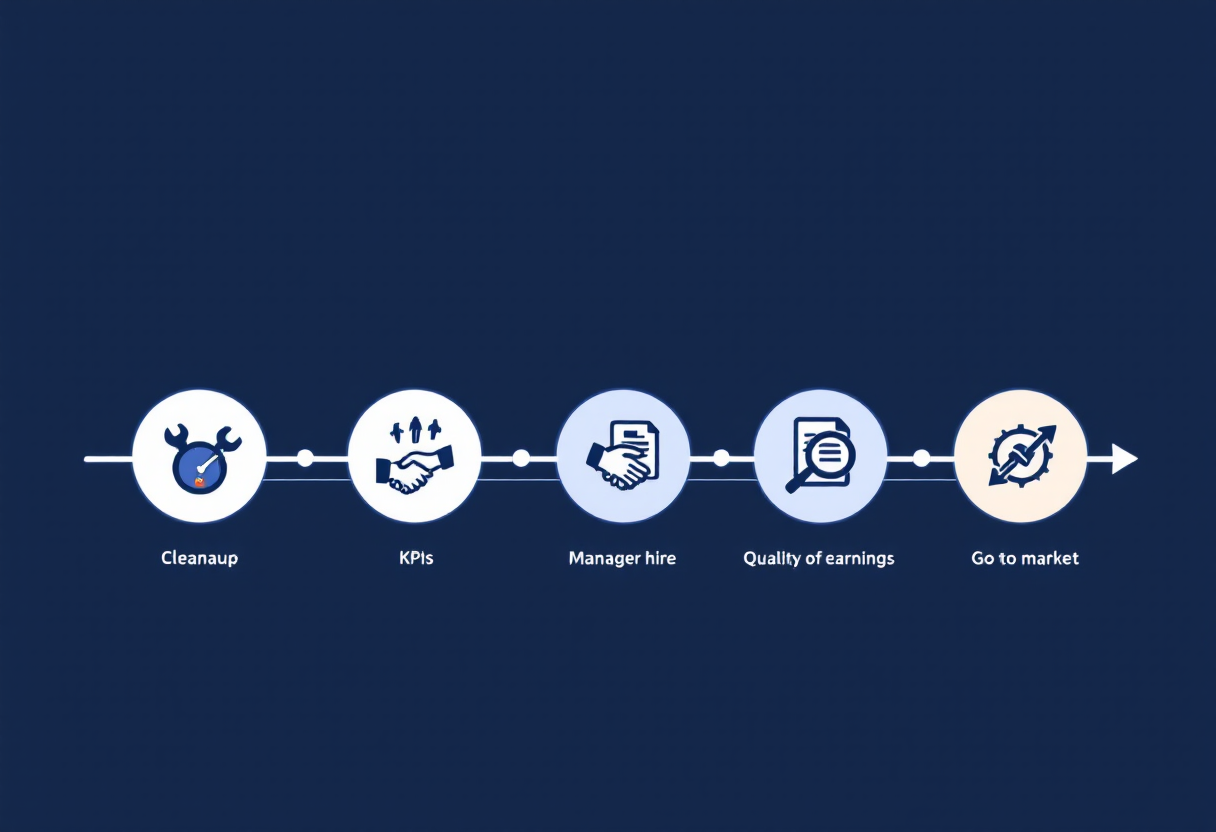
T-36 months: Cleanup phase
- Switch to accrual basis accounting if still on cash
- Pick a UC-purpose-built EMR (Experity, Athenahealth, eClinicalWorks, Epic) and start migration; budget 12 to 18 months for full implementation including coding optimization
- CPOM and MSO structure review by healthcare M&A counsel in every operating state; restructure if needed (especially CA, TX, NY, IL, NC)
- Start monthly OIG LEIE plus GSA SAM plus state Medicaid exclusion screening for every provider, employee, vendor, and owner
- Conduct a W-2 vs. 1099 classification audit; reclassify locums and moonlighters where needed
- Restruck related-party rent to FMV with appraisal
- Phase I ESA on any owned real estate
- Begin tagging EBITDA add-backs as they occur with documentation
- Identify medical director and operations leader hires (internal promotion or external recruit)
- Run a baseline outside coding audit (AAPC-certified or HIA) and remediate documentation gaps
T-24 months: Financial discipline and KPI infrastructure
- Medical director and operations leader onboarded
- Monthly close within 15 days; per-clinic and per-service-line P&L every month
- KPI dashboard live (visits per day per clinic, ARPV, payer mix, denial rate, AR days, net collection, provider productivity, conversion rate, telehealth share, occupational health revenue)
- Launch occupational health build-out: hire B2B rep, build contract menu, target 15% to 25% revenue from employer, workers comp, and occ-health
- In-network conversion on payers you are out-of-network on; renegotiate worst-rate commercial contracts
- Provider staffing rebalance toward APP-led model where state rules allow
- De novo or tuck-in one or two clinics if multi-site density is the strategic gap
- Document SOPs for every operational role
- Build the add-back bridge as a living document
T-12 months: QoE-ready close discipline, eliminate owner dependence
- Owner steps out of daily clinical operations; medical director and operations leader run the platform
- Owner takes a 2-week unplugged vacation as the stress test
- Run the sell-side QoE (budget $75K to $150K for multi-clinic platforms)
- Run a parallel outside coding audit (budget $15K to $40K) to lock down coding documentation
- Tighten balance sheet: clean AR, isolate deferred revenue from prepaid contracts, kill dormant inventory of expired medications and vaccines
- Final org chart review; backfill any gaps
- Final compliance scrub: PECOS reassignment readiness, DEA registration audit, state license audit, CON verification where applicable, HIPAA risk assessment refresh, OIG exclusion re-screen
- Lock in long-dated leases (7+ years remaining with renewal options) on clinics the buyer would keep
- Lock in 12 months of clean payer-mix and per-clinic data for the CIM
T-6 months: Pre-marketing prep
- Engage an M&A advisor (healthcare-specialized investment bank or M&A advisory firm). Typical fee structure for $5M to $50M deals: $25K to $100K monthly retainer credited against a success fee of 3% to 7% of enterprise value, often modified Lehman scaling. Healthcare-specialized firms with UC track record include Capstone Partners, FOCUS Investment Banking, M&A Healthcare Advisors, American Healthcare Capital, Coker Capital, SovDoc, Provident Healthcare Partners, Edgemont Partners, and Houlihan Lokey
- CIM drafted from QoE and operating model: company history, ownership, geography, service-line breakdown, payer mix, employer contracts, KPI dashboard, financial summary, growth narrative, transaction structure preferences
- Teaser drafted (anonymized 1-pager)
- Buyer list finalized: 30+ active PE-backed UC platforms as the starting universe, plus hospital-system buyers in your geography (Ardent, CHS Northwest, Bon Secours, HCA Florida, regional academic medical centers), plus the public strategics (Concentra for occupational health, AFC for franchise add-ons)
- Virtual data room populated
- Management presentation deck built and rehearsed (medical director and operations leader present alongside owner)
T-3 months: Go to market
- Teaser distributed; NDAs collected; CIMs distributed
- IOIs collected 2 to 3 weeks after the CIM goes out
- Narrow to 4 to 6 finalists for management meetings
- Management meetings; LOIs solicited
- Select LOI; sign with exclusivity (45 to 90 days typical for healthcare lower middle market, sometimes 120 for multi-state complexity)
- Enter confirmatory diligence: QoE, coding audit, OIG and Stark and AKS, payer-contract DD, PECOS, DEA, state license, HIPAA, environmental, tax, real estate
- Close. PECOS reassignment, DEA address modification, state license updates, and payer credentialing transfer trail the close by 30 to 90 days; the SPA addresses how revenue and risk allocate during the transition
End-to-end from engagement to close: 10 to 14 months for a well-run urgent care process (M&A Healthcare Advisors; American Healthcare Capital; SovDoc; Auxo Capital Advisors). Healthcare deals run longer than home services deals because of payer-credentialing and PECOS overhead.
Frequently Asked Questions
How long should I plan for before selling my urgent care clinic to a private equity buyer?
The owners who get top-quartile pricing start preparing 24 to 36 months before going to market. The minimum useful prep window for urgent care is 12 months, because most of the high-leverage levers (in-network conversion, building an occupational health book to 15% to 25% of revenue, installing an employed medical director, running a sell-side QoE plus parallel outside coding audit, restructuring the CPOM / MSO setup) need 12+ months of clean trailing-twelve-months data to be credible to a buyer. Owners who try to sell in under 6 months typically leave 15% to 30% of enterprise value on the table, and healthcare adds payer-credentialing and PECOS overhead that home services deals do not face.
What is a realistic EBITDA multiple for a $1.5M EBITDA, 3-clinic urgent care platform in 2026?
For a small regional urgent care group of 3 to 10 clinics in the $1M to $3M EBITDA band, the range is 5.0x to 8.0x in 2026 (CT Acquisitions; FOCUS Investment Banking, April 2025; Scope Research, April 2025; LBMC). The bottom of the band applies to Medicaid-heavy or out-of-network platforms with owner-physician dependence, a legacy EMR, single-payer concentration above 25%, and no occupational health book. The top of the band applies to commercial-mix above 50%, an employed medical director and operations leader, Experity or equivalent EMR fully implemented, 15% to 25% occupational health revenue, in-network with top commercial payers, and a clean coding audit on file. The Concentra / Nova Medical Centers deal at 9.4x EBITDA and 2.0x revenue is the recent disclosed comparable for the upper end. The 36-month prep playbook moves you from the bottom of the band to the top, often worth $3M to $6M of additional sale price on a $1.5M EBITDA base.
Should I get a quality of earnings report and a coding audit done before going to market?
For urgent care platforms at $1M+ EBITDA, yes to both. A sell-side QoE costs $75K to $150K typical for a multi-clinic UC platform, up to $400K+ for complex multi-state platforms (Eton Venture Services, 2025; Citrin Cooperman). An AAPC-certified outside coding audit runs $15K to $40K and is the single highest-impact compliance dollar in urgent care prep, because up-coding findings in a buyer's confirmatory diligence routinely cause 10% to 25% EBITDA downward repricing. On a $2M EBITDA business at a 6x multiple, a 20% EBITDA haircut is $2.4M of price erased. Doing the QoE and coding audit pre-market surfaces issues you can fix while you can still fix them, rather than during exclusivity when the buyer re-trades the deal.
How much commercial payer mix and occupational health revenue do PE buyers want to see?
The PE-attractive urgent care payer profile is commercial above 50%, Medicare 15% to 25%, Medicaid below 25%, no single payer above 20%, and in-network with the top 3 to 5 commercial payers in market. The UCAOA 2017 Benchmarking Survey (the most recent comprehensive UC payer-mix benchmark published) reported the industry average at roughly 67% commercial, 17% Medicare and Medicaid, 12% cash, though that data is somewhat stale. On occupational health, the target is 15% to 25% of total revenue from employer contracts, workers comp, DOT physicals, and on-site clinics. Workers comp visits pay $200 to $400 vs. $150 to $200 for commercial UC, and insurers pay 97% of workers comp claims vs. 65% of commercial UC claims (Experity 5-year employer services analysis). The Concentra / Nova Medical Centers deal at 9.4x EBITDA on an occupational-health-heavy book is the benchmark for what this profile transacts at.
Do I need to install an employed medical director and operations leader before I sell?
If your goal is to maximize price, yes, ideally 18 to 24 months pre-sale. Owner-physician dependence is the most-cited multiple haircut across UC valuation literature (SovDoc; Scope Research; FOCUS Bankers; HealthFMV; LBMC). In CPOM-strict states (CA, TX, NY, IL, NC, NV, CO, NJ) and states with strict APP supervision ratios (FL, NC, TX), the buyer needs a credentialed replacement medical director on day one. On a $1M to $5M EBITDA business, getting the owner out of the chair moves the multiple from the 5x to 6x band into the 7x to 9x band, worth $2M to $15M of additional sale price. A full-time employed medical director runs $325K to $400K typical (OnCall Solutions APP and physician salary guides; Barton Associates). An operations leader runs $150K to $250K plus bonus. Both pay for themselves many times over in multiple uplift.
Should I sell my clinic real estate with the business or hold it back?
Holding the real estate separately is usually the higher-value path for urgent care. Move it into a separate LLC at fair market value triple-net rent to the operating PC or MSO. This often lifts the implied EBITDA multiple on the operating business because the buyer is not forced to underwrite real estate exposure (Plante Moran; Northmarq sale-leaseback primer). You then have three options at close: assign the lease to the buyer, sell the real estate to the buyer at appraised value, or execute a sale-leaseback with a triple-net REIT or healthcare real estate investor at the same time as the operating company sale. Urgent care real estate transacts at 6.5% to 8.0% cap rate in 2026; on $200K of clinic NOI, that is $2.5M to $3.0M of additional value separately monetized (W. P. Carey; Northmarq; Plante Moran). The sale-leaseback path can convert up to 100% of property market value to cash, vs. 70% to 80% LTV via traditional refinancing.
What to Do Next
The urgent care owners who get the top-quartile multiple all do the same four things. They start preparing 24 to 36 months before they want to be out. They install an employed medical director and operations leader 12 to 18 months pre-sale. They invest in a sell-side QoE plus parallel outside coding audit before any buyer sees a CIM. And they get the CPOM / MSO structure and PECOS provider enrollment file clean enough that the buyer's healthcare counsel cannot find a reason to re-trade.
The 2024 to 2026 cycle has reset how buyers underwrite urgent care. The Concentra / Nova Medical Centers deal at 9.4x EBITDA in March 2025 anchored the realistic comp for sub-$30M EBITDA occupational health heavy platforms. The Walgreens / VillageMD / CityMD unwind plus the $5.8B writedown taught every buyer to underwrite integration risk harder. The FTC, DOJ, and HHS inquiry that named urgent care as a target sector in March 2024 added a reputation-risk layer to PE diligence. And the September 2025 FTC noncompete vacatur threw provider non-compete enforceability back to state law. The buyers who closed deals through this cycle are buying clean files. Yours has to be one of them.
If you are 12+ months from a potential exit and want a structured pre-sale optimization roadmap, CT Acquisitions has healthcare operations specialists in our partner network who run multi-quarter prep engagements specific to urgent care and occupational medicine. If you are 6 to 12 months out and ready to start the sell-side process, our M&A advisory team runs the buyer outreach across PE platforms, hospital systems, and the public strategics. No fee to you on buy-side introductions; sell-side mandates are paid on success at closing. Either way, the first 30 minutes are free.
Ready to talk?
Schedule a 30-minute exit-readiness call
Or read more: How to Sell an Urgent Care Center (active sale guide) | How to Sell a Medical Practice | Healthcare Business Valuation Guide
Ready to Explore Your Options?
A 30-minute confidential conversation is all it takes.