How to Prepare Your Septic Service Business for a Sale or Exit in 2026: The 36-Month PE-Buyer Playbook
Preparing your septic service business for exit in 2026 is a 36-month playbook. The first 12 months tighten the operating story around pumping-route density and inspection-contract recurrence, the middle 12 fix pre-LOI diligence gaps around disposal permits and truck fleet condition, and the final 12 turn one offer into a real competitive process. The septic sector is early in its PE consolidation cycle, which is a good time to prepare.
Exiting your septic business is the single largest financial event most owners will ever face. This guide is the no-fluff playbook for septic business owners who are 12-36 months from sale, covering how PE-backed buyers actually value your business in 2026, the 12 levers that move your multiple, pre-LOI diligence, deal-killers to fix before going to market, and the full 36-month exit prep timeline.
Updated April 2026 · CT Acquisitions
Most septic owners decide to sell, hire a broker, and find out 90 days later that their business is worth 30% to 40% less than they thought. The owners who get the top-quartile price start preparing 24 to 36 months before they ever talk to a buyer. This guide is the 36-month playbook for septic pumping, installation, and repair operators who want to maximize the multiple before going to market. It covers what private equity actually buys in septic, the 12 levers that move multiples, the documents PE will ask for before they send an indication of interest, and the deal-killers that re-trade septic transactions during confirmatory diligence. Every number cites its source. Every recommendation comes from how the most active septic buyers in 2026 actually behave.
If you are 6 to 36 months from a possible exit, this is the work that turns a 4x EBITDA outcome into a 7x EBITDA outcome. On a $2M EBITDA septic shop, that is the difference between an $8M sale and a $14M sale. Whether you want to prepare your septic service business for a sale to private equity, prepare your septic service business for an exit to a strategic acquirer like Wind River Environmental, or simply maximize value over the next 1 to 3 years before going to market, the work below applies.
Building toward an exit in 12 to 36 months?
CT Acquisitions runs sell-side advisory for septic owners $1M+ EBITDA. We also have environmental-services operations specialists in our partner network who run pre-sale optimization engagements when the timeline is longer. No fee to you on buy-side introductions; sell-side mandates are paid on success at closing.
What Private Equity Actually Buys in Septic Service (2026)
Septic is an emerging PE consolidation lane. Capstone Partners reports water and wastewater treatment PE-backed deal volume up 41.7% year over year through YTD 2025 (34 deals vs. 24 in the prior YTD period). Private strategic acquirers in industrial and environmental services completed 25 sector deals YTD 2025 vs. 16 YTD 2024 (Capstone Partners, “Industrial & Environmental Services M&A Update”, 2025). The US septic, drain, and sewer cleaning services market sits at about $8.1B in 2025 with a 6.7% CAGR over 2020 to 2025 (IBISWorld 2025), and the decentralized wastewater sector is in a documented workforce shortage with an aging operator base (US EPA, “Decentralized Wastewater Treatment Workforce”, 2025). The sponsor money flowing in is not random. PE buys specific profiles, and the profile you build determines the multiple you get.
The PE-attractive septic profile
- EBITDA threshold for a platform-quality deal: $1M to $3M is the entry band where sponsor-backed platforms will run a competitive add-on process. Above $5M EBITDA you become an attractive bolt-on for Wind River or a regional plumbing-and-septic combo platform. Above $15M EBITDA you are a platform candidate yourself.
- Recurring pumping route revenue: 40% or higher is the line between demand-only and premium. Demand-only pumping shops trade at 2.0x to 2.8x SDE. Shops with a managed pumping route trade at 4.0x to 4.5x+ SDE (10X Business Broker, “How to Properly Value a Septic Business”, 2025).
- Geography: Florida, Texas, the Carolinas, Virginia, Georgia, the mid-Atlantic, and PE-active Northeast metros are where 2024 to 2026 septic sponsor demand concentrates. Wind River, Septic Blue, P3 Services, and Seekye Capital all sit in those geos.
- Customer concentration: No single customer above 10% of revenue. Top 5 customers below 30%. Concentration above 20% triggers buyer pushback; above 25% triggers a 15% to 30% valuation discount or buyer withdrawal (Beancount.io May 2026; Strategex; Eagle Rock CFO; Morgan & Westfield).
- Service mix: Recurring pumping route plus a commercial book (restaurants, multi-family, manufacturing) plus an ATU service contract base prints above the blended industry median. Install-heavy shops with no recurring pumping discount.
- Owner role: Owner is in management, not driving a vacuum truck or holding the only qualifier license. GM in place 12+ months pre-sale and a second licensed qualifier on payroll.
- Disposal redundancy: Two or more POTW or land-application arrangements with written multi-year agreements. Single-disposal-site dependence is a stated deal-killer (Centergrowth septic broker guide 2025).
Active septic PE platforms in 2026
The list below covers the most active sponsor-backed septic and septic-adjacent platforms in the 2024 to 2026 cycle. This is who will see your teaser. Add-on counts are point-in-time. Sources: Wind River Environmental press releases 2023 to 2026; Gryphon Investors press release April 4, 2017; ION Analytics June 25, 2024; Goldman Sachs Asset Management press release July 2025; Audax Private Equity 2025; Georgia Oak Partners press releases; Hidden Harbor Capital Partners press releases; PRNewswire P3 Services release March 4, 2025; MFG Partners press release November 17, 2022; Businesswire ProSite Services release October 7, 2025; Businesswire Total Sanitation Services release August 26, 2025; Aurora Capital Partners press releases; Seekye Capital August 15, 2025; PrivSource environmental services tracker.
| Platform | Sponsor | Profile |
|---|---|---|
| Wind River Environmental | Gryphon Investors (majority since April 2017; exploring sale per ION Analytics June 2024 at reported ~$50M to $60M EBITDA via William Blair and Baird) | 100+ historical acquisitions; 8+ disclosed 2024 to 2026 including Brockwell’s, Greenway/TCW, Hapchuk, AA Cut Rate, Triple T, M&S Septic + Fenkner, Keystone Wastewater, J&M Transfer; Eastern Seaboard, Mid-Atlantic, Florida, Northeast; septic + grease + liquid waste + drain |
| Liquid Environmental Solutions (LES) | Goldman Sachs Alternatives Infrastructure (closed September 2, 2025 from Audax) | 13 add-ons over the Audax 8-year hold; 90+ locations in 50 states; recent adds Commercial Pumping Services (Nov 2025), Grease Masters (Dec 2025), New Orleans Grease Trap Cleaning (Mar 2026); grease trap, used cooking oil, liquid waste |
| Septic Blue | Georgia Oak Partners (acquired November 15, 2023) | Add-ons A-1 Septic Services Orlando (Sept 10, 2025) and Advanced Septic Florida (Oct 31, 2025); Atlanta, Charlotte, Raleigh, Orlando; residential septic pumping, install, inspection |
| P3 Services (formerly Peltram Plumbing Holdings) | Stellex Capital Management (AUM $2.8B+) | 6 add-ons in 2024 including Forsyth Septic & Rooter (Winston-Salem NC), Schrader Plumbing (Dallas), Bob’s Backflow (Jax FL), Rolland Reash Plumbing (Jax FL), The Plumbing & Drain Co (Seattle), 2 Sons Plumbing (Seattle); plumbing + septic + rooter combo |
| The Rapid Group (TRG) | Hidden Harbor Capital Partners | 2024 to 2026 add-ons O&M Solutions, Pumping Solutions Inc (Dec 10, 2025 Clifton NJ), Metro Pumps & Systems; Northeast and NY metro; pump service and repair to water and wastewater facilities |
| Seekye Capital | Seekye Capital (firm founded 2025, Fairfax VA) | Inaugural investment August 15, 2025: platform formation combining SES Mid Atlantic, Advantage Septic, and Joiner Micro Laboratories; Virginia and DMV; soil eval, septic design/install/inspection, environmental lab |
| CST Utilities / Chuck’s Septic Tank & Drain Cleaning / I-Bore | MFG Partners (8th platform investment November 17, 2022) with PNC Mezzanine and Centerfield Capital | Platform formation; Grove City OH base; excavation, boring, drain cleaning, pumping for public utilities and telecom |
| ProSite Services | RF Investment Partners (platform formed August 2024) | 5 add-ons in 2024 to 2025: Rent-A-John (NC), Potter’s Potties (VA, Mar 2025), Texas Throne, A&B Portable Toilets, Parks Portable Toilets; NC, VA, TX, Mid-Atlantic; portable sanitation, septic-adjacent |
| Total Sanitation Services (TSS) | International parent (Canada-based) | First US deals 2025: American Sanican (Portland OR) and Cap City Rentals (Austin TX); national, expanding US in 2025; portable sanitation and septic-adjacent |
| Liberty Waste Solutions | Allied Industrial Partners | Add-ons AJ Disposal (NC, Feb 2026), Randolph County Garbage Services (NC, May 2026); North Carolina; solid waste plus residential collection (adjacent) |
| Straight Flush Rentals / MWM Environmental | Concentric Equity Partners (acquired April 20, 2026) | Platform formation; Alberta Canada cross-border comp; portable sanitation, septic, temp fencing |
| Impact Environmental Group (IEG) | Aurora Capital Partners (growth capital April 2023) | Multiple add-ons; national and Europe; products and services to waste and recycling industry (septic-adjacent) |
Add to that list the strategic acquirers. Wind River Environmental doubles as the dominant strategic on the septic side, having completed 100+ acquisitions along the Eastern Seaboard since 2009 per Mergermarket (ION Analytics 2024) and continuing to actively absorb sub-$10M EBITDA targets. GFL Environmental (NYSE: GFL) recently agreed to sell its Environmental Services division to Apollo and BC Partners for ~$5.6B and used proceeds for solid-waste M&A, with residential septic appetite limited but real (Waste Dive 2024). Waste Connections (NYSE: WCN) closed 24 acquisitions in 2024 representing ~$750M of annualized revenue with regional residential-septic-adjacent fit in select deals (Waste Dive Q4 2024 earnings recap; Waste Connections Form 10-Q Q2 2025). Note that United Site Services, previously a portable sanitation strategic, is owned by Platinum Equity and filed for Chapter 11 protection on December 29, 2025 (Bondoro and Octus case summaries), removing it as an active acquirer for now.
Septic Valuation Multiples in 2026 (What You Are Actually Worth)
The multiple a buyer pays comes down to your size, your service mix, your recurring pumping route revenue, and your geographic fit. Here is the 2026 range, cross-referenced from 10X Business Broker’s septic-vertical multiple framework, Equidam industry tables, Sundance Financial, Capstone Partners environmental services M&A reports, and the platform-level transaction record in Section 1.
SDE multiples (smaller, owner-operated)
| SDE band / profile | SDE multiple | Source |
|---|---|---|
| Lower tier: older equipment, weak financials, no recurring contracts, owner-dependent, limited service area | 2.0x to 2.8x | 10X Business Broker, “How to Properly Value a Septic Business”, 2025 |
| Mid-range: solid financials, multiple trucks, some recurring revenue, established reputation | 3.0x to 3.8x | 10X Business Broker 2025 |
| High end: multiple trucks, strong recurring pumping contracts, documented processes, management team, strong digital presence, high margins, growth potential | 4.0x to 4.5x+ | 10X Business Broker 2025 |
| Demand-only residential pumping, under $500K SDE | 2.5x to 3.5x (estimate) | Cross-referenced from Centergrowth septic broker guides 2025 and 10X 2025 |
The SDE valuation formula septic brokers use: Business Value = (SDE x Multiple) + Fair Market Value of Equipment. The equipment add-on matters more in septic than in most service trades because vacuum trucks carry $40K to $300K of fair market value each (KeeVac Industries 2025; Satellite Industries 2025).
EBITDA multiples (PE-attractive size)
Septic does not publish a clean multiple grid the way HVAC does. The bands below are estimates synthesized from 10X Business Broker SDE ranges, Equidam and Sundance Financial industry tables, Capstone Partners environmental services M&A reports, and reverse-engineering from the platform-level Wind River, LES, and Septic Blue transaction record. Treat all EBITDA bands above $1M as ranges to model against, not as quoted deal multiples.
| EBITDA band | Pumping-route-heavy residential | Commercial / grease / mixed liquid waste |
|---|---|---|
| Under $1M EBITDA | 3x to 5x | 4x to 6x |
| $1M to $3M EBITDA | 5x to 7x | 6x to 8x |
| $3M to $10M EBITDA | 7x to 9x | 8x to 10x |
| Platform tier $10M+ EBITDA | 9x to 12x | 10x to 13x |
| Mega-platform (Wind River / LES scale) | 12x to 15x+ | 12x to 15x+ |
IBBA Q4 2025 Market Pulse blended multiples for reference: $1M to $2M deals at ~3.1x SDE/EBITDA, $2M to $5M at ~4.1x EBITDA, $5M to $50M at ~5.5x EBITDA (IBBA Market Pulse Q4 2025, PR Newswire February 24, 2026). Septic shops with a documented recurring pumping route typically print above the blended industry median because pumping route revenue qualifies as recurring under most QoE methodologies. Equidam’s 2026 industry tables put the broader Industrials sector at a median ~5x EBITDA with a 2.3x to 8.2x range (Equidam, “EBITDA Multiples by Industry in 2026”).
Recent disclosed septic transactions (2023 to 2026)
| Acquirer | Target | Date | Value / detail |
|---|---|---|---|
| Goldman Sachs Alternatives (Infrastructure) | Liquid Environmental Solutions (from Audax) | September 2, 2025 | Terms not disclosed; 13 add-ons over Audax 8-year hold; ~90 locations in 50 states |
| Gryphon Investors (per ION Analytics) | Wind River Environmental (exploring sale) | Mid-2024 process via William Blair and Baird | Reported ~$50M to $60M EBITDA at the time; no closed sale through May 2026 |
| Georgia Oak Partners | Septic Blue (founder Bob Minkert) | November 15, 2023 | Terms not disclosed; Septic Blue had 18% CAGR pre-deal |
| Wind River Environmental | Hapchuk Inc + Liquid Assets Disposal (Washington PA + WV) | April 25, 2025 | Terms not disclosed |
| Wind River Environmental | M&S Septic Services + Fenkner Septic Services (PA) | August 2025 | Terms not disclosed |
| The Rapid Group (Hidden Harbor) | Pumping Solutions Inc (Clifton NJ, founded 1996) | December 10, 2025 | Terms not disclosed; LBC Credit Partners financed |
| Seekye Capital | SES Mid Atlantic + Advantage Septic + Joiner Micro Laboratories (VA) | August 15, 2025 | Terms not disclosed; platform formation |
Sources: Goldman Sachs Asset Management press release July 2025; Audax Private Equity 2025; Houlihan Lokey transaction page; Waste360 2025; ION Analytics / Mergermarket June 25, 2024; Gryphon Investors press release April 4, 2017; Georgia Oak Partners press release November 15, 2023; Wind River Environmental press releases April 25 and August 2025; Hidden Harbor Capital Partners press release December 10, 2025; PRNewswire MidCap Advisors release; PRLog Seekye Capital August 15, 2025; PrivSource environmental services tracker.
A coverage note: virtually no septic-specific add-on transactions in 2024 to 2026 disclose purchase price publicly. Multiples above are reverse-engineered from platform-level disclosures like Wind River’s reported ~$50M to $60M EBITDA (ION Analytics June 2024) and from segment-level Capstone Partners reports rather than from individual deal announcements.
The 12 Value Levers That Move Your Multiple (Ranked by Impact)
These are the levers that move septic multiples in the 24 months before a sale. Each one has a current state, a target state, and an estimated financial impact. The ordering is by dollar impact per unit of effort, based on cross-source synthesis from 10X Business Broker, Centergrowth, ServiceTitan and ServiceCore septic-vertical content, Tank-Track, Owned & Operated, EPIC Septic, Blue Ribbon Septic, and the Capstone Partners environmental services M&A reports.
Lever 1: Build the recurring pumping route to 40%+ of revenue
Current: Demand-only pumping calls when customers remember; under 20% of revenue tied to a managed pumping schedule; no last-pumped-date discipline. Target: 40%+ revenue from a managed pumping route with residential customers on 3 to 5 year auto-renewal pumping, commercial on 1 to 2 year cycle with auto-billing, and grease trap customers on monthly or quarterly schedules with auto-renewal. Impact: Recurring revenue moves a septic shop from the 2.0x to 2.8x SDE band into the 4.0x to 4.5x+ SDE band per 10X Business Broker 2025. On a $750K SDE business that is a $1.5M sale vs. a $3.4M+ sale. At PE scale ($3M+ EBITDA), the equivalent delta is roughly +2x to +4x EBITDA, worth $6M to $12M of price. How: Set up a customer database with last-pumped date for every account. Send “you are due” mail and SMS at the 3-year mark. Convert demand calls to a quarterly grease trap or annual pumping contract on the spot. Auto-renew with stored payment.
Lever 2: Move the owner out of the chair and license a second qualifier
Current: Owner drives a vacuum truck, holds the state qualifier license, signs every invoice, is on every commercial estimate. Target: GM in place 12+ months before going to market. Owner doing under 30 hours per week of operational work. A second licensed qualifier on payroll so the state installer or maintenance-provider license is not personally tied to the owner. Sales and field operations have promoted-from-within leadership. Impact: Owner dependence is the single most-cited multiple haircut in service-business valuation literature (10X 2025; Centergrowth 2025). On a $1M to $3M EBITDA septic business, this moves the multiple from the 4x to 5x band into the 5x to 7x band, worth $1M to $6M of price. How: GM hire 18 to 24 months pre-sale (typical septic GM comp $100K to $175K per Indeed and ZipRecruiter wage data 2026). License a second qualifier under your state’s path: Florida 3-year Registered Septic Tank Contractor then 30 hours coursework for Master; California 4-year apprenticeship for CSLB C42 Sanitation System Contractor; Texas TCEQ 1+ year as Installer I before Installer II; New York DEC, Virginia DPOR, Massachusetts Title 5, Pennsylvania DEP as applicable. Take a 2-week unplugged vacation as the stress test.
Lever 3: Tighten service mix toward commercial pumping and grease trap
Current: 80% residential pumping plus repair plus occasional install; under 10% commercial. Target: 25% to 40% commercial revenue across restaurants, multi-family, manufacturing, retail with grease, RV parks, mobile home parks. Quarterly grease trap contracts. Multi-tank commercial accounts on 1 to 2 year cycles. Impact: Commercial pumping offers better route density and per-stop economics (Owned & Operated 2025; Blue Ribbon Septic 2025). Average commercial pumping ticket runs $485 vs. residential $290 to $425 per Tank-Track 2026 and Financial Models Lab 2026. Quarterly grease trap pumping is the industry standard for Central Texas restaurants per EPIC Septic 2025 and produces predictable monthly billing. Estimate +0.5x to 1.5x multiple uplift plus direct revenue growth. How: Build a B2B sales motion: cold-call restaurant clusters, multi-family property managers, food trucks, mobile home parks. Lead with the operational-shutdown risk message (commercial properties face immediate shutdown on failure, making scheduled maintenance non-negotiable per Blue Ribbon Septic 2025).
Lever 4: Get on field-service software and run a real monthly close
Current: QuickBooks plus paper tickets or simple spreadsheets. No service-line P&L. No monthly close. Truck productivity is anecdotal. Target: ServiceTitan, FieldEdge, ServiceCore, or FieldPulse in place 24+ months. Monthly close within 15 days. Real KPI dashboard tracking jobs per truck per day, route density, average ticket by service line, re-pump rate, grease contract renewal rate, ATU contract renewal rate, commercial vs. residential mix, and gross margin by service line. Impact: Estimate +0.5x to 1.0x multiple uplift, driven mostly by the speed and credibility of data-room responses during diligence. Septic-vertical FSM software is now mature enough that buyers expect to see it (ServiceTitan “Best Septic Business Software 2026”; FieldEdge 2026; ServiceCore “Route Optimization for Septic Tank Routing” 2026). PE platforms typically want acquired companies on the same FSM as the rest of their portfolio. How: Budget $25K to $100K implementation cost plus per-user license. Force adoption with payroll-tied job-completion compliance. Tag every customer with system type, last-pumped date, and recurring-revenue flag.
Lever 5: Lift average ticket and price the right book
Current: Residential pumping at $290 to $350. No dispatch or trip fee. Pricing not reviewed annually. No options-based commercial bidding. Target: Residential pumping at $400 to $500 with regional adjustment. Dispatch fee held. Annual 4% to 8% price book refresh. Commercial bids bundle scheduled pumping, emergency call-outs, and grease maintenance as options. Impact: Direct EBITDA growth. A $2M revenue residential shop that lifts average ticket by $100 across 5,000 jobs per year adds $500K to revenue, with most of that dropping to EBITDA at typical septic gross margins. At a 5x EBITDA exit, $500K of EBITDA growth is $2.5M of sale price. Industry baseline for residential pump-out: $290 to $650 nationally with $425 typical per Tank-Track 2026 and Angi 2026. How: Flat-rate pricing book. Quarterly refresh. Technician training on options presentation. Eliminate driver discretion on the meter.
Lever 6: De-concentrate the customer base (especially commercial)
Current: Top commercial customer (a restaurant group, multi-family operator, manufacturing plant) above 15% of revenue. Target: Top customer below 10%; top 5 below 30%. Impact: Concentration above 20% triggers buyer pushback; above 25% triggers a 15% to 30% valuation discount or buyer withdrawal (Strategex; Eagle Rock CFO; Beancount.io May 2026; Morgan & Westfield). For septic specifically, a single commercial account loss can also strain disposal-site planning if that customer accounts for a meaningful share of daily route gallons. SBA lenders, who finance much of the lower middle market, get uncomfortable at 20% (Wall Street Prep 2025). How: Pursue more commercial accounts across adjacent verticals (restaurants + multi-family + manufacturing + retail + RV parks and mobile home parks), expand the residential footprint county by county, intentionally kill the discount on the biggest account so the relative weighting shrinks naturally.
Lever 7: Build an ATU and advanced-treatment service contract book
Current: No or minimal aerobic treatment unit (ATU) service base; advanced systems serviced ad hoc with no contracts. Target: Documented ATU service contract book of 200 to 1,000+ customers at $200 to $600 per year per contract (Advanced Aerobic Systems 2025; ACE Septic 2-Year ATU Maintenance Plan 2025; SepticTankBusiness 2025). Impact: Most states require ATU homeowners to maintain an active service contract with a licensed maintenance provider (Texas TCEQ Maintenance Provider, Florida DEP). That makes ATU contracts among the stickiest recurring revenue in residential septic, with two to four mandatory inspections per year per system. Estimate +0.25x to 0.5x multiple uplift on the operating company plus direct ARR growth. How: Sales-team comp on ATU contract conversion at every install. Educate ATU homeowners on the legal mandate at first service call. Auto-renew with stored payment. Cross-sell peat-moss and sand-filter system service where present.
Lever 8: Disposal-site redundancy
Current: One POTW accepts all your septage; one land-application site under a single state permit; verbal arrangement with no written contract. Target: 2+ disposal arrangements with written multi-year agreements, each with documented capacity, fee schedule, and change-of-control language. Backup land-application sites permitted under 40 CFR Part 503 with complete 5-year records. Impact: Single-disposal-site dependence is a stated septic deal-killer (Centergrowth septic broker guide 2025). A buyer’s environmental diligence will model the scenario of primary-site loss. Estimate +0.25x to 0.5x multiple uplift on the operating company. More importantly, this prevents a 20% to 40% discount or walk during confirmatory. National disposal fee range: $0.024 per gallon Winston-Salem NC to $0.076 per gallon US Virgin Islands as of January 2026 per Tank-Track 2026. How: Identify and contract with 2+ POTWs in operating geography. Build relationships with neighboring counties. If land-applying, ensure 40 CFR Part 503 Subpart B records are complete: site location, acres, dates, nitrogen requirement, application rate, pathogen and vector-attraction-reduction records, all 5-year retention per Part 503.18.
Lever 9: EBITDA add-back hygiene and fleet-CapEx defensibility
Current: Owner mixes personal expenses through the business; vehicle and vacuum-truck CapEx irregular; no add-back schedule. Target: Every potential add-back documented as it happens with the underlying invoice; FMV rent appraisal on file if owner owns the shop; clean payroll for owner-family members; fleet CapEx normalized over a 7 to 12 year truck replacement cycle and disclosed transparently. Impact: On a 6x multiple, every $100K of clean add-backs equals $600K of sale price (Morgan & Westfield QoE guide). Septic-specific add-back note: 10X Business Broker 2025 explicitly identifies fleet CapEx as a septic-vertical add-back when defending SDE. How: Monthly add-back log. Document the business purpose of every charge. FMV rent appraisal if owner-owned shop. Maintain a 7 to 12 year vacuum-truck replacement schedule with full documentation.
Lever 10: Fleet age and vacuum-pump compliance discipline
Current: Mixed fleet age; some trucks past their 7 to 12 year useful life; vacuum-pump maintenance logs incomplete; DOT inspections behind. Target: Documented annual DOT vacuum-truck inspections current on every unit; hose pressure-test logs maintained; vacuum-pump make, model, and service log per truck; CDL driver qualification files complete per DOT 49 CFR Part 391; capital lease vs. owned vs. financed clearly identified; replacement schedule in the operating plan. Impact: Every vacuum truck operating on public roads must pass annual DOT inspection (KeeVac Industries DOT Inspection Guide 2025), and drivers must hold a CDL Class A or B with tanker endorsement (KeeVac CDL Guide 2025). A fleet that needs $500K+ of immediate truck replacement reduces purchase price by close to $500K because the buyer prices the post-close CapEx forecast directly into the offer. New replacement runs $140K to $300K per truck (KeeVac 2025). How: Spreadsheet per truck: number, make/model/year, tank capacity, mileage, ownership status, monthly payment, condition, last DOT inspection date and result, last hose pressure-test date. Pull FMCSA SAFER scores; clean up out-of-service history before going to market.
Lever 11: Working capital normalization
Current: Seasonal A/R, inventory undisciplined, prepaid maintenance liability not isolated. Target: TTM-average working capital stable and predictable; deferred revenue on prepaid ATU contracts, residential pumping memberships, and grease trap plans separately tracked on the balance sheet. Impact: The working capital peg is set off the trailing 6 to 12 months (BDO and Morgan & Westfield NWC guides). Volatile working capital lets the buyer set a higher peg, which subtracts from purchase price. Estimate: poorly managed working capital can cost 2% to 5% of enterprise value at close. How: Tighten A/R collection cycle, manage truck-stock inventory on parts and chemicals, isolate prepaid maintenance liability so the QoE accountant treats it cleanly.
Lever 12: Real estate decision (shop + yard + land-application site)
Current: Shop, yard, and truck-parking real estate held in same entity as the operating business, or in an LLC at above-FMV rent. Possibly a permitted land-application site held inside the operating real estate footprint. Target: Operating real estate in a separate LLC at FMV NNN lease to the operating company. Land-application site real estate treated separately given its environmental risk profile. Impact: Separating real estate often lifts the implied EBITDA multiple on the operating business because the buyer is not forced to underwrite real estate or environmental land exposure (Plante Moran sale-leaseback primer; Northmarq sale-leaseback guide). Estimate +0.5x to 1.0x multiple uplift on the operating company. A sale-leaseback on shop real estate can convert up to 100% of property market value as cash vs. 70% to 80% LTV via traditional financing. How: Get an FMV market rent study now. Restruck rent to FMV. Decide before going to market whether real estate is in or out of the deal. Land-application sites with PFAS or other environmental sensitivity may need to stay out of the buyer’s deal entirely.
Want to grow your business to maximize value before exiting?
We connect septic owners with operations experts in our partner network who run 12 to 24 month pre-sale optimization engagements. The engagement pays for itself in incremental sale price.
What PE Asks Before They Send an LOI (The Pre-LOI Diligence Stack)
Before a PE firm commits to a letter of intent, they ask for a focused diligence package. The list below is the real ask from a 2026 sponsor targeting a septic platform or add-on. The “why” and “how to prepare” expand each item to what is typical across the industry. Sources: Colonnade Advisors podcast 020; Auxo Capital Advisors sell-side process guide 2025; Wall Street Prep sell-side primer; Riveron M&A advisory; BDO sector publications.
1. Income statements for 2024, 2025, and the latest trailing twelve months
Why PE asks: They are building the LTM EBITDA they will multiply. They want trend, seasonality (septic skews to spring and fall pumping cycles in some climates), and any one-time movers. LTM is the bridge between the most recent year-end and today, so the headline price reflects current run-rate, not stale data.
How to prepare: Accrual-basis P&L by month with a service-line P&L isolating residential pumping (recurring), commercial pumping (recurring, higher ticket), grease trap pumping (commercial recurring), new installation (one-time, lower multiple), repair (high margin, lumpier), ATU service contracts, and portable toilet rental if applicable. Reconcile to tax returns. Disposal expense and fuel are the two biggest cost lines and need clean monthly trending.
2. Balance sheet at the latest month
Why PE asks: Two reasons. First, to start sizing the working capital peg in the purchase agreement. Second, to identify net debt (cash minus interest-bearing debt minus debt-like items). For septic, deferred revenue on prepaid ATU contracts and pumping plans sits as a debt-like item; capital lease balances on vacuum trucks reduce price; customer deposits on multi-stage installation jobs are also debt-like.
How to prepare: Tie the balance sheet to the trial balance. Identify which liabilities are debt-like. Reconcile vacuum truck book value vs. fair market value (these run $40K to $300K each per KeeVac Industries 2025). Isolate prepaid ATU/pumping/grease plan deferred revenue as a separate line so the QoE accountant treats it cleanly.
3. Add-back estimates
Why PE asks: To preview your adjusted EBITDA story before sinking diligence cost into the file. Aggressive or undocumented add-backs discount the rest of your numbers.
How to prepare: Build the bridge line by line. Septic add-backs that hold up: owner compensation above market, owner truck and personal travel, family-member payroll, related-party rent at above-FMV (added back to the FMV delta only), one-time legal fees from past spill claims or compliance settlements, fleet CapEx normalization (truck capital expenditures are added back to SDE per 10X Business Broker 2025, distinct from the EBITDA depreciation add-back), one-time software conversion costs, COVID-era ERC if any.
4. Anonymized employee roster (titles, start dates, pay structure)
Why PE asks: To stress-test technician tenure and the W-2/1099 classification mix. The decentralized wastewater sector has documented workforce shortage with an aging workforce expected to retire in high numbers (US EPA 2025). Buyers want to see if the operating crew is a flight risk or a defensible asset. They also want to see who holds the state installer or qualifier license.
How to prepare: Roster columns: role (CDL driver, installer, helper, dispatch, office), hire date, full-time vs. part-time, W-2 vs. 1099 with classification rationale, comp structure (hourly, salary, commission, spiff), CDL class held (Class A or Class B with tanker endorsement), state installer license number (FL DEP Registered Septic Tank Contractor or Master Septic Contractor, TX TCEQ Installer I/II or Maintenance Provider, CA CSLB C42), NAWT certifications held (Vacuum Truck Technician, Inspector). Calculate 12-month and 24-month rolling driver and tech retention. Identify any non-compete or non-solicit on file.
5. Revenue breakdown and average ticket by service mix
Why PE asks: The single most diagnostic exhibit. It tells the buyer whether the business is install-heavy (one-time, lower multiple), pumping-route-heavy (recurring, higher multiple), repair-heavy (high margin), or commercial-grease-heavy (recurring, highest multiple).
How to prepare: Three columns at minimum by service line, 36 months trailing plus 2024, 2025, and LTM: residential pumping (job count, average ticket, recurring vs. one-time), commercial pumping (restaurants, multi-family, manufacturing, contract vs. on-call), grease trap pumping (restaurant book, monthly/quarterly cycle), new installation (residential vs. commercial, average project size $10K to $50K+ for ATU systems per SepticTankHub 2026), repair (per-call, average ticket, gross margin), ATU service contracts (count, ARR, plan mix), portable toilet rental if applicable. Benchmark: residential pump-out $290 to $650 nationally with $425 typical; commercial pumping average ticket $485 (Tank-Track 2026; Financial Models Lab 2026).
6. Customers and recurring revenue snapshot
Why PE asks: Recurring pumping route revenue is the single biggest multiple driver in septic. The buyer wants absolute count of active pumping-route customers with last-pumped dates, growth rate, re-pump rate (residential 3 to 5 year cycle, commercial 1 to 2 year, grease monthly to quarterly), plan mix, average revenue per customer, and the deferred revenue liability on prepaid plans.
How to prepare: Customer database export with last-pumped date, system type (conventional gravity, ATU, mound, drip), service frequency, last invoice amount, contract type. Records of last-pumped dates allow automated marketing pulls that prove future revenue. Buyers pay a premium for this organized data (10X Business Broker 2025; ServiceTitan septic content 2026). Pull the 12-month and 24-month re-pump rate. Grease trap pumping cycle: every 1 to 3 months for typical restaurants, quarterly the industry standard for Central Texas (EPIC Septic 2025; CL Septic 2026).
7. Five-year business plan
Why PE asks: PE underwrites a forward case (years 1 through 5 post-close). They want a credible growth story and a sense of how aggressive you are.
How to prepare: Revenue by service line, gross margin assumptions, overhead growth, EBITDA. Include capacity build (vacuum trucks and CDL drivers), planned expansion territories or service lines (add grease trap, add ATU service, add portable sanitation), pricing actions, commercial pipeline. Reference industry growth: US septic services market 6.7% CAGR 2020 to 2025 per IBISWorld 2025.
8. Vehicle and fleet list
Why PE asks: Three reasons. CapEx forecast on vacuum trucks (useful life 7 to 12 years, replacement cost $140K to $300K new per KeeVac 2025). Capital lease vs. owned vs. financed (leased trucks are debt-like and reduce price). DOT compliance (vacuum trucks are commercial motor vehicles requiring annual DOT inspection per the FMCSA framework per KeeVac 2025).
How to prepare: Spreadsheet: truck number, make/model/year, tank capacity (residential 2,000 to 4,000 gallons; commercial 4,000 to 5,000+ gallons per Tank-Track 2026), mileage, ownership status, monthly payment, condition, last DOT inspection date and result, last hose pressure-test date, vacuum pump make/model and service log. Include CDL endorsement requirements per truck. Wrap and brand condition for the eventual rebrand.
9. Disposal-site documentation
Why PE asks: Loss of disposal access can shut the business down on the affected route overnight. Single-POTW dependence is a stated deal-killer (Centergrowth septic broker guide 2025). The buyer needs to see every disposal arrangement: which POTWs accept septage, fees per gallon, annual permits, contract length, any rate-increase clauses. Land-application sites require 40 CFR Part 503 Subpart B compliance: site location records, acres, application dates, nitrogen requirement, application rate, pathogen and vector-attraction-reduction (PSRP/PFRP) compliance records, all retained 5 years per Part 503.18.
How to prepare: Disposal-site list with POTW name, contact, contract expiry, fee per gallon, annual gallons disposed by site. Land-application permit copies and 5-year records. Any state environmental agency correspondence. Backup arrangements for primary-site loss.
10. Permits and state compliance records
Why PE asks: Each state regulates septic differently and confirmatory diligence verifies license validity, install-permit history, and inspection records.
How to prepare: Roster of every state license held with license number, holder, expiration date, qualifier on file. Florida DEP Registered Septic Tank Contractor or Master Septic Contractor (expires annually September 30). California CSLB C42 Sanitation System Contractor (4 years experience + Trade exam + Law/Business exam + bonding + workers’ comp). Texas TCEQ Installer I/II + Maintenance Provider classes. New York DEC, Virginia DPOR, Massachusetts Title 5 inspector certifications, Pennsylvania DEP sewage enforcement officer endorsements as applicable. Past 5 years of install permits issued (state agency lookup will surface unpermitted work).
Confirmatory Diligence (After You Sign the LOI)
Once an LOI is signed and exclusivity starts (typically 45 to 90 days per Colonnade Advisors podcast 020), the buyer runs seven parallel workstreams. This is the depth of inspection your business will undergo. If anything was hiding, it surfaces here.
- Quality of Earnings (QoE). Outside accounting firm runs revenue cut-off testing, deferred revenue analysis (large for septic because of prepaid annual ATU and pumping plans), expense normalization, add-back validation, working capital trends, fleet CapEx forecast.
- Customer concentration and commercial DD. Customer-by-customer revenue analysis, calls with top accounts (commercial property managers, restaurant groups, multi-family operators), contract review (assignment clauses, change-of-control triggers, renewal dates).
- Disposal-site DD. POTW contract review, change-of-control language, permit transferability, surface and groundwater discharge permits, biosolids land-application records under 40 CFR Part 503.
- IT systems audit. ServiceTitan, FieldEdge, ServiceCore, FieldPulse, or whatever FSM is in place. Data quality, customer-database hygiene, last-pumped-date completeness, integration capability with the platform’s stack.
- Legal. Entity good standing in every operating state, contractor licenses, contracts assignment, IP, litigation history (active and threatened) especially environmental claims, warranty and callback liability, real estate leases.
- HR/Payroll. W-2 vs. 1099 classification audit (a recurring issue for installer helpers paid as 1099), I-9 compliance, wage-and-hour exposure (overtime classification for CDL drivers and installers), benefits, PTO accrual, any pending EEOC, DOL, or state labor board claims, non-compete enforceability.
- Environmental and safety. PFAS exposure on land-application sites, prior spill claims, EPA 40 CFR Part 503 land-application records (5-year retention), state environmental agency correspondence, Phase I ESA on owned real estate, OSHA 29 CFR 1910.146 confined-space records, DOT vacuum-truck inspection records, CDL driver qualification files per DOT 49 CFR Part 391, hours-of-service records.
Why You Should Pay for Your Own Quality of Earnings Before Going to Market
A sell-side QoE is your own outside accountant’s QoE, paid for by you, before you go to market. It does three things: pre-empts the buyer’s QoE by getting to the adjusted EBITDA number first with documentation; surfaces issues you can fix before the buyer sees them (revenue recognition on prepaid pumping and ATU plans, working capital, deferred revenue treatment, add-back documentation, fleet CapEx normalization); and tightens the EBITDA number you take to market, which directly drives the headline price.
Cost
- $25K to $35K for QoE if revenue is below $10M (Eton Venture Services 2025; Morgan & Westfield QoE guide).
- $35K to $75K typical range for sell-side QoE on a healthy septic business with multiple service lines (residential pumping + commercial + grease + ATU service + install) given the deferred-revenue complexity (estimate, cross-referenced from Eton 2025 and Kahn Litwin Renza 2025).
- Up to $150K for businesses with complex add-backs, multiple entities, prior environmental claims, or messy books (Eton 2025).
ROI
Example commonly cited across QoE provider content: $25M revenue, $5M EBITDA business. Moving the multiple from 5x to 6x equals $5M of additional sale price. A $50K QoE that supports the 1x lift is a 100x return (Eton, “Quality of Earnings Report Cost”, 2025). Septic-specific application: a $5M revenue septic shop with $1.2M reported EBITDA. Owner-comp add-back ($200K) + family-member payroll cleanup ($75K) + above-FMV rent normalization ($50K) + fleet CapEx normalization adjustments = adjusted EBITDA closer to $1.5M. At a 6x multiple that is $1.8M of additional sale price, against $50K to $75K of QoE cost.
Deal-Killers That Re-Trade Septic Transactions (Avoid These)
These are the recurring kill-shots cited across septic M&A advisory content, environmental services diligence frameworks, and federal and state regulatory enforcement records. Most are fixable in 12 to 24 months. None are fixable in 30 days.
1. Customer concentration above 20% on commercial accounts
Top commercial customer above 15% gets PE buyers nervous; above 20% they price the discount; above 25% they walk or restructure (Strategex; Eagle Rock CFO; Beancount.io May 2026). SBA lenders, who finance much of the lower middle market, get uncomfortable at 20% (Wall Street Prep 2025). For septic specifically, a single commercial account loss can also strain disposal-site planning if that customer accounted for a meaningful share of daily route gallons.
2. State installer or qualifier license tied to the owner personally
Florida requires either a Registered Septic Tank Contractor (3 years verifiable experience + exam) or Master Septic Contractor (3 years as Registered + 30 hours coursework), renewable annually September 30 (Florida DEP Onsite Sewage Program). California requires the CSLB C42 Sanitation System Contractor license (4 years experience + Trade exam + Law/Business exam + bonding + workers’ comp). Texas requires TCEQ Installer I, Installer II (with experience requirement), or Maintenance Provider classes. New York DEC, Virginia DPOR, Massachusetts Title 5, and Pennsylvania DEP each have their own scheme. If the license is owner-personal with no qualified successor on payroll, the buyer either has to find a new qualifier on day one or restructure the deal (FieldPulse 2025; ServiceTitan licensing pages 2025).
3. Disposal-site loss or single-site dependence
If a POTW closes acceptance of septage or a land-application permit lapses with no alternative, the business shuts down on the affected route. The buyer’s environmental DD will model the loss-of-primary-site scenario. Centergrowth septic broker guide 2025 explicitly lists loss of disposal access as a deal-killer. Documented secondary disposal arrangements are worth +0.25x to 0.5x multiple uplift on the operating company (estimate).
4. PFAS exposure on biosolids and septage land application
This is the defining 2024 to 2026 deal-killer for septage land-application heavy operators. The EPA released its Draft Sewage Sludge Risk Assessment for PFOA and PFOS on January 14, 2025, with public comment closing August 14, 2025. EPA concluded that biosolids containing PFOA and PFOS at even low concentrations (1 ppb) may exceed conservative criteria for possible health risks under long-term exposure scenarios (US EPA News Release January 2025; Black & Veatch 2025; J.S. Held 2025). State-level action is ahead of the federal rule: Maine LD 1911 signed April 2022 bans land application and sale/distribution of biosolids-based soil amendments. Maine DEP cannot license new septage land-application sites and currently-licensed sites cannot land-apply if nearby groundwater PFAS exceeds the state’s interim drinking water standard of 20 ppt for the sum of six PFAS (NEBRA 2022; Pierce Atwood Maine PFAS Tracker 2024; Inside Climate News November 2025). Connecticut banned use or sale of PFAS-containing biosolids or wastewater sludge as soil amendments effective October 1, 2024 (Napoli Law 2025; Marten Law 2024). Active state regulators include CO, MA, MD, ME, MI, MN, NH, NY, and WI (ECOS 2023; Marten Law 2024). PE buyers in 2024 to 2026 are pricing PFAS regulatory risk into septage-related deals. A target heavily dependent on land application in a state moving toward restriction faces multiple compression or buyer walk.
5. EPA 40 CFR Part 503 land-application records gaps
If you land-apply septage, Part 503.18 requires 5-year retention of: site location, acres, date applied, crop nitrogen requirement, application rate in gallons per acre per 365-day period. Plus pathogen-reduction (PSRP or PFRP) records and vector-attraction-reduction records per 503.32(c) and 503.33(b)(9), (b)(10), or (b)(12) (US EPA Domestic Septage Regulatory Guidance; eCFR 40 CFR Part 503). Gaps in these records are a common confirmatory DD finding and trigger remediation costs or buyer holdback.
6. OSHA confined-space program gaps (29 CFR 1910.146)
Septic tanks are explicitly listed as examples of confined spaces under OSHA’s permit-required confined space standard (29 CFR 1910.146). Appendix E covers sewer system entry specifically. Common audit findings: no written confined-space program, no attendant procedures, no atmospheric testing logs, no rescue protocol, no documented entrant training. A confined-space fatality on the premises is a deal-killer at any stage. Per OSHA’s 2025 civil penalty schedule, willful or repeat violations can run $165K+ per violation and serious violations $16K+ per violation (estimate based on annual OSHA penalty adjustments; verify with current Federal Register at time of process).
7. DOT and CDL compliance gaps on vacuum trucks
Every vacuum truck operating on public roads must pass an annual DOT inspection (KeeVac Industries DOT Inspection guide 2025). Drivers must hold a CDL Class A or B with tanker endorsement (KeeVac CDL guide 2025). Buyer confirmatory diligence pulls FMCSA SAFER scores, out-of-service rates, and driver qualification files (DOT 49 CFR Part 391: medical card, MVR, application, road test). Driver hours-of-service violations and out-of-service rates drive insurance premiums and are a documented diligence focus.
8. W-2 vs. 1099 misclassification (installer helpers and part-time drivers)
Septic shops that run installer helpers or part-time drivers as 1099 to dodge payroll tax are sitting on a liability. IRS settlements range $10K to $100K+ per misclassified worker once back taxes, penalties, interest, and legal cost are aggregated (Tax1099 2025; ADP SPARK 2023; IRS Worker Classification 101). DOL and IRS renewed enforcement focus in 2025. Any single SS-8 filing by a former contractor opens a workforce-wide audit. Common in septic because seasonal install crew help is often paid off-books.
9. Environmental insurance and prior spill claims
Septic businesses carry environmental and pollution liability insurance, typically running ~$223 per month (~$2,675 per year) for a small operator (Tank-Track 2026). Past spill claims (overflows on residential properties, septage truck rollovers, leaked transport hoses) create future-claims exposure that buyers price in. Any disputed claim or undisclosed past incident is a re-trade item during confirmatory.
10. Workforce and CDL driver flight risk
Septic industry pays median $32.60 per hour for septic tank truck drivers, with some employers offering $25 to $28 per hour starting plus benefits (ZipRecruiter 2026; Indeed CDL Class B septic pump truck driver listings 2026). General septic technician pay averages $22.55 per hour with $19.23 to $25.96 typical (ZipRecruiter May 2026). Combined with the EPA-documented workforce shortage (aging workforce plus insufficient training pipeline), CDL driver turnover is a stated buyer concern. Above 25% driver turnover triggers questions about route continuity and revenue defensibility post-close.
11. Permit and licensing exposure on past installation work
State agencies (FL DEP, TX TCEQ, CA Regional Water Boards, NY DEC) maintain permit databases that surface in legal DD. Past commercial or residential install jobs completed without proper permits trigger remediation obligations buyers price into the deal.
12. Fleet age and undocumented vacuum-pump maintenance
Vacuum trucks have a 7 to 12 year useful life. New replacement runs $140K to $300K each (KeeVac 2025). A fleet that needs $500K+ of immediate truck replacement reduces purchase price by close to $500K. Vacuum-pump maintenance logs, hose pressure-test records, and last DOT inspection dates are all standard DD requests.
The 36-Month Exit Prep Timeline
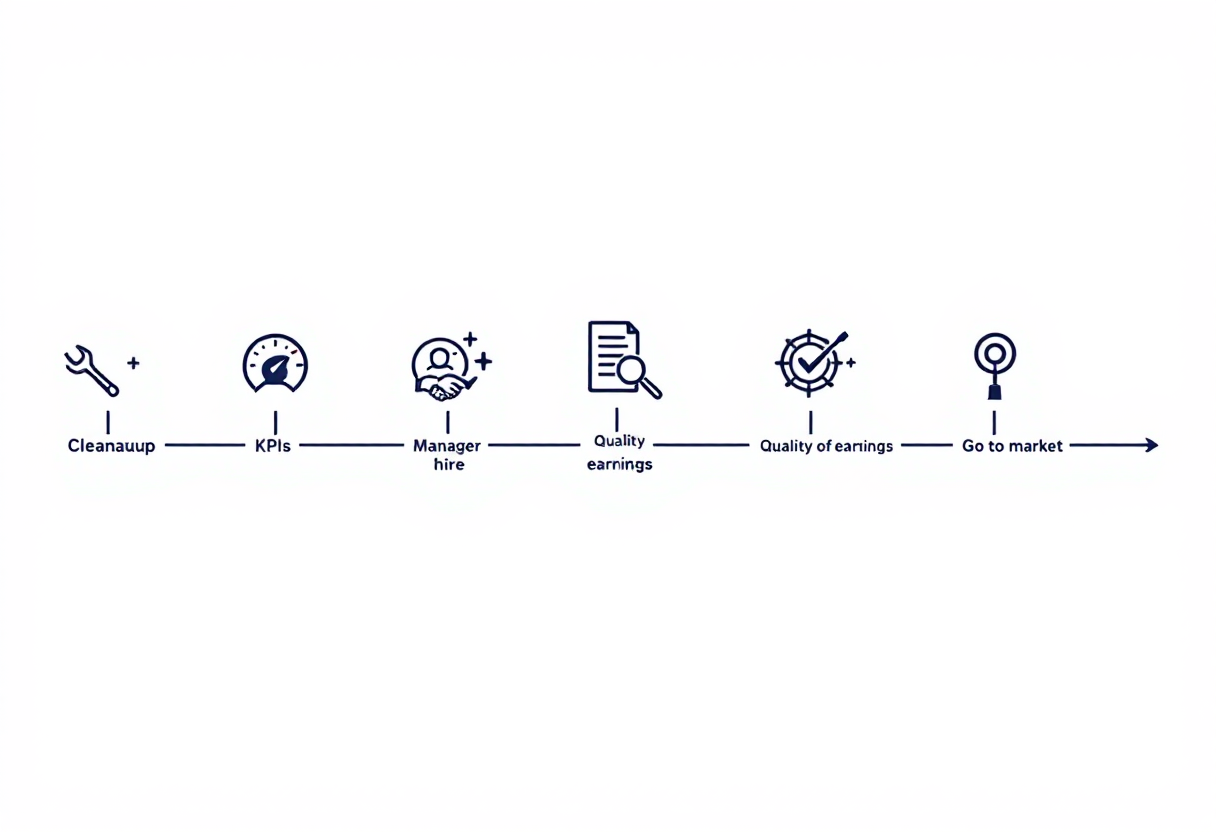
T-36 months: Cleanup phase
- Switch to accrual basis if still on cash basis. Open a service-line P&L.
- Pick an FSM (ServiceTitan, FieldEdge, ServiceCore, FieldPulse) and migrate. Tag every customer with system type, last-pumped date, and recurring-revenue flag.
- Start tagging every potential EBITDA add-back as it happens.
- Conduct W-2/1099 audit; reclassify if needed (settle exposure now while it is small).
- License a second qualifier under your state’s path (FL Registered + Master, CA C42, TX TCEQ Installer/Maintenance Provider, NY DEC) so the license is not personally tied to the owner.
- Restruck related-party rent to FMV with appraisal.
- Build the org chart and identify the GM hire (internal promotion target or external recruit).
- Phase I ESA on any owned real estate (especially shop yards with historical fuel storage or land-application sites).
- Sales/use tax compliance review by outside counsel in every operating state.
- Begin 40 CFR Part 503 land-application records digitization with 5-year retention.
- Write the OSHA 29 CFR 1910.146 confined-space program; train every entrant and attendant; start atmospheric testing log.
- Pull FMCSA SAFER scores; clean up DOT inspection records on every vacuum truck.
- Identify and contract with a second POTW or land-application site.
- For shops in PFAS-impacted states (ME, CT, MA, MD, MI, MN, NH, NY, WI, CO), inventory current land-application exposure and consider transitioning to POTW disposal where feasible.
T-24 months: Financial discipline and KPI infrastructure
- GM hire onboarded and starting to take operational load.
- Monthly close in 15 days; service-line P&L every month.
- KPI dashboard: jobs per truck per day, route density, average ticket by service line, re-pump rate (residential and commercial), grease contract renewal rate, ATU contract renewal rate, commercial vs. residential mix, gross margin by service line.
- Launch recurring pumping route push if recurring % is under 40%. Convert demand calls to scheduled cycles.
- Build the commercial and grease trap book: target restaurant clusters, multi-family, manufacturing, retail.
- Pricing review: 5% to 8% list increase, dispatch fee held.
- Diversify customer base if any top commercial is above 15%.
- ATU service contract push: convert every aerobic-system homeowner to a contract.
- Document SOPs for every operational role.
- Build the add-back bridge as a living document with documentation per line.
T-12 months: QoE-ready close discipline, eliminate owner dependence
- Owner steps out of daily operations; GM runs the shop.
- Owner takes a 2-week unplugged vacation as the stress test.
- Run the sell-side QoE (budget $35K to $75K).
- Tighten balance sheet: clean A/R, kill dormant inventory, isolate deferred revenue on prepaid pumping, ATU, and grease plans.
- Final org-chart review; backfill any gaps.
- Final compliance scrub: state license transferability, OSHA 1910.146, DOT inspections current, CDL driver qualification files, W-2/1099 cleanup, sales/use tax, 40 CFR Part 503 records, environmental insurance current.
- Lock in 12 months of clean service-line P&L for the CIM.
T-6 months: Pre-marketing prep
- Engage an M&A advisor or septic-specialty sell-side investment bank. Typical fee structure: $25K to $75K monthly retainer credited against a success fee of 4% to 8% of enterprise value, with Lehman or modified Lehman scaling.
- CIM drafted from QoE and operating model.
- Teaser drafted (anonymized 1-pager).
- Buyer list finalized. Starting list from the platform table above: Wind River Environmental (Gryphon), LES (Goldman Sachs Alternatives), Septic Blue (Georgia Oak), P3 Services (Stellex), The Rapid Group (Hidden Harbor), Seekye Capital, MFG Partners / CST Utilities, ProSite Services (RF Investment Partners), Total Sanitation Services, Liberty Waste Solutions (Allied Industrial), Concentric Equity / MWM Environmental, Aurora Capital / Impact Environmental Group, plus selected regional plumbing-and-septic combo platforms. Add strategic acquirers GFL Environmental (limited residential septic appetite) and Waste Connections (regional fit only). Total candidate list typically 20 to 35 names for a well-run septic process.
- Virtual data room populated with everything from the pre-LOI and confirmatory sections above.
- Management presentation deck built and rehearsed.
T-3 months: Go to market
- Teaser distributed; NDAs collected; CIMs distributed.
- IOIs collected 2 to 3 weeks after the CIM goes out.
- Narrow to 4 to 6 finalists for management meetings.
- Management meetings; LOIs solicited.
- Select LOI; sign with exclusivity (typically 45 to 90 days).
- Enter confirmatory diligence; close.
End-to-end from engagement to close: 9 to 12 months in a well-run process (Auxo Capital Advisors sell-side process guide 2025; Wall Street Prep sell-side primer).
Frequently Asked Questions
How long should I plan for before selling my septic business to a private equity buyer?
The owners who get top-quartile pricing start preparing 24 to 36 months before going to market. The minimum useful prep window is 12 months, because most of the high-leverage levers (lifting recurring pumping route revenue from under 20% to 40%+, installing a GM, getting a second qualifier license on payroll, getting on a real FSM platform, running a sell-side QoE) need 12+ months of clean trailing-twelve-months data to be credible to a buyer. Owners who try to sell in under 6 months typically leave 15% to 30% of enterprise value on the table.
What is a realistic EBITDA multiple for a $2M EBITDA septic business in 2026?
For a residential pumping-route-heavy septic business at $2M EBITDA, the range is 5x to 7x EBITDA. The bottom of that range applies to demand-only shops with under 20% recurring revenue, owner dependence, and concentrated commercial customers. The top applies to shops with 40%+ recurring pumping revenue, a GM in place, ServiceTitan or FieldEdge running, a documented ATU service contract book, two or more POTW disposal arrangements, and customer concentration under 10% (estimate, synthesized from 10X Business Broker 2025, Equidam 2026, and the platform-level Wind River and LES transaction record). For commercial-heavy or grease-heavy septic at the same $2M EBITDA level, the range shifts up to 6x to 8x. The 36-month prep playbook moves you from the bottom of the band to the top.
Should I get a quality of earnings report done before going to market?
For septic businesses at $1M+ EBITDA, yes. A sell-side QoE costs $35K to $75K typical, up to $150K for complex add-back situations or prior environmental claims (Eton Venture Services 2025). The ROI is leverage. If your QoE supports a 1x multiple uplift on a $5M EBITDA business at a 6x baseline, that is $5M of additional sale price for a $50K investment. More importantly, a pre-market QoE surfaces revenue recognition issues on prepaid ATU and pumping plans, working capital surprises, fleet CapEx normalization, and add-back weaknesses while you can still fix them, rather than during exclusivity when the buyer re-trades the deal.
What percentage of recurring pumping route revenue do PE buyers want to see?
40% or higher is the threshold that moves your septic shop from commodity pricing into premium pricing. Demand-only shops with under 20% recurring revenue trade at 2.0x to 2.8x SDE. Shops with a documented recurring pumping route trade at 4.0x to 4.5x+ SDE (10X Business Broker 2025). On a $750K SDE business that is a $1.5M sale vs. a $3.4M+ sale. At PE scale ($3M+ EBITDA), the equivalent delta is roughly +2x to +4x EBITDA, worth $6M to $12M of price. Buyers care about three pieces of evidence: absolute count of active pumping-route customers with last-pumped dates, the 12-month and 24-month re-pump rate, and the deferred revenue line on prepaid annual plans.
Do I need to put a general manager in place before I sell?
If your goal is to maximize price, yes, ideally 12+ months pre-sale. Owner dependence is the single most-cited multiple haircut in service-business valuation literature (10X Business Broker 2025; Centergrowth 2025). On a $1M to $3M EBITDA septic business, eliminating key-person risk moves the multiple from the 4x to 5x band into the 5x to 7x band, worth $1M to $6M of price. A septic GM hire typically runs $100K to $175K plus bonus per Indeed and ZipRecruiter wage data 2026, and needs 12 to 18 months to fully take operational load before the buyer’s diligence team will believe the transition. Pair the GM hire with a second qualifier on payroll so the state installer license is not personally tied to the owner.
Should I sell my shop real estate and land-application site with the business or hold them back?
Holding the operating real estate separately is usually the higher-value path. Move it into a separate LLC at fair market value triple-net rent to the operating company. This often lifts the implied EBITDA multiple on the operating business by 0.5x to 1.0x because the buyer is not forced to underwrite real estate exposure (Plante Moran sale-leaseback primer; Northmarq sale-leaseback guide). A sale-leaseback can convert up to 100% of property market value as cash vs. 70% to 80% LTV through traditional financing. The land-application site is a separate question. Sites with PFAS exposure or in PFAS-restricting states like Maine and Connecticut often need to stay out of the buyer’s deal entirely to protect the operating company valuation from environmental risk pricing.
What to Do Next
The septic owners who get the top-quartile multiple all do the same three things. They start preparing 24 to 36 months before they want to be out. They put a GM in place 12+ months pre-sale and license a second qualifier so the state installer license is not personally tied to them. And they invest in a sell-side QoE before any buyer sees a CIM.
The buyer universe is also clearer than most operators realize. Wind River Environmental (Gryphon Investors), Liquid Environmental Solutions (Goldman Sachs Alternatives), Septic Blue (Georgia Oak Partners), P3 Services (Stellex), The Rapid Group (Hidden Harbor), Seekye Capital, MFG Partners / CST, ProSite Services (RF Investment Partners), Total Sanitation Services, and a handful of regional plumbing-and-septic combo platforms cover most of the realistic outcomes for a sub-$15M EBITDA septic business. The disposal-site and PFAS picture (EPA draft risk assessment January 2025, Maine 2022 ban, Connecticut 2024 ban) is the variable that most often separates a clean process from a re-trade.
If you are 12+ months from a potential exit and want a structured pre-sale optimization roadmap, CT Acquisitions has environmental services operations specialists in our partner network who run multi-quarter prep engagements. If you are 6 to 12 months out and ready to start the sell-side process, our M&A advisory team runs the buyer outreach across the 12 named platforms above plus the regional strategics. No fee to you on buy-side introductions; sell-side mandates are paid on success at closing. Either way, the first 30 minutes are free.
Ready to talk?
Schedule a 30-minute exit-readiness call
Or read more: Sell Your Septic Business (active sale guide) | Buying a Septic Business (buyer’s playbook) | How to Prepare Your HVAC Business for a Sale or Exit
Unsure on price? See what a septic business is worth in 2026.
Ready to Explore Your Options?
A 30-minute confidential conversation is all it takes.