
How to Prepare Your Recruiting Firm for a Sale or Exit (2026)
Exiting your recruiting firm business is the single largest financial event most owners will ever face. This guide is the no-fluff playbook for recruiting firm owners who are 12-36 months from sale, covering how PE-backed buyers actually value your business in 2026, the 12 levers that move your multiple, pre-LOI diligence, deal-killers to fix before going to market, and the full 36-month exit prep timeline.
Updated April 2026 · CT Acquisitions

Most recruiting firm owners decide to sell, hire a banker, and find out 90 days later that their business is worth 30% to 50% less than they thought. The owners who get the top-quartile price start preparing 24 to 36 months before they ever talk to a buyer. This guide is the 36-month playbook for how to prepare your recruiting firm for a sale or exit. It covers what private equity actually buys in staffing and recruiting, the 12 levers that move multiples by specialty, the documents PE will ask for before they send an indication of interest, and the deal-killers that re-trade staffing transactions during confirmatory diligence. Every number cites its source. Every recommendation comes from how the most active recruiting and staffing buyers in 2026 actually behave.
If you are 6 to 36 months from a possible exit, this is the work that turns a 3x EBITDA outcome into a 7x or 9x EBITDA outcome. On a $2M EBITDA IT staffing firm, that is the difference between a $6M sale and a $14M to $18M sale. Healthcare staffing at scale stretches that gap even wider. Whether you want to prepare your recruiting firm for a sale to private equity, prepare your recruiting firm for an exit to a strategic acquirer like Allegis or Kelly, or simply maximize value over the next 1 to 3 years before going to market, the work below applies across IT staffing, healthcare staffing, executive search, light industrial, professional contingent, and RPO and MSP businesses.
Building toward an exit in 12 to 36 months?
CT Acquisitions runs sell-side advisory for recruiting and staffing firm owners $1M+ EBITDA. We also have staffing operations specialists in our partner network who run pre-sale optimization engagements when the timeline is longer. Buyers pay our fee, not you.
What Private Equity Actually Buys in Recruiting and Staffing (2026)
The recruiting and staffing M&A market is the most bifurcated services category in the lower middle market. Healthcare staffing platforms trade at 9x to 13x EBITDA. IT staffing trades at 5.5x to 9x. Light industrial trades at 4x to 4.5x. The contingent contract vs. direct-hire mix swings the same firm’s multiple by 3x to 6x. Specialty depth, recruiter retention, and recurring contract revenue are the three biggest swing factors. 2025 marked the start of Hunt Scanlon’s forecast five-year peak consolidation cycle for the sector through 2030, with Griffin Financial Group projecting 85 to 100 US staffing transactions in full-year 2026 (Griffin Financial Group Staffing Market M&A Report Q1 2026; Hunt Scanlon Ventures 2025 Mid-Year Executive Search M&A Report).
The PE-attractive recruiting firm profile
- EBITDA threshold for a platform-quality deal: $2M to $5M is the entry band where sponsor-backed platforms run a competitive process. Below $1M EBITDA you are an add-on inside a roll-up. Above $5M EBITDA you become an attractive bolt-on for ASGN, Kelly, ManpowerGroup, Korn Ferry, or a healthcare strategic. Above $15M EBITDA you are a platform candidate yourself.
- Contract revenue mix: 70%+ contract and contingent revenue is the line between commodity and premium. Pure direct-hire and pure retained-search shops trade at 3x to 4x EBITDA. Contract-heavy shops trade at 6x to 9x in IT and 4x to 5x in light industrial. Even 10% to 20% of revenue from permanent placement can drop EV/EBITDA by as much as 50% (Ascen, “Why is Contract Staffing More Valuable than Direct Hire in M&A”, 2025).
- Specialty depth: 70%+ revenue from a single specialty (healthcare allied or clinical, IT and tech, engineering, life sciences, finance and accounting). Generalist staffing firms trade at a 1x to 3x multiple discount versus specialty-deep peers.
- Client concentration: No single client above 12% of gross profit. Top 5 clients below 40%. Concentration above 25% triggers a 15% to 30% valuation discount or buyer withdrawal (David Jacobs Business Broker 2025; Viking Mergers Deal Killer Series).
- Gross profit margin floor: Above 25% is the industry hard floor for premium multiples; 30%+ for IT and healthcare. Below 25% buyers discount or walk (Talant Staffing Group; SIA Staffing Stream “EBITDA, Not Revenue, Drives Staffing Company Valuations”).
- Recruiter retention: Under 12% annual producer turnover; no single recruiter owns more than 15% of gross profit; clean enforceable non-compete and non-solicit in every operating state (or compensatory retention structure where non-competes are unenforceable per state law).
- Recruiter productivity: $500K+ gross profit per desk producer; top quartile $700K+ in IT and healthcare (David Jacobs Business Broker 2025).
- Owner role: Owner in pure GM or CEO seat 12+ months pre-sale. Owner produces less than 10% of gross profit personally. Client relationships are firm-owned, not person-owned.
- Tech stack: Bullhorn, JobDiva, or Avionte in place with at least 18 months of clean trailing data history. Spreadsheets and PCRecruiter are red flags.
Active recruiting and staffing PE platforms and strategics in 2026
The table below covers the most active sponsor-backed and strategic acquirers in the 2024 to 2026 cycle. This is who will see your teaser. Sources include Hunt Scanlon Media, Staffing Industry Analysts, Capstone Partners HR & Staffing M&A Update 2025, Griffin Financial Group Q4 2025 and Q1 2026 reports, RSM UK 2025 Year in Review, IMAP Recruitment Sector Update July 2025, Advent International press releases December 10, 2025, Kelly Services SEC Form 8-K June 3, 2024, ASGN SEC filings 2025, and Businesswire Knox Lane / Cross Country Healthcare May 6, 2026.
| Platform | Sponsor | Profile |
|---|---|---|
| Heidrick & Struggles | Advent International + Corvex Private Equity ($1.3B take-private, Dec 10, 2025) | Largest exec-search platform transaction of 2025; global executive search, leadership advisory, on-demand interim; $20M to $250M EBITDA targets |
| ASGN / Everforth (NYSE: ASGN) | Public; rebrand to Everforth across Apex Systems, Creative Circle, ECS, GlideFast, TopBloc | Q1 2025 TopBloc $340M; 2025 Quinnox $290M; ECS Federal $1.2B+ revenue 2024; IT consulting, federal, digital transformation; $10M to $100M EBITDA add-ons |
| Kelly Services (NYSE: KELYA) | Public | June 3, 2024: Motion Recruitment Partners $425M cash + $60M earnout from Littlejohn & Co.; IT staffing, telecom, RPO and MSP, government; $10M to $50M EBITDA add-ons |
| Cross Country Healthcare (Nasdaq: CCRN) | Going private to Knox Lane (announced May 6, 2026; $437M EV; $13.25/share; expected close Q3 2026) | Healthcare staffing platform consolidator post-close; nurse, allied, MSP |
| ZRG Partners | RFE Investment Partners + RGreen Invest | 10+ add-ons in 24 months: NextCap Search (Jul 31, 2025), EP Dine (Mar 2025), Aspen Leadership Group (Feb 2025), Seba International, The Registry, Helbling & Associates; sector-specialist exec search consolidator; $1M to $10M EBITDA |
| Allegis Group (private) | Davis family (founder-controlled) | $14.2B revenue 2024; TEKsystems ($3.9B IT staffing, 10.1% share), Aerotek, Aston Carter, Actalent, MarketSource, Allegis Global Solutions; continuous tuck-ins; $5M to $50M EBITDA |
| Insight Global (private) | Originally PE-backed via Harvest Partners | $3.1B revenue 2024; second-largest US IT staffing firm; continuous tuck-ins |
| Aya Healthcare (private) | Founder-controlled | $6.9B revenue 2024; 16.1% share; largest US travel-nurse firm; walked from $615M Cross Country acquisition Q3 2025 after FTC challenge ($20M break fee); healthcare add-ons up to $100M EBITDA |
| CHG Healthcare (private) | Leonard Green & Partners | $2.8B revenue 2024; 6.5% share; locum tenens and allied; $5M to $30M EBITDA |
| Jackson Healthcare (private) | Founder-controlled (Rick Jackson) | 2023: LRS Healthcare; ongoing tuck-ins; locum tenens, travel nurse, allied; $5M to $50M EBITDA |
| Triage Medical Staffing (private) | Self-funded, founder-led | October 2024: RTG Medical; 4 acquisitions cumulative; travel nurse and allied; $5M to $25M EBITDA |
| Care Career | PE-backed (sponsor in transition) | 6 acquisitions in 18 months including IDR Healthcare (Feb 2026); healthcare and education staffing; Southeast US; $1M to $10M EBITDA |
| Akkodis (Adecco) | Public Swiss; Adecco retained Akkodis after July 2024 sale exploration | Jan 2026: Synergeticon (Germany AI and automation); 2025: Raland Compliance Partners; engineering and tech consulting; $5M to $50M EBITDA |
| Hudson RPO (Hudson Global, Nasdaq: HSON) | Public | 2024: Executive Solutions (Dubai) and Striver (Dubai exec search); global RPO and exec search; $1M to $10M EBITDA |
| Frontenac Company | PE multi-platform | September 2025: Beckway (10th platform in Fund XII); professional services and staffing; $5M to $25M EBITDA |
| Riata Capital Group | PE multi-platform | August 2025: COEO Solutions recap; services and staffing-adjacent; $1M to $10M EBITDA |
| HireQuest (Nasdaq: HQI) | Public franchisor model | Franchise add-ons; light industrial and on-demand labor; $1M to $5M EBITDA |
| Mainsail Partners | Growth equity, $1.535B Fund VII closed April 2025 | Talent-tech and recruiting-platform investments; bootstrapped B2B SaaS; $10M to $50M revenue |
Add to that list the public-company strategic acquirers. ManpowerGroup (NYSE: MAN) paid $925M cash for ettain group in 2021, creating its $4.5B Experis IT staffing business, and continues selective IT staffing M&A. Robert Half (NYSE: RHI) does limited M&A but is the dominant strategic in finance, accounting, legal, and admin contingent placement, plus Protiviti consulting. Korn Ferry (NYSE: KFY) runs continuous tuck-ins across exec search, leadership consulting, RPO, and Futurestep professional search. TrueBlue (NYSE: TBI), parent of PeopleReady, PeopleScout, and PeopleManagement, makes selective light industrial tuck-ins. Kforce (Nasdaq: KFRC) acquires opportunistically in tech and finance and accounting professional staffing. Randstad N.V. (Euronext: RAND) acquires across IT, professional, and light industrial. Recruit Holdings (Tokyo: 6098), parent of Indeed and Glassdoor, focuses on HR Tech and platform M&A above $50M EBITDA. AMN Healthcare (NYSE: AMN), Aya Healthcare, Cross Country Healthcare, and CHG Healthcare are the four big healthcare strategics. For exec search outside Heidrick and Korn Ferry, Spencer Stuart, Egon Zehnder, Boyden, and DHR International are active strategic buyers; Egon Zehnder acquired The Prince Houston Group in 2025 and Spencer Stuart acquired Meyler Campbell (leadership coaching) in 2025 (Hunt Scanlon Media, 2025).
Recruiting Firm Valuation Multiples in 2026 (What You Are Actually Worth)
The multiple a buyer pays comes down to your size, your specialty, your contract vs. direct-hire mix, and your gross margin. Here is the 2026 range, cross-referenced from Griffin Financial Group Staffing M&A Reports Q4 2025 and Q1 2026, Capstone Partners HR & Staffing M&A Update 2025, Raincatcher Staffing Company Valuation Multiples 2025, Ascen 2025, David Jacobs Business Broker 2025, BizBuySell Staffing Agency Valuation Benchmarks, and Scope Research Healthcare Staffing Valuation Multiples and M&A Trends 2025.
SDE multiples (smaller, owner-operated, typically under $3M revenue)
| SDE band | SDE multiple | Profile fit |
|---|---|---|
| Under $500K SDE | 2.0x to 3.0x | Mostly contingent direct-hire shops; owner-producer dependence (Raincatcher 2025; David Jacobs 2025) |
| $500K to $1M SDE | 2.5x to 4.0x; 80% of small staffing agencies sell in the 3.5x to 5.5x range of adjusted earnings | Jaken Equities; altLINE 2025; BizBuySell |
| Contract staffing-heavy, recurring book | 4.0x to 5.5x SDE | Raincatcher 2025; David Jacobs 2025 |
| Direct-hire only / contingent-only | 2.0x to 3.5x SDE | One-time placement revenue is heavily discounted (Ascen 2025) |
EBITDA multiples by specialty (PE-attractive size, $3M to $4M EBITDA reference)
| Specialty | Mid-market EBITDA multiple | Platform-scale EBITDA multiple |
|---|---|---|
| Light industrial and commercial staffing | 4.0x to 4.5x | 5.0x to 7.0x |
| Professional staffing (admin, finance, accounting) | 5.0x to 6.0x | 6.5x to 9.0x |
| IT and technology staffing | 5.5x to 7.0x | 7.0x to 9.0x |
| Healthcare staffing | 5.5x to 7.0x | 9.0x to 13.0x (Cross Country / Aya proposed at 12.1x 2024 adj EBITDA) |
| Executive and retained search | 5.5x to 7.0x | 7.0x to 9.0x (Heidrick and Korn Ferry traded ~5.5x EV/EBITDA average pre-take-private) |
Sources: Griffin Financial Group Staffing Market M&A Report Q4 2025; Raincatcher Staffing Company Valuation Multiples 2025; Ascen “Why is Contract Staffing More Valuable than Direct Hire in M&A” 2025; Scope Research “Healthcare Staffing Valuation Multiples and M&A Trends 2025”; SIA Staffing Stream “EBITDA, Not Revenue, Drives Staffing Company Valuations”.
Average sector M&A multiple from 2021 through 2025 YTD across HR and Staffing combined is 8.2x EV/EBITDA, with the HR segment commanding premium pricing (Capstone Partners HR & Staffing M&A Update 2025). Large national staffing firms trade at 8x to 12x EBITDA. Specialty staffing providers of scale in growth niches trade at 10x to 20x EBITDA (Raincatcher 2025). The single largest multiple-mover in this industry is the contingent vs. direct-hire mix: a staffing firm with $1M EBITDA from heavy direct-hire mix often trades at 3x EV/EBITDA = $3M EV; the same firm with $1M EBITDA from 100% contingent contract staffing trades at 6x = $6M EV (Ascen 2025).
Recent disclosed recruiting and staffing transactions (2024 to 2026)
| Acquirer | Target | Date | Value | Implied multiple |
|---|---|---|---|---|
| Advent International + Corvex Private Equity | Heidrick & Struggles (Nasdaq: HSII) | Dec 10, 2025 close; announced Oct 6, 2025 | $1.3B; $59/share; 26% 90-day VWAP premium | Estimate: high-single-digit on adj EBITDA (firm guided ~$120M to $140M) |
| Aya Healthcare (proposed; terminated) | Cross Country Healthcare (Nasdaq: CCRN) | Announced 2024; terminated 2025 after FTC challenge ($20M break fee) | $615M; $18.61/share | 12.1x 2024 adjusted EBITDA (~$51M) |
| Knox Lane | Cross Country Healthcare (Nasdaq: CCRN) | Announced May 6, 2026; expected close Q3 2026 | $437M; $13.25/share; 31% premium to close; 45% premium to 90-day VWAP | Estimate: high-single-digit on softer 2025 EBITDA |
| Kelly Services (NYSE: KELYA) | Motion Recruitment Partners (from Littlejohn & Co.) | June 3, 2024 close | $425M cash + up to $60M earnout | Estimate: ~10x EBITDA (~$45M implied including earnout) |
| ASGN | TopBloc | Q1 2025 | $340M (90% cash, 10% equity) | Not disclosed |
| ASGN | Quinnox | 2025 | $290M | Estimate: ~3x revenue on ~$100M Quinnox revenue |
| Menzies Aviation | G2 Secure Staff | 2025 | $305M | Not disclosed |
| Care Career | IDR Healthcare | Feb 2026 | Not disclosed | Not disclosed |
Sources: Advent International press release December 10, 2025; PRNewswire and Heidrick & Struggles Media Room December 10, 2025; FierceHealthcare and Scope Research 2025; Businesswire Knox Lane / Cross Country Healthcare May 6, 2026; Kirkland & Ellis press release May 2026; Kelly Services press release June 3, 2024 and SEC Form 8-K; ASGN SEC filings 2025; Virginia Business 2025; IMAP Recruitment Sector Update July 2025; SIA February 2026.
The 12 Value Levers That Move Your Multiple (Ranked by Impact)

These are the levers that move recruiting firm multiples in the 24 months before a sale. Each one has a current state, a target state, and an estimated financial impact. The ordering is by dollar impact per unit of effort, based on cross-source synthesis from Ascen, Griffin Financial Group, Raincatcher, David Jacobs Business Broker, R.A. Cohen Consulting, SIA Staffing Stream, KPMG human-side DD 2024, and The McLean Group 2025.
Lever 1: Shift the revenue mix from direct-hire to contract and contingent
Current: 40% to 60% direct-hire or one-time placement revenue. Target: 70%+ contract staffing revenue, ideally with an MSP or VMS-anchored multi-year client base. Impact: Pure direct-hire trades at 3x to 4x EBITDA; pure contract trades at 6x to 9x for IT and healthcare and 4x to 5x for light industrial. On a $1M EBITDA firm, moving from direct-hire-heavy to contract-heavy is the difference between $3M to $4M EV and $6M to $9M EV (Ascen 2025; Griffin Financial Q4 2025; Raincatcher 2025). Even 10% to 20% perm-placement revenue drops the multiple by up to 50% (Ascen 2025). This is the single largest mix-driven multiple gap in the industry. How: Convert direct-hire client placements into contract-to-hire and pure-contract engagements. Pursue MSP and VMS programs (2% to 3.5% of spend fee on top of markup) to anchor multi-year recurring revenue (SIA “VMS and MSP Fees and Recommended MSPs”).
Lever 2: Own a single specialty deep and drop the generalist book
Current: Generalist staffing across multiple specialties at shallow gross profit depth. Target: 70%+ revenue from a single specialty (healthcare allied or clinical, IT and tech, engineering, life sciences, finance and accounting, light industrial). Impact: Specialty premium adds 1x to 4x multiple. Healthcare staffing at scale commands 9x to 13x (Griffin Q4 2025; Scope Research 2025); IT staffing 5.5x to 9x; light industrial only 4x to 4.5x. A specialty-deep $2M EBITDA IT staffing firm sells for $14M to $18M while a generalist with the same EBITDA sells for $7M to $10M. How: Pick the highest-margin specialty in your book and lean in. Hire specialty recruiters from competitors. Build a candidate database and content marketing in that specialty. Exit unprofitable generalist clients to redirect recruiter capacity.
Lever 3: De-concentrate the client base (top client below 12% gross profit)
Current: Top client at 20%+ of gross profit; top 5 above 50%. Target: Top client below 12% of gross profit; top 5 below 40%. Impact: Concentration above 25% triggers a 15% to 30% valuation discount or buyer withdrawal (David Jacobs Business Broker 2025; Viking Mergers Deal Killer Series; Acquisition Stars 2025). Even 20% top-client is a key flag. SBA lender comfort thresholds sit at 20% (Wall Street Prep 2025). Common in IT staffing where one Fortune 500 client can dominate. How: Aggressive sales push on mid-tier clients. Specialty diversification (one client cannot exceed 12% if you sell into 30 unique enterprises in the same specialty). Kill discounted big-account work that distorts the mix.
Lever 4: Move the owner out of the producer or account-manager seat
Current: Owner personally produces 30%+ of gross profit, owns top client relationships, signs every offer. Target: Owner in pure GM or CEO role for 12+ months. Producers and account managers own client and candidate relationships. Firm-owned, not person-owned. Impact: Owner-dependence is the most-cited multiple haircut for recruiting firms. Removing it moves a $1M to $3M EBITDA firm from the 4x to 5x band into the 5x to 7x band, worth $1M to $6M of price. How: Hire a GM 18 to 24 months pre-sale ($175K to $250K plus bonus typical). Transition owner-owned client relationships to named account managers. Document SOPs. Take a 2-week unplugged vacation as the stress test.
Lever 5: Recruiter retention as a defensible asset
Current: 25%+ annual recruiter turnover. Top producer owns 40%+ of gross profit with a weak non-compete. Target: Under 12% annual recruiter turnover. No single recruiter owns more than 15% of gross profit. Clean enforceable non-compete and non-solicit in every operating state, or compensatory retention structure where non-competes are unenforceable. Impact: +0.5x to 1.0x multiple. Replacing a senior producer costs 100% to 150% of the annual gross profit they produced in the first year (KPMG “Human side of due diligence” 2024; ASA Staffing Industry Statistics 2025). Recruiters with books are mobile, and a top producer flight at LOI can collapse the deal. How: Comp-plan review (top producers at 30% to 35% comp ratio of gross profit). Vested deferred comp and phantom equity tied to multi-year retention. Career-ladder design. Aggressive but enforceable non-solicit on candidates and clients. In California, Minnesota, North Dakota, Oklahoma, Washington, and Wyoming where non-competes are banned by state law, rely on non-solicit, customer-list trade-secret protection, and rollover-equity vesting on multi-year cliffs (Foley & Lardner Sep 2025; Husch Blackwell Sep 2025; ASA “Beyond the Ban” Jan 2026).
Lever 6: Tech stack on Bullhorn, JobDiva, or Avionte with clean data
Current: PCRecruiter, Crelate, spreadsheets, QuickBooks. No service-line P&L. No KPI dashboard. Target: Bullhorn (most universal at 11,000+ customers globally), JobDiva (IT staffing with patented Skills by Years of Experience matching engine), or Avionte (light industrial and high-volume back-office). Clean data hygiene with no duplicate candidate records, every requisition closed properly, every placement tagged to service line and specialty. Real-time KPI dashboard covering submittal-to-interview, interview-to-offer, offer-to-acceptance, time-to-fill, gross profit per producer, contractor-active count, contractor tenure on assignment, fall-off and replacement rate, MSP-program scorecard. Impact: +0.5x to 1.0x multiple. Speed and credibility of data-room responses during diligence is what wins in competitive auctions (Bullhorn 2026; SystemRatings JobDiva Review 2025; SIA Carv staffing benchmarks 2024). How: Budget $50K to $250K implementation plus per-seat license. 18 months pre-sale is the minimum window for clean go-live data history.
Lever 7: Lift gross margin and mark-up discipline (defend the spread)
Current: Inconsistent markups, MSP markdowns eroding margin, pay-bill ratio variable client by client. Target: Standardized mark-up grid by specialty and bill-rate band. MSP-spread defended on every program. Gross margin above 25% (industry hard floor for premium multiples), ideally 30%+ for IT and healthcare. Impact: Each 100 basis points of gross margin on a $20M revenue staffing firm is $200K of EBITDA. At a 6x multiple that is $1.2M of EV. The 25% to 30% gross margin jump on $20M revenue is $5M+ of EV uplift (David Jacobs 2025; Lone Oak Payroll Staffing Profit Formula; altLINE Staffing Agency Markup; The Resource Company “Average Staffing Agency Markup in 2025”). How: Markup grid by specialty (IT 35% to 60% markup, light industrial 30% to 45%, healthcare 25% to 40% on travel-nurse bill rate). MSP-program selectivity (walk from programs below the gross-margin floor). Recruiter comp tied to gross margin, not just gross profit. Annual bill-rate review.
Lever 8: EBITDA add-back hygiene
Current: Personal expenses through the business with no documentation; related-party rent above FMV; owner family on payroll for unclear duties; one-time legal fees (FCRA or FLSA settlements) mixed into recurring operations. Target: Every potential add-back tagged in the general ledger as it happens, with the underlying invoice attached. FMV rent appraisal on file. Market-rate owner comp. One-time costs (ATS conversion, office relocation, ERC) clearly bucketed. Impact: Every defensible dollar of adjusted EBITDA gets multiplied by the buyer’s multiple. On a 6x multiple, $200K of clean add-backs equals $1.2M of EV (Morgan & Westfield QoE 2025). How: Monthly add-back log starting today. Document the business purpose of every line. Common recruiting and staffing add-backs that hold up at QoE include owner compensation above market, one-time legal fees (FCRA suits, FLSA collective actions, ICE I-9 settlements), owner family-member payroll, owner vehicle and travel, owner health insurance, one-time ATS implementation costs ($50K to $250K for Bullhorn or JobDiva conversion), office consolidation costs, deferred placement fees normalized to recognition cadence, COVID-era ERC, and related-party rent above FMV.
Lever 9: Working capital normalization and A/R discipline
Current: DSO at 65 to 90 days. A/R aging buckets ugly. Deferred recruiter commissions accruing on the balance sheet. Factoring or invoice-financing balances unclear. Target: DSO at 45 to 55 days. Clean A/R aging with greater-than-90-day balances under 5% of total A/R. Deferred recruiter commission accrued and disclosed. Factoring relationship clean or paid off pre-close. Impact: The working capital peg in the purchase agreement is set off trailing 6 to 12 months of net working capital. A volatile working capital pattern lets the buyer set a higher peg, which subtracts from purchase price. Estimate 2% to 5% of EV erosion on a poorly managed working capital profile (BDO net working capital guide; Morgan & Westfield 2025; eCapital Staffing 2025). For staffing this matters more than in most industries because A/R is the dominant balance-sheet asset: firms wait 30 to 90 days for client payment while paying contractors weekly. How: Tighten collections (dedicated AR clerk per $25M of revenue). Automate invoicing out of Bullhorn or Avionte back-office. Kill credit lines that obscure economics. Healthcare staffing in particular needs aggressive collections on MSP-program payments which run long.
Lever 10: Recruiter productivity (gross profit per producer) lift
Current: Under $300K gross profit per desk producer. Target: $500K+ gross profit per producer. Top quartile $700K+ in IT and healthcare. Impact: Direct EBITDA growth plus multiple expansion. A 10-producer firm lifting average from $300K to $500K gross profit per producer adds $2M of gross profit, $1M+ of EBITDA at 50% incremental flow-through, worth $6M+ of EV at a 6x multiple. How: Comp plan redesign tied to gross profit and retention, not just headcount or placements. Sourcing-tech investment (Sense, hireEZ, Loxo, SeekOut, AI-driven sourcing). Structured training program. Removing under-performers below year-2 gross-profit threshold.
Lever 11: Brand, candidate database, and employer reviews
Current: 60%+ of placements from owner-rolodex relationships. Weak digital brand. Glassdoor or Indeed rating under 3.5. Target: Diversified inbound from owned candidate database (more than 50K active records), SEO, content marketing, paid search. 4.0+ Glassdoor and Indeed rating. More than 25% repeat placements with returning candidates. Impact: Concentrated lead source through the owner is owner-dependence by another name. Diversified, trackable demand is what makes the engine transferable in buyer underwriting. Estimate +0.25x to 0.75x multiple. How: SEO and content build 12+ months pre-sale; programmatic JD posting; candidate-database hygiene investment with deduplication and tagging cycles.
Lever 12: Compliance scrub (the cliff-edge items)
Current: W-2, 1099, and C2C classification not audited. H-1B LCA records in binders. FCRA disclosure form has extra language. State staffing licenses out of date or missing. Workers comp X-Mod above 1.0. I-9s incomplete on some hires. Non-compete forms last reviewed in 2018. Target: All twelve checklist items in Section 6 below cleared and outside-counsel-blessed. Impact: Any one of these can kill or re-trade the deal at confirmatory diligence (1.0x to 2.0x multiple haircut or escrow holdback of 10% to 25% of EV). How: Owner-led compliance scrub starting in T-24 months. Outside specialty counsel for FCRA (employment-screening counsel), H-1B and immigration (Seyfarth Shaw, Greenberg Traurig, or specialty firm), worker classification (employment counsel), and state staffing licenses (Harbor Compliance or Wolters Kluwer outsourced).
For vertical-specific bonus levers, healthcare staffing firms should pursue Joint Commission Healthcare Staffing Services Certification (drives hospital MSAs and improves multiples by 0.5x to 1.0x) and credentialing automation with monthly verification per CMS deemed-status requirements. IT staffing firms should build skills taxonomy depth in the ATS (JobDiva’s patented Skills by Years of Experience search is the gold standard) and H-1B LCA portfolio depth (firms with 100+ active H-1Bs trade at a premium because the visa book itself is a moat); TS/SCI cleared candidate inventory is its own moat for government IT staffing. Executive and retained search firms should invest in named-contact database value with ratings and last-touch tracking, sector practice-area depth, and referral economics from prior placements. Light industrial staffing firms should drive workers comp X-Mod below 0.85, OSHA recordable rate below industry average, clean ICE I-9 audit history, and a documented driver and safety program.
Want to grow your business to maximize value before exiting?
We connect recruiting and staffing firm owners with operations experts in our partner network who run 12 to 24 month pre-sale optimization engagements. The engagement pays for itself in incremental sale price.
What PE Asks Before They Send an LOI (The Pre-LOI Diligence Stack)
Before a PE firm commits to a letter of intent, they ask for a focused diligence package. The list below is the real ask from a 2026 PE firm targeting a recruiting and staffing business in CT Acquisitions’ pipeline. The “why” and “how to prepare” expand each item to what is typical across the industry, drawing from Auxo Capital Advisors sell-side process guide 2025, Colonnade Advisors, Hunt Scanlon Ventures 2025, KPMG human-side DD 2024, and The McLean Group “Labor Retention and Quality of Earnings” 2025.
1. Income statements 2022 through 2025 plus LTM
Why PE asks: They are building the trailing-twelve-months EBITDA and pay-bill economics they will multiply. They want trend (gross profit growth, gross margin trajectory), client mix shifts, recession resilience, and seasonality. LTM bridges last fiscal year-end to today, so the headline price reflects current run-rate, not stale data.
How to prepare: Accrual-basis P&L by month. Revenue split by service line (contract, contingent direct-hire, retained search, RPO, MSP) and by specialty (IT, healthcare, light industrial, professional). Bill rate, pay rate, gross profit, gross margin trends. Reconcile to tax returns so there are no surprises in confirmatory.
2. Balance sheet at the latest month, with working capital schedule
Why PE asks: Two reasons. First, size the working capital peg they will set in the SPA. For staffing firms, the working capital peg is the most contested line item because A/R is often the dominant balance-sheet asset (eCapital, Encore Funding, 1st Commercial Credit 2025). DSO benchmark for healthy staffing is 45 to 55 days; above 60 lets the buyer set a higher peg. Second, identify net debt and debt-like items: deferred commissions to recruiters, accrued PTO, unpaid sales bonuses, factoring or invoice-financing balances, any tail liability for misclassification, FUTA and SUTA accruals, workers comp deductible accruals.
How to prepare: Trial-balance-tied balance sheet. A/R aging buckets (1 to 30, 31 to 60, 61 to 90, and over 90 days). Itemized debt-like-items schedule.
3. Adjusted EBITDA bridge with add-back documentation
Why PE asks: They want a sneak peek at your adjusted EBITDA story before sinking diligence cost into the file. If your add-backs are aggressive or undocumented, they discount the rest of your numbers and may withdraw before LOI.
How to prepare: Build the bridge from book EBITDA to adjusted EBITDA, line by line. Document every add-back with the underlying invoice or payroll record. Buyers will not add back recurring sign-on bonuses for recruiters (those are part of the cost of running the business), back-office software subscriptions, or ongoing marketing spend. See Lever 8 above for the full list of what does stick. Source: Morgan & Westfield Quality of Earnings 2025; The McLean Group “Labor Retention and Quality of Earnings” 2025; Citrin Cooperman sell-side QoE guide.
4. Anonymized recruiter and employee roster
Why PE asks: Recruiter retention is the staffing-industry equivalent of customer concentration. Recruiters with books are mobile. If the top 3 producers have weak non-competes and own 60% of gross profit, the buyer treats the firm as flight risk. PE is also stress-testing W-2 vs. 1099 vs. C2C classification mix, which is a massive risk in IT staffing.
How to prepare: Roster columns include role (recruiter, account manager, sales lead, back-office), specialty, hire date, full-time vs. part-time, comp structure (base, commission split, comp ratio target), W-2 vs. 1099 vs. corp-to-corp classification, current trailing 12-month gross profit per producer, prior 12-month gross profit, active non-compete and non-solicit, geographic operating state. Disclose 12-month and 24-month rolling recruiter retention. Industry-published staffing turnover sits near 20% annually for office staff (ASA 2025); top-tier shops hold producer turnover under 12%.
5. Revenue breakdown by service line and specialty
Why PE asks: Single most diagnostic exhibit. It tells them whether mix is contract (recurring, valuable) or perm and direct-hire (transactional, discounted). It tells them whether gross margin is trending up or down, and whether average bill rate is growing through pricing power or just inflation pass-through.
How to prepare: Pull from Bullhorn, JobDiva, Avionte, or whatever ATS and back-office runs. Columns: total revenue, total gross profit, gross margin percent, headcount placed, average bill rate, average pay rate, average mark-up, average contractor tenure on assignment, by service line and specialty, year over year from 2022 through LTM. Cross-reference to SIA gross-margin and bill-rate trends data.
6. Client concentration and contract terms (top 20 clients)
Why PE asks: They want top-client below 12% of gross profit and top-5 below 40%. Beyond 20% top-client they price the discount; at 25%+ they walk or restructure. They also want to see MSA assignment clauses, change-of-control triggers, renewal terms, payment terms (DSO impact), and any MSP or VMS markdown-tail provisions.
How to prepare: Client list ordered by trailing-12-months gross profit. For each top-20 client, document contract type (MSA plus work order, MSP, VMS, retained), tenure, renewal cadence, change-of-control clause text, assignment clause text, exclusivity provisions, rebate clauses, and contractor-conversion provisions. Source: LegalSifter “Why Standard MSAs Are Quietly Eroding Staffing Agency Margins” 2025; SMVRT Legal “Key Clauses in a Master Service Agreement” 2025.
7. Contractor and consultant book (active placements roster)
Why PE asks: For contract staffing this is the recurring revenue base. They want active placements, average remaining contract length, conversion-to-perm rate, contractor tenure on assignment (longer equals more annuity value), pay rate and bill rate, classification (W-2 vs. 1099 vs. corp-to-corp), visa status (H-1B with active LCA, F-1 OPT, TN, L-1), and contractor satisfaction signal (renewal and extension rate).
How to prepare: Direct pull from back-office payroll system. Critical: every 1099 and corp-to-corp consultant should have signed independent-contractor or vendor-MSA documentation, plus articles of incorporation and EIN-on-1099 verification for C2C consultants. Source: Ascen “Understanding W-2, 1099, and C2C Worker Classifications” 2025; Advance Partners “1099-MISC Tax Forms, Misclassifications, and Staffing Agencies” 2025.
8. Five-year business plan
Why PE asks: Underwrite a forward case post-close. They want to see if you understand your own levers and have a credible growth story (geographic expansion, new specialty practice areas, MSP wins, recruiter hires, AI and sourcing automation).
How to prepare: Operating model with revenue and gross profit by service line, gross margin assumptions, recruiter productivity targets, comp ratio targets, EBITDA build. Include planned recruiter hires, MSP and VMS new-program wins, geographic expansions, and new vertical launches.
9. Tech stack summary
Why PE asks: ATS, CRM, and back-office is critical integration friction. Bullhorn is the de facto standard at 11,000+ customers globally and most PE-backed platforms standardize on it (Bullhorn 2026; Recruiterflow 2026). JobDiva is preferred in IT staffing for its skills-matching engine. Avionte is preferred in light industrial and high-volume where back-office payroll, billing, and compliance is heavy.
How to prepare: List your ATS and CRM (Bullhorn, JobDiva, Avionte, Erecruit, Exeter, PCRecruiter, Crelate), back-office payroll (Bullhorn Back Office, Avionte, ADP, Paychex, Tempworks), VMS connectivity (Beeline, SAP Fieldglass, IQNavigator), credentialing tools for healthcare staffing, sourcing tech (Sense, hireEZ, Loxo, SeekOut), and AI sourcing tools.
10. Org chart with key-person dependence flags
Why PE asks: Owner-dependence in recruiting and staffing is brutal. If the owner books 40% of gross profit personally or owns the top client relationships, the multiple drops 1x to 2x.
How to prepare: Org chart with named individuals, role, gross profit and specialty owned, and client relationships owned by named recruiter vs. firm-owned. Document a path to firm-owned client and candidate relationships.
11. Legal and regulatory snapshot
Why PE asks: Recruiting and staffing carry concentrated compliance exposure (FCRA, W-2 and 1099 misclassification, H-1B LCA, ICE I-9, state staffing licenses, MSP markdown disputes, wage-hour FLSA collective actions). They want to know what is sitting in the file.
How to prepare: Litigation history (active and settled FCRA, FLSA, EEOC, DOL, IRS SS-8, state UI claims, state staffing-license disputes). Pending arbitrations (recruiter non-compete enforcement). H-1B LCA filing history. ICE I-9 audit history. State staffing-license registration status (FL, NJ, NY, CA, IL, and others).
Confirmatory Diligence (After You Sign the LOI)
Once an LOI is signed and exclusivity starts (typically 45 to 90 days per Colonnade Advisors and Auxo Capital sell-side process guides), the buyer runs parallel workstreams. This is the depth of inspection your business will undergo. If anything was hiding, it surfaces here.
- Quality of Earnings (QoE). Outside accounting firm runs revenue cut-off testing (especially direct-hire placement-fee recognition timing), contractor-pay-cycle expense matching, gross-profit-by-client analysis, deferred-revenue and unbilled-receivables analysis (significant for staffing because contractor weeks-worked spans pay periods and invoice timing), add-back validation, and working capital trend (DSO drives the peg). Cost for a $1M to $10M EBITDA staffing firm sell-side: $20K to $75K typical; $50K to $150K for complex multi-entity or multi-specialty firms (Eton Venture Services 2025; Morgan & Westfield 2025).
- Customer concentration and commercial DD. Client-by-client gross-profit analysis. Buyer-side calls with top 5 to 10 clients about renewal intent, satisfaction, and any concerns about post-close continuity. Review of every top-20 MSA for assignment clause, change-of-control, exclusivity, and rebate provisions.
- Recruiter retention DD. Review of producer roster, comp plans, non-compete and non-solicit enforceability state by state (post-FTC-rule-vacatur landscape, see Section 6), interviews with key producers under buyer NDA, retention-bonus and rollover-equity structuring.
- IT systems audit. ATS and CRM (Bullhorn, JobDiva, Avionte), back-office payroll, VMS and MSP integrations. Data quality (contact records, requisition data, contractor data hygiene), license counts, security posture, integration roadmap. SOC 2 status of major data systems.
- Legal. Entity good standing in every operating state. State staffing-license and employment-agency registration status (NY, NJ, FL, CA, IL specifically). Non-compete and non-solicit enforceability mapping. FCRA disclosure-form audit. H-1B LCA file audit. ICE I-9 audit. Pending litigation and arbitration. Client MSA review. Vendor, 1099-contractor, and corp-to-corp agreement audit.
- HR and payroll. W-2, 1099, and C2C classification audit across the entire contingent placement book. I-9 compliance. Wage-and-hour overtime classification audit (especially internal recruiters classified as FLSA exempt). PTO accrual. Benefits and 401(k). Pending EEOC and DOL claims. Workers compensation experience modifier and loss history (critical in light industrial staffing).
- Tax. Federal income, payroll (940, 941, FUTA, SUTA, state UI), sales and use tax (most US states do not tax staffing services but some categorize back-office support or specific verticals as taxable; verify state by state). State income tax nexus for every operating state. International tax exposure (Canada, UK, India delivery hubs).
- Regulatory. State staffing-license and employment-agency registration. Healthcare-staffing certifications (Joint Commission Healthcare Staffing Services Certification for sales to hospitals; CMS deemed-status implications for clinical staffing). Required state licensure for nurse staffing in CA, FL, NY, NJ, IL. FCRA disclosure and authorization forms (must be standalone; Barnes & Noble $600K settlement and J.B. Hunt $5M settlement show the risk; Magallon v. Robert Half class action is direct staffing-industry precedent).
Why You Should Pay for Your Own Quality of Earnings Before Going to Market
A sell-side QoE is your own outside accountant’s QoE, paid for by you, before you go to market. For a staffing firm it does four things: pre-empts the buyer’s QoE by getting to the adjusted EBITDA number first with documentation; surfaces issues you can fix before the buyer sees them (contractor-pay-cycle expense matching, placement-fee recognition timing on one-time direct-hire fees, deferred commission accruals, MSP-rebate accruals, fall-off reserves); tightens the EBITDA number you take to market, which directly drives headline price; and stress-tests labor retention assumptions and pay-bill ratios in the projections (which The McLean Group 2025 flags as people-driven margin risk specific to people-services businesses).
Cost
- $20K to $35K for a low-complexity perm or direct-hire-only shop with revenue below $5M (Eton Venture Services 2025; The Website Flip QoE provider guide; Morgan & Westfield 2025).
- $35K to $75K typical for a contract-staffing firm with 1 to 3 specialties, multi-state operations, and an MSP program or two (Eton 2025; Citrin Cooperman 2024).
- $75K to $150K+ for complex multi-entity firms with significant international delivery, multiple service lines, or aggressive add-back stories (Eton 2025).
ROI
Example commonly cited across QoE provider content: $30M revenue, $3M EBITDA contract staffing firm. Moving the multiple from 5.5x to 6.5x equals $3M of additional sale price. A $60K QoE investment that supports the 1x lift is a 50x return (Eton Venture Services 2025; Citrin Cooperman 2024). The McLean Group 2025 specifically frames labor retention as a QoE issue for people-driven businesses like staffing firms, because workforce stability directly influences revenue continuity, service delivery, customer retention, and EBITDA sustainability. A sell-side QoE that documents recruiter retention trends and pay-bill discipline is itself a valuation lever, not just a defensive document.
Deal-Killers That Re-Trade Recruiting Firm Transactions (Avoid These)
These are the recurring kill-shots cited across recruiting and staffing M&A advisory content and confirmatory diligence checklists. Most of them are fixable in 12 to 24 months. None of them are fixable in 30 days.
1. Client concentration above 20% of gross profit
Top client above 15% of gross profit raises questions; above 20% gets a pricing discount; above 25% triggers a walk or restructured deal (David Jacobs Business Broker 2025; Viking Mergers Deal Killer Series; Acquisition Stars 2025; SBA lender comfort thresholds at 20% per Wall Street Prep 2025). Especially common in IT staffing where one Fortune 500 client can dominate the book and crowd out diversification work.
2. Recruiter or producer concentration with weak non-compete enforceability
The FTC’s federal non-compete ban (proposed April 2024) was vacated in federal court on September 5, 2025; the FTC formally accepted the vacatur the same day (FTC press release Sep 5, 2025; AHA News Sep 8, 2025; Foley & Lardner “Five Takeaways” Sep 2025; Husch Blackwell Sep 2025; American Staffing Association “Beyond the Ban” Jan 2026). Non-competes now revert to state-by-state law. California, Minnesota, North Dakota, Oklahoma, Washington, and Wyoming ban most non-competes. Florida (effective July 2025) and Kansas enacted presumption-of-enforceability laws for covered employees. Other states enforce with restrictions or income thresholds. The FTC also announced a Labor Task Force in September 2025 to continue case-by-case enforcement of unfair non-competes under Section 5 of the FTC Act (Morrison Foerster Sep 2025; Squire Patton Boggs Sep 2025). A top producer with no non-compete in California or a weak non-compete in a litigation-friendly state is a flight risk priced into the deal at a 1x to 2x multiple haircut. Buyer remedy: rollover equity vesting on multi-year cliffs, retention bonuses, garden-leave terms, customer-list trade-secret protection.
3. W-2 vs. 1099 vs. corp-to-corp (C2C) misclassification
This is the single largest re-trade risk in IT staffing, where consultants are commonly paid C2C through the consultant’s S-corp or LLC. Reputable firms verify articles of incorporation, EIN-on-1099, and bona-fide-business documentation (Ascen 2025; Staffing Management Group 2025; Advance Partners 2025). Paying a worker on 1099 to a Social Security number is a major red flag for IRS, DOL, and state classification audits. IRS penalty exposure is up to 100% of taxes owed plus penalties plus $50 per unfiled W-2 (Klasing & Associates; ADP SPARK 2023; MGO 1099 Compliance Guide). Settlements range from $10K to $100K+ per misclassified worker once back taxes, penalties, interest, and legal cost are aggregated (Tax1099; ADP SPARK 2023; IRIS 2025). A single SS-8 filing by a former consultant opens a workforce-wide audit. At LOI the buyer’s labor counsel runs a classification audit, and any meaningful exposure becomes either a price reduction or escrow holdback.
4. H-1B and LCA wage and worksite compliance
The H-1B Modernization Rule, effective January 17, 2025, added FDNS site-visit cooperation as mandatory; non-cooperation triggers denial or revocation (Seyfarth Shaw 2025; Greenberg Traurig “Remote Work Compliance Considerations for H-1B” 2025; Bhimdi Global Immigration LCA Compliance Guide 2025). The DOL launched Project Firewall in September 2025 authorizing Secretary-certified investigations into H-1B wage and LCA violations for the first time (Husch Blackwell; ASA 2026). LCA wage attestation must match the actual prevailing wage for the SOC code; many staffing firms historically under-attested for IT Consultant roles by picking lower OES wage levels (Keshab Raj Seadie “DOL Audit and the Nuts and Bolts of H-1B Visa Compliance” 2025). IT staffing firms with more than 15% H-1B workforce are H-1B-dependent and face heightened scrutiny. The buyer’s immigration counsel will audit the LCA file and any wage shortfalls become back-wage liability that funds the escrow.
5. ICE I-9 audit exposure
ICE I-9 audits can identify both I-9 errors and H-1B deficiencies in parallel (Alma “Mid-Market Immigration Compliance in 2026” 2026; Seyfarth 2025). For mid-market staffing firms with hundreds of hires per year, I-9 errors compound; this is the single largest area of penalty exposure during an ICE audit. Light industrial and healthcare staffing firms with immigrant-heavy workforces have the highest exposure.
6. FCRA background-check compliance failures
FCRA requires a standalone “clear and conspicuous” disclosure form for background checks. Any extra language (including footnotes like “this is not legal advice”) triggers willful-violation class actions (HireSafe FCRA Lawsuits 2025). Recent staffing-specific precedent: Magallon v. Robert Half International class action settled 2025 over pre-adverse-action procedure violations (MyHRConcierge July 2025; My HR Screens 2025). Other staffing-relevant settlements include J.B. Hunt $5M (Integris Screen 2025), Barnes & Noble $600K from a single disclosure-form footnote (HR Morning 2025), EBI / Sterling subsidiary $611.6K (Top Class Actions 2025), and an FTC $5.8M FCRA settlement against background-check providers (JDP 2025). In confirmatory DD the buyer’s employment counsel reviews the disclosure form and adverse-action workflow; failures become a direct price reduction.
7. State staffing license and employment-agency registration gaps
New York, New Jersey, California, Florida, Illinois, and others require employment-agency licenses or registrations to operate (Harbor Compliance state guides; Wolters Kluwer “Professional Employment and Staffing Services Licensing Requirements” 2025; SmallBizHandbook 2026). New Jersey requires registration with the Division of Consumer Affairs. New York requires a state employment-agency license pre-business. Florida does not require a state-level employment-agency license but PEO-style payroll handlers face employee-leasing regulations with financial-solvency requirements. Many states require surety bonds ranging $5K to $100K (premium 1% to 15% annually). For healthcare staffing, state nurse-staffing-agency licenses are required in CA, FL, NY, NJ, IL, and others (Ascen “Health Care Staffing Agencies, Which States Require a License” 2025).
8. Workers compensation experience modifier (X-Mod) above 1.0
This is particular to light industrial staffing. X-Mod above 1.0 means more claims than the industry baseline; above 1.25 is “high X-Mod” and many private carriers decline (Zurich Temporary Staffing 2025; Key Risk 2025; Staff Comp Solutions 2025). Light industrial staffing carriers underwrite on classification accuracy (industrial vs. clerical OOH codes), safety training programs, claim history, and class-code splits. The buyer underwrites workers comp cost as a recurring expense, so a 1.25 X-Mod adds 25% on top of base premium across millions of dollars of payroll. The fix takes 3 years because X-Mod is computed off trailing 3 years of claim data.
9. Healthcare staffing CMS, Medicare, Medicaid, and Joint Commission compliance gaps
Joint Commission Healthcare Staffing Services Certification is a specialized certification many hospitals require for nurse and allied staffing supply (Joint Commission “What is Accreditation”; CMS Quality Safety & Oversight Certification & Compliance). Hospitals with Joint Commission deemed-status accreditation can pass through Medicare and Medicaid certification, so staffing firms supplying those hospitals must maintain credential-verification rigor (Ethico Insights Compliance Roadmap 2025). Monthly verification is required for all credentialed professionals: medical staff licenses, advanced practice provider licenses, nursing licenses, DEA registrations. The buyer’s healthcare regulatory counsel will audit the credentialing files, and any documentation gaps become escrow or price reduction.
10. Client MSA assignment and change-of-control clause exposure
Many enterprise MSAs require client written consent for any assignment, including change of control via merger or sale (SMVRT Legal “Key Clauses in a Master Service Agreement” 2025; Daeryun Law MSA template 2025). 10-day post-close notification requirements are standard. Lost-client risk on top accounts during the assignment-consent process can re-trade the deal mid-close. Mitigation: pre-quietly review top-20 MSAs for change-of-control language at T-12 months pre-sale; for any with strict consent requirements, build a buyer-friendly transition narrative the client can buy into.
11. Pay-bill ratio compression on MSP programs
MSP programs charge 2% to 3.5% of spend as a fee that reduces effective markup (SIA “VMS and MSP Fees and Recommended MSPs”; Airswift MSP Pricing Guide 2025). If your MSP-program-revenue share is 60%+ and pay-bill discipline has eroded over time, gross-margin compression of 200 to 400 basis points is common. Buyers stress-test this, and any gross-margin erosion trend over 24 months is a yellow flag that questions whether your projection model is achievable.
12. Pending FLSA collective actions, EEOC charges, or state UI wage-hour claims
Internal-recruiter FLSA exemption misclassification (treating recruiters as exempt when they do not meet the administrative or outside-sales exemption) is a recurring exposure. Open EEOC charges or state UI wage-hour claims on internal staff or placed contractors create unresolved liability that becomes escrow or price reduction.
13. ATS and CRM data hygiene failures
Bullhorn or JobDiva data with 30%+ duplicate candidate records, open requisitions never closed, placement-tagging gaps, missing specialty, industry, or service-line codes makes the post-close integration painful and surfaces in IT DD as a red flag on the data quality of the underlying business analytics (SystemRatings 2025). Clean it 12+ months pre-sale, not 30 days before going to market.
The 36-Month Exit Prep Timeline
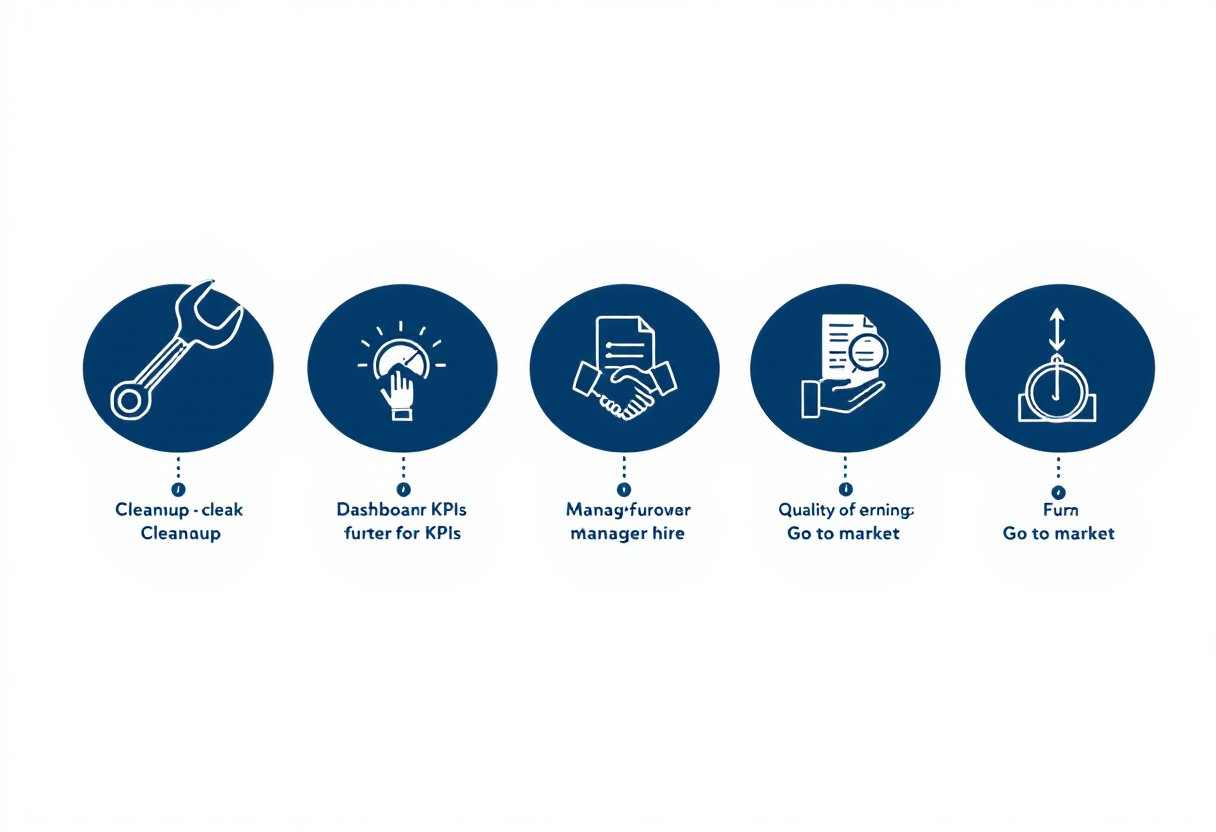
T-36 months: Cleanup phase
- Switch to accrual basis if still on cash basis.
- Pick an ATS, CRM, and back-office platform (Bullhorn most universal; JobDiva for IT specialty; Avionte for light industrial plus back-office payroll) and migrate.
- Start tagging every potential EBITDA add-back as it happens, in the general ledger.
- Conduct W-2, 1099, and C2C classification audit; reclassify if needed and settle exposure now while it is small.
- Restruck related-party rent to FMV with appraisal.
- Build the org chart and identify the GM hire (internal promotion target or external recruit).
- State staffing-license and employment-agency registration scrub (especially NY, NJ, CA, FL, IL).
- For healthcare staffing: begin Joint Commission Healthcare Staffing Services Certification process (typically 9 to 12 months to certify).
- For IT staffing: H-1B LCA file audit by outside immigration counsel.
- For light industrial: workers comp X-Mod review and safety-program build-out (3-year horizon to lower X-Mod).
- FCRA disclosure-form audit by outside employment-screening counsel.
- I-9 audit and self-correction (consider voluntary disclosure to ICE if material gaps are found).
T-24 months: Financial discipline and KPI infrastructure
- GM hire onboarded and starting to take operational load.
- Monthly close in 15 days; revenue, gross profit, and gross margin by service line and specialty every month.
- KPI dashboard live: submittal-to-interview, interview-to-offer, time-to-fill, fill rate, gross profit per producer, contractor-active count, contractor tenure on assignment, fall-off rate, MSP-program scorecard, recruiter retention.
- Comp-plan redesign tied to gross profit and retention, not just headcount.
- Markup grid rolled out by specialty and bill-rate band.
- Begin client diversification if top client above 12% of gross profit.
- For healthcare: credentialing automation and monthly verification cadence.
- For IT staffing: LCA wage-level audit and re-attestation if shortfalls are found; H-1B portfolio depth investment.
- Non-compete and non-solicit form refresh post-FTC vacatur, with state-by-state enforceability legal opinion.
- Top-20 client MSA review for assignment and change-of-control clauses; negotiate cleaner language at next renewal.
- Document SOPs for every operational role.
- Build the add-back bridge as a living document.
T-12 months: QoE-ready close discipline and elimination of owner dependence
- Owner steps out of producer and account-manager roles; GM and named producers own client and candidate relationships.
- Owner takes a 2-week unplugged vacation as the stress test.
- Run the sell-side QoE (budget $35K to $75K, see Section 5 above).
- Tighten balance sheet: collect aged A/R, pay off or restructure factoring, isolate deferred commission accruals, isolate fall-off and replacement reserves.
- Final compliance scrub (W-2, 1099, C2C, H-1B, FCRA, state staffing licenses, workers comp, I-9, healthcare credentialing where applicable).
- Lock 12 months of clean service-line and specialty P&L for the CIM.
T-6 months: Pre-marketing prep
- Engage M&A advisor (sell-side investment bank or specialist staffing M&A boutique: Hunt Scanlon Ventures, R.A. Cohen Consulting, Bigelow LLC, Founders Advisors, Auxo Capital Advisors, Raincatcher, Recruitment Transactions International, Amafi Advisory). Typical fee structure: $25K to $100K monthly retainer credited against success fee, with Modified Lehman (3-3-2-1-1) at most middle-market mandates. Total advisor fees on $10M to $30M EBITDA deals land in the 3% to 5% success-fee zone (Auxo Capital Advisors Lehman Formula Calculator 2025; Morgan & Westfield Business Broker Fees Guide 2025; Founders Advisors 2024; First Page Sage 2025).
- CIM drafted from the QoE and operating model.
- Teaser drafted (anonymized 1-pager).
- Buyer list finalized: from the named PE platforms and strategics above, build a tailored 50 to 100 buyer outreach list weighted by specialty. Healthcare goes to AMN, Aya, CHG, Jackson, Cross Country / Knox Lane, Care Career, Triage. IT goes to Allegis, Insight Global, Kelly, ASGN / Everforth, ManpowerGroup / Experis, Adecco / Akkodis, Randstad. Exec search goes to ZRG, Heidrick / Advent, Korn Ferry, Boyden, DHR, Spencer Stuart, Egon Zehnder. Light industrial goes to TrueBlue, HireQuest, and EmployBridge.
- Virtual data room populated with everything from the pre-LOI and confirmatory lists above.
- Management presentation deck built and rehearsed.
T-3 months: Go to market
- Teaser distributed; NDAs collected; CIMs distributed.
- IOIs collected ~2 to 3 weeks after CIM goes out.
- Narrow to 4 to 6 finalists for management meetings.
- Management meetings; LOIs solicited.
- Select LOI; sign with exclusivity (typically 45 to 90 days per Colonnade Advisors; Auxo Capital 2025).
- Enter confirmatory diligence; close.
End-to-end from advisor engagement to close: 9 to 12 months in a well-run process (Auxo Capital Advisors sell-side process guide 2025; Hunt Scanlon Ventures 2025; Founders Advisors 2024).
Frequently Asked Questions
How long should I plan for before selling my staffing or recruiting firm to a private equity buyer?
The owners who get top-quartile pricing start preparing 24 to 36 months before going to market. The minimum useful prep window is 12 months, because most of the high-leverage levers (shifting from direct-hire to contract mix, installing a GM, getting on Bullhorn or JobDiva with clean data, running a sell-side QoE, cleaning up W-2 and 1099 and C2C classification, building 9 to 12 months for Joint Commission Healthcare Staffing Services Certification if relevant) need 12+ months of clean trailing-twelve-months data to be credible to a buyer. Owners who try to sell in under 6 months typically leave 15% to 30% of enterprise value on the table.
What is a realistic EBITDA multiple for a $2M EBITDA recruiting firm in 2026 by specialty?
It depends on the specialty and the contract vs. direct-hire mix. For a $2M EBITDA light industrial firm, the range is 4.0x to 4.5x (roughly $8M to $9M EV). For a professional staffing firm (admin, finance and accounting), 5.0x to 6.0x ($10M to $12M EV). For an IT staffing firm, 5.5x to 9.0x ($11M to $18M EV) depending on contract mix, H-1B portfolio depth, and federal and clearance exposure. For a healthcare staffing firm at $2M EBITDA, mid-market multiples run 5.5x to 7.0x ($11M to $14M EV) with platform-scale healthcare reaching 9x to 13x at larger size; the Cross Country / Aya proposed deal was at 12.1x 2024 adjusted EBITDA before FTC termination. For an executive and retained search firm, 5.5x to 7.0x ($11M to $14M EV), with 7x to 9x at platform scale; Heidrick & Struggles and Korn Ferry traded around 5.5x EV/EBITDA average pre-take-private (Ascen 2025; Griffin Financial Group Q4 2025; Raincatcher 2025; Scope Research 2025). The 36-month prep playbook moves you from the bottom to the top of these bands.
Should I get a sell-side quality of earnings report done before going to market?
For recruiting and staffing firms at $1M+ EBITDA, yes. A sell-side QoE costs $20K to $35K for a low-complexity perm or direct-hire shop, $35K to $75K typical for a contract-staffing firm with 1 to 3 specialties and multi-state operations, up to $150K+ for complex multi-entity firms (Eton Venture Services 2025; Morgan & Westfield 2025). The ROI is leverage: if your QoE supports a 1x multiple uplift on a $3M EBITDA contract staffing firm moving from 5.5x to 6.5x, that is $3M of additional sale price for a $60K investment, a 50x return. More importantly, a pre-market QoE surfaces contractor-pay-cycle expense matching, placement-fee recognition timing, deferred commission accruals, and MSP-rebate accruals while you can still fix them, rather than during exclusivity when the buyer re-trades the deal.
What percentage of contract or contingent revenue do PE buyers want vs. direct-hire or retained search?
70%+ contract and contingent revenue is the line between commodity and premium. Pure direct-hire and pure retained-search shops trade at 3x to 4x EBITDA. Contract-heavy shops trade at 6x to 9x in IT and healthcare and 4x to 5x in light industrial. Even 10% to 20% of revenue from permanent placement can drop the multiple by as much as 50% (Ascen 2025). A staffing firm with $1M EBITDA from heavy direct-hire mix often trades at 3x EV/EBITDA = $3M EV; the same firm with $1M EBITDA from 100% contingent contract staffing trades at 6x = $6M EV. This is the single largest mix-driven multiple gap in the industry. Heidrick & Struggles and Korn Ferry as nearly pure retained-search public comps traded around 5.5x EV/EBITDA pre-2025; staffing peers with modest direct-hire mix traded around 7.5x.
Will the FTC non-compete rule vacatur affect my ability to lock in my top recruiters before a sale?
Yes, materially. The FTC’s federal non-compete ban was vacated in federal court on September 5, 2025; the FTC formally accepted the vacatur the same day (FTC press release Sep 5, 2025; AHA News Sep 8, 2025; Foley & Lardner; Husch Blackwell; ASA “Beyond the Ban” Jan 2026). Non-competes now revert to state-by-state law. California, Minnesota, North Dakota, Oklahoma, Washington, and Wyoming ban most non-competes outright. Florida (effective July 2025) and Kansas now enforce them with a statutory presumption of enforceability for covered employees. In states that ban non-competes, the right way to lock in your top 5 producers ahead of a sale is rollover equity vesting on multi-year cliffs, deferred comp and phantom equity tied to post-close retention, garden-leave structures, and customer-list trade-secret protection. The FTC also announced a Labor Task Force in September 2025 to continue case-by-case enforcement of unfair non-competes under Section 5 of the FTC Act, so even in friendly states a sloppy non-compete is exposure (Morrison Foerster Sep 2025; Squire Patton Boggs Sep 2025).
Should I clean up W-2, 1099, and corp-to-corp classification before going to market, even if it costs me money?
Yes. The W-2, 1099, and C2C classification audit is the single largest re-trade risk in IT staffing, and the second-largest deal-killer across the broader sector (after client concentration). Paying a worker on 1099 to a Social Security number, or paying C2C without verifying articles of incorporation and EIN-on-1099, is the kind of finding that becomes a price reduction or escrow holdback at confirmatory diligence (Ascen 2025; Staffing Management Group 2025; Advance Partners 2025). IRS penalty exposure runs up to 100% of taxes owed plus penalties plus $50 per unfiled W-2; settlements range from $10K to $100K+ per misclassified worker once back taxes, penalties, interest, and legal cost are aggregated (Tax1099; ADP SPARK 2023; IRIS 2025). A single SS-8 filing by a former consultant opens a workforce-wide audit. Cleaning it up at T-24 months while exposure is small is dramatically cheaper than discovering it during the buyer’s labor counsel audit at LOI.
What to Do Next
The recruiting and staffing firm owners who get the top-quartile multiple all do the same three things. They start preparing 24 to 36 months before they want to be out. They put a GM in place 12+ months pre-sale and move themselves out of the producer chair. They invest in a sell-side QoE before any buyer sees a CIM. On top of that, they make one or two specialty-specific moves that swing the multiple: in IT, they clean up W-2, 1099, and C2C classification and build H-1B LCA depth; in healthcare, they earn Joint Commission Healthcare Staffing Services Certification and automate credentialing; in light industrial, they drive workers comp X-Mod below 0.85; in exec search, they shift book share into retained-with-recurring-advisory and database depth.
The shared structural move underneath all of that is the contract-vs-direct-hire mix. If you are at 50% direct-hire and you spend 24 months getting to 80% contract with an MSP anchor, you have done more for your enterprise value than every other lever combined. Pure direct-hire trades at 3x to 4x EBITDA; contract-heavy trades at 6x to 9x in IT and healthcare. On a $2M EBITDA firm that is the difference between a $6M sale and a $14M to $18M sale.
If you are 12+ months from a potential exit and want a structured pre-sale optimization roadmap, CT Acquisitions has staffing and recruiting operations specialists in our partner network who run multi-quarter prep engagements. If you are 6 to 12 months out and ready to start the sell-side process, our M&A advisory team runs the buyer outreach against the named PE platforms and strategics above. Buyers pay our fee, not you. Either way, the first 30 minutes are free.
Ready to talk?
Schedule a 30-minute exit-readiness call
Or read more: Sell Your Recruiting Firm (active sale guide) | How to Prepare Your Consulting Firm for a Sale or Exit | What Is an Indication of Interest? 2026 IOI vs. LOI Guide
Ready to Explore Your Options?
A 30-minute confidential conversation is all it takes.