
How to Prepare Your Pressure Washing Business for a Sale or Exit in 2026: The 36-Month Playbook
Preparing your pressure washing business for exit in 2026 is a 36-month playbook. The first 12 months tighten the operating story around commercial recurring revenue and route density, the middle 12 fix pre-LOI diligence gaps around chemical handling and safety records, and the final 12 turn one offer into a competitive process. Pressure washing is early in its PE consolidation cycle, which is a good time to prepare.
Exiting your pressure washing business is the single largest financial event most owners will ever face. This guide is the no-fluff playbook for pressure washing business owners who are 12-36 months from sale, covering how PE-backed buyers actually value your business in 2026, the 12 levers that move your multiple, pre-LOI diligence, deal-killers to fix before going to market, and the full 36-month exit prep timeline.
Updated April 2026 · CT Acquisitions
Most pressure washing owners decide to sell, hire a broker, and find out 90 days later that their business is worth 30% to 50% less than they thought. The owners who get the top-quartile price start preparing 24 to 36 months before they ever talk to a buyer. This guide is the 36-month playbook for pressure washing exit prep in 2026. It covers what private equity actually buys in this segment (still emerging, not mature), the 12 levers that move multiples, the documents PE will ask for before they send an indication of interest, and the deal-killers that re-trade pressure washing transactions during confirmatory diligence. Every number cites its source. Every recommendation comes from how the most active pressure washing buyers in 2026 actually behave.
If you are 6 to 36 months from a possible exit, this is the work that turns a 3x EBITDA outcome into a 6x EBITDA outcome. On a $750K EBITDA pressure washing business, that is the difference between a $2.25M sale and a $4.5M sale. Whether you want to prepare your pressure washing business for a sale to private equity, prepare your pressure washing business for an exit to a strategic acquirer like Kept Companies or Tendit Group, or simply maximize value over the next 1 to 3 years before going to market, the work below applies.
Building toward an exit in 12 to 36 months?
CT Acquisitions runs sell-side advisory for pressure washing and exterior cleaning owners $500K+ EBITDA. We also have facility services operations specialists in our partner network who run pre-sale optimization engagements when the timeline is longer. No fee to you on buy-side introductions; sell-side mandates are paid on success at closing.
What Private Equity Actually Buys in Pressure Washing (2026)
Pure-play pressure washing private equity is in an emerging consolidation cycle in 2024 to 2026, not the mature platform stage HVAC reached. A pressure washing seller at $500K to $3M EBITDA typically sees 4 to 8 serious bidders, not the 20 to 30 a comparable HVAC seller would see. Most exits route to one of four buyer types: multi-trade facility services platforms (Kept Companies, Tendit Group, Vixxo, Divisions Maintenance Group), residential franchise systems (Neighborly, Authority Brands, Evive Brands), regional exterior services consolidators, and PE-backed founders building greenfield or franchise hybrids. The dollar dynamics still favor sellers who get the commercial recurring mix and the wastewater compliance file right.
The PE-attractive pressure washing profile
- EBITDA threshold for a platform-attractive deal: $500K to $3M is the entry band where multi-trade facility platforms and franchise consolidators run a competitive process. Below $500K SDE, you are a tuck-in to a regional consolidator like Allbrite Pressure Wash or a franchise convert into Rolling Suds. Above $3M EBITDA, you become a meaningful add-on for Kept Companies or Tendit Group, or a platform candidate yourself.
- Commercial recurring revenue mix: 60% or higher commercial recurring is the line between commodity and premium pressure washing pricing. Demand-only residential shops trade at 1.5x to 2.5x EBITDA. Shops with 60%+ commercial recurring at $1M to $3M EBITDA trade at 5.5x to 8.0x (Meridian Investment Banking Facility Maintenance and Janitorial Services M&A Market Update Winter 2025; Peak Business Valuation 2025; Jack Talks Business pressure washing multiples).
- Geography: Sun Belt year-round operators (Florida, Texas, Arizona, Carolinas, Georgia) carry less revenue seasonality than snowbelt shops where Q1 and most of Q4 are dead. Metro density wins because route efficiency is the gross margin lever.
- Customer concentration: No single account above 15% of revenue. Top 5 below 40%. A single QSR or fuel-station master service agreement above 25% triggers a 15% to 30% valuation discount or buyer withdrawal (Keystone CPAs 2026; Beancount.io 2026; Wall Street Prep customer concentration formula).
- Service-line depth: Hot-water capable trucks, SoftWash Systems Certified Applicator credential on staff, graffiti and oil-stain capability, fleet washing rigs. Specialty work runs at 30%+ gross margin vs. 20% to 30% commodity (Spruce Industries case; Pressure-Wash content).
- Owner role: Owner is in management, not on the truck, not running every estimate, not dispatching. GM in place 12+ months pre-sale.
- Environmental compliance file: Documented NPDES Best Management Practices, water reclaim/vacuum recovery equipment on the rigs, signed sanitary sewer discharge agreements with operating municipalities. This is the pressure washing-specific deal-killer if missing.
Active pressure washing PE platforms and franchise consolidators in 2026
The table below covers the most active sponsor-backed and franchise-system buyers in the 2024 to 2026 cycle. This is who will see your teaser. Add-on counts are point-in-time; sources include PrivSource pressure washing deal pages, DFW Capital press releases (March/April 2025), ACON Investments exit release April 2025, Incline Equity Partners press (July 2024), Riverside Company press (November 2025), Authority Brands 2025 PRNewswire annual update, Neighborly February 2024 release, Rolling Suds 2025 FDD, and Cleaner Times November 2025.
| Platform / Buyer | Sponsor / Owner | Profile |
|---|---|---|
| Kept Companies (fka Fleetwash) | DFW Capital Partners (Fund VII $800M, recap from ACON April 2025) | 137 cumulative acquisitions since 1973; 130+ company-owned and franchised locations; commercial mobile power washing + facility maintenance; $500K to $5M EBITDA targets |
| Perfect Power Wash | Incline Equity Partners (July 2024 recap) | Residential exterior cleaning platform; Akron OH base; planned greenfield expansion across OH, PA, IN; founder rolled equity |
| Tendit Group (fka Top Gun Pressure Washing) | Osceola Capital Management (2019 platform recap) | 9+ Mountain West add-ons including Birrell Services (UT), CAM Services (CO), Bob Popp Window Cleaning, Zoneez Power Washing, American Striping, Apex Pavement, Precision Asphalt Maintenance, Legends Landscape; CO, UT, AZ, ID, WY; $500K to $3M EBITDA |
| Rolling Suds Power Washing | David Barr + multi-investor group (strategic capital, not traditional PE) | 356 territories across 37 states, ~100 franchise owners, ~$22M systemwide revenue as of April 2026; 64 outlets open at end of 2024, 177 agreements signed; new franchise units only, not acquiring operators |
| Window Genie | Neighborly (KKR backed) | 100+ franchises in 33 states; cross-sells pressure washing + window cleaning + tinting + gutter cleaning + holiday lighting; 2024 FDD reports ~$601K estimated average gross sales; royalty 7% of gross |
| Shine Window Care | The Riverside Company / Evive Brands (Nov 2025 acquisition) | 75+ territories across 20 states; window cleaning + pressure washing + gutter + holiday lighting; Harrington Park Advisors ran the sell-side |
| Renew Crew | Premium Service Brands (Riverside-backed, acquired March 2020) | Power washing + outdoor surface renewal franchise; proprietary pre-soak / power-clean / protect process |
| Shack Shine | Neighborly / O2E Brands | 40+ locations (20 US + 20 Canada); “house detailing” bundle: pressure washing, gutter cleaning, window cleaning, holiday lighting |
| Mosquito Squad | Authority Brands (Apax Partners + BCI) | 250+ franchisees globally; $124.3M systemwide sales in 2024 per 2025 FDD; cross-sell potential with exterior cleaning brands inside Authority portfolio |
| Color World Painting | Authority Brands (acquired Jan 2022 from Boxwood Partners) | 20+ franchise sites; bundles painting + power washing + gutters + holiday lighting |
| Vixxo | Insight Partners | National multi-site facility maintenance; 150,000+ technician network; sources pressure washing through subcontractor network for QSR / grocery / convenience / retail clients |
| Divisions Maintenance Group | Warburg Pincus | National facility maintenance aggregator; pressure washing is a service-line within multi-trade facility programs |
| Allbrite Pressure Wash | Family / regional, openly seeking acquisitions | Maryland-based; published roll-up intent to acquire small pressure washing operators within and beyond MD; sub-$500K EBITDA tuck-ins |
| SoftWash Systems | Independent (no PE control); affiliate network model | 100+ affiliates / franchisees across 7 countries; $39M systemwide revenue in 2025; strategic alliance with Aero Velocity / BT Brands Feb 2026 for drone-washing integration; chemical + training consolidator |
| Pressure Systems Innovations (PSI) | Private (acquired Oct 31, 2025) | Acquired Nilfisk US High Pressure Washer business including Pressure Pro and Hydrotek brands; equipment manufacturer, key supply-side player |
| Authority Brands (multi-brand parent) | Apax Partners + BCI | 2,700+ territories across 15 home-service brands; 246 new franchise owners and 340 new territories in 2025 alone; cross-sell pressure washing inside Color World + Mosquito Squad units |
| Neighborly (parent) | KKR | $4B+ systemwide sales in 2023; 5,500+ franchises globally across 19 brands; multiple pressure washing channels via Window Genie + Shack Shine |
Add to that list the strategic acquirer pool. Multi-trade facilities platforms like Kept Companies, Tendit Group, Vixxo, and Divisions Maintenance Group buy or contract with pressure washing operators to fill out their service portfolios for national multi-site customers. Residential franchise systems like Neighborly (Window Genie, Shack Shine), Authority Brands (Color World, Mosquito Squad), Evive Brands (Shine), and Premium Service Brands (Renew Crew) convert independent operators into branded units. SoftWash Systems serves as an industry consolidator on the chemical and training side. There is no single national pure-play pressure washing platform comparable to Apex Service Partners in HVAC or Service Logic at $4.1B EV. The closest analog is Kept Companies, which is technically a multi-service mobile facility maintenance platform with pressure washing as the largest single service line. That structural reality is why most pressure washing owners selling at $300K to $3M EBITDA will see four to eight serious bidders, and why the active buyers that do exist move quickly and pay competitively for clean commercial route revenue.
Pressure Washing Valuation Multiples in 2026 (What You Are Actually Worth)
The multiple a buyer pays comes down to your size, your service mix, your commercial recurring revenue percentage, and your environmental compliance file. Here is the 2026 range, cross-referenced from BizBuySell 2025 cleaning and janitorial benchmarks, IBBA Market Pulse Q4 2025, Lincoln International Facilities Services Index Q2 2025, Meridian Investment Banking Facility Maintenance and Janitorial Services Winter 2025, Peak Business Valuation, and Jack Talks Business pressure washing commentary.
SDE multiples (smaller, owner-operated, typically under $2M revenue)
| SDE band | SDE multiple | Profile fit |
|---|---|---|
| Under $200K SDE | 1.5x to 2.5x | Primarily residential demand work; one-truck operator (Jack Talks Business; Peak Business Valuation cleaning multiples 2025) |
| $200K to $500K SDE | 2.0x to 3.0x | Mixed residential / light commercial (BizBuySell 2025 cleaning average 2.3x earnings) |
| $500K to $1M SDE | 2.5x to 3.5x | Route density plus some recurring commercial (IBBA Q4 2025 Market Pulse) |
| Premium small-shop, 30%+ commercial recurring, retention above 85% | 3.0x to 4.0x | Estimate cross-referenced from Peak Business Valuation 2025 and Aspire commercial cleaning content |
EBITDA multiples (PE-attractive size)
Pressure washing pure-play does not command the multiples that HVAC and plumbing do at comparable size. Buyer underwriting sits closer to commercial cleaning and janitorial, with one exception: commercial-route, recurring-revenue businesses serving national multi-site customers earn meaningful premium uplift.
| EBITDA band | Residential demand-only | Commercial mixed | Commercial recurring 60%+ |
|---|---|---|---|
| Under $300K EBITDA | 1.5x to 2.5x | 2.0x to 3.5x | 3.0x to 4.5x |
| $300K to $1M EBITDA | 2.5x to 3.5x | 3.5x to 5.0x | 4.5x to 6.0x |
| $1M to $3M EBITDA | 3.5x to 5.0x | 4.5x to 6.5x | 5.5x to 8.0x |
| $3M to $5M EBITDA, dense commercial route + national multi-site contracts | 5.0x to 6.5x | 6.0x to 8.0x | 7.0x to 9.5x |
| $5M+ EBITDA, multi-region with platform attributes | 6.0x to 8.0x | 7.0x to 10.0x | 8.0x to 11.0x (estimate) |
Source: BizBuySell cleaning and janitorial 2025 earnings multiple averaged 2.3x (vs. 2.0x in 2021) and revenue multiple 0.78x (vs. 0.62x). IBBA Q4 2025 Market Pulse general LMM ranges: $1M to $2M deals at 3.1x SDE/EBITDA; $2M to $5M at 4.1x EBITDA; $5M to $50M at 5.5x EBITDA. Lincoln Facilities Services Index Q2 2025: 15.3x EV/EBITDA at the public-platform tier, used here as a ceiling reference for full platform deals. Meridian Investment Banking Facility Maintenance and Janitorial Services M&A Market Update Winter 2025 provides the cross-walk for sub-platform commercial cleaning multiples. Several bands above $3M EBITDA are flagged as estimate because no pure-play pressure washing platform has disclosed transaction multiples at that tier.
Recent disclosed pressure washing transactions (2022 to 2025)
| Acquirer | Target | Date | Value / Terms | Source |
|---|---|---|---|---|
| DFW Capital Partners (Fund VII $800M) | Kept Companies (recap from ACON) | April 2025 | Not disclosed; ACON had held since 2018 | DFW Capital press; ACON exit release; PRNewswire 302419671; PE Hub; Lincoln International transactions page |
| Incline Equity Partners | Perfect Power Wash (Akron OH residential exterior cleaning) | July 2024 | Not disclosed; founder rolled equity | Incline Equity Partners press; MelCap Partners as sell-side advisor; PE Hub |
| The Riverside Company / Evive Brands | Shine Window Care (75+ territories, 20 states) | November 2025 | Not disclosed; Harrington Park Advisors ran sell-side | Riverside Company press; PRNewswire 302631728; PrivSource MySx05 |
| Tendit Group / Osceola Capital | Birrell Services (Salt Lake City commercial pressure washing + exterior services) | May 2022 | Not disclosed; shows platform cadence | PRNewswire 301548966; PrivSource n8S9ZR; Osceola Capital news |
| Tendit Group / Osceola Capital | CAM Services (Denver exterior facility maintenance + power washing) | 2023 | Not disclosed | Tendit Group news; Osceola Capital |
| Kept Companies / DFW | Pressure Pros (commercial/industrial/multi-family pressure washing) | 2024 to 2025 vintage | Not disclosed | PrivSource LXSqOq; Kept Companies acquisitions page |
| Authority Brands | Color World Painting (painting + power washing + gutters franchise, 20+ sites) | January 12, 2022 | Not disclosed; Boxwood Partners ran sell-side | PRNewswire 301459531; Daily Record |
| Premium Service Brands (Riverside) | Renew Crew (power washing + outdoor surface renewal franchise) | March 2020 | Not disclosed; historical benchmark for franchisor consolidation | Premium Service Brands blog; PrivSource |
| Pressure Systems Innovations | Nilfisk US High Pressure Washer business (Pressure Pro + Hydrotek brands) | October 31, 2025 | Financial impact not material to Nilfisk per Q3 2025 slides; value not disclosed | Cleaner Times November 2025; Nilfisk Q3 2025; DLA Piper |
Multiples on the disclosed pressure washing deals are not public. PE platform-tier comps from HVAC (Champions Group at ~18.5x, Service Logic in the high-teens, Redwood Services at ~17x) do not translate to pressure washing because no pure-play has reached comparable scale. Treat the table as evidence of buyer activity, not as a multiple ladder. The Lincoln Facilities Services Index ceiling of 15.3x applies only at the full-platform tier reached by large multi-trade aggregators, not by sub-$5M EBITDA pressure washing operators.
The 12 Value Levers That Move Your Multiple (Ranked by Impact)

These are the levers that move pressure washing multiples in the 24 months before a sale. Each one has a current state, a target state, and an estimated financial impact. The ordering is by dollar impact per unit of effort, based on cross-source synthesis from Meridian Investment Banking, Peak Business Valuation, Jack Talks Business, ServiceTitan cleaning content, FieldCamp pricing benchmarks, King of Pressure Wash, and Bella FSM route optimization commentary.
Lever 1: Shift mix from one-time residential to commercial recurring
Current: 70%+ one-time residential demand work, under 20% commercial recurring. Target: 60%+ commercial recurring revenue (strip malls, retail centers, gas stations, QSR chains, HOAs, multi-family complexes, fleet washing on monthly or quarterly cycles). Impact: The single largest valuation lever in pressure washing. Demand-only residential shops trade at 1.5x to 2.5x EBITDA. 60%+ commercial recurring shops at $1M to $3M EBITDA trade at 5.5x to 8.0x. On $1M EBITDA, that is the difference between a $1.5M to $2.5M sale and a $5.5M to $8M sale (Jack Talks Business 2.5x baseline; Meridian IB commercial cleaning LMM tier; Peak Business Valuation 2025). How: Target multi-site property management groups, regional QSR franchisees, fleet operators with truck-wash needs, HOAs with sidewalk and breezeway maintenance cycles. Sell monthly or quarterly recurring contracts with auto-renew, stored payment on file, and route-density-aware pricing. Offer a 10% to 15% discount in exchange for a 12-month commitment.
Lever 2: Land 1 to 3 national multi-site commercial accounts
Current: All local single-site customers. Target: 1 to 3 national or regional multi-site accounts via Vixxo, Divisions Maintenance Group, FacilitySource, or direct facility management at a QSR, fuel chain, retail, or convenience chain. Impact: Multi-site accounts demonstrate the business is scalable for a platform buyer. Estimate +0.5x to 1.5x multiple uplift. Critical risk: do not let any single multi-site customer cross 25% of revenue or it becomes a concentration deal-killer (Keystone CPAs 2026; Beancount.io 2026). How: Get on the approved vendor list at Vixxo and Divisions Maintenance Group. Bid regional roll-outs at QSR brands operating in your metro. Most multi-site work bids at lower per-stop pricing but delivers predictable monthly volume, which is the part buyers underwrite.
Lever 3: Add SoftWash Systems certification and lift specialty mix
Current: Pressure-only generalist; no roof cleaning, no graffiti removal, no industrial fleet work. Target: SoftWash Systems Certified Applicator status (20-class SoftWash Academy Online program plus 200-question test), PWNA certification across crew (House Washing, Roof Cleaning, Flatwork, Fleet Washing, Environmental Awareness modules), UAMCC certified membership. Impact: Specialty services run at materially higher gross margin than commodity pressure washing. Soft washing for roofs commands premium pricing because it removes algae, lichen, and moss without high-pressure damage. Graffiti removal and oil-stain removal command 30%+ gross margins vs. 20% to 30% commodity (Pressure-Wash content; Spruce Industries case). Estimate +0.25x to 0.75x multiple uplift driven by gross margin expansion and a defensible service moat. How: SoftWash Systems Certified Applicator credential ($1K to $5K typical training investment), PWNA membership $200 to $500 annual plus per-module certification fees, UAMCC certification. Bundle pricing for soft-wash roof plus house wash combo.
Lever 4: Install wash water recovery on the fleet and document NPDES BMPs
Current: Wash water runs to nearest storm drain. No containment documentation. No municipal sanitary sewer discharge agreement. Target: Vacuum recovery and water reclaim equipment on the trucks (8 to 100 GPM recovery capacity per unit; Landa MWP-30E recovers up to 30 GPM, Alkota Vacuum Filtration up to 8.0 GPM, Karcher Mississippi Recovery up to 30 GPM, larger commercial systems to 100 GPM). Documented BMP manual. Signed sanitary sewer discharge agreements with relevant municipalities for legal disposal. Impact: Eliminates the single largest pressure washing deal-killer. Equipment cost typically $3,000 to $15,000+ per rig depending on capacity. Failing this check during environmental DD can knock a deal off entirely or trigger a 5% to 15% holdback escrow. CWA Section 309 fines are $1,000 to $25,000 per day per violation, billable to both property owner and contractor (CMM Online; Wash on Wheels; EPA NPDES Stormwater Program). How: PowerWash Store, North American Pressure Wash Outlet, SCE Clean, and Seattle Pump are common vendor options. Use bermed-area capture for jobs without on-rig recovery. Document every job’s containment approach in the FSM.
Lever 5: Hire a GM and remove yourself from operations
Current: Owner sells, dispatches, runs crews, signs every check, is on every commercial estimate. Target: GM in place 12+ months before going to market. Owner doing under 30 hours/week of operational work. Impact: Owner-dependence is universally cited as a major multiple haircut in cleaning and pressure washing valuation (Legacy Entrepreneurs; MassMutual; Maui Mastermind pressure-washing scale guide). On a $500K to $2M EBITDA pressure washing business, removing key-person risk lifts the multiple by an estimated 0.5x to 1.0x, worth $250K to $2M of price. Bonus: buyers may shorten the post-close transition contract from 1 to 3 years down to 3 to 6 months. How: GM hire 18 to 24 months pre-sale (typical GM comp $90K to $150K plus bonus in pressure washing). Document SOPs, build a leadership scorecard, transition commercial relationships to the sales team and GM, take a 2-week vacation as a stress test.
Lever 6: Move from QuickBooks to a real FSM with KPI reporting
Current: QuickBooks plus spreadsheets, no service-line P&L, no monthly close, route productivity is anecdotal. Target: Jobber, Housecall Pro, or ServiceTitan in place 18 to 24 months. Monthly close within 15 days. KPI dashboard covering jobs per crew per day, route density, average ticket, recurring renewal rate, gross margin by service line, water reclaim compliance rate. Impact: Estimated +0.25x to 0.75x multiple uplift driven by data-room speed and KPI defensibility during diligence. Route optimization alone can lift revenue per crew-day by 20% to 35% with no headcount addition (Bella FSM pressure washing route optimization guide). How: Sizing per Rivetops 2026 comparison, Jobber Academy, and Field Service Software comparison hub: Housecall Pro for 1 to 8 techs and faster onboarding; Jobber for 5 to 25 techs and best mid-market value; ServiceTitan at $2M+ revenue and 10+ techs with a structured sales process. Implementation cost $0 to $150K depending on platform.
Lever 7: Drive route density and crew productivity
Current: 1 to 2 stops per crew-day, refills 3 to 4 times per day, drive time above 30% of working hours. Target: 3 to 5 stops per crew-day with sharper routing; refills down to 1 to 2 per day; drive time cut by 20% to 30%. Impact: Direct EBITDA growth. Route density optimization adds the equivalent of a workday per week without adding labor (Bella FSM 2026). A 200-gallon tank typically runs two residential house washes or one mid-size commercial flat-work job before refill, making cluster scheduling essential. Setup and breakdown adds 12 to 25 minutes of unbillable time per stop. Pairing two small stops in one neighborhood block cuts effective setup time by 40%+ (Bella FSM). How: Geographic cluster scheduling in the FSM. Recurring customer routing built around fixed cycles. Crew-level commission tied to billable hours per workday.
Lever 8: Pricing discipline and annual increases
Current: Average ticket flat for 3 years. Dispatch fee waived on conversion. No annual price review. Target: Annual 5% to 8% list-price increase on residential, 3% to 5% on commercial. Floor pricing held for recurring routes. Average residential house wash $300+; soft wash roof $350+. Impact: Direct EBITDA growth. Pressure washing pricing benchmarks: residential hourly $50 to $150; commercial hourly $70 to $450; commercial flat-work $0.10 to $0.40 per square foot; after-hours commercial premium 25% to 50% (Housecall Pro pricing guide 2026; FieldCamp; HomeGuide; Joist). A $1M revenue shop lifting average ticket 10% adds $100K of revenue, with most dropping to EBITDA at service gross margins of 40% to 50%. How: Quarterly price-book refresh. Crew training on options-based presentations (basic, plus, premium). Eliminate crew discretion on pricing.
Lever 9: Customer concentration de-risk
Current: Top customer above 20% of revenue, often a single QSR chain or fuel-station master service agreement. Target: Top customer below 15%; top 5 below 40%. Impact: Concentration above 20% triggers buyer pushback; above 25% prompts a 15% to 30% valuation discount or buyer withdrawal; above 30% buyers treat it as a key-account risk (Keystone CPAs 2026; Beancount.io 2026; Eagle Rock CFO; Wall Street Prep customer concentration formula; Morgan & Westfield customer concentration glossary). How: Grow around the top customer rather than shrink it. Diversify into adjacent commercial verticals. If a single account is structurally too large, get the account onto a multi-year MSA with strong assignment language and a steep early-termination penalty so the buyer can underwrite it.
Lever 10: EBITDA add-back hygiene
Current: Owner mixes personal expenses through the business with no documentation, related-party rent at well-above FMV, undocumented family payroll. Target: Every potential add-back documented as it happens with the underlying invoice; related-party rent restruck to FMV with appraisal on file; clean payroll for owner-family members. Impact: Every defensible dollar of adjusted EBITDA gets multiplied. On a 5x multiple, $100K of clean add-backs equals $500K of sale price. For typical $500K to $3M EBITDA pressure washing, total defensible add-backs commonly run $100K to $400K (Profitability Partners 2026; CT Acquisitions Adjusted EBITDA Add-Backs 2026; Benchmark International related-party rent guide). How: Monthly add-back log starting today. Document the business purpose of every charge. Get an FMV rent appraisal if owner owns the real estate. Hold related-party transactions to arm’s-length terms.
Lever 11: Working capital normalization
Current: Wildly seasonal A/R, no recurring agreement deferred revenue isolation, customer deposits and prepaid plans buried in mixed accounts. Target: TTM-average working capital is stable; deferred revenue on prepaid contracts is isolated; A/R aging cleaned with 90+ day buckets actively pursued. Impact: The working capital peg is set off trailing 6 to 12 months (Morgan & Westfield NWC guide; BDO; Auxo Capital Advisors). A volatile pattern lets the buyer set a higher peg, which comes out of purchase price. Estimate: poorly managed working capital can cost 2% to 5% of enterprise value at close. For pressure washing the seasonality challenge is significant in snowbelt operators where Q1 revenue can drop 70%+ vs. summer peak. How: Tighten A/R collection cycle (target DSO 35 to 45 days commercial). Manage truck-stock inventory of chemicals and surfactants. Isolate prepaid annual contract deferred revenue line.
Lever 12: Real estate decision (own or lease, and the sale-leaseback option)
Current: Owner-occupied shop and yard held in same entity as operating business, or in an LLC at above-FMV rent. Target: Real estate in a separate LLC at FMV NNN lease to operating company, with a clear decision on whether buyer assumes the lease or buys the real estate. Impact: Separating real estate often lifts the implied EBITDA multiple on the operating business because the buyer is not forced to underwrite real estate (Northmarq sale-leaseback guide; Ascension Advisory; Investment Grade sale-leaseback pros and cons). A sale-leaseback can free up to 100% of property market value as cash vs. 70% to 80% LTV via traditional financing. Estimate +0.5x to 1.0x to operating company multiple from clean real estate separation. How: FMV market rent study. Restruck rent to FMV before going to market. Decide whether real estate is part of the deal or held back.
Want to grow your business to maximize value before exiting?
We connect pressure washing owners with facility services operations experts in our partner network who run 12 to 24 month pre-sale optimization engagements. The engagement pays for itself in incremental sale price.
What PE Asks Before They Send an LOI (The Pre-LOI Diligence Stack)
Before a PE firm or platform buyer commits to a letter of intent, they ask for a focused diligence package. The list below is the standard pre-LOI ask spanning 8 to 12 items, plus the pressure-washing-specific overlays that come up in every facility services platform process.
1. Income statements for 2024, 2025, and the latest trailing twelve months
Why PE asks: Building the LTM EBITDA they will multiply, identifying seasonality (very pronounced in snowbelt pressure washing where Q1 can drop 70%+ from summer peak), and isolating one-time movers. LTM bridges the most recent year-end to today, so the headline price reflects current run-rate.
How to prepare: Accrual-basis P&L by month, mapped to a clean chart of accounts. Service-line P&L (residential house wash, residential roof soft wash, residential concrete, commercial flat work, commercial fleet/QSR, graffiti removal) where possible. Reconcile to tax returns so confirmatory DD finds no surprises.
2. Balance sheet at the latest month
Why PE asks: Sizing the working capital peg in the SPA, and identifying net debt (cash minus interest-bearing debt minus debt-like items including customer deposits, prepaid annual recurring contracts, accrued bonuses, equipment lease balances on truck-mounted rigs).
How to prepare: Tie to trial balance. Flag deferred revenue on prepaid annual recurring contracts; this is the most commonly disputed debt-like item in pressure washing alongside customer deposits.
3. Adjusted EBITDA bridge with add-back documentation
Why PE asks: Stress-testing your “adjusted EBITDA” story before sinking diligence cost into the file. Aggressive or undocumented add-backs cause buyers to discount the rest of your numbers.
How to prepare: Bridge from book EBITDA to adjusted, line by line, with underlying invoice or payroll record. Common pressure washing add-backs that hold up: owner compensation above market (if owner takes $250K but a GM would cost $110K to $140K, the delta adds back); one-time legal fees; owner family-member payroll for unclear duties; owner vehicle and personal travel; owner health insurance; software conversion one-time costs; one-time truck or equipment write-downs; related-party rent at above-FMV (added back to the FMV delta); spousal “office” salary that does not match actual hours (CT Acquisitions Adjusted EBITDA Add-Backs 2026; Profitability Partners; Benchmark International related-party rent guide).
4. Anonymized employee roster with titles, start dates, pay, and classification
Why PE asks: Two risks. First, crew tenure in a high-turnover trade. Second, misclassification exposure: many pressure washing shops run crew leads as W-2 and helpers or seasonal residential techs as 1099 to dodge payroll tax. Either pattern triggers a wage-and-hour review during HR DD.
How to prepare: Roster columns include role, hire date, full-time vs. part-time, W-2 vs. 1099 (with classification rationale), comp structure (hourly, salary, commission, per-job piece rate), any active non-compete or non-solicit, training certifications held (PWNA, UAMCC, SoftWash Systems Certified Applicator). Calculate and disclose 12-month and 24-month rolling crew retention. Total labor cost should run below 35% of revenue once scaled (King of Pressure Wash commentary).
5. Revenue breakdown by service line with job counts and average ticket
Why PE asks: The most diagnostic exhibit. Tells the buyer (a) residential vs. commercial mix; (b) one-time vs. recurring split; (c) average ticket trajectory by line; (d) whether job count is growing through capacity or just price.
How to prepare: Pull from Jobber, Housecall Pro, or ServiceTitan. Three columns minimum per service line: total revenue, number of jobs, average ticket per service line, year over year. Pressure washing residential house wash sits at $250 to $500 typical residential ticket; commercial flat-work prices at $0.10 to $0.40 per square foot; commercial hourly rates run $70 to $450/hr (Housecall Pro Pressure Washing Pricing Guide 2026; FieldCamp pressure washing pricing 2026; Joist; HomeGuide).
6. Customer concentration top 10 by revenue, both residential and commercial
Why PE asks: Pressure washing-specific concentration risk pattern. A national QSR chain or fuel-station-chain master service agreement that represents 30%+ of revenue is both a strength (recurring, scalable) and a vulnerability (single-cancellation event). Buyers treat any single account above 15% as heightened risk and above 20% to 30% as a valuation discount or walk-away trigger.
How to prepare: Top 10 customers by revenue last two years and LTM. Note whether contracts are master service agreements, statements of work, or PO-based. Disclose change-of-control and assignment clauses. Note the renewal cadence on each.
7. Recurring contract base and route schedule snapshot
Why PE asks: Recurring commercial route revenue is the multiple driver. They want absolute count of active recurring accounts, growth rate, churn and renewal rate (target 80%+ annual renewal), plan mix (monthly, quarterly, annual), average revenue per account, and the deferred revenue liability on the balance sheet from prepaid annual contracts.
How to prepare: Recurring account count by month for the last 36 months. Renewal rate calculation. Revenue per account. Plan-mix breakdown. ARR snapshot.
8. Five-year business plan
Why PE asks: They underwrite a forward case (years 1 through 5 post-close). Want to see a credible growth story and how aggressive you are. They will overlay their own model on top, but your plan tells them whether you understand your own levers.
How to prepare: Simple operating model: revenue by service line, gross margin assumptions, overhead growth, EBITDA. Include capacity build (trucks and crews), planned expansion territories, pricing actions, commercial pipeline. For pressure washing specifically: include the planned commercial-recurring mix shift if you have one.
9. Vehicle and fleet list with rig configuration
Why PE asks: Three reasons. (a) CapEx forecast. Truck-mounted pressure washing rigs cost $15,000 to $30,000+ for trailer-mounted and $5,000 to $20,000+ for truck skid systems; hot-water units add $2,000 to $6,000+ (Power Line Industries 2026; Landa). (b) Capital lease vs. owned status, because leased trucks are debt-like. (c) Hot-water capability on the fleet, which is premium for QSR, fleet, and industrial work.
How to prepare: Vehicle number, make/model/year, mileage, ownership status, monthly payment, condition, rig configuration (cold-only vs. hot-water vs. soft-wash with downstream injector vs. surface-cleaner attachment), tank capacity, water reclaim or vacuum recovery equipment on board.
10. Environmental compliance file
Why PE asks: Wastewater discharge is the pressure washing deal-killer. Buyers want to see documented NPDES Best Management Practices, wash water capture and recovery equipment, and signed agreements with municipal sanitary sewer authorities for legal discharge. Without it, the buyer assumes Clean Water Act exposure at $1,000 to $25,000 per day per violation under CWA Section 309.
How to prepare: BMP manual, water reclaim equipment list, NPDES permit copies where applicable, sanitary sewer discharge agreements, training records for crews on containment procedures.
11. Licensing and insurance file
Why PE asks: State-by-state license matrix. Most states do not require a state-level pressure washing license. Florida has no state pressure washing license but most counties require a local business tax receipt. California is the major exception: requires a contractor’s license for jobs above $500 and a D-38 Sand and Water Blasting Contractor specialty license for many public works (Levelset; Invoice Fly Pressure Washing Business License 2026). Insurance file: general liability ($1M per occurrence / $2M aggregate is standard; pressure washing GL premium averages $895/year, BOP averages $1,924/year per Insureon and TechInsurance), commercial auto on the fleet, workers comp, janitorial bond ($131+/year).
How to prepare: License matrix by state and municipality. Insurance binder. Certificates of insurance template for commercial clients with additional-insured endorsements.
Confirmatory Diligence (After You Sign the LOI)
Once an LOI is signed and exclusivity starts (typically 45 to 90 days per Colonnade Advisors podcast 020), the buyer runs five to seven parallel workstreams. This is the depth of inspection your business will undergo. If anything was hiding, it surfaces here.
- Quality of Earnings (QoE). Buyer’s outside accounting firm runs revenue cut-off testing, deferred revenue analysis on prepaid recurring contracts, expense normalization, add-back validation, working capital trends. Buy-side QoE cost: $25K to $75K typical for $500K to $3M EBITDA pressure washing; up to $150K with multiple entities or messy books (DueDilio Quality of Earnings Analysis Complete Guide 2025; CT Acquisitions QoE 2026; EBIT Community). Output: an adjusted EBITDA number the buyer locks into the model.
- Customer concentration and commercial DD. Customer-by-customer revenue analysis, calls with top accounts, contract review (assignment clauses, change-of-control triggers, renewal dates). Critical for commercial-route pressure washing where the top 5 accounts often represent 40%+ of revenue.
- IT systems audit. Jobber, Housecall Pro, ServiceTitan, or whatever FSM is in place. Data quality, route data, customer master, recurring agreement flags, integration capability with the platform’s stack.
- Legal. Entity good standing, state and municipal licenses, contracts assignment, IP, litigation history (active and threatened), warranty and callback liability, real estate leases.
- HR and payroll. W-2 vs. 1099 classification audit (priority item for pressure washing because of seasonal helper labor), I-9 compliance, wage-and-hour exposure (overtime classification for crew leads and helpers), benefits, PTO accrual, any pending EEOC or DOL claims, non-compete enforceability in operating states.
- Environmental. NPDES BMP file, wash water reclaim equipment, sanitary sewer discharge agreements, chemical handling SDS files (sodium hypochlorite 12.5% bleach SDS required at every jobsite per OSHA), any pending or historical CWA or municipal stormwater notice of violation, Phase I ESA on any owned property (especially shop yards where hot tanks, used soap, and equipment wash-down create soil or groundwater exposure).
- Tax. Federal income, payroll, sales and use, property. Sales tax on commercial cleaning labor varies by state (some states tax it, others exempt it, several have exemption mechanics that require a properly executed certificate). Pressure washing owners frequently under-collect on commercial flat-work and roof cleaning in states that treat it as taxable cleaning service. CT Acquisitions recommends outside state-and-local tax counsel in every operating state.
Why You Should Pay for Your Own Quality of Earnings Before Going to Market
A sell-side QoE is your own outside accountant’s QoE, paid for by you, before you go to market. It does three things: pre-empts the buyer’s QoE by getting to the adjusted EBITDA number first with documentation; surfaces issues you can fix before the buyer sees them (revenue recognition on annual prepaid recurring contracts, working capital, add-back documentation, deferred revenue isolation); tightens the EBITDA number you take to market, which directly drives the headline price. Pressure washing falls into the lower middle market category where sell-side QoE adoption has been slower than HVAC and plumbing but is rising.
Cost
- $15K to $25K for QoE if revenue is below $3M (DueDilio Quality of Earnings Analysis Complete Guide 2025; EBIT Community).
- $25K to $50K typical for sell-side QoE on a $1M to $3M EBITDA pressure washing business with multiple service lines (Eton Venture Services 2025; CT Acquisitions QoE 2026).
- Up to $75K for businesses with multiple entities, related-party transactions, or messy books (Eton 2025).
ROI
Per GF Data and Middle Market Growth research, sellers who used a sell-side QoE saw TEV/EBITDA multiples of 7.4x on average vs. 7.0x for those that did not (Middle Market Growth “Why More Sellers Are Using Quality of Earnings Reports for M&A Deals”, Fall 2025). On a $1.5M EBITDA pressure washing business, that 0.4x lift is $600K of additional sale price for a $25K to $50K QoE investment. Working example: $2M revenue / $400K EBITDA pressure washing business. Tax returns show $400K EBITDA. Sell-side QoE adds back $80K of defensible owner compensation excess plus $25K of family payroll plus $35K of related-party rent excess = $540K adjusted EBITDA. At a 5x multiple the headline price moves from $2.0M to $2.7M for a $25K QoE investment. Greer Walker, KMCO, TNMA, and Withum publish 4x to 10x ROI ranges on sell-side QoE.
Deal-Killers That Re-Trade Pressure Washing Transactions (Avoid These)
These are the recurring kill-shots cited across facility services M&A advisory content and confirmatory diligence checklists. Most of them are fixable in 12 to 24 months. None of them are fixable in 30 days.
1. Wastewater discharge and Clean Water Act exposure
The single most common pressure washing deal-killer. EPA NPDES prohibits discharge of pollutants and non-stormwater runoff into MS4 storm drains unless authorized by an NPDES permit. Fines: $1,000 to $25,000 per day per violation under CWA Section 309, billable to both property owner and contractor. With hazardous chemicals or contamination, fines can reach $50,000 per day (CMM Online “Pressure Washing And EPA Fines”; Wash on Wheels “EPA Water Recovery”; ProMatcher; EPA Clean Water Act Section 309; Cleaner Times “Power Washers’ Guidebook: Environmental Concerns”). Many counties and cities require all wash water to be reclaimed and discharged to an NPDES-permitted sanitary sewer system. Buyer environmental DD will surface every notice of violation, every settlement, and every uncontained job documented in customer complaints or municipal records.
2. Sodium hypochlorite handling violations and missing SDS
OSHA requires a Safety Data Sheet at every jobsite for every chemical used. Pressure washing’s primary soft-wash chemical is 12.5% sodium hypochlorite, applied with a downstream injector at 1% to 3% mix with surfactant. Mixing acids with sodium hypochlorite produces chlorine gas, potentially fatal even in small concentrations (Pressure Tek; Softwash Technologies “Sodium Hypochlorite 101”; Alliance Chemical Pressure Washing Chemicals Guide). A single OSHA inspection finding missing SDS, no documented training on chemical handling, or an actual chlorine gas exposure event becomes a workforce-wide finding.
3. W-2 vs. 1099 misclassification on seasonal helpers
Pressure washing shops that run residential helpers, seasonal crew, or summer hires as 1099 to dodge payroll tax are sitting on liability. IRS settlements range $10K to $100K+ per misclassified worker once back taxes, penalties, interest, and legal costs aggregate (Tax1099 W-2 vs 1099 guide; ADP SPARK 2023; IRS “Worker Classification 101”). Any single SS-8 filing by a former contractor opens a workforce-wide audit. DOL and IRS renewed enforcement focus in 2025.
4. Customer concentration above 20%, especially single-chain QSR or fuel-station MSAs
A pressure washing business with 30% concentration in a single national QSR brand’s master service agreement looks like a strength on the surface (recurring, large, predictable) but is a clear key-account risk in PE underwriting. Buyer commercial DD will call the chain’s facility lead, ask about renewal intent, and price the discount accordingly. Concentration above 20% triggers pushback; above 25% triggers 15% to 30% valuation discount or buyer walk (Keystone CPAs 2026; Beancount.io 2026; Wall Street Prep customer concentration formula).
5. State or county pressure washing license tied to the owner personally
Most states do not require a state-level pressure washing license. California is the major exception: requires a contractor’s license for jobs above $500 and a D-38 Sand and Water Blasting Contractor specialty license for many public works projects (Levelset; Invoice Fly “Pressure Washing Business License” 2026). Florida has no state license but most counties require a local business tax receipt; commercial water-impact and saltwater coastal jurisdictions add their own permitting requirements. If the D-38 or local license is held in the owner’s personal name, license transfer or qualifier substitution must be planned for the close (Bella FSM “Do You Need License to Start Pressure Washing Business” 2026).
6. OSHA fall and ladder safety records on residential soft-wash and roof-cleaning work
Fall protection ranks #1 among OSHA citations annually (6,143 citations in FY 2014, pattern continues through 2024 and 2025 per OSHA Establishment Specific Injury and Illness Data). Pressure washing soft-wash and roof-cleaning work often involves ladder or aerial-lift platform exposure. Buyer HR DD will pull OSHA 300 logs, workers comp loss runs, and EMR. A single recorded fall fatality or serious injury within the trailing 3 years is a re-trade item (OSHA Recordkeeping 1904.7; OneGroup 2025 “What Is an OSHA Recordable Injury”; A&N Solutions “OSHA Safety Standards for Pressure Washing”). Confined-space OSHA exposure also lives on parking deck washing projects.
7. Truck-mounted rig leasing exposure and fleet age
Capital lease balances on truck-mounted pressure washing rigs ($15K to $30K trailer-mounted, $5K to $20K truck skid, $2K to $6K+ hot-water add-on, $20K to $80K all-in for fully configured commercial rigs) are debt-like items at close. A fleet with average age above 7 years or rigs needing immediate replacement reduces purchase price dollar-for-dollar (Power Line Industries; Landa; CTS Cleaning Systems; Pressure Washing Skids).
8. Sales and use tax exposure on commercial cleaning service revenue
States vary widely on whether commercial cleaning service labor is taxable. Some treat janitorial and building cleaning services as taxable services (Texas, Connecticut, Hawaii, New Mexico, South Dakota, West Virginia, certain Pennsylvania scenarios). Pressure washing of buildings, roofs, sidewalks, and parking is treated as building cleaning in many of these states. Owners frequently under-collect. Confirmatory tax DD will surface multi-year exposure that comes out of purchase price as a holdback or escrow. CT Acquisitions recommends engaging outside SALT counsel in every operating state 18+ months before going to market.
9. Above-FMV related-party rent paid to owner LLC
Above-FMV rent paid to owner’s real estate LLC is a major add-back item (Benchmark International “EBITDA Adjustments for a Related Party Rent Expense”), but unless clean and supported by FMV appraisal, it erodes buyer trust in the broader numbers. Most experienced buyers expect to see an independent rent study on file before they will accept the related-party add-back.
10. Undocumented warranty or callback liability on commercial flat-work and residential soft-wash
Streaking on commercial flat work, etching on stamped concrete, paint stripping on aluminum siding from over-aggressive soft-wash, killed landscaping from chemical drift on roof cleaning, slip-and-fall liability on wet surfaces, ladder-fall liability on residential softwash. Unrecorded warranty exposure becomes a re-trade item. Pressure washing-specific risk: chemical drift damage to ornamental landscaping is the #1 callback class in residential soft-wash.
11. Permit and licensing exposure on commercial work in regulated jurisdictions
Several municipalities (especially in CA, WA, FL coastal zones, and increasingly in Mid-Atlantic Chesapeake Bay watershed counties) require permits for stormwater BMPs on certain commercial pressure washing projects. Legal DD will pull state contractor board and municipal records. Environmental contamination if wash water is discharged into storm drains can trigger Clean Water Act violation findings even years after the job.
12. Crew certification concentration on a single technician
Beyond shop-level certification, individual PWNA, UAMCC, or SoftWash Systems Certified Applicator credentials concentrated in 1 or 2 long-tenured techs make the shop a flight risk if those techs leave. Buyers treat single-tech credentialing as key-person risk and either insist on cross-certification before close or build retention bonuses into the SPA.
The 36-Month Exit Prep Timeline
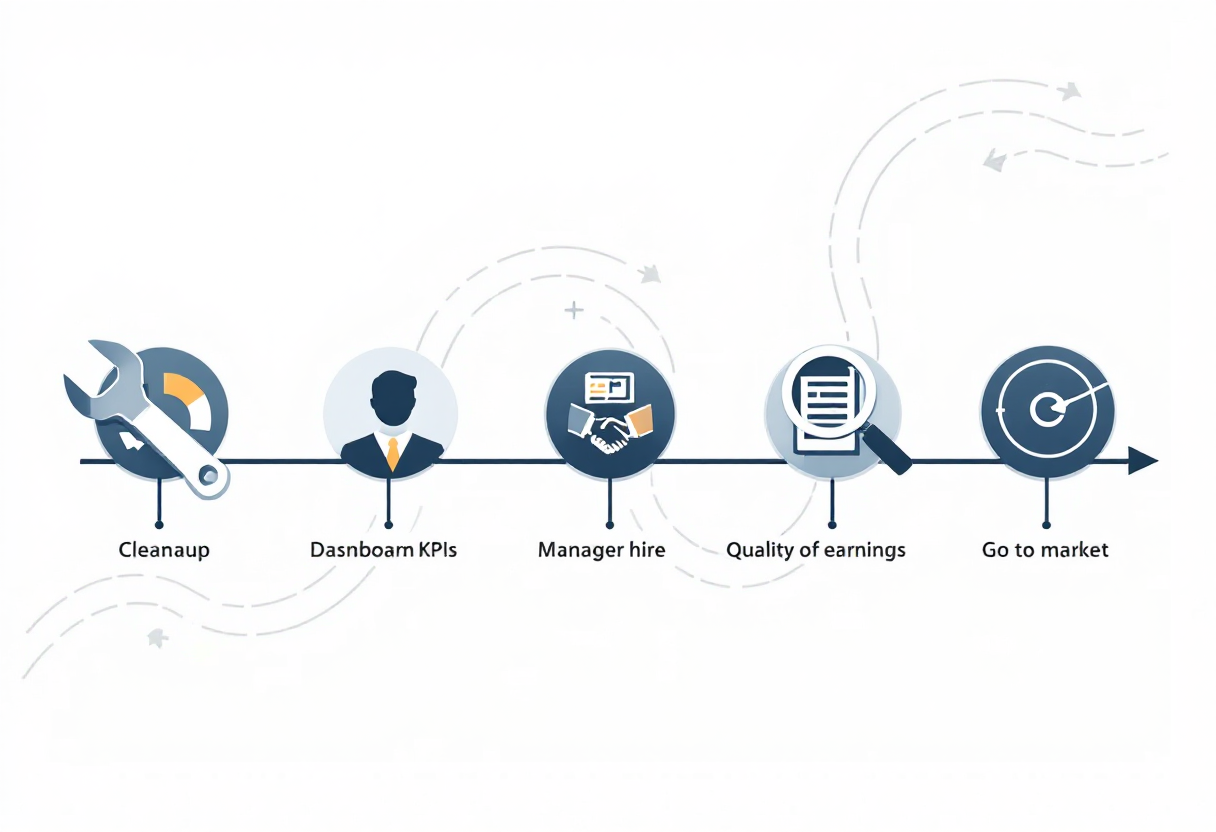
T-36 months: Cleanup phase
- Switch to accrual basis if still on cash basis.
- Pick an FSM (Jobber, Housecall Pro, or ServiceTitan depending on size) and migrate.
- Start tagging every potential EBITDA add-back as it happens.
- Conduct W-2/1099 classification audit; reclassify seasonal and helper labor if needed (settle exposure now while small).
- Restruck related-party rent to FMV with appraisal.
- Build the org chart and identify the GM hire (internal promotion target or external recruit).
- Phase I ESA on any owned shop and yard real estate.
- Sales and use tax compliance review by outside counsel in every operating state.
- Install or upgrade water reclaim equipment on the fleet; document NPDES BMPs; sign sanitary sewer discharge agreements with relevant municipalities.
- Crew certification push: SoftWash Systems Certified Applicator, PWNA modules, UAMCC certification. Cross-train so no single tech is the only credentialed person on a service line.
T-24 months: Financial discipline, KPI infrastructure, commercial recurring push
- GM hire onboarded and starting to take operational load.
- Monthly close in 15 days; service-line P&L every month.
- KPI dashboard: jobs per crew per day, route density, average ticket, recurring renewal rate, gross margin by service line, water reclaim compliance rate, customer concentration top 10.
- Commercial recurring contract push: target moving recurring mix from under 20% to 40%+ in 12 months and 60%+ by go-to-market.
- Pricing review: 5% to 8% list increase, dispatch fee held.
- Customer base de-concentration: if any top customer is above 15%, grow around them.
- Document SOPs for every operational role.
- Build the add-back bridge as a living document.
- Get on the approved vendor list at Vixxo and Divisions Maintenance Group if not already.
T-12 months: QoE-ready close discipline, eliminate owner dependence
- Owner steps out of daily operations; GM runs the shop.
- Owner takes a 2-week unplugged vacation as the stress test.
- Run the sell-side QoE (budget $15K to $50K for $500K to $3M EBITDA pressure washing).
- Tighten balance sheet: clean A/R, kill dormant inventory, isolate deferred revenue from prepaid recurring contracts.
- Final org-chart review; backfill any gaps.
- Final compliance scrub (license transferability where applicable, environmental, W-2/1099, sales and use tax, OSHA recordable history).
- Lock in 12 months of clean service-line P&L for the CIM.
T-6 months: Pre-marketing prep
- Engage M&A advisor. For sub-$3M EBITDA pressure washing this is often a lower-middle-market business broker (Calder Group, Chelsis Financial, Green Bridge Advisors, MidStreet, Centergrowth, Sell Cleaning Business). Above $3M EBITDA, sell-side investment bank with home services or facility services practice (Harrington Park Advisors, MelCap Partners, Northern Edge, Boxwood Partners, Generational Group). Typical broker commission 8% to 12%; investment bank retainer $15K to $50K monthly credited against success fee of 3% to 8% on Lehman or modified Lehman.
- CIM drafted from the QoE and operating model.
- Teaser drafted (anonymized 1-pager).
- Buyer list finalized: start with the 17 buyers in the platforms table above plus the 30 to 50 regional and sub-platform names the advisor maintains in their database.
- Virtual data room populated with everything from the pre-LOI and confirmatory sections above.
- Management presentation deck built and rehearsed.
T-3 months: Go to market
- Teaser distributed; NDAs collected; CIMs distributed.
- IOIs collected 2 to 3 weeks after CIM goes out.
- Narrow to 3 to 6 finalists for management meetings.
- Management meetings; LOIs solicited.
- Select LOI; sign with exclusivity (typically 45 to 90 days).
- Enter confirmatory diligence; close.
End-to-end from engagement to close: 6 to 12 months in a well-run process for pressure washing. Faster than HVAC because deal sizes are smaller and diligence scope is more contained (Auxo Capital Advisors sell-side process guide 2025; Wall Street Prep sell-side primer; Colonnade Advisors podcast 020).
Frequently Asked Questions
How long should I plan for before selling my pressure washing business to a private equity buyer?
The owners who get top-quartile pricing start preparing 24 to 36 months before going to market. The minimum useful prep window is 12 months, because most of the high-leverage levers (lifting commercial recurring revenue from under 20% to 60%+, installing a GM, installing wash water recovery on the fleet, getting on Jobber or ServiceTitan, running a sell-side QoE) need 12+ months of clean trailing-twelve-months data to be credible to a buyer. Owners who try to sell in under 6 months typically leave 20% to 40% of enterprise value on the table. Pressure washing transactions also have a more contained diligence scope than HVAC, so well-prepared owners can run a 6 to 12 month sell-side process once the prep work is done.
What is a realistic EBITDA multiple for a $750K EBITDA pressure washing business in 2026?
For a pressure washing business at $750K EBITDA in 2026, the range is 2.5x to 6.0x. The bottom of that range applies to demand-only residential shops with under 20% commercial recurring revenue, owner-dependence, and concentrated customer base. The top applies to shops with 60%+ commercial recurring, a GM in place, Jobber or ServiceTitan running, hot-water capable fleet with documented NPDES BMPs, and customer concentration below 15% (BizBuySell 2025 cleaning and janitorial benchmarks; Meridian Investment Banking Facility Maintenance and Janitorial Services Winter 2025; Peak Business Valuation 2025; Jack Talks Business pressure washing multiples). On $750K EBITDA, that is the difference between a $1.9M sale and a $4.5M sale. The 36-month prep playbook moves you from the bottom of the band to the top.
What percentage of commercial recurring revenue do PE buyers want to see?
60% or higher commercial recurring revenue is the threshold that moves your business from commodity pricing into premium pricing. Demand-only residential shops with under 20% recurring trade at 1.5x to 2.5x EBITDA. Shops with 60%+ commercial recurring revenue at $1M to $3M EBITDA trade at 5.5x to 8.0x EBITDA (Meridian Investment Banking Winter 2025; Jack Talks Business pressure washing multiples; Peak Business Valuation 2025). Recurring revenue from monthly or quarterly route contracts with strip malls, retail centers, gas stations, QSR chains, and HOAs is what platform buyers underwrite, because it is predictable, scalable across geographies, and supports debt financing on the deal.
Do I need to put a general manager in place before I sell?
If your goal is to maximize price, yes, ideally 12+ months pre-sale. Owner-dependence is universally cited as a major multiple haircut in cleaning and pressure washing valuation literature (Legacy Entrepreneurs; MassMutual; Maui Mastermind pressure-washing scale guide). On a $500K to $2M EBITDA pressure washing business, removing key-person risk lifts the multiple by an estimated 0.5x to 1.0x, worth $250K to $2M of price. A GM hire runs $90K to $150K plus bonus in pressure washing and needs 12 to 18 months to fully take operational load before the buyer’s diligence team will believe the transition. Bonus: with a credible GM in place, buyers may shorten the post-close owner transition from 1 to 3 years down to 3 to 6 months.
How do I handle the NPDES and wash water discharge compliance question during diligence?
This is the single most pressure washing-specific item in confirmatory diligence, and it kills or re-trades more deals in this segment than any other issue. Buyers want to see three things: documented NPDES Best Management Practices (a written BMP manual covering containment, capture, and disposal); water reclaim or vacuum recovery equipment on the trucks (Landa MWP-30E up to 30 GPM, Alkota Vacuum Filtration up to 8.0 GPM, Karcher Mississippi Recovery up to 30 GPM, larger commercial systems to 100 GPM); and signed agreements with municipal sanitary sewer authorities for legal discharge of recovered wash water. Without these, the buyer prices the deal assuming Clean Water Act exposure at $1,000 to $25,000 per day per violation under CWA Section 309. Equipment investment is typically $3,000 to $15,000+ per rig. Install 18+ months pre-sale and start documenting compliance on every job in the FSM.
How do I know if my customer concentration is too high to attract PE buyers?
The buyer-friendly target is: no single customer above 15% of revenue, top 5 customers below 40%. Concentration above 20% triggers buyer pushback; above 25% prompts a 15% to 30% valuation discount or buyer withdrawal; above 30% buyers treat it as a key-account risk and may walk (Keystone CPAs 2026; Beancount.io 2026; Eagle Rock CFO; Wall Street Prep customer concentration formula; Morgan & Westfield customer concentration glossary). The pressure washing-specific pattern is a single national QSR chain or fuel-station chain master service agreement representing 25%+ of revenue. The fix is not to shrink the top customer; the fix is to grow around them so the relative weighting drops, and to get the top account onto a multi-year MSA with strong assignment language and a steep early-termination penalty so the buyer can underwrite the contract.
What to Do Next
The pressure washing owners who get the top-quartile multiple all do the same three things. They start preparing 24 to 36 months before they want to be out. They put a GM in place 12+ months pre-sale and get wash water reclaim equipment on the fleet with documented NPDES BMPs in the same window. And they invest in a sell-side QoE before any buyer sees a CIM.
The pressure washing buyer universe is smaller than HVAC. A seller at $500K to $3M EBITDA will see 4 to 8 serious bidders, not the 20 to 30 a comparable HVAC seller would see. That makes process management and buyer selection more important, not less. The most active platforms (Kept Companies, Tendit Group, Perfect Power Wash, the Evive Brands/Shine combination, Vixxo and Divisions on the facility services side) move quickly when the file is clean and the commercial recurring mix is there. The franchise consolidators (Neighborly, Authority Brands, Premium Service Brands) offer a different exit profile with rolled equity, ongoing royalty obligations, and a brand conversion path.
If you are 12+ months from a potential exit and want a structured pre-sale optimization roadmap, CT Acquisitions has facility services operations specialists in our partner network who run multi-quarter prep engagements. If you are 6 to 12 months out and ready to start the sell-side process, our M&A advisory team runs the buyer outreach. No fee to you on buy-side introductions; sell-side mandates are paid on success at closing. Either way, the first 30 minutes are free.
Ready to talk?
Schedule a 30-minute exit-readiness call
Or read more: Sell Your Pressure Washing Business (active sale guide) | How to Prepare Your HVAC Business for a Sale or Exit (2026) | Sell Your Cleaning Business
Ready to Explore Your Options?
A 30-minute confidential conversation is all it takes.
