
How to Prepare Your PR Firm for Sale or Exit (2026)
Preparing your PR firm for exit in 2026 is a 36-month playbook. The first 12 months tighten the operating story around vertical specialization (healthcare, technology, financial services), MRR/retainer percentage, and consultant retention. The middle 12 fix pre-LOI diligence gaps around client concentration, contract length, and financial reporting quality. The final 12 turn one offer into a real competitive process. Named strategic and PE-backed acquirers include Stagwell (NASDAQ: STGW), Publicis, Omnicom, WPP, plus PE-backed marketing services platforms. Retainer-model firms command premium versus project-based operators.
Exiting your pr firm business is the single largest financial event most owners will ever face. This guide is the no-fluff playbook for pr firm owners who are 12-36 months from sale, covering how PE-backed buyers actually value your business in 2026, the 12 levers that move your multiple, pre-LOI diligence, deal-killers to fix before going to market, and the full 36-month exit prep timeline.
Updated April 2026 · CT Acquisitions

Most PR firm owners decide to sell, hire a banker, and find out 90 days later that their firm is worth 30% to 50% less than they thought. The owners who clear top-quartile multiples start preparing 18 to 36 months before they ever pick up a phone. This guide is the operating playbook for how to prepare your PR firm for a sale or exit. It covers what private equity actually buys in communications, the value drivers that move multiples by 2 to 4 turns, the documents PE will demand before they send an indication of interest, and the deal-killers that re-trade PR transactions during confirmatory diligence. Every multiple, named buyer, and stat traces to a verifiable transaction or industry source. The market in 2026 is unusually friendly to specialty sellers. It will not stay that way once the Omnicom-IPG combination closes and the buyer pool re-rationalizes.
If you are 6 to 36 months from a possible exit, the work below is the difference between a 5x outcome and a 12x outcome. On a $3M EBITDA financial PR or healthcare PR firm, that is the difference between a $15M sale and a $36M sale. Whether you want to prepare your PR firm for a sale to private equity, prepare your PR firm for an exit to a holding company, or sit down with a strategic adjacency like a consulting firm, the diligence is the same and the levers are the same. KKR paid an estimated 18 to 22 times trailing EBITDA for the strategic-communications portion of FGS Global in 2024. That is not a number you back into 90 days before going to market. It is the result of a multi-year operating program.
Building toward an exit in 12 to 36 months?
CT Acquisitions runs sell-side advisory for PR firm owners with $1M+ EBITDA. We also have communications-services operating specialists in our partner network who run pre-sale optimization engagements when the timeline is longer. No fee to you on buy-side introductions; sell-side mandates are paid on success at closing.
What Private Equity Actually Buys in PR (2026)
The signal transaction in modern PR M&A is KKR’s August 2024 majority acquisition of FGS Global at a $1.7 billion enterprise value, with WPP selling its roughly 50% stake for $775 million in cash and FGS partners retaining 26% (Axios, August 2024; PR Week, December 2024; FGS Global press release). KKR funded the deal primarily through European Fund VI, an $8 billion vehicle, and closed in December 2024. Trade press characterized the price as “an attractive multiple to 2023 EBITDA,” with bankers privately estimating 18 to 22 times trailing EBITDA on the strategic-communications portion of the platform. Healthcare communications produced a parallel story: New Mountain Capital’s continuation vehicle for Real Chemistry closed April 2025 at $3.1 billion enterprise value, on $560 million in 2025 global revenue (Simpson Thacher, April 2025; MM&M, 2025). Real Chemistry has since overtaken Edelman as the largest US PR firm by revenue. PR has become a recognized, fund-level theme.
The PE-attractive PR firm profile
- EBITDA threshold for a platform-quality deal: $3M to $10M adjusted EBITDA is the entry band where sponsor-backed buyers run a competitive process. Below $1M, you are an add-on inside a roll-up at 4x to 6x. $10M+ EBITDA gets you to platform candidate status with multiples that can reach 13x to 18x for true outliers.
- Retainer mix: 70%+ retainer revenue is the line between commodity and premium. Project-heavy firms (70% project) trade at 0.5x to 0.9x revenue and 2x to 3x EBITDA. Retainer-heavy firms (70%+ recurring) trade at 1.2x to 2.0x revenue and 4x to 6x EBITDA on the generalist side, with specialty firms reaching 9x to 14x (SagaImpact agency valuation; Merge PR valuation guide; PricingLink IR/PR pricing models).
- Specialty niche: Defensible vertical positioning in financial PR, healthcare PR, crisis communications, public affairs, or another regulated-industry adjacency lifts the multiple by 2 to 4 turns over generalist comparables.
- Client concentration: No single client above 20% of revenue; top three clients combined under 50%; ideal target is no single client above 5% with top 10 below 30% (FE International agency M&A 2026; SagaImpact). Above 30% from a single client, buyers either reprice 20% to 30% or walk.
- Client tenure and retention: Trailing three-year client retention above 90%, weighted-average client tenure above four years, and at least 18 months of evidence that the named senior account director (not the founder) is the primary client voice.
- Owner role: Owner is in strategic positioning, not in the war room on every account. Two senior managing directors named on the top accounts at least 18 months pre-sale.
- Geography: US firms with at least a functional London or APAC presence open IPO and global M&A mandates that single-country firms cannot win.
Active PR firm buyers in 2026
The list below covers the most active strategic, PE, and roll-up buyers in the 2024-2026 cycle. Sources: PRovoke Media 2024 Global PR Agencies of the Year; PR Week 2025 Agency Business Report; SEC filings for Stagwell, WPP, Omnicom, and IPG; Alternatives Watch and Buyouts Insider for sponsor transactions; PRovoke PR Agency Acquisitions tracker.
| Buyer | Type | Profile |
|---|---|---|
| KKR (via FGS Global platform) | Private equity | Acquired majority of FGS at $1.7B EV (Aug 2024); financial PR + public affairs; specialty bolt-on appetite; $5M+ EBITDA targets |
| New Mountain Capital (via Real Chemistry) | Private equity | $3.1B continuation vehicle closed Apr 2025; Real Chemistry overtook Edelman as #1 US PR firm by revenue; healthcare PR bolt-ons; $3M+ EBITDA |
| Stagwell (NASDAQ: STGW) | Holding company / public | $410M-$460M Adjusted EBITDA guidance FY2025; target $5B revenue by 2029; $80M-$100M identified cost savings; most active acquirer among the holding companies |
| Omnicom Group | Holding company / public | FleishmanHillard, Ketchum already inside; pending IPG combination will rationalize buyer pool but adds Weber Shandwick and Golin to portfolio post-close |
| WPP | Holding company / public | Net seller in 2024 (sold FGS to KKR); merged Burson Cohn & Wolfe and Hill+Knowlton into “Burson” Jul 2024; Ogilvy PR retained |
| Publicis Groupe | Holding company / public | MSL, Kekst CNC inside; acquisitive in healthcare and tech-comms adjacencies |
| Havas (Vivendi) | Holding company | Smaller appetite; specialty tuck-ins; corporate and healthcare comms |
| GIC + Linden Capital (via Klick Health) | Private equity | Healthcare communications platform; bolt-on appetite in life sciences PR |
| Golden Gate Capital | Private equity | Former minority holder in Sard Verbinnen (pre-FGS); active across professional services |
| PE-backed marketing roll-ups (mid-market) | Private equity platforms | Bolt-on appetite at 5x to 8x with 30%-40% equity rollover into platform; best fit $1M-$5M EBITDA |
| Brunswick Group (private partnership) | Strategic | Top global M&A PR advisor by deal value; tuck-ins for capability expansion |
| Joele Frank (private partnership) | Strategic | #1 in M&A PR since 2013, #1 in shareholder activism defense since 2019; conflict-free, company-only positioning |
| Edelman (private, family-owned) | Strategic | $986M FY2024 revenue (down 4.9%); selective tuck-ins for specialty expansion |
| APCO Worldwide | Strategic (independent) | Public affairs + corporate comms platform; bolt-on appetite |
| Padilla / AVENIR / Allison+Partners | Strategic (independent mid-tier) | Tuck-ins for vertical expansion (consumer, B2B, food and beverage) |
| Consulting firms (Deloitte, EY, KPMG, Accenture) | Strategic adjacency | Capability-extension acquisitions of small comms shops; lower headline multiples but cultural-fit upside |
The strategic acquirer landscape is shifting. Holding company moves over the past 24 months tell a coherent story: WPP merged Burson Cohn & Wolfe with Hill+Knowlton Strategies into a single rebranded entity, “Burson,” in July 2024 and sold FGS to KKR in the same year. Omnicom’s pending acquisition of IPG will bring FleishmanHillard, Ketchum, Weber Shandwick, and Golin under one parent and force portfolio rationalization that creates further divestitures. Stagwell reiterated 2025 guidance of approximately 8% organic net revenue growth and Adjusted EBITDA between $410M and $460M, with a $5B annual revenue target by 2029 (SEC 8-K Stagwell strategic update, 2025). For sellers, the next 24 months represent an unusually open window before the buyer pool re-rationalizes.
PR Firm Valuation Multiples in 2026 (What You Are Actually Worth)
PR firm valuation follows a clear size-and-specialty curve. Generalist consumer PR shops trade at lower multiples; specialty firms in financial PR, healthcare PR, crisis communications, and public affairs trade at premiums driven by retainer concentration, regulated-industry switching costs, and seller scarcity. The table below summarizes 2026 ranges from First Page Sage, Anders CPA, Agencies.co, Equidam, DealFlow Agent, Axial, Capital A, Auxo Capital, FE International, ExitValue.ai, OffDeal, Merge, SagaImpact, and Intelek.
SDE multiples (smaller, owner-operated PR shops)
| SDE band | SDE multiple | Profile fit |
|---|---|---|
| Under $250K SDE | 2.0x to 3.0x | Solo-practitioner consumer or B2B PR; project-heavy; minimal retainer base |
| $250K to $500K SDE | 2.5x to 3.5x | 5-10 person generalist shop; 40%-60% retainer; owner-led on top accounts |
| $500K to $1M SDE | 3.0x to 4.5x | 10-20 person; 60%+ retainer; second-tier leadership emerging |
| Specialty under $1M SDE (financial PR, healthcare PR, public affairs) | 3.5x to 5.0x | Niche positioning with retainer-heavy book; defensible regulated-industry expertise |
EBITDA multiples (PE-attractive size)
| EBITDA tier | Generalist consumer / corporate PR | Specialty (financial PR, healthcare PR, crisis, public affairs) | Platform / strategic outlier |
|---|---|---|---|
| Under $1M EBITDA | 3x to 5x | 4x to 6x | n/a |
| $1M to $3M EBITDA | 5x to 7x | 6x to 9x | n/a |
| $3M to $10M EBITDA | 7x to 10x | 9x to 13x | 10x to 12x |
| $10M+ EBITDA | 9x to 11x | 11x to 14x | 13x to 18x+ (FGS-tier outliers) |
Sources: First Page Sage marketing agency valuation 2026; ExitValue.ai PR firm valuation; OffDeal PR agency M&A; Merge agency valuation; Agencies.co 2026 valuation guide; Equidam EBITDA multiples by TRBC industry; SagaImpact agency valuation reality. Agencies with average adjusted EBITDA around $2.4M trade at average 6.46x, with select strategic transactions reaching 12x where double-digit growth, low client concentration, and long client lifespans align (Anders CPA, agency M&A 2026).
Recent disclosed PR transactions (2021-2026)
| Acquirer | Target | Date | Value | Implied multiple |
|---|---|---|---|---|
| KKR (European Fund VI) | FGS Global (majority from WPP) | Aug 2024 announce / Dec 2024 close | $1.7B enterprise value; $775M to WPP for ~50% stake; partners retain 26% | ~3.4x revenue; 18x-22x EBITDA (estimate) |
| New Mountain Capital (continuation vehicle) | Real Chemistry (single-asset CV) | Apr 2025 close | $3.1B enterprise value (incl. debt) | ~5.5x revenue on $560M FY2025; 14x-16x EBITDA (estimate) |
| WPP (with Golden Gate roll) | Finsbury Glover Hering + Sard Verbinnen merger | Dec 2021 close | $917M valuation; ~$330M+ pro forma 2020 revenue | ~2.8x revenue at formation |
| Real Chemistry | Greater Than One (GTO) | Jul 2025 | Not disclosed | Healthcare bolt-on; terms not public |
| WPP (internal merger) | Burson Cohn & Wolfe + Hill+Knowlton (rebrand “Burson”) | Jul 2024 | Internal; no disclosed value | Portfolio rationalization, not acquisition |
Sources: Alternatives Watch (Aug 2024); Axios (Aug 2024); Businesswire KKR/FGS announcement; PR Week (Dec 2024 close); FGS Global press release; Kirkland & Ellis advisor announcement; Simpson Thacher (Apr 2025); Buyouts Insider (Apr 2025); Bloomberg (Apr 2025 New Mountain CV); WPP corporate release (Oct 2021 merger announcement); Bloomberg (Oct 2021 Finsbury-Sard); Golden Gate Capital release; MM&M (Real Chemistry FY2025 revenue; Real Chemistry / GTO).
The FGS outlier deserves a careful caveat. At roughly $1.7B enterprise value on a business doing roughly $500M+ in revenue, FGS traded at 3.4x revenue and an estimated 18x-22x EBITDA. That multiple is not generalizable. It reflects platform scale, global office footprint, financial PR plus public affairs blended mix, embedded relationships with PE sponsors and corporate boards, and KKR’s strategic conviction in communications as a fund-level theme. A $5M EBITDA financial PR firm will not get FGS multiples. With the right preparation, it can get to 11x to 13x, which is still life-changing.
The 12 Value Levers That Move Your Multiple (Ranked by Impact)

These are the levers that move PR firm multiples in the 18 to 24 months before a sale. Each one has a current state, a target state, an estimated financial impact, and a how. The ordering is by dollar impact per unit of effort, based on cross-source synthesis from SagaImpact, Merge, FE International, Anders CPA, ExitValue.ai, OffDeal, and the named transaction data above.
Lever 1: Lift retainer mix to 70%+ recurring
Current: 40% to 50% retainer revenue; balance is project work, paid by hour or milestone, with no MSAs or month-to-month engagements. Target: 70%+ retainer revenue inside multi-year MSAs with retainer-floor language and 12-month minimum terms. Impact: This is the single largest multiple mover in PR. Agencies with 70%+ retainer revenue trade at 1.2x to 2.0x trailing-twelve-months revenue and 4x to 6x EBITDA; project-heavy comparables trade at 0.5x to 0.9x revenue and 2x to 3x EBITDA (SagaImpact agency valuation; Merge PR valuation guide; PricingLink IR/PR pricing). On a $5M revenue specialty PR firm at $1M EBITDA, lifting retainer mix from 50% to 75% can move the multiple from 5x to 8x, worth $3M of price. Every point of retainer above 60% expands multiple. How: Convert project clients to retainer at renewal with bundled deliverables and a retainer floor. Add executive-positioning, thought-leadership, and ongoing-measurement components as monthly add-ons. Sign 24-month MSAs with 12-month minimum and auto-renew language. Document monthly billing cadence so QoE can recognize retainer revenue ratably.
Lever 2: De-concentrate the client base
Current: Top client at 25%+ of revenue; top three clients combined above 50%. Target: No single client above 20%; top three under 50%; aspirational target is no single client above 5% with top 10 below 30%. Impact: Concentration above 30% from a single client either triggers a 20% to 30% reprice or causes the buyer to walk (FE International; SagaImpact; Anders CPA). Above 40% concentration, multiple reduction of 1.5x to 3.0x is typical. How: Diversify by industry and by buyer persona. Convert one large client into multiple smaller business units (e.g. the corporate parent plus three brand-level engagements) where economic substance supports it. If a major client cannot be diversified, scale up other accounts to dilute the concentration percentage. Plan for 12 to 18 months of organic dilution.
Lever 3: Build the specialty niche (financial PR, healthcare PR, crisis, public affairs)
Current: Generalist consumer or corporate PR mix; no defensible vertical positioning; clients won on relationship and price. Target: 15% to 25% of revenue from a defensible niche where regulated-industry expertise, switching costs, or seller scarcity drive premium pricing. Impact: Specialty positioning (biotech IPO PR, activist-defense, healthcare payor comms, ESG/sustainability advisory, federal lobbying) raises the multiple by 2 to 4 turns over generalist comparables. Specialty firms in financial PR and healthcare PR can charge 4x to 8x consumer-PR rates per engagement. How: Hire a senior practice lead in the chosen specialty 18 months before market. Be honest: an under-scale specialty practice (one practice lead plus two AEs) does not earn a specialty premium. Buyers need to see at least 15% to 20% of revenue in the specialty for it to credit.
Lever 4: Move the owner out of the chair (named senior managing directors on every account)
Current: Founder personally pitches stories to top-tier journalists, attends every crisis war-room, and signs every major client’s strategy memo. Target: Two named senior managing directors with primary client-facing voice on the top 10 accounts; founder visible in strategic positioning, not daily account work; deputy lead on every account so no client has a single relationship inside the firm. Impact: Key-person risk is the most common PR firm failure mode in diligence. Buyers cannot underwrite continuity if the founder is the sole journalist contact and the sole client relationship. Resolving this moves the multiple from the 5x to 6x band into the 7x to 9x band on a $2M to $5M EBITDA specialty firm, worth $4M to $20M of price. How: Promote or hire two senior managing directors with named-client relationships at least 18 months before sale. Let them sign client communications. Record 18 to 24 months of touchpoints where the SMD, not the founder, is the primary voice. Run a stress test: founder unplugged for one month.
Lever 5: Convert from cash to accrual with ratable retainer recognition
Current: Cash basis accounting; retainer revenue recognized when invoiced rather than ratably across the engagement period; expense pass-throughs netted below the line. Target: Two clean reviewed or audited fiscal years on accrual basis; retainer revenue recognized ratably over the engagement period; project revenue recognized at performance milestones with ASC 606 disclosure; pass-throughs grossed up under principal-vs-agent guidance with an accounting-policy memo on file. Impact: A QoE will surface revenue-recognition gaps immediately. The gap between the LOI EBITDA and the QoE-confirmed EBITDA is where deals reprice. Sellers who go to market with cash-basis books leave 1x to 2x of multiple on the table. How: Engage an M&A-experienced CPA at T-24 months. Convert chart of accounts. Run two clean trailing years on accrual before the CIM goes out. Get an accounting-policy memo on revenue recognition and pass-through treatment.
Lever 6: Senior account director retention with double-trigger packages
Current: Senior account directors on standard at-will employment; no non-competes; no retention bonus architecture; no equity participation. Target: Top 8 to 10 senior personnel on multi-year non-competes plus double-trigger retention packages that vest on (a) closing and (b) continued employment 12 to 24 months post-close. Impact: Post-close reality is that nearly 50% of key employees leave within the first year and 75% within three years (Advisor Legacy client retention; Clearly Acquired key retention; McCauley Knutsen earnouts and retention). Cost of replacing a senior account director runs 50% to 200% of annual salary, plus 6 to 12 months of relationship rebuild. A buyer-credible retention plan converts an earnout into cash at close and lifts headline multiple. How: Size retention bonuses at 25% to 75% of annual cash comp for senior managing directors, 50% to 150% for practice-area heads. Buyers will help fund this from purchase price. Issue retention letters at T-12 months.
Lever 7: Document SOPs and capture AI margin
Current: No documented standard operating procedures; tribal knowledge; founder is the playbook; AI tools used informally if at all. Target: Documented SOPs for every recurring deliverable (press release production, media list build, briefing book, crisis playbook, IPO communications playbook, executive briefing deck) loaded into an internal wiki; AI tools deployed (Claude, ChatGPT Enterprise, Jasper, Writer, Grammarly Business) for first-draft press release writing, media monitoring summarization, briefing-book research, and social copy. Impact: Buyers underwriting “the playbooks survive without the founder” get to a higher multiple. AI tooling captured as margin (not passed to clients) lifts EBITDA 5 to 10 points without compressing pricing. On a $5M revenue firm, that is $250K to $500K of additional EBITDA, multiplied at sale. How: Assign each service line a process owner. Build templates in Notion or Confluence. Pilot AI in one practice. Measure time saved per deliverable. Hold pricing flat to clients and capture the productivity gain as margin.
Lever 8: Pricing actions on existing book (raise retainer floors 8% to 15%)
Current: Retainers under market by 10% to 20% on long-tenured accounts; project work scoped on time-and-materials with frequent overrun; no annual pricing review. Target: Retainer floors raised 8% to 15% at next renewal across the book; project work moved to scoped fixed-fee with overage clauses; explicit 15% to 20% project-management fee on all sub-vendor pass-throughs. Impact: Direct EBITDA growth. A $5M revenue firm raising blended pricing 10% with 80% retention adds roughly $400K of revenue, with most dropping to EBITDA. At a 7x multiple, that is $2.8M of additional sale price. How: Schedule pricing conversations with each major client at renewal anchor (calendar year, fiscal year, or contract anniversary). Lead with new scope additions to justify increases. Quietly add a thought-leadership or executive-positioning add-on at $5K to $15K per month.
Lever 9: Compliance scrub (LDA, FARA, FCPA, SOC 2)
Current: Lobbying activity tracked informally; no FARA review; ad-hoc anti-corruption policy; SOC 2 not on the radar. Target: Written LDA registration analysis with time-tracking sufficient to defend non-registration; FARA forensic review of every client and pitch over the trailing 5 years; written anti-corruption policy with employee training records and third-party due diligence program; SOC 2 Type II for any firm handling sensitive client data. Impact: 2024-2025 included multiple landmark FARA deferred-prosecution agreements and the DOJ National Security Division has materially escalated enforcement (Jenner & Block FARA DPAs; Mayer Brown FARA 2025; Day Pitney FARA enforcement). Buyers run a forensic check of every client and pitch over the trailing 5 years to identify any unregistered activity. A single seven-figure pending claim or open FARA exposure can stall a deal indefinitely. How: Engage political-law counsel at T-24 months. Document time spent on federal-lobbying contacts. Identify any client where FARA registration was potentially required but not filed. Remediate before market.
Lever 10: 1099 freelance classification audit
Current: Heavy bench roster of writers, photographers, video editors, influencer managers, and event producers classified as 1099 with W-2-like supervision pattern. Target: Worker classification audit completed in every operating state (California AB5, New York, Massachusetts, New Jersey enforce aggressively); reclassifications executed where economic substance is W-2; contractor agreements include IP assignment language so the firm owns the deliverables it has paid for. Impact: Misclassification is both a contingent-liability item and a deal structural issue. A buyer’s diligence team will flag it inside the first 30 days of exclusivity and price the exposure into a holdback or escrow. How: Run the audit at T-24 months. Reclassify in stages so the change does not appear in confirmatory diligence. Audit contractor agreements for unambiguous IP assignment.
Lever 11: International capability (London, Singapore, or virtual EMEA presence)
Current: Single-country US firm; international work referred to network partners; no registered foreign office. Target: One functional London or APAC presence (even a one-person registered office) that opens IPO and global M&A mandates. Impact: A US firm with at least minimal global footprint commands a premium because the buyer can underwrite cross-border work that a single-country firm cannot win. Estimated +0.5x to 1.0x multiple uplift for specialty firms targeting financial PR or M&A communications. How: Hire a senior individual in London with a registered address and serviced office. Add the London capability to the website and the CIM. Cost: roughly $250K to $400K annually fully-loaded; payback typically inside 12 months on a single inbound IPO mandate.
Lever 12: Awards portfolio, measurement and analytics adoption
Current: No active awards strategy; no formal measurement; client reporting is ad hoc. Target: Active submission program for PRWeek Awards, SABRE Awards, Cannes Lions PR Lions, and Holmes Reports Agency of the Year; subscriptions and trained users on Cision, Muck Rack, Meltwater, Onclusive, and Memo (for AI-search measurement); standard quarterly client business reviews with earned-media value, share of voice, sentiment scoring, and AI-search visibility metrics. Impact: Awards are a marketing signal to buyers running a competitive sale process, not in themselves a multiple mover. Measurement and analytics adoption is what allows a buyer to underwrite recurring retainer expansion under the new ownership. Treat awards as proof points and measurement as a real driver. Estimated +0.25x to 0.5x multiple uplift in a competitive process. How: Assign a marketing manager (not the founder) to awards submissions. Subscribe to Memo or another AI-search measurement tool. Standardize a quarterly business review template for every retainer client.
Want to grow your business to maximize value before exiting?
We connect PR firm owners with communications operating specialists in our partner network who run 12 to 24 month pre-sale optimization engagements. The engagement pays for itself in incremental sale price.
What PE Asks Before They Send an LOI (The Pre-LOI Diligence Stack)
Before a PE firm or strategic acquirer commits to a letter of intent, they ask for a focused diligence package. The list below is the realistic pre-LOI ask for a $3M to $10M EBITDA specialty PR firm in 2026. The “why” and “how to prepare” expand each item to what is typical across the industry.
1. Trailing financials: 2023, 2024, 2025, and LTM income statements
Why PE asks: They are building the LTM EBITDA they will multiply. They want trend (growth rate, margin trajectory), seasonality of project work, and any one-time movers. LTM is the bridge between the most recent year-end and today, so the headline price reflects current run-rate rather than stale data. They also want to identify any client churn embedded in the trend that the next twelve months will continue.
How to prepare: Accrual-basis P&L by month, mapped to a clean chart of accounts. Service-line P&L (retainer vs. project vs. pass-through) where possible. Reconcile to tax returns so there are no surprises in confirmatory diligence. Pre-empt obvious questions on revenue mix and margin compression.
2. Balance sheet at the latest month-end
Why PE asks: Two reasons. First, to start sizing the working capital peg they will set in the purchase agreement. Second, to identify net debt (cash minus interest-bearing debt minus debt-like items including unbilled work-in-process, deferred revenue from retainers billed in advance, accrued bonuses, and any pass-through accruals). Both peg and net debt come out of the purchase price.
How to prepare: Tie the balance sheet to the trial balance. Identify which liabilities are debt-like (deferred revenue on prepaid retainers is the most commonly disputed item for PR firms). Document client deposits and any prepaid project work that has not yet been performed.
3. Adjusted EBITDA bridge with documented add-backs
Why PE asks: They want a sneak peek at your adjusted EBITDA story before they sink diligence cost into the file. If your add-backs are aggressive or undocumented, they discount the rest of your numbers and assume the QoE will haircut you further.
How to prepare: Build the bridge from book EBITDA to adjusted EBITDA, line by line. Document every add-back with the underlying invoice or payroll record. Common PR firm add-backs that hold up: owner salary above market rate, owner’s family on payroll, non-business travel and entertainment, one-time legal and professional fees, severance from a one-time reduction in force, one-time office relocation, COVID-era ERC, transaction-related fees, and cautiously discretionary bonuses tied to founder-control decisions. Common rejections: ongoing T&E that supports client work, “owner does the work of three people” labor add-backs (hire the replacement before going to market instead), and reclassed cost of goods that masquerade as discretionary.
4. Client roster and revenue waterfall (trailing 36 months)
Why PE asks: This is the single most diagnostic exhibit. It tells them concentration (top-1, top-3, top-10 as percentage of revenue), tenure (weighted-average), and churn pattern (new, expansion, contraction, loss). It also reveals whether the founder is the named relationship on the largest accounts.
How to prepare: Per-client revenue waterfall for trailing 36 months that calculates exactly how much revenue churned and why. Anonymize client names if needed before pre-LOI (initials or codes), but be ready to disclose under NDA. Document multi-level penetration: CMO, GC, CFO, IR, and product-line stakeholders where the firm has relationships.
5. Retainer vs. project revenue mix with MSA inventory
Why PE asks: Recurring retainer revenue is the single biggest multiple driver in PR. They want to see absolute retainer dollars, growth rate, weighted-average MSA term, retainer floor pricing, and how many MSAs auto-renew vs. require manual renewal. Month-to-month engagements get heavily discounted.
How to prepare: Master inventory of every MSA: client, start date, term, retainer floor, auto-renew language, change-of-control assignment clause, governing law. Calculate retainer revenue as percentage of total trailing-twelve-months revenue. Identify the MSAs that will be in force through the expected close date.
6. Employee roster (titles, start dates, comp structure, non-competes)
Why PE asks: Stress-testing two risks. First, senior account director tenure and the question of whether the firm runs without the founder. Second, key-person risk on the named senior managing directors. They want to see at least two SMDs with multi-year non-competes who are primary on top accounts.
How to prepare: Roster columns should include role, hire date, full-time vs. part-time, W-2 vs. 1099 (with classification rationale), comp structure (base, commission, bonus), and any active non-compete or non-solicit. Calculate and disclose 12-month and 24-month rolling senior-personnel retention. Have a written retention plan for the top 8 to 10 personnel.
7. Three-to-five year operating plan
Why PE asks: PE underwrites a forward case (years 1 through 5 post-close). They want to see if you have a credible growth story and how aggressive you are. They will overlay their own model on top, but your plan tells them whether you understand your own levers.
How to prepare: A simple operating model: revenue by service line, retainer vs. project, gross margin assumptions, overhead growth, EBITDA. Include capacity build (account directors and AEs), planned specialty practice expansion, pricing actions, and any committed new-business pipeline.
8. Compliance and regulatory stack inventory
Why PE asks: Because LDA, FARA, FCPA, Reg FD, FTC influencer disclosure, FDA off-label, GDPR, CCPA, and SOC 2 are all live risks for PR firms. They want to see the inventory before they offer a price, not after they have spent $250K on diligence.
How to prepare: Working document that lists each applicable regime, who at the firm owns compliance, training records, the third-party due diligence program, and any pending or threatened enforcement matter. Have political-law counsel and employment counsel on retainer 12 to 18 months pre-sale.
9. Insurance inventory (E&O, media-perils, cyber, EPL, D&O)
Why PE asks: A buyer’s lender will require tail coverage post-close on any policy that does not transfer cleanly. Media-perils (libel and defamation) is particularly important for crisis PR and corporate PR firms.
How to prepare: Inventory each active policy: carrier, limits, retention, premium, expiration, claims history. Be ready to bind tail coverage at close. Resolve any prior-acts exclusions.
10. Litigation and pending claims schedule
Why PE asks: Crisis PR and corporate PR firms periodically draw threatened defamation suits when an aggressive media strategy lands badly. Any open claim is a contingent liability that will hit indemnity caps and may stall the deal.
How to prepare: Schedule every open or threatened claim, arbitration, or governmental investigation. Settle, dismiss, or fully reserve before going to market. A single seven-figure pending claim can stall a deal indefinitely.
Confirmatory Diligence (After You Sign the LOI)
Once an LOI is signed and exclusivity starts (typically 60 to 90 days), the buyer runs parallel workstreams. This is the depth of inspection the firm will undergo. If anything was hiding, it surfaces here.
- Quality of Earnings (QoE). Outside accounting firm runs revenue cut-off testing, retainer revenue recognition analysis (huge for PR because of advance-billed retainers), expense normalization, pass-through principal-vs-agent review, add-back validation, working capital trends. Buyer QoE cost: $75K to $250K typical for $3M to $10M EBITDA. Output: an adjusted EBITDA number the buyer locks into the model.
- Customer concentration and commercial DD. Client-by-client revenue analysis, calls with top accounts (anonymized at first, then named under NDA inside exclusivity), MSA review (assignment clauses, change-of-control, renewal dates), and a competitive-conflict check against the buyer’s portfolio.
- IT and data audit. Cision, Muck Rack, Meltwater, Onclusive subscription inventory, internal CRM hygiene, project management platform standardization (Monday, Asana, Wrike, ClickUp), data security posture, SOC 2 Type II report if applicable.
- Legal. Entity good standing, MSA assignment review, work-for-hire and IP assignment in client and contractor agreements, litigation history (active and threatened defamation, breach, copyright), real estate leases.
- HR and payroll. W-2 vs. 1099 classification audit, I-9 compliance, wage-and-hour exposure, benefits, PTO accrual, any pending EEOC or DOL claims, non-compete enforceability in each operating state (California disallows most non-competes; New York and Massachusetts limit them).
- Political law and regulatory. LDA registration filings, FARA exposure on every client over trailing 5 years, FCPA program documentation, Reg FD protocols for financial PR engagements, FTC influencer disclosure for consumer PR programs.
- Tax. Federal income, payroll, state and local. State-level sales/use tax exposure on certain creative services in states that tax them. International tax exposure if the firm has any cross-border revenue.
Why You Should Pay for Your Own Quality of Earnings Before Going to Market
A sell-side QoE is your own outside accountant’s QoE, paid for by you, before you go to market. It does three things: pre-empts the buyer’s QoE by getting to the adjusted EBITDA number first with documentation; surfaces issues you can fix before the buyer sees them (retainer revenue recognition, working capital surprises, add-back weaknesses); and tightens the EBITDA number you take to market, which directly drives the headline price.
Cost
- $25K to $35K for a basic QoE if revenue is below $5M (DealFlow Agent business exit valuations 2025-26).
- $50K to $100K typical for a healthy specialty PR firm at $3M to $10M EBITDA with multiple service lines and pass-through complexity.
- Up to $200K for businesses with complex add-backs, multiple entities, international revenue, or messy retainer accruals.
ROI
Example: a $20M revenue specialty PR firm with $4M EBITDA. Moving the multiple from 7x to 9x equals $8M of additional sale price. A $75K QoE investment that supports that 2x lift is a 100x return. A more conservative example: a $5M revenue, $1.2M EBITDA firm where the sell-side QoE finds $250K of legitimate add-backs the owner had not flagged and tightens the working capital story. At a 7x multiple, that is $1.75M of additional purchase price for a $50K spend, before counting the avoided re-trade risk. The sell-side QoE also surfaces the issues you can fix before the buyer sees them rather than during exclusivity when re-trade is a credibility hit.
Deal-Killers That Re-Trade PR Firm Transactions (Avoid These)
These are the recurring kill-shots cited across PR firm M&A advisory content and confirmatory diligence checklists. Most are fixable in 12 to 24 months. None are fixable in 30 days.
1. Client concentration above 20%
Buyers consistently want no single client representing more than 20% of revenue, and the top three clients combined below 50%. Above 30% from a single client, buyers either reprice 20% to 30% or walk (FE International agency M&A 2026; SagaImpact; Anders CPA). Aspirational benchmark is no single client above 5% with top 10 below 30%.
2. Founder is the chief media-relations contact
The single most common PR firm failure mode in diligence. If the founder personally pitches stories to top-tier journalists, attends every crisis war-room, and signs every major client’s strategy memo, the buyer cannot underwrite continuity. Hire and promote two senior managing directors with named-client relationships at least 18 months before sale, and let them sign client communications.
3. Client retention through ownership change
Industry reality: 30% to 40% of PR firm clients churn within 18 months of a change of control if no retention plan is built. Buyers know this and price it in. Lock-in MSAs with multi-year terms, build deputy-relationship coverage on every account, and prepare a written client-transition memo for diligence.
4. Work-for-hire and IP assignment problems in MSAs
PR firms produce campaigns, strategy decks, branded content, video, and influencer creative. If client MSAs do not include unambiguous work-for-hire language assigning all deliverables to the client, buyers demand reps and warranties that may be impossible to give. Conversely, if your firm has not assigned IP from contractors back to itself, the firm does not actually own its own playbooks. Audit all MSAs and contractor agreements; remediate before market.
5. 1099 freelance misclassification
PR firms run heavy bench rosters of writers, photographers, video editors, influencer managers, and event producers, frequently misclassified as 1099 when their work and supervision pattern resembles W-2 employment. California AB5, New York, Massachusetts, and New Jersey enforce aggressively. A buyer’s diligence team will flag this as both a contingent-liability item and a deal structural issue.
6. FCPA and anti-corruption exposure
Firms working for foreign governments, foreign state-owned enterprises, or large multinationals that touch government procurement face FCPA scrutiny. Buyers demand a written anti-corruption policy, employee training records, and a clean third-party due diligence program.
7. Unregistered FARA or LDA activity
If any team member spends more than 20% of working time on federal-lobbying contacts in a calendar quarter, LDA registration and quarterly LD-2 reporting are required. If any client is a foreign government, foreign political party, or foreign principal whose principal beneficiary is a foreign state, you may have FARA obligations that the LDA exemption does not cover. The DOJ National Security Division has materially escalated FARA enforcement, with multiple landmark deferred-prosecution agreements in 2024-2025 (Jenner & Block; Mayer Brown; Day Pitney). Buyers run a forensic check of every client and pitch over the trailing 5 years.
8. Retainer revenue recognition errors
PR firms invoice retainers in advance and pass-through expenses on lag. If your accounting team has been recognizing retainer revenue when invoiced rather than ratably across the engagement period, you have a GAAP problem that the QoE will surface immediately. Convert to accrual plus ratable recognition at least 24 months before sale to produce two clean reviewed years.
9. Pass-through expense accounting and ASC 606 principal-vs-agent
Many PR firms net pass-throughs (media buys, paid influencer fees, event production costs) below the revenue line and report only the markup. Buyers and QoE teams may insist on grossing these up under ASC 606 principal-vs-agent guidance, which dramatically changes apparent gross margin. Get an accounting-policy memo from your CPA before market.
10. Pending defamation, libel, or arbitration claims
Crisis PR and corporate PR firms periodically draw threatened defamation suits when an aggressive media strategy lands badly. Settle, dismiss, or fully reserve every open claim before going to market. A single seven-figure pending claim can stall a deal indefinitely.
11. Client conflict portfolio mismatch with the buyer
If a buyer’s existing portfolio competes with one of your top accounts, the acquisition might trigger a forced resignation. Map all top-20 clients against likely strategic buyers and PE platforms before going wide. The data point that ruins a process: a 25% client whose direct competitor is already inside the buyer’s portfolio.
12. SOC 2, GDPR, and CCPA gaps
Larger PE platforms increasingly require SOC 2 of their portfolio agencies. Healthcare PR firms touching PHI need HIPAA compliance. EU client work triggers GDPR. California exposure triggers CCPA. Each of these can become an indemnity cap issue if the firm has not invested in formal compliance documentation. Buyers will check.
The 36-Month Exit Prep Timeline
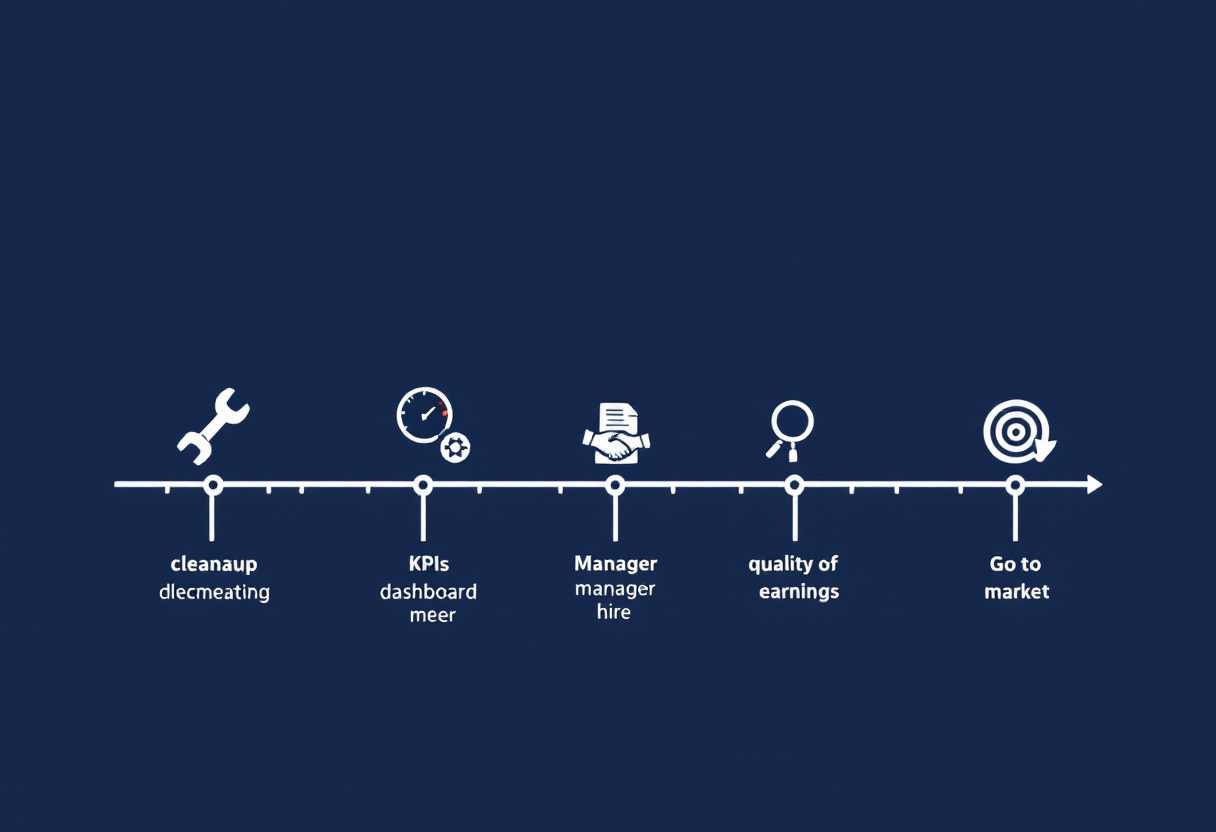
T-36 months: Foundational hygiene
- Engage M&A counsel and an M&A-experienced CPA to scope the data room and QoE prep
- Convert accounting to accrual basis; recognize retainer revenue ratably over engagement period
- Begin two clean reviewed or audited fiscal years on accrual basis
- Run a confidential top-30 client account-health review and triage at-risk relationships
- Audit MSAs for work-for-hire, IP assignment, governing law, change-of-control, and assignment provisions
- Run a worker classification audit on 1099 bench; reclassify in stages
- Begin LDA/FARA review with political-law counsel; close any gaps
- Identify the 8 to 10 senior account directors and practice leads who must be retained
- Phase I anti-corruption policy in place with training records
T-24 months: Operating leverage actions
- Raise retainer pricing 8% to 15% at renewal across the book
- Move project work to scoped fixed-fee with overage clauses
- Build out the thought-leadership and executive-positioning product line at $5K to $15K monthly add-on
- Deploy AI tools and capture the margin (do not pass to clients)
- Document standard operating procedures across every recurring deliverable
- Hire a senior healthcare PR, financial PR, or public affairs practice lead if rebalancing portfolio toward specialty
- Begin recording founder-led client touchpoints with named senior managing directors on every account
- Launch international footprint (London serviced office) if specialty work supports it
T-12 months: Pre-market positioning
- Renew MSAs to multi-year terms with retainer-floor language and 12-month minimum
- Document client-by-client revenue waterfall trailing 36 months
- Issue double-trigger retention letters to top 8 to 10 personnel
- Run the sell-side QoE (budget $50K to $100K)
- Tighten balance sheet: clean WIP aging, isolate deferred revenue, reconcile pass-throughs
- Final compliance scrub (LDA, FARA, FCPA, SOC 2, GDPR, CCPA)
- Build the CIM skeleton with banker; identify three highest-priority strategic buyers and five PE platforms
- Owner steps out of daily account work; SMDs run the book
T-6 months: Pre-marketing prep
- Engage banker (common PR sell-side mandates: Houlihan Lokey, Raine Group, JEGI Clarity, Capstone Partners, GP Bullhound, Berkshire Global Advisors, AdMedia Partners, Lincoln International, William Blair, Ardea Partners, Solomon Partners)
- Banker prepares CIM and teaser (anonymized 1-pager)
- Buyer list finalized: 30 to 60 logical buyers under NDA
- Virtual data room populated with every pre-LOI and confirmatory exhibit
- Management presentation deck built and rehearsed; founder unplugged stress test
- F-reorganization or PTET election executed if tax structuring supports it
T-3 months: Go to market
- Teaser distributed; NDAs collected; CIMs distributed
- Indications of Interest (IOI) collected at week 4 to 5; down-select to 8 to 15 for management meetings
- Management meetings over 4 to 6 weeks; LOIs solicited at week 12 to 14
- Select winning LOI; enter 60 to 90 day exclusivity for confirmatory diligence
- Sign and close; hold-back, earnout, and rollover equity architecture set during purchase agreement negotiation
- Coordinated day-1 communications to staff and clients
Expected deal structure for a $3M to $10M EBITDA specialty PR firm in 2026: 60% to 75% cash at close, 10% to 20% rollover equity into buyer or platform, 10% to 20% earnout tied to 12 to 24 month EBITDA or client retention, senior management retention packages funded outside the purchase price by the buyer, working capital target reconciled at close, and reps and warranties insurance (RWI) to cap seller indemnity exposure. Tail E&O and media-perils coverage required by buyer.
Frequently Asked Questions
How long should I plan for before selling my PR firm to a private equity buyer?
The owners who get top-quartile pricing start preparing 18 to 36 months before going to market. The minimum useful prep window is 12 months because most of the high-leverage levers (lifting retainer mix from 50% to 70%+, installing two named senior managing directors on top accounts, converting accounting to accrual with ratable retainer recognition, running a sell-side QoE) need 12+ months of clean trailing-twelve-months data to be credible to a buyer. Owners who try to sell in under 6 months typically leave 20% to 40% of enterprise value on the table.
What is a realistic EBITDA multiple for a $3M EBITDA specialty PR firm in 2026?
For a specialty PR firm (financial PR, healthcare PR, crisis communications, or public affairs) at $3M EBITDA in 2026, the range is 9x to 13x. The bottom of that range applies to firms with under 60% retainer revenue, founder-led top accounts, and concentration above 25%. The top applies to firms with 70%+ retainer revenue, two named senior managing directors, customer concentration under 15%, and 90%+ trailing client retention. For generalist consumer or corporate PR at the same $3M EBITDA, the range shifts to 7x to 10x. The 18 to 24 month prep playbook moves you from the bottom of the band to the top, which on $3M EBITDA is the difference between $21M and $39M of purchase price.
What percentage of retainer revenue do PR buyers want to see?
70% or higher retainer mix is the threshold that moves a PR firm from commodity pricing into premium pricing. Agencies with 70%+ retainer revenue trade at 1.2x to 2.0x trailing revenue and 4x to 6x EBITDA on the generalist side, with specialty firms reaching 9x to 14x. Project-heavy firms (70% project) trade at 0.5x to 0.9x revenue and 2x to 3x EBITDA (SagaImpact; Merge; PricingLink IR/PR pricing). Every percentage point of retainer above 60% expands multiple. Buyers also reward multi-year MSAs with retainer floors, since contracted forward revenue shortens the post-close ramp story.
Should I get a quality of earnings report done before going to market?
For PR firms at $1M+ EBITDA, yes. A sell-side QoE costs $50K to $100K typical for a $3M to $10M EBITDA firm, up to $200K for complex add-back or multi-entity situations (DealFlow Agent; Eton Venture Services). The ROI is leverage. If your QoE supports a 1x multiple uplift on a $5M EBITDA business at an 8x baseline, that is $5M of additional sale price for a $75K investment. More importantly, a pre-market QoE surfaces retainer revenue recognition issues, working capital surprises, pass-through accounting gaps, and add-back weaknesses while you can still fix them, rather than during exclusivity when the buyer re-trades the deal.
Do I need to put senior managing directors in place before I sell?
If your goal is to maximize price, yes, ideally 18 months pre-sale. Founder-as-only-client-contact is the most common PR firm failure mode in diligence. Two named senior managing directors with primary relationships on the top 10 accounts, signing client communications and attending crisis war rooms, is what allows a buyer to underwrite continuity. On a $2M to $5M EBITDA specialty firm, resolving key-person risk moves the multiple from the 5x to 6x band into the 7x to 9x band, worth $4M to $20M of price.
How do FARA and LDA exposure affect a PR firm sale?
FARA and LDA exposure is one of the fastest ways to stall or re-trade a deal. If any client over the trailing five years was a foreign government, foreign political party, or foreign principal whose principal beneficiary is a foreign state, FARA registration may have been required. The LDA exemption does not apply to direct foreign-government clients. The DOJ National Security Division has materially escalated FARA enforcement, including multiple landmark deferred-prosecution agreements in 2024-2025 (Jenner & Block; Mayer Brown; Day Pitney). Buyers will run a forensic check of every client and pitch over the trailing 5 years. Engage political-law counsel at T-24 months, document time-tracking on federal-lobbying contacts, and remediate any unregistered activity before market. A single open FARA exposure can collapse a transaction.
What to Do Next
The PR firm owners who get the top-quartile multiple all do the same three things. They start preparing 18 to 36 months before they want to be out. They put two named senior managing directors on the top 10 accounts at least 18 months pre-sale. And they invest in a sell-side QoE before any buyer sees a CIM.
The market in 2026 is unusually friendly to specialty sellers who can demonstrate 70%+ retainer mix, sub-20% top-client concentration, 90%+ trailing client retention, defensible niche, clean LDA/FARA compliance, and credible second-tier leadership that can run the firm without the founder. The KKR-FGS transaction at $1.7B and the Real Chemistry $3.1B continuation vehicle have set the upper end of what specialty platforms can command. The Omnicom-IPG combination will rationalize the buyer pool once it closes. The next 24 months are an unusually open window before that happens.
If you are 12+ months from a potential exit and want a structured pre-sale optimization roadmap, CT Acquisitions has communications-services operating specialists in our partner network who run multi-quarter prep engagements. If you are 6 to 12 months out and ready to start the sell-side process, our M&A advisory team runs the buyer outreach. No fee to you on buy-side introductions; sell-side mandates are paid on success at closing. Either way, the first 30 minutes are free.
Ready to talk?
Schedule a 30-minute exit-readiness call
Or read more: Sell Your Marketing Agency (active sale guide) | Talk to a CT Acquisitions advisor
Ready to Explore Your Options?
A 30-minute confidential conversation is all it takes.
