How to Prepare Your Painting Business for a Sale or Exit in 2026: The 36-Month PE-Buyer Playbook
Preparing your painting business for exit in 2026 is a 36-month playbook. The first 12 months tighten the operating story around commercial recurring revenue and crew productivity, the middle 12 fix pre-LOI diligence gaps around subcontractor status and safety records, and the final 12 turn what would have been a single lowball offer into a real competitive process.
Exiting your painting business is the single largest financial event most owners will ever face. This guide is the no-fluff playbook for painting business owners who are 12-36 months from sale, covering how PE-backed buyers actually value your business in 2026, the 12 levers that move your multiple, pre-LOI diligence, deal-killers to fix before going to market, and the full 36-month exit prep timeline.
Updated April 2026 · CT Acquisitions

Most painting owners decide to sell, hire a broker, and find out 90 days later that their business is worth 30% to 50% less than they thought. The owners who get the top-quartile price start preparing 24 to 36 months before they ever talk to a buyer. This guide is the 36-month playbook for how to prepare your painting business for a sale or exit. It covers what private equity actually buys in painting (which is not the same map as HVAC), the 12 levers that move multiples, the documents PE will ask for before they send an indication of interest, and the deal-killers that re-trade painting transactions during confirmatory diligence. Every number cites its source. Every recommendation comes from how the most active painting buyers in 2026 actually behave.
If you are 6 to 36 months from a possible exit, this is the work that turns a 4x EBITDA outcome into a 7x EBITDA outcome. On a $1.5M EBITDA painting business, that is the difference between a $6M sale and a $10.5M sale. Whether you want to prepare your painting business for a sale to private equity, prepare your painting business for an exit to a franchise system, or simply maximize value over the next 1 to 3 years before going to market, the work below applies.
Building toward an exit in 12 to 36 months?
CT Acquisitions runs sell-side advisory for painting owners $1M+ EBITDA. We also have painting operations specialists in our partner network who run pre-sale optimization engagements when the timeline is longer. No fee to you on buy-side introductions; sell-side mandates are paid on success at closing.
What Private Equity Actually Buys in Painting (2026)
The US painting services industry hit approximately $49.0 billion in revenue in 2025 against a 5-year CAGR of 2.2%, with the commercial painting subset growing 6.5% annually (IBISWorld, “House Painting & Decorating Contractors in the US Industry Analysis”, 2025; Dataintelo Commercial Painting Services Market Research Report, 2025). The industry is one of the most fragmented in all of construction: 75% of painting contractors have 4 or fewer people, and 88% of industry revenue comes from companies with under a dozen employees (Siteline, “20 Top Commercial Painting Contractors in the US in 2025”). That fragmentation is exactly what attracts roll-up sponsors. Franchise and national-chain operators captured an estimated 28.5% of US commercial painting service revenue in 2025, up from approximately 22% in 2019 (Dataintelo, 2025). The consolidation curve is steep, and painting is roughly 2 to 3 years behind HVAC on that curve. That gap is the window painting owners have right now.
The headline insight every painting owner needs to internalize before they think about exit. The map of buyers for a painting service business is fundamentally different from HVAC. Paint-product manufacturers (Sherwin-Williams, PPG, Behr/Masco, Benjamin Moore, AkzoNobel) almost never acquire residential or light-commercial painting service contractors. They acquire each other and they acquire distribution channels. The realistic exit channels for a painting service contractor in 2026 are: (a) a franchise system (CertaPro, Five Star, 360, WOW 1 DAY, Color World, ProTect); (b) a direct PE platform (Cherry Coatings, R.L. James, Painters USA, TMI Coatings); (c) a multi-trade home-services holding (Authority Brands, Neighborly, Apex Service Partners cross-sell); or (d) an SBA-backed individual buyer for sub-$1M EBITDA shops. There is no painting equivalent of Comfort Systems USA bidding for your residential book. That changes how you should prep.
The PE-attractive painting profile
- EBITDA threshold for a platform-quality deal: $1M to $3M is the entry band where sponsor-backed platforms run a competitive process. Below that, you are an add-on inside a roll-up or a franchise resale. Above $5M with a commercial mix, you are an attractive bolt-on for the larger commercial coatings platforms. Above $8M with an industrial coatings line, you are a platform candidate in your own right.
- Recurring or repeat revenue: 25%+ of revenue from HOA contracts, property-management recurring repaint cadences, or commercial preventive-maintenance programs trades at a 0.5x to 1.0x EBITDA premium versus pure residential one-and-done work (CT Acquisitions painting business valuation 2026; Williams Professional Painting; Preprite Coatings 2025).
- Service mix: 25%+ commercial revenue lifts the business into the upper end of the EBITDA multiple bands. A 10% to 20% industrial / specialty coatings line (epoxy floors, chemical-resistant linings, intumescent fire-retardant, structural steel) lifts it further (CT Acquisitions painting 2026; TMI Coatings platform reference).
- Geography: Sun Belt, Florida, Texas, Carolinas, Georgia, Arizona, and major Mountain West metros are where 2026 painting sponsor demand concentrates. Cherry Coatings (TX, AZ, TN, CO, GA, UT, VA, OK, FL) and R.L. James (Florida statewide) are the proof points.
- Customer concentration: Top customer below 30% of revenue. Above 30% creates a 10% to 25% discount off standard multiples (Acquira 2025; Mineola Search Partners June 2025; Morgan & Westfield customer concentration; basecoatmarketing.com painting sale guide; Klipfolio).
- Crew depth and classification: 100% W-2 classification with documented training. Painting is one of the most-1099’d trades in construction, and 1099 misclassification is the most explosive painting-specific deal-killer.
- Owner role: Owner in management, not running estimates or running crews. GM in place 12+ months pre-sale. Contractor license has a documented path to a non-owner qualifying party.
- Insurance posture: EMR below 1.0 (ideally under 0.85) to keep commercial bid prequalification open. Above 1.0 effectively caps the commercial growth story PE wants to underwrite.
Active painting PE platforms and franchise consolidators in 2026
The list below covers the most active sponsor-backed painting platforms and franchise consolidators in the 2024 to 2026 cycle. This is who will see your teaser. Add-on counts are point-in-time; sources include FirstService Corp 6-K filings FY2025, Hidden Harbor Capital Partners press releases, American Industrial Partners press, Apax Partners press, PrivSource, PitchBook, Sharpsheets and Franchise Chatter FDD analyses, PCI Magazine, Coatings World, and CT Acquisitions’ painting PE map.
| Platform | Sponsor / Parent | Profile |
|---|---|---|
| CertaPro Painters | FirstService Brands (FirstService Corp, NASDAQ: FSV) | 360 units (1 corporate, 330 US franchise, 29 international) per 2023 FDD; average franchisee revenue ~$1.85M; national and international |
| Five Star Painting | Neighborly (KKR-owned since 2021) | 245 to 260+ franchised units across US and Canada; part of Neighborly’s 28-brand, 4,500-location system |
| 360 Painting | Premium Service Brands (Riverside Company-affiliated portfolio) | 100+ franchise locations across US and Canada; one of 4 brands under Premium Service Brands LLC |
| WOW 1 DAY PAINTING | O2E Brands (parent of 1-800-GOT-JUNK?) | Franchise; US plus Canada; one-day residential repaint positioning |
| Color World Painting | Authority Brands (Apax Partners majority since 2018; BCI minority stake Sept 2022) | 20 franchise locations; the 11th brand added to Authority Brands’ 12-brand, 1,900+ territory portfolio |
| ProTect Painters | Neighborly (KKR) | Part of the Neighborly system since prior to the 2021 KKR acquisition |
| Spray-Net | Independent (Carmelo Marsala founder); not sponsor-backed per public filings reviewed | 26 franchised units across QC, ON, NS, AB, BC, plus US expansion; 7% royalty, 3% brand fund |
| Cherry Coatings | Brookfield Capital Partners + Trilantic North America | Direct PE platform; ~1,000 employees, ~$381.9M annual revenue 2025 (PitchBook); most recent add-on Vision Painting (Feb 3, 2026); footprint TX, AZ, TN, CO, GA, UT, VA, OK, FL; $5M to $50M commercial add-ons |
| R.L. James (Exteriors) | Hidden Harbor Capital Partners (acquired Dec 15, 2023) | Direct PE platform; Florida exterior restoration + commercial painting; add-ons include Commercial Plastering USA (Sept 2025), Blanchard Caulking & Coating (Oct 2025), and a Tampa commercial painting + waterproofing + restoration add-on (Feb 2026) |
| Painters USA | Privately held (Cook family founded 1982; WBENC-certified) | Direct platform; commercial + industrial painting, coatings, industrial cleaning, concrete flooring; offices TX, IL, WI; acquired Lakeside Painting (WI) Sept 2024; $1M to $5M commercial add-ons |
| TMI Coatings | PCM Companies (Northstar Capital mezz financing, 2024) | Direct industrial platform; founded 1985, Eagan MN; industrial water towers, stacks, structural steel coatings for Fortune 1000 and government |
| The Brock Group | American Industrial Partners (acquired Oct 30, 2017) | Industrial services platform: scaffolding, coatings/linings, insulation, asbestos abatement; ~$1.3B revenue; 13,000 employees; recent add-ons include Aegion Energy Services and Chinook Scaffold Systems |
| The Pittsburgh Paints Company | American Industrial Partners (closed Dec 2, 2024 at $550M from PPG) | Manufacturer-distributor platform created from PPG’s US + Canada Architectural Coatings carve-out; channel-adjacent, not a service contractor acquirer |
| ASRC Industrial | Arctic Slope Regional Corporation | Industrial services holding; ~$202.4M painting/coatings revenue line per Siteline 2025; national industrial coatings and abatement |
| Authority Brands (parent holding) | Apax Partners + BCI | Franchise holding company; grew from 2 to 12 brands since 2018 Apax investment; 1,900+ territories across home services |
| Apex Service Partners | Alpine Investors + Partners Group + Apollo (minority May 2026 at $10B valuation) | Multi-trade home services (HVAC, plumbing, electrical primary); 107 brands, ~60 add-ons in 2025, $1.3B revenue; painting as cross-sell adjacency within partner shops |
Beyond the named list, regional sponsor-backed painting consolidators are emerging across Sun Belt and Southeast metros and frequently surface via Axial and PrivSource deal feeds. A clean YTD count of US painting-services-only PE add-on transactions is not yet published by Capstone, PitchBook, or PrivSource the way HVAC is, which is itself a data point: the painting vertical is earlier in the institutional tracking cycle. Cross-source synthesis estimates 30 to 50 painting service add-on transactions per year are happening in the US, with most sub-$25M EV and many undisclosed (estimate).
Now the strategic acquirer reality check. Sherwin-Williams (NYSE: SHW) did $23.6B of 2025 revenue and acquired Suvinil (BASF’s Brazilian architectural paints business) for $1.15B all-cash in February 2025 plus Shingels (a coil and industrial coatings manufacturer) in March 2025 (Sherwin-Williams press; PRNewswire 302377655). Both targets are paint-product OEMs, not service contractors. PPG Industries (NYSE: PPG) moved the opposite direction, divesting its US and Canada Architectural Coatings business to American Industrial Partners for $550M on December 2, 2024 (PPG press; AIP press; Stocktitan). Benjamin Moore (Berkshire Hathaway subsidiary) has not made material US painting-service-contractor acquisitions in 2024 to 2026. Behr Process (Masco subsidiary) has not made any either. AkzoNobel announced a $25B all-stock merger of equals with Axalta Coating Systems in November 2025 and divested AkzoNobel India to JSW Group for EUR 1.4B at 22x EBITDA in June 2025 (Coatings World 2025). BASF Coatings went to Carlyle and Qatar Investment Authority at EUR 8.7B enterprise value in October 2025. Every single one of those transactions is a manufacturer or distributor play. None of them are buying service contractors. For a painting service business reading this guide, your buyer is going to be a franchise system, a direct PE coatings platform, a multi-trade home-services holding, or an SBA-financed individual buyer. Plan around that map.
Painting Valuation Multiples in 2026 (What You Are Actually Worth)
The multiple a buyer pays comes down to your size, your service mix (residential vs commercial vs industrial), your recurring revenue, your customer concentration, and your geographic fit. Here is the 2026 range, cross-referenced from CT Acquisitions’ painting valuation guide, Brentwood Growth, DealStream painting rules of thumb, Peak Business Valuation, and IBBA Q3 2025 Market Pulse.
SDE multiples (smaller, owner-operated, typically under $3M revenue)
| SDE band | SDE multiple | Profile fit |
|---|---|---|
| Sub-$1M revenue, residential | 2.0x to 3.0x SDE | Owner-operator residential repaint (CT Acquisitions painting 2026; Brentwood Growth; DealStream) |
| $1M to $3M revenue | 2.5x to 3.5x SDE | Small crew, mixed service mix (CT Acquisitions 2026) |
| Residential-focused, owner-operated, repeat-client base | 3.0x to 5.5x SDE | Repeat-client residential with documented retention (CT Acquisitions 2026) |
| Commercial / HOA-heavy with crews and systems | 5.0x to 7.0x SDE | HOA contract base, multiple crews, owner in management role (CT Acquisitions 2026) |
| Peak Business Valuation generic range | 1.41x to 2.84x SDE | Averages thousands of sub-$500K owner-operator shops (Peak Business Valuation, “Painting Business Valuation Multiples”) |
The Peak range trends low because it averages thousands of sub-$500K owner-operator shops. The brokered-deal range above is more representative of a planned sale process.
EBITDA multiples (PE-attractive size)
| EBITDA band | Residential | Commercial | Industrial / specialty coatings |
|---|---|---|---|
| Sub-$1M EBITDA | 2.0x to 4.0x | 3.5x to 5.0x | 4.0x to 6.0x |
| $1M to $3M EBITDA | 4.0x to 6.0x | 5.0x to 7.0x | 6.0x to 8.0x |
| $3M to $5M EBITDA | 5.0x to 7.0x | 6.0x to 9.0x | 7.0x to 10.0x |
| $5M+ EBITDA (commercial) | n/a | 6.0x to 9.0x | 7.0x to 11.0x |
| Platform candidate ($8M+ EBITDA, scale + systems + recurring) | n/a | 9.0x to 12.0x | 9.0x to 13.0x (estimate, cross-source synthesis) |
Source: CT Acquisitions painting business valuation 2026, cross-referenced with Brentwood Growth painting page, DealStream painting rules of thumb, Cherry Coatings platform valuation reference (PitchBook 2026), and Peak Business Valuation. IBBA Q3 2025 Market Pulse, completed by 300 brokers covering 247 transactions, prints construction and engineering at 4.1x EBITDA blended for the $2M to $5M deal band; painting prints higher in the commercial subsegment and lower in the residential one-and-done segment.
Recent disclosed painting transactions (2024 to 2026)
| Acquirer | Target | Date | Value / Detail |
|---|---|---|---|
| American Industrial Partners | PPG Architectural Coatings US + Canada (renamed The Pittsburgh Paints Company) | Dec 2, 2024 | $550M EV; ~$2B 2023 revenue at low-single-digit EBITDA margin |
| Sherwin-Williams | Suvinil (BASF Brazilian architectural paints) | Announced Feb 2025, closed Oct 2025 | $1.15B all cash; ~$525M annual sales |
| Cherry Coatings (Brookfield + Trilantic) | Vision Painting | Feb 3, 2026 | Buyout; terms undisclosed |
| R.L. James (Hidden Harbor portfolio) | Tampa FL commercial painting and waterproofing add-on | Feb 2026 | Add-on; commercial painting + waterproofing + restoration |
| R.L. James (Hidden Harbor portfolio) | Blanchard Caulking & Coating (Jacksonville FL) | Oct 2025 | Add-on; terms undisclosed |
| R.L. James (Hidden Harbor portfolio) | Commercial Plastering USA (Bradenton FL) | Sept 2025 | Add-on; terms undisclosed |
| Painters USA | Lakeside Painting (Wisconsin) | Sept 2024 | Add-on; commercial + industrial painting, floor coating, industrial cleaning |
| PCM Companies (Northstar Capital mezz) | TMI Coatings (Eagan MN) | 2024 | Platform investment; industrial coatings for water towers, stacks, structural steel |
| Sheboygan Paint Company | Bradley Coatings Group | July 2024 | Terms undisclosed |
| AkzoNobel + Axalta Coating Systems | All-stock merger of equals | Announced Nov 2025 | $25B combined EV; ~$17B annual revenue combined |
| Carlyle + Qatar Investment Authority | BASF Coatings Division | Binding agreement Oct 2025 | EUR 8.7B EV; automotive OEM + refinish + surface treatment |
Sources: PPG press release Sept 27, 2024; American Industrial Partners press; Stocktitan; PRNewswire 302377655; Sherwin-Williams investor relations; PitchBook Cherry Coatings (507103-12); Hidden Harbor Capital Partners press 2024 to 2026; PrivSource; PCI Magazine 112785; Northstar Capital press; PCM Companies press; Coatings World 2025; American Coatings Association.
The 12 Value Levers That Move Your Multiple (Ranked by Impact)

These are the levers that move painting multiples in the 24 months before a sale. Each one has a current state, a target state, and an estimated financial impact. The ordering is by dollar impact per unit of effort, based on cross-source synthesis from CT Acquisitions painting valuation 2026, Brentwood Growth, basecoatmarketing.com, PaintScout industry data 2026, Williams Professional Painting, and Preprite Coatings.
Lever 1: Shift revenue mix from residential one-and-done toward commercial and HOA recurring
Current: 100% residential repaint, no HOA or property-management contracts, heavy weather seasonality on northern exterior work. Target: 25%+ commercial revenue, 25%+ HOA and property-management repeat-client revenue. A single commercial property management firm can hold 30 to 100 buildings on a multi-year repaint cadence. Impact: Commercial-oriented painters command multiples at the upper end of the bands due to larger project sizes and predictable cash flows (CT Acquisitions painting 2026; basecoatmarketing.com). HOA and PM recurring contracts trade at a 0.5x to 1.0x EBITDA premium versus residential repaint or one-off project work. On a $1.5M EBITDA business that delta is $750K to $1.5M of additional sale price. How: Hire a commercial business-development rep with a property-management book; sponsor local CAM (Community Association Management) chapter events; build a 5 to 7 year exterior repaint maintenance program priced as an annual contract with touch-up visits; standardize the proposal template for HOAs around CARB-compliant low-VOC coatings.
Lever 2: Build an industrial or specialty coatings line
Current: Residential and commercial repaint only. Target: 10% to 20% of revenue from epoxy floor coatings, chemical-resistant linings, intumescent or fire-retardant coatings, or industrial structural-steel coatings. Impact: Industrial and specialty coatings shops trade at 7.0x to 11.0x EBITDA in the $3M+ EBITDA band vs 6.0x to 9.0x for generic commercial painting (CT Acquisitions painting 2026; TMI Coatings / PCM Companies platform reference; Brock Group / AIP industrial coatings reference). The premium reflects higher gross margins, less labor competition (specialty trades have higher barriers to entry), and more recurring industrial maintenance. How: Send 2 to 3 lead painters to NACE / SSPC / AMPP coatings inspector certification; partner with a Sherwin-Williams or PPG industrial coatings rep for spec work; secure a manufacturer’s representative letter on your top 3 industrial coatings systems; target one anchor industrial account in the first 12 months.
Lever 3: Move the owner out of the chair
Current: Owner runs sales, estimates every commercial job, is the named qualifying party on the contractor license. Target: GM or operations leader in place 12+ months before going to market. Owner doing under 30 hours per week of operational work. Sales has promoted-from-within leadership. The contractor license has a documented path to a non-owner qualifying party. Impact: Owner dependence is the single most-cited multiple haircut in painting valuation literature (Brentwood Growth painting page; basecoatmarketing.com; CT Acquisitions painting 2026). On a $1M to $3M EBITDA business, removing key-person risk moves the multiple from the 4.0x to 5.0x band into the 5.0x to 7.0x band, worth $1M to $6M of price. How: GM hire 18 to 24 months pre-sale (typical operations leader or GM comp in painting $120K to $200K plus bonus). Document SOPs for every operational role (estimating, color consultation, job-start, daily report, punch list, final walkthrough, warranty callback). Take a 2-week unplugged vacation as the stress test.
Lever 4: W-2 conversion and crew retention
Current: 60%+ of crew on 1099, 25% to 40% annual turnover, no internal leveling or career ladder. Target: 100% W-2 with classification rationale documented per the IRS Behavioral / Financial / Relationship test, under 15% annual turnover on lead painters, painter career ladder (apprentice, painter, lead painter, foreman, estimator), documented training program. Impact: Two stacked impacts. First, 1099 misclassification is the single most explosive deal-killer for painting. Average IRS settlement runs $10K to $100K+ per misclassified worker once back taxes, penalties, interest, and legal aggregate (Salinger Tax Consultants W-2 vs 1099; Tax1099 classification guide; IRIS Global 2026; ADP SPARK 2023; IRS Worker Classification 101). A 30-painter shop with 20 misclassified can sit on $200K to $2M+ of contingent liability. Clean W-2 conversion preserves 1.0x to 2.0x of multiple that would otherwise come off in DD. Second, W-2 classification signals a trainable, scalable workforce, which CT Acquisitions painting 2026 calls out as a premium driver in its own right. Retention work is then incremental: 4+ year average crew tenure on lead painters lifts the multiple by another 0.25x to 0.5x. How: Reclassify proactively using the IRS Voluntary Classification Settlement Program (VCSP) to settle past liabilities at a fraction of full audit cost. Pay piece-rate inside a W-2 wrapper. Invest in OSHA 10 and OSHA 30 for crew supervisors. Pay for EPA RRP certification renewal. Build a take-home truck policy.
Lever 5: Get on PaintScout, Bolster Built, Estimate Rocket, or ServiceTitan and run a real monthly close
Current: QuickBooks plus spreadsheets, no service-line P&L, no monthly close, average ticket and conversion rate are anecdotal. Target: PaintScout / Bolster Built (acquired by Bolster late 2025), Estimate Rocket, ServiceTitan, or BuildOps in place 18+ months, monthly close within 15 days, real KPI dashboard covering average ticket, close rate, jobs per crew per day, revenue per crew, repeat-client share. Impact: Painting companies that adopt dedicated estimating software see average ticket size rise 18% to 27% within 12 months and quote turnaround drop from 3.4 days to under 24 hours (PaintScout industry data 2026; 62% of paint estimates are now created in the field on phone or tablet). Estimated +0.5x to 1.0x multiple uplift, driven mostly by data-room speed and KPI defensibility during diligence. How: Budget $5K to $25K implementation cost plus per-seat license. Force estimator adoption by tying proposal-completion compliance to comp.
Lever 6: Drive average ticket and pricing discipline
Current: Average residential repaint $3K to $5K with little year-over-year price movement; commercial bids run with stale labor-burden assumptions. Target: Average residential repaint $5K to $9K with annual 4% to 8% list-price increase; options-based proposals (good / better / best) standard; estimate fee or dispatch fee held. Impact: Direct EBITDA growth. A $4M revenue shop with a 60% residential mix that lifts average ticket by 20% adds roughly $480K to revenue. At painting gross margins of 60% to 75% (ServiceTitan paint business margin guide; FinancialModelsLab painting KPIs; BTAcademy painter benchmarks; HelloGroundwork) and overhead largely fixed, most of that drops to EBITDA. At a 6x multiple that is $1.8M+ of additional sale price. How: Quarterly price-book refresh, painter training on options-based presentations, eliminate estimator discretion on pricing, build a tighter labor-burden model that captures workers comp 5474 rates by state.
Lever 7: De-concentrate the customer base
Current: Top customer above 30% of revenue (single property-management firm or single commercial GC), or top 5 above 60%. Target: Top customer below 15%; top 5 below 40%. Impact: Reliance on one or two large clients creates a 10% to 25% discount off standard multiples (Acquira 2025; Mineola Search Partners June 2025; Morgan & Westfield customer concentration; basecoatmarketing.com painting sale). Above 40%, a multiple reduction of 1.0x to 2.0x is typical (Klipfolio). How: Diversify into new commercial verticals (medical office, education, hospitality), expand into adjacent metros, kill the volume discount on the biggest account so the relative weighting shrinks naturally.
Lever 8: Active EMR management to keep commercial bid access open
Current: EMR above 1.0, occasional fall-from-ladder claims, no formal return-to-work program, no OSHA 10 or 30 for supervisors. Target: EMR below 0.85, fall-protection program documented, OSHA 10 for all crew and OSHA 30 for supervisors, claims investigation and return-to-work program in writing. Impact: A 1.20 EMR adds $2,000 to a $10K premium and disqualifies the contractor from many commercial bids; large project owners require EMR under 0.85 (Highwire EMR guide; GoContractor EMR; Vertikal RMS 2026 EMR construction guide; Triax Tec). For a painting business pitching itself as a commercial growth story to PE, an EMR above 1.0 effectively caps the growth narrative because the contractor cannot bid the commercial work it claims to be chasing. Falls from ladders and scaffolding are the most common workers comp claims for painters (1800insurance.com painters workers comp 2025), so EMR runs structurally high in this trade and requires active management. Workers comp class code 5474 for painting contractors has a national average rate of $5.57 per $100 of payroll in 2025 but ranges from $2.54 in North Dakota to $13.20 in New York. How: Aggressive claims investigation, dedicated safety officer at $80K to $120K once revenue passes $5M, OSHA 10 / 30 training scheduled in onboarding, ladder and scaffold fall-protection program with documented training records.
Lever 9: EBITDA add-back hygiene
Current: Owner mixes personal expenses through the business with no documentation; related-party rent at well-above-FMV; no add-back schedule. Target: Every potential add-back is documented as it happens with the underlying invoice; related-party rent restruck to FMV with appraisal on file; clean payroll for owner-family members. Impact: Every defensible dollar of adjusted EBITDA gets multiplied by the buyer’s multiple. On a 6x multiple, $100K of clean add-backs equals $600K of sale price (Morgan & Westfield QoE guide; Eton Venture Services; basecoatmarketing.com). How: Adopt a monthly add-back log starting today. Document business purpose of every charge. Get an FMV rent appraisal if the owner owns the shop real estate and the business rents it.
Lever 10: Working capital normalization
Current: Wildly seasonal A/R (heavy summer build, slow winter on residential exterior shops), no inventory discipline on truck-stock paint and prep supplies. Target: TTM-average working capital is stable and predictable; deferred revenue from any prepaid HOA maintenance is separately tracked. Impact: The working capital peg is set off the trailing 6 to 12 months (most commonly TTM average per BDO, Morgan & Westfield NWC, Auxo Capital Advisors working capital peg, KMCO). A volatile working capital pattern lets the buyer set a higher peg, which subtracts from purchase price. Estimated: poorly managed working capital can cost 2% to 5% of enterprise value at close. How: Tighten A/R collection cycle, send progress invoices on commercial work, manage truck-stock paint and prep-supply inventory with monthly counts.
Lever 11: Real estate decision (shop and yard)
Current: Owner-occupied shop and yard held in the same entity as the operating business, or in an LLC at above-FMV rent. Target: Real estate in a separate LLC at FMV NNN lease to the operating company, with a clear path for the buyer to either assume the lease or buy the real estate. Impact: Separating real estate often lifts the implied EBITDA multiple on the operating business because the buyer is not forced to underwrite real estate exposure. A sale-leaseback can release up to 100% of property market value as cash vs 70% to 80% LTV via traditional financing (Northmarq sale-leaseback primer). Estimated impact: holding real estate separately at FMV typically adds 0.5x to 1.0x to the operating company multiple. How: Get a FMV market rent study now. Restruck rent to FMV. Decide before going to market whether the real estate is part of the deal or held back.
Lever 12: Compliance and licensing scrub
Current: Painting license in the owner’s name with no alternate qualifier; EPA RRP firm certification expired or never renewed; no W-2/1099 audit trail; no Phase I ESA on owned property; sales/use tax compliance uneven on commercial work; OSHA recordable history not formally tracked. Target: License with a clear post-close qualifier path (employee qualifier rather than owner); EPA RRP firm certification current with all field workers trained, records in a digital system with 6-year retention; W-2/1099 classification audit completed; sales/use tax compliance verified by outside counsel in every operating state; Phase I ESA on file for any owned property; OSHA 300, 300A, and 301 logs maintained current; EMR pulled and tracked on a rolling 3-year basis. Impact: Each of these can kill or re-trade the deal at confirmatory diligence. See the deal-killer section below for specifics. How: Cover this in months 24 to 12 of the run-up, before the QoE.
Want to grow your business to maximize value before exiting?
We connect painting owners with operations specialists in our partner network who run 12 to 24 month pre-sale optimization engagements. The engagement pays for itself in incremental sale price.
What PE Asks Before They Send an LOI (The Pre-LOI Diligence Stack)
Before a PE firm or franchise consolidator commits to a letter of intent, they ask for a focused diligence package. The list below is the universal core that painting buyers pull in the pre-LOI window. The “why” and “how to prepare” expand each item to what is typical across the industry.
1. Income statements for 2024, 2025, and the latest trailing twelve months
Why PE asks: They are building the LTM EBITDA they will multiply. They want trend (growth rate, gross margin trajectory), seasonality (painting has heavy spring-to-fall exterior seasonality in northern markets), and any one-time movers. LTM is the bridge between the most recent year-end and today, so the headline price reflects current run-rate, not stale data.
How to prepare: Accrual-basis P&L by month, mapped to a clean chart of accounts. Service-line P&L broken out (residential interior, residential exterior, commercial interior, commercial exterior, industrial / specialty coatings, HOA / PM recurring, new construction, repaint, specialty, insurance restoration). Most painting shops conflate residential interior and exterior in one bucket; the buyer wants them broken out to model weather-volatility separately. Reconcile to tax returns so there are no surprises in confirmatory diligence.
2. Balance sheet at the latest month
Why PE asks: Two reasons. First, to start sizing the working capital peg they will set in the purchase agreement. Second, to identify net debt (cash minus interest-bearing debt minus debt-like items). For painting specifically, debt-like items include unfunded warranty obligations on recent exterior repaints (typical 3 to 7 year warranty on premium work), unfunded customer deposits on signed-but-not-started exterior jobs, accrued bonuses, capital lease balances on lifts and sprayers, and deferred revenue from any prepaid HOA maintenance contracts.
How to prepare: Tie the balance sheet to the trial balance. Separately tag the warranty reserve. Quantify customer deposits on the backlog.
3. Adjusted EBITDA bridge with add-back documentation
Why PE asks: They want a preview of your adjusted-EBITDA story before sinking diligence cost into the file. Aggressive or undocumented add-backs discount the rest of your numbers.
How to prepare: Build the bridge from book EBITDA to adjusted EBITDA, line by line, each add-back paired with the underlying invoice or payroll record. Common painting add-backs that hold up under QoE scrutiny: owner compensation above market (if the owner takes $300K but a GM / operations leader replacement runs $140K to $180K, $120K to $160K adds back), one-time legal fees, owner family-member payroll without clear duties, owner vehicle and personal travel, owner health insurance and country-club dues, COVID-era ERC, software conversion one-time costs (the PaintScout or Estimate Rocket implementation), related-party rent at above-FMV adjusted back to the FMV delta. Painting-specific add-backs: lead-paint remediation training cost amortized over multiple jobs, OSHA fall-protection equipment one-time CapEx, EMR-related premium spike from a single claim being normalized to baseline. Sources: Morgan & Westfield QoE guide; EBIT Community $25K QoE deal-insurance guide; basecoatmarketing.com painting sale guide; CT Acquisitions painting 2026; Brentwood Growth painting page.
4. Anonymized employee roster (titles, start dates, pay, W-2 vs 1099 status)
Why PE asks: For painting more than almost any other trade, this is the single most-loaded exhibit. Painting-specific turnover has historically run at the high end of construction trades because of seasonality, weather pay disputes, and 1099 churn. The construction industry quit rate hit a 9-year low at 1.5% in July 2025 and layoffs were at 1.8% in February 2026 per BLS JOLTS, but painting bucks the trend on the high side. More importantly, painting is one of the most-1099’d trades in construction, and any single SS-8 filing by a former painter triggers a workforce-wide IRS audit. Owner-family on payroll without clear duties also surfaces as an add-back dispute.
How to prepare: Roster columns: role, hire date, full-time vs part-time, W-2 vs 1099 with classification rationale per the IRS Behavioral / Financial / Relationship test (IRS Worker Classification 101), comp structure (hourly, salary, piece-rate, commission, bonus), active non-compete or non-solicit. Calculate and disclose 12-month and 24-month rolling crew retention by role (estimator, lead painter, helper, prep). Above-80% retention is the threshold the buyer wants to see for estimators and lead painters; helpers will always churn higher.
5. Revenue breakdown and average ticket by service mix
Why PE asks: This is the diagnostic exhibit. It tells them whether the business is residential repaint (one and done), commercial (more predictable), or industrial (premium pricing); whether average ticket is growing (pricing discipline) or flat (price-taker); and whether job count is growing through capacity expansion vs just price. Painting buyers also want HOA and property-management contract count broken out separately as a proxy for recurring revenue.
How to prepare: Pull this straight out of PaintScout (now Bolster Built post-acquisition late 2025), Estimate Rocket, ServiceTitan, or whatever estimating and CRM platform is in place. Columns: total revenue by service line, number of jobs by service line, average ticket per service line, year over year. Benchmark: painting companies that adopt dedicated estimating software see average ticket rise 18% to 27% within 12 months (PaintScout industry data 2026).
6. HOA, property management, and commercial account list with contract status
Why PE asks: Recurring or repeat revenue is the single biggest multiple driver in this vertical. HOAs that negotiate long-term contracts with reputable providers save an average of 15% annually (Preprite Coatings HOA painting 2025; Williams Professional Painting); for the painter, those HOA contracts are the closest thing to true recurring revenue. PE wants absolute count of active HOA and commercial property-management accounts, average years of relationship, renewal rate, revenue per account, the deferred revenue liability from any prepaid annual maintenance arrangement on the balance sheet, and GC concentration on commercial new construction (which is volatile and often single-shot).
How to prepare: Account list by year, last 36 months. Renewal rate calculation. Revenue per account. Contract end dates and assignment-clause review (whether the HOA contract automatically assigns on change of control). Most exterior surfaces should be repainted every 5 to 7 years; interior high-traffic every 3 to 5 years (Preprite Coatings 2025; RW Professional Painting). That cycle becomes the recurring revenue narrative when documented.
7. Five-year business plan
Why PE asks: They underwrite a forward case (years 1 through 5 post-close). They want to see if you have a credible growth story and how aggressive you are.
How to prepare: Operating model: revenue by service line, gross margin assumptions (gross margin sits at 60% to 75% for well-run painting businesses; net margins 10% to 30% with 25% being a top-quartile benchmark per ServiceTitan paint business margin guide; FinancialModelsLab painting KPIs; BTAcademy painter benchmarks; HelloGroundwork), overhead growth, EBITDA. Include capacity build (crews and trucks), planned expansion territories or service lines (industrial coatings line-up is a frequent growth story), pricing actions, commercial pipeline.
8. Fleet, equipment, sprayer, and lift list
Why PE asks: Three reasons. CapEx forecast (trucks have 7 to 10 year useful life; airless sprayers 5 to 7 years with rebuild kits; boom lifts owned vs rented vs leased). Capital lease vs owned vs financed (leased equipment is debt-like and comes out of purchase price). Wrap and brand condition for the eventual roll-up rebrand.
How to prepare: Spreadsheet: vehicle / equipment number, make / model / year, mileage or hours, ownership status, monthly payment, condition. Wrapped vs unwrapped. Sprayers tagged with last rebuild date.
9. Insurance, bond, and EMR schedule
Why PE asks: Painting-specific exposure. GCs require painting subs to carry $1M per occurrence / $2M aggregate general liability plus statutory workers comp plus often a $1M+ umbrella, and to name the GC as additional insured (GritInsurance subcontractor insurance requirements 2026; Construction Coverage GL requirements; National Painting Authority). Bond capacity sets the size of commercial bid the painting contractor can chase. EMR above 1.0 disqualifies the contractor from many commercial prequalifications, and EMR runs structurally high in painting because falls from ladders and scaffolding are the most common claims (1800insurance.com painters workers comp 2025).
How to prepare: Three-year claims schedule, current GL plus WC plus umbrella plus auto plus tools plus EPLI policies with limits and carrier, current EMR and rolling 3-year EMR, current bond program with single-project and aggregate capacity, OSHA logs (300, 300A, 301) for the last 5 years.
10. Licensing schedule
Why PE asks: State and local painting licenses are typically tied to a qualifying party (often the owner). If that license does not have a clean transfer or alternate qualifier path, the buyer either needs to find a new qualifier on day one or restructure the deal. California: C-33 Painting and Decorating Contractor License through CSLB requires 4 years documented journeyman experience, trade plus law / business exam, $25K bond, $1M GL (CSLB C-33; California Contractors License School; PaintPricing.com painting business license requirements 2026). Florida: jobs above $2,500 require Certified Residential Contractor or Certified Commercial Contractor (CCC) through DBPR, 4 years experience, trade plus business exam, $20K bond, $300K minimum GL. Texas has no statewide painting license, but city-level licenses are common and commercial work above certain thresholds requires a GC license.
How to prepare: Schedule of every license: state, license number, qualifying party named on the license, expiration, renewal cost. Identify which licenses transfer at close vs require new application vs require a continuing qualifying party.
Confirmatory Diligence (After You Sign the LOI)
Once an LOI is signed and exclusivity starts (typically 45 to 90 days per Colonnade Advisors podcast 020 IOIs and LOIs), the buyer runs parallel workstreams. This is the depth of inspection your business will undergo. If anything was hiding, it surfaces here.
- Quality of Earnings (QoE). Outside accounting firm runs revenue cut-off testing, deferred revenue analysis (HOA prepaid plans), expense normalization, add-back validation, working capital trends. Buyer’s QoE cost: $35K to $150K typical for a $1M to $5M EBITDA painting business (Eton Venture Services QoE cost 2025; Morgan & Westfield QoE; EBIT Community small business QoE; Citrin Cooperman sell-side QoE; Windes QoE; Holthouse Carlin & Van Trigt). Output: an adjusted EBITDA number the buyer locks into the model.
- Customer concentration and commercial DD. Customer-by-customer revenue analysis, calls with top accounts (especially the largest HOAs and GCs), contract review for assignment clauses, change-of-control triggers, renewal dates. Reliance on one or two large clients can create a 10% to 25% discount off standard multiples (Acquira 2025; Mineola Search Partners June 2025; Morgan & Westfield customer concentration; Klipfolio).
- IT systems audit. PaintScout / Bolster Built, Estimate Rocket, ServiceTitan, BuildOps, or whatever estimating and CRM is in place. Data quality, integration capability with the platform’s stack, license counts, master data hygiene.
- Legal. Entity good standing in every operating state, contractor licenses, contracts assignment language, IP, litigation history (lead-paint claims, slip-and-fall, scaffold incidents), warranty and callback liability, real estate leases.
- HR / Payroll. W-2 vs 1099 classification audit, I-9 compliance, wage-and-hour exposure on piece-rate painters, prevailing-wage compliance on public commercial jobs, benefits, PTO accrual, OSHA recordable incident history, EEOC or DOL claims, non-compete enforceability in operating states.
- Environmental and safety. EPA Lead Renovation, Repair, and Paint (RRP) firm certification status, RRP training records for every worker who has touched a pre-1978 surface in the last 6 years (RRP records retention requirement), VOC compliance with the California Air Resources Board if operating in CA (architectural coatings VOC limits 50 g/L flat, 150 g/L high gloss per CARB Architectural Coatings Suggested Control Measure), solvent and used-rag disposal records, OSHA Subpart L scaffolding compliance with fall protection above 10 feet (29 CFR 1926 Subpart L per OSHA Scaffold standard).
- Tax. Federal income, payroll, sales / use, property. Sales tax on labor in states that tax it (Texas non-residential repair and maintenance is taxable per the Texas Comptroller; Pennsylvania repair and maintenance on tangible property is taxable in many situations) is a recurring painting exposure on commercial jobs.
Why You Should Pay for Your Own Quality of Earnings Before Going to Market
A sell-side QoE is your own outside accountant’s QoE, paid for by you, before you go to market. It does three things: pre-empts the buyer’s QoE by getting to the adjusted EBITDA number first with documentation; surfaces issues you can fix before the buyer sees them (warranty reserve adequacy, deferred revenue on prepaid HOA plans, 1099 reclassification exposure, add-back documentation, related-party rent); tightens the EBITDA number you take to market, which directly drives the headline price. The painting-specific value is high because painting books are typically messier than HVAC books at the same revenue level: 1099 misclassification, prepaid maintenance plans not segregated, weather-related revenue volatility that needs to be normalized, and add-backs tied to seasonal labor.
Cost
- $5K to $30K for QoE if revenue is below $5M (EBIT Community small business QoE, 2025).
- $20K to $75K typical range for sell-side QoE on a $1M to $5M EBITDA painting business with multiple service lines (Eton Venture Services 2025; Morgan & Westfield; Citrin Cooperman; Windes; Holthouse Carlin & Van Trigt; DueDilio 2025).
- $35K to $150K for businesses with complex add-backs, multiple entities, or messy books (Eton Venture Services 2025; Morgan & Westfield).
ROI
A $25K QoE for a small business acquisition is deal insurance that typically saves 10x to 30x its cost in avoided overpayment or prevented disasters (EBIT Community, 2025). Painting-specific example: a $4M revenue painting shop where the owner reports $750K EBITDA. The QoE comes back at $620K adjusted EBITDA after removing one undocumented owner add-back and normalizing for one seasonally-high year. The owner gets to fix that pre-market by documenting the add-back properly or by waiting one quarter for the trailing-12 to refresh, rather than re-trading during confirmatory. A $50K QoE investment that supports a 1.0x multiple lift on a $1.5M EBITDA business is $1.5M of additional sale price for a $50K spend, a 30x ROI (Eton Venture Services, “Quality of Earnings Report Cost”, 2025).
Deal-Killers That Re-Trade Painting Transactions (Avoid These)
These are the recurring kill-shots cited across painting M&A advisory content and confirmatory diligence checklists. Most are fixable in 12 to 24 months. None are fixable in 30 days.
1. W-2 vs 1099 misclassification (the biggest painting-specific deal-killer)
Painting is one of the most-1099’d trades in construction. The IRS treats misclassification with average settlements of $10K to over $100K per misclassified worker once back taxes, penalties, interest, and legal cost aggregate (Salinger Tax Consultants W-2 vs 1099 IRS payroll tax; Tax1099 classification guide; IRIS Global 2026 W-2 vs 1099 employer guide; ADP SPARK 2023; IRS Worker Classification 101). DOL and IRS renewed enforcement focus in 2025. Any single SS-8 filing by a former contractor opens a workforce-wide audit. Painting buyers price this in heavily, and an undocumented 1099 base can cost a deal 1.0x to 2.0x of multiple at confirmatory, or kill it outright.
2. EPA Lead Renovation, Repair, and Paint (RRP) firm certification lapse
EPA RRP certification is required for any paid work that disturbs painted surfaces in pre-1978 homes, child care facilities, or pre-schools (EPA RRP Program; Environmental Education Associates EPA Lead Renovator Certification; ZackAcademy EPA Lead RRP Overview; GritInsurance EPA RRP painting rules 2026). Civil penalties under the Toxic Substances Control Act can reach $49,772 per violation per day as of January 2025 (Environmental Education Associates 2025; EPA RRP enforcement alert). Criminal penalties for knowing violations: fines up to $50K per day, imprisonment up to one year, or both. Real enforcement: Home Depot paid $20.75M in 2021 for alleged RRP violations across its contractor network; Lowe’s Home Centers paid $12.5M for failing to ensure its hired contractors were EPA-certified on pre-1978 homes (Winston & Strawn EPA guidance on property management; EPA enforcement alert). EPA issued guidance in 2025 expanding the RRP rule to property management companies, which materially expands the audit surface for painters doing HOA work. Certification valid 5 years; 4-hour refresher required to renew.
3. State contractor license tied to the owner personally
California C-33 license assigned to the owner does not auto-transfer; the buyer needs an alternate qualifier on day one or must restructure the deal (CSLB C-33 page; California Contractors License School; Digital Constructive C-33 painting contractor’s guide). Florida CCC is similar through DBPR. Some states allow a qualifying party employee designation that survives the deal; others do not. The buyer’s legal DD will pull every license and trace the qualifying party. If the qualifying party is the seller and the seller is leaving at close, the deal either gets restructured around an earn-out tied to license re-qualification or the buyer takes a price haircut.
4. Customer concentration above 30%
Top customer above 30% creates a 10% to 25% discount off standard multiples (Acquira customer concentration 2025; Mineola Search Partners June 2025; basecoatmarketing.com painting sale guide; Morgan & Westfield customer concentration; Klipfolio). For commercial painters working through GCs or a single property-management firm, concentration is the rule rather than the exception; the prep work is to actively diversify in the 18 to 24 months before sale. Above 40%, a multiple reduction of 1.0x to 2.0x is typical.
5. EMR above 1.0 blocking commercial bid access
A 1.20 EMR adds $2,000 to a $10K premium and disqualifies the contractor from many commercial bids; large project owners often require EMR under 0.85 (Highwire EMR guide; GoContractor EMR construction; Vertikal RMS EMR construction 2026; Triax Tec EMR; Morris Garritano EMR). For a painting business pitching itself as a commercial growth story to PE, an EMR above 1.0 effectively caps the growth narrative because the contractor cannot bid the commercial work it claims to be chasing. Falls from ladders and scaffolding are the most common workers comp claims for painters (1800insurance.com painters workers comp 2025), so EMR runs structurally high in this trade and requires active management.
6. OSHA Subpart L scaffolding and fall-protection exposure on commercial jobs
OSHA Subpart L (29 CFR 1926 Subpart L per the OSHA Scaffold Standard) requires fall protection above 10 feet on scaffolding and guardrails along all open sides and ends before scaffold is released for use (OSHA scaffolding general requirements eTool; OSHA scaffold A Guide OSHA3150). A documented fall-protection program with training records is table-stakes for any commercial painting contractor. OSHA 300 / 300A / 301 logs are pulled in legal DD; recurring fall incidents are a re-trade or walk item.
7. Sales / use tax exposure on commercial repair and maintenance painting
Texas non-residential repair and maintenance services are taxable (Texas Comptroller; Justanswer.com TX lump-sum GC painting contract analysis). Pennsylvania repair and maintenance on tangible property is taxable in many situations. Painting contractors frequently under-collect on commercial maintenance and repair work. Buyer confirmatory tax DD surfaces multi-year exposure that comes out of purchase price as a holdback or escrow.
8. VOC compliance exposure in California (and creeping out to other states)
California Air Resources Board (CARB) architectural coatings rules limit VOC by category: flat coatings 50 g/L, high gloss 150 g/L (CARB Architectural Coatings program; Diamondstar Painting California VOC; DL Painting Sacramento; LNL Construction California VOC; Green Seal VOC guide). South Coast Air Quality Management District has even tighter rules. A painting contractor using non-compliant coatings on a California job is exposed to fines and remediation orders. The buyer’s environmental DD pulls a sample of recent purchase orders and cross-checks to product VOC datasheets.
9. Concentration on a single property-management firm or commercial GC
The single property-management firm (a multi-property apartment REIT or HOA management company) and the single commercial GC are the two most common painting concentration patterns. A property-management contract is also typically thin on change-of-control protection, meaning the buyer assumes it walks at the first opportunity post-close. Contract review pulls assignment clauses, and if they read against the seller, the buyer either restructures price or makes a portion of the consideration contingent on retention.
10. Warranty and callback liability on recent repaints
Premium exterior repaints typically carry 3 to 7 year warranties. The buyer wants to see the reserve on the balance sheet, the historical warranty-claim rate, and any open claims. Unrecorded warranty exposure on a string of recent exterior jobs (especially in coastal or high-UV climates) is a recurring re-trade item.
11. Estimating and quoting software gaps
If the painting business runs on spreadsheets and paper, the buyer cannot answer basic questions: average ticket trend, close rate, estimator productivity, job profitability by service line. The buyer treats this as integration risk and prices it in. Adoption of PaintScout / Bolster Built or Estimate Rocket 12+ months pre-sale closes the gap (PaintScout pricing and research 2026; Estimate Rocket).
12. Phase I ESA findings on owned shop or yard property
Paint waste, solvent storage, sprayer-cleaning sumps, used-rag disposal. Triggers Phase II if anything is found. Common in shops with long-tenured yards.
13. Insurance bond capacity below commercial bid requirements
GCs on commercial projects require bid bonds, performance bonds, and payment bonds (Contractor Nerd painter surety bonds; JW Surety Bonds painters). Bond capacity is set by the surety based on the painting contractor’s financial strength and EMR. A painting business with single-project bond capacity below $500K or aggregate below $2M cannot chase the commercial work the buyer is underwriting growth from. The buyer prices this in or makes growth contingent on bond expansion. Bond capacity is also typically renegotiated at change of control, which can suspend in-progress commercial work if not pre-arranged.
The 36-Month Exit Prep Timeline
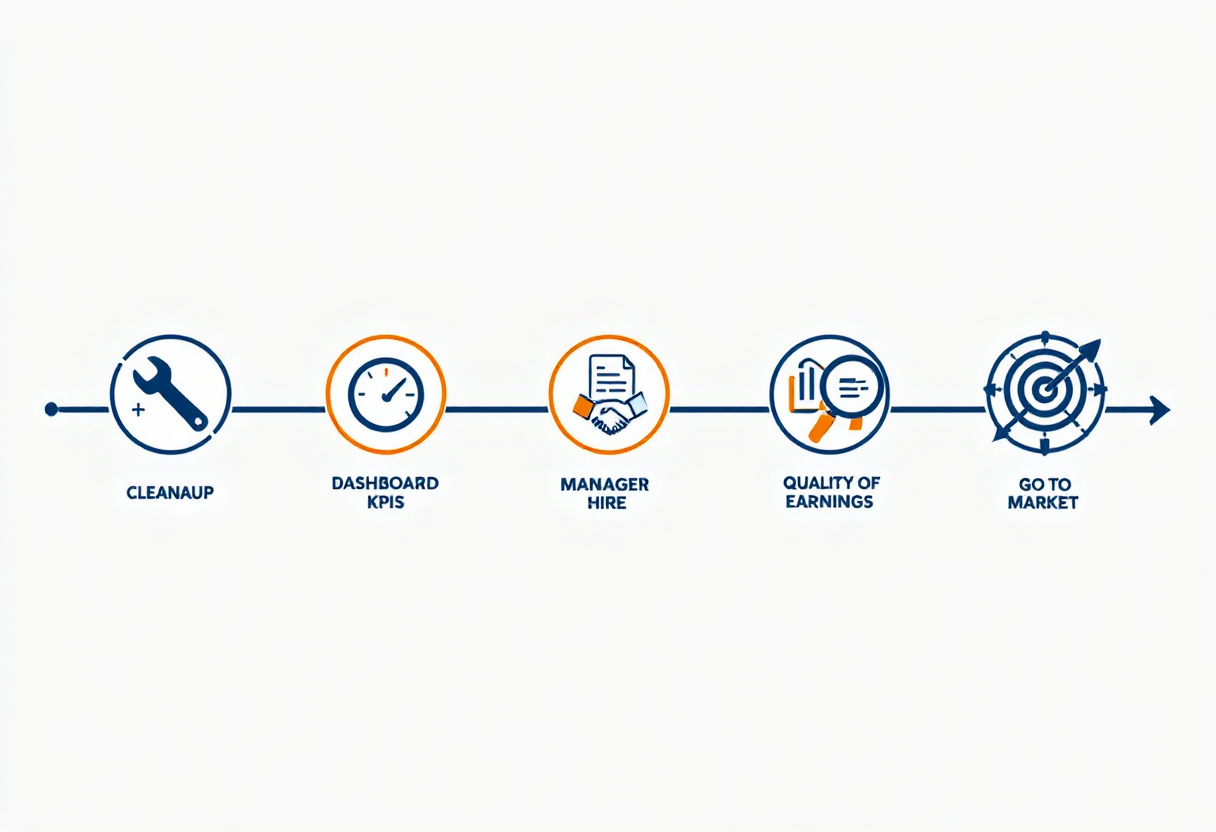
T-36 months: Cleanup phase
- Switch to accrual basis if still on cash basis
- Pick a stack (PaintScout / Bolster Built or Estimate Rocket for estimating + CRM; QuickBooks or NetSuite for accounting; ServiceTitan or BuildOps if running a service-heavy commercial book) and migrate
- Start tagging every potential EBITDA add-back as it happens with a monthly add-back log
- Conduct W-2 / 1099 audit; reclassify proactively using the IRS Voluntary Classification Settlement Program (VCSP) to settle exposure now while it is small
- Restruck related-party rent to FMV with appraisal
- Build the org chart and identify the GM hire (internal promotion or external recruit)
- Phase I ESA on any owned shop or yard real estate
- Sales / use tax compliance review by outside counsel in every operating state (especially TX, PA, OH, and any state where the painter has commercial repair / maintenance revenue)
- EPA RRP firm certification renewal; digital recordkeeping system with 6-year retention; refresher training scheduled for every field worker
- Pull current EMR and start active management (claims investigation, return-to-work program, OSHA 10 / OSHA 30 for supervisors)
- License audit: every state and city license, qualifying party named on each, transferability path documented
T-24 months: Financial discipline and KPI infrastructure
- GM hire onboarded and starting to take operational load
- Monthly close in 15 days; service-line P&L every month
- KPI dashboard (average ticket, close rate, jobs per crew per day, revenue per crew, repaint vs new construction split, HOA / PM contract count, repeat-client share)
- Launch commercial + HOA recurring push: hire dedicated commercial BD rep with a property-management book; sponsor local CAM chapter; build a 5 to 7 year exterior repaint maintenance program
- Pricing review: 5% to 8% list increase; options-based proposals (good / better / best) standard; piece-rate labor burden model refreshed for state-specific workers comp 5474 rates
- Begin diversification if any top customer is above 30%; target sub-15% top customer concentration
- Document SOPs for every operational role (estimating, color consultation, job-start, daily report, punch list, final walkthrough, warranty callback)
- Build the add-back bridge as a living document
- Pull and document 12-month and 24-month rolling crew retention by role
T-12 months: QoE-ready close discipline, eliminate owner dependence
- Owner steps out of daily operations; GM runs the shop
- Owner takes a 2-week unplugged vacation as the stress test
- Run the sell-side QoE (budget $35K to $75K typical for painting)
- Tighten balance sheet: clean A/R, kill dormant paint inventory, isolate deferred revenue on prepaid HOA plans, validate warranty reserve adequacy
- Final org-chart review; backfill any gaps; designate an employee qualifying party for the contractor license if the owner is the named qualifying party
- Final compliance scrub: license transferability, EPA RRP records, W-2 / 1099 classification, sales / use tax, environmental, CARB VOC if operating in CA, OSHA Subpart L scaffolding records
- Lock in 12 months of clean service-line P&L for the CIM
T-6 months: Pre-marketing prep
- Engage M&A advisor specializing in painting, trades, or home services. Typical fee structure: $25K to $75K monthly retainer credited against success fee of 4% to 10% of enterprise value on Lehman or modified Lehman scaling. Some advisors (Brentwood Growth, for example) charge success fee only at closing using the industry-accepted Double Lehman scale with no retainer (Wall Street Prep sell-side primer)
- CIM drafted from the QoE and operating model
- Teaser drafted (anonymized 1-pager)
- Buyer list finalized from the platform list above: CertaPro / FSV, Five Star / Neighborly, 360 Painting / Premium Service Brands, Color World / Authority Brands, Cherry Coatings, R.L. James / Hidden Harbor, Painters USA, TMI Coatings / PCM, ASRC Industrial, plus regional sponsor-backed consolidators surfaced via Axial and PrivSource. 25+ names typical
- Virtual data room populated with everything from the pre-LOI and confirmatory sections above
- Management presentation deck built and rehearsed
T-3 months: Go to market
- Teaser distributed; NDAs collected; CIMs distributed
- IOIs collected approximately 2 to 3 weeks after CIM goes out
- Narrow to 4 to 6 finalists for management meetings
- Management meetings; LOIs solicited
- Select LOI; sign with exclusivity (typically 45 to 90 days)
- Enter confirmatory diligence; close
End-to-end from engagement to close: 9 to 12 months in a well-run painting process (Auxo Capital Advisors sell-side process guide 2025; Wall Street Prep sell-side primer; Brentwood Growth painting page).
Frequently Asked Questions
How long should I plan for before selling my painting business to a private equity buyer?
The painting owners who get top-quartile pricing start preparing 24 to 36 months before going to market. The minimum useful prep window is 12 months, because most of the high-leverage levers (lifting commercial and HOA recurring revenue from under 10% toward 25%+, installing a GM, getting on PaintScout or Estimate Rocket, converting 1099 painters to W-2, running a sell-side QoE) need 12+ months of clean trailing-twelve-months data to be credible to a buyer. Owners who try to sell in under 6 months typically leave 20% to 35% of enterprise value on the table.
What is a realistic EBITDA multiple for a $1.5M EBITDA painting business in 2026?
For a residential painting business at $1.5M EBITDA in 2026, the range is 4.0x to 6.0x. The bottom of that range applies to owner-dependent shops with 100% residential one-and-done work, heavy 1099 crew, concentrated property-management exposure, and no estimating system in place. The top applies to shops with 25%+ commercial or HOA recurring revenue, a GM in place, PaintScout or Estimate Rocket running, 100% W-2 crews, and customer concentration under 15% (CT Acquisitions painting business valuation 2026; Brentwood Growth; DealStream; Peak Business Valuation). For commercial painting at the same $1.5M EBITDA level, the range shifts to 5.0x to 7.0x. For industrial or specialty coatings, 6.0x to 8.0x. The 36-month prep playbook moves you from the bottom of the band to the top.
Should I get a quality of earnings report done before going to market?
For painting businesses at $1M+ EBITDA, yes. A sell-side QoE costs $20K to $75K typical for painting, up to $150K for complex add-back situations or multiple entities (Eton Venture Services 2025; Morgan & Westfield; Citrin Cooperman). The ROI is meaningful. If your QoE supports a 1.0x multiple uplift on a $1.5M EBITDA business at a 5x baseline, that is $1.5M of additional sale price for a $50K investment, a 30x return. More importantly, a pre-market QoE surfaces 1099 reclassification exposure, warranty reserve adequacy, deferred revenue on prepaid HOA plans, and add-back weaknesses while you can still fix them, rather than during exclusivity when the buyer re-trades the deal.
What percentage of commercial or HOA recurring revenue do PE buyers want to see in a painting business?
25% or higher is the threshold that moves a painting business from commodity residential pricing into premium pricing. HOA and property-management recurring contracts trade at a 0.5x to 1.0x EBITDA premium versus residential repaint (CT Acquisitions painting business valuation 2026; Williams Professional Painting; Preprite Coatings 2025). 25%+ commercial revenue lifts the business into the upper end of the EBITDA multiple bands; a 10% to 20% industrial or specialty coatings line lifts it further into the 7.0x to 11.0x range in the $3M+ EBITDA band (CT Acquisitions painting 2026; TMI Coatings platform reference). For an owner today running 100% residential one-and-done work, the commercial and HOA build is the single highest-leverage move available.
Do I need to put a general manager in place before I sell my painting business?
If your goal is to maximize price, yes, ideally 12+ months pre-sale. Owner dependence is the single most-cited multiple haircut in painting valuation literature (Brentwood Growth painting page; basecoatmarketing.com; CT Acquisitions painting 2026). On a $1M to $3M EBITDA business, eliminating key-person risk moves the multiple from the 4.0x to 5.0x band into the 5.0x to 7.0x band, worth $1M to $6M of price. A GM or operations leader hire runs $120K to $200K plus bonus and needs 12 to 18 months to fully take operational load before the buyer’s diligence team will believe the transition. There is a secondary benefit: if the owner is the named qualifying party on the state contractor license, the GM can also be set up as the alternate qualifying party so the license has a clean post-close path.
Do I need to convert my 1099 painters to W-2 before I can sell?
Yes, in almost every case. 1099 misclassification is the single biggest painting-specific deal-killer. Average IRS settlement runs $10K to $100K+ per misclassified worker once back taxes, penalties, interest, and legal cost aggregate (Salinger Tax Consultants; Tax1099; IRIS Global 2026; ADP SPARK 2023; IRS Worker Classification 101). A 30-painter shop with 20 misclassified is sitting on $200K to $2M+ of contingent liability that PE prices in heavily during HR diligence. The right move is to reclassify proactively 18 to 24 months pre-sale using the IRS Voluntary Classification Settlement Program (VCSP), which settles past liabilities at a fraction of full audit cost. Pay piece-rate inside a W-2 wrapper if the existing comp structure is the reason for the 1099 designation. Clean W-2 conversion preserves 1.0x to 2.0x of multiple that would otherwise come off in confirmatory diligence and signals a trainable, scalable workforce, which CT Acquisitions painting 2026 calls out as a premium driver in its own right.
What to Do Next
The painting owners who get the top-quartile multiple all do the same three things. They start preparing 24 to 36 months before they want to be out. They put a GM in place 12+ months pre-sale and document a non-owner qualifying party for the state contractor license. And they invest in a sell-side QoE before any buyer sees a CIM, with the W-2 conversion completed before that QoE runs.
If you are 12+ months from a potential exit and want a structured pre-sale optimization roadmap, CT Acquisitions has painting operations specialists in our partner network who run multi-quarter prep engagements covering commercial and HOA build-out, W-2 conversion under the VCSP, EMR remediation, EPA RRP firm-certification cleanup, and the estimating-software transition. If you are 6 to 12 months out and ready to start the sell-side process, our M&A advisory team runs the buyer outreach across the franchise consolidators, direct PE platforms, and multi-trade home-services holdings that actually buy painting service businesses in 2026. No fee to you on buy-side introductions; sell-side mandates are paid on success at closing. Either way, the first 30 minutes are free.
Ready to talk?
Schedule a 30-minute exit-readiness call
Or read more: Painting Business Valuation 2026: Multiples, Residential vs Commercial, PE Buyers | How to Sell or Buy a Painting Business | Talk to a CT painting M&A advisor
Ready to Explore Your Options?
A 30-minute confidential conversation is all it takes.