
How to Prepare Your Fire Alarm Business for a Sale or Exit in 2026: The 36-Month PE-Buyer Playbook
Preparing your fire alarm business for exit in 2026 is a 36-month playbook. The first 12 months tighten the operating story around monitoring RMR percentage and inspection contract recurrence, the middle 12 fix pre-LOI diligence gaps around technician certifications and central station relationships, and the final 12 turn one offer into a real competitive process where FLS platforms (Pye-Barker, Sciens, Marmic) bid against strategics.
Exiting your fire alarm business is the single largest financial event most owners will ever face. This guide is the no-fluff playbook for fire alarm business owners who are 12-36 months from sale, covering how PE-backed buyers actually value your business in 2026, the 12 levers that move your multiple, pre-LOI diligence, deal-killers to fix before going to market, and the full 36-month exit prep timeline.
Updated April 2026 · CT Acquisitions

Most fire alarm owners decide to sell, hire a broker, and find out 90 days later that their business is worth 30% to 50% less than they thought. The owners who get top-quartile pricing start preparing 24 to 36 months before they ever talk to a buyer. This guide is the 36-month playbook for how to prepare your fire alarm business for a sale or exit. It covers what private equity actually buys in 2026, the 14 levers that move multiples, the documents PE asks for before they send an indication of interest, and the deal-killers that re-trade fire alarm transactions during confirmatory diligence. Every number cites its source. Every recommendation comes from how the most active fire alarm and life safety buyers in 2026 actually behave.
If you are 6 to 36 months from a possible exit, this is the work that turns a 5x EBITDA outcome into an 11x EBITDA outcome on a $1.5M EBITDA fire alarm business with strong NFPA 72 inspection, testing, and maintenance (ITM) revenue and a real commercial monitoring book. That is the difference between a $7.5M sale and a $16M sale, before you even add the 30x to 50x premium that fire alarm monitoring recurring monthly revenue (RMR) commands on top of the EBITDA multiple. Whether you want to prepare your fire alarm business for a sale to a private equity platform, prepare your fire alarm business for an exit to a strategic acquirer like APi Group or Cintas, or simply maximize value before going to market, the work below applies.
Building toward an exit in 12 to 36 months?
CT Acquisitions runs sell-side advisory for fire alarm and life safety owners $1M+ EBITDA. We also have fire alarm operations specialists in our partner network who run pre-sale optimization engagements when the timeline is longer. Buyers pay our fee, not you.
What Private Equity Actually Buys in Fire Alarm (2026)
The Capstone Partners Security Solutions M&A Update (2026) tracked 242 Security Solutions deals in 2025, up 24.1% year over year. The Fire & Life Safety segment alone ran 125 deals in 2025, up 66.7% year over year. PE add-ons accounted for 45.9% of sector volume. The five-year average sector EV/EBITDA multiple sits at 11.8x, materially above the broader middle market average of 9.8x (Capstone Partners Middle Market M&A Valuations Index, 2026). Lincoln International tracked 129 PE-backed Fire & Life Safety deals in 2023 and another 109 through September 2024. The sponsor money flowing in is not random. PE buys specific profiles, and the profile you build determines the multiple you get.
The PE-attractive fire alarm profile
- EBITDA threshold for a platform-quality deal: $1M to $3M is the entry band where sponsor-backed platforms run a competitive process. Below that, you are an add-on inside a roll-up. Above $5M, you are an attractive bolt-on for the larger commercial platforms. Above $25M of EBITDA, you are a platform candidate yourself.
- ITM recurring revenue: 40% or higher is the line between commodity and premium. Install-only shops trade in the 4x to 5x EBITDA band. Shops with 60%+ inspection-first revenue and a real monitoring book trade in the 9x to 13x EBITDA band (Breakwater M&A, 2026; Essential.com Fire Protection Business Valuation 2026; CT Acquisitions Fire Protection PE Map 2026).
- Commercial monitoring RMR: Branded fire alarm monitoring on a UL Listed Central Station (UL 827) at $25 to $75 monthly recurring revenue per commercial account, with 95%+ annual renewal. Monitoring RMR is valued 30x to 50x the monthly figure SEPARATELY from EBITDA (Breakwater M&A, 2026; Security Sales & Integration RMR Deep Dive 2024).
- Customer mix: Commercial-heavy with healthcare, data centers, hospitality, multi-family, education, government, and industrial property. Commercial monitoring commands 1.5x to 2.5x the multiple of residential monitoring (Security Sales & Integration 2024; Vector Security SDM 100 commentary 2024).
- Geography: Florida, Texas, the Carolinas, Arizona, the Sun Belt broadly, plus dense Northeast metros. Sciens Building Solutions alone has done 9 Florida acquisitions. Pye-Barker closed 57 deals in 2025 across 47 states (PR Newswire, January 2026).
- Customer concentration: No single customer above 10% of revenue. Top 5 customers below 30%. Concentration above 20% triggers buyer pushback; above 25% triggers a 15% to 30% valuation discount or buyer withdrawal (Beancount.io 2026; Strategex; Eagle Rock CFO; Morgan & Westfield; Essential.com 2026).
- NICET and license depth: 2+ alternate qualifying individuals beyond the owner, with NICET Level III or higher in Fire Alarm Systems and ITM Fire Alarm Systems. NICET cert depth is “a major asset” per DealFlowAgent 2026 because certified fire alarm techs are structurally scarce (iRecruit 2024; EHS Careers 2024).
- Owner role: Owner is in management, not running install crews or estimating. GM in place 12+ months pre-sale. Owner is not the sole qualifying NICET-holder on the state license.
Active fire alarm and life safety PE platforms in 2026
The list below covers the most active sponsor-backed fire alarm and integrated life safety platforms in the 2024-2026 cycle. This is who will see your teaser. Sources include company press releases, sponsor websites, Tracxn, PrivSource, PitchBook, PE Hub, Capstone Partners, Lincoln International, Hyde Park Capital, Meridian Capital, SDM Magazine, Security Sales & Integration, Security Systems News, and Fire & Safety Journal Americas.
| Platform | Sponsor | Profile |
|---|---|---|
| Pye-Barker Fire & Safety | Altas Partners + Leonard Green; ADIA + GIC minority added Jan 2025 | 57 acquisitions in 2025; integrated alarm + sprinkler + suppression; ~40% revenue from fire alarm install, ITM, monitoring; $6B implied valuation reported (SDM Magazine 2024) |
| APi Group (NYSE: APG) | Public strategic | “Inspection-first” thesis targeting 60%+ revenue from inspection, service, monitoring; CertaSite ($90M revenue, Q1 2026); Onyx-Fire ($190M revenue, Q2 2026 from Blackstone) |
| Encore Fire Protection | Permira (from LLCP March 2025 at $1.8B EV) | Full-service fire alarm + sprinkler + suppression + extinguisher ITM; LLCP grew EBITDA 9x over 4 years with 55 add-ons |
| Sciens Building Solutions | The Carlyle Group (majority) | Most fire-alarm-led PE platform in the market; 26+ historical; 9 Florida acquisitions; recent: Akers Fire (Feb 2025), Alarmtechs (Aug 2025), Southern Fire Control (Jan 2026), Fire Safety Inc. (March 2026) |
| Summit Fire & Security | BDT & MSD Partners (from BlackRock LTPC, Aug 2025 announcement, Q4 2025 close) | Commercial fire alarm + sprinkler + monitoring; 37-state footprint |
| Marmic Fire & Safety | KKR (from HGGC July 2024 via Ascendant Strategy) | Self-performing fire alarm install + ITM + extinguisher + sprinkler; 56,000+ customers; broad-based employee ownership |
| Convergint Technologies | Leonard Green + Harvest; Ares $850M continuation vehicle March 2026 | Fire alarm + security + critical communications; 40+ acquisitions since 2018; 220+ technology centers |
| Eagle Fire Inc. | Cobepa (closed July 2025 from Rosewood PI) | Fire alarm + sprinkler + suppression for education, data centers, healthcare; Harris Security Systems acquired Jan 2026 |
| AI Fire | TruArc Partners (from Snow Phipps; originally Audax) | Multi-line: extinguishers, sprinklers, fire alarms, emergency lighting; national chains, healthcare, industrial, education |
| Altus Fire & Life Safety | Apax Partners (from AE Industrial, Sept 2024) | Regulation-mandated ITM + service/repair + drills/training + monitoring + install; Northeast US focus |
| RapidFire Safety & Security | Concentric Equity Partners (platform founded March 2022) | Low-voltage fire alarm + security; 11+ acquisitions; 2025: All Source Fire, Tri-X, Christopherson Fire, Kane Fire |
| ORR Protection Systems | Würth Industry North America (March 2021) | Specialty alarm, detection, suppression, monitoring including clean agent (FM-200, Novec 1230, Inergen) for mission-critical; recent: DSI (Oct 2024), Compass Fire (Aug 2025) |
| ADT Commercial / Everon | GTCR ($1.6B from ADT in 2023) | Commercial fire alarm + life safety + monitoring + security; national commercial |
| High Rise Fire and Security | Scutum Group (April 2020) | Pure high-rise fire alarm and life safety vertical; 1,900+ NYC high-rise buildings |
| Thompson Safety | Berkshire Partners | On-site first aid, fire protection, PPE, AED, training; added Kingdom Fire Protection Dec 2024 |
| Frontier Fire / National Fire & Safety | Highview Capital | Mountain West and Southwest sprinkler + fire alarm install + ITM |
Add to that list the strategic acquirers. APi Group (NYSE: APG) is the premier strategic consolidator in fire and life safety, with CertaSite (~$90M revenue, closed February 2026) and Onyx-Fire (~$190M revenue, Q2 2026 from Blackstone Tactical Opportunities) both targeting 50%+ revenue from inspection, service, and monitoring (APi Group press releases 2025 to 2026; SEC EDGAR 8-K December 10, 2025). Cintas Fire Protection (NYSE: CTAS) reported 11.5% organic growth in Fire Protection Services and is pursuing the $5.5B UniFirst acquisition (Cintas Q2 FY2026 earnings). Securitas Technology absorbed the STANLEY Security business from Stanley Black & Decker for $3.2B in February 2022, adding significant fire alarm scope across the US. Honeywell Building Technologies owns the Notifier, Silent Knight, FireLite, Gamewell-FCI, System Sensor, and Honeywell Power Products brands but is distribution-led, not currently a US service-channel acquirer of independents. Johnson Controls owns Simplex and the Tyco SimplexGrinnell service network but is in a portfolio-reshaping phase (Johnson Controls press release, July 23, 2024; Facilities Dive 2024). Carrier sold its global access solutions and fire & security businesses to Honeywell in pieces for roughly $5B, closing through August 2024 (Honeywell and Carrier press releases 2023 to 2024). Siemens Smart Infrastructure (NYSE: SIEGY) owns Siemens Fire Safety (Cerberus PRO) and continues to expand the US service network via authorized dealers.
Fire Alarm Valuation Multiples in 2026 (What You Are Actually Worth)
The multiple a buyer pays comes down to your size, your service mix, your ITM recurring revenue, your monitoring RMR base, your specialty depth, and your geographic fit. Here is the 2026 range, cross-referenced from CT Acquisitions’ Fire Protection PE Map, Capstone Partners reports, Hyde Park Capital, Lincoln International, Breakwater M&A, Essential.com, Morgan Business Sales, and DealStream.
SDE multiples (smaller, owner-operated, typically under $5M revenue)
| SDE band and profile | SDE multiple | Source |
|---|---|---|
| Under $500K SDE, install-only | 2.5x to 3.5x | Breakwater M&A 2026; Essential.com 2026 |
| $500K to $1M SDE, mixed install + ITM | 3.5x to 5.0x | Breakwater M&A 2026; Morgan Business Sales 2026 |
| Recurring-heavy small shop (40%+ ITM + monitoring), 3+ techs | 4.0x to 6.0x SDE | Breakwater M&A 2026; DealFlowAgent 2026 |
| Pure alarm dealer (residential heavy) with monitoring base | RMR-based: 25x to 40x monthly fee for monitoring book + 2x to 3x EBITDA on install side | DealStream Security & Fire Alarm Business Rules of Thumb; Security Sales & Integration 2024 |
EBITDA multiples (PE-attractive size)
| EBITDA band | Install-only | Mixed install + ITM | Strong ITM (40%+) | Platform-ready (60%+ ITM + monitoring) |
|---|---|---|---|---|
| $1M to $3M | 4x to 5x | 5x to 7x | 7x to 10x | 9x to 13x |
| $3M to $10M | 5x to 6x | 6x to 8x | 8x to 11x | 10x to 13x |
| $10M+ | 6x to 8x | 7x to 10x | 9x to 12x | 11x to 15x |
| $25M+ EBITDA platform candidates | n/a | 10x to 13x | 12x to 16x | 14x to 18x+ (PE Hub reports 17x to 20x at the top end) |
Source: CT Acquisitions Fire Protection PE Map 2026, cross-referenced with Breakwater M&A Fire Alarm & Life Safety Company Valuation Multiples 2026, Essential.com Fire Protection Business Valuation 2026, Hyde Park Capital Fire & Life Safety Summer 2024, Lincoln International 2024, and Capstone Partners Security Solutions M&A Update 2026 (which cites the 11.8x five-year sector average).
The monitoring RMR and ITM ARR premium (the fire alarm-specific value layer)
Fire alarm monitoring RMR and inspection ARR are valued SEPARATELY from EBITDA, on top of the base multiple. This is the single most fire alarm-specific valuation mechanic and the one most owners under-realize.
- Fire alarm monitoring RMR trades at 30x to 50x the monthly figure (Breakwater M&A 2026; CT Acquisitions Fire Protection guide 2026; DealStream Security & Fire Alarm Business Rules of Thumb; Security Sales & Integration RMR Deep Dive 2024). Commercial fire alarm monitoring on a UL Listed Central Station with two-path or cellular redundancy sits at the high end. Residential alarm monitoring sits at the low end.
- Commercial RMR commands a 1.5x to 2.5x premium over residential RMR because of stickiness, contract-protected churn under 3% annually, and the AHJ and UL compliance moat (Security Sales & Integration 2024; Vector Security SDM 100 commentary 2024).
- Inspection ARR adds 2.0x to 3.5x the annual figure to enterprise value (Breakwater M&A 2026).
- Worked example: A fire alarm company with $200K/month in commercial monitoring RMR adds $7M to $10M to EV (200K x 12 = $2.4M ARR, at 35x to 50x = $7M to $10M on the monthly figure). A company with $2M of annual ITM contract base adds $4M to $7M. That is why a $1.5M EBITDA fire alarm business with a real monitoring book and a strong inspection base can clear $20M+ at sale.
Recent disclosed fire alarm transactions (2024 to 2026)
| Acquirer | Target | Date | Value | Implied multiple |
|---|---|---|---|---|
| Permira | Encore Fire Protection (from LLCP) | March 2025 | $1.8B EV | High teens implied (PE Hub 2025 cites 17x to 20x for mid- to large-cap F&LS) |
| KKR (Ascendant Strategy) | Marmic Fire & Safety (from HGGC) | July 24, 2024 | Not disclosed | Estimate mid-teens given 56,000 customers and ITM scale |
| Apax Partners | Altus Fire & Life Safety (from AE Industrial) | September 5, 2024 | Not disclosed | Not disclosed |
| BDT & MSD Partners | Summit Companies majority (from BlackRock LTPC) | Announced Aug 2025, Q4 2025 close | Not disclosed | Not disclosed |
| Cobepa | Eagle Fire Inc. (Rosewood PI retained meaningful stake) | July 16, 2025 | Not disclosed | Not disclosed |
| APi Group (NYSE: APG) | CertaSite | Announced Dec 10, 2025, closed Feb 2, 2026 | ~$90M revenue target | Not disclosed |
| APi Group (NYSE: APG) | Onyx-Fire Protection Services (from Blackstone Tactical Opportunities) | Announced April 23, 2026, Q2 2026 close | ~$190M revenue target | Not disclosed |
| Ares Management | Convergint Technologies (single-asset continuation vehicle, Leonard Green-led) | March 2026 | $850M continuation vehicle | n/a (recap structure) |
| Securitas | STANLEY Security business (referenced for buyer context) | February 2022 | $3.2B | Not disclosed |
| Honeywell (NYSE: HON) | Carrier Global access solutions and fire & security businesses (in pieces) | Announced 2023, closed 2024 | ~$5B | Not disclosed for fire alarm portion |
Sources: Permira portfolio; LLCP press release March 12, 2025; Mergr; KKR press release; HGGC release; Latham & Watkins; Apax press release September 5, 2024; AE Industrial Partners; Simpson Thacher; Summit Companies press August 2025; BDT & MSD; Davis Polk; Cobepa news; Paul Hastings; APi Group 8-K December 10, 2025; SEC EDGAR; APi Group press April 23, 2026; Fire & Safety Journal Americas; Leonard Green press March 2026; Businesswire; Securitas press February 2022; Honeywell and Carrier press 2023 to 2024. The reported “$6B implied valuation at 17x to 20x EBITDA on $350M EBITDA” for Pye-Barker comes from 2024 sale-process reporting before the company opted for the minority recap with ADIA and GIC (SDM Magazine 2024); treat as a directional benchmark for platform-tier pricing, not a confirmed close multiple.
The 14 Value Levers That Move Your Multiple (Ranked by Impact)

These are the levers that move fire alarm multiples in the 24 months before a sale. Each one has a current state, a target state, and an estimated financial impact. The ordering is by dollar impact per unit of effort, based on cross-source synthesis from Breakwater M&A, Essential.com, DealFlowAgent, Hyde Park Capital, Lincoln International, and the APi Group inspection-first thesis embedded in the CertaSite and Onyx-Fire acquisition rationale.
Lever 1: Shift revenue mix toward ITM (inspection-first) and tighten the deficiency-to-repair attach
Current: Install-heavy (60%+ of revenue from new construction fire alarm install or retrofit). Target: 50%+ revenue from NFPA 72 ITM contracts, with stated 60%+ if pursuing platform-tier pricing. Deficiency-to-repair attach at $3 to $4 of repair revenue per $1 of inspection revenue (Essential.com 2026). Impact: Moves the multiple from the 4x to 5x band into the 9x to 13x band. On a $1.5M EBITDA business that delta is the difference between a $6M and an $18M sale (Breakwater M&A 2026). Also adds 2.0x to 3.5x ARR premium on the ITM contract base on top of the EBITDA multiple. APi Group built its entire 60% inspection-first thesis around exactly this revenue-quality premium (APi Group FY2025 annual report; CertaSite acquisition rationale December 2025). How: Cross-sell ITM contracts to every new install customer with a written 5-year auto-renew agreement attached to the install scope at commissioning. Build a dedicated inside-sales team for cold-calling commercial property managers with NFPA 72 expiration prospecting. Roll out a deficiency-to-repair attach playbook with techs trained to write up deficiencies on the inspection at the customer site (paper copy signed by customer rep before tech leaves).
Lever 2: Build commercial monitoring RMR (the single highest-leverage capital allocation in the prep window)
Current: No central station, or wholesale-monitoring relationships with no markup margin captured, or wholesale monitoring with branded contracts but no clear account-portability rights. Target: Branded fire alarm monitoring with $25 to $75 MRR per commercial account, 95%+ annual renewal, on a UL Listed Central Station (owned at scale or wholesale at margin with branded contracts and account-portability rights). Two-path or cellular-primary signaling. Documented response-time metrics. Commercial account mix above 70% of the monitored base. Impact: Monitoring RMR is valued at 30x to 50x the monthly figure SEPARATELY from EBITDA (Breakwater M&A 2026; DealStream Security & Fire Alarm Rules of Thumb; Security Sales & Integration 2024). 1,000 commercial accounts at $40/month = $40K MRR x 35x to 50x = $1.4M to $2.0M added to enterprise value. 5,000 accounts adds $7M to $10M+. Commercial monitoring commands 1.5x to 2.5x the multiple of residential monitoring. How: Acquire a small alarm dealer with a commercial monitoring base. Or wholesale-resell from a UL Listed central station (Affiliated, Bold, COPS, Rapid Response, AvantGuard) with branded contracts and account-portability rights spelled out in the wholesale agreement. Convert inspection-only customers to inspection-plus-monitoring bundles at every annual renewal. Convert single-path monitoring accounts to two-path or cellular-primary (often a $5 to $15 MRR uplift per account and a UL 864 / NFPA 72 compliance fix that customers accept).
Lever 3: Move the owner out of the chair and out of the qualifying license
Current: Owner runs sales, runs install crews, signs every check, and is the qualifying NICET-holder or state low-voltage license-holder for the firm in 1 to 4 states. Target: GM in place 12+ months before market; owner doing under 30 hours/week of operational work; firm has 2+ alternate qualifying individuals on payroll (NICET Level III or higher in Fire Alarm Systems plus ITM Fire Alarm Systems) so the license does not depend on the owner in any operating state. Impact: Owner dependence is the most-cited multiple haircut in fire protection valuation literature (Essential.com 2026; Breakwater M&A 2026; DealFlowAgent 2026). On a $1M to $3M EBITDA business, removing owner-and-qualifier dependence moves the multiple from the 4x to 5x band into the 7x to 10x band, worth $2M to $7M of price. The qualifier issue is binary: if the owner is the only NICET, the buyer cannot pull permits or accept commissioning sign-offs Day 1 post-close. How: Hire or promote a GM 18 to 24 months pre-sale. Recruit 2+ NICET Level III techs who hold the certs required to qualify the firm in every operating state. Pay for their NICET prep and exam fees. Document SOPs. Owner takes a 2-week unplugged vacation as the stress test.
Lever 4: Stack NICET certifications and manufacturer factory-training across the bench
Current: 1 to 2 senior techs hold NICET, often Level II only; owner is the qualifying NICET-holder; manufacturer-authorized status (Notifier Engineered Systems Distributor, Simplex Authorized Service Provider, Edwards EST Strategic Partner) sits on a single owner or senior tech. Target: Multiple NICET Level II to IV techs across Fire Alarm Systems and ITM Fire Alarm Systems; at least 2 alternate qualifying individuals; manufacturer factory-trained techs at the cert level required for ESD/ASP status (Notifier ESD typically requires 2+ factory-trained techs per territory; Simplex ASP similar). Impact: NICET certification is “a major asset” per DealFlowAgent 2026, and the certified-tech labor pool is structurally tight (iRecruit 2024; EHS Careers 2024). Companies with deep NICET benches command 0.5x to 1.0x multiple premium and remove the buyer’s key-person-risk discount. Manufacturer authorization depth protects roughly 15% to 30% of revenue tied to manufacturer-exclusive parts and pricing (estimate based on Notifier ESD program economics; Honeywell ESD listing materials). How: Sponsor every senior tech through NICET Level II within 18 months and Level III within 36 months. Pay exam fees, prep courses, and a NICET-pass bonus. Send 2+ techs per OEM through factory training in the prep window. Use NICET and manufacturer-cert as a retention tool.
Lever 5: Add a specialty capability (mass notification, voice evac, clean agent, or high-rise)
Current: Generalist commercial fire alarm; no mass notification capability; no voice evac for large venues; no clean agent design experience; no high-rise specialty. Target: At least 1 specialty discipline beyond generalist commercial fire alarm. The top candidates by buyer demand: mass notification and Emergency Communication Systems per NFPA 72 Chapter 24 (post-Parkland K-12 mandates in Florida and 30+ states by 2026 per K-12 Security Information Exchange tracking; Florida HB 1473 / Alyssa’s Law 2020); voice evacuation for large venues, schools, hospitals, hotels, high-rise office (NFPA 72 mandates voice evac for occupancies above 1,000 in many AHJ-adopted editions); high-rise (Class A) with smoke control interface per NFPA 92, elevator recall per ASME A17.1, firefighter communications; clean agent detection (FM-200, Novec 1230, Inergen) for data centers, server rooms, telecom switching, military command centers. Impact: Specialty commands a 1x to 2x multiple premium per CT Acquisitions Fire Protection 2026. The data center construction boom is the largest near-term demand pull, with Capstone Security 2026 citing data center construction as driving 66.7% YoY F&LS deal growth. Data center clean-agent rooms run $25K to $100K+ per room with $50 to $100+/lb agent (Firetron 2026). How: Add 1 to 2 specialty-trained techs over the prep window (NICET Special Hazards Suppression for clean agent; manufacturer voice-evac certification through Notifier ONYX, Simplex 4100ES, EST Vialink, Siemens FireVision). Pursue 2 to 3 commercial customer wins in the specialty as proof. Cite specialty mix in the CIM.
Lever 6: Get on ServiceTrade or BuildOps and run a real monthly close
Current: QuickBooks plus spreadsheets plus handwritten inspection forms. No contract-level reporting. No monitoring RMR dashboard. No deficiency attach tracking. Target: ServiceTrade or BuildOps fully deployed 24+ months pre-sale. NFPA 72-templated inspection forms aligned to the AHJ-adopted edition in every jurisdiction. Deficiency tracking automated with customer-signed deficiency reports. Customer portal active for inspection report access. Monthly close in 15 days. KPI dashboard (booking rate, ITM contract conversion, monitoring conversion, deficiency attach rate, jobs per tech per day, revenue per truck, monitoring MRR by month). Impact: Estimate +0.5x to 1.0x multiple uplift driven by diligence-data speed and contract-level defensibility. Buyers do not want to see “handwritten inspection reports, a scheduling system that lives in the dispatcher’s head, and customer data tracked in Excel spreadsheets” (DealFlowAgent 2026). ServiceTrade built its fire vertical around NFPA-compliant templates and acquired Asurio’s BirdDog platform in September 2021, which had run 5M+ inspections. BuildOps’ fire vertical anchors evidence per asset (gauge readings, panel-history pulls, device counts, signal-strength readings, decibel readings for ECS audibility tests, signatures). How: Budget $50K to $150K implementation plus per-tech license. Force tech adoption by tying payroll to inspection-report submission inside the system.
Lever 7: Tighten customer contracts to multi-year auto-renew with written terms
Current: Mix of year-to-year handshake agreements, one-page POs, and PO-by-PO billing. Target: 80%+ of ITM and monitoring revenue under written 3 to 5 year agreements with auto-renew unless notice is given 60 to 90 days pre-expiration. Impact: Multi-year contracts with auto-renewal command 25%+ multiple premium (Breakwater M&A 2026; DealFlowAgent 2026). Handshake renewal is a buyer underwriting penalty. How: Run a 12-month written-agreement push 18 months before market. Standard template: 3-year initial term, 60-day notice for cancellation, 5% annual price escalation, auto-renew for 1-year periods after the initial term. Quarterly tracking of contract conversion rate.
Lever 8: De-concentrate the customer base
Current: Top customer above 15% of revenue (or top 5 above 40%), often a single hospital system, a school district, a national property management firm, or a major data center operator. Target: Top customer below 10%; top 5 below 30%. Impact: Concentration above 20% triggers buyer pushback. Above 25% triggers a 15% to 30% valuation discount or buyer withdrawal (Beancount.io 2026; Eagle Rock CFO; Strategex; Morgan & Westfield). Essential.com 2026 cites 20% to 40% valuation haircuts at high concentration specifically in fire protection. Above 40%, multiple reduction of 1.0x to 2.0x is typical. How: Diversify into adjacent commercial verticals (data centers, healthcare, hospitality, multi-family, education, government, industrial). Add a second metro. Build a dedicated sales motion targeting property management firm portfolios.
Lever 9: Drive pricing discipline on ITM, service, and monitoring
Current: Inspection pricing flat for 3+ years; monitoring pricing flat at 2018 rates; deficiency repair quoted with technician discretion; no annual price increase across the contract base. Target: Annual 5% to 8% list-price increase on ITM; monitoring MRR escalated 3% to 5% annually with contractual escalator language; deficiency repair flat-rate priced from a standardized price book; dispatch fee held on service calls. Impact: Direct EBITDA growth. A $5M fire alarm revenue business with 50% ITM mix that lifts ITM pricing 5% adds roughly $125K of revenue at 50%+ gross margin, or $60K+ of EBITDA, or $600K+ of sale price at 10x. Monitoring MRR escalation compounds even harder: a $40K MRR base at 4% escalation adds $1.6K MRR per year, which adds roughly $56K to EV at 35x per year of escalation. Compounded over 3 years of prep, pricing discipline is one of the highest-ROI levers. How: Annual price-letter campaign to the contract base. Flat-rate deficiency price book updated quarterly. Tech compensation tied to deficiency-quote-to-close conversion. Monitoring escalator language written into every new contract renewal.
Lever 10: EBITDA add-back hygiene
Current: Owner mixes personal expenses through the business with no documentation, related-party rent at well-above FMV, no add-back schedule. Target: Every potential add-back documented as it happens with the underlying invoice; related-party rent restruck to FMV with appraisal on file; clean payroll for owner-family. Impact: Every defensible dollar of adjusted EBITDA is multiplied. At a 10x multiple, $100K of clean add-backs equals $1M of sale price (Morgan & Westfield QoE guide). How: Adopt a monthly add-back log starting today. Document business purpose of every charge. Get an FMV rent appraisal if the owner owns the real estate.
Lever 11: Working capital and deferred revenue isolation
Current: Prepaid annual ITM contracts and prepaid monitoring sit commingled in cash with no deferred revenue accounting; A/R aging is opaque; engineered-job customer deposits commingled. Target: Deferred revenue separately tracked monthly; A/R aging clean (target DSO 35 to 45 days for commercial fire alarm); customer deposits on engineered design-build jobs isolated. Impact: Working capital peg is set off TTM average (BDO; Morgan & Westfield NWC). Volatile or opaque working capital lets the buyer set a higher peg, which subtracts from purchase price. Estimate: poor working capital management costs 2% to 5% of EV at close. Deferred revenue on prepaid ITM and monitoring contracts is the single most-disputed item in fire alarm QoE (buyer treats it as debt-like; seller wants normal-course revenue). How: Restate the prior 24 months to recognize prepaid ITM and monitoring revenue ratably; isolate the deferred liability on the balance sheet; run an aggressive A/R collection cycle.
Lever 12: Real estate decision (own or lease, sale-leaseback)
Current: Owner-occupied shop with vehicle bay and parts mezzanine in the same entity as the operating business, or at above-FMV rent. Target: Real estate in a separate LLC at FMV triple-net lease to the operating company, with a clear path for the buyer to assume the lease or buy the property. Impact: Separating real estate often lifts the implied EBITDA multiple on the operating business (Plante Moran sale-leaseback primer; Northmarq sale-leaseback guide). A sale-leaseback can extract up to 100% of property market value as cash vs. 70% to 80% LTV via traditional financing. Estimate: holding real estate separately at FMV typically adds 0.5x to 1.0x to the operating company multiple. How: Get an FMV market rent study. Restruck rent to FMV. Decide before going to market whether real estate is part of the deal or held back.
Lever 13: Cybersecurity hardening on networked fire systems
Current: Networked fire alarm panels on customer LANs with default passwords, no segmentation, no firmware patching cadence, no documented vulnerability disclosure response. Target: Networked fire alarm and monitoring infrastructure segmented from corporate IT (separate VLAN minimum, with a separate physical network recommended); default passwords changed at commissioning; firmware patched on manufacturer cadence; MFA on remote access portals (Notifier ONYXWorks, Simplex SafeLINC, EST FireWorks); documented vulnerability management aligned to NIST SP 800-82r3 OT cybersecurity; customer-facing cybersecurity attestation letter. Impact: Increasingly diligenced by buyers given CISA AA23-353A advisory on building automation systems (2023) and NIST SP 800-82r3 (2023). Estimate +0.25x to 0.5x multiple plus the removal of cybersecurity deal re-trade risk. A documented OT-cyber breach at a monitored customer site is the modern equivalent of a wrongful-death subrogation claim and can be a deal-killer. How: Adopt a written OT cybersecurity baseline. Train techs on the commissioning checklist (change all default passwords; segment; patch). Build a customer-facing attestation letter that the buyer can review during diligence.
Lever 14: Compliance scrub (THE fire alarm-specific lever)
Current: Licenses in owner’s name; NICET records in a binder; W-2/1099 audit trail uneven; sales/use tax compliance uneven; manufacturer-authorization renewals tracked informally; AHJ relationships informal; OSHA fall-protection training spotty; cybersecurity posture on networked fire panels undocumented. Target: Licenses transferable or with a clear post-close qualifier path in every state; NICET records digital with a renewal calendar; W-2/1099 classification audit completed; sales/use tax compliance verified by outside counsel in every operating state (Texas, Connecticut, Iowa, West Virginia get extra attention because they tax commercial monitoring); Davis-Bacon compliance audited on every federally-funded job; OSHA 30 (supervisors) and OSHA 10 (workers) on file; fall-protection program documented; manufacturer-authorization renewals tracked with named factory-trained tech on each authorization; AHJ-relationship log built with named contacts; cybersecurity posture on networked fire panels documented per NIST SP 800-82r3 and CISA AA23-353A baseline. Impact: Each of these can kill or re-trade the deal at confirmatory diligence. See the deal-killer section below for specifics. How: Cover this in months 24 to 12 of the run-up, before the QoE.
Want to grow your business to maximize value before exiting?
We connect fire alarm and life safety owners with operations experts in our partner network who run 12 to 24 month pre-sale optimization engagements. The engagement pays for itself in incremental sale price.
What PE Asks Before They Send an LOI (The Pre-LOI Diligence Stack)
Before a PE firm commits to a letter of intent, they ask for a focused diligence package. The list below is the real ask from 2026 PE firms targeting fire alarm businesses in CT Acquisitions’ pipeline, mapped to the universal core list plus the items specific to fire alarm.
1. Income statements for 2024, 2025, and the latest trailing twelve months
Why PE asks: They are building the LTM adjusted EBITDA they will multiply. Fire alarm businesses with strong inspection bases run more seasonally stable than install-heavy fire alarm shops because NFPA 72 inspection cycles are scheduled year-round (monthly, quarterly, semi-annual, annual, 5-year), while install revenue can be lumpy with construction cycles.
How to prepare: Accrual-basis P&L by month, mapped to a clean chart of accounts. Service-line P&L (ITM contracts, monitoring, install, service and repair, deficiency repair) with separation between fire-alarm-only, intrusion, access control, video, and any low-voltage data work. Reconcile to tax returns. Fire alarm businesses with strong ITM and monitoring should show 30%+ gross margins on inspection labor and 60%+ on monitoring.
2. Balance sheet at the latest month
Why PE asks: Sizing the working capital peg and identifying debt and debt-like items. Fire alarm-specific issues: prepaid annual ITM contracts and prepaid monitoring become deferred revenue and a debt-like item at close. Capital lease balances on install vans and bucket trucks. Customer deposits on engineered alarm systems (design-build jobs running 12+ months from deposit to commissioning) sit as deferred revenue. RMR contract base value is a balance-sheet intangible.
How to prepare: Tie the balance sheet to the trial balance. Isolate deferred revenue (one of the most-disputed items in fire alarm deals). List every capital lease on vehicles and equipment.
3. Add-back estimates
Why PE asks: Preview of the adjusted EBITDA story. If add-backs are aggressive or undocumented, they discount the rest of the numbers.
How to prepare: Build the bridge from book EBITDA to adjusted EBITDA, line by line. Document every add-back with the underlying invoice. Common fire alarm add-backs that hold up: owner compensation above market, one-time legal fees, family payroll, owner vehicle and travel and health and club, COVID-era ERC, one-time software conversion costs (ERP migration from QuickBooks to ServiceTrade or BuildOps), NICET prep and exam fees, NFPA cert renewals, manufacturer training and authorization renewal costs (Notifier, Simplex, Edwards EST trainings can run $5K to $25K per tech per year for cert maintenance), related-party rent above FMV, one-time bond increases. Truck repair spikes from aging fleet are commonly debated and rarely add back cleanly.
4. Anonymized employee roster (titles, start dates, pay, certifications)
Why PE asks: Fire alarm has a unique key-person risk profile. The qualifying NICET certification holder is the license that lets the firm pull permits, accept commissioning sign-offs, and serve as the “Responsible Managing Employee” in states that require one. If 1 or 2 senior techs hold the NICET certs required to qualify the firm, that is the deal. NICET-certified fire alarm techs are structurally scarce; recruiters report 30 to 60 day vacancies for Level II+ techs per iRecruit 2024 and EHS Careers 2024 industry commentary.
How to prepare: Roster columns: role, hire date, FT/PT, W-2 vs. 1099 with classification rationale, comp structure, state low-voltage / fire alarm license held individually, NICET level by sub-discipline (Fire Alarm Systems, ITM Fire Alarm Systems, Special Hazards Suppression Systems), manufacturer factory-training certs (Notifier, Simplex, EST, Siemens, Bosch, Mircom, Gamewell-FCI, Silent Knight, FireLite), OSHA 10/30, EPA Section 608 if applicable to clean-agent work, fall-protection training, active non-compete or non-solicit. Calculate 12-month and 24-month rolling tech retention. Above 85% retention is satisfactory given labor scarcity.
5. Revenue breakdown by service mix
Why PE asks: The single most diagnostic exhibit for fire alarm. It tells them whether you are install-heavy (commodity, project-cycle, low-margin) vs. inspection-first (recurring, code-required, high-margin); ITM contract count and average annual contract value (target $1,500 to $6,000+ depending on building size and number of devices); monitoring account count and MRR per account (target $25 to $75/account for commercial fire alarm monitoring per Vector Security and Security Sales & Integration 2024 commentary); deficiency-to-repair attach rate (fire protection businesses generate up to $4 of service revenue per $1 of inspection revenue through the deficiency repair cycle per Essential.com 2026); install vs. ITM vs. monitoring gross margin (50%+ on ITM, 65%+ on monitoring after central-station wholesale cost, 25% to 35% on engineered install).
How to prepare: Pull from ServiceTrade, BuildOps, or the field service management platform in use. Minimum columns: revenue by service line, number of contracts/jobs by service line, average contract value or ticket per service line, year over year. Show the deficiency attach rate and average repair dollars per inspection. Show the monitoring account base trend (counts, MRR, churn). Break out specialty work (mass notification, voice evac, clean agent detection, high-rise) as separate service lines because buyers price these at premium multiples.
6. Customer contract schedule (every active ITM and monitoring contract)
Why PE asks: The contract base is the entire valuation thesis. Buyer wants contract base ARR, renewal timing (anything bunched in the 90 days post-close is a transition risk), multi-year vs. annual mix, written vs. handshake, auto-renew vs. notice-required, scope (ITM only, ITM-plus-monitoring, ITM-plus-monitoring-plus-service-and-repair bundle), and assignability.
How to prepare: Spreadsheet: customer name, building(s), contract scope, annual contract value, monthly monitoring fee, contract start, contract end, auto-renew terms, notice-of-cancellation requirements, whether assignment requires customer consent (most do not but check). Above 80% of revenue in written multi-year contracts with auto-renew is “platform quality.”
7. Customers and concentration (top 10 by revenue, top 5 by ITM ARR, top 5 by monitoring MRR)
Why PE asks: Customer concentration above 15% gets pushback; above 20% prices in 15% to 30% discount; above 25% the buyer walks or restructures (Beancount.io 2026; Strategex; Eagle Rock CFO 2026; Morgan & Westfield). Fire alarm-specific concentration patterns: a single hospital system, a large school district, a national property management firm (CBRE, JLL, Cushman & Wakefield), or a major data center operator can become 30%+ quickly.
How to prepare: Top 10 customer list with revenue last 3 years. Note any general-contractor relationships (project-only and lumpy, treat separately from property management ITM). Note any national chain accounts.
8. Manufacturer authorization schedule (Notifier, Simplex, EST, Honeywell, Siemens, Bosch, Mircom)
Why PE asks: Authorized dealer status with major fire alarm manufacturers is per-market, limited by the manufacturer, and frequently has change-of-control clauses. A Notifier Engineered Systems Distributor (ESD) authorization can be cancelled or transferred at manufacturer discretion. A Simplex Authorized Service Provider (ASP) agreement is similar. The buyer must verify the authorization survives the change of control or be re-issued post-close.
How to prepare: Schedule of every active manufacturer-authorized dealer, distributor, and service agreement: manufacturer, product line, certification level, geographic territory, expiration, change-of-control language, technician factory-training records, current per-tech cert levels.
9. License schedule (state low-voltage and fire alarm contractor licenses, qualifying individuals)
Why PE asks: The fire alarm-specific item. Most states require (a) a firm-level low-voltage or fire alarm contractor license, and (b) a qualifying individual (usually NICET-certified or state-test-passed) attached to the firm. If the qualifier is the owner, the license does not transfer on sale. The buyer needs a replacement qualifier on Day 1 of close, or the firm cannot pull permits, accept commissioning sign-offs, or legally service systems.
How to prepare: Spreadsheet: state, firm license number, license type (Florida Electrical Contractor with EF Specialty for fire alarm; California C-10 Electrical with fire alarm classification or ACO under the Bureau of Security and Investigative Services; Texas Fire Alarm License at the State Fire Marshal plus electrical contractor license; New York City Department of Buildings Class C-D fire alarm; New Jersey Fire Alarm/Burglar Alarm/Locksmith license under the Division of Consumer Affairs), expiration, qualifying individual name, individual’s personal license number, NICET levels, and the post-close transition plan for every state.
10. Central station compliance (UL 827, FM Approval, AHJ Listing)
Why PE asks: If the firm operates its own central station, the buyer wants the UL 827 Listing certificate, FM Approval if applicable, redundancy posture (second-site disaster recovery), staffing roster, and response-time metrics. If wholesale-monitoring, the buyer wants the central station wholesale contract, pricing structure, branded-contract status, and customer-account portability rights at termination.
How to prepare: UL 827 Certificate; redundancy and DR documentation; staffing and operator certification records; wholesale-monitoring contracts; account-portability terms in writing.
Confirmatory Diligence (After You Sign the LOI)
Once an LOI is signed and exclusivity starts (typically 60 to 90 days for fire alarm given license, AHJ, manufacturer-authorization, and OT-cybersecurity complexity), the buyer runs parallel workstreams. This is the depth of inspection your business will undergo. If anything was hiding, it surfaces here.
- Quality of Earnings (QoE). Outside accounting firm runs revenue cut-off testing, deferred revenue analysis (huge for fire alarm because of prepaid annual ITM and monitoring contracts), expense normalization, add-back validation, working capital trends. Buy-side QoE for $1M to $10M EBITDA fire alarm: $50K to $250K typical. Sell-side QoE: $35K to $75K typical.
- Contract and customer DD. Customer-by-customer revenue analysis, calls with top 10 to 15 accounts toward the end of exclusivity. Contract review for assignment, change-of-control, and renewal dates. AHJ relationship audit.
- License and compliance DD. State contractor board verifications in every operating state. NICET cert verification for every qualifying individual. Lookup of past AHJ-noticed deficiencies, failed final inspections, and complaints. Manufacturer-authorization verification with each OEM (Notifier, Simplex, EST, Siemens, Bosch).
- NFPA 72 standard compliance audit. Spot-check of completed inspection reports against the current NFPA 72 (fire alarm and signaling), NFPA 2001 (clean agent), NFPA 10 (extinguishers), and NFPA 25 (water-based) where overlapping. The 2025 edition of NFPA 72 introduced expanded ECS and MNS requirements; older inspection templates may not capture the new items (NFPA 72 2025 edition release; NFPA news 2024).
- IT systems and cybersecurity audit. ServiceTrade, BuildOps, or whatever ERP/FSM. Data quality on contract base, inspection templates, deficiency tracking, asset register. Plus the cybersecurity audit of networked fire systems per CISA AA23-353A 2023 and NIST SP 800-82r3 2023: are panels segmented from corporate IT, are default passwords changed, is firmware patched, is remote access through MFA. Honeywell, Notifier, Simplex, and EST all issued cybersecurity bulletins 2023 to 2025 confirming networked fire panels are an OT-attack target.
- Legal. Entity good standing in every state. Contractor bond review. Customer contract assignment review. IP. Litigation history including any wrongful-death or insurance subrogation claims related to fire incidents at monitored properties (uncommon but devastating; full insurance-recovery and litigation file review).
- HR/Payroll. W-2 vs. 1099 audit (apprentices on install crews are a common 1099 misclassification risk). I-9 compliance. Wage-and-hour exposure on prevailing-wage and Davis-Bacon projects (federal projects above $2K contract value trigger Davis-Bacon per 29 USC 3142 and DOL Fact Sheet #66; fire alarm techs on federal facility installs are commonly mis-classified by labor category). Non-compete enforceability in operating states. Background-check policy for techs who access secure facilities (data centers, federal buildings, schools, healthcare).
- Environmental. EPA Section 608 records if the firm services any HFC-based clean agent systems (FM-200 / HFC-227ea falls under HFC regulation; AIM Act expansion January 2026 dropped the HFC threshold from 50 lb to 15 lb, expanding scope per ACHR News 2025 cross-reference). Halon recovery records for legacy data center systems.
- Tax. Federal income, payroll, sales/use, property. Sales tax on inspection, monitoring, and service revenue varies widely by state. Texas non-residential fire alarm labor (install, repair, maintenance, inspection) is taxable per Comptroller guidance; commercial monitoring is taxable in Texas, Connecticut, Iowa, West Virginia, and a handful of others while exempt in many states. Davis-Bacon prevailing-wage exposure on federally-funded fire alarm install jobs is a recurring sell-side miss.
Why You Should Pay for Your Own Quality of Earnings Before Going to Market
A sell-side QoE is your own outside accountant’s QoE, paid for by you, before you go to market. It does three things. First, it pre-empts the buyer’s QoE by getting to the adjusted EBITDA number first, with documentation. Second, it surfaces issues you can fix before the buyer sees them (deferred revenue treatment on prepaid ITM and monitoring contracts; customer deposit classification on engineered design-build jobs; sales tax on monitoring revenue in Texas, Connecticut, Iowa, and West Virginia; manufacturer-authorization change-of-control exposure). Third, it tightens the EBITDA number you take to market, which directly drives headline price.
Cost
- $25K to $35K for QoE if revenue is below $10M (Eton Venture Services 2025; Morgan & Westfield QoE guide).
- $35K to $75K typical range for sell-side QoE on a healthy fire alarm business with multiple service lines (Kahn Litwin Renza; Eton 2025).
- Up to $150K for businesses with complex add-backs, multiple entities, or an owned central station and multi-state operations (Eton 2025).
Fire alarm businesses often run at the higher end of the range because of deferred revenue treatment on prepaid annual ITM and monitoring, multi-state licensing and sales tax complexity, and manufacturer-authorization change-of-control review.
ROI
Example: $25M revenue, $5M EBITDA fire alarm business. Moving the multiple from 9x to 10x equals $5M of additional sale price. A $50K QoE investment that supports the 1x lift is a 100x return (Eton, “Quality of Earnings Report Cost”, 2025). Fire alarm-specific example: a $3M revenue fire alarm business shows tax-return EBITDA of $700K but QoE comes back at $470K because deferred revenue on prepaid annual ITM contracts and prepaid annual monitoring contracts was booked as cash revenue in January, and customer deposits on multi-month engineered design-build jobs were booked as revenue at deposit rather than at commissioning. The owner gets to fix that pre-market rather than re-trading during confirmatory (EBIT Community QoE guide 2025).
Deal-Killers That Re-Trade Fire Alarm Transactions (Avoid These)
These are the recurring kill-shots cited across fire alarm M&A advisory content and confirmatory diligence checklists. Most of them are fixable in 12 to 24 months. None of them are fixable in 30 days.
1. Qualifying NICET / state license tied to the owner personally
Every state requires (a) a firm-level low-voltage or fire alarm contractor license, and (b) a qualifying individual (typically NICET-certified or state-test-passed). Florida fire alarm requires an Electrical Contractor license with EF Specialty (Florida Statute 489 and FBC Section 401); California requires a C-10 Electrical or an Alarm Company Operator (ACO) license under the Bureau of Security and Investigative Services; Texas requires a Fire Alarm License at the State Fire Marshal plus electrical contractor licensing (Texas Department of Insurance Fire Alarm Licensing page); New York City has a Class C-D fire alarm sub-license through the NYC Department of Buildings. If the qualifier is the owner, the license does not transfer with the sale. This is the single most deal-fatal fire alarm-specific issue. The buyer needs a replacement qualifier in place on Day 1 of close, or the firm cannot pull permits, accept commissioning sign-offs, or sign deficiency repair quotes legally.
2. Manufacturer-authorization change-of-control loss
Notifier Engineered Systems Distributor (ESD), Simplex Authorized Service Provider (ASP), Edwards EST Strategic Partner, Siemens Cerberus PRO Authorized Service Partner, Bosch authorized status, and similar OEM authorizations frequently include change-of-control clauses that allow the manufacturer to cancel or re-evaluate the authorization at sale. Per Notifier’s ESD program structure, ESDs are limited per geography and re-evaluated on ownership change. Loss of Notifier ESD status post-close cuts off the buyer from competitively-priced Notifier parts and the manufacturer-only design tools, which often represents 15% to 30% of revenue tied to Notifier-installed bases (estimate cross-referenced against SDM 100 manufacturer-relationship commentary 2024). Pre-clear with every manufacturer authorization holder 6+ months before market. Pre-identify the buyer-side replacement authorization path.
3. Customer concentration above 20%
Top customer above 15% gets buyers nervous; above 20% they price in discount; above 25% they walk or restructure (Beancount.io 2026; Strategex; Eagle Rock CFO; Morgan & Westfield; Essential.com 2026 cites 20% to 40% haircuts at high concentration specifically in fire protection). SBA lenders financing the lower middle market get uncomfortable at 20% (Wall Street Prep 2025).
4. Prepaid ITM and monitoring contract deferred revenue mis-treatment
Many fire alarm businesses collect annual ITM and monitoring fees upfront in January for the year ahead. If that cash is booked as January revenue rather than recognized ratably across the year, trailing twelve months EBITDA is inflated. QoE will surface this; the buyer will demand restated EBITDA and the multiple will be applied to the lower number. This is the single most-disputed financial item in fire alarm deals. Fix it with proper deferred revenue recognition 12+ months before going to market.
5. W-2 vs. 1099 misclassification of installer helpers and apprentices
Fire alarm install crews frequently run helpers and apprentices on 1099 to dodge payroll tax. IRS settlements range $10K to $100K+ per misclassified worker once back taxes, penalties, interest, and legal cost are aggregated (Tax1099; ADP SPARK 2023; IRIS 2025). DOL and IRS renewed enforcement in 2025 per multiple compliance publications. A single SS-8 filing by a former contractor opens a workforce-wide audit.
6. Sales/use tax exposure on inspection, monitoring, and service revenue
Texas non-residential fire alarm labor (install, repair, maintenance, inspection) is taxable per Comptroller guidance. Texas, Connecticut, Iowa, West Virginia, and a handful of others tax commercial monitoring services; most states do not (cross-reference Avalara monitoring tax guide; Texas Comptroller; Sales Tax Helper). Pennsylvania repair, maintenance, and installation labor on tangible property is taxable in many situations (Sales Tax Helper PA contractor guide 2023). Fire alarm contractors frequently under-collect on commercial ITM, monitoring, and service. Buyer confirmatory tax DD surfaces multi-year exposure that comes out of purchase price as holdback or escrow.
7. Davis-Bacon and state prevailing-wage compliance gaps on public projects
Federal-funded projects (federal courthouses, GSA buildings, military installations, certain HUD-funded multifamily, federally-funded school construction) trigger the Davis-Bacon Act and Related Acts above $2,000 contract value (29 USC 3142; DOL Fact Sheet #66). Fire alarm installers have specific labor classifications (Low Voltage Sound and Communications Technician; Electrician depending on jurisdiction). Failure to pay locally prevailing wages plus fringe, misclassification of labor categories, and failure to pay fringe-for-overtime hours are the most common findings (DOL WHD Conformance Guide 2021). Liability can be 2x to 3x the underpayment plus debarment risk from future federal work.
8. AHJ-noticed past failed inspections
Each state fire marshal and each local AHJ maintains a record of inspection findings on commercial properties. A pattern of AHJ-noticed deficiencies on the contractor’s completed work shows up in legal DD. Buyer’s counsel pulls every operating state’s fire marshal records. Frequent failed final inspections, lapsed AHJ certifications, or open AHJ complaints create remediation obligations and reputation risk.
9. NFPA 72 standard-version compliance gaps
NFPA 72 (Fire Alarm and Signaling Code) is updated on 3-year cycles. The 2025 edition adds expanded ECS and MNS requirements (NFPA 72 Chapter 24) and updated cybersecurity guidance for networked systems. Local AHJ adoption of the latest edition varies. Inspection reports referencing outdated standard versions, or templates that do not capture the items added in the latest edition, create compliance gap risk. Buyer’s NFPA 72 spot-audit will surface this. Update inspection templates inside ServiceTrade or BuildOps to the AHJ-adopted edition in every jurisdiction.
10. Cybersecurity exposure on networked fire panels
Networked fire alarm panels (Notifier ONYX, Simplex 4100ES, EST3, EST iO, Siemens Cerberus PRO, Bosch FPA-1200) connected to customer LANs are an OT-cyberattack vector. CISA AA23-353A (2023) and NIST SP 800-82r3 (2023) place building automation and life safety systems within OT-cyber scope. Default passwords, unsegmented LAN deployment, unpatched firmware, and remote-access portals without MFA are common findings. A networked fire panel breach at a monitored customer site is a modern subrogation-equivalent risk. Buyer’s IT security team will diligence this and a poor posture can re-trade the deal.
11. UL Listed Central Station compliance and assignability
If the firm operates its own central station, the UL 827 Listing certificate, redundancy posture, and staffing roster are diligenced. If wholesale-monitoring, the wholesale contract change-of-control language and account-portability rights are diligenced. Without UL Listing or with non-portable wholesale contracts, the buyer may have to re-paper the monitoring base post-close, which is a transition-risk discount.
12. EPA Section 608 / AIM Act exposure on clean agent work
Clean agent FM-200 (HFC-227ea) falls under HFC regulation. AIM Act expansion January 2026 dropped the HFC regulatory threshold from 50 lb to 15 lb, adding facilities to scope (ACHR News 2025 cross-reference). Companies doing FM-200 install or recharge need EPA Section 608 certification on file for every tech, leak repair logs, and 5-year recordkeeping. FM-200 is no longer being manufactured; refilling is harder and more costly (Sciens Building Solutions blog; Control Fire Systems comparison; Kord Fire Protection). Novec 1230 has near-zero GWP and is preferred from environmental and insurer standpoints but requires more storage tank space and costs more per pound.
13. OSHA fall-protection citations on install crews
OSHA 29 CFR 1926.501 (Fall Protection General Requirements) is the single most-cited OSHA violation in construction. Fire alarm install crews routinely work at heights on lifts in warehouses, schools, high-rise lobbies, and parking decks. A pattern of OSHA citations or a recent serious citation surfaces in HR DD and prices into the deal. Document the fall-protection program, supervisor OSHA 30 cert, worker OSHA 10 cert, weekly toolbox-talk logs, and rescue plan.
14. Insurance subrogation and wrongful-death litigation exposure
Uncommon but devastating. If a fire incident occurs at a property the contractor monitored or inspected, the property insurer’s subrogation team will look at the monitoring logs and inspection records first. A poorly documented monitoring response (slow operator dispatch, missed signal) or an inspection that missed a deficiency is open litigation risk. Buyer’s legal DD asks for every insurance demand letter, every subrogation file, every settled claim. Document monitoring response logs (operator timestamps, customer call-back records, AHJ dispatch logs), inspections to NFPA 72 edition standard, deficiencies in writing with customer signature, and recommended repair scopes in writing.
15. Background-check and access-control compliance for techs in secure facilities
Fire alarm techs working in federal facilities, data centers, schools, and healthcare often face background-check requirements (DoD CAGE Code requirements; HHS background-check for healthcare; FBI fingerprint clearance for K-12 in many states). Inconsistent background-check records or expired clearances surface in HR DD on government-heavy fire alarm books.
The 36-Month Exit Prep Timeline
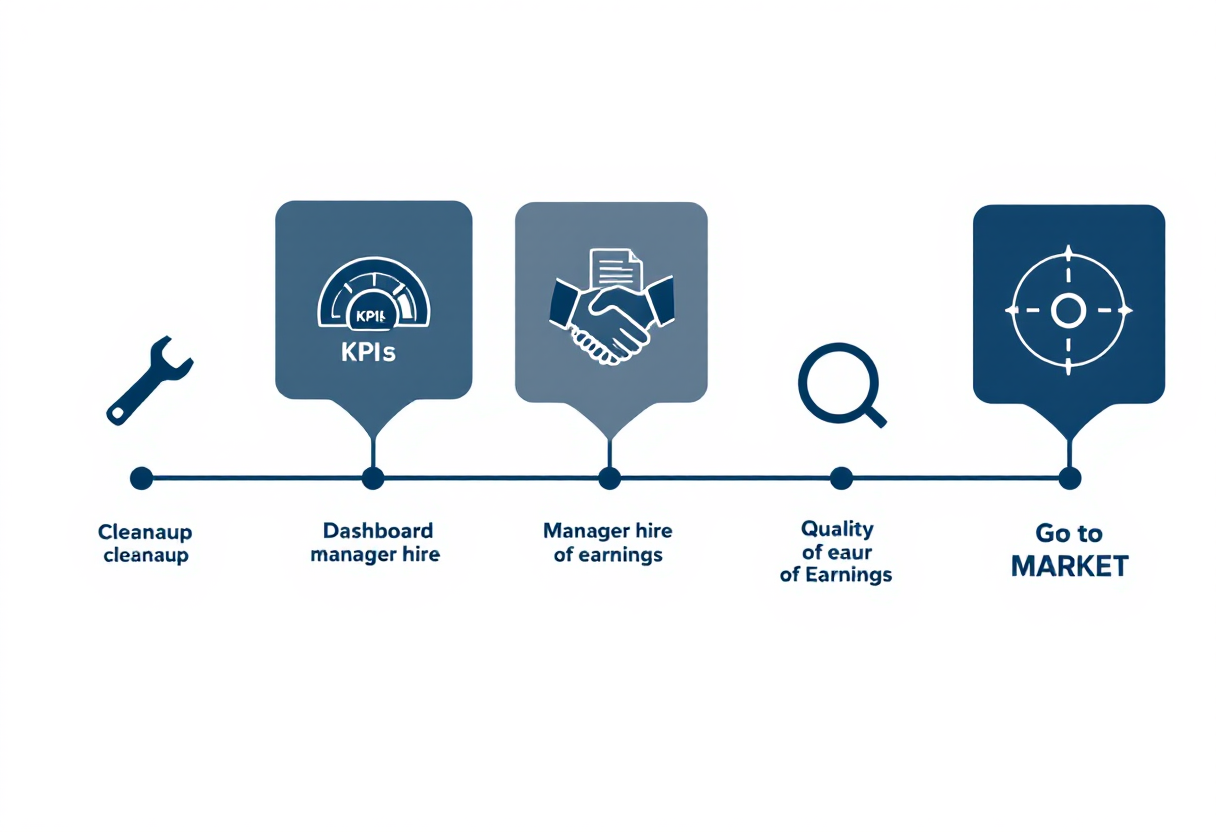
T-36 months: Cleanup phase (fire alarm-specific)
- Switch to accrual basis with proper deferred revenue recognition on prepaid ITM and monitoring contracts
- Pick an FSM (ServiceTrade or BuildOps) and migrate. Build out NFPA 72-template inspection forms aligned to the AHJ-adopted edition in every jurisdiction
- Start tagging every potential EBITDA add-back as it happens
- Conduct W-2/1099 audit; reclassify if needed
- Restruck related-party rent to FMV with appraisal
- Build the org chart; identify GM hire target
- Identify 2+ NICET Level III tech candidates who can qualify the firm beyond the owner; start sponsoring NICET prep
- Sales/use tax compliance review by outside counsel in every operating state, with particular attention to monitoring tax exposure in Texas, Connecticut, Iowa, West Virginia
- Davis-Bacon compliance audit on every federally-funded project in the last 3 years
- Manufacturer-authorization roster: identify every active OEM authorization, change-of-control language, named factory-trained techs on each
- Document OT-cybersecurity baseline for networked fire systems aligned to NIST SP 800-82r3
T-24 months: Financial discipline and KPI infrastructure
- GM hire onboarded and starting to take operational load
- 2+ alternate qualifying individuals on payroll with NICET Level III across Fire Alarm Systems and ITM Fire Alarm Systems
- Monthly close in 15 days; service-line P&L (ITM, monitoring, install, service and repair, deficiency repair) every month
- KPI dashboard: ITM contract base ARR, monitoring MRR with commercial / residential split, deficiency attach rate, booking rate, jobs per tech per day, revenue per truck
- Launch ITM contract conversion push if ITM revenue is under 50%; goal to hit 50%+ within the next 18 months
- Launch written-multi-year-auto-renew contract conversion across the customer and monitoring base
- Pricing review: 5% to 8% list increase on ITM; 3% to 5% monitoring escalator written into renewals
- Begin diversification of customer base if any top customer is above 15%
- Document SOPs for every operational role
- Build add-back bridge as a living document
- Build commercial monitoring RMR (acquire a small alarm dealer with commercial book, or wholesale-resell with branded contracts and account-portability rights)
- Specialty expansion: add 1 to 2 specialty-trained techs (mass notification, voice evac, high-rise, clean agent) and pursue 2 to 3 specialty customer wins
T-12 months: QoE-ready close discipline, eliminate owner dependence
- Owner steps out of daily operations; GM runs the shop
- Owner takes a 2-week unplugged vacation as the stress test
- Run the sell-side QoE (budget $35K to $75K)
- Tighten balance sheet: clean A/R, isolate deferred revenue on prepaid ITM and monitoring contracts, isolate engineered-job customer deposits
- Final org-chart review; backfill any gaps
- Final compliance scrub: license transferability in every state with documented alternate qualifier; NICET records digital; manufacturer-authorization renewals current with documented factory-trained tech roster; W-2/1099 audit closed; sales/use tax verified; Davis-Bacon compliant; OSHA fall-protection program documented; AHJ-relationship log built; OT-cybersecurity attestation letter ready
- Lock in 12 months of clean service-line P&L for the CIM
T-6 months: Pre-marketing prep
- Engage M&A advisor. Typical fee: $25K to $75K monthly retainer credited against success fee of 4% to 8% of EV on Lehman or modified-Lehman scale
- CIM drafted from QoE and operating model
- Teaser drafted (anonymized 1-pager)
- Buyer list finalized. Starting list of 25+ active platforms from Section 1: Pye-Barker, APi Group (via Davis-Ulmer, CertaSite, Onyx-Fire channels), Encore (Permira), Sciens (Carlyle), Convergint (Leonard Green), Summit (BDT & MSD), Marmic (KKR), Eagle Fire (Cobepa), AI Fire (TruArc), Altus (Apax), RapidFire (Concentric), Thompson Safety (Berkshire), ORR Protection (Würth), ADT Commercial / Everon (GTCR), High Rise Fire and Security (Scutum), Allied Universal (Warburg minority), Cintas Fire Protection (NYSE: CTAS), Securitas Technology, Frontier / National Fire & Safety (Highview), Davis-Ulmer (APi subsidiary), Performance Systems Integration, Per Mar Security Services, Doyle Security Systems, Vector Security, Brinks Home (Monitronics), Bay Alarm Company. Plus adjacencies into Honeywell Building Technologies (Notifier channel), Siemens Smart Infrastructure (Cerberus PRO channel), Johnson Controls (Simplex channel), Carrier Fire & Security (Edwards EST channel)
- Virtual data room populated with everything from Sections pre-LOI and confirmatory
- Management presentation deck built and rehearsed
T-3 months: Go to market
- Teaser distributed; NDAs collected; CIMs distributed
- IOIs collected 2 to 3 weeks after CIM goes out
- Narrow to 4 to 6 finalists for management meetings
- Management meetings; LOIs solicited
- Select LOI; sign with exclusivity (60 to 90 days for fire alarm given license, AHJ, manufacturer-authorization, and OT-cybersecurity diligence complexity)
- Enter confirmatory diligence; close
End-to-end from engagement to close: 9 to 12 months in a well-run process (Auxo Capital Advisors sell-side process guide 2025; Wall Street Prep sell-side primer; Meridian Capital Fire & Life Safety Winter 2025 update).
Frequently Asked Questions
How long should I plan for before selling my fire alarm business to a private equity buyer?
The owners who get top-quartile pricing start preparing 24 to 36 months before going to market. The minimum useful prep window is 12 months because most of the high-leverage levers (lifting ITM revenue from 20% to 50%+ of mix, building a commercial monitoring RMR base, installing a GM, recruiting 2+ alternate NICET qualifying individuals, getting on ServiceTrade or BuildOps, running a sell-side QoE) need 12+ months of clean trailing-twelve-months data to be credible to a buyer. Owners who try to sell in under 6 months typically leave 20% to 40% of enterprise value on the table, and on fire alarm businesses with significant monitoring books the gap is often larger because the RMR multiplier compounds against any pre-sale discount.
What is a realistic EBITDA multiple for a $2M EBITDA fire alarm business in 2026?
For a $2M EBITDA fire alarm business in 2026 the range is 5x to 13x depending on revenue mix. The bottom of that range applies to install-only or install-heavy shops with under 20% ITM revenue, owner dependence, no monitoring base, and concentrated customers. The top applies to inspection-first shops with 60%+ NFPA 72 ITM revenue, branded commercial monitoring RMR on a UL Listed Central Station, 2+ alternate NICET qualifying individuals, ServiceTrade or BuildOps running, customer concentration under 10%, and a specialty (mass notification, voice evac, clean agent, or high-rise) (CT Acquisitions Fire Protection PE Map 2026; Breakwater M&A Fire Alarm & Life Safety Company Valuation Multiples 2026; Essential.com 2026). On top of that multiple, monitoring RMR is valued at 30x to 50x the monthly figure separately. The 36-month prep playbook moves you from the bottom of the band to the top, and the monitoring RMR build alone can add several million dollars of separate value on top of the EBITDA multiple.
What percentage of NFPA 72 inspection, testing, and maintenance recurring revenue do PE buyers want to see?
40% or higher is the threshold that moves your business from commodity pricing into premium pricing, and 60%+ is the threshold that hits platform-tier pricing. Install-only shops trade in the 4x to 5x EBITDA band. Shops with 40%+ ITM trade in the 7x to 10x band. Shops with 60%+ ITM and a real monitoring base trade in the 9x to 13x band (Breakwater M&A 2026; Essential.com 2026). APi Group built its entire “inspection-first” thesis around exactly this revenue-quality premium, with CertaSite and Onyx-Fire both targeting 50%+ revenue from inspection, service, and monitoring at acquisition (APi Group FY2025 annual report; APi Group press releases December 2025 and April 2026). On top of the EBITDA multiple, the ITM contract base ARR adds another 2.0x to 3.5x the annual figure to enterprise value (Breakwater M&A 2026).
Will my state low-voltage / fire alarm license and NICET certifications transfer to the new owner, or do I need to stay involved post-close?
The firm-level state license can usually be transferred or re-issued with the right structure (asset vs. stock deal, qualifying-individual replacement filing), but only if the buyer has an immediate replacement qualifying individual on payroll. If you, the owner, are the only NICET-certified qualifier on the firm’s license, the license effectively does not transfer because the buyer cannot pull permits, accept commissioning sign-offs, or sign deficiency repair quotes legally on Day 1 of close. This is the single most deal-fatal fire alarm-specific issue per DealFlowAgent 2026 and NICET fire alarm certification requirements. The fix is to recruit 2+ alternate qualifying individuals (NICET Level III or higher in Fire Alarm Systems plus ITM Fire Alarm Systems) onto payroll 12 to 24 months before market, and to document the qualifier transition plan for every operating state in your data room. Most state contractor boards (Florida, California, Texas, New York City) have specific qualifier-replacement filings; pre-clearing these with regulator and counsel is part of the T-12 to T-6 prep window.
How much is my fire alarm monitoring RMR worth on top of my EBITDA multiple?
Fire alarm monitoring RMR trades at 30x to 50x the monthly figure SEPARATELY from EBITDA (Breakwater M&A 2026; CT Acquisitions Fire Protection guide 2026; DealStream Security & Fire Alarm Business Rules of Thumb; Security Sales & Integration RMR Deep Dive 2024). Commercial fire alarm monitoring on a UL Listed Central Station with two-path or cellular redundancy sits at the high end of the range; residential alarm monitoring sits at the low end. Commercial RMR commands a 1.5x to 2.5x premium over residential RMR because of stickiness, contract-protected churn under 3% annually, and the AHJ and UL compliance moat (Security Sales & Integration 2024; Vector Security SDM 100 commentary 2024). Worked example: a fire alarm company with $200K/month in commercial monitoring RMR adds $7M to $10M to enterprise value (200K x 12 = $2.4M ARR, at 35x to 50x = $7M to $10M on the monthly figure). 1,000 commercial accounts at $40/month equals $40K MRR, which adds $1.4M to $2.0M to EV; 5,000 accounts adds $7M to $10M+. This is why a $1.5M EBITDA fire alarm business with a strong monitoring book can clear $20M+ at sale.
Will I lose my Notifier (or Simplex, or EST) authorized dealer status when the business sells?
You might, and pre-clearing this is one of the most important items in the prep window. Notifier Engineered Systems Distributor (ESD), Simplex Authorized Service Provider (ASP), Edwards EST Strategic Partner, Siemens Cerberus PRO Authorized Service Partner, and Bosch authorized status all frequently include change-of-control clauses that allow the OEM to cancel or re-evaluate the authorization at sale. Per Notifier’s ESD program structure, ESDs are limited per geography and re-evaluated on ownership change (Notifier ESD program reference; Honeywell channel materials). Loss of Notifier ESD status post-close cuts off the buyer from competitively-priced Notifier parts and the manufacturer-only design tools, which often represents 15% to 30% of revenue tied to Notifier-installed bases (estimate cross-referenced against SDM 100 manufacturer-relationship commentary 2024). The fix is to (1) build the manufacturer-authorization schedule into your data room 12 months before market with change-of-control language flagged on each, (2) pre-clear with every manufacturer authorization holder 6+ months before market, and (3) deepen factory-trained tech bench so the buyer can re-qualify the authorization if needed. Manufacturer authorization depth is also worth a 0.5x to 1.5x multiple uplift in its own right because the authorization is per-territory limited and quasi-moat.
What to Do Next
The fire alarm owners who get the top-quartile multiple all do the same three things. They start preparing 24 to 36 months before they want to be out. They put a GM in place and recruit 2+ alternate NICET qualifying individuals 12+ months pre-sale. And they invest in a sell-side QoE before any buyer sees a CIM. The owners who do all three on a fire alarm business with strong ITM and a real commercial monitoring book consistently clear platform-tier multiples plus the separate 30x to 50x RMR premium on top.
The window matters. Capstone Partners tracked 125 Fire & Life Safety deals in 2025 alone, up 66.7% year over year, with PE add-ons accounting for 45.9% of volume. APi Group is mid-stride with $90M and $190M revenue acquisitions inside 6 months (CertaSite, Onyx-Fire). Pye-Barker closed 57 deals in 2025. Sciens has done 9 Florida acquisitions and counting. The data center construction boom is the single largest demand pull and is structural, not temporary. For fire alarm owners with clean financials, a qualifier bench, and a commercial monitoring book, the next 24 to 36 months are the most active and best-priced exit window the sector has seen.
If you are 12+ months from a potential exit and want a structured pre-sale optimization roadmap, CT Acquisitions has fire alarm operations specialists in our partner network who run multi-quarter prep engagements. If you are 6 to 12 months out and ready to start the sell-side process, our M&A advisory team runs the buyer outreach. Buyers pay our fee, not you. Either way, the first 30 minutes are free.
Ready to talk?
Schedule a 30-minute exit-readiness call
Or read more: Sell Your Fire Alarm Business (active sale guide) | Sell Your Fire Sprinkler Business (companion guide) | Buying a Fire Protection Business (buyer’s playbook)
Ready to Explore Your Options?
A 30-minute confidential conversation is all it takes.