How to Prepare Your Accounting Firm for a Sale or Exit in 2026: The 36-Month PE-Buyer Playbook
Preparing your accounting firm for exit in 2026 is a 36-month process that starts long before the first inbound call from a consolidator. The first 12 months tighten the operating story around advisory revenue mix and partner-track retention (the two levers PE consolidators underwrite first), the middle 12 fix pre-LOI diligence gaps, and the final 12 turn a single offer into a real competitive process with pricing tension.
Exiting your accounting firm business is the single largest financial event most owners will ever face. This guide is the no-fluff playbook for accounting firm owners who are 12-36 months from sale, covering how PE-backed buyers actually value your business in 2026, the 12 levers that move your multiple, pre-LOI diligence, deal-killers to fix before going to market, and the full 36-month exit prep timeline.
Updated April 2026 · CT Acquisitions

Most accounting firm owners decide to sell, hire a broker, and find out 90 days later that their firm is worth 30% to 50% less than they thought. The CPA owners who get the top-quartile price start preparing 24 to 36 months before they ever talk to a buyer. This guide is the 36-month playbook for how to prepare your accounting firm for a sale or exit. It covers what private equity actually buys in CPA firms, the 12 levers that move multiples, the Alternative Practice Structure (APS) that makes every PE deal in accounting possible, the documents PE will ask for before they send an indication of interest, and the deal-killers that re-trade CPA firm transactions during confirmatory diligence. Every number cites its source. Every recommendation comes from how the most active accounting firm buyers in 2026 actually behave.
If you are 6 to 36 months from a possible exit, this is the work that turns a 5x EBITDA outcome into a 10x EBITDA outcome. On a $3M EBITDA accounting firm, that is the difference between a $15M sale and a $30M sale. Whether you want to prepare your accounting firm for a sale to private equity, prepare your accounting firm for an exit to a strategic acquirer, or prepare your CPA firm for a sale or exit to a PE-backed mid-tier consolidator, the work below applies.
Building toward an exit in 12 to 36 months?
CT Acquisitions runs sell-side advisory for accounting firm owners $1M+ EBITDA. We also have CPA-firm operations specialists in our partner network who run pre-sale optimization engagements when the timeline is longer. No fee to you on buy-side introductions; sell-side mandates are paid on success at closing.
What Private Equity Actually Buys in Accounting (2026)
For 2026 sell a bookkeeping business at 2x-8x SDE/EBITDA with named buyers (Bench, Pilot, FinancePal, Patriot) and PE roll-ups, see our reference.
2021 was Year Zero for private equity in US accounting. Before that, no Top 25 US CPA firm had taken outside institutional capital. EisnerAmper sold a stake to TowerBrook Capital Partners in August 2021. Citrin Cooperman followed three months later with a New Mountain Capital deal at roughly $500M EV (Journal of Accountancy, “Private equity’s push into accounting”, October 2021; CFO Brew, January 2025). Five years later, more than 27 PE-backed CPA platforms are actively buying. PE-backed accounting transactions hit 22 in 2023, 65 in 2024, and 104 in 2025; January 2026 alone produced 25+ transactions, almost a third of the full 2025 count (CPA Trendlines / Cornerstone PE Deal Tracker, January 2026). The first PE-to-PE flip in accounting closed in January 2025 when Blackstone acquired Citrin Cooperman from New Mountain at a roughly $2.0B EV, implying about 15x EBITDA, up from the 11x New Mountain paid in 2021 (Journal of Accountancy, January 2025; NYSSCPA, January 2025).
Multiples have compressed upward. The old broker world ran on 1x revenue and 2.75x SDE. The new PE-platform world runs on 8x to 15x+ EBITDA at scale. The sponsor money flowing in is not random. PE buys specific profiles, and the profile you build determines the multiple you get.
The Alternative Practice Structure (APS), explained in two paragraphs
A CPA firm cannot be majority-owned by non-CPAs in the vast majority of US states. North Carolina caps non-CPA ownership at 49%; Washington requires simple majority CPA ownership; California requires more CPA owners than non-CPA owners; Texas Section 513.11 permits non-CPA ownership under specific conditions (AICPA / NASBA, “Uniform Accountancy Act non-CPA ownership”, 2024; state CPA board rules 2024 to 2025). That means a “PE-backed CPA firm” is always two legal entities. The licensed CPA firm (the attest entity, doing audits and reviews) stays majority CPA-owned. The non-attest business (tax compliance, advisory, consulting, outsourced accounting) takes the PE check. The two are linked by a long-term Administrative Services Agreement.
This is the Alternative Practice Structure (APS), and every PE deal cited in this article uses it (Hunton Andrews Kurth, “Forming an Accounting Firm Alternative Practice Structure”, 2024; ICPAS Insight, “The Ethics of Alternative Practice Structures”, Summer 2025; California Board of Accountancy APS session paper, September 2025). If you have any attest revenue at all, your sell-side process will rely on APS, and that structure has implications for the levers and deal-killers below.
The PE-attractive accounting firm profile
- EBITDA threshold for a platform-quality deal: $1M to $3M EBITDA is the entry band where sponsor-backed platforms run a competitive process. Below that you are an add-on inside a roll-up at broker-tier multiples. Above $5M EBITDA you are an attractive bolt-on for any Top 25 PE-backed firm. Above $15M EBITDA you are a platform candidate yourself.
- Recurring revenue percentage: 60% or higher recurring (annual tax-compliance renewals + monthly CAS retainers + advisory retainers) is the line between commodity and premium. Tax-compliance-heavy seasonal shops trade at 4x to 6x EBITDA. Firms with 60%+ recurring trade at 7x to 10x+ EBITDA (Firmlever, 2026; Auxo Capital Advisors, 2025; Sofer Advisors, 2025).
- Service mix: CAS (Client Accounting Services) and outsourced CFO revenue is valued at 1.5x to 2.0x the multiple of seasonal tax-prep revenue (Sofer Advisors, 2025). The single highest-leverage repositioning over a 24-month prep window.
- Geography: Nearly 20% of recent CPA transactions cluster in Georgia, Florida, Texas, North Carolina, and South Carolina (CPA Trendlines, November 2025). Sun Belt and Texas fit is preferred. Stranded geographies discount.
- Customer concentration: No single client above 10% of revenue. Top 10 below 35%. Concentration above 20% triggers buyer pushback; above 25% triggers 15% to 30% valuation discount or buyer withdrawal (Sofer Advisors, 2025; Wall Street Prep; cross-referenced Auxo).
- Partner concentration: No single partner controls more than 15% of client relationships. Multiple partners touching every top-10 client.
- Niche specialty: SALT, R&D credits, IRS controversy, healthcare, manufacturing, real estate, or professional services niche commanding 25%+ of revenue. Premium of 0.5x to 1.5x EBITDA over generalist (estimate, synthesized across Cherry Bekaert, Kaufman Rossin, MGO content).
- Managing partner role: Managing partner is strategic / client-facing, not operational. COO or non-partner GM in place 12+ months pre-sale. Documented G2 partner pipeline.
- Independence posture: If the firm is PCAOB-registered or audits SEC clients or PE-portfolio companies, an outside-counsel independence-impairment analysis is on file.
Active accounting firm PE platforms in 2026
The list below covers the most active sponsor-backed CPA platforms and PE-backed mid-tier consolidators in the 2024-2026 cycle. This is who will see your teaser. Add-on counts are point-in-time; sources include Inside Public Accounting, Accounting Today, Journal of Accountancy, CPA Practice Advisor, Cornerstone PE Deal Tracker, and sponsor press releases as of May 2026.
| Platform / PE-backed firm | PE Sponsor | Profile |
|---|---|---|
| Citrin Cooperman (Top 20) | Blackstone (Jan 2025, from New Mountain Capital Nov 2021) | First US accounting PE-to-PE flip at ~$2.0B EV / ~15x EBITDA; 15+ add-ons since New Mountain entry; national, broad practice |
| EisnerAmper (Top 15) | TowerBrook Capital Partners (2021); continuation vehicle Mar 2026 led by Carlyle AlpInvest + Hamilton Lane | National; recent add-ons include Krost CPAs (Aug 2024), HDA Accounting Group (Jan 2025), Prague & Company (Apr 2025) |
| Grant Thornton US (Top 7) | New Mountain Capital majority; CDPQ + OA Private Capital minority (closed May 2024) | Largest US CPA PE deal at announcement; FY23 revenue $2.36B; national |
| CohnReznick (Top 20) | Apax Partners (51% of non-attest, Feb 2025) | FY25 revenue $1.12B; 5,000 employees, 350+ partners; national |
| Baker Tilly US (Top 6 post-Moss Adams) | Hellman & Friedman + Valeas Capital Partners (Feb 2024; additional H&F investment Apr 2025 for Moss Adams combination) | Combined with Moss Adams Jun 2025 to create 6th-largest US CPA firm; Berkowitz Pollack Brant announced Dec 2025 |
| Wipfli (Top 20) | New Mountain Capital (~40% minority, Aug 2025) | FY24 revenue ~$600M; national |
| Aprio (Top 25) | Charlesbank Capital Partners majority (Jul 2024) | Mize CPAs + Prism Financial (Nov 2025, ~$1.8B AUM); Delap, Hoffman Stewart & Schmidt, TaxOps SALT (Jan 2026); national; advisory + wealth focus |
| Carr Riggs & Ingram (CRI, Top 25) | Centerbridge Partners + Bessemer Venture Partners (51% voting interest, Nov 2024) | FY23 revenue $455.4M; CapinCrouse acquired Jan 2025 (+40 partners +185 professionals); Southeast |
| PKF O’Connor Davies (Top 30) | Investcorp + PSP Investments (Nov 2024) | FY23 revenue $377.5M; NY metro and East Coast |
| Cherry Bekaert (Top 25) | Parthenon Capital (Jun 2022) | FY22 revenue $252.1M; first 2022-era PE deal in CPA; Tarsus (Jan 2026); Herbein + Company (Oct 2025); national |
| Sikich (Top 25) | Bain Capital Special Situations + Bain Capital Credit ($250M minority May 2024) | ~2,000 employees; tech-enabled professional services positioning; CEO Christopher Geier retained majority control |
| Doeren Mayhew (Top 40) | Audax Private Equity (Aug 2024) | Pre-deal revenue $137.4M, FY25 revenue $240M; 13 deals in 2025 including Lancaster & Reed, Carson & McKinney, Thurman Campbell Group, Reimer McGuinness Hess; national |
| Schellman & Company (Top 50) | Lightyear Capital (2021; restructured 2023 to form Schellman Compliance LLC) | IT compliance + cybersecurity specialty; SOC, ISO, PCI; national |
| Springline Advisory | Trinity Hunt Partners (Jan 2024 launch) | Sub-Top-100 platform; MarksNelson (founding), BGBC, HM&M, EFPR, Clarke Raymond, Fiske, Smart Accountants (Nov 2025), Cg Advisory (Mar 2026); national mid-market |
| Ascend | Alpine Investors (Aug 2023 launch) | Opsahl Dawson (founding); Walter Shuffain (Jan 2025); KSDT (Sept 2025, Ascend’s largest deal, 29 partners + 276 professionals); BiggsKofford (Nov 2025); national entrepreneurial CPAs |
| Crete Professionals Alliance | Thrive Capital + Bessemer Venture Partners (May 2024 raise; founded 2023) | 16 deals cumulative per Cornerstone tracker; alliance model; national |
| Smith + Howard (Top 200) | Broad Sky Partners (Nov 2022) | FY21 revenue $36.7M; Horton Lee Burnett (Sept 2025); Bauknight Pietras & Stormer (Jan 2026); Atlanta + Southeast |
| Pinion (formerly KCoe Isom) | PE-backed (rebrand Aug 2022) | Agribusiness niche; national |
| LBMC | HighWire Capital | Torrillo & Associates (Jan 2026); Frazee Ivy Davis (Dec 2024); Southeast |
Add to that list the strategic acquirers. The Big 4 (Deloitte, PwC, EY, KPMG) are structurally not US CPA-firm consolidators because of SEC independence rules and size mismatch; their absence from the buyer table for sub-Top-20 US firms is itself important context for sellers because it means PE platforms and PE-backed mid-tier firms dominate the bid sheet. Independent mid-tier networks still active as strategic buyers include CliftonLarsonAllen (CLA), Eide Bailly (Hamilton Tharp May 2025, Edward White Jun 2025, Wall Einhorn & Chernitzer Dec 2025), Withum (BBD Apr 2024, CTM CPAs May 2025, PKF Texas Jun 2025, Freed Maxick Aug 2025), Forvis Mazars (formed Jun 2024 from FORVIS + Mazars USA combination at ~$5B global revenue), and Frazier & Deeter. Withum publicly favors stewardship over PE: “philosophy rooted in stewardship rather than ownership” (Thomson Reuters Institute, “Pat Walsh, CEO of Withum”, 2025). Bennett Thrasher publicly declined PE in May 2025 (Accounting Today, “Bennett Thrasher resists private equity funding”, May 2025). For wealth-management bolt-ons specifically, Marsh McLennan, Aon, Mariner Wealth, Mercer Advisors, Creative Planning, and Allworth are active buyers; CPA Trendlines tracked 30+ wealth-management arm transactions in 2025 alone.
Accounting Firm Valuation Multiples in 2026 (What You Are Actually Worth)
The multiple a buyer pays comes down to your size, your service mix, your recurring revenue, your niche, and your geographic fit. Here is the 2026 range, cross-referenced from Firmlever, Auxo Capital Advisors, Peak Business Valuation, Cherry Bekaert sample case studies via Parthenon, Sofer Advisors, IBBA Market Pulse Q4 2025, and the Cornerstone PE Deal Tracker observed bands.
SDE and revenue multiples (smaller, broker-tier practices)
| Revenue / SDE band | Revenue multiple | SDE multiple |
|---|---|---|
| Sub-$500K revenue, owner-operated tax/comp | 0.75x to 1.0x | 2.0x to 2.5x |
| $500K to $2M revenue, established with infrastructure | 0.9x to 1.2x | 2.5x to 3.0x |
| Recurring revenue heavy (monthly CAS + tax comp) | 1.1x to 1.35x | 2.75x to 3.5x |
| Premium sticky compliance book | 1.25x to 1.5x+ | 3.25x to 4.0x |
Median per Poe Group Advisors broker data across 600+ transactions: 1.0x revenue or 2.75x SDE (Firmlever, 2025). Bizbuysell reports comparable median ranges. The “1x revenue” rule still holds for compliance-heavy books under $2M revenue.
EBITDA multiples (PE-attractive size, $1M+ EBITDA)
| EBITDA band | Compliance-heavy multiple | CAS / advisory-heavy multiple |
|---|---|---|
| Under $500K EBITDA | 3.0x to 4.0x | 3.5x to 4.5x |
| $500K to $1M EBITDA | 4.0x to 5.0x | 4.5x to 5.5x |
| $1M to $3M EBITDA | 5.0x to 7.0x | 7.0x to 9.0x |
| $3M to $5M EBITDA | 6.5x to 8.5x | 8.0x to 10.0x |
| $5M to $15M EBITDA | 8.0x to 11.0x | 9.0x to 12.0x |
| $15M+ EBITDA (sub-Top-100 platform candidate) | 10.0x to 13.0x | 11.0x to 14.0x+ |
| Top 25 platform deals at scale | 11.0x to 18.5x+ (Citrin Cooperman traded at 11x at NM entry 2021, 15x at BX flip Jan 2025) | |
Source: Firmlever 2026, Auxo Capital Advisors 2025, Cherry Bekaert case studies, Cornerstone PE Deal Tracker bands, IBBA Market Pulse Q4 2025 (released January 2026, n=350 brokers + M&A advisors). IBBA confirms the lower middle market is in a clear seller’s market: 76% to 89% average cash at close, 71% of advisors expect multiples to remain steady in 2026, 72% expect 2026 conditions to match or exceed the 2021 peak.
Recent disclosed accounting firm transactions (2024-2026)
| Acquirer / sponsor | Target | Date | Value | Implied multiple |
|---|---|---|---|---|
| Blackstone | Citrin Cooperman (from New Mountain Capital) | Jan 7, 2025 | ~$2.0B EV | ~15x EBITDA (vs ~11x NM paid Nov 2021) |
| New Mountain Capital | Citrin Cooperman (original deal) | Nov 2021 | ~$500M EV | ~11x EBITDA (disclosed publicly) |
| New Mountain Capital | Grant Thornton US (majority) | Closed May 31, 2024 | Not disclosed; widely reported $1B+ | Implied high single to low double digit on $2.36B revenue base |
| Hellman & Friedman + Valeas | Baker Tilly US | Feb 2024 ($1B reported initial); additional H&F investment Apr 2025 | $1B+ initial; additional undisclosed | Not disclosed |
| Apax Partners | CohnReznick (51% of non-attest) | Feb 27, 2025 | Not disclosed; FY25 revenue $1.12B | Not disclosed |
| Charlesbank Capital Partners | Aprio (majority) | Jul 2024 | Not disclosed | Not disclosed |
| Bain Capital Special Sit + Bain Credit | Sikich ($250M minority) | May 9, 2024 | $250M minority investment | Implied $1B+ valuation given minority stake size |
| Centerbridge Partners + Bessemer Venture Partners | Carr Riggs & Ingram (51% voting interest) | Nov 18, 2024 | Not disclosed; FY23 revenue $455.4M | Not disclosed |
| Investcorp + PSP Investments | PKF O’Connor Davies | Nov 18, 2024 | Not disclosed; FY23 revenue $377.5M | Not disclosed |
| TowerBrook continuation (Carlyle AlpInvest + Hamilton Lane lead) | EisnerAmper | Mar 2026 | Not disclosed; secondary single-asset structure | Not disclosed |
Sources: Journal of Accountancy (multiple 2024-2026); CPA Practice Advisor; Inside Public Accounting; NYSSCPA; CFO Brew; Private Equity Wire; Accounting Today. Citrin Cooperman is the only US CPA firm with both entry and exit multiples disclosed publicly (~11x at New Mountain 2021, ~15x at Blackstone 2024-2025). Citrin Cooperman revenue went from $350M in 2021 to $850M in 2024 under New Mountain ownership.
The 12 Value Levers That Move Your Multiple (Ranked by Impact)

These are the levers that move accounting firm multiples in the 24 months before a sale. Each one has a current state, a target state, and an estimated financial impact. The ordering is by dollar impact per unit of effort, based on cross-source synthesis from Firmlever 2026, Sofer Advisors 2025, Auxo Capital Advisors 2025, Rosenberg Associates MAP Survey, Karbon, Madras Accountancy, and CPA Practice Advisor 2025-2026 content.
Lever 1: Lift recurring revenue from under 40% to 70%+
Current: Tax-compliance heavy, Q1-spike business, demand-only individual tax + small-biz comp. Recurring revenue under 40%. Target: 60% to 70%+ revenue from recurring sources: monthly CAS retainers + annual tax-compliance contracted with multi-year engagement letters + monthly advisory retainers. Impact: The single biggest multiple driver in modern CPA firm M&A. Sofer Advisors 2025: buyers value outsourced CFO / CAS revenue at 1.5x to 2.0x the multiple of seasonal tax-prep revenue. On a $1.5M EBITDA firm, shifting from 30% recurring to 70% recurring moves the EBITDA multiple from the 5x to 6x band into the 8x to 10x band, worth $4.5M to $6M of additional price (Firmlever 2026; Sofer Advisors 2025; Auxo 2025). How: Build a CAS practice. Hire a CAS practice leader. Standardize on QuickBooks Online Accountant + Xero + Karbon + TaxDome. Move small-biz tax-comp clients to year-round CAS retainers priced $500 to $5,000 per month (OnPay CAS pricing data). Multi-year engagement letters for tax compliance clients. CAS firms grew revenue 17% median in 2023 with continued double-digit growth since 2018 (Thomson Reuters CAS Benchmark via TaxDome 2025).
Lever 2: Move the managing partner out of the chair
Current: Founder runs every major client relationship, signs every engagement letter, reviews every major deliverable, handles admin and business development. Target: COO or non-partner GM in place 12+ months pre-sale. Managing partner role is strategic and client-relationship only, not operational. Internal G2 partner cohort identified, vesting, and ready. Impact: PE buyers in 2024-2026 rarely appoint existing managing partners as CEO of the rolled-up platform; they want C-suite talent with enterprise P&L experience (CPA Practice Advisor, “5 Hidden Risks of PE Buyouts for CPA Firms”, November 2025). Without a transition-ready leadership layer, the buyer prices in integration risk: estimated haircut of 0.5x to 1.5x EBITDA. A firm with a credible succession bench commands the premium end of its band. How: COO hire 18 to 24 months pre-sale (typical COO comp for $10M+ revenue firm $200K to $300K plus bonus plus equity). Document SOPs for every operational role. Move 70% of admin / business development / personnel decisions to COO. Promote a Senior Manager to non-equity partner now and a non-equity to equity over the 2-year run-up (Rosenberg Associates, “Should You Have Non-Equity Partners?”, 2025).
Lever 3: Get on the PE-standard tech stack and run a real monthly close
Current: Lacerte or UltraTax or Drake + Excel + Outlook + Dropbox; tax season is fire-drill chaos; no real monthly close on the firm itself; no service-line P&L; KPIs are anecdotal. Target: Wolters Kluwer CCH Axcess (or equivalent platform-tier tool) for tax; Karbon or TaxDome for practice management and client portal; ShareFile or SmartVault for documents; monthly close on the firm itself by day 15; real KPI dashboard covering realization rate, utilization, revenue per partner, revenue per FTE, MRR, CAS client count. Impact: Estimated +0.5x to 1.0x multiple uplift, driven primarily by data-room speed and KPI defensibility during diligence. CCH Axcess Advisor and Expert AI for CCH Axcess launched late 2025 and early 2026 (CPA Practice Advisor, October to December 2025). Sikich’s tech-enabled professional services positioning justified Bain Capital’s $250M minority investment at premium valuation (Bain Capital, May 2024). How: Budget $50K to $250K implementation for mid-size firm. Force adoption by tying partner comp to time-tracking compliance and engagement-letter completion in the system.
Lever 4: Build a defensible niche specialty practice
Current: Generalist tax + audit + bookkeeping; no clear vertical or specialty hook. Target: Identifiable niche commanding 25%+ of revenue: SALT (state and local tax), R&D tax credits, IRS controversy / OPR-defense, healthcare / dental / real estate / manufacturing / professional services vertical, ASC 740 / GAAP-conversion advisory, forensic / litigation support, ESG / sustainability assurance, cannabis-industry CPA, crypto-tax practice. Impact: Estimated +0.5x to 1.5x EBITDA premium for defensible niche. Specialty practices (like Cherry Bekaert’s R&D tax credit unit) get cited explicitly by PE platforms as multiple-expanders. Schellman & Company’s IT compliance + cybersecurity specialty drove its Lightyear Capital deal and the 2023 rebrand to Schellman Compliance LLC. How: Pick the niche with strongest local and national demand. Hire the practice leader externally if needed (sub-specialist tax controversy CPA, ex-IRS Appeals Officer, ex-Big 4 SALT director). Build the practice over 18 to 24 months. Market the specialty separately in the CIM.
Lever 5: Diversify client and partner concentration
Current: Top client above 10% of revenue; top 5 above 40%; or one partner controls 30%+ of client relationships. Target: Top client below 10%; top 10 below 35%; partner-relationship concentration distributed across at least 4 to 5 partners. Impact: Concentration above 20% triggers buyer pushback. Above 25% drives 15% to 30% discount or buyer walk. Above 40% drives 1.0x to 2.0x EBITDA multiple haircut (Wall Street Prep; Auxo; Sofer Advisors). Partner-relationship concentration is a separate but parallel risk: if one partner owns 40% of client relationships and that partner is leaving post-close, every one of those clients is at risk. How: Diversify new-client wins through marketing, SEO, conference circuit, sub-specialty hooks. Cross-staff every top-10 client so multiple partners are touching the relationship in the 24 months pre-sale. Fire unprofitable small clients; consolidate to a tighter, higher-value base.
Lever 6: Drive revenue per equity partner toward elite benchmark
Current: $400K to $600K revenue per equity partner (non-elite). Target: $2.4M+ revenue per equity partner (elite per Rosenberg Associates AICPA MAP Survey, 2025). Achieve via leverage: more managers, seniors, and staff per partner. Impact: PE pays for leverage. Higher revenue per partner equals more profit per partner equals higher EBITDA. A $5M revenue firm with 5 equity partners ($1M per partner) trades lower than a $5M firm with 2 equity partners ($2.5M per partner) because the firm with leverage shows the buyer that the partner layer is doing rainmaking, not delivery. Estimated +0.5x to 1.5x EBITDA multiple shift. How: Hire managers, seniors, and staff. Promote senior managers to non-equity partner instead of admitting to equity. Restructure the partnership agreement to convert some equity partners to senior managing director or principal track over 18 to 24 months pre-sale.
Lever 7: Lift realization rate from 85% to 92%+
Current: Realization rate 80% to 85% (industry average). Hours written down on most engagements. Pricing pressure on individual tax. No standard discount policy. Target: Realization rate 92% to 98% (good to elite per Karbon, 2025). Engagement letters with fixed-fee or value-pricing wherever possible. Standard discount approval workflow. Quarterly partner review of realization by client and engagement. Impact: Direct EBITDA growth. A 5-point realization lift on a $5M revenue firm with 60% gross margin adds roughly $300K to bottom line, which at a 7x multiple is $2.1M of additional price (Karbon “Realization Rate”; Madras Accountancy KPIs 2026). How: Move from hourly to fixed-fee or subscription pricing on as much work as possible. Implement client-by-client realization tracking. Stop writing off hours on chronic under-realizers (fire those clients or raise prices). Adopt Karbon or TaxDome realization reporting.
Lever 8: Lift utilization from 60% to 75% on professional staff
Current: 50% to 65% utilization on managers and below. Target: 70% to 80% utilization. Impact: Moving 10-person professional staff from 65% to 75% adds $75K to $150K to bottom line (Madras Accountancy, 2026). At a 7x multiple, $75K to $150K of EBITDA lift is $525K to $1.05M of additional price. How: Workflow management discipline; engagement-letter scoping discipline; tax-season planning starting in October not January; project management software (Karbon, TaxDome workflow); off-season utilization through CAS and advisory work.
Lever 9: EBITDA add-back hygiene and partner-comp normalization
Current: Managing partner mixes personal expenses through firm; partner family on payroll without clear duties; related-party rent above FMV; no add-back schedule; partner comp not normalized to market replacement rate. Target: Every potential add-back documented monthly with underlying invoice; related-party rent at FMV with appraisal on file; partner comp normalized to market for the role (typical CEO-equivalent for $10M revenue firm $300K to $500K all-in; partner-equivalent $250K to $400K depending on role and region). Impact: Every defensible dollar of adjusted EBITDA is multiplied. On a 7x multiple, $100K of clean add-backs equals $700K of additional price (Morgan & Westfield QoE guide). Many firm owners forget legitimate add-backs and leave money on the table (Firmlever 2026; Poe Group Advisors). For CPA firms specifically, the single most important add-back is replacing partner draws with market-rate compensation. If the seller takes $700K but a comparable hired CEO + practice leader would cost $450K, the $250K delta adds back. How: Adopt monthly add-back log starting today. Document business purpose of every charge. Get FMV rent appraisal if related party. Get a partner-comp benchmarking report (Rosenberg Associates publishes annual MAP Survey benchmarks).
Lever 10: Working capital normalization and the unbilled WIP problem
Current: Heavy unbilled WIP that swells in Q1 then snaps back post-tax-season; A/R cycles ride alongside; partner draws taken from firm cash instead of metered. Target: TTM-average working capital that is stable and predictable; unbilled WIP held to under 30 days; A/R DSO held to under 45 days (Auxo, 2025); partner draws on a fixed schedule. Impact: The working capital peg is set off TTM average. A volatile working capital pattern lets the buyer set a higher peg, which subtracts from purchase price at close. Estimated: poorly managed working capital can cost 2% to 5% of EV at close (BDO and Morgan & Westfield NWC guides). How: Tighten billing cadence (no engagement letter goes more than 30 days without an interim bill); enforce 45-day DSO target; isolate retainer deferred revenue separately on balance sheet; set a fixed partner draw schedule.
Lever 11: Diversify lead generation away from partner relationships
Current: 70%+ of new clients come from one or two senior partners’ relationships; under 100 Google reviews; weak SEO. Target: Diversified lead engine: SEO + content + paid search + referral partners + conference circuit + niche thought leadership + paid LinkedIn. New-client wins distributed across 4+ partners. Impact: Concentrated lead source through senior partners is key-person risk by another name. Diversified marketing makes the demand engine transferable. Estimated +0.25x to 0.75x multiple. How: Hire a marketing manager 18 months pre-sale. Build a content engine (publish weekly on tax updates, R&D credit changes, SALT alerts). LinkedIn paid + LinkedIn organic by every partner. Google Local Service Ads if local mid-market focused.
Lever 12: Compliance scrub (independence, licensing, peer review)
Current: Permit to practice not current in all client states; partner CPA licenses not all current; Peer Review with Deficiencies status not fully remediated; PCAOB inspection findings open if registered; independence-impairment analysis never done. Target: Permit to practice current in every state where firm has clients; every partner CPA license current; Peer Review last cycle returned Pass; if PCAOB registered, last 2 inspection cycles clean; independence-impairment audit by outside counsel completed; no Circular 230 OPR matters open. Impact: Each of these can kill or re-trade the deal at confirmatory. Failure to remediate a Peer Review deficiency puts a firm in danger of license revocation under New York State Mandatory Peer Review and AICPA Peer Review Standards. Cover this in months 24 to 12 of the run-up. How: Outside-counsel-led compliance scrub. State board status confirmation in every operating state. Peer Review remediation plan if any deficiency is open. PCAOB inspection finding documentation.
Bonus Lever: Decide the wealth-management arm separately
Current: Wealth-management book embedded in CPA firm without separate decision on whether to sell or carve out. Target: Explicit pre-marketing decision. Impact: PE platforms increasingly want wealth as part of the deal (Charlesbank / Aprio bought Mize CPAs explicitly for the affiliated $1.98B AUM Prism Financial Group). But wealth is its own animal: AUM-based recurring revenue, SEC-registered RIA structure, different multiples. Wealth-management bolt-ons in 2025 traded at AUM multiples (1.5% to 4% AUM) or RIA EBITDA multiples (8x to 14x). How: Sell wealth as part of the deal (and capture wealth’s premium multiple in EV) or carve out, keep, and run separately. Decide pre-marketing, not pre-LOI.
Want to grow your firm to maximize value before exiting?
We connect CPA firm owners with operations experts in our partner network who run 12 to 24 month pre-sale optimization engagements. The engagement pays for itself in incremental sale price.
What PE Asks Before They Send an LOI (The Pre-LOI Diligence Stack)
Before a PE firm commits to a letter of intent on an accounting firm, they ask for a focused diligence package. The list below is the real ask from a 2026 PE-backed CPA platform targeting a Top-200 firm in CT Acquisitions’ pipeline. The “why” and “how to prepare” expand each item to what is typical across the industry.
1. Income statements for 2024, 2025, and the latest trailing twelve months
Why PE asks: They are building the LTM EBITDA they will multiply. Accounting firms have heavy Q1 tax-season seasonality, so LTM with January through April included is critical to see a full tax-season cycle. Service-line P&L (tax compliance, audit / attest, advisory, CAS) shows mix shift, which determines the multiple band you fall into.
How to prepare: Accrual-basis P&L by month with revenue by service line: tax compliance, audit / attest, CAS / outsourced accounting, fractional CFO, advisory, wealth (if applicable), specialty (R&D, SALT, controversy). Reconcile to tax returns. Add a column for billable hours and realization rate per service line per quarter.
2. Balance sheet at the latest month
Why PE asks: Sizing the working capital peg plus identifying net debt (debt-like items including unbilled WIP, deferred revenue on retainers, accrued partner bonuses, capital lease balances). For CPA firms the unique items are partner capital accounts and any deferred-comp or partner-retirement obligations that may become debt-like at close.
How to prepare: Tie balance sheet to trial balance. Segregate partner capital accounts. Identify any prepaid retainer balances and unbilled WIP. Disclose any partner deferred-comp or pension obligations.
3. Adjusted EBITDA bridge with add-back documentation
Why PE asks: Adjusted EBITDA is the number they will multiply. For CPA firms the single most important adjustment is replacing partner draws with market-rate compensation. If the seller takes $700K but a comparable hired CEO + CFO + practice leader would cost $450K, the $250K delta adds back.
How to prepare: Build the bridge from book EBITDA to adjusted EBITDA line by line. Document every add-back. Common defensible CPA-firm add-backs: partner compensation above market-rate replacement, partner family-member payroll, partner vehicle and personal travel, partner health insurance / country club / CPE that exceeds policy, one-time legal fees, one-time tech-stack migration costs (CCH Axcess conversion, Karbon implementation), one-time office moves, related-party rent above FMV (Morgan & Westfield QoE Guide; Anders CPA QoE Report; LGA QoE Reports).
4. Anonymized employee and partner roster (titles, start dates, pay, classification, license status)
Why PE asks: Buyers stress-test partner retention risk (PE pays attention to partner age, equity / non-equity mix, billing / managing partner status, client relationships); CPA license status (especially for any partner whose name is on the firm’s permit to practice in a state); staff age pyramid and CPA-track development.
How to prepare: Columns must include role (Partner / Director / Senior Manager / Manager / Senior / Staff / Admin), equity vs non-equity, hire date, full-time vs part-time, W-2 vs 1099, comp structure (base, bonus, equity draw), CPA license status (state + license number + expiration), any active non-compete or non-solicit. Provide 12-month and 24-month rolling staff retention. AICPA MAP Survey shows elite firms run staff retention above 80% with a structured Senior to Manager to Partner pipeline; non-elite firms churn at 25%+.
5. Revenue breakdown by service line and client (2022 to LTM)
Why PE asks: Tells them whether the firm is compliance-heavy (lower multiple, seasonal) or CAS / advisory heavy (higher multiple, recurring). Whether average client size is growing, flat, or declining. Whether new-client wins are coming through the firm brand or through one partner.
How to prepare: Pull from the practice management system (CCH Axcess, Thomson Reuters CS Professional Suite, Karbon time data, TaxDome client data). For each year and LTM: total revenue, number of clients, average revenue per client, by service line. Top 10 clients by revenue with concentration percentages. Service-line P&L with realization rates. Disclose any specialty-niche revenue separately.
6. Customer concentration snapshot (top 10 plus concentration analysis)
Why PE asks: Single highest-leverage analysis. CPA firm concentration risk is uniquely sticky because the relationship is built on years of trust; loss of one anchor client is catastrophic.
How to prepare: Top 10 clients by revenue with revenue + tenure + industry + service-line mix. Identify any client where revenue is above 10% of total; flag. Provide a same-store revenue analysis for the top 10 over 3 years. Top 10 should not exceed 35% of revenue; single client should not exceed 10% (Sofer Advisors, 2025).
7. Recurring revenue snapshot (CAS clients, monthly retainers, ARR)
Why PE asks: Recurring revenue is the single biggest multiple driver in modern accounting M&A. Specifically: number of monthly CAS clients, monthly recurring revenue, average revenue per CAS client, churn rate, plan mix (basic bookkeeping vs full CAS + CFO).
How to prepare: From the CAS practice management system: client count by month last 36 months, MRR trend, churn calculation (target under 5% annual for CAS), revenue per CAS client (industry $500 to $5,000 per month per OnPay 2025). Separate the annual tax-comp recurring renewal rate (target 95%+ since tax-comp engagements are nearly automatic year over year).
8. Five-year business plan
Why PE asks: PE underwrites a 1-to-5-year forward case. They want to see if the seller understands the levers (CAS expansion, niche specialty buildout, partner pipeline, geographic expansion, technology adoption).
How to prepare: Operating model with revenue by service line, gross margin assumptions (industry benchmark: 50%+ gross margin, 20%+ EBITDA margin for healthy firms; 30% to 40% EBITDA margin for well-managed; 40%+ for elite per Madras Accountancy and Rosenberg surveys), partner-pipeline / staff-hire ladder, planned tech investments, planned CAS expansion, M&A pipeline if any.
9. Org chart with partner equity, managing partner structure, succession plan
Why PE asks: PE buyers in 2024-2026 are paying premiums but rarely appointing existing managing partners as CEOs; they want C-suite talent with enterprise P&L experience (CPA Practice Advisor, “5 Hidden Risks of PE Buyouts for CPA Firms”, November 2025). They want to know: is there a non-equity partner layer? Is there a G2 succession plan? Is the managing partner replaceable or essential?
How to prepare: Org chart with equity percentage by partner, last 3 years of partner buy-in and buyout activity, partnership agreement summary (vesting, retirement, deferred comp, non-compete and non-solicit terms), any G2 partners in line for promotion, the firm’s documented succession plan.
10. Tech-stack inventory and practice-management data
Why PE asks: Acquired firms typically need to migrate to the platform’s standard tech stack. CCH Axcess vs UltraTax CS vs Thomson Reuters GoSystem vs Lacerte. Karbon vs TaxDome vs Canopy. ShareFile vs SmartVault. Modern stack equals easier integration equals higher multiple.
How to prepare: Inventory of every software license, per-seat count, contract dates. The PE-preferred stack per CPA Practice Advisor Readers’ Choice Awards 2025 includes Wolters Kluwer CCH Axcess (tax) + Karbon (workflow) + TaxDome (client portal) + ShareFile or SmartVault (document) + QuickBooks Online Accountant or Xero (CAS).
11. Legal and regulatory history
Why PE asks: For CPA firms specifically: AICPA Peer Review history (Pass / Pass with Deficiencies / Fail), PCAOB inspection results (if registered), state board of accountancy disciplinary actions, IRS Office of Professional Responsibility (OPR) referrals, malpractice claims, independence violations (especially if firm audits PE-portfolio companies).
How to prepare: Last 6 years of AICPA Peer Review reports (Peer Review Public File at AICPA); last 6 years of PCAOB inspection reports (if registered); state board permit-to-practice status in every state; CPA license status for every partner and qualifier; OPR records; malpractice claim and settlement history; independence-impairment audit conducted by outside counsel for any SEC or PE-portfolio audit clients.
Confirmatory Diligence (After You Sign the LOI)
Once an LOI is signed and exclusivity starts (typically 45 to 90 days per industry practice), the buyer runs parallel workstreams. This is the depth of inspection your firm will undergo. If anything was hiding, it surfaces here.
- Quality of Earnings (QoE). Outside accounting firm runs revenue cut-off testing, deferred revenue and unbilled WIP analysis, expense normalization, partner-comp normalization at market rate, add-back validation, working capital trends. Buyer’s QoE cost: $50K to $250K typical for $1M to $10M EBITDA CPA firms (Eton Venture Services; Anders CPA QoE Guide). Output: adjusted EBITDA the buyer locks into the model.
- Customer concentration and commercial DD. Customer-by-customer revenue analysis, calls with top accounts (with seller’s permission and on best-and-final basis), contract review (engagement letters, retainer agreements), client industry analysis.
- IT and practice-management audit. Tech stack assessment, data quality in CCH / Thomson Reuters / Karbon, license counts, integration capability with platform stack. CCH Axcess Advisor (early adopter 2025, full release post-2025 tax season) and Expert AI for CCH Axcess (October 2025) are the new tools for the PE-platform tier.
- Legal. Entity good standing in every operating state; CPA permit-to-practice in every state; partnership agreement review (including non-compete + non-solicit + deferred comp + retirement obligations); litigation history; engagement-letter library review; assignment / change-of-control triggers; malpractice insurance coverage and claims; warranty and engagement-deficiency exposure.
- Independence audit. For attest firms, full independence-impairment analysis under AICPA Code of Professional Conduct, SEC Rule 2-01 of Reg S-X (for SEC audit clients), PCAOB independence standards, GAGAS for government audits. The PE deal structure itself triggers an independence review because PE-portfolio companies cannot be audited by the CPA firm post-close (Cherry Bekaert “SEC Auditor Independence Rules for PE Funds”; PCAOB Auditor Independence Spotlight).
- HR and payroll. W-2 vs 1099 classification audit (for any 1099 contractors); I-9 compliance; partner-employment-agreement analysis; pending EEOC / DOL claims; partner non-compete and non-solicit enforceability state by state.
- Tax. Federal income, payroll, sales / use (any state with services-revenue taxation), state nexus analysis (any state where firm has clients but is not registered).
- Peer Review and PCAOB inspection scrub. Pre-close confirmation that the most recent peer review came back Pass; that any prior Pass with Deficiencies has been fully remediated (AICPA confirms ~80% of firms in remediation improve scores by next peer review). Any PCAOB inspection deficiency on file gets diligence-flagged.
Why You Should Pay for Your Own Quality of Earnings Before Going to Market
A sell-side QoE is your own outside accountant’s QoE, paid for by you, before going to market. It does three things: pre-empts the buyer’s QoE by getting to the adjusted EBITDA number first with documentation, so the deal price is not being negotiated from the buyer’s downward-revised number; surfaces issues you can fix before the buyer sees them (revenue recognition cut-off, unbilled WIP normalization, partner-comp normalization, add-back documentation, related-party rent FMV check); tightens the EBITDA number you take to market. For PE-attractive ($5M+ revenue) accounting firms, a sell-side QoE is essentially mandatory. PE buyers expect to see one, and the credibility cost of going to market without one is the loss of bidder competition.
Cost
- $25K to $35K for QoE if revenue is below $10M (Eton Venture Services QoE Cost Guide, 2025; Morgan & Westfield QoE Guide, 2025).
- $35K to $75K typical for sell-side QoE on a healthy CPA firm with multiple service lines.
- Up to $150K for firms with complex add-backs, multiple legal entities (the APS already creates two), partner-deferred-comp arrangements, or messy books.
ROI
Example synthesized across QoE-provider content: $20M revenue, $4M EBITDA CPA firm. Moving the multiple from 7x to 8x equals $4M of additional sale price. A $60K QoE investment that supports the 1x lift is a 67x return. Specific CPA-firm example referenced: a $3M revenue tax + advisory firm where seller’s tax returns showed $700K EBITDA. QoE came back at $470K adjusted EBITDA after partner-comp normalization. The owner fixed pre-market rather than re-trading during confirmatory (EBIT Community QoE guide, 2025). Sources: Anders CPA “QoE Report”; LGA “QoE Reports”; H2R CPA “Sell-Side QoE Benefits”; KMCO “Benefits of a Sell-Side QoE”; HCVT QoE; Windham Brannon QoE.
Deal-Killers That Re-Trade Accounting Firm Transactions (Avoid These)
These are the recurring kill-shots cited across CPA-firm M&A and confirmatory diligence content. Most are fixable in 12 to 24 months. None are fixable in 30 days.
1. Independence violations on attest clients
The most catastrophic CPA-firm deal-killer. Under SEC Rule 2-01 of Regulation S-X, the CPA firm cannot audit any company in the PE sponsor’s portfolio post-close. PCAOB Auditor Independence Spotlight (2025) explicitly calls out the risk: regulators are concerned that PE firms may not be familiar with independence requirements and that combined firm structures impair audit independence in fact and appearance. SOX Title II imposes strict independence on auditors of SEC issuers. A firm that audits even a single SEC client or a PE-portfolio company can lose that engagement on close, a meaningful revenue hit, which forces a pre-close restructuring of the client portfolio (Cherry Bekaert “SEC Auditor Independence Rules”; Cybersierra SOX Title II; Linfordco “The Great Audit Heist”).
2. AICPA Peer Review failure or unremediated deficiency
Firms get Pass, Pass with Deficiencies, or Fail. Pass with Deficiencies triggers Peer Review Oversight Committee monitoring and required remediation; firms that fail remediation are at risk of state license revocation (NYS Mandatory Peer Review; AICPA Peer Review Standards). Roughly 80% of firms in remediation improve scores by the next cycle, but the 20% that do not face a profession-defining problem. A target with open Peer Review deficiencies will see PE pricing it in or walking.
3. State CPA permit-to-practice gaps
Each state has its own permit-to-practice rules and nexus rules. A CPA firm serving clients in 30 states needs permits and firm registrations in many of those states. Gaps surface in confirmatory legal DD. Remediation cost is real (filing fees, back-dating, potential disciplinary action from state boards).
4. PCAOB inspection deficiencies (if firm is PCAOB-registered)
PCAOB inspection reports are public for the inspection-quality (Part I) findings. If the firm has open or recent Part I findings, the buyer will price in remediation cost and reputational risk. If quality control (Part II) findings are not remediated within 12 months, the PCAOB makes those public, which is a brand event.
5. Partner non-compete and non-solicit enforceability issues
The FTC Non-Compete Clause Rule was vacated nationwide by the US District Court for the Northern District of Texas (Judge Ada Brown) in August 2024 in Ryan, LLC v. FTC. The FTC dismissed its 5th Circuit appeal on September 5, 2025 and acceded to the vacatur (FTC press release, September 5, 2025; Faegre Drinker; Squire Patton Boggs). Enforceability of partner non-competes therefore reverts to state law. In California (which generally voids non-competes) the protection is limited and PE buyers price that in. In states that enforce, the protection holds. CPA firms specifically rely heavily on non-solicits and client-protection agreements; those remain widely enforceable (Rosenberg Associates “Non-Compete Laws Have Little Impact on CPA Firms”, 2025; Poe Group Advisors).
6. Customer concentration above 20%
Concentration above 15% triggers buyer scrutiny; above 20% triggers active pricing of the discount; above 25% triggers buyer walk or 15% to 30% valuation haircut (Wall Street Prep; Sofer Advisors; Auxo). Particularly painful for CPA firms because the relationship is built on years of trust, so a top-10 client lost post-close is typically permanently lost.
7. Partner concentration (one rainmaker controls majority of relationships)
If one partner owns 40% of client relationships and that partner is the selling principal stepping away post-close, the buyer treats the entire 40% as at-risk. Earnout structures typically include client-retention clawbacks that hit if retention drops below 90% (typical clawback; CPA Practice Advisor “5 Hidden Risks of PE Buyouts”, November 2025). Partner retention bonuses commonly run as 4-to-6-year earnouts to address this risk.
8. Aggressive R&D credit, SALT, or niche-tax positions with thin documentation
Specialty tax practices holding positions on R&D credits, SALT, or IRS controversy that lack defensible documentation become contingent-liability risks. Cherry Bekaert, Kaufman Rossin, and MGO content all flag this: contingent-fee R&D providers maximize the credit at the cost of audit defensibility; full-service CPA firms with disciplined documentation hold up. Buyer’s confirmatory tax DD surfaces aggressive positions and either prices in remediation cost or extracts escrow.
9. Worker classification (W-2 vs 1099) and partner classification
Standard 1099 classification problem applies to any contractor-style tax preparers on the roster. CPA-firm specific: classification of non-equity partners as W-2 vs guaranteed-payment recipients, and the deferred-comp / retirement-buyout obligations baked into the partnership agreement. Misclassification triggers payroll-tax-back exposure ($10K to $100K+ per misclassified worker once back taxes, penalties, interest, legal cost are aggregated per Tax1099, ADP SPARK 2023, IRS).
10. Unfiled state nexus and sales-tax exposure
CPA firms providing services across state lines may have undeclared nexus in states where they do not have permit-to-practice. Some states (notably Washington, Texas, Hawaii, New Mexico) tax professional services. Confirmatory tax DD will surface undeclared nexus and back-tax exposure.
11. Partnership-agreement vesting and clawback overhangs
Many CPA partnership agreements have decade-old deferred-comp and retirement-buyout obligations that have not been documented or funded. These show up at close as debt-like items that reduce purchase price. Solo CPA firms and 2-partner firms with informal partnership agreements get scrutinized hardest.
12. PCAOB-registered status without sufficient SEC client revenue to justify the cost
Some firms maintain PCAOB registration but have only 1 or 2 SEC clients. Buyer may want to drop PCAOB registration and the SEC clients post-close; if any of those clients have multi-year engagement commitments, that creates legal-deficiency exposure (engagement-letter breach).
13. AICPA, state society, or Circular 230 lapses
Most state boards link CPA license and permit-to-practice to AICPA and state society membership. Lapse triggers disciplinary review. IRS Circular 230 violations (any active OPR matter) become a legal-DD finding. Easy to fix pre-close, but if not fixed it surfaces as a finding that erodes buyer trust in the broader compliance posture.
The 36-Month Exit Prep Timeline
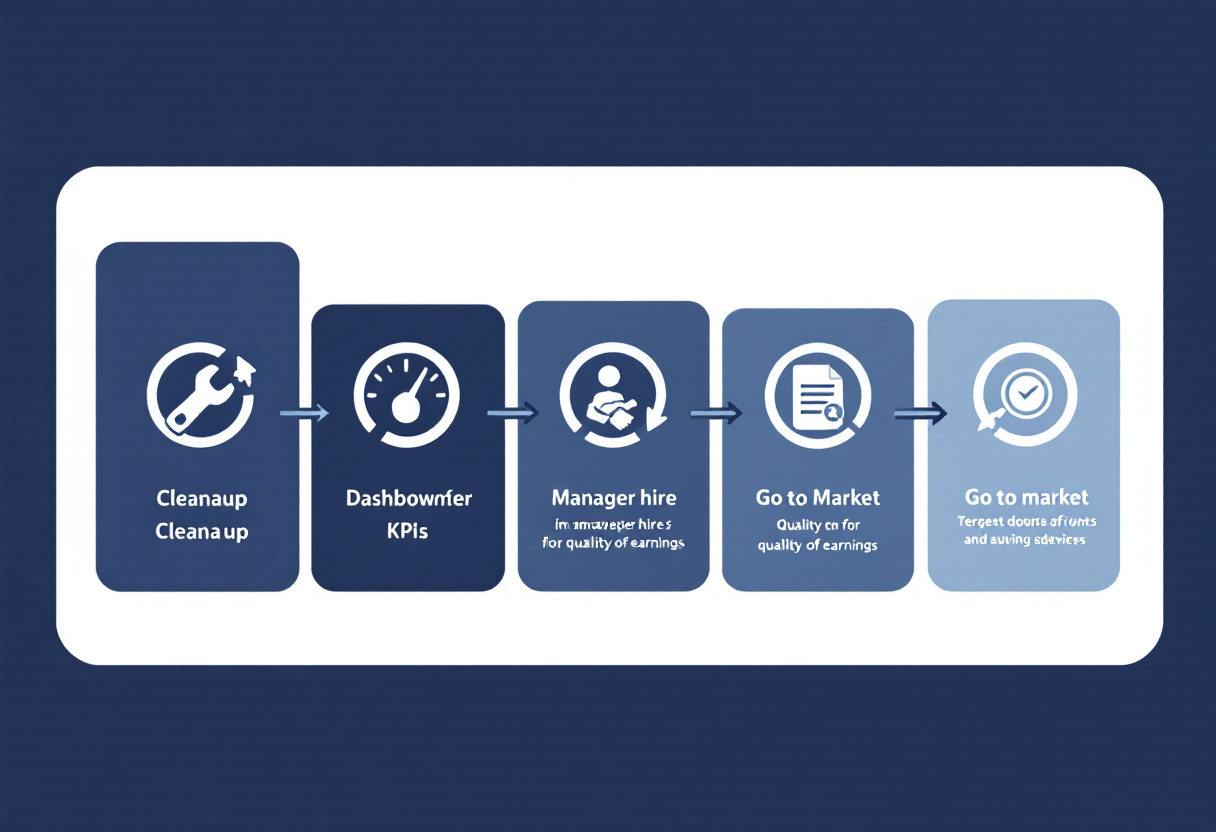
T-36 months: Cleanup phase
- Switch fully to accrual basis if still on cash basis (the QoE will require accrual anyway)
- Pick the tech stack (CCH Axcess + Karbon or TaxDome + ShareFile / SmartVault + QuickBooks Online Accountant) and start migration
- Start tagging every potential EBITDA add-back as it happens
- W-2 / 1099 classification audit; reclassify if needed (settle exposure while it is small)
- Restruck related-party rent to FMV with appraisal
- Identify the COO, non-equity partner, or G2 hire or promote
- AICPA Peer Review status confirmation; if Pass with Deficiency, build remediation plan
- State permit-to-practice scrub in every operating state
- Independence-impairment audit by outside counsel for any SEC or PE-portfolio attest clients
T-24 months: Financial discipline and KPI infrastructure
- COO onboarded; taking operational load off managing partner
- Monthly close in 15 days; service-line P&L every month (tax, audit / attest, CAS, advisory, niche)
- KPI dashboard: realization rate by service line, utilization by class, revenue per equity partner, revenue per FTE, MRR for CAS, CAS client count, churn, top-10 concentration percentage
- Launch CAS push if recurring revenue is under 50%; sales-team comp tied to CAS conversion
- Pricing review: 5% to 10% annual list increase on tax-comp engagements; fixed-fee or value-pricing wherever defensible
- Diversify customer base if top client is above 15%
- Document SOPs for every operational role
- Build the add-back bridge as a living document
- Begin specialty-niche practice buildout if needed
T-12 months: QoE-ready close discipline, eliminate owner dependence
- Managing partner steps out of daily operations; COO runs the shop
- Run the sell-side QoE (budget $35K to $75K for $1M to $5M EBITDA firm)
- Tighten balance sheet: clean A/R (DSO target under 45 days), kill unbilled WIP overhang, isolate retainer deferred revenue
- Final org-chart review; backfill any gaps
- Final compliance scrub (Peer Review remediation complete; state permits current; independence-impairment audit complete; partner CPA licenses all current)
- Convert any equity-partner-to-non-equity restructuring under the partnership agreement to free up equity for the buyer
- Get a partner-compensation benchmarking report (Rosenberg Associates publishes annual benchmarks)
- Lock in 12 months of clean service-line P&L for the CIM
T-6 months: Pre-marketing prep
- Engage M&A advisor (sell-side investment bank or M&A advisory firm specializing in professional services; named players include Capstone Partners, Hovde Group, Whitman Advisory LLC (formerly Whitman Transition Advisors), Koltin Consulting Group, Auxo Capital Advisors, Poe Group Advisors for sub-$10M firms, ProHorizons, Accounting Practice Sales). Typical fee structure: $25K to $75K monthly retainer credited against success fee of 1% to 5% of EV with Lehman or modified Lehman scaling for mid-market sell-side mandates
- CIM drafted from the QoE and operating model. A strong CIM can add 1 to 2 turns of EBITDA to outcome (Roadmap Advisors; Capstone Partners “What is a CIM”)
- Teaser drafted (anonymized 1-pager)
- Buyer list finalized (the 18+ active PE-backed CPA platforms in the table above are the starting list)
- Virtual data room populated with everything from the pre-LOI section
- Management presentation deck built and rehearsed
T-3 months: Go to market
- Teaser distributed; NDAs collected; CIMs distributed to 20 to 30 buyers
- IOIs collected 2 to 3 weeks after CIM goes out
- Narrow to 4 to 6 finalists for management meetings
- Management meetings; LOIs solicited
- Select LOI; sign with exclusivity (typically 45 to 90 days)
- Enter confirmatory diligence; close
End-to-end from engagement to close: 9 to 12 months in a well-run process (Auxo Capital Advisors “Sell-Side M&A Timeline: 9-12 Months to Close”, 2025; Capstone Partners “M&A Process Step-by-Step Guide”; Lutz “M&A Process Timeline and Milestones”).
Frequently Asked Questions
How long should I plan for before selling my CPA firm to a private equity buyer?
The owners who get top-quartile pricing start preparing 24 to 36 months before going to market. The minimum useful prep window is 12 months, because most of the high-leverage levers (lifting recurring revenue from 30% to 70%+, installing a COO, getting on CCH Axcess and Karbon, running a sell-side QoE, remediating any Peer Review deficiency) need 12+ months of clean trailing-twelve-months data to be credible to a buyer. Owners who try to sell in under 6 months typically leave 20% to 40% of enterprise value on the table. The end-to-end process from advisor engagement to close runs 9 to 12 months in a well-run sell-side process (Auxo Capital Advisors, 2025).
What is a realistic EBITDA multiple for a $3M EBITDA accounting firm in 2026?
For a $3M EBITDA accounting firm in 2026, the range is 5x to 9x. The bottom of that range (5x to 6x) applies to compliance-heavy firms with under 40% recurring revenue, heavy owner dependence, and concentrated client or partner relationships. The top (8x to 9x+) applies to CAS-heavy and advisory-heavy firms with 60%+ recurring revenue, a COO in place, modern tech stack, defensible niche specialty, and distributed partner relationships (Firmlever 2026; Auxo Capital Advisors 2025; Cornerstone PE Deal Tracker observed bands). For sub-Top-100 platform candidates at $15M+ EBITDA, the range stretches to 10x to 13x+ EBITDA; Top 25 platform deals trade at 11x to 18.5x+ (Citrin Cooperman traded at 11x at New Mountain entry in 2021 and 15x at the Blackstone flip in January 2025). The 36-month prep playbook moves you from the bottom of the band to the top.
Should I get a quality of earnings (QoE) report done before going to market?
For accounting firms at $1M+ EBITDA, yes. A sell-side QoE costs $25K to $75K typical, up to $150K for complex add-back situations or firms with the APS two-entity structure already in place (Eton Venture Services, 2025; Morgan & Westfield, 2025). The ROI is leverage. If your QoE supports a 1x multiple uplift on a $4M EBITDA firm at a 7x baseline, that is $4M of additional sale price for a $60K investment. More importantly, a pre-market QoE surfaces partner-comp normalization issues, revenue cut-off problems on tax-engagement timing, unbilled WIP treatment, and add-back weaknesses while you can still fix them, rather than during exclusivity when the buyer re-trades the deal.
What percentage of recurring (CAS + monthly retainer) revenue do PE buyers want to see?
60% or higher is the threshold that moves your firm from commodity tax-compliance pricing into premium PE-attractive pricing. Compliance-heavy firms with under 40% recurring revenue trade at 5x to 7x EBITDA. Firms with 60% to 70%+ recurring (annual tax-compliance renewals + monthly CAS retainers + monthly advisory retainers) trade at 8x to 10x+ EBITDA. Buyers value CAS and outsourced CFO revenue at 1.5x to 2.0x the multiple they pay for seasonal tax-prep revenue (Sofer Advisors, 2025). CAS firms grew revenue 17% median in 2023 with continued double-digit growth since 2018 (Thomson Reuters CAS Benchmark via TaxDome 2025). For a $1.5M EBITDA firm, shifting mix from 30% recurring to 70% recurring moves the multiple from the 5x to 6x band into the 8x to 10x band, worth $4.5M to $6M of additional price.
Do I need to put a COO or G2 succession plan in place before I sell?
If your goal is to maximize price, yes, ideally 12+ months pre-sale. PE buyers in 2024-2026 are paying premiums but rarely appointing existing managing partners as CEO of the rolled-up platform; they want C-suite talent with enterprise P&L experience (CPA Practice Advisor, “5 Hidden Risks of PE Buyouts for CPA Firms”, November 2025). Without a transition-ready leadership layer, the buyer prices in integration risk: estimated haircut of 0.5x to 1.5x EBITDA. A COO hire runs $200K to $300K plus bonus and equity for a $10M+ revenue firm, and needs 12 to 18 months to fully take operational load before the buyer’s diligence team will believe the transition. A non-equity partner cohort (carrying partner title with comp between Senior Manager and Equity Partner) is the parallel move to distribute leadership without diluting equity (Rosenberg Associates, “Should You Have Non-Equity Partners?”, 2025).
How does the Alternative Practice Structure (APS) work, and why do all PE deals use it?
A CPA firm cannot be majority-owned by non-CPAs in the vast majority of US states. North Carolina caps non-CPA ownership at 49%; Washington requires simple majority CPA; California requires more CPA owners than non-CPA owners; Texas Section 513.11 permits non-CPA ownership under specific conditions (AICPA / NASBA Uniform Accountancy Act). The APS works around this by splitting the firm into two legal entities: the licensed CPA firm (the attest entity, which does audits and reviews) stays majority CPA-owned; the non-attest business (tax compliance, advisory, consulting, CAS, outsourced accounting) takes the PE check. The two are linked by a long-term Administrative Services Agreement. Every PE deal in US accounting since EisnerAmper / TowerBrook in August 2021 uses some version of APS, including all of the deals listed in the platforms table above (Hunton Andrews Kurth, “Forming an Accounting Firm Alternative Practice Structure”, 2024; ICPAS Insight, “The Ethics of Alternative Practice Structures”, Summer 2025; California Board of Accountancy APS session paper, September 2025).
What to Do Next
The CPA firm owners who get the top-quartile multiple all do the same things. They start preparing 24 to 36 months before they want to be out. They put a COO or non-equity partner cohort in place 12+ months pre-sale. They lift recurring revenue past 60%. They invest in a sell-side QoE before any buyer sees a CIM. And they run an outside-counsel independence-impairment audit if they have any attest revenue at all.
If you are 12+ months from a potential exit and want a structured pre-sale optimization roadmap, CT Acquisitions has CPA-firm operations specialists in our partner network who run multi-quarter prep engagements covering CAS buildout, partner-comp normalization, niche specialty buildout, and tech-stack migration. If you are 6 to 12 months out and ready to start the sell-side process, our M&A advisory team runs the buyer outreach to the 18+ active PE-backed CPA platforms and the independent mid-tier networks listed above. No fee to you on buy-side introductions; sell-side mandates are paid on success at closing. Either way, the first 30 minutes are free.
Ready to talk?
Schedule a 30-minute exit-readiness call
Or read more: Accounting Firm Business Valuation (sell-side and buy-side guide) | How to Prepare Any Business for Sale (master guide) | Sell Your Accounting Firm (active sale guide)
Ready to Explore Your Options?
A 30-minute confidential conversation is all it takes.