No, a CRM is not required to sell your business, but it significantly increases your sale price. Buyers in the home services space pay 15-30% premiums for businesses with documented customer data, recurring revenue tracking, and systematized operations. Without one, you’re leaving $500K-$2M on the table depending on your business size. Most acquirers, PE firms, strategic buyers, and search funds, view CRM adoption as evidence of scalability and operational maturity. If you’re selling within 12 months, implementing a basic system now pays dividends.
Why Buyers Care About CRM Data
Private equity and strategic acquirers conduct customer concentration analysis during due diligence. They want proof that your revenue doesn’t depend on a handful of relationships or your personal network. A CRM shows:
Customer lifetime value and repeat purchase rates
Service history and documented quality metrics
Seasonal patterns and revenue predictability
Which team members drive retention
Buyers use this data to stress-test their acquisition thesis. A home services company with 60% customer retention documented in a CRM commands a higher multiple than one where the owner claims “retention is probably around 60%.”
The Real Cost of Not Having One
In HVAC and plumbing businesses we’ve worked with, the absence of a CRM typically results in a valuation haircut. Here’s why: acquirers assume customer relationships walk out the door with you. Without documented touchpoints, service records, and repeat revenue patterns, they can’t verify the business generates recurring income. They default to treating your customer base as transactional, not recurring.
A $5M HVAC company with 40% recurring revenue gets valued differently than one where recurring revenue is undocumented. The buyer might apply a 6.0x multiple to the first and 4.5x to the second, that’s a $7.5M difference in enterprise value.
What Kind of CRM You Actually Need
You don’t need Salesforce. Home services buyers understand that HubSpot, ServiceTitan, Jobber, or even basic Zoho implementations tell the story they need to hear. The system matters less than the data: customer contact info, job history, revenue per customer, and appointment/completion records. Most companies implement a CRM in 4-8 weeks with 3-4 months of clean historical data before it becomes useful during diligence.
Timeline Matters
If you’re selling in the next 6 months, a CRM won’t be ready in time, focus on organizing existing customer records instead. If you’re 12+ months out, implement one now. If you’re uncertain about your timeline, a basic system costs $100-300/month and takes minimal time to set up.
Key Takeaways
A CRM is a financial decision, not an operational one.
Every business is different. A quick conversation can give you a real answer based on your specific numbers.
EBITDA multiples for lower middle market businesses vary by size, buyer type, and vertical.
What This Means for You
A CRM is a financial decision, not an operational one. If you’re serious about a transaction, the ROI is immediate and large. Most home services owners we work with at CT Acquisitions wish they’d implemented one 18 months earlier. It also makes your business easier to run day-to-day, giving you documented evidence of operational systems that buyers value in competitive processes.
A CRM is a financial decision, not an operational one. If you’re serious about a transaction, the ROI is immediate and large. Most home services owners we work with at CT Acquisitions wish they’d implemented one 18 months earlier. It also makes your business easier to run day-to-day, giving you documented evidence of operational systems that buyers value in competitive processes.
Selling a business in East Hartford, CT: what local sellers should know
East Hartford and greater Hartford business sellers typically work with regional M&A advisors covering New England (Sagemark, GulfStar, Founders Advisors) or Connecticut-based business brokers (Sunbelt Business Brokers of Hartford, VR Business Brokers). Median LMM sale timeline is 8-11 months. Common East Hartford verticals for sale include manufacturing, aerospace suppliers (near Pratt & Whitney), and specialty services. Connecticut has no state-specific broker license.
Related Question
Does the buyer expect to keep my CRM system after acquisition?
Usually not. Acquirers typically migrate your data into their own systems within 90 days post-close. They care about extracting clean customer data, not keeping your software license. Focus on data quality and completeness, not platform preference. The CRM’s real value is proving your customers exist and generate recurring revenue.
“`
How can I determine my business’s specific valuation before selling?
Every business is different. A quick conversation can give you a real answer based on your specific numbers. Book a Free Consultation Try Our Valuation Tool.
Every business is different. A quick conversation can give you a real answer based on your specific numbers.
Christoph Totter is the founder of CT Acquisitions, an M&A advisory firm working both sides of the table, headquartered in Sheridan, Wyoming. We work directly with 500+ buyers, search funders, family offices, lower middle-market PE, and strategic consolidators, including direct mandates with the largest home services consolidators that other intermediaries can’t access. No fee to you on buy-side introductions; sell-side mandates are paid on success at closing. Connect on LinkedIn · Get in touch
What EBITDA multiples apply by deal size in 2026?
EBITDA multiples for lower middle market businesses vary by size, buyer type, and vertical. The table below shows typical bands for privately-held sellers in 2026 based on GF Data and Axial 2025 benchmarks.
EBITDA size band
Typical multiple
Dominant buyer type
$500K to $1M
3.0x to 4.5x
Individual buyers, ETA, small local PE
$1M to $3M
4.0x to 6.0x
Search funds, small PE, family offices
$3M to $10M
5.5x to 8.0x
Lower middle market PE, strategic tuck-ins
$10M to $25M
7.0x to 10.5x
Middle market PE platforms, strategic acquirers
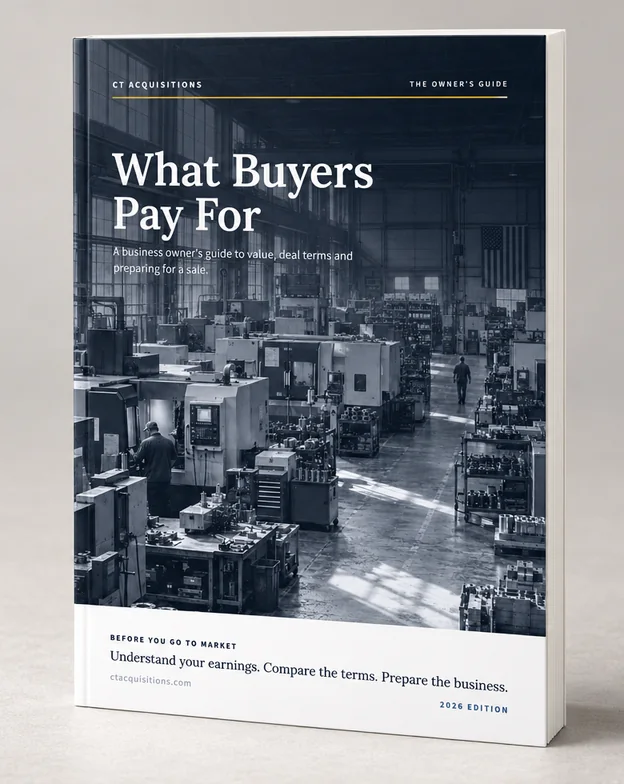
Free owner’s guideKnow what buyers pay for before you sell
Score your business on the 9 factors that set your multiple
See why two offers with the same headline can pay very different cash at closing
Spot the letter-of-intent terms where owners lose money after signing
Free owner’s guide
Know what buyers pay for before you sell
How buyers price a business, the terms that shrink what you keep, and a scorecard to rate yours. Read it on your own time.