
M&A Finance Explained in 2026: The Capital, Debt, and Equity Behind Every Deal
M&A finance in 2026 combines equity, senior debt, subordinated debt, and seller financing into capital stacks that determine both deal certainty and after-tax proceeds. Equity typically comes from PE fund commitments (25-40% of capital stack), family office direct-invest, or search-fund investor pools. Senior debt from SBA 7(a) (up to $5M), asset-based lenders, or unitranche facilities (Ares, Blue Owl, Antares) covers 40-60%. Mezzanine debt or subordinated seller notes fill the remaining 10-20%. Structure matters as much as headline price because it shapes seller certainty of close and buyer return.
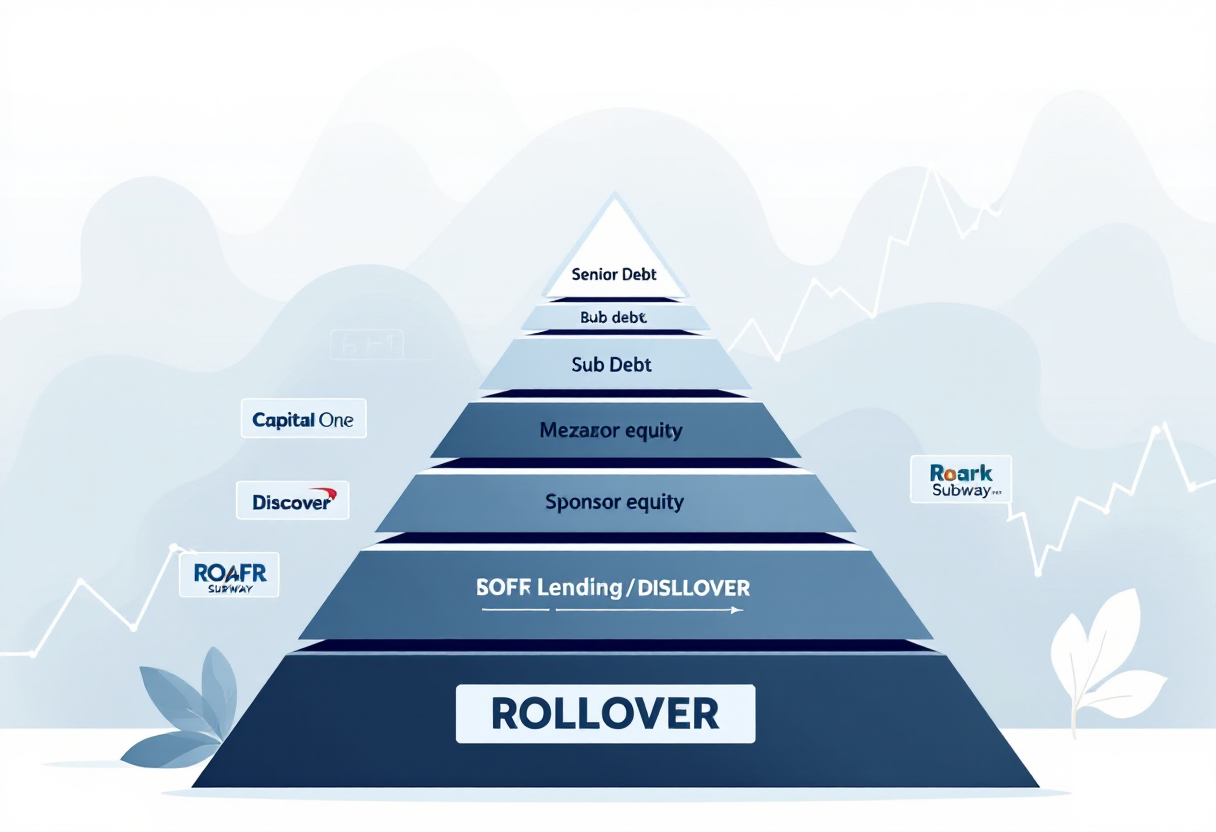
M&a finance is the discipline of structuring and sourcing the capital that pays for a merger or acquisition, and it is the part of the deal where the purchase price stops being a headline number and starts being a working capital stack of cash, senior debt, mezzanine, sponsor equity, stock consideration, and contingent payments. It is a different function from M&A advisory, which runs the process and the negotiation. Advisory tells you what the company is worth and how to sell it. M&a finance tells you how the buyer is going to pay for it, who is writing every check in the funding waterfall, what those checks cost, and what happens if revenue softens in year two.
This guide is for founders, CFOs, deal lawyers, and operators who keep hearing terms like “unitranche,” “second lien,” “WBS notes,” “Section 163(j) cap,” “Acquirer Cash,” “Term Loan B,” and “sponsor co-invest” and want a single reference that explains how the capital stack on a real acquisition gets built in 2026. We will walk the three cash sources, the lender categories, the documentation, and five named recent transactions where the financing structure is on the public record. By the end, you should be able to read an 8-K describing a financing commitment and tell within two minutes whether the deal is bank-led, private credit-led, equity-heavy, or stretched.
What M&A Finance Actually Covers
When practitioners say m&a finance, they mean the engineering, sourcing, and documentation of the capital used to complete a control transaction. That includes a few discrete jobs.
The first job is sizing the capital need. Purchase price is only one input. A buyer also has to fund transaction expenses (advisory, legal, financing fees), refinance the target’s existing debt that is callable at change of control, fund a working capital adjustment, and pre-fund integration costs in the first 12 to 24 months. A $500 million enterprise value deal can easily require $560 to $600 million of “sources” once those line items are added.
The second job is sourcing the cheapest blended cost of capital that the buyer can defend to its board and to the rating agencies. Cheap means after-tax interest plus dividend cost, not headline coupon. A 9% second lien that is fully tax-deductible can be cheaper after tax than 10% preferred equity that is not.
The third job is allocating risk across tranches so the deal can clear the market. Senior banks want the lowest-risk, lowest-yield piece. Private credit and mezzanine want a higher coupon for taking a junior position. Sponsors want equity returns on the residual. M&a finance is the work of slicing the cash flow and the collateral such that every constituency gets the risk-adjusted return it needs.
The fourth job is documentation: credit agreements, intercreditor agreements, escrow agreements, security agreements, and the disclosure schedules that ride on top of the merger agreement. This is where the LSTA Loan Market Covenant Trends matter, because covenant slippage in one quarter can quietly add or remove hundreds of basis points of optionality for the borrower.
The fifth job is closing the funding. The wire from the agent bank has to land in the seller’s account on the morning of close, in the right amount, with the right escrow withholdings. Wires getting unwound mid-day because the lender failed to fund is the nightmare scenario, and most of the credit-agreement conditions precedent exist to prevent it.
Everything else in this guide is downstream of those five jobs.
The Three Cash Sources in M&A: Acquirer Cash, Debt, and Equity Issuance
Every dollar of consideration a buyer pays in an M&A deal comes from one of three pools. Most deals blend two or three of them. Knowing which pool dominates tells you almost everything about the structure.
Acquirer cash. The buyer uses cash already on its balance sheet, or cash it can generate from operations and divestitures over the period before close. Strategic acquirers with investment-grade ratings often lean here first because there is no third-party negotiation and no incremental interest cost. The Microsoft acquisition of Activision Blizzard is the canonical recent example. Microsoft funded the $68.7 billion purchase price largely from cash on hand and modest incremental debt, declining to issue equity even though Activision’s stock had been trading at a meaningful discount to the offer. The $3.65 billion exchange offer for Activision’s existing notes was about absorbing the target’s debt, not about funding the deal.
Third-party debt. The buyer borrows new money specifically to fund the transaction. This is the heart of m&a finance and the part this guide spends the most time on. Debt can be drawn from a syndicate of commercial banks, a private credit direct lender, a mezzanine fund, an insurance company’s private placement desk, a high-yield bond issuance, an asset-backed structure, or in the special case of Subway, a whole business securitization (WBS) trust. The Subway transaction put roughly $5 billion of WBS notes on the company’s books, an unusually large use of that structure outside the restaurant and franchise sector.
Equity issuance. The buyer pays in its own stock, in newly issued preferred equity, or in a combination of new equity and rolled-over equity from the existing shareholders. ExxonMobil’s $59.5 billion acquisition of Pioneer Natural Resources was an all-stock transaction, with Pioneer holders receiving 2.3234 ExxonMobil shares per Pioneer share, valued at $253 per share based on Exxon’s October 5, 2023 close. The deal closed in May 2024 after antitrust review, and the implied enterprise value of about $64.5 billion was almost entirely paid in Exxon paper. Capital One’s pending acquisition of Discover Financial, announced in February 2024, is also 100% stock, with Discover holders receiving 1.0192 Capital One shares per share and ending up with roughly 40% of the combined company.
The decision among these pools is not arbitrary. It is driven by the buyer’s cost of capital, the target’s accretion math, the rating agencies’ tolerance for incremental borrowing, and the seller’s tax position. A seller who wants tax deferral will push the buyer toward stock consideration that qualifies for tax-free reorganization treatment under Section 368. A buyer with a stretched balance sheet may need to issue equity to keep its credit rating. We will return to these tradeoffs throughout the guide.
Capital Stack Engineering in M&A Finance
The capital stack is the ordered list of every claim on the acquired business, from most senior to most junior. In a clean private-equity-style buyout, it usually has four or five layers. The order matters because in a downside scenario, claims are paid in order until the cash runs out.
From most senior to most junior, a typical stack runs as follows.
Revolving credit facility (the revolver). A working capital line sized at 10 to 15 percent of revenue, undrawn at close, priced at SOFR plus 250 to 400 basis points, and secured by a first-priority lien on receivables, inventory, and other current assets. Revolvers are rarely drawn at close because the unused fee is cheaper than the drawn margin.
First lien term loan (Term Loan A in bank deals, Term Loan B in syndicated deals). The senior debt tranche. In a syndicated transaction this is a Term Loan B (TLB) sold to institutional investors and CLOs, priced at SOFR plus 300 to 500 basis points, amortizing 1% per year with a bullet at maturity. In a direct-lending transaction this is a unitranche, a single first-lien tranche that combines what used to be senior and second-lien layers, priced at SOFR plus 500 to 650 basis points.
Second lien term loan. A junior secured tranche that sits behind the first lien on the same collateral. Priced at SOFR plus 700 to 900 basis points, often with a bullet maturity longer than the first lien. Second liens have shrunk as a share of the market because unitranche has absorbed most of that demand, but they still appear in larger deals.
Subordinated and mezzanine debt. Unsecured or contractually subordinated debt, often with payment-in-kind (PIK) features and equity warrants. Mezzanine is the gap-filler between senior debt and equity. Priced at 10% to 14% cash coupon plus 1% to 3% PIK, with a small equity kicker.
Preferred equity. A hybrid that sits below all debt but above common equity, often with a fixed dividend (cash or PIK) and a liquidation preference. Used heavily in growth equity and minority recapitalizations. A single tranche of preferred at 8% to 12% can replace a layer of mezzanine when the sponsor wants to avoid additional debt covenants.
Common equity. Sponsor equity, management rollover, and co-investment. This is the residual claim and bears the first dollar of losses. Sponsors typically write 40% to 55% of the enterprise value as equity in 2026 deals, up from the 30% to 35% norms of 2018-2020 as senior debt multiples have compressed.
The art of capital stack engineering is choosing how much to put in each layer so that the blended cost of capital is minimized subject to the constraints of debt service coverage, rating agency debt-multiple tests, and lender appetite. A sponsor that takes on too much senior debt will trip a maintenance covenant in the first soft quarter. A sponsor that takes on too little will dilute its equity returns. The sweet spot moves quarter to quarter with the credit cycle.
Senior Debt: Banks vs. Private Credit
The biggest structural shift in m&a finance over the past decade has been the rise of private credit at the expense of the broadly syndicated loan (BSL) market. In 2025, PitchBook LCD tracked $247 billion of total direct lending volume, with $81 billion specifically funding LBOs, the highest LBO-financing figure on record. Average direct-lending LBO deal size reached approximately $380 million.
The choice between a bank-led syndicated loan and a private credit unitranche comes down to four variables.
Size. Above roughly $1.5 billion in senior debt, the syndicated loan market is usually cheaper because the issuer can spread the paper across hundreds of CLOs and institutional investors. Below $500 million, private credit is faster and often cheaper once you factor in execution risk. The middle ground is contested, and the same deal can be quoted both ways by competing arrangers.
Speed and certainty. Private credit can issue a binding commitment within 7 to 14 days of receiving a confidential information memorandum. A syndicated deal needs a 4 to 6 week marketing period plus rating agency engagement. Sponsors trying to win a competitive auction often pay a 50 to 100 basis point premium for private credit because the certainty closes the deal.
Covenants. Syndicated TLBs are largely covenant-lite, meaning no maintenance covenant on a quarterly basis. Private credit unitranche typically retains a maintenance debt-to-EBITDA covenant, which gives the lender a seat at the table sooner if performance softens. For a sponsor with a complex value-creation plan, the covenant tradeoff matters.
Confidentiality. A private credit deal does not produce a public credit rating, does not require a public filing of the credit agreement until the next 10-K, and does not have a trading desk reporting the loan’s mark every Friday. For founder-led businesses or sensitive carve-outs, this matters.
Named private credit lenders that finance M&A in 2026 include Apollo’s direct lending platform, Ares Capital Corporation (the largest publicly traded BDC), Blue Owl Capital, KKR Credit, Blackstone Credit, Antares Capital, Golub Capital, NXT Capital, and Owl Rock (now part of Blue Owl). Most of these firms run both a private fund vehicle and a publicly listed BDC, and the BDC 10-Ks are the cleanest public window into the actual loans being written, the spreads, the debt-to-EBITDA multiples, and the names of the underlying borrowers.
On the bank side, the lead arrangers for syndicated M&A debt are the usual suspects: JPMorgan, Bank of America, Wells Fargo, Citi, Goldman Sachs, Morgan Stanley, and Barclays. The 2025 syndicated loan year saw $36.9 billion of direct-lender loans refinanced back into the syndicated market, the highest volume since LCD started tracking the data, indicating that the boundary between the two markets is permeable.
Subordinated and Mezzanine Debt
Mezzanine is the bridge between senior debt and equity. It exists because senior lenders will not lend past a certain debt-to-EBITDA multiple (typically 4.5x to 6.0x in 2026), and sponsor equity is the most expensive money on the page. A mezzanine tranche at 12% to 14% all-in cost can close the gap and improve the sponsor’s equity return.
The structural features of mezzanine matter for the buyer.
Mezzanine is usually unsecured, or secured by a third-lien interest behind the first lien and second lien. It carries an intercreditor agreement that subordinates it to the senior debt, often with a payment block during senior defaults.
Most mezzanine in 2026 carries a cash coupon plus a PIK toggle. A typical structure is 10% cash plus 2% to 4% PIK, where the PIK can be deferred and capitalized into principal during the early years. The PIK feature is what makes mezzanine attractive to growth-stage borrowers whose free cash flow does not yet support the full coupon.
Mezzanine lenders frequently take equity warrants, typically 1% to 3% of the fully diluted equity, struck at the transaction valuation. The warrants give the mezzanine investor a piece of the equity upside in exchange for accepting a coupon lower than the borrower’s cost of equity.
The active mezzanine lenders include the credit arms of Audax, Crescent Capital, Carlyle, Cerberus, and HPS Investment Partners, plus a long list of smaller funds that specialize in the lower middle market. Most insurance companies (Allianz, MetLife, Northwestern Mutual, MassMutual) also run private placement desks that buy mezzanine paper.
For a fuller treatment of how mezz fits into the broader buyout structure, see our LBO model step-by-step guide and how to build a buyout model from scratch.
Sponsor Equity and Co-Investment
Sponsor equity is the bottom of the capital stack. In a $500 million enterprise value buyout with $300 million of debt, the sponsor writes a $200 million equity check. That check almost never comes from a single source.
The fund itself writes the largest portion, typically 60% to 75% of the equity. A $200 million equity check from a $5 billion fund is a 4% concentration, which is right at the limit of most LPA single-investment concentration limits.
Co-investors write the next 15% to 25%. These are LPs in the sponsor’s fund who want to deploy additional capital alongside the fund at a discounted (often zero) management fee and carry. Co-invest demand has exploded since 2020, and large deals are now routinely syndicated to 5 to 10 co-investors before close.
Management rollover writes 3% to 8%. The existing management team takes some of their cash consideration and rolls it into equity in the new holding company, alongside the sponsor. This creates alignment and signals to the sponsor that management believes in the plan.
Founder rollover, in deals where the founder is staying involved, can be much larger, sometimes 20% to 40% of the new equity. The founder is effectively partnering with the sponsor for a second bite of the apple at exit.
Preferred equity from a separate institutional check writer (a so-called “structured equity” investor like Goldman Sachs Private Capital, BlackRock LTPC, or Owl Rock GP Strategic Capital) can sit between the sponsor common and the mezzanine debt. Preferred equity does not count as debt for covenant purposes but does carry a fixed return and a liquidation preference. It is increasingly common in 2026 as a way to reduce the headline equity check.
For a list of the firms writing the largest equity checks in 2026, see our directory of top private equity firms you should know.
Stock-for-Stock M&A Finance Structure
Stock-for-stock deals replace the financing question with a different question: how much of the combined company should each shareholder group own at close? The math is driven by the exchange ratio, which sets a fixed number of acquirer shares for each target share.
The ExxonMobil-Pioneer transaction illustrates the mechanics. The fixed exchange ratio was 2.3234 ExxonMobil shares per Pioneer share. At ExxonMobil’s October 5, 2023 closing price of $108.89, the implied price per Pioneer share was $253, a roughly 18% premium to Pioneer’s pre-announcement close. Davis Polk represented ExxonMobil on the transaction. The deal’s all-stock structure meant that ExxonMobil did not need to raise any third-party debt or cash, and the implied enterprise value of $64.5 billion (including assumed net debt) was paid entirely in newly issued ExxonMobil paper.
Stock consideration has three properties that drive its use.
First, it preserves the buyer’s balance sheet. ExxonMobil did not have to take on $59.5 billion of incremental debt or issue $59.5 billion of cash from operations. The transaction was net debt-neutral except for the assumed debt at close.
Second, it can qualify as a tax-free reorganization under Section 368, which means the selling shareholders defer capital gains tax on their stock consideration until they sell the acquirer shares. This is a major incentive for long-tenured holders, including founders and family offices.
Third, it shares the integration risk. If the merger generates the projected synergies, both sets of shareholders benefit. If it disappoints, both sets share the pain. In contrast, an all-cash deal locks in the seller’s price and concentrates the integration risk on the buyer.
The downside of stock consideration is dilution. ExxonMobil issued roughly 545 million new shares, increasing its share count by about 14%. The market has to believe the synergies justify the dilution. The Capital One-Discover deal is a similar exercise: Capital One holders end up with roughly 60% of the combined entity, Discover holders with 40%, and the deal pencils out only if the combined network economics deliver the projected accretion.
Mixed Cash and Stock Consideration
Mixed consideration deals pay part in cash, part in stock. The cash portion gets funded through the same three sources as a pure cash deal (acquirer cash, debt, equity issuance), and the stock portion is issued from the buyer’s authorized share count.
The most common reason to mix is to give selling shareholders an election. Some sellers want cash (often the index funds and quant holders who don’t want to hold the new combined company). Others want stock (founders, family offices, long-only managers who like the combined thesis). A mixed structure with a cash/stock election, capped on either side with proration, lets each shareholder pick.
The Cisco-Splunk transaction, announced September 21, 2023, took the opposite approach: it was a $28 billion all-cash deal at $157 per Splunk share, financed with a combination of cash on hand and new debt. Splunk’s Form 8-K disclosed the cash consideration and the financing commitment. Cisco issued $13.5 billion of investment-grade notes in February 2024 to fund the deal, the largest USD investment-grade bond offering of that year. Mixed consideration was not used because Cisco’s equity was trading at a level where management did not want to issue stock as currency.
The decision to mix is therefore driven by the buyer’s view of its own stock price, the seller’s tax position, and the integration thesis. A buyer that thinks its stock is undervalued will pay cash. A buyer that thinks its stock is fully valued will pay stock. Founder-led targets often push for some stock to keep tax deferral optionality, and the resulting compromise is a mixed structure.
Earnouts and Contingent Consideration as M&A Finance
An earnout is a contingent payment from buyer to seller, payable only if the acquired business hits specified performance targets after close. Earnouts are technically not financing, but they function as financing because they shift the funding burden from the close date to a future date and tie the seller’s payment to the business’s actual performance.
Earnouts solve three problems in m&a finance.
They bridge valuation gaps. If the buyer values the business at $80 million and the seller values it at $100 million, an earnout of “up to $25 million if EBITDA hits $X in year two” can close the gap. The buyer pays the higher price only if the seller’s projections come true.
They reduce the cash needed at close. A buyer financing 80% of purchase price with debt at close, plus a 20% earnout payable over three years, has effectively financed part of the deal on the seller’s balance sheet at a 0% interest rate.
They align the seller with the buyer post-close. A founder who is staying on as CEO will work harder to hit the targets if a meaningful portion of the consideration depends on it.
The downside is litigation. Earnouts are the single most-litigated feature of M&A purchase agreements. The drafting of the EBITDA definition, the buyer’s covenant to operate in the ordinary course, and the dispute-resolution mechanism need to be airtight or the post-close litigation costs will eat the earnout. The Roark-Subway transaction includes an earn-out provision as part of its $9.6 billion purchase consideration, with payment tied to franchise-system performance through the late 2020s.
Worked Example: A $500M Acquisition Financing Stack
Consider a sponsor acquisition of a $500 million enterprise value services business at 10x EBITDA ($50 million LTM EBITDA), closing in Q2 2026. The sponsor is a middle-market firm with a $4 billion current fund. The lender of choice is a unitranche private credit facility.
The sources side has to fund the purchase price plus transaction costs and minimum cash at close. A reasonable budget:
Purchase price (enterprise value): $500.0 million
Refinance existing debt: $25.0 million
Transaction expenses (advisory, legal, financing fees): $15.0 million
Minimum cash at close: $10.0 million
Total uses: $550.0 million
The sources need to total $550 million. A typical 2026 stack:
Revolving credit facility ($60 million, $0 drawn at close): $0.0 million
First lien unitranche term loan (4.5x EBITDA at SOFR+550): $225.0 million
Second lien (1.0x EBITDA at SOFR+850): $50.0 million
Total senior + second lien: $275 million (5.5x debt-to-EBITDA)
Preferred equity (8% cash + 4% PIK): $50.0 million
Sponsor common equity (including management rollover and co-invest): $225.0 million
Total sources: $550.0 million
The blended cost of debt, assuming SOFR at 4.30% (consistent with the Federal Reserve H.15 SOFR release in mid-2026), is about 11.0% pretax on the unitranche, 13.3% on the second lien, and 12.0% on the preferred. After-tax, with a 24% effective rate, the debt blended cost is roughly 8.5%.
Annual cash interest in year one: roughly $26.6 million on the unitranche, $6.65 million on the second lien, and $4.0 million cash plus $2.0 million PIK on the preferred. Total cash interest: about $37.3 million, which gives an interest coverage ratio of 1.34x against $50 million of EBITDA. That coverage is at the low end of what a unitranche lender will support and is a reason the sponsor sized the second lien modestly and put preferred equity (which has flexible PIK) above the equity.
Note the IRS limit. Under IRC Section 163(j), business interest expense deductibility is capped at 30% of adjusted taxable income (ATI), with ATI now calculated on an EBIT (not EBITDA) basis for tax years beginning after 2021. For our $50 million EBITDA business with about $10 million of D&A, ATI is roughly $40 million, so 30% of ATI is $12 million. Cash interest of $37 million would mean only $12 million is currently deductible, with the remainder carried forward indefinitely. The sponsor has to model the 163(j) carryforward and the present value of the deferred deductions when calculating after-tax cost of capital. We dig into this in the tax-efficiency section below.
The sponsor’s IRR math now depends on the value-creation plan: revenue growth, EBITDA margin expansion, multiple expansion, and debt paydown. We cover the full LBO mechanics in our LBO step-by-step guide.
Recent 2024-2026 Named M&A Finance Structures
Public filings give a clean look at how some of the largest M&A deals of the past two years were actually financed. Each tells you something different about the state of the market.
Capital One acquires Discover Financial Services (announced February 19, 2024). 100% stock, no third-party debt or cash. Exchange ratio of 1.0192 Capital One shares per Discover share. Closing ownership: 60% Capital One holders, 40% Discover holders. Approved by the Federal Reserve in April 2025 with a conditional approval order requiring a five-year, $265 billion community benefits plan. The lesson: when both companies have public stock that the other side’s holders are willing to receive, an all-stock deal is the cleanest path and avoids the financing risk and rating-agency review of a debt-funded cash deal.
ExxonMobil acquires Pioneer Natural Resources (announced October 11, 2023, closed May 2024). All-stock at 2.3234 ExxonMobil shares per Pioneer share, $59.5 billion equity value, $64.5 billion implied enterprise value. Davis Polk advised Exxon; the transaction was 100% stock with no incremental debt issuance specifically to fund the deal. The lesson: a strategic with strong equity currency and a long-term thesis can pay tens of billions in stock without touching the credit markets.
Microsoft acquires Activision Blizzard (closed October 13, 2023, $68.7 billion). All-cash at $95 per share, funded primarily from Microsoft’s existing cash balance with modest incremental debt. A separate $3.65 billion exchange offer for Activision’s outstanding notes handled the target’s pre-existing debt at the holding company level. The lesson: cash on the balance sheet is the cheapest form of m&a finance when you have it, and an investment-grade strategic with $80+ billion of cash can dwarf the syndicated debt market.
Cisco acquires Splunk (announced September 21, 2023, closed March 18, 2024, $28 billion). All-cash at $157 per Splunk share. Cisco financed the cash consideration with a $13.5 billion investment-grade bond issuance in February 2024 (six tranches across the 2-year through 40-year tenors), plus existing cash on hand. Splunk’s Form 8-K confirmed the cash consideration. The lesson: an investment-grade strategic doing a $20-30 billion deal will use the public investment-grade bond market, not a syndicated high-yield loan, because the spread differential between IG and HY is several hundred basis points.
Roark Capital acquires Subway (closed April 30, 2024, $9.6 billion). Sponsor LBO financed via whole business securitization (WBS) notes totaling roughly $5 billion at close, plus sponsor equity and an earnout component tied to future franchise system performance. WBS structures pledge the cash flows of an entire franchise system to a bankruptcy-remote trust that issues fixed-rate notes to insurance company and pension investors. The structure was pioneered in restaurant franchising (Domino’s, Wendy’s, Five Guys, Jack in the Box, Planet Fitness) and gives a sponsor access to long-dated, fixed-rate debt at investment-grade-like spreads. The lesson: in certain sectors with stable royalty streams, exotic structures like WBS can deliver senior debt at terms that no traditional syndicated senior loan can match.
These five structures span the full range: pure stock, pure cash from balance sheet, cash plus IG bonds, all-stock with no debt, and exotic securitization plus sponsor equity. Reading the 8-K and proxy statement is the single best way to build intuition for how real m&a finance works.
Tax-Efficient M&A Finance: Section 163(j), 338, and NOL Planning
Tax is the silent partner in every m&a finance decision. Three provisions of the Internal Revenue Code drive most of the structuring.
Section 163(j). Caps the deductibility of business interest expense at 30% of ATI. For tax years beginning after 2021, ATI is computed on an EBIT (not EBITDA) basis, which means depreciation and amortization no longer add back to ATI. The practical effect is that debt-funded buyouts of capital-intensive businesses (manufacturing, healthcare, industrials) lose a meaningful share of their interest deductibility, raising the after-tax cost of debt. Sponsors model the present value of disallowed interest carryforwards and adjust the capital structure accordingly. The CARES Act temporarily raised the cap to 50% for 2019 and 2020 only; the 30% cap is back in force in 2026 and is unlikely to change absent legislation.
Section 338(h)(10) and Section 336(e) elections. When a buyer acquires the stock of an S-corp or a corporate subsidiary, a joint election under 338(h)(10) (or unilateral under 336(e) for certain S-corp situations) lets the buyer treat the stock acquisition as an asset acquisition for tax purposes. The buyer gets a stepped-up tax basis in the acquired assets, which means new D&A deductions over 15 years (for goodwill) and shorter lives for tangible assets. The seller, in exchange, recognizes any built-in gain at the higher ordinary-asset rates rather than the lower stock-sale capital gain rate. The buyer usually pays the seller for the incremental tax cost. Whether the election is economic depends on the present value of the buyer’s new deductions versus the seller’s accelerated tax bill.
Section 382 NOL limitations. When a buyer acquires a target with net operating loss carryforwards, the use of those NOLs against post-close income is limited by Section 382 to roughly the target’s pre-change equity value multiplied by the long-term tax-exempt rate (about 3% to 4% in 2026). NOLs that looked valuable on the seller’s tax return may turn out to be worth pennies on the dollar after Section 382. Sophisticated buyers model the NOL haircut explicitly and adjust the purchase price.
These three rules interact. A buyer financing a debt-heavy deal with maximal borrowing has to model the 163(j) cap on the interest deduction. A buyer pricing a target with NOLs has to model Section 382. A buyer choosing between stock and asset acquisition has to model 338(h)(10) economics. In a complex deal, all three matter, and the right m&a finance answer is the one that minimizes the after-tax blended cost of capital while satisfying the seller’s tax preferences.
See our deep dive on what a business acquisition actually means and how recapitalizations work for further reading on the structuring choices that drive these tax outcomes.
M&A Finance for Lower-Middle-Market Deals
The dynamics above describe the upper middle market and large cap. For deals at $20 million to $150 million of enterprise value, the m&a finance toolkit looks different.
SBA 7(a) loans are the dominant financing tool for transactions under $5 million in purchase price. The SBA guarantees up to 75% of the loan principal, which gives the lender confidence to lend against goodwill rather than just hard assets. The maximum loan size is $5 million per borrower (raised from $2 million in earlier years). Maturity is up to 10 years for working capital and up to 25 years for real estate. Rate is typically the prime rate plus 2.25% to 2.75%, which in 2026 means roughly 9.75% to 10.25%. The SBA program funds thousands of small-business M&A transactions per year.
Seller financing fills the gap between SBA loans and the buyer’s equity. A typical lower-middle-market deal might be financed 70% SBA loan, 15% seller note (subordinated to the SBA loan, often 5 to 7 year amortization at 8% to 10%), and 15% buyer equity. The seller note functions as both financing and a form of post-close insurance, because the buyer can offset claims against the note if representations turn out to be inaccurate.
Below-investment-grade BDCs and middle-market direct lenders compete for the $50 million to $500 million senior debt tickets. Names include Main Street Capital, Capital Southwest, Hercules Capital (for venture-backed deals), and a long tail of regional and specialist funds. Spreads are wider than the upper middle market (often SOFR+650 to SOFR+850 on unitranche), but the deals close in 4 to 8 weeks.
Search funds, independent sponsors, and family offices increasingly compete for these deals as buyers, each with a different equity check size and a different appetite for seller continuity. The m&a finance question for the founder-seller is which buyer’s capital stack actually closes and which is contingent on a financing condition that may not fund.
How CT Acquisitions Approaches M&A Finance in Sell-Side Mandates
On the sell side, m&a finance shows up in the buyer’s offer and in the certainty-of-close analysis. A higher offer with a financing contingency may be worth less than a lower offer with committed financing from a credible lender. Part of our job as a sell-side advisor is to evaluate each bidder’s capital structure, the credibility of the financing commitment, the lender’s track record of closing, and the conditions precedent that could derail funding.
We organize this work around three questions for every bid.
First, where is the money actually coming from? A strategic with cash on hand and an investment-grade rating is the lowest-risk buyer. A sponsor with a committed equity check and a signed debt commitment letter from a top-tier lender is the second-lowest. A sponsor with a soft equity check and a “highly confident” letter from a lender is materially higher risk and may need to be priced accordingly in the negotiation.
Second, what is the structure of the consideration? An all-cash bid at $100 million is meaningfully different from a $90 million cash bid plus a $20 million earnout. The earnout has a present value that depends on the achievability of the targets and the buyer’s covenant to operate in the ordinary course. We model both, and we negotiate the earnout drafting to maximize the seller’s expected recovery.
Third, what is the post-close capital structure of the combined business, and what does it imply about the buyer’s ability to keep the operating team motivated? An over-levered deal can starve the business of growth capital, which damages the founder’s legacy even if the sale closes at a strong price. For founders who care about what happens after they leave, this matters.
Our framework on enterprise value, net debt, and the relationship between the two is the starting point for every sell-side conversation. We layer the financing analysis on top of that to give founders a complete view of what a bid is really worth.
M&A Finance: Frequently Asked Questions
What is the difference between M&A finance and M&A advisory?
M&A advisory is the process function: running the sale process, marketing the business, negotiating with bidders, and getting the deal to close. M&a finance is the capital function: structuring the buyer’s funding, sourcing the senior debt and equity, and engineering the capital stack. The advisor often coordinates with the finance team but the two functions are distinct, and they are usually billed separately.
How much debt can I use to finance an acquisition in 2026?
Senior debt typically maxes out at 4.5x to 6.0x EBITDA for stable businesses, with another 1.0x to 2.0x from subordinated debt or mezzanine. The actual cap depends on the sector (recurring-revenue software supports higher debt loads than cyclical manufacturing), the lender (private credit will stretch further than syndicated banks), and the credit cycle. As of mid-2026, average LBO debt-to-EBITDA in the LCD data set is roughly 5.5x to 6.0x, with sponsors writing 45% to 55% equity on the residual.
What is a unitranche loan and when does it make sense?
A unitranche is a single first-lien senior debt tranche that combines what used to be a senior loan and a second-lien layer. It is provided by a private credit lender (or a small club of two or three) rather than a syndicate. Unitranche makes sense when speed and certainty matter, when the deal size is too small for a public syndicated loan, when the borrower wants documentation confidentiality, or when the sponsor values the absence of a public credit rating. Pricing is typically SOFR plus 500 to 650 basis points, including the all-in original issue discount.
How is the Roark-Subway WBS financing different from a normal LBO loan?
A whole business securitization (WBS) pledges all of the cash flows of a franchise system to a bankruptcy-remote trust, which then issues fixed-rate notes to investors. The notes get an investment-grade rating because the trust holds the IP, the royalty contracts, and most of the cash flow rights. The structure delivers 7 to 12 year fixed-rate debt at a rate that is meaningfully lower than a comparable syndicated senior loan. The tradeoff is execution complexity, ongoing trust administration, and limits on how the operating company can be managed. Roark used roughly $5 billion of WBS notes in the Subway transaction, alongside sponsor equity.
Why did Microsoft fund Activision in cash and not stock?
Microsoft had over $100 billion of cash and short-term investments on its balance sheet when the deal was announced, and its cost of capital was lower than the cost of issuing stock at the prevailing valuation. Paying cash also avoided diluting existing Microsoft shareholders. The Activision target shareholders likewise wanted cash certainty at $95 per share rather than exposure to a future Microsoft stock price. Both sides preferred cash, so cash is what they used.
What is Section 163(j) and how does it limit acquisition financing?
Section 163(j) of the Internal Revenue Code caps the deductibility of business interest expense at 30% of adjusted taxable income (ATI). For tax years beginning after 2021, ATI is computed on an EBIT basis, which excludes depreciation and amortization addbacks. The practical effect is that highly levered acquisitions of capital-intensive businesses can have a meaningful share of their interest expense disallowed in the current year, raising the after-tax cost of debt. Disallowed interest carries forward indefinitely. Sponsors model the present value of the carryforward when sizing debt.
What is a private credit unitranche and how does it compare to a syndicated TLB?
A private credit unitranche is held by one lender or a small club, has a maintenance covenant, is documented privately, and prices at SOFR+500 to SOFR+650. A syndicated TLB is sold to 100+ CLOs and institutional investors, is usually covenant-lite, is documented publicly, and prices at SOFR+300 to SOFR+450 for similar credits. The unitranche is faster and more confidential; the TLB is cheaper and provides public price discovery.
How does a buyer use stock-for-stock structure to defer seller taxes?
If the transaction qualifies as a reorganization under Section 368 of the Code, the selling shareholders do not recognize gain on the stock consideration they receive at closing. Their tax basis in the new acquirer shares equals their basis in the old target shares (carryover basis), and they defer gain until they ultimately sell the acquirer stock. This can be a multi-year, sometimes multi-decade, tax deferral. Cash consideration does not qualify and is taxed at closing. Mixed cash-and-stock structures get partial deferral.
What does it mean when a deal has a “financing contingency”?
A financing contingency lets the buyer walk away from the deal if it cannot raise the debt or equity needed to close. Most institutional M&A transactions in 2026 do not have a financing contingency; instead, the buyer signs the purchase agreement only after it has received committed financing letters from its lenders. Private equity sponsors typically deliver a debt commitment letter and an equity commitment letter at signing, and the seller’s main remedy is the specific performance clause that requires the buyer to use commercially reasonable efforts to close. Lower-middle-market deals (especially SBA-financed ones) sometimes do retain a financing contingency, which adds real closing risk for the seller.
What is “Term Loan B” and who buys it?
A Term Loan B (TLB) is the institutional broadly syndicated senior loan that funds most upper-middle-market and large-cap LBOs. It is bought by collateralized loan obligations (CLOs), loan mutual funds, separately managed accounts, and a small number of insurance company portfolios. TLB is typically priced at SOFR plus 300 to 500 basis points, amortizes at 1% per year, and has a 5 to 7 year maturity. The TLB market is roughly $1.4 trillion in outstandings, and the LSTA tracks it through the Morningstar LSTA Leveraged Loan Index.
The fundamentals of m&a finance do not change as quickly as the market headlines suggest. The buyer needs cash to pay the seller. The cash comes from three pools. The pools have different costs and different risks. The art is in the allocation. Everything else is detail.