
Cost of Acquisition Calculator: The Formula and Worked Examples (2026)
Cost Of Acquisition Calculator And Formula in 2026 depends on scale, sector, and recurring revenue percentage. Named PE-backed and strategic acquirers pursue this vertical actively, and multiples clear meaningful ranges depending on platform readiness and market cycle timing. This page covers the operational specifics that matter to owner-operators considering a sale.
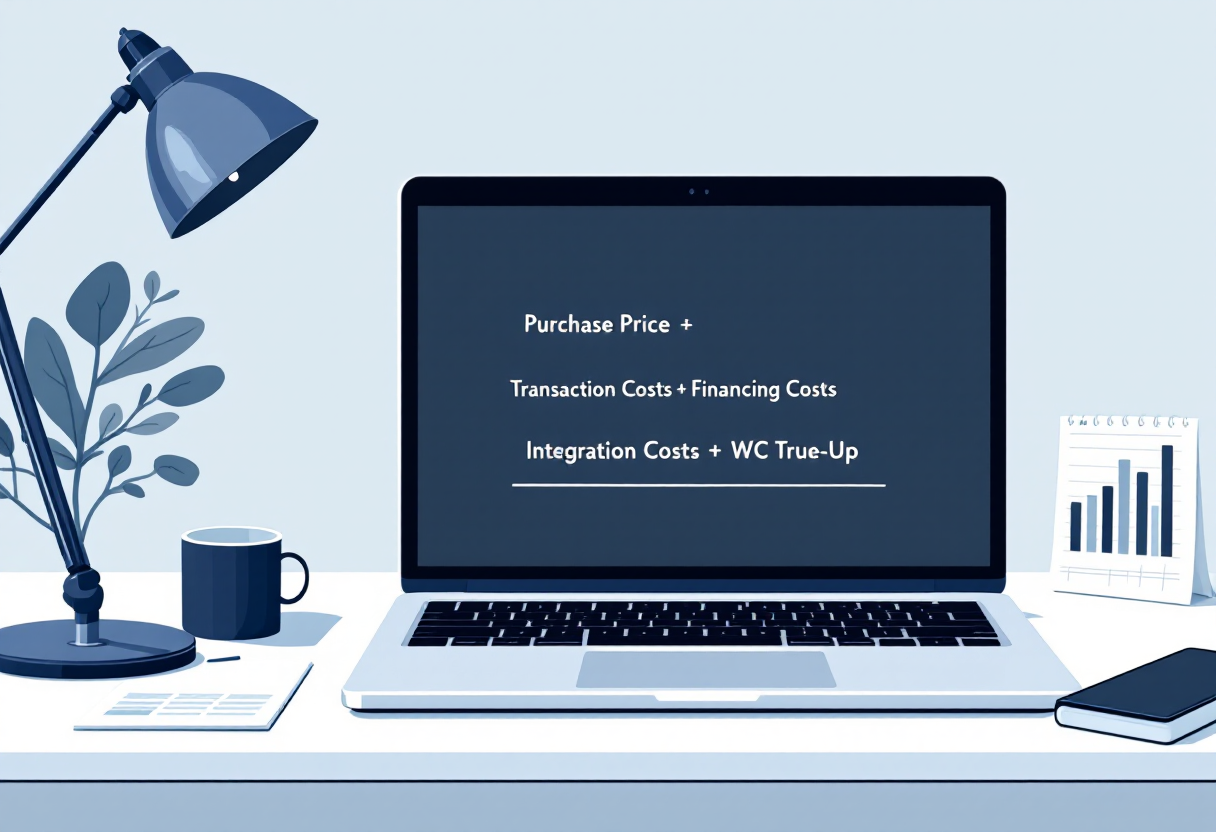
A cost of acquisition calculator helps a buyer or seller estimate the true all-in cost of a business acquisition, which goes far beyond the headline purchase price. The cost of acquisition formula is: Total Acquisition Cost = Purchase Price + Transaction Costs + Financing Costs + Integration Costs + Working Capital True-Up. This guide walks through each line of the calculator, shows worked examples for SBA 7(a) and private equity deals, and explains how to build your own cost of acquisition calculator in a spreadsheet.
Most first-time buyers anchor on the purchase price in the letter of intent and assume that number is the check they will write at closing. It is not. Across the deals CT Acquisitions has closed in the lower middle market, the true acquisition cost runs 12 to 28 percent above the headline enterprise value once every line in the calculator is filled in. A $5,000,000 business does not cost $5,000,000 to buy. It costs $5,600,000 to $6,400,000 once advisors, lenders, integration, and working capital are paid out. The cost of acquisition calculator is the tool that surfaces that gap before it becomes a cash crisis.
What a Cost of Acquisition Calculator Calculates
A cost of acquisition calculator is a structured worksheet, usually built in Excel or Google Sheets, that totals every dollar a buyer will spend to take ownership of a target company. The output is the true acquisition cost, sometimes called the all-in cost or fully loaded purchase price. This figure drives three downstream decisions: how much equity the buyer must inject at closing, how much debt the senior lender will underwrite, and what return-on-investment the deal can realistically produce.
The calculator is not the same as a valuation model. A valuation answers the question “what is this business worth.” A cost of acquisition calculator answers “what will it cost me to own it.” A target company can be worth $5,000,000 in a discounted cash flow analysis, trade at a $4,750,000 purchase price after negotiation, and still consume $6,100,000 of buyer capital by the time the wire clears and the first integration invoice is paid. The valuation tells you the price. The calculator tells you the cost.
Buyers use the calculator in three places. First, before signing the letter of intent, to confirm the deal fits within available capital. Second, during diligence, as new costs surface (a missing controller, an aging ERP, a deferred capex item) and get added to the model. Third, at closing, as a final reconciliation against the sources-and-uses statement the lender produces. Sellers use it less often, but smart sellers run the buyer’s calculator from the buyer’s seat, because a deal that strains the buyer’s capital stack is a deal that dies during financing.
The Cost of Acquisition Formula: Five Components
The cost of acquisition formula breaks the all-in cost into five components, each of which has its own subcomponents and benchmarks. Here is the master formula every cost of acquisition calculator should produce:
Total Acquisition Cost = Purchase Price + Transaction Costs + Financing Costs + Integration Costs +/- Working Capital True-Up
Working capital carries a plus-or-minus sign because the true-up can move in either direction. If the seller delivers less working capital than the agreed peg, the buyer pays the difference at closing (cost goes up). If the seller delivers more, the buyer pays the excess back to the seller (cost also goes up, but the buyer receives a higher-quality balance sheet). If the seller delivers exactly the peg, the line is zero.
The five components, in the order they typically appear on a calculator:
- Purchase Price: the headline number in the LOI and purchase agreement, adjusted for variants like cash-free debt-free, stock vs. asset structure, earnouts, and seller notes.
- Transaction Costs: advisor fees, legal fees, quality of earnings, environmental, insurance, and other one-time deal expenses paid by the buyer.
- Financing Costs: loan origination, packaging, guaranty fees, original issue discount, and capitalized interest that the buyer funds at closing to secure debt.
- Integration Costs: post-merger integration expenses booked in the first 12 to 24 months, including IT systems, severance, rebranding, and consolidation.
- Working Capital True-Up: the closing-date adjustment between the working capital peg negotiated in the LOI and the actual working capital delivered.
The next five sections unpack each component with the benchmarks and gotchas that show up most often in lower-middle-market deals.
Component 1: Purchase Price (And the Variants)
The purchase price line looks simple. It is not. The same business can have four different purchase prices depending on how the deal is structured.
Enterprise value is the value of the operating business, independent of how it is capitalized. This is the number most LOIs lead with, calculated as a multiple of EBITDA. Equity value is what the seller actually receives at closing, equal to enterprise value plus cash on hand minus interest-bearing debt assumed by the buyer. Cash-free debt-free price is the most common structure in the lower middle market and means the seller keeps the cash, the seller pays off the debt at closing, and the buyer receives the operating assets free and clear. Asset purchase price versus stock purchase price can differ by 5 to 15 percent because asset deals give the buyer a stepped-up basis (a tax benefit worth real dollars) while stock deals are simpler but carry historical liabilities.
Other purchase price variants the calculator needs to handle:
- Earnouts: contingent payments tied to post-close performance. The calculator should show the maximum earnout as a line item even if achievement is uncertain, because the buyer may need to reserve capital.
- Seller notes: a portion of the price the seller agrees to receive over time, usually 10 to 25 percent at 6 to 9 percent interest. This reduces cash at closing but adds to the all-in cost through interest.
- Rollover equity: in PE-sponsored deals, the seller often rolls 10 to 30 percent of proceeds into the newco. This reduces cash needed at closing.
- Assumed liabilities: accrued PTO, deferred revenue, customer deposits, and litigation reserves the buyer takes on.
For a more detailed view of how purchase price is built from EBITDA, see our guide on how investment bankers value a business. For the relationship between purchase price and the cash that actually changes hands, our explainer on what is net debt walks through the cash-free debt-free mechanic line by line.
Component 2: Transaction Costs (Legal, Diligence, Advisory)
Transaction costs are the fees a buyer pays to professionals who get the deal to closing. In the lower middle market (deals from $5,000,000 to $50,000,000 of enterprise value), transaction costs typically run 3 to 7 percent of purchase price. On larger deals the percentage compresses because fixed fees spread across a bigger base. On smaller deals (under $2,000,000), the percentage can spike to 8 to 12 percent because the same diligence work has to happen regardless of deal size.
The standard line items and 2026 benchmarks:
| Line Item | LMM Benchmark | Notes |
|---|---|---|
| M&A advisor / business broker fee (buy-side) | Modified Lehman, typically 1.0 to 3.0 percent of price | Buy-side fees are lower than sell-side; many buyers retain a sourcing advisor on retainer plus success fee |
| Legal fees (buyer counsel) | $50,000 to $300,000 | Asset deals on the low end, complex stock deals with reps and warranties on the high end |
| Quality of earnings (QofE) | $25,000 to $100,000 | Buy-side QofE from a regional CPA firm; bigger firms (Big 4, RSM, BDO) charge $75,000 to $200,000 |
| Environmental Phase I | $5,000 to $15,000 per site | Required by most senior lenders for any deal touching real estate; Phase II testing if Phase I flags concerns runs $15,000 to $75,000 |
| Representations & warranties (R&W) insurance | 2.0 to 4.0 percent of policy limit | Policy limit is typically 10 percent of enterprise value; minimum policies start at $5,000,000 of coverage |
| Tax due diligence and structuring | $15,000 to $60,000 | Separate from QofE; covers entity structure, NOLs, state apportionment, transfer tax |
| IT and cybersecurity diligence | $10,000 to $50,000 | Increasingly standard; some deals add a 30-day penetration test |
| Industry-specific diligence | varies | Insurance specialist for an agency deal, regulatory counsel for healthcare, etc. |
| Title insurance and recording fees | 0.3 to 0.7 percent of any real estate value | Only applies if real estate is in the deal |
The Modified Lehman formula referenced above is the industry-standard scale for advisor success fees: 5 percent on the first million, 4 percent on the second, 3 percent on the third, 2 percent on the fourth, and 1 percent on everything above $4,000,000. On a $5,000,000 deal that works out to $150,000 in advisor fees on the sell side. Buy-side fees usually run lower because the buyer’s advisor adds less value at the negotiation table than the seller’s. Some buy-side fees are flat retainers ($25,000 to $75,000) plus a smaller success fee.
R&W insurance has become standard on deals above $10,000,000 of enterprise value because it shifts post-close indemnity risk from the seller to a carrier. The premium runs 2 to 4 percent of the policy limit, and the policy limit is typically set at 10 percent of enterprise value. So a $20,000,000 deal carries a $2,000,000 policy at 3 percent, or $60,000 in premium plus a 10 to 15 percent retention. Underwriting fees of $25,000 to $50,000 also apply.
For a complete view of what gets reviewed during the diligence phase that generates these fees, see our due diligence checklist.
Component 3: Financing Costs (Origination, Interest, Fees)
Financing costs are the fees the buyer pays to secure debt capital. Whether the deal is funded by an SBA 7(a) loan, a conventional bank loan, a private equity sponsor’s credit facility, or a unitranche from a private credit fund, every debt source carries upfront fees that the calculator must capture.
SBA 7(a) financing costs (2026 schedule):
- Guaranty fee: 2.75 percent of the guaranteed portion for loans between $150,000 and $700,000; 3.5 percent for loans above $700,000 up to $1,000,000; 3.75 percent for loans above $1,000,000 (capped at the $5,000,000 program ceiling).
- Annual servicing fee: 0.55 percent of the outstanding guaranteed balance, paid by the borrower over the life of the loan.
- Packaging fees: 1.0 to 2.0 percent of loan amount, paid to the loan packager (some lenders waive this; some third-party packagers charge a flat $7,500 to $25,000).
- Prepayment penalty: for loans with terms longer than 15 years, the SBA enforces a 3-2-1 schedule (3 percent in year one, 2 percent in year two, 1 percent in year three) on prepayments exceeding 25 percent of the original loan.
- Closing costs: title, recording, lender legal review (typically $5,000 to $15,000), and any required appraisals.
On a $4,000,000 SBA 7(a) loan for a business acquisition, the buyer should expect roughly $150,000 in upfront financing costs (3.75 percent guaranty fee on the guaranteed portion of $3,000,000 = $112,500, plus packaging $40,000, plus closing $15,000 to $30,000). The annual servicing fee of 0.55 percent shows up in operating expenses, not on the closing statement, but should still be modeled.
Private equity and sponsored deal financing costs (2026 market):
- Arrangement fees: 1.0 to 3.0 percent of total debt, paid to the lead arranger at closing.
- Original issue discount (OID): 1.0 to 2.0 percent on second-lien and subordinated debt, effectively pricing the loan below par.
- Senior debt pricing: SOFR plus 450 to 650 basis points for senior secured term loans in the lower middle market, with SOFR floors of 100 to 150 bps and quarterly amortization on the term loan A piece.
- Subordinated and mezzanine debt: SOFR plus 800 to 1,200 basis points, or fixed-rate notes at 12 to 15 percent, often with PIK toggles and warrant coverage of 1 to 5 percent.
- Commitment and unused line fees: 0.50 percent on undrawn revolver capacity.
- Lender legal and admin fees: $75,000 to $250,000, paid by the borrower, even if you do not see the invoice.
One often-missed financing cost is capitalized interest during a construction-in-process or earn-up period. If a deal has a delayed-draw term loan or an acquisition facility that funds add-ons over 18 months, interest accrues during the draw period and is typically capitalized into the loan balance, increasing the all-in financing cost by 1 to 3 percent of the facility.
Component 4: Integration Costs (PMI, Systems, Severance)
Integration costs are the post-merger integration (PMI) expenses a buyer incurs in the first 12 to 24 months after closing to combine the acquired business into the buyer’s platform (in an add-on context) or to stand it up as a new operating unit (in a platform-acquisition context). These costs are real cash out the door, even though they happen after closing, and a serious cost of acquisition calculator captures them as a discounted present value at the closing date.
Industry research from McKinsey and BCG on lower-middle-market integrations consistently puts integration cost at 5 to 15 percent of enterprise value, with the high end on cross-border, regulated, or technology-intensive deals. For a $10,000,000 LMM acquisition, that is $500,000 to $1,500,000 of integration cost, separate from the purchase price.
The main integration line items:
- IT and ERP integration: $50,000 to $2,000,000 in the LMM. Migrating to the buyer’s accounting system, CRM, payroll, and email runs $50,000 to $250,000 for a simple QuickBooks-to-NetSuite move; full ERP cutover (Microsoft Dynamics, SAP B1, Oracle NetSuite) can hit $1,000,000 to $2,000,000 once licensing, configuration, data migration, and training are added.
- Workforce severance: typically 1 week of pay per year of service, plus health benefit continuation under COBRA for any redundant positions. On a 50-person workforce with 10 redundancies averaging 8 years of tenure and $75,000 of comp, that is 10 x 8/52 x $75,000 = $115,000 of severance, plus COBRA.
- Retention bonuses: 10 to 30 percent of base salary for key employees, paid at 12 or 18 months post-close. Typical pool size is 1 to 3 percent of enterprise value.
- Brand refresh and rebranding: $25,000 to $250,000 depending on whether the target keeps its name (cheaper) or gets folded into the buyer’s brand (more expensive). Includes signage, vehicle wraps, website, business cards, uniforms, and marketing collateral.
- Real estate consolidation: lease buyouts, broker fees on new space, build-out costs, and moving expenses. Highly variable; one-office consolidations run $50,000 to $200,000, multi-site consolidations can hit $1,000,000.
- Integration management office (IMO): dedicated PMI consultants or an internal team. External consultants run $200 to $500 per hour; a typical LMM PMI engagement is $100,000 to $500,000.
- Insurance binder and bonding: $10,000 to $50,000 to re-bind the target’s GL, workers comp, professional liability, and surety bonds under the buyer’s program.
- Customer and supplier transition: change-of-control notices, contract reassignments, and any concessions given to retain key customers or suppliers through the transition.
Sophisticated buyers build integration cost into the model at the LOI stage, not after closing, because the all-in cost determines what the buyer can afford to pay for the equity. Skipping integration in the calculator is the single most common reason a deal looks accretive on paper and dilutive in year one.
Component 5: Working Capital True-Up
The working capital true-up is the closing-date adjustment between the working capital peg negotiated in the LOI and the actual working capital delivered at closing. It is the line item that surprises buyers most often because it can move six or seven figures in either direction.
Here is how it works. The LOI typically says the deal is priced cash-free, debt-free, with a “normalized level of working capital” delivered at closing. During diligence, the buyer and seller agree on a target working capital peg, usually calculated as the trailing 12-month average of working capital (current assets minus current liabilities, excluding cash and interest-bearing debt). That peg is fixed in the purchase agreement.
At closing, the parties calculate actual working capital as of the closing date. If actual exceeds the peg, the buyer pays the difference to the seller (the seller delivered “extra” working capital, which has value). If actual falls short of the peg, the seller pays the difference to the buyer (the seller is delivering a thinner balance sheet than agreed). The post-closing true-up usually finalizes 60 to 120 days after closing once the closing balance sheet is audited.
Why this matters for the cost of acquisition calculator: the true-up can swing the all-in cost by 1 to 5 percent of enterprise value. A seller who runs down inventory or stretches payables in the weeks before closing can deliver $400,000 less working capital than the peg on a $5,000,000 deal, which becomes a $400,000 reduction in cash the buyer pays. Conversely, a buyer who underestimates seasonal working capital needs may take on a closing balance sheet that requires another $200,000 to $500,000 of revolver draws within 30 days, which is functionally another cost of acquisition even though it is not a true-up payment.
The calculator should carry two working capital lines: the formal true-up (peg minus actual, with sign convention) and a “post-close working capital reserve” of 30 to 90 days of operating expenses to cover the gap between closing and the first cash collection cycle.
Worked Example: $3M EBITDA Manufacturing Buy via SBA 7(a)
Target: precision machining business, $3,000,000 of seller’s discretionary earnings (SDE), located in Ohio, real estate included (small 15,000 sq ft shop). LOI price: $7,500,000 (2.5x SDE for the business plus $750,000 for the building at appraised value). Structure: asset deal, SBA 7(a) financing, buyer puts in 10 percent equity, seller carries 10 percent on a 5-year note at 7 percent.
| Line | Amount | Notes |
|---|---|---|
| Purchase price (business + real estate) | $7,500,000 | $6,750,000 business + $750,000 real estate |
| M&A buy-side advisor (1.5%) | $112,500 | Buy-side success fee |
| Buyer legal (asset deal) | $85,000 | Lower end for clean asset purchase |
| Quality of earnings | $40,000 | Regional CPA firm |
| Environmental Phase I (manufacturing site) | $8,500 | Required by SBA lender |
| Tax structuring | $20,000 | Asset allocation, 338(h)(10) review |
| Title insurance & recording (real estate) | $5,250 | 0.7% of $750,000 |
| Equipment appraisal | $12,000 | SBA requirement on >$250K equipment |
| Transaction costs subtotal | $283,250 | 3.8% of price |
| SBA guaranty fee (3.75% on $4,500,000 guaranteed) | $168,750 | $6,000,000 loan x 75% guaranty |
| SBA packaging fee (1.5%) | $90,000 | Third-party packager |
| Lender legal & closing | $15,000 | SBA-specific closing costs |
| Financing costs subtotal | $273,750 | 4.6% of debt |
| IT migration (QuickBooks to NetSuite) | $95,000 | Single-site, mid-size |
| Severance (2 redundant office roles) | $28,000 | 1 week per year of service |
| Brand refresh (keep name, refresh signage) | $35,000 | Light touch |
| Insurance re-bind | $15,000 | GL, workers comp, property |
| Integration consultant (3-month engagement) | $75,000 | External IMO |
| Integration costs subtotal | $248,000 | 3.3% of price |
| Working capital true-up (actual below peg) | $45,000 | Slight shortfall paid by seller to buyer (reduces cost) |
| Working capital reserve (60 days OpEx) | $280,000 | Buyer-funded cushion |
| Working capital subtotal | $235,000 | $280,000 reserve minus $45,000 received |
| TOTAL ACQUISITION COST | $8,540,000 | 13.9% above $7,500,000 headline |
Buyer’s actual capital injection at closing: $750,000 equity (10 percent of price) + $283,250 transaction costs + $273,750 financing costs + $280,000 working capital reserve = $1,587,000 of cash out the door at closing, with another $248,000 of integration cost rolling out over the following 12 months. The headline 10-percent-down SBA deal actually required 21 percent of the purchase price in buyer cash by month 12.
Worked Example: $10M EBITDA Services Buy via PE Sponsor
Target: commercial HVAC service business, $10,000,000 of adjusted EBITDA, 6.0x multiple. Enterprise value $60,000,000. Structure: stock deal with 338(h)(10) election, PE sponsor capital structure with 50 percent senior debt, 15 percent sub-debt, 35 percent sponsor equity (of which 5 percent is seller rollover).
| Line | Amount | Notes |
|---|---|---|
| Enterprise value | $60,000,000 | 6.0x adjusted EBITDA |
| Sell-side advisor (Modified Lehman) | $1,140,000 | Paid by seller from proceeds (not buyer cost, shown for reference) |
| Buy-side advisor (sponsor’s IB) | $600,000 | 1% of EV |
| Buyer legal (stock deal, R&W) | $425,000 | Complex transaction |
| Quality of earnings (Big 4) | $185,000 | Bigger firm for sponsor deal |
| Commercial & market diligence | $165,000 | Sponsor-mandated |
| Tax structuring & 338(h)(10) modeling | $95,000 | Asset election analysis |
| R&W insurance (3% on $6M policy) | $180,000 | 10% of EV policy limit |
| R&W underwriting fees | $40,000 | Carrier admin |
| IT and cybersecurity diligence | $45,000 | Including penetration test |
| Environmental (multi-site) | $32,000 | 4 service yards |
| Transaction costs subtotal | $1,767,000 | 2.9% of EV |
| Senior debt arrangement fee (2% on $30M) | $600,000 | SOFR + 550 bps |
| Sub-debt arrangement fee (2.5% on $9M) | $225,000 | SOFR + 950 bps |
| Original issue discount on sub-debt (1.5%) | $135,000 | Below par pricing |
| Lender legal (senior + sub) | $185,000 | Two facilities |
| Revolver commitment fee (0.5% on $5M) | $25,000 | Undrawn capacity |
| Financing costs subtotal | $1,170,000 | 3.0% of debt |
| ERP rollout (NetSuite multi-entity) | $650,000 | 4-site cutover |
| Severance (corporate overlap) | $280,000 | CFO, controller, HR consolidation |
| Retention bonuses (2% of EV pool) | $1,200,000 | Paid 18 months post-close |
| Rebrand under sponsor platform name | $185,000 | Full brand fold-in |
| IMO consulting (12-month) | $425,000 | External PMI lead |
| Insurance re-bind (multi-line) | $45,000 | GL, WC, professional, cyber |
| Real estate lease consolidation | $220,000 | 2 yard consolidations |
| Integration costs subtotal | $3,005,000 | 5.0% of EV |
| Working capital true-up (seller delivered $300K extra) | $300,000 | Buyer pays seller extra (cost up) |
| Post-close working capital reserve | $1,500,000 | 90 days for HVAC seasonal cycle |
| Working capital subtotal | $1,800,000 | True-up + reserve |
| TOTAL ACQUISITION COST | $67,742,000 | 12.9% above $60M headline |
Sponsor cash required at closing: $21,000,000 equity (35 percent of EV) minus $3,000,000 seller rollover = $18,000,000 of new sponsor capital, plus $1,767,000 transaction costs plus $1,170,000 financing costs plus $1,800,000 working capital = $22,737,000. Integration costs of $3,005,000 are funded from the operating company’s cash flow or a revolver draw over 12 to 24 months. The cost of acquisition calculator turned a “$60 million deal” into a $22.7 million day-one capital call plus a $3 million integration overhang.
How to Build Your Own Cost of Acquisition Calculator in Excel
You can build a functional cost of acquisition calculator in Excel or Google Sheets in about 30 minutes. The model has five sections (one per component) plus a summary tab. Here is the recommended structure.
Sheet 1: Inputs. One column of named cells the user fills in: enterprise value, EBITDA, multiple, deal structure (asset/stock), real estate value, financing source (SBA/conventional/PE), senior debt amount, sub-debt amount, equity amount, seller note amount, seller rollover amount, working capital peg, expected closing date.
Sheet 2: Transaction Costs. Use a two-column structure (line item, amount) with each amount driven by a formula that scales with deal size. For example, the buy-side advisor line: =IF(EV<5000000, 50000, EV*0.015) caps small deals at a flat fee and scales larger deals at 1.5 percent. Use SUMIF or a simple SUM at the bottom of each section.
Sheet 3: Financing Costs. Use an IF chain on the financing source input to apply the right schedule. For SBA: =IF(LoanAmount<=700000, LoanAmount*0.0275, IF(LoanAmount<=1000000, LoanAmount*0.035, GuaranteedPortion*0.0375)) for the guaranty fee, where GuaranteedPortion = MIN(LoanAmount*0.75, 3750000). For PE: arrangement fee = SeniorDebt*0.02 + SubDebt*0.025, OID = SubDebt*0.015.
Sheet 4: Integration Costs. Drive these from a “deal complexity” input (simple/moderate/complex) using a lookup table. For example, ERP integration: VLOOKUP(Complexity, ComplexityTable, ERPColumn, FALSE) where the table holds $75K / $400K / $1.2M. Severance: =Headcount*RedundancyRate*AvgComp*(AvgTenure/52).
Sheet 5: Working Capital. Two lines: true-up = ActualWC - PegWC (positive means buyer pays seller, negative means seller pays buyer), and reserve = AnnualOpEx/365*ReserveDays where ReserveDays defaults to 60.
Sheet 6: Summary. Pull each subtotal from sheets 2 through 5, plus purchase price from inputs. Show three numbers: headline price, all-in cost, percentage premium. Add a chart that breaks the all-in cost into the five components so the user can see at a glance which component is driving the total.
One optional refinement: a sensitivity table that flexes the multiple paid (5.0x to 7.0x) against the assumed integration complexity, showing the all-in cost in each cell. This is the view that helps a buyer decide whether to walk from a deal where the seller will not negotiate price.
Total Cost of Acquisition: The Definition and How to Calculate It
The total cost of acquisition is the sum of every dollar a buyer commits to complete and absorb a deal, not the headline purchase price alone. To calculate cost of acquisition, add purchase price, transaction costs, financing costs, integration costs, and the working capital true-up.
People search “cost of acquisition” and “total cost of acquisition” looking for one plain number: what a business truly costs once the deal closes and the new owner runs it. The acquisition price on a term sheet answers only the first component. A cost of acquisition calculator answers the rest, because the money spent on lawyers, lenders, systems, and a working capital shortfall never appears on the purchase agreement’s front page yet lands squarely on the buyer.
The calculation itself is short. Start with the purchase price, the figure most people mean when they say acquisition price. Add transaction costs for legal, diligence, and advisory work. Add financing costs, meaning origination fees and interest on any debt used to fund the buy. Add integration costs to combine systems, retain staff, and cover severance. Then apply the working capital true-up, which carries a plus or minus sign because the settlement can move in either direction depending on the balance sheet at close.
Owning this term matters because the gap between acquisition price and total cost of acquisition is where deals quietly break. A buyer who models only the headline figure will structure financing and a first-year budget against a number that understates the real commitment. If you are pricing your own exit rather than buying, our sell your business team maps the same components from the seller side so the net proceeds match expectations.
When the True Acquisition Cost Exceeds the Headline Price by 15-30%
Across the deals CT Acquisitions sees in the lower middle market, the all-in cost runs 12 to 28 percent above the headline enterprise value. The distribution is not random. Deals that drift to the high end share four characteristics:
- Multi-site or multi-state operations. Each location adds environmental, real estate, insurance, and integration cost. A single-site shop might add 3 to 5 percent of EV in integration; a 6-site service business can add 10 to 15 percent.
- Tech debt at the target. A target still on QuickBooks Desktop, paper timesheets, or a custom Access database will require $250,000 to $1,500,000 of IT integration that a target already on a modern SaaS stack will not.
- Regulated industries. Healthcare, financial services, government contracting, and any FDA/EPA/DOT-regulated business carries 1 to 3 percent of additional regulatory diligence and licensing transition cost.
- Cross-border or sponsor-led deals. Any deal involving a private equity sponsor will carry sponsor-mandated diligence (commercial, IT, ESG) plus R&W insurance, adding 1.5 to 3 percent of EV in transaction costs that an independent buyer would skip.
The buyers who get caught are almost always first-time or second-time buyers who built their cost of acquisition calculator with the purchase price line and the SBA fee line, and nothing else. They go into closing assuming a 10-percent-down deal needs 10 percent cash; they discover at closing it needs 18 to 22 percent cash; and they either pull equity from a personal line of credit at unfavorable terms or scramble to renegotiate a seller note with two weeks to go. Neither outcome is good for the deal. For context on what an acquisition actually entails beyond the financial mechanics, see our primer on the business acquisition meaning.
How CT Acquisitions Helps Buyers Stress-Test the Calculator
CT Acquisitions advises buyers and sellers in the lower middle market on M&A transactions ranging from $2,000,000 to $100,000,000 of enterprise value. We do not build cost of acquisition calculators for clients (every buyer should own this model), but we do stress-test the calculators buyers bring to the table.
The stress-test process has three steps. First, we benchmark the buyer’s transaction cost assumptions against the actual fees paid by our last 25 closed deals in the same industry and size band. Buyers consistently underestimate legal by 30 to 50 percent and overestimate advisor fees by 10 to 20 percent. Second, we model the financing cost line under three lender scenarios (the buyer’s preferred lender, a backup, and a more expensive last-resort option) because financing falls through in roughly 1 of every 7 LMM deals and the calculator needs to survive the backup. Third, we run the integration cost line against industry-specific benchmarks. A buyer expecting $250,000 of integration on a 4-site HVAC business is going to be wrong; the realistic number is $800,000 to $1,400,000.
The output of the stress-test is a revised all-in cost number and a recommended equity cushion (typically 10 to 15 percent above the calculator’s required equity) to absorb surprises during diligence and closing. Buyers who go into LOI with a stress-tested calculator close 30 to 40 percent more often than buyers who walk in with the purchase-price-only view. For sellers, we run the buyer’s calculator from the seller side to confirm the deal will actually fund. If it will not, we know that before reps and warranties are negotiated, not after. For a deeper look at how valuation work feeds the calculator, see our business valuation services cost guide.
Cost of Acquisition Calculator: Frequently Asked Questions
What is the total cost of acquisition?
The total cost of acquisition is the full amount a buyer spends to complete and absorb a business purchase. It equals the purchase price plus transaction costs, financing costs, integration costs, and the working capital true-up. The headline acquisition price is only the first of those five components, which is why the true figure typically runs above the number on the term sheet.
What is the difference between cost of acquisition and customer acquisition cost?
Cost of acquisition in M&A refers to the total cost of buying a business, including purchase price, transaction costs, financing, integration, and working capital. Customer acquisition cost (CAC) is a marketing metric measuring how much a company spends to acquire one new customer (marketing spend divided by new customers acquired). The two share a name but are unrelated. A cost of acquisition calculator in the M&A context produces a dollar figure for buying a company. A CAC calculator produces a dollar figure for acquiring one customer.
The sourcing methodology behind this discussion is covered in buy-side sourcing methodology.
Should the cost of acquisition calculator include opportunity cost?
No, the calculator should produce a cash-out-the-door number, not a return analysis. Opportunity cost (what the buyer’s equity could have earned elsewhere) belongs in the return-on-investment model, where it is captured by the hurdle rate or required IRR. Mixing the two confuses the question of “what does this deal cost” with “is this deal worth it.” Keep the calculator focused on actual cash flows; build a separate IRR or DCF model to evaluate whether those cash flows produce an acceptable return.
How accurate are the transaction cost benchmarks in a calculator built before diligence?
A well-built calculator at the LOI stage will be within 10 percent of the actual all-in cost about 70 percent of the time, within 20 percent about 90 percent of the time, and off by more than 20 percent in the remaining 10 percent (almost always because a surprise emerges in diligence: environmental issues, customer concentration, deferred capex, or pension liabilities). The way to improve accuracy is to add a 5 to 10 percent contingency line at the bottom of the calculator and treat anything inside that contingency as a normal outcome, not a surprise.
Does the calculator change for an asset deal versus a stock deal?
Yes, in three meaningful ways. First, asset deals usually have lower legal costs ($50K to $150K) than stock deals with R&W insurance ($200K to $500K plus the policy premium). Second, asset deals trigger transfer taxes in some states (real estate transfer, bulk sales, sales tax on tangible assets) that stock deals avoid. Third, asset deals provide a stepped-up tax basis worth real money (typically 5 to 12 percent of purchase price in present value), which most calculators show as a “tax benefit” line that reduces the all-in cost. Stock deals with a 338(h)(10) election get the same benefit but require a joint election and may cost the seller in incremental tax.
Who pays the working capital true-up on the closing statement?
Both sides can pay, depending on which way the actual closing-date working capital lands relative to the peg. If actual exceeds the peg, the buyer pays the seller the difference (the seller delivered a richer balance sheet, so they get paid for it). If actual falls below the peg, the seller pays the buyer the difference (the seller delivered a thinner balance sheet, so they refund the gap). The final true-up payment typically settles 60 to 120 days after closing, once the post-closing audited balance sheet is finalized and any disputes resolved through the procedure spelled out in the purchase agreement (usually a neutral accountant if the parties cannot agree).