M&A Firms: How to Choose the Right M&A Advisory Firm for Your Sale in 2026
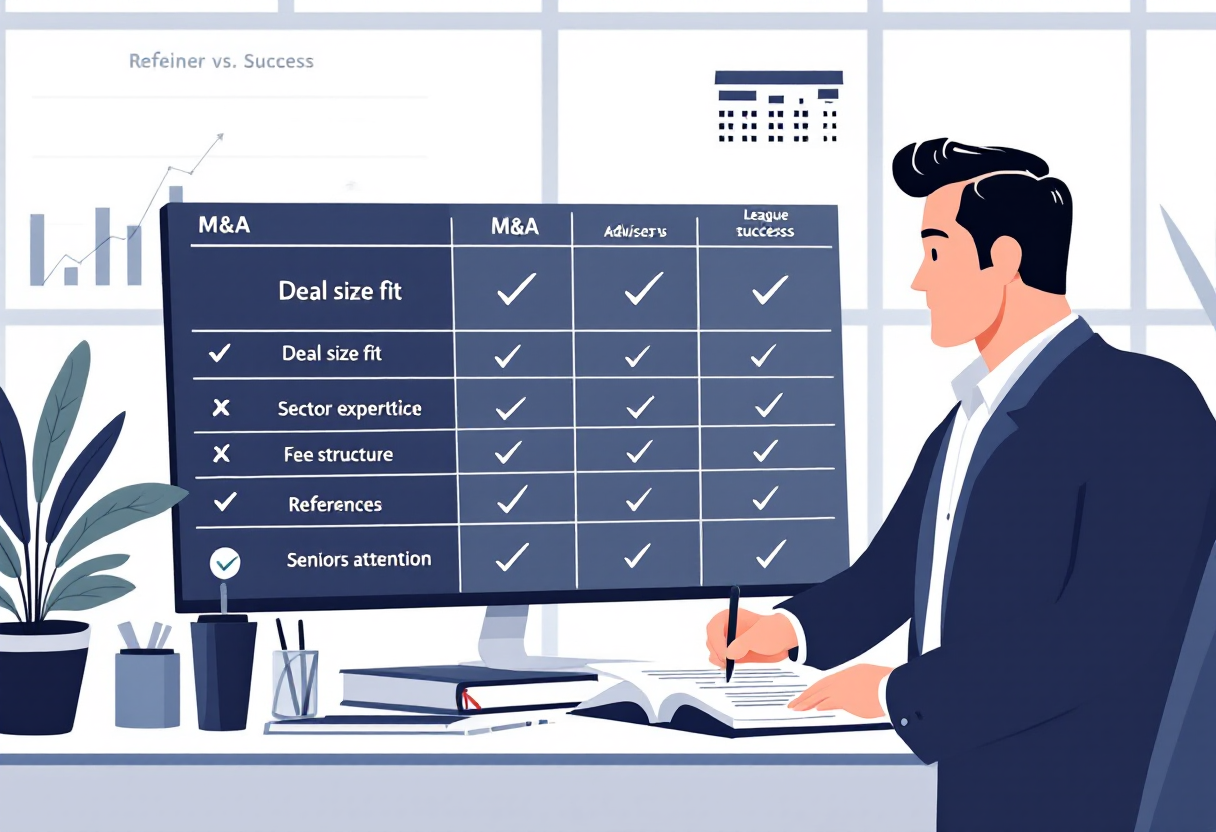
Choosing the right advisory firm among M&A firms for your sale in 2026 comes down to five criteria that separate real deal-makers from generalists: closed transactions in your sub-sector within the past 24 months, direct partner-level relationships with the buyer pool you actually want, mandate scope matching your process needs (retained sell-side vs project vs contingent), fee structure alignment without upfront-heavy incentive misalignment, and references from sellers similar to your profile. Engagement letter terms to negotiate: retainer refundability, tail definition, termination clauses, buyer-introduction disclosure.
M&A advisory firms run sell-side and buy-side processes for business owners who need more than a listing service. The right M&A advisory firm matches your deal size, industry, and exit timeline, runs a competitive process, and earns its fee by lifting the closing price far above what a single buyer would offer. This guide walks through what M&A advisory firms actually do, how to compare them, and how to choose the right one for your specific sale.
Related: New York M&A advisor services. Our New York page covers who is buying, how a confidential process works, and what to prepare.
What M&A Advisory Firms Do
An M&A advisory firm is an investment bank or boutique that runs the sale or purchase of a company for its client. It values the business, prepares the marketing materials, finds and qualifies buyers, runs a competitive process, and negotiates price and terms through closing. Most of its pay comes as a success fee when the deal closes.

An M&A advisory firm sits between a business owner and the market of capital. The firm packages the company for buyers, identifies and approaches strategic and financial acquirers, runs a structured bidding process, negotiates the letter of intent, manages due diligence, and shepherds the deal to a signed purchase agreement and wire transfer at closing.
Most owners assume the value of an M&A advisor is finding a buyer. That is the easy part. The real value is creating competitive tension. A single buyer with no competition will bid at the bottom of the range. Five qualified buyers in a managed process bid against each other, and the closing price often lands 20 to 40 percent above the first indication of interest. The Pepperdine Private Capital Markets Report consistently shows that businesses sold through a structured process trade at higher multiples than those sold in one-off negotiations.
The work an M&A advisory firm does in a typical sell-side engagement breaks into six phases. First, financial preparation and recasting, where the firm normalizes EBITDA, identifies addbacks, and builds a quality-of-earnings-ready model. Second, marketing materials, which includes the teaser, the confidential information memorandum or CIM, and the management presentation. Third, buyer identification and outreach, where the firm builds a list of 50 to 300 targets and reaches out under NDA. Fourth, indication of interest collection and management meetings. Fifth, letter of intent negotiation and exclusivity. Sixth, due diligence, definitive agreement, and closing.
The firm also handles the parts of the deal owners do not see. Pushing back on buyer working capital pegs. Defending earnouts that try to claw back purchase price. Negotiating reps and warranties and the survival period. Coordinating with the seller’s CPA, attorney, and wealth advisor. Managing the emotional rollercoaster of a process that can take six to twelve months from kickoff to wire.
The Five Categories of M&A Advisory Firms
Not all M&A advisors compete for the same deals. The market splits into five distinct tiers, and each tier has a deal size sweet spot, a fee posture, and a typical client profile. Understanding which tier matches your business prevents you from hiring a firm that will treat you as a B-list client or, worse, a firm that lacks the buyer relationships to run a real process.
Elite Boutiques
Centerview Partners, Evercore, Lazard, and Moelis & Company sit at the top of the independent advisory market. These firms compete with bulge bracket banks for deals above $500 million and frequently advise on transactions in the billions. Centerview alone advised on multiple multi-billion-dollar deals in 2024 and 2025. Their senior partners are former heads of M&A at Goldman, Morgan Stanley, and JPMorgan. They do not take engagements below roughly $250 million in enterprise value and are not the right call for a $20 million HVAC business.
Full-Service Boutiques
Houlihan Lokey, William Blair, Lincoln International, Harris Williams, Robert W. Baird, Piper Sandler, and Raymond James occupy the middle market. Houlihan Lokey has ranked first by deal count globally for several consecutive years, including 2024, with most of its engagements in the $50 million to $1 billion range. William Blair and Lincoln International run dozens of sell-side processes per quarter in the $25 million to $500 million band. These firms have sector teams, deep buyer rolodexes, and the operational infrastructure to run a process at scale.
Lower-Middle-Market Specialists
Capstone Partners, Generational Equity, Calder Capital, FOCUS Investment Banking, Cascadia Capital, and a long tail of regional firms serve owners selling businesses in the $5 million to $100 million enterprise value range. These firms understand the lower middle market in ways the big boutiques do not. They know which private equity platforms are actively building in your sector, which strategic buyers have an open mandate, and how to position a founder-owned business for institutional capital. CT Acquisitions sits in this tier.
Business Brokers
Sunbelt Business Brokers, Murphy Business, Transworld Business Advisors, and tens of thousands of solo brokers list businesses on platforms like BizBuySell and Axial. Brokers typically handle deals below $5 million in enterprise value, often Main Street businesses like laundromats, single-location restaurants, and small service companies. The model is listing-driven rather than process-driven. Brokers post the business publicly, wait for inbound inquiries, and qualify buyers as they show up. Useful for sub-$2 million deals where a structured process would cost more than it returns.
Bulge Bracket Investment Banks
Goldman Sachs, Morgan Stanley, JPMorgan, Bank of America, and Citi advise on the largest transactions in the market. Minimum deal sizes typically start around $1 billion in enterprise value for sell-side mandates, with most engagements well above that threshold. A founder selling a $40 million distribution business will never appear on a bulge bracket pitch sheet. The firms are structured to capture megadeals, IPOs, and strategic advisory for Fortune 500 boards. For the lower middle market, the bulge brackets are not in the conversation.
The Top M&A Advisory Firms by Deal Size (2026)
The best M&A firm for your sale is the strongest firm in your deal size band, not the biggest name. Each tier below is built from LSEG, PitchBook and Stout league data, compiled in our US investment banking M&A league table report. A firm working outside its band either declines the mandate or hands it to its most junior team.
| Deal size | Firms that lead this band | What the data shows |
|---|---|---|
| $5 billion and above | Goldman Sachs, Morgan Stanley, JPMorgan, Bank of America, Citi; independents Centerview, Evercore, Lazard, PJT Partners, Moelis | Goldman Sachs advised on 38 of the 68 announced deals above $10 billion in 2025 (LSEG). |
| $1 billion to $5 billion | Houlihan Lokey, Lazard, Evercore, Jefferies, William Blair, Lincoln International, Baird | Houlihan Lokey advised on 552 transactions in FY25, the most of any advisor by count (PitchBook). |
| $250 million to $1 billion | Houlihan Lokey, William Blair, Baird, Lincoln International, Harris Williams, Jefferies, Piper Sandler, Raymond James, Stifel | Won on sector depth: Baird in industrials, William Blair in healthcare, Harris Williams in technology. |
| $50 million to $250 million | Capstone Partners, Configure Partners, BDA Partners, DC Advisory, Founders Advisors, regional bank boutiques | Tracked in the Stout Annual Middle Market Investment Banking Report. |
| Under $50 million | Capstone Headwaters, Generational Equity, Murphy McCormack Capital Advisors, IAG M&A Advisors, about 400 boutiques | Fragmented. Roughly 400 boutiques compete here on the Axial deal network, so sector fit matters more than brand. |
For most founder-owned companies the realistic shortlist sits in the bottom three rows. Use the vetting questions further down this guide to compare two or three firms from your band on closed deals in your sector, not on league table rank.
M&A Advisory Firms vs Business Brokers vs Investment Banks
The terms get used loosely, and that confusion costs sellers money. Here is the practical distinction.
A business broker lists a business for sale. The broker takes a percentage of the sale price, usually 8 to 12 percent on Main Street deals. The broker rarely produces a real CIM, does not build a targeted buyer list, and does not negotiate complex deal terms. The broker connects a willing seller with a willing buyer and collects a commission. Good for sub-$2 million deals. Wrong for anything with institutional buyer interest.
An investment bank is a regulated entity, often a FINRA-registered broker-dealer, that advises on transactions, raises capital, and provides strategic counsel. Investment banks run structured processes, produce institutional-grade marketing materials, and negotiate complex terms. For more on the regulated side, see our guide on the investment banking process for selling a company.
An M&A advisory firm is the broader umbrella. Some M&A advisors are FINRA-registered investment banks. Others operate under M&A broker exemptions, which the SEC formalized in 2023 for transactions below certain thresholds. The label matters less than what the firm actually does. The question to ask is whether the firm runs a structured competitive process, has the buyer relationships to fill that process, and has closed deals in your size band and sector in the last 24 months. For a deeper breakdown of the structural differences, read our piece on boutique investment bank vs bulge bracket.
Sell-Side Advisory: The Process M&A Firms Actually Run
A sell-side engagement at a real M&A advisory firm follows a defined process. The variation between firms is in the quality of execution, not the steps themselves.

Phase one is preparation, which typically runs six to twelve weeks. The firm collects three to five years of financial statements, builds a normalized EBITDA bridge, identifies customer concentration risks, and drafts the CIM. A good CIM is 40 to 80 pages and reads like a private equity investment memo. It tells the story of the business, the market opportunity, the management team, the financial trajectory, and the rationale for sale. The teaser is a one or two page anonymous summary used for initial outreach.
Phase two is buyer outreach. The firm builds a buyer list, usually 100 to 300 names depending on the sector. Strategics, financial sponsors, family offices, search funds, and independent sponsors all get categorized. The firm sends the teaser, executes NDAs, and distributes the CIM to qualified parties. This phase runs four to eight weeks.
Phase three is indications of interest, or IOIs. Buyers submit non-binding indications stating their proposed valuation range, structure, sources of financing, and conditions to close. The M&A advisor reviews IOIs with the seller, selects the top five to ten, and invites them to management meetings.
Phase four is management meetings and the data room. Selected buyers meet the management team, tour the facility if relevant, and ask diligence questions. The firm hosts a virtual data room with financials, contracts, customer data, employee information, and operational documents. This phase runs three to six weeks.
Phase five is the letter of intent. Buyers submit LOIs with a binding price and key terms. The M&A advisor negotiates back and forth, often using competing LOIs to push the lead bidder up on price, structure, or both. For a deeper view of how this auction dynamic works, see our guide on how investment bankers run a sell-side auction. The seller signs an LOI with one buyer, typically with a 60 to 90 day exclusivity period.
Phase six is confirmatory diligence and definitive agreement. The buyer’s accountants run a quality of earnings. Legal counsel drafts the purchase agreement. The M&A advisor coordinates the workstreams, pushes back on diligence over-reach, and brings the deal to closing. Total elapsed time from kickoff to wire is typically six to twelve months.
Buy-Side Advisory: When You Hire an M&A Firm to Acquire
Buy-side advisory is the mirror image of sell-side. The M&A advisory firm represents the buyer rather than the seller. The buyer engages the firm to source acquisition targets, run financial analysis, structure offers, and negotiate purchase agreements.
Buy-side engagements are common for three buyer profiles. Private equity platforms building add-on acquisitions hire M&A advisors to source proprietary deal flow outside of auction processes. Strategic acquirers expanding into new geographies or product lines use buy-side advisors when their internal corporate development team lacks regional reach. Independent sponsors and family offices, which often lack institutional infrastructure, hire buy-side advisors to find and underwrite deals.
Fee structures on buy-side mandates differ from sell-side. Retainers are common and often higher, because the firm is investing real time in sourcing before any deal materializes. Success fees on buy-side are typically lower as a percentage than sell-side, because the work to find a target is front-loaded and the value-add at the negotiating table is smaller than running an auction. A 1 to 2 percent success fee on a closed buy-side transaction is normal.
The risk on buy-side is that the firm spends six months sourcing and the buyer walks away from every target. For that reason, most buy-side engagements include either a meaningful monthly retainer or a per-LOI fee structure that compensates the advisor regardless of close.
M&A Advisory Fee Structures: Retainer, Success Fee, Tail
Fee structures vary across the five tiers of advisory firms, but the components are consistent. Every engagement letter has some combination of retainer, success fee, expense reimbursement, and tail provisions.
Retainer
The retainer is the upfront and ongoing fee the seller pays the firm during the engagement. In the lower middle market, retainers run from $25,000 to $150,000 total, often paid as a kickoff fee plus monthly installments. The retainer compensates the firm for the work-product creation phase. Some firms credit the retainer against the success fee at close. Others treat it as non-refundable and not credited.
Retainer-free engagements exist but should be approached with caution. A firm with no retainer is taking 100 percent of the risk on the deal closing, and is incentivized to push the seller toward whatever buyer materializes fastest rather than the highest bidder. Some quality firms offer success-only structures on deals they consider highly sellable, but the absence of a retainer is a signal worth probing.
Success Fee Structures
The success fee is paid at closing as a percentage of the transaction value. Three structures dominate the lower middle market.
The Lehman Formula is the classic structure: 5 percent on the first million, 4 percent on the second, 3 percent on the third, 2 percent on the fourth, and 1 percent on everything above. The original Lehman is rarely used today because it produces small fees on larger deals, but it remains a reference point.
The Modified Lehman, also called Double Lehman, doubles each tier: 10 percent on the first million, 8 percent on the second, 6 percent on the third, 4 percent on the fourth, and 2 percent on everything above. This is the most common structure in the lower middle market for deals under $25 million.
Flat percentage success fees are used on larger deals. A 1.5 to 3 percent success fee on a $50 million transaction is typical. As deal size grows, the percentage compresses. A $500 million transaction might carry a 0.75 to 1.25 percent success fee.
Minimum success fees protect the firm on smaller-than-expected closings. A firm might engage on a deal pitched at $20 million with a minimum success fee of $400,000. If the deal closes at $12 million, the firm collects the minimum rather than the calculated percentage. Always read the minimum carefully. For a deeper financial walkthrough, see our guide on how investment bankers value a business.
Tail Period
The tail clause says that if the seller closes a deal with any party introduced by the advisor during a defined period after the engagement ends, the success fee is still owed. Tails of 12 to 24 months are standard. Some firms push for 36 months. The tail is reasonable as a concept because it prevents sellers from firing the advisor and closing with an introduced buyer to dodge the fee. But the language must be tight, which we cover in the next section.
Breakup Fees
Some engagement letters include a breakup fee payable if the seller walks away from a deal the advisor brought to a signed LOI. Breakup fees are uncommon in the lower middle market and often a red flag if pushed hard.
The Engagement Letter: What to Negotiate
The engagement letter is the contract between seller and advisor. Most sellers sign without negotiating. That is a mistake. A handful of clauses meaningfully shift risk and economics. For a clause-by-clause breakdown of the document, read our companion piece on the investment banker engagement letter explained.

Tail Period Definition
The tail is reasonable. The definition of who counts as an introduced party is where the fight happens. A loose definition says any party the advisor contacted during the engagement. A tighter definition says any party that signed an NDA and received the CIM. The tighter definition protects the seller from owing a fee on a buyer who happened to be on a generic outreach list but never engaged.
Push for a written list of introduced parties delivered to the seller at engagement end. If the buyer is not on the list, the tail does not apply. This single change can save the seller hundreds of thousands in fees on a post-engagement deal.
Scope
The default scope is often sell-side advisory for the operating business. Make sure the scope language excludes real estate, related entities, future capital raises, and any transactions the seller might pursue separately. An ambiguous scope clause can pull a future refinancing or sale of a subsidiary into the success fee calculation.
Termination Rights
Most engagement letters give the firm a 30 to 60 day notice period before termination. The seller should have the same right. Watch for clauses that require the seller to pay a termination fee or that lock the seller in for a minimum engagement period regardless of performance.
Indemnification
Engagement letters routinely include broad indemnification clauses that require the seller to indemnify the firm for claims by buyers, even claims arising from the firm’s own errors. Negotiate the carve-out for the firm’s gross negligence or willful misconduct. The standard is that the seller indemnifies for everything except the firm’s own bad acts.
Definition of Transaction Value
Success fees are calculated on transaction value. The definition of transaction value matters. Does it include rolled equity? Earnouts? Assumed debt? Working capital adjustments? Real estate sold separately? A loose definition can inflate the fee on a deal where the seller’s cash at close is much smaller than the headline number.
How to Vet an M&A Advisory Firm
Most sellers vet advisors badly. They take a referral from their attorney or CPA, sit through one pitch, and sign. The right vetting takes three to five firms, structured questions, and reference calls with actual former clients. Here is the diligence checklist.
Deal Count in the Last 24 Months
Ask for the count of closed deals in the last 24 months in your size band and sector. A firm that closed 18 deals in your range over two years has a real practice. A firm that closed two is either selective or struggling, and either way is not the right answer for a seller who needs execution certainty.
Sector Focus
Ask for the sectors the firm has closed in over the last 24 months. A firm with a deep healthcare practice will not run a great process for a home services platform. The buyer relationships, the comp set knowledge, and the diligence playbook are all sector-specific.
References from Closed Clients
Ask for three references from sellers whose deals closed in the last 12 months in your size band. Call all three. Ask whether the deal closed at, above, or below the IOIs. Ask whether senior bankers stayed on the deal through closing. Ask whether the firm pushed back on buyer over-reach during diligence. Ask whether they would hire the firm again.
Senior Attention vs Analyst Handoff
The pitch meeting is run by the senior banker. The deal is often executed by associates and analysts. Ask explicitly who will draft the CIM, who will run buyer outreach, who will sit in management meetings, and who will negotiate the LOI. Get names. A common failure mode is the bait-and-switch from a senior partner pitch to a 26-year-old analyst execution.
Buyer List Preview
Ask the firm to walk through the top 20 buyers they would approach for your deal. Real firms can do this in the pitch. The list reveals the firm’s relationships, the strategic logic, and whether they have actually done deals in your sector. A vague answer is a tell. For more on this vetting framework, see our guide on how to choose an investment bank for selling a business.
The Deal Size Sweet Spot for Each Firm Type
Deal size determines firm fit more than any other variable. The wrong-tier firm either ignores you or overcharges you.
Under $2 million in enterprise value, a business broker is usually the right call. The deal is too small to justify a structured process. The buyer pool is largely individual buyers, search funds, and small operators. List the business, qualify the inbound, close.
From $2 million to $10 million, a lower-middle-market M&A advisory firm or a regional investment bank fits. Process matters at this size because private equity platforms and strategic acquirers are real buyers, and they bid more aggressively when they know they are competing. Retainers are modest, success fees are Modified Lehman or similar.
From $10 million to $75 million, lower-middle-market specialists and the smaller end of the full-service boutiques are in scope. Sector specialization starts to matter more. The buyer universe is dominated by private equity and strategic buyers, and the firm needs deep relationships in both camps.
From $75 million to $500 million, full-service boutiques like Houlihan Lokey, William Blair, Lincoln International, and Harris Williams are the right tier. These firms run dozens of processes per year in this band, have institutional buyer coverage, and produce institutional-grade work product.
Above $500 million, elite boutiques and bulge bracket banks compete. The decision is often driven by sector expertise, banker relationship, and the specific deal dynamic rather than tier.
Sector Specialists vs Generalists
The other axis of firm selection is sector. Some firms cover everything. Others build deep practices in two or three industries. The right answer depends on the buyer dynamic in your sector.
If the buyer universe in your sector is concentrated, sector specialization is critical. Healthcare services, software, defense and aerospace, financial services, and industrial technology all have buyer pools dominated by a small number of acquisitive strategics and sector-focused private equity funds. A generalist firm will miss buyers a specialist would call first. The specialist often knows the corporate development heads at the strategics personally and knows which PE funds have an open mandate in the sector this quarter.
If the buyer universe is broad and fragmented, generalists work fine. Distribution, light manufacturing, home services, and many B2B services categories have buyer pools spread across hundreds of strategic acquirers and generalist private equity funds. A good generalist firm with strong process discipline will run a competitive auction and clear the market.
The other consideration is sector valuation knowledge. A specialist firm knows the comp set, the multiple range, the typical structure, and the buyer playbook. That knowledge feeds back into the CIM, the management presentation, and the LOI negotiation. A generalist working a sector for the first time will get a deal closed but may leave value on the table.
Red Flags When Choosing an M&A Advisory Firm
Most M&A advisors are legitimate. A meaningful minority are not. Here are the red flags that should end the conversation.
An upfront fee with no scope of work attached. Some firms charge $20,000 to $80,000 for a market valuation or business assessment, then disappear or fail to deliver a real process. Legitimate firms charge a retainer tied to a defined engagement, not a fee for a report.
Promised valuations far above market. If a firm tells you your business is worth 12 times EBITDA when the comp set trades at 6 to 8 times, the firm is buying the engagement. The actual market reaction will be a fraction of the promise, and the seller will be locked into a tail clause with a firm that cannot deliver.
No closed deal references in your size band. A firm that cannot produce three closed-deal references in your size and sector in the last 12 to 24 months should not be on your shortlist, regardless of pedigree.
Pressure to sign before competing pitches. A reputable firm welcomes a competitive selection process. A firm that pressures you to sign at the first meeting is signaling that it cannot win on merit.
Vague answers on senior banker time commitment. If you cannot get a specific commitment on which senior banker is on the deal and for how many hours per week, the deal will be staffed down to junior bankers as soon as a bigger client appears.
Engagement letter clauses that lock the seller into broad tails, vague definitions of introduced parties, or extended termination notice periods. The engagement letter is the firm’s view of the seller relationship. A heavy-handed engagement letter signals heavy-handed deal execution.
Marketing language that overpromises certainty. M&A deals fail. About 30 percent of LOIs do not reach closing, according to several lower-middle-market practitioner surveys including PitchBook coverage of deal break data. A firm that promises a closed deal is selling something other than reality.
How CT Acquisitions Fits the M&A Advisory Landscape
CT Acquisitions is a lower-middle-market M&A advisory firm. Our practice focuses on owner-operated businesses with $5 million to $75 million in enterprise value across home services, healthcare services, distribution, light manufacturing, and B2B services.
Our typical client is a founder-owned business that has been built over 15 to 40 years, generates $1 million to $10 million in EBITDA, and is preparing for a first institutional transaction. The seller often has no prior M&A experience and is making the largest financial decision of a lifetime. We design the process for that reality. Senior bankers stay on the deal through closing. The CIM and management presentation are built around the specific story of the business, not a template. Buyer outreach goes to a curated list of strategic and financial buyers we know are active in the sector.
Our fee structure is a retainer plus a success fee at closing, with the retainer credited against the success fee at close. We disclose our buyer lists, the names of our active deals in the sector, and the names of closed client references at the pitch meeting. We do not pressure for signed engagements at first meetings, and we welcome competing pitches.
If you are evaluating M&A advisors for a lower-middle-market exit, we are happy to send our credentials, walk through how we would approach your specific deal, and connect you with closed-deal references. The right M&A advisor for your sale may or may not be CT Acquisitions. The wrong firm will cost you several percent of enterprise value at closing, which is a much larger number than the fee itself.
M&A Advisory Firms: Frequently Asked Questions
How much do M&A advisors charge?
Lower-middle-market M&A advisors typically charge a retainer of $25,000 to $150,000 and a success fee structured as a Modified Lehman or flat percentage of transaction value. Modified Lehman runs 10 percent on the first million, 8 on the second, 6 on the third, 4 on the fourth, and 2 percent above. Flat success fees on deals above $25 million run 1.5 to 3 percent. Larger deals carry compressed percentages.
How long does an M&A advisory engagement take?
A typical sell-side process runs six to twelve months from kickoff to wire. Preparation takes six to twelve weeks. Buyer outreach runs four to eight weeks. Management meetings and the IOI round take another four to six weeks. LOI negotiation and exclusivity run two to four weeks. Confirmatory diligence and the definitive agreement run eight to sixteen weeks. Speed depends on financial readiness, buyer interest, and any unexpected diligence findings.
Do I need an M&A advisor or can I sell my business myself?
For businesses below roughly $2 million in enterprise value, a direct sale or a business broker is often sufficient. Above that threshold, sellers who go to market without an M&A advisor typically transact with the first interested buyer at a lower price and weaker terms than a structured process would produce. The fee is usually a fraction of the price uplift a competitive process generates.
What is the difference between an M&A advisor and a business broker?
A business broker lists a business publicly, qualifies inbound buyers, and brokers a single transaction. An M&A advisor runs a structured competitive process, builds a targeted buyer list, produces institutional marketing materials, and negotiates complex deal terms. Brokers are right for sub-$2 million Main Street deals. M&A advisors are right for deals with institutional buyer interest.
Should I hire a sector specialist or a generalist M&A advisor?
If your sector has a concentrated buyer pool, such as healthcare services or software, a sector specialist is worth the premium. If your sector has a broad and fragmented buyer pool, such as distribution or B2B services, a strong generalist with process discipline is usually sufficient. The wrong answer is a generalist working a concentrated-buyer sector for the first time.
What is a tail clause in an M&A engagement letter?
A tail clause requires the seller to pay the success fee if the deal closes with a buyer the advisor introduced during the engagement, even if the deal closes after the engagement ends. Standard tails run 12 to 24 months. Negotiate a tight definition of introduced parties, ideally limited to buyers who signed an NDA and received the CIM, and require a written list of introduced parties at engagement end.
What are the top M&A advisory firms?
By deal value, Goldman Sachs has held the number one M&A advisory ranking for 23 consecutive years, ahead of JPMorgan and Morgan Stanley (LSEG). Among independent firms, Centerview, Evercore, Lazard, PJT Partners and Moelis lead. For companies under $1 billion, Houlihan Lokey, William Blair, Lincoln International, Baird and Harris Williams dominate, and below $50 million the market splits across roughly 400 boutiques.
Who are the Big 4 in M&A?
The Big 4 are the accounting firms Deloitte, PwC, EY and KPMG. In M&A they mainly provide transaction services such as quality of earnings reports, financial due diligence and valuation, rather than running the sale process the way an investment bank does. Sellers usually meet them through the buyer’s diligence, or hire one for a sell-side quality of earnings report before going to market.
What is an M&A firm?
An M&A firm advises companies on buying, selling or merging with another company. The term covers bulge bracket banks, independent boutiques, middle market banks and lower middle market advisors. No fee to you on buy-side introductions; sell-side mandates are paid on success at closing.