
Supply Chain Acquisitions in 2026 depends on scale, sector, and recurring revenue percentage. Named PE-backed and strategic acquirers pursue this vertical actively, and multiples clear meaningful ranges depending on platform readiness and market cycle timing. This page covers the operational specifics that matter to owner-operators considering a sale.
Supply Chain Acquisitions: 2026 Strategic Buyers, Synergies, and Recent Deals
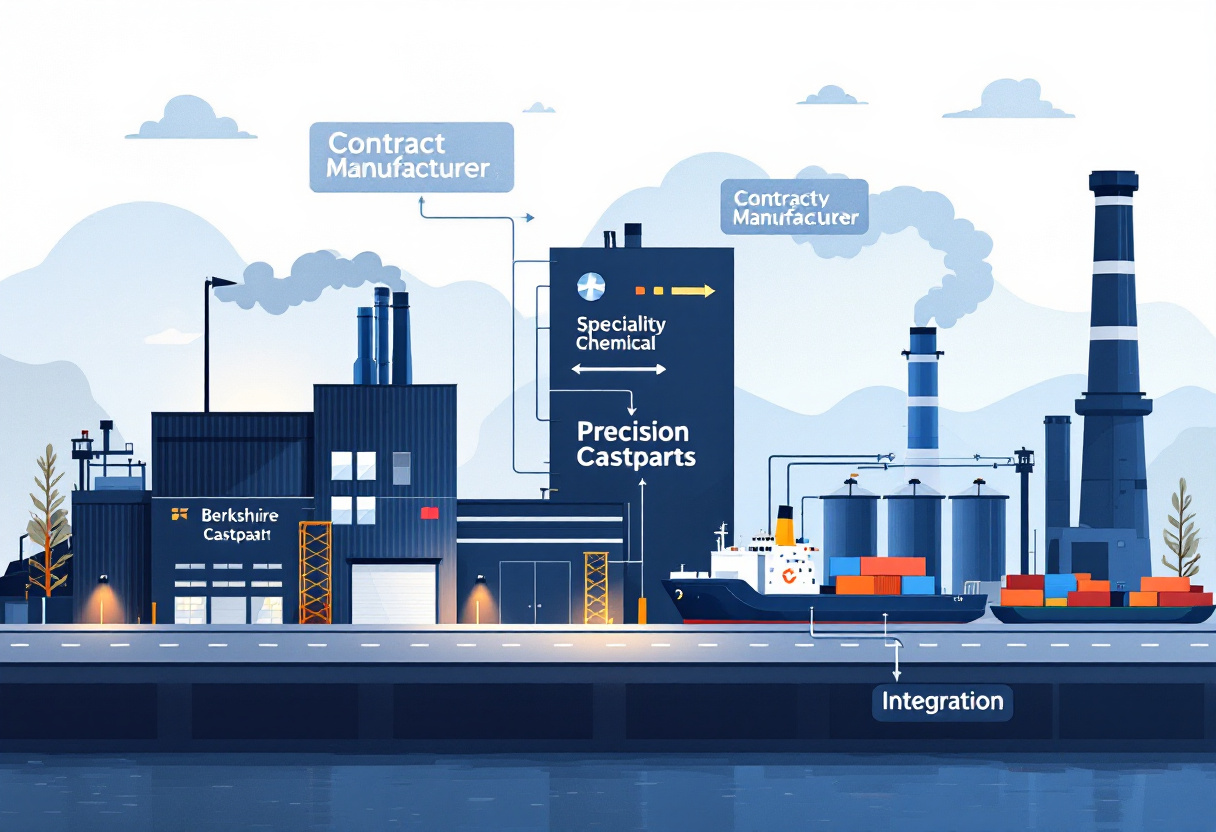
Supply chain acquisitions in 2026 are driven by three forces: post-pandemic reshoring of critical inputs back to North America, vertical integration as corporations protect themselves from another 2020-2022 disruption cycle, and consolidation among industrial distributors, contract manufacturers, and specialty material suppliers. This guide explains why supply chain acquisitions matter in 2026, names the strategic and financial buyers most active in the space, walks through valuation frameworks for supply chain assets, and shows founders how to position a supply chain business for sale.
Supply Chain Acquisitions in 2026: Why Now
Four years after the container ship Ever Given wedged itself sideways in the Suez Canal and froze 12 percent of global trade for six days, the boardroom memory of supply shock is still fresh. The 2020-2022 disruption cycle taught Fortune 500 procurement teams that a 5 percent cost saving on offshore inputs evaporates the first time a typhoon, a port strike, or a geopolitical flare-up shuts down a single sole-source vendor. The corporate response has been to buy, not build. Supply chain acquisitions in 2026 are the dominant tool large industrials use to onshore production, diversify supplier rosters, and lock in capacity.
The numbers tell the story. Refinitiv tracked $187 billion in announced North American supply chain M&A in 2025, the third consecutive year above $150 billion and well above the 2017-2019 average of $98 billion. PitchBook attributes roughly 41 percent of that volume to strategic acquirers buying suppliers two or three tiers down their own bill of materials, and another 38 percent to private equity sponsors rolling up fragmented distribution, packaging, and contract manufacturing platforms. The remaining 21 percent is cross-border activity, mostly European and Japanese strategics buying U.S. assets to anchor North American supply.
For lower-middle-market founders, the practical consequence is that a well-run $5 million EBITDA industrial distributor or specialty packaging business is now an in-demand asset. Buyers who would have ignored sub-$100 million targets in 2018 are running tuck-in programs that target precisely the $3 million to $15 million EBITDA band. Roper Technologies completed 11 such tuck-ins in 2025. Illinois Tool Works closed 14. Dover Corporation completed nine. Fastenal added three regional bolt-ons. The depth of buyer interest is the highest it has been since the pre-2008 industrial roll-up era.
Three macro drivers explain the durability. First, the CHIPS and Science Act and the Inflation Reduction Act together released roughly $480 billion of public and private capital for U.S. industrial capacity, and the supply chains that feed semiconductor fabs, EV battery plants, and grid infrastructure are being assembled in real time. Second, the average S&P 500 industrial now carries 78 days of inventory versus 61 days in 2019, and CFOs are paying acquisition premiums to bring critical inventory and capacity in-house rather than carry it as a balance sheet line. Third, baby-boomer ownership of the U.S. industrial base is reaching the demographic cliff: 51 percent of industrial distribution and contract manufacturing businesses are owned by founders aged 62 or older, and roughly 9,000 such businesses transact each year in the lower middle market.
The Five Supply Chain Sub-Verticals Driving Deal Activity
Not all supply chain assets trade the same way. Strategic acquirers and PE sponsors target six distinct sub-verticals, each with different multiples, working capital profiles, and diligence focus areas. Understanding which sub-vertical a business sits in is the first step in valuation.
Industrial Distribution
Industrial distribution covers MRO supply houses, electrical distributors, fluid power distributors, fastener specialists, safety equipment distributors, and the broader category of value-added wholesalers that sit between OEM manufacturers and end-user buyers. The category trades at the highest multiples in supply chain, 8x to 12x EBITDA for sub-$25 million EBITDA platforms and 12x to 16x for larger franchises with national branch networks. Buyers value the recurring nature of MRO customer relationships, the gross margin stability (typically 28 to 38 percent), and the scarcity of high-quality regional distributors. Wesco International, Fastenal, MSC Industrial, and Grainger are the four anchor consolidators, with Audax Private Equity and Wynne Systems-backed platforms competing aggressively for sub-scale targets.
Contract Manufacturing
Contract manufacturing spans precision machined parts, sheet metal fabrication, plastic injection molding, electronic manufacturing services, and assembly. Multiples are lower (5x to 8x EBITDA for owner-operator shops, 7x to 10x for platforms above $10 million EBITDA) because of customer concentration risk, capital intensity, and labor exposure. The buyer pool is broader, however: every Tier 1 OEM in aerospace, defense, medical device, and EV powertrain is hunting Tier 2 and Tier 3 capacity. Berkshire Hathaway’s $37 billion 2016 acquisition of Precision Castparts established the playbook for vertical integration into critical contract manufacturing, and Honeywell, Parker Hannifin, and Emerson Electric all run active bolt-on programs in the category.
Specialty Chemicals and Materials
Specialty chemicals, advanced materials, coatings, adhesives, and engineered polymers trade at 7x to 12x EBITDA, with bolt-on multiples for differentiated formulations reaching 13x to 15x. The premium reflects high gross margins (35 to 55 percent), regulatory moats (FDA, EPA, REACH registration costs), and customer stickiness driven by formulation qualification cycles that can take 12 to 24 months. Roper Technologies, Dover Corporation, and PPG Industries are perennial buyers, joined by financial sponsors including Platinum Equity, AEA Investors, and KPS Capital Partners. KPS in particular has built a track record in specialty materials carve-outs, including the $1.7 billion 2022 acquisition of Tate and Lyle’s Primary Products business.
Packaging
Packaging covers rigid plastic, flexible film, corrugated, glass, metal, and specialty protective packaging. Multiples cluster at 7x to 10x EBITDA, with cold-chain and food-grade specialists pulling 9x to 12x. The category has consolidated heavily over the past decade (Berry Global, Sealed Air, Sonoco, WestRock-Smurfit), but the sub-$50 million EBITDA tier remains highly fragmented and is the active hunting ground for both strategic tuck-ins and PE platform builds. Apollo Industrial, Brookfield Business Partners, and Onex have all backed packaging platforms in the past 36 months.
Food-Grade and Cold Chain Logistics
Cold-chain warehousing, refrigerated transport, and food-grade contract logistics carry the highest multiples in supply chain, 8x to 14x EBITDA, driven by capacity scarcity, regulatory complexity (FSMA, USDA, ISO 22000), and the structural growth of e-grocery and pharmaceutical biologics that require temperature-controlled storage. Lineage Logistics and Americold are the public anchors; on the PE side, Bain Capital, Brookfield, and Stonepeak Infrastructure Partners have all built cold-chain platforms. Sub-$20 million EBITDA regional cold storage operators routinely receive 10x to 12x offers from sponsors building national footprints.
Electronic Components Distribution
Electronic components distribution, including authorized distributors, independent distributors, and franchise line card holders, trades at 6x to 10x EBITDA depending on franchise authorizations, inventory mix, and end-market exposure. Arrow Electronics and Avnet anchor the public tier; in the lower middle market, sponsors including Audax Private Equity and HEICO have built rollups of niche component distributors serving aerospace, defense, and industrial automation customers. The 2021-2022 semiconductor shortage permanently raised the strategic value of independent distribution capacity.
Vertical Integration as the Strategic Rationale
The single most powerful thesis driving supply chain acquisitions in 2026 is vertical integration. When a corporate acquirer buys a supplier two or three tiers down its own bill of materials, the transaction is what economists call a vertical merger. The strategic logic is straightforward: control the input, control the cost, control the timeline.
The post-2022 environment has reframed vertical integration from a defensive play into an offensive one. In the offshoring era of 1995 to 2018, vertical integration was viewed as capital-inefficient because cheap global supply chains made arms-length procurement the dominant strategy. The 2020 to 2022 shock cycle reversed that calculus. Procurement teams that had spent two decades optimizing for landed cost now optimize for resilience, and the cheapest way to buy resilience is to acquire the supplier.
Three vertical integration patterns dominate supply chain acquisitions today. The first is backward integration into raw materials and critical inputs: Berkshire Hathaway’s Precision Castparts and Lubrizol acquisitions, Apple’s continued backward investment in display and chip supply, and Tesla’s lithium hydroxide refining ventures all fit this pattern. The second is sideways integration into adjacent components: Parker Hannifin’s $8.8 billion 2022 acquisition of Meggitt expanded its aerospace components footprint and locked in Tier 2 capacity. The third is forward integration into distribution: industrial OEMs acquiring the regional distributors that carry their products in order to capture distribution margin and customer data.
Founders evaluating strategic buyers should map which integration pattern their business fits. A precision machine shop selling to three aerospace primes is a backward integration target for any of those primes or for a Tier 1 like Howmet or Heico. A specialty coatings formulator is a sideways integration target for PPG, Sherwin-Williams, or RPM International. A regional electrical distributor is a forward integration target for the manufacturers whose product it represents. The integration pattern determines the buyer list, the synergy math, and ultimately the multiple.
The advantages of mergers and acquisitions in vertically integrated supply chain deals compound: cost reduction through procurement consolidation, margin capture by eliminating intermediary markup, capacity assurance for critical inputs, and competitive moats that make the integrated entity harder for new entrants to attack.
Strategic Supply Chain Acquirers: Who Is Buying
The strategic acquirer universe in supply chain breaks into four tiers. Founders need to understand which tier is the natural buyer of their business in order to set expectations on process design, valuation, and timing.
Tier 1: Mega-cap industrial conglomerates. Berkshire Hathaway (through Precision Castparts, Marmon Holdings, IMC International Metalworking, and Lubrizol), Honeywell, Emerson Electric, Dover Corporation, Illinois Tool Works, Parker Hannifin, and Roper Technologies sit at the top of the food chain. These buyers run continuous tuck-in programs, typically deploying $500 million to $3 billion per year in supply chain bolt-ons. Their sweet spot is $25 million to $250 million enterprise value targets that slot into an existing platform business. Roper closed 11 such deals in 2025. ITW closed 14. Dover closed nine.
Tier 2: Specialist consolidators. Watts Water Technologies (plumbing and water flow components), Wesco International (electrical distribution), Fastenal (fasteners and industrial supply), MSC Industrial (metalworking distribution), Grainger (broadline MRO), Heico (aerospace parts and electronic components), and Arrow Electronics (component distribution) are highly focused acquirers that run disciplined M&A in their specific sub-verticals. They tend to know every regional competitor by name and will move quickly on a quality target.
Tier 3: Vertically integrating end-market OEMs. Aerospace primes (Boeing, Lockheed Martin, Raytheon, Northrop Grumman), defense electronics integrators, EV powertrain OEMs (Tesla, Rivian, Ford and GM through their EV divisions), and medical device leaders (Medtronic, Stryker, Boston Scientific) acquire suppliers to lock in critical capacity. These buyers pay strategic premiums but expect long-term capacity commitments and may require post-close governance that founders find restrictive.
Tier 4: Cross-border strategics. European and Japanese industrials including Siemens, ABB, Schneider Electric, Mitsubishi Heavy Industries, Sumitomo, and Nidec have been net buyers of U.S. supply chain assets since 2022, partly as a hedge against U.S. trade policy and partly to anchor North American production. Cross-border deals typically carry 15 to 25 percent premiums to comparable domestic transactions but bring additional CFIUS and antitrust review timelines.
The right buyer for a given supply chain business is rarely obvious from the outside. A sell-side process run by an experienced advisor will systematically test all four tiers, document each buyer’s strategic thesis, and use the competitive tension to drive both price and terms.
Private Equity in Supply Chain: Active Sponsors
Private equity has become the dominant buyer of lower-middle-market supply chain businesses, particularly in the $3 million to $25 million EBITDA range where strategic acquirers historically would not engage. The sponsor universe most active in supply chain in 2026 includes a clear top tier and a deep bench of specialists.
Audax Private Equity has been the most active supply chain investor in the U.S. lower middle market over the past five years, with roughly 40 platform and add-on transactions in industrial distribution, specialty distribution, and contract manufacturing. Audax’s playbook is to acquire a regional platform at 7x to 8x and execute 8 to 12 add-ons over a four-year hold, then exit at 10x to 12x to a strategic or a larger sponsor. AEA Investors runs a similar specialist program with deeper exposure to specialty chemicals and engineered materials.
KPS Capital Partners is the leading sponsor for complex carve-outs and turnarounds in the space. KPS’s $1.7 billion 2022 acquisition of Tate and Lyle’s Primary Products business (now Primient) is the canonical example of how a sophisticated financial sponsor can extract value from a non-core corporate division. Platinum Equity runs a parallel strategy with particular strength in industrial services and distribution carve-outs.
Apollo Industrial, Brookfield Business Partners, and Onex compete for larger supply chain platforms ($50 million EBITDA and above), often in packaging, cold-chain, and infrastructure-adjacent supply categories. Brookfield’s industrials portfolio in particular has been an aggressive consolidator in packaging and logistics over the past 36 months.
Below the mega-fund tier, a deep bench of specialist sponsors runs supply chain platforms: Wynnchurch Capital (industrial services and distribution), Court Square Capital Partners (specialty industrial), Incline Equity (industrial distribution), Pfingsten Partners (industrial manufacturing), Industrial Opportunity Partners (carve-outs), and Mason Wells (specialty packaging and industrial). The full landscape is documented in our overview of the top private equity firms you should know.
For a lower-middle-market founder, the PE buyer universe is both an opportunity and a risk. The opportunity is that competitive sponsor processes routinely produce multiples 1.5x to 2.5x turns above what a single strategic conversation will deliver. The risk is that an inexperienced founder selling to a sponsor without a competitive process will leave significant value on the table, particularly on working capital, escrow, and rollover equity terms.
Supply Chain Valuation Multiples by Sub-Vertical (2026)
Valuation in supply chain acquisitions is sub-vertical specific. The table below summarizes 2026 multiple ranges from CT Acquisitions’ proprietary deal database, cross-referenced against PitchBook, Refinitiv, and S&P Capital IQ data for transactions in the $3 million to $100 million EBITDA range.
| Sub-vertical | EBITDA range | Multiple range | Premium drivers |
|---|---|---|---|
| Industrial distribution | $3M to $25M | 8x to 12x | Branch density, MRO mix, gross margin above 32 percent |
| Industrial distribution | $25M to $100M | 10x to 14x | National footprint, vendor authorizations, e-commerce penetration |
| Contract manufacturing | $3M to $15M | 5x to 8x | End-market diversity, AS9100 or ISO 13485, capacity utilization |
| Contract manufacturing | $15M to $75M | 7x to 10x | Long-term contracts, regulated end markets, automation |
| Specialty chemicals and materials | $3M to $50M | 7x to 12x | Patent and formulation IP, regulatory moats, customer stickiness |
| Specialty chemicals (premium) | $10M+ | 13x to 15x | Single-source qualifications, sole-spec formulations |
| Packaging (rigid, flexible, corrugated) | $3M to $50M | 7x to 10x | Customer concentration, raw material pass-through, sustainability mix |
| Cold chain and food-grade logistics | $3M to $30M | 8x to 14x | Capacity scarcity, FSMA compliance, biologics exposure |
| Electronic components distribution | $3M to $25M | 6x to 10x | Franchise authorizations, aerospace/defense mix, inventory turns |
Three caveats on the ranges. First, customer concentration above 20 percent on a single account compresses multiples by 1.0x to 2.0x. Second, owner dependency where the founder is the primary commercial relationship compresses multiples by 0.5x to 1.5x. Third, working capital intensity above 18 percent of revenue is a multiple compressor of 0.5x to 1.0x because buyers price for the deployed cash. Conversely, recurring revenue contracts, multi-year customer commitments, and proprietary formulations or process IP can drive multiples 1.5x to 3.0x above the base range.
Founders working with experienced advisors should expect a defensible valuation range, not a single number. The job of the sell-side process is to find the buyer for whom the synergy math justifies the top of the range.
Synergy Math in Supply Chain Acquisitions
Strategic acquirers in supply chain underwrite to four categories of synergy. Understanding each category lets a founder anticipate how a strategic buyer will model the acquisition and where the buyer can defend a premium multiple.
Procurement spend consolidation. When two industrial companies combine, the merged entity has greater purchasing power with shared suppliers. Procurement synergies in supply chain acquisitions typically run 5 to 15 percent of combined COGS, with the high end achievable when the acquirer has dominant regional or national share with key suppliers. On a target with $40 million of COGS, a 10 percent procurement synergy is $4 million of annual EBITDA uplift, which at a 10x multiple is $40 million of incremental enterprise value the buyer can pay without diluting their own multiple.
Logistics network rationalization. Distribution and manufacturing acquirers extract substantial synergies by consolidating warehouses, optimizing truck routes, and rebalancing inventory across the combined footprint. A 100,000 square foot redundant warehouse closure saves $1.2 million to $2.0 million per year in occupancy, labor, and overhead. Route optimization across combined fleets typically yields 8 to 14 percent reductions in transportation cost. For a target with $25 million of distribution and logistics spend, network rationalization synergies of $2 million to $3.5 million annually are realistic in year two.
Working capital optimization. Acquirers in supply chain frequently model 10 to 20 percent inventory reductions post-close, driven by SKU rationalization, shared safety stock, and tighter forecasting. On a target with $30 million of inventory, a 15 percent reduction releases $4.5 million of cash, which buyers price into the synergy bridge as a one-time cash benefit. Similar improvements in accounts receivable management (typically 5 to 10 day DSO reductions) and accounts payable discipline (3 to 8 day DPO extensions) compound the working capital release.
Revenue and cross-selling synergies. The hardest synergy category to underwrite credibly, revenue synergies in supply chain deals come from selling the acquired company’s products through the acquirer’s distribution channels, or vice versa. Roper Technologies, Dover, and ITW all explicitly underwrite revenue synergies in their tuck-in models, typically at 2 to 5 percent of the target’s revenue base in year three. The math is straightforward: on a $50 million revenue target, a 3 percent revenue synergy is $1.5 million of incremental sales, which at the combined entity’s gross margin contributes $400,000 to $700,000 of EBITDA.
The combined synergy stack on a typical strategic acquisition in supply chain runs 18 to 32 percent of target EBITDA, which is the math that justifies strategic acquirers paying 2x to 4x turns above what a financial sponsor will pay. Founders who understand the synergy framework can position diligence materials to highlight the specific synergies their business creates for each buyer, which is the factor that drives final price.
Named 2024-2026 Supply Chain Deals Worth Studying
Five recent transactions illustrate the patterns driving supply chain acquisitions in 2026 and provide reference points founders can use to calibrate expectations.
The sourcing methodology behind this discussion is covered in origination playbook step-by-step.
KPS Capital Partners / Tate and Lyle Primary Products ($1.7 billion, 2022). KPS acquired Tate and Lyle’s Primary Products business (now operating as Primient) in a complex corporate carve-out covering corn wet milling, sweeteners, starches, and industrial alcohols across the U.S. The deal is the template for sophisticated PE carve-outs in specialty materials: KPS took on a non-core business at a discount to public comps, separated it operationally, and is now running the standard PE playbook of margin expansion, capacity investment, and add-on M&A. Founders considering a sale to KPS, Platinum Equity, or another carve-out specialist should expect a longer diligence cycle and a strong operational team post-close.
Berkshire Hathaway / Precision Castparts ($37 billion, 2016). Although dated, the Precision Castparts acquisition remains the canonical example of how a long-duration capital pool can value vertical integration into critical contract manufacturing. Berkshire paid roughly 16x EBITDA at the time, and the strategic logic (irreplaceable aerospace and industrial precision parts capacity) is now the template for every vertical integration thesis in supply chain. The deal also illustrates the downside: Berkshire took a $9.8 billion writedown in 2020 when the aerospace cycle collapsed, a reminder that even strategic acquirers price cyclicality into terminal multiples.
Parker Hannifin / Meggitt ($8.8 billion, 2022). Parker Hannifin’s acquisition of UK-based Meggitt expanded Parker’s aerospace and defense components platform and locked in critical Tier 2 capacity. The deal closed at roughly 17x trailing EBITDA, justified by Parker’s modeled $300 million of annual run-rate synergies (procurement, footprint rationalization, and cross-selling). Meggitt is now the benchmark transaction for Tier 1 aerospace strategics targeting Tier 2 components businesses.
Roper Technologies bolt-on program (continuous). Roper completed 11 bolt-on acquisitions in 2025 across its industrial software, network software, and TEP segments, with aggregate deal value above $2.4 billion. The program is the playbook for serial acquirers: Roper targets $25 million to $150 million enterprise value acquisitions, pays 12x to 16x EBITDA, and underwrites synergies of 15 to 25 percent. Lower-middle-market supply chain businesses that fit Roper’s verticals should expect a disciplined, repeatable process with a strong post-close integration framework.
Illinois Tool Works tuck-in program (continuous). ITW completed 14 tuck-in acquisitions in 2025, the most active year for the program in a decade. ITW’s tuck-ins typically range from $20 million to $80 million in enterprise value, focus on the seven ITW operating segments (Automotive OEM, Food Equipment, Test and Measurement, Welding, Polymers and Fluids, Construction Products, Specialty Products), and are integrated into the ITW 80/20 operating model within 18 months. Founders selling to ITW should expect a transparent process, a fair price, and a fast close.
Founders evaluating their own potential buyers should study comparable transactions in their specific sub-vertical, ideally with the help of an advisor who can pull deal-level data from PitchBook, Refinitiv, S&P Capital IQ, and Mergermarket.
Working Capital, Inventory, and Cash Conversion in Supply Chain Deals
No category of acquisition is more sensitive to working capital diligence than supply chain. Inventory-heavy businesses (distributors, contract manufacturers, packaging converters) carry 15 to 30 percent of revenue as net working capital, and the working capital target in the purchase agreement is one of the most negotiated terms in the deal.
Three working capital concepts determine the cash a founder actually receives at close. First, the working capital peg is the agreed normalized level of net working capital the seller must deliver at close, typically calculated as the trailing 12-month average. A target that delivers working capital above the peg receives a dollar-for-dollar increase to the purchase price; a target that delivers below the peg sees the purchase price reduced. Second, the inventory adjustment is a specific subset of the peg that focuses on obsolete, slow-moving, and excess inventory. Buyers routinely propose reserves of 15 to 35 percent of inventory book value during diligence, and negotiation of these reserves is one of the largest single value swings in a supply chain deal. Third, the cash conversion cycle (DSO plus DIO minus DPO) is the operational metric buyers use to underwrite ongoing working capital needs. A target with a 65-day cash conversion cycle is materially more attractive than one with a 95-day cycle, even at the same EBITDA.
Founders should prepare for working capital diligence 12 to 18 months before going to market. The practical steps include cleaning up inventory (writing off obsolete SKUs against current period earnings rather than allowing them to surface as buyer reserves), tightening AR collection processes, and documenting the rationale for the existing AP terms with key suppliers. Each of these moves both improves the cash conversion cycle and reduces the surface area for buyer challenges in diligence.
The due diligence checklist after closing mergers and acquisitions includes a dedicated working capital true-up that typically resolves 60 to 90 days after closing. Disputes are common, and the dispute resolution mechanism (specified accountant, baseball arbitration, definitive accounting firm) should be negotiated tightly in the definitive agreement. Founders who skip this work routinely give back 3 to 7 percent of headline purchase price during the post-close true-up.
Customer Concentration, Single-Source Risk, and Supplier Audits
Three risk categories dominate supply chain diligence and routinely either kill deals or compress valuations: customer concentration, single-source supplier exposure, and quality system audits.
Customer concentration is the percentage of revenue derived from the top customer and the top five customers. Buyers in supply chain typically apply the following framework: top customer above 30 percent is a deal breaker for most strategics; top customer 20 to 30 percent compresses multiple by 1.0x to 2.0x; top customer 10 to 20 percent compresses by 0.5x to 1.0x; below 10 percent is neutral. Customer contracts that include long-term volume commitments, dedicated capacity carve-outs, or single-source qualifications can offset concentration penalties if the documentation is solid.
Single-source supplier risk is the mirror image: how exposed the target is to a single supplier of critical raw materials, components, or services. Buyers will map every BOM line above 5 percent of COGS and ask for evidence of qualified alternates. Where alternates do not exist, buyers either model the cost of qualification (typically $50,000 to $300,000 per line) or require contractual remedies in the purchase agreement. Founders should pre-empt this diligence by qualifying secondary suppliers for the top 10 raw material lines before going to market.
Quality and regulatory audits cover ISO 9001, AS9100 (aerospace), ISO 13485 (medical device), IATF 16949 (automotive), FSMA (food safety), USDA (meat and poultry), and FDA (pharmaceutical and medical device) certifications. Buyers will pull audit findings for the trailing three years and inspect remediation. Open major nonconformities can delay closings by 90 to 180 days while remediation is verified, and unresolved findings can prompt purchase price holdbacks of 5 to 15 percent against the risk of customer requalification. Founders should ensure all audit findings are closed and documented before launching a sale process.
The diligence playbook for supply chain businesses is more intensive than for service businesses precisely because the operational risks compound. A well-prepared seller can compress the diligence timeline from the typical 90 to 120 days down to 60 to 75 days, which both protects against deal fatigue and reduces the risk of macro disruptions during the diligence window.
How to Prepare a Supply Chain Business for Sale
A supply chain business that walks into a sale process unprepared loses 15 to 25 percent of achievable value relative to one that has spent 12 to 18 months in a structured preparation program. The preparation playbook for supply chain businesses has eight components.
- Quality of earnings. Engage a regional or national accounting firm to perform a sell-side QofE report 9 to 12 months before going to market. The QofE will normalize EBITDA, identify pro-forma adjustments, surface revenue recognition issues, and document customer-level profitability. Buyers will discount any EBITDA claim that is not backed by a credible QofE.
- Customer documentation. Build a customer file that includes contracts, purchase orders, historical volume data, profitability by customer, and qualitative notes on customer health and concentration risk. Buyers will model customer-by-customer retention risk; sellers who provide the data set save 30 to 60 days in diligence.
- Working capital cleanup. Write down obsolete inventory, tighten AR collections, and document AP terms. The goal is a clean 12-month working capital history that supports a defensible peg negotiation.
- Supplier qualification program. Qualify secondary suppliers for the top 10 raw material lines. Document the alternates and the qualification timelines so buyers can underwrite supply risk.
- Quality system remediation. Close all open major audit findings against ISO, AS, IATF, or FSMA certifications. Document remediation and verification.
- Management team development. Identify and develop a number two who can operate the business if the founder rolls off post-close. Buyers (both strategic and financial) discount businesses where the founder is the only person who can run operations, source customers, or negotiate supplier terms.
- Capex and capacity story. Document the trailing five years of capex, current capacity utilization, and the capex required to support the next three years of growth. Buyers model capacity headroom into their growth case, and a clear capex narrative supports a higher growth multiple.
- Strategic narrative. Articulate the strategic thesis for each buyer category (Tier 1 conglomerate, Tier 2 specialist, Tier 3 vertically integrating OEM, Tier 4 cross-border, financial sponsor). The narrative drives buyer outreach, the CIM, and the management presentations.
The preparation playbook is the difference between a process that delivers the top quartile of multiples and one that closes at the median or below. Most founders underinvest in preparation because the work feels indirect; experienced advisors quantify the value created by each step and prioritize the highest-impact moves.
How CT Acquisitions Runs Supply Chain Sell-Side
CT Acquisitions runs sell-side mandates for supply chain businesses with $3 million to $25 million of EBITDA. Our process is purpose-built for the diligence intensity, buyer breadth, and synergy complexity that define supply chain acquisitions.
The engagement begins with a 60-day preparation phase. We conduct a sell-side quality of earnings review, build the customer profitability and concentration analysis, document the supplier risk map, and construct the strategic narrative for each buyer tier. Output is a confidential information memorandum (CIM), a financial model with synergy bridge templates, and a curated buyer list of typically 60 to 120 strategic and financial buyers.
The outreach phase runs 30 to 45 days. We launch outreach to the full buyer list under NDA, qualify interest through introductory calls, and convert qualified buyers into indication of interest (IOI) submissions. Typical conversion rates for supply chain processes are 35 to 50 percent of contacted buyers requesting a CIM and 15 to 25 percent submitting an IOI.
The management presentation and second-round bid phase runs 30 to 45 days. We host management presentations and site visits for the four to six buyers selected from the IOI round, and convert these into letters of intent (LOIs) with purchase price, structure, and key terms specified.
The selection and exclusivity phase converts the leading LOI into an exclusivity agreement (typically 60 to 75 days) during which the buyer completes confirmatory diligence. The phase concludes with negotiation of the definitive purchase agreement and closing. Total process timeline from engagement to closing is typically six to nine months for a well-prepared supply chain business.
What distinguishes CT Acquisitions in supply chain is the depth of buyer relationships and the rigor of synergy modeling. We maintain active dialogue with the corporate development teams at the Tier 1 industrials (Roper, Dover, ITW, Honeywell, Parker Hannifin, Emerson, Watts Water) and the supply chain investment teams at Audax, AEA, KPS, Platinum Equity, Apollo Industrial, and Brookfield. We model deal-specific synergies for each buyer in the process, which is the lever that supports premium pricing at the LOI stage. Founders considering a sale of a supply chain business should reach out for a confidential, no-obligation conversation about valuation and process design.
Supply Chain Acquisitions: Frequently Asked Questions
What multiples do supply chain businesses trade at in 2026?
Multiples vary significantly by sub-vertical. Industrial distribution trades at 8x to 12x EBITDA, contract manufacturing at 5x to 8x, specialty chemicals and materials at 7x to 12x (with premium formulations reaching 13x to 15x), packaging at 7x to 10x, cold-chain logistics at 8x to 14x, and electronic components distribution at 6x to 10x. Customer concentration, owner dependency, and working capital intensity each compress multiples by 0.5x to 2.0x.
Sponsors moving to action can register through the CT buy-side partnership.
Who are the most active strategic acquirers of supply chain businesses?
The Tier 1 strategic acquirers include Berkshire Hathaway (via Precision Castparts, Marmon, and Lubrizol), Honeywell, Emerson Electric, Dover Corporation, Illinois Tool Works, Parker Hannifin, and Roper Technologies. Specialist consolidators include Watts Water, Wesco International, Fastenal, MSC Industrial, Grainger, and Heico. End-market OEMs in aerospace, defense, EV, and medical device complete the strategic universe.
Which private equity firms are most active in supply chain?
The most active sponsors include Audax Private Equity, AEA Investors, KPS Capital Partners, Platinum Equity, Apollo Industrial, Brookfield Business Partners, and Onex. The specialist tier includes Wynnchurch Capital, Court Square, Incline Equity, Pfingsten Partners, Industrial Opportunity Partners, and Mason Wells.
What working capital terms are typical in supply chain deals?
Buyers require a working capital peg calculated as the trailing 12-month average of net working capital. Sellers deliver working capital at or above the peg to receive full purchase price; below-peg delivery triggers dollar-for-dollar reductions. Inventory adjustments are negotiated separately and frequently involve reserves of 15 to 35 percent of book value for obsolete or slow-moving inventory.
How long does it take to sell a supply chain business?
A well-prepared supply chain business typically takes six to nine months from engagement to closing. Preparation runs 60 days, outreach runs 30 to 45 days, management presentations and second-round bidding run 30 to 45 days, and exclusivity and definitive agreement negotiation runs 60 to 75 days. Poorly prepared businesses can take 12 to 18 months and often close at compressed multiples.
What is the difference between strategic and financial buyers for a supply chain business?
Strategic buyers underwrite synergies (procurement consolidation, logistics rationalization, working capital optimization, cross-selling) that justify multiples 2x to 4x turns above what financial sponsors will pay on a standalone basis. Financial sponsors compete by promising a clean process, strong post-close partnership, and roll-over equity that lets founders participate in the second turn of value creation. The best sell-side processes test both categories of buyers and use the competitive tension to drive both price and terms. For deeper background, see our overview of business acquisition meaning explained and how investment bankers value a business.