
EBITDA Meaning: What EBITDA Stands For and Why It Matters
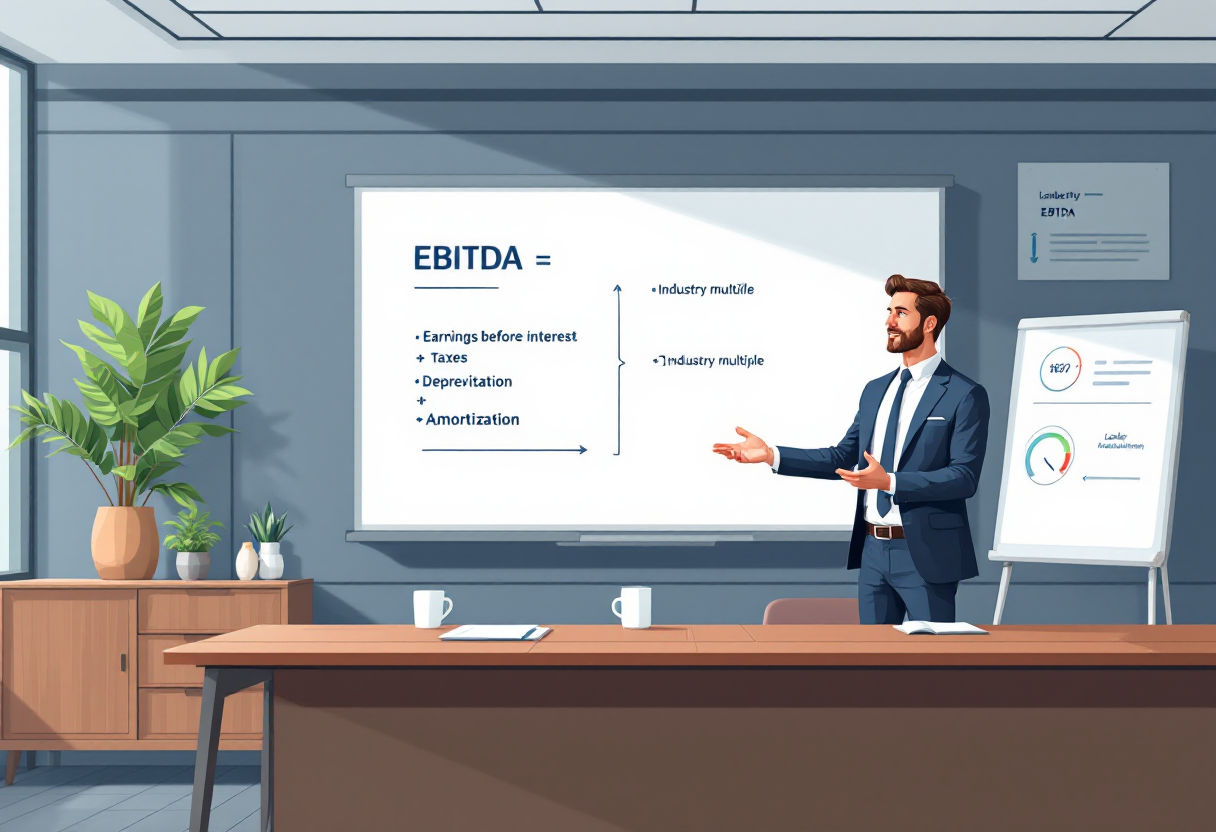
EBITDA meaning, in one line: Earnings Before Interest, Taxes, Depreciation, and Amortization. EBITDA isolates the operating cash flow a business generates before financing decisions, tax structure, and accounting policy, which is exactly why buyers, lenders, and M&A advisors use it as the universal comparable across deals.
For a lower-middle-market business owner thinking about selling, raising debt, or buying a competitor, EBITDA is the number that controls almost every conversation. The price a buyer offers is usually a multiple of EBITDA. The size of an SBA 7(a) loan an acquirer can get is gated by EBITDA. The covenants a senior lender writes into a term sheet reference EBITDA. If you walk into a negotiation without a defensible EBITDA figure, you are negotiating against the buyer’s number, not your own.
This guide walks through the EBITDA meaning from the simplest plain-English version all the way to how adjusted EBITDA gets fought over line-by-line in a quality of earnings report. We use real FY2024 and FY2025 10-K data from Apple, Microsoft, Tesla, Amazon, and Walmart, current 2026 multiples from Pitchbook and BVR DealStats, and the specific add-backs CT Acquisitions sees buyers accept and reject every week. By the end, you should be able to calculate EBITDA, defend an adjusted EBITDA number, read a lender’s coverage ratio, and spot the three places EBITDA quietly misleads.
EBITDA Meaning in Plain English
The EBITDA meaning is best understood by walking through each letter. EBITDA stands for Earnings Before Interest, Taxes, Depreciation, and Amortization. It is a measure of operating profitability that strips out four expenses that do not reflect the underlying performance of the business itself.
Interest gets removed because interest expense reflects how the business is financed, not how it operates. Two identical HVAC companies generating $2 million of operating profit will report very different net income if one carries $5 million of debt and the other is debt-free. By stripping out interest, EBITDA puts both on the same footing.
Taxes get removed because tax expense depends on jurisdiction, entity structure (C-corp vs S-corp vs LLC), net operating loss carryforwards, and timing differences. A buyer who plans to acquire the company and roll it into their own tax structure does not care about the seller’s historical tax bill.
Depreciation and amortization are non-cash expenses. They represent the accounting allocation of past capital spending (a delivery truck bought three years ago, a customer list acquired five years ago) across future periods. Cash already left the business when the asset was bought. Pulling depreciation and amortization back out of operating profit gives a cleaner read on the cash the business is currently generating.
Put it all together and EBITDA is a proxy for operating cash flow before working capital changes and before capital expenditure. It is not the same as free cash flow (we cover this gap in the pitfalls section below), but it is the cleanest single number for comparing two operating businesses against each other.
The History of EBITDA
EBITDA was popularized in the 1980s during the debt-financed buyout boom. Investors like John Malone at TCI used EBITDA to value cable television companies that were heavily depreciated and carried significant debt loads. Under GAAP, those companies reported tiny net income or outright losses, but EBITDA showed they were throwing off real cash. EBITDA spread from cable to private equity to SBA-backed Main Street acquisitions, and today it is the default valuation metric across deal sizes from $500,000 to $5 billion.
The EBITDA Formula: Step-by-Step Calculation
There are two standard ways to calculate EBITDA. Both produce the same answer when done correctly. The first builds up from net income (the “bottom-up” approach), the second starts from revenue and subtracts operating costs (the “top-down” approach).
Bottom-Up Formula
EBITDA = Net Income + Interest Expense + Tax Expense + Depreciation + Amortization
This is the formula you will see in most textbooks. You start at the bottom of the income statement (net income), then add back the four expenses that get stripped out. The advantage of this approach is that net income is a single audited number, so you only need to pull four other line items.
Top-Down Formula
EBITDA = Revenue – Cost of Goods Sold – Operating Expenses (excluding D&A)
Equivalently: EBITDA = Operating Income (EBIT) + Depreciation + Amortization
This is the formula most operators prefer because it ties directly to how they think about the business. Revenue minus the costs of running the business equals operating profit. Add back the non-cash items and you have EBITDA.
Worked Example: HVAC Company With $4M Revenue
Consider a residential HVAC contractor in Phoenix with FY2025 financials as follows:
| Line Item | Amount |
|---|---|
| Revenue | $4,000,000 |
| Cost of Goods Sold (parts, subcontractor labor) | $2,200,000 |
| Gross Profit | $1,800,000 |
| Operating Expenses (SG&A, marketing, office) | $1,150,000 |
| Depreciation (trucks, equipment) | $120,000 |
| Amortization (goodwill from prior acquisition) | $30,000 |
| Operating Income (EBIT) | $500,000 |
| Interest Expense | $80,000 |
| Pre-Tax Income | $420,000 |
| Tax Expense (effective rate 25%) | $105,000 |
| Net Income | $315,000 |
Bottom-up: $315,000 + $80,000 + $105,000 + $120,000 + $30,000 = $650,000 EBITDA.
Top-down: $500,000 + $120,000 + $30,000 = $650,000 EBITDA.
Both methods produce $650,000. That is the reported EBITDA. The adjusted EBITDA, which is what the buyer actually pays a multiple on, will be different (and usually higher). We cover the adjustments in section 5.
Where to Find the Inputs
For a private company, you pull these numbers from the profit-and-loss statement and the depreciation schedule in your accounting software (QuickBooks, NetSuite, Sage). For a public company, every input is in the 10-K: net income on the income statement, interest expense in the same place or in the notes, tax expense on the income statement, and depreciation and amortization in the cash flow statement (operating activities section).
EBITDA vs Net Income vs Operating Income
The three profit metrics often get confused. Each one strips out different expenses and answers a different question. Here is how they line up on a typical income statement, working from top to bottom.
| Metric | What It Includes | What It Excludes | Best Use Case |
|---|---|---|---|
| Gross Profit | Revenue minus COGS | Operating costs, D&A, interest, tax | Pricing analysis, unit economics |
| Operating Income (EBIT) | Gross profit minus operating expenses including D&A | Interest, tax | Operating efficiency comparison |
| EBITDA | EBIT plus D&A added back | Interest, tax, D&A | Valuation, lender coverage, peer comparison |
| Net Income | Everything: revenue minus all expenses | Nothing | Shareholder reporting, tax filing |
Why the Three Numbers Diverge
For a capital-light SaaS business with little debt and few fixed assets, the three numbers are close together. For an asset-heavy industrial or transportation business with significant debt, the three numbers can be wildly different.
Take Walmart’s FY2025 (fiscal year ended January 2025) results as a reference. Walmart reported $681 billion in revenue, operating income of $29.3 billion, depreciation and amortization of approximately $13 billion, interest expense around $2.3 billion, tax expense of $5.6 billion, and net income of $19.4 billion. EBITDA was roughly $42.3 billion (operating income plus D&A). The gap between Walmart’s $19.4 billion net income and $42.3 billion EBITDA is $22.9 billion, driven mostly by depreciation on Walmart’s real estate and distribution infrastructure.
Now look at Apple FY2024 (fiscal year ended September 2024). Apple reported $391 billion in revenue, operating income of $123.2 billion, depreciation and amortization of about $11.4 billion, and net income of $93.7 billion. EBITDA was roughly $134.6 billion. Apple’s net income to EBITDA ratio is much tighter because Apple is capital-light relative to its earnings power, has minimal interest expense, and runs a comparatively low tax rate.
The Practical Implication
When a private equity firm evaluates your HVAC business at $650,000 of EBITDA, they are not comparing it to your net income of $315,000. They are comparing it to other HVAC businesses at their EBITDA. That comparison is only meaningful because EBITDA strips out the financing and tax noise that varies wildly from one company to the next.
Why Buyers Use EBITDA in Business Valuation
EBITDA dominates business valuation for three reasons: it normalizes across capital structures, it approximates cash flow, and it is hard to manipulate at the operating-line level. We will take each in turn.
Normalization Across Capital Structures
A buyer evaluating two competing HVAC targets, one debt-free and one carrying $3 million of senior debt, needs a way to compare them apples-to-apples. Net income will be lower for the levered company because of interest expense. EBITDA removes that distortion. The buyer can compare operating performance directly and then make a separate decision about how to finance the acquired business.
Proxy for Cash Flow
EBITDA is not free cash flow, but it is a reasonable proxy for operating cash flow before working capital changes and capex. For mature businesses with stable working capital and maintenance capex below 5% of revenue, EBITDA tracks cash flow closely enough that buyers and lenders treat it as a stand-in. For high-growth or capital-intensive businesses, the gap widens, which is why sophisticated buyers also look at EBITDA minus capex.
Resistance to Manipulation
Below the operating income line, sellers have several ways to make net income look better or worse: changing depreciation methods, accelerating tax deductions, restructuring debt. EBITDA strips all of that out and forces the conversation back to operating revenue and operating costs, which are harder to dress up.
The Multiple Method
Once you have EBITDA, valuation usually proceeds by applying a multiple drawn from comparable transactions. If HVAC businesses are trading at 5x EBITDA in your market and your business generates $650,000 of adjusted EBITDA, the implied enterprise value is $3.25 million. The buyer subtracts net debt and adjusts for working capital to get to the equity check.
For a deeper walkthrough of how M&A advisors and investment bankers build these valuations from EBITDA upward, see our guide on how investment bankers value a business. For a sense of what a formal valuation engagement costs, see business valuation services cost.
Adjusted EBITDA: The Number That Actually Matters in an M&A Deal
Reported EBITDA is what the company posts in its financials. Adjusted EBITDA is what a buyer is willing to pay a multiple on after both sides agree on a normalized run-rate of profitability. The gap between the two is where most lower-middle-market deals get won or lost.
Adjusted EBITDA adds back items that are non-recurring, non-operational, or owner-specific. The goal is to show the buyer what the business will look like once they own it, with their cost structure and without the seller’s personal expenses running through the P&L.
Standard Add-Backs Buyers Accept
- Owner compensation above market: If the owner pays themselves $400,000 and a hired CEO would cost $200,000, the $200,000 difference is added back.
- Owner perks: Personal vehicle leases, country club memberships, family travel charged to the business.
- Non-recurring legal fees: A one-time lawsuit settlement or M&A advisory fees being paid to sell the business.
- Rent paid above market to an owner-controlled entity: If the building is owned by the seller’s LLC and rent is $200,000 against a market rate of $140,000, the $60,000 difference is added back.
- One-time bad debt: A single large customer write-off that is not expected to repeat.
- COVID-era distortions: PPP forgiveness income, ERTC credits, one-time relief grants.
Add-Backs Buyers Reject
- Lost customer “would have been” revenue: Sellers sometimes try to add back revenue from a customer who left. Buyers refuse.
- Owner’s salary in full: The replacement cost of the owner is still a real expense.
- Capex disguised as repairs: If a $80,000 truck rebuild was expensed instead of capitalized, the buyer will not let you add it back on top of leaving it in repairs.
- Discretionary marketing the buyer plans to keep: If the marketing produced the revenue, you cannot strip the cost.
Worked Adjusted EBITDA: The HVAC Example Continued
| Item | Amount |
|---|---|
| Reported EBITDA | $650,000 |
| Add back: Owner comp above market ($350k paid, $180k replacement) | +$170,000 |
| Add back: Owner truck and personal vehicle expenses | +$22,000 |
| Add back: One-time legal fees (commercial dispute settled) | +$45,000 |
| Add back: Above-market rent to owner’s real estate LLC | +$36,000 |
| Subtract: Normalized insurance increase (under-insured historically) | -$18,000 |
| Adjusted EBITDA | $905,000 |
At a 5x multiple, reported EBITDA of $650,000 implies $3.25 million in enterprise value. Adjusted EBITDA of $905,000 implies $4.525 million. That $1.275 million gap is why quality of earnings work matters and why CT Acquisitions builds the adjusted EBITDA bridge before going to market.
The Quality of Earnings Report
For deals above roughly $5 million in transaction value, the buyer typically commissions a quality of earnings (QoE) report from an accounting firm. The QoE scrutinizes every add-back, tests the underlying transactions, and produces an “adjusted EBITDA per QoE” figure that becomes the basis for the final purchase price. Sellers who run a sell-side QoE before going to market typically defend a higher adjusted EBITDA because they have already documented the add-backs.
EBITDA Multiples by Industry in 2026
EBITDA multiples vary widely by industry, deal size, and growth profile. The figures below reflect typical lower-middle-market ranges (transaction values $2M to $50M) drawn from the Pitchbook EBITDA Multiples Report 2026 and BVR DealStats Q1 2026. Larger deals and high-growth outliers can trade well above these ranges.
| Industry | 2026 EBITDA Multiple Range | Typical Buyer Profile |
|---|---|---|
| SaaS / Vertical Software | 5x to 15x | PE growth funds, strategic acquirers |
| Healthcare services (dental, vet, behavioral) | 6x to 10x | PE roll-ups, DSO/VSO platforms |
| Professional services (accounting, consulting) | 4x to 7x | Strategic acquirers, search funds |
| HVAC, plumbing, electrical (home services) | 4x to 6x | PE-backed roll-ups, strategic acquirers |
| Manufacturing (industrial, contract) | 4x to 6x | Strategic acquirers, PE |
| Ecommerce / DTC brands | 3x to 6x | Aggregators, strategic acquirers |
| Restaurants (independent, single-unit) | 2.5x to 4x | Operators, family offices |
| Distribution / wholesale | 4x to 7x | Strategic acquirers, PE |
| MSP / IT services | 5x to 9x | PE-backed roll-ups |
| Insurance agencies | 7x to 11x | PE-backed aggregators |
What Drives a Higher Multiple Within a Range
- Size: A $5 million EBITDA business typically trades at a meaningfully higher multiple than a $1 million EBITDA business in the same industry. Size reduces buyer risk.
- Recurring revenue: Contracts, subscriptions, and maintenance plans command premiums over project-based revenue.
- Customer concentration: A top customer above 20% of revenue compresses the multiple. Below 10% supports the high end.
- Owner dependence: A business that runs without the owner sells for more than one where the owner is the rainmaker.
- Growth rate: A business growing 15% year over year sells at a higher multiple than a flat business.
- Gross margin: Higher gross margins indicate pricing power and operational discipline.
Pitchbook 2026 Lower-Middle-Market Median
According to Pitchbook’s 2026 EBITDA Multiples Report, the median EBITDA multiple for lower-middle-market deals (sub-$25M transaction value) sat at 5.4x in Q1 2026, up modestly from 5.1x in 2024 as private credit availability improved. The 75th percentile reached 7.2x, and the 25th percentile was 3.8x. BVR DealStats reports similar ranges, with Main Street deals (under $2M) clustering between 2.5x and 4x of seller’s discretionary earnings (SDE), a related but distinct metric for owner-operator businesses.
Common EBITDA Adjustments Owners and Buyers Negotiate
Every adjusted EBITDA bridge has a handful of items where reasonable people disagree. Understanding the standard categories prepares you for the conversation.
Owner Compensation Normalization
The single largest add-back in most lower-middle-market deals. The seller’s W-2 wages, distributions, and bonuses are replaced with the market rate for the equivalent operating role. If the seller is the working CEO and a replacement CEO costs $180,000 with benefits, that figure stays in the cost base. The excess is added back.
Related-Party Rent
Many owners hold their operating real estate in a separate LLC and charge the operating company rent. When the rent is above market (often set high for tax reasons), the buyer adjusts it down to market. When the building is also being sold as part of the transaction, the rent becomes irrelevant and the asset gets valued separately.
Family Members on Payroll
A spouse listed as office manager at $90,000 who works ten hours a week is a classic add-back. The replacement cost (a part-time bookkeeper at $25,000) stays in.
Non-Recurring Items
One-time legal settlements, hurricane damage, COVID-era PPP forgiveness, and similar items can be normalized out. The discipline is that “non-recurring” means truly non-recurring, not “I do not want this in there.”
Discretionary Expenses
Charitable contributions, sponsorships, and country club memberships that the buyer would not continue can come out. Marketing that drives revenue cannot.
Capex Misclassified as Opex
Smaller businesses sometimes expense capital items (truck rebuilds, equipment replacements) instead of capitalizing them. The buyer either adjusts those into capex (which reduces the implied cash flow) or, more commonly, normalizes maintenance capex as a separate line in the model.
Stock-Based Compensation
For private companies this is usually zero, but for businesses that have issued phantom equity or carve-out plans, the buyer expects to see the economic cost stay in EBITDA. Public companies are increasingly pressured to stop excluding stock-based compensation from “adjusted” figures.
Lease Accounting Under ASC 842
Since ASC 842 took effect, operating leases sit on the balance sheet as right-of-use assets and lease liabilities, with rent expense replaced by amortization and interest. The classification has subtle implications for EBITDA: under ASC 842, the depreciation and interest components of a finance lease are excluded from EBITDA, which can inflate EBITDA relative to pre-ASC-842 reporting. Buyers and lenders generally normalize this back so that rent expense stays in EBITDA, especially for businesses with significant real estate or fleet leases.
EBITDA Margin: What Is a Good EBITDA Margin?
EBITDA margin equals EBITDA divided by revenue. It tells you what percentage of every dollar of revenue drops to operating profitability before financing, tax, and non-cash items. A higher margin generally signals pricing power, operational efficiency, or scale advantages.
Margin Benchmarks by Sector
| Sector | Typical EBITDA Margin |
|---|---|
| Vertical SaaS (mature) | 25% to 45% |
| Insurance agencies | 25% to 35% |
| Professional services | 15% to 25% |
| HVAC / plumbing / electrical | 10% to 18% |
| Healthcare services (dental, vet) | 18% to 28% |
| Manufacturing (contract / industrial) | 8% to 15% |
| Distribution / wholesale | 4% to 10% |
| Restaurants (independent) | 8% to 15% |
| Ecommerce / DTC | 5% to 15% |
Real Public Company Margins
Apple FY2024 EBITDA margin sat around 34%, reflecting hardware-plus-services pricing power and minimal channel friction. Microsoft FY2025 (fiscal year ended June 2025) reported revenue of approximately $282 billion and EBITDA around $147 billion for a margin near 52%, driven by Azure and high-margin commercial cloud. Tesla FY2024 came in around 14% EBITDA margin as automotive pricing pressure compressed unit economics. Amazon FY2024 EBITDA margin was approximately 18%, weighed down by the retail business but lifted by AWS. Walmart FY2025 EBITDA margin was about 6.2%, characteristic of high-turnover, low-margin retail at scale.
Reading Margin in Context
A 12% EBITDA margin is excellent for a distributor, average for an HVAC company, and below par for a SaaS business. There is no single “good” margin, only “good for the sector and size.” Buyers will benchmark your margin against industry medians and ask hard questions if you are notably above or below.
EBITDA Coverage Ratio: How Lenders Use EBITDA
Senior lenders, mezzanine lenders, and SBA lenders all use EBITDA-based ratios to size loans and write covenants. The three most common ratios are debt service coverage ratio (DSCR), interest coverage ratio, and debt-to-EBITDA ratio.
Debt Service Coverage Ratio (DSCR)
DSCR = EBITDA divided by (Annual Principal + Interest). SBA 7(a) lenders typically require a minimum DSCR of 1.15x to 1.25x, with most preferring 1.35x or higher. If your business generates $900,000 of adjusted EBITDA and the proposed loan requires $600,000 of annual debt service, your DSCR is 1.5x, which is comfortably above SBA minimums.
Interest Coverage Ratio
Interest Coverage = EBITDA divided by Interest Expense. Senior bank lenders often require interest coverage above 3.0x. This ratio measures how many times the business could pay its interest bill from operating cash flow.
Debt-to-EBITDA Ratio
Debt-to-EBITDA = Total Funded Debt divided by EBITDA. Commercial banks generally cap senior debt at 3.0x to 3.5x of EBITDA for healthy borrowers. Unitranche and mezzanine structures can stretch total debt to 4.5x or 5.0x of EBITDA for stronger businesses. SBA 7(a) deals are limited by the loan cap ($5 million) and the underwriting cash flow analysis, but effective total debt in SBA acquisitions often runs 3.5x to 4.5x EBITDA.
Why Lenders Care About EBITDA
Lenders are not buying equity. They are lending against cash flow. EBITDA, especially when adjusted for non-recurring items, is the cleanest proxy for the cash available to service debt. Net income is too far down the waterfall (interest is already deducted), and free cash flow swings too much with working capital. EBITDA sits at the right altitude.
For more on how net debt interacts with enterprise value when calculating the equity check, see what is net debt.
EBITDA Pitfalls: Where the Number Misleads
EBITDA earned its popularity by stripping out distortions, but the same simplifications cause genuine problems if you stop there. Warren Buffett has called EBITDA “deceptive” because it treats real economic costs as if they did not exist. Three pitfalls show up most often.
EBITDA Ignores Capex
The biggest issue. A trucking company that needs to replace its fleet every five years has very real ongoing capital requirements. EBITDA strips out depreciation as if those trucks were free. For a capital-intensive business, EBITDA minus maintenance capex is the cleaner number. A common rule of thumb: if maintenance capex consistently runs above 50% of depreciation, the business has higher real capital requirements than EBITDA suggests.
EBITDA Ignores Working Capital
A fast-growing distributor may show strong EBITDA while burning cash on rising accounts receivable and inventory. The growth is funded by working capital draw, not by operating cash. Buyers and lenders look at the change in net working capital separately when modeling cash flow.
EBITDA Can Hide Bad Quality of Revenue
A business with high customer concentration, declining repeat rates, or one-time project revenue may report strong EBITDA in a single year that does not persist. The number says nothing about durability. This is where a quality of earnings report and trailing-twelve-months trend analysis matter.
The “EBITDA Before Bad Stuff” Problem
Some companies report “adjusted EBITDA” that adds back so many items the number stops being meaningful. WeWork famously reported “community-adjusted EBITDA” that excluded a long list of operating costs. Public market investors learned to discount aggressive adjustments. In private M&A, the buyer’s quality of earnings firm will challenge anything that looks like an inflated add-back.
EBITDA Is Not Cash Flow
The cleanest way to bridge from EBITDA to free cash flow:
Free Cash Flow = EBITDA – Cash Taxes – Capex – Change in Net Working Capital – Cash Interest
For a stable business, free cash flow typically runs 50% to 70% of EBITDA. For a fast-growing business with heavy capex, the ratio can drop below 30%. Buyers who pay 5x EBITDA for a business with low cash conversion are effectively paying a much higher multiple of actual cash.
EBITDA in SBA 7(a) Acquisition Loans
The SBA 7(a) program is the single most common financing vehicle for sub-$5 million business acquisitions in the United States. Every aspect of how the SBA underwrites a 7(a) acquisition loan ties back to EBITDA, even though SBA SOP 50 10 7.1 uses slightly different terminology.
How SBA Lenders Calculate Cash Flow
SBA lenders calculate “business cash flow available for debt service” (often abbreviated BCF or simply “cash flow”) using a formula very close to adjusted EBITDA. They start with net income, add back interest, depreciation, amortization, and the seller’s compensation that will not transfer to the buyer. They then subtract the new buyer’s reasonable owner salary and any required capex. The result is the cash flow figure the loan must cover.
SBA SOP 50 10 7.1 Requirements
Under SBA SOP 50 10 7.1 (the operating procedure governing 7(a) lending as of 2026), lenders are required to document the cash flow analysis and demonstrate that the projected post-acquisition DSCR is at least 1.15x. Most lenders underwrite to 1.25x or higher in practice. The SOP also requires that the buyer have relevant industry experience and that the seller-paid portion of the deal (if any seller note exists) be on standby terms.
Worked SBA Loan Sizing Example
An HVAC business generates $905,000 of adjusted EBITDA. A buyer wants to acquire it for $4.5 million (5x). The SBA lender works through the cash flow analysis:
| Line Item | Amount |
|---|---|
| Adjusted EBITDA | $905,000 |
| Less: Maintenance capex | ($75,000) |
| Less: New buyer reasonable owner salary differential | $0 (already in adjustment) |
| SBA Cash Flow Available for Debt Service | $830,000 |
| Required minimum DSCR | 1.25x |
| Maximum annual debt service | $664,000 |
At current 2026 SBA 7(a) rates around Prime + 2.75% (roughly 11.25%) on a 10-year amortization, $664,000 of annual debt service supports roughly $4.0 million of debt. The buyer needs to bring equity, a seller note, or a combination to close the $500,000 gap to the $4.5 million purchase price. SBA 7(a) caps the loan at $5 million regardless of cash flow.
For a structural walkthrough of a Letter of Intent that captures these mechanics, see our letter of intent to sell business sample.
EBITDA at the Negotiation Table: What CT Acquisitions Sees
Working sell-side mandates in the lower middle market, CT Acquisitions watches the EBITDA number get debated in nearly every deal. A few patterns repeat consistently.
The Seller’s First EBITDA Number Is Almost Always High
Sellers tend to start with their most aggressive adjusted EBITDA: every add-back included, every COVID year normalized, every one-time expense excluded. That number is usually 15% to 30% above what the market will defend in diligence. Setting expectations against a defensible number from the start protects the deal from a downward repricing six weeks in.
The Buyer’s First Multiple Is Almost Always Low
Buyers anchor low on the multiple, knowing they can move up if they have to. The seller’s job is to compress the multiple range by demonstrating recurring revenue, low customer concentration, low owner dependence, and a growth trajectory. Each of those moves the multiple up within the industry range.
Where the Deal Actually Gets Made
Most deals settle not at the headline EBITDA times multiple, but in the working capital target, the net debt adjustment, the seller note terms, the rollover equity percentage, and the indemnity caps. EBITDA sets the headline price. The rest of the terms move the seller’s actual proceeds by 10% to 20% either way.
The Trailing Twelve Months Trap
Most letters of intent reference trailing twelve months (TTM) EBITDA as of a recent cutoff date. If the deal closes six months later, the closing EBITDA may have moved materially. Smart sellers negotiate either a fixed price based on the LOI-date EBITDA or a defined collar around movements. Smart buyers push for a TTM-at-close repricing mechanism. The negotiation matters.
Post-Close Surprises
After closing, buyers often find that the actual run-rate EBITDA is 5% to 15% below the diligence figure once they own the business and apply their own cost structure. This is partly normal (purchase accounting, new owner overhead) and partly a function of how aggressively the diligence-stage number was adjusted. The post-close due diligence checklist covers what to verify in the first 90 days.
The Acquirer’s Perspective
For first-time buyers, EBITDA is also the central metric in evaluating which business to acquire. Our overview of business acquisition meaning walks through the broader vocabulary and process around buying a company.
EBITDA Meaning: Frequently Asked Questions
Is EBITDA the same as cash flow?
No. EBITDA is a proxy for operating cash flow before working capital changes and capex, but it is not the same as free cash flow. To get from EBITDA to free cash flow, subtract cash taxes, capex, change in working capital, and cash interest. For mature businesses, free cash flow typically runs 50% to 70% of EBITDA. For capital-intensive or fast-growing businesses, the gap is much wider, which is why buyers also look at EBITDA minus capex.
What is the difference between EBITDA and SDE?
Seller’s Discretionary Earnings (SDE) adds back the full owner’s compensation, while EBITDA only adds back the portion above market rate. SDE is the standard valuation metric for owner-operator Main Street businesses (under roughly $1M of cash flow). EBITDA is the standard for lower-middle-market and above, where the buyer is typically replacing the owner with hired management. SDE multiples are generally lower than EBITDA multiples because SDE is a higher number.
Why do private equity firms care so much about EBITDA?
Private equity firms buy businesses, fund them with senior debt sized against EBITDA, hold for 4 to 6 years, and exit at a multiple of EBITDA. EBITDA drives every step: the entry valuation, the debt capacity, the covenant package, the operating targets, and the exit valuation. Improving EBITDA by 30% over a hold period while debt is paid down can double or triple the equity return, which is the core of the PE model.
Can EBITDA be negative?
Yes. A business that is unprofitable at the operating level after stripping out D&A will have negative EBITDA. This is common for early-stage growth companies, distressed businesses, or companies going through a major restructuring. Negative EBITDA businesses are typically valued on revenue multiples or on projected future EBITDA rather than on current results.
How many years of EBITDA do buyers look at?
Standard diligence reviews three full years of historical financials plus the trailing twelve months. Buyers want to see consistency, trend direction, and any volatility. A business with $800,000, $850,000, and $900,000 of EBITDA over three years is far more valuable than a business with $1.2M, $400K, and $900K, even though the three-year averages are similar. Stability commands a higher multiple.
What is a good EBITDA multiple for selling my business?
The right multiple depends on industry, size, growth, recurring revenue, customer concentration, and owner dependence. For a typical $1M to $5M EBITDA lower-middle-market business in 2026, ranges run from 4x for services with high owner dependence to 10x or higher for sticky recurring revenue in attractive verticals. The Pitchbook 2026 lower-middle-market median is 5.4x. The best way to know what your business is worth is to run a competitive process with multiple qualified buyers, which is exactly what an M&A advisor does.
2 Responses