
Can Options Get Diluted in a Merger and Acquisition? Full Treatment Guide (2026)
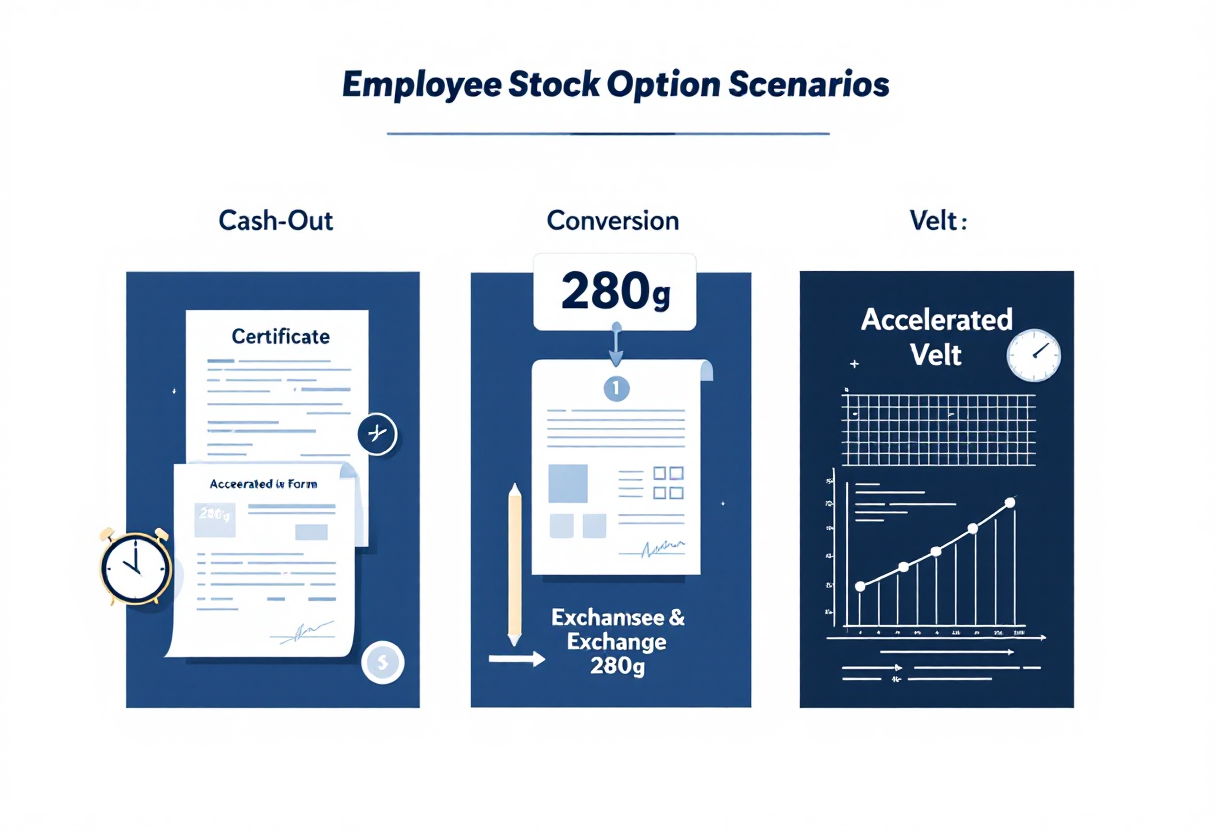
Yes, can options get diluted in a merger and acquisition is the wrong question for most employees, because options are almost never simply “diluted” the way common stock is, instead they get assigned to one of three deterministic fates that range from a same-day cash payout to a forced rollover that can leave the holder underwater for years. SRS Acquiom’s 2025 Deal Terms Study, drawn from more than 1,800 private-target M&A transactions, shows that 73 percent of deals trigger at least partial acceleration of unvested awards, and 41 percent use a double-trigger structure tied to involuntary termination inside the post-close protection window. That gap between “vested cash-out” and “rolled, unvested, and at risk” is where most employee value is won or lost.
Selling a company with a meaningful option pool?
The way option holders are treated in the merger agreement drives retention, 280G exposure, and post-close litigation risk. CT Acquisitions structures deals so vested holders are paid cleanly and unvested holders have a real, modeled retention path. No fee to you on buy-side introductions; sell-side mandates are paid on success at closing.
Book a Free ConsultationWhat This Actually Means
The phrase “option dilution” gets used loosely in two very different contexts. The first is ordinary-course dilution, when a company issues new shares (a financing round, a new option pool top-up, a secondary offering) and existing option holders see their fully-diluted ownership percentage shrink. The second is M&A-specific treatment, where a change-in-control event triggers contractual provisions inside the equity plan and the individual award agreements that determine exactly what happens to every option, restricted stock unit, restricted share, performance share, and ESPP purchase right on the books.
The M&A version is not really dilution in the accounting sense. It is conversion. Treasury Regulation 1.424-1 and the ASC 718 codification on stock compensation both contemplate that a corporate transaction will either cash out outstanding awards, replace them with substantially equivalent awards in the acquirer’s stock, or accelerate them. Which path applies is governed by three documents: the equity incentive plan, the individual grant agreement, and the definitive merger agreement signed at signing. When those three documents disagree, the merger agreement controls for the transaction itself and the grant agreement controls for anything that survives the close.
The practical impact on the option holder is binary in a way that ordinary dilution is not. In an ordinary financing, a 0.5 percent stake might shrink to 0.42 percent and the holder still has the same number of shares with the same exercise price. In M&A, a 0.5 percent stake might convert to a wire transfer at close, or it might convert to a new grant in a private acquirer’s stock that the holder cannot sell for five years. The difference is not a few basis points. It is the difference between a liquidity event and a hostage situation.
The Six Things You Need to Understand About Option Treatment in M&A
The Three Fates of Vested Options
Every vested option in the target’s pool ends up in exactly one of three places on closing day. The merger agreement’s “treatment of equity awards” section spells out which fate applies to which tranches, and the choice has direct cash-flow and tax consequences for both sides.
The first fate is cash-out at deal price. The acquirer pays the option holder the spread between the per-share deal consideration and the exercise price, net of applicable tax withholding. For an option with a $10 strike when the deal price is $50 per share, the holder receives $40 per share in cash. SRS Acquiom’s 2025 data shows cash-out is the most common treatment in private-target deals, used in roughly 58 percent of transactions where vested awards exist. It is clean, it is taxable as ordinary income for non-qualified options, and it eliminates ongoing administrative burden for the acquirer.
The second fate is conversion to acquirer options at the exchange ratio. The target option becomes an option to buy acquirer shares, with the share count and exercise price both adjusted so the intrinsic value and ratio of exercise price to fair market value are preserved. This is the path required when the acquirer wants to retain the holder and the deal includes a stock component. Treasury Reg 1.424-1(a) sets the technical rules that must be followed to avoid triggering a new grant for tax purposes, and a deviation from those rules can convert an incentive stock option into a non-qualified option, which costs the holder favorable long-term capital gains treatment.
The third fate is accelerated vesting followed by cash-out. This applies when the merger agreement provides for full acceleration on the close (single-trigger), regardless of whether the holder stays. The acquirer pays the spread on the now-fully-vested award and the option terminates. This is the most employee-friendly outcome and the least common in 2025 deals.
Unvested Options and the Single vs Double Trigger Question
Unvested options are the central battleground of the merger agreement’s equity section. Under the typical NVCA model change-in-control provision, unvested options follow one of two structures.
Single-trigger acceleration means the change-in-control event itself causes all unvested awards to vest immediately. The holder gets the full economic value of the award at close, even if they leave the next day. This sounds attractive to employees but acquirers hate it because it eliminates the retention tool the equity was supposed to provide. Mercer’s 2025 M&A integration practices report indicates that fewer than 18 percent of private-company deals use single-trigger acceleration for the rank and file, though it remains common for the CEO and named executive officers under their employment agreements.
Double-trigger acceleration requires both the change-in-control and a qualifying termination, typically termination without cause or resignation for good reason within a 12 to 24 month protection window after close. SRS Acquiom 2025 reports the 12 month window appears in 43 percent of deals, the 18 month window in 31 percent, and 24 months in 22 percent. If the holder survives the window without being terminated, the unvested awards simply continue vesting on the original schedule, now denominated in acquirer stock. If the holder is terminated without cause inside the window, the unvested awards accelerate and pay out at the deal price (or a formula tied to it).
The double-trigger design is the workhorse of modern M&A equity treatment because it aligns three interests at once. The acquirer keeps a retention tool. The selling shareholders avoid 280G excise tax exposure (more on this below). The employee gets meaningful protection against being acquired and immediately fired.
Underwater Options Get Cancelled for Nothing
An option is underwater when the exercise price exceeds the per-share deal consideration. A $60 strike option in a deal that closes at $50 per share has no intrinsic value, and the standard merger agreement cancels these options for no consideration at close. This is one of the most painful surprises for employees who joined late in the company’s life cycle, after the 409A valuation had already climbed past the eventual sale price.
Underwater treatment is not a negotiation point in most deals because the underwater holders are usually not large enough in aggregate to block the transaction. The exception is a distressed sale where most of the option pool is underwater, in which case some acquirers will offer a token retention payment to underwater holders, structured as a cash bonus rather than option consideration, to keep critical employees engaged through integration. Carta’s 2025 State of Private Markets report notes that distressed sale “consolation pool” payments to underwater holders averaged $4,200 per affected employee in the deals where they appeared, which is enough to ease the sting but not enough to make the holder whole.
RSU Treatment Looks Cleaner But Hides a Cliff
Restricted stock units are simpler than options because there is no exercise price to worry about. A vested RSU is essentially a share, and at close it gets the same per-share consideration any common share gets. Unvested RSUs follow the same single-trigger or double-trigger logic as unvested options, with the key difference that an unvested RSU always has positive value (it is never “underwater”) because there is nothing to pay to exercise it.
The cliff problem with RSUs is in cliff-vesting awards, where the first tranche does not vest until a 12 or 18 month anniversary. WTW’s 2025 M&A retention bonus survey shows that 31 percent of target-company RSU grants in the dataset had not yet reached their cliff at the time of signing, meaning those holders were entirely dependent on the merger agreement’s acceleration treatment. If the deal provides for single-trigger acceleration, the cliff RSUs pay out. If the deal provides for double-trigger and the holder is not terminated, the cliff RSUs roll into acquirer RSUs with the original cliff date intact, which can mean an employee waits two years for a first tranche to vest into a stock they did not choose.
The Dilution Math When Options Roll to Acquirer Stock
When the merger agreement calls for conversion rather than cash-out, the mechanical conversion preserves both intrinsic value and the ratio of exercise price to fair market value, per the Treasury Reg 1.424-1 rules. The math works as follows. The exchange ratio is the per-share deal consideration divided by the acquirer’s reference stock price. New share count equals old share count multiplied by the exchange ratio. New exercise price equals old exercise price divided by the exchange ratio.
An employee with 10,000 options at a $10 strike, in a deal where the target sells for $50 per share and the acquirer’s reference price is $100 per share, would see the following conversion. The exchange ratio is 0.5 ($50 / $100). The new share count is 5,000 (10,000 x 0.5). The new exercise price is $20 ($10 / 0.5). Intrinsic value before the deal was $400,000 (10,000 shares times the $40 spread between $50 and $10). Intrinsic value after the deal is $400,000 (5,000 shares times the $80 spread between $100 and $20). The economic position is identical at the close.
The dilution risk emerges from what happens next. The employee now holds an option on the acquirer’s stock and is exposed to acquirer dilution events: new option pool top-ups, secondary offerings, acquisition-driven share issuances. The treasury method anti-dilution language found in most well-drafted equity plans protects against splits, stock dividends, and recapitalizations, but it does not protect against ordinary-course dilution from new financings. A holder converted into a private acquirer’s stock can watch their fully-diluted percentage shrink with every subsequent round, while still being unable to sell.
The 280G Golden Parachute Trigger for Executives
Internal Revenue Code Section 280G and the implementing Treasury Regulation 1.280G-1 impose a 20 percent excise tax on “excess parachute payments” made to “disqualified individuals” in connection with a change in control. The disqualified individual category includes officers, shareholders owning more than 1 percent, and the highest-paid 1 percent of employees. The excess parachute payment is the portion of the change-in-control payment that exceeds three times the individual’s base amount, where the base amount is the five-year average W-2 compensation.
The trigger is meaningful because accelerated equity counts toward the parachute payment calculation. A senior executive with a $400,000 average base amount has a 280G threshold of $1.2 million (3x base). If the change-in-control acceleration produces $2.5 million in equity payout plus a $500,000 retention bonus, the total parachute payment is $3 million. The excess over the threshold is $1.8 million ($3 million minus $1.2 million), but the excise tax is calculated on the amount over one times base ($400,000), not the amount over three times base. So the executive owes 20 percent excise tax on $2.6 million ($3 million minus $400,000), a $520,000 tax bill on top of ordinary income tax, and the company loses its deduction for the same $2.6 million.
Mitigating 280G is a standard exercise on every deal with executive equity. Common techniques include valuation cutbacks (reducing the parachute payment so it falls just below the three-times threshold), shareholder vote cleanse procedures available only to private companies under Section 280G(b)(5), and reasonable-compensation defenses where the company demonstrates that some portion of the payment is consideration for post-close services or a covenant not to compete. WTW’s 2025 survey shows that 67 percent of deals with named executive officer equity acceleration involved a formal 280G analysis, and 41 percent used the shareholder cleanse vote.
Worked Example: 10,000 Options at $10 Strike in a $50 Deal
Consider a fictional but realistic scenario. Maria is a senior engineer at a software company being acquired. She holds 10,000 options with a $10 exercise price, granted three years ago. The vesting schedule was a four-year monthly vest with a one-year cliff. At signing, 7,500 of her options are vested and 2,500 remain unvested. The deal price is $50 per share. The acquirer’s reference stock price is $100. The merger agreement provides for cash-out of vested options and double-trigger acceleration of unvested options, with a 12 month protection window.
At close, Maria’s 7,500 vested options are cashed out at the spread. The payment is 7,500 multiplied by ($50 minus $10), or $300,000 gross. This is treated as ordinary compensation income because her options are non-qualified options (they were originally incentive stock options but the cash-out triggers disqualifying disposition treatment). Federal withholding at 22 percent supplemental rate plus state and FICA brings net cash to her bank account to approximately $195,000 (assuming a 35 percent all-in marginal effective rate).
The 2,500 unvested options convert to acquirer options at the 0.5 exchange ratio. Maria now holds 1,250 acquirer options at a $20 exercise price, with the original vesting schedule intact. If she stays employed for the full 12 month protection window, the options continue vesting and become exercisable as a normal acquirer grant. If she is terminated without cause inside the window, the 1,250 options accelerate and pay out at the then-current acquirer stock price minus $20.
If Maria’s role is eliminated six months after close and the acquirer stock is trading at $110, the accelerated payment is 1,250 multiplied by ($110 minus $20), or $112,500 gross, again as ordinary compensation. Net cash is approximately $73,000 after withholding. Total economic outcome over the transaction and termination event is roughly $268,000 net of tax.
If Maria is a senior executive rather than a senior engineer, the 280G analysis becomes binding. Assume her base amount is $250,000. Three times base is $750,000. Her gross parachute payments are $300,000 (vested cash-out) plus $112,500 (accelerated unvested) plus a $500,000 retention bonus, totaling $912,500. She is over the threshold by $162,500. Without a cutback or cleanse vote, the excise tax is 20 percent of $662,500 ($912,500 minus $250,000), or $132,500. With a $162,500 cutback to her retention bonus, the total drops to $750,000 and the excise tax is zero. Maria takes home more after tax with the cutback than without it.
Common Mistakes Option Holders Make
Not Modeling the Acceleration Tax Hit Before Signing
The single biggest mistake is treating gross acceleration value as net take-home. The 22 percent supplemental federal withholding rate is not the same as the marginal federal rate that applies when income is reconciled on the annual return, and high earners typically face an additional reconciliation bill of 15 to 20 percent of the gross payment when they file. An employee planning to use acceleration proceeds for a house down payment or debt payoff should run the after-tax number through a CPA before signing the offer letter or accepting the deal terms.
Not Reading the Clawback Provisions
Many merger agreements include clawback provisions for accelerated equity if the holder breaches a non-compete, non-solicit, or confidentiality covenant within 12 to 24 months after close. A clawback can require the holder to return the gross pre-tax accelerated payment even though they only received the after-tax net, leaving them out of pocket for the withholding that was already remitted to the IRS. Reading the survival provisions in the grant agreement and the merger agreement before deciding to leave for a competitor is essential.
Assuming ISOs Stay ISOs Through Conversion
Incentive stock options under IRC Section 422 retain their favorable tax treatment only if the post-merger option meets the same technical requirements as the pre-merger ISO. The Treasury Reg 1.424-1 mechanics for the share count and exercise price adjustment must be followed precisely. If the merger agreement’s conversion formula deviates, the post-merger option becomes a non-qualified stock option for tax purposes, and the holder loses the ability to qualify for long-term capital gains treatment on the spread.
Ignoring ESPP Treatment
Employee stock purchase plans under IRC Section 423 are usually handled by truncating the current offering period and forcing a final purchase at close, with the deal consideration applying to the purchased shares. Employees who were enrolled at the 15 percent maximum discount get the discount on the final purchase, but the offering period ends, and ESPP enrollment in the acquirer’s plan (if one exists) requires separate election. Many employees miss the enrollment window and lose six to twelve months of accumulated benefit.
Not Negotiating the Definitive Agreement Equity Section
Rank and file employees have no control to negotiate the merger agreement, but senior individual contributors and executives often have material control in the weeks before signing, when the acquirer is still trying to lock down key talent. The right time to negotiate enhanced acceleration, a 280G gross-up, or a transaction bonus is during the offer-letter amendment or retention agreement discussion that precedes the merger close, not after the deal is announced.
Confusing Acceleration With Vesting Credit
Some deals provide “vesting credit” rather than acceleration. A 12 month vesting credit means the holder is treated as if they had been employed an additional 12 months, accelerating only the tranches that would have vested in that window. A holder with a four-year vest who is 18 months in will see a substantially smaller payout under 12 month vesting credit than under full acceleration. SRS Acquiom 2025 reports that vesting credit appears in 14 percent of deals as a middle-ground compromise between full acceleration and no acceleration.
Timeline and Process: From Signing to Cash in Hand
The timeline from merger signing to cash in an option holder’s account follows a predictable pattern.
Phase 1: Signing to Employee Communication (Day 0 to Day 7). The merger agreement is signed and announced publicly. Within seven days, most acquirers publish a transition FAQ to employees describing the high-level equity treatment. The FAQ typically does not include individualized payout numbers and explicitly references the closing date as the trigger for individual equity letters.
Phase 2: Equity Treatment Letters (Day 30 to Day 60). The target company’s stock administrator, usually working with Carta, Shareworks, or the acquirer’s transition team, sends individual equity treatment letters showing each holder’s options by tranche, the vested versus unvested split, the cash-out versus rollover treatment, and the gross payment estimate. Holders are asked to sign acknowledgement forms and update payment information.
Phase 3: Regulatory and Shareholder Approval (Day 60 to Day 120). Hart-Scott-Rodino antitrust review, target shareholder approval, and any required regulatory consents proceed in parallel. Option holders do not need to take any action during this phase. The merger agreement contains a long-stop date, typically six to nine months after signing, by which all conditions must be satisfied or the deal can be terminated.
Phase 4: Closing (Day 120 to Day 180). The acquirer wires the merger consideration to the paying agent. The paying agent (typically a transfer agent such as Computershare or Equiniti) distributes the consideration to common shareholders, preferred shareholders, and the option holders entitled to cash payment. Cash-out option holders typically receive payment within 10 business days after close. Rolled options are reflected in the acquirer’s stock administration system within 30 days.
Phase 5: Post-Close Protection Window (Day 180 to Day 720). The double-trigger protection window runs from close. Holders with rolled unvested awards are protected against involuntary termination during this period. If termination without cause occurs inside the window, the accelerated payment is typically wired within 30 days of the termination date.
How Acceleration Provisions Compare Across Deal Types
| Deal structure | Vested option treatment | Unvested option treatment | Frequency in 2025 deals |
|---|---|---|---|
| Strategic acquirer, all cash | Cash-out at spread | Double-trigger acceleration, 12-18 mo window | ~46 percent (SRS Acquiom 2025) |
| Strategic acquirer, stock-for-stock | Roll to acquirer options at exchange ratio | Roll to acquirer with double-trigger overlay | ~22 percent (SRS Acquiom 2025) |
| Private equity sponsor buyout | Cash-out plus rollover offer for management | Cancel and replace with sponsor management equity plan | ~24 percent (Mercer 2025) |
| Take-private of public target | Cash-out at deal price | Single-trigger acceleration common for NEOs, double for rank and file | ~6 percent (WTW 2025) |
| Distressed or fire sale | Underwater options cancelled; in-the-money rare | Most awards cancelled, consolation cash bonuses for key talent | ~2 percent (Carta 2025) |
The table understates the variance inside each category. Within strategic all-cash deals, the double-trigger window ranges from 12 months (most common) to 24 months (most generous), and a handful of deals run as short as 6 months for non-executive holders. Within sponsor buyouts, the rollover offer to management is usually capped at the top 10 to 20 holders, and the new sponsor equity plan rebases vesting from close, meaning a manager who was 75 percent vested at signing restarts a four-year vest after close on the new sponsor pool.
Frequently Asked Questions
Are vested options always paid out in cash at close?
No. Vested options can be cashed out, rolled into acquirer options, or accelerated and cashed out, depending on what the merger agreement provides. Cash-out is the most common treatment in private-target deals, but stock-for-stock transactions often roll vested options to preserve continuity. The treatment of equity awards section in the definitive merger agreement controls.
What happens to my options if the deal falls through?
Nothing. Until close, the options continue to vest and remain exercisable under their original terms. If the deal terminates before close, the option holder is in the same position as before signing, with the same vesting schedule and the same exercise price. The only practical effect is that any new grants made during the pendency may be subject to delayed processing.
Can my employer cancel my vested options in a merger?
Vested options can be cancelled only with consideration. The merger agreement cannot extinguish vested options for no payment unless the options are underwater (exercise price exceeds deal price), in which case cancellation for no consideration is standard. Vested in-the-money options must be cashed out, rolled, or accelerated and cashed out.
How long do I have to exercise my options after the merger announces?
Most plans give holders a window between signing and closing to exercise vested options under the original terms. The window matters for ISO holders who want to start the one-year holding period for long-term capital gains treatment before the cash-out triggers a disqualifying disposition. Exercising before close also locks in pre-merger 409A valuation for AMT purposes, which can reduce the alternative minimum tax bill for high-spread ISO exercises.
What if my unvested options roll to a private acquirer?
The options continue vesting in the acquirer’s stock on the original schedule. If the acquirer is private, the holder has no public market to sell into, and liquidity depends on the acquirer’s own future exit, secondary tender, or recapitalization. The holder is also exposed to ordinary-course dilution from new acquirer financings, which can shrink the fully-diluted percentage over time.
How are options taxed differently from RSUs in M&A?
Cash-out of non-qualified options is taxed as ordinary compensation income at the spread between deal price and exercise price, with FICA and Medicare withholding applied. Cash-out of RSUs is taxed as ordinary compensation income on the full deal price, also with FICA and Medicare. ISOs cashed out in a disqualifying disposition lose long-term capital gains treatment and become ordinary income. Rolled options and RSUs generally do not trigger immediate tax because the conversion is structured to preserve the tax basis and holding period.
What to Do Next
If you are running a company through a sale process and option treatment is on the agenda, the merger agreement equity section is one of the highest-impact documents in the deal. Get it right and the company retains key talent, manages 280G exposure, and avoids post-close litigation from disgruntled holders. Get it wrong and the integration loses the people who built the product, the executive team faces personal tax bills they did not expect, and the acquirer inherits a morale problem on day one.
If you are an option holder waiting to see how your awards get treated, the most useful thing you can do is read the equity treatment letter carefully, model the after-tax outcome before signing the acknowledgement, and ask the company’s stock administrator any question you do not understand. The administrator is not your lawyer, but they will tell you what the merger agreement provides and how the payout was calculated.
CT Acquisitions advises sellers on the full M&A process, including the equity treatment provisions that drive employee outcomes and post-close retention. No fee to you on buy-side introductions; sell-side mandates are paid on success at closing.
Get clarity on how your option pool will be treated.
No fee to you on buy-side introductions; sell-side mandates are paid on success at closing. CT Acquisitions models cash-out, rollover, and double-trigger scenarios in the same engagement that runs your buyer outreach.
Book a Free ConsultationRelated reading: how mergers and acquisitions affect employee compensation, is preferred stock used in mergers and acquisitions, and the CT sell-side hub for the full set of seller resources.