What Is a Good Percentage to Sell Your Business?
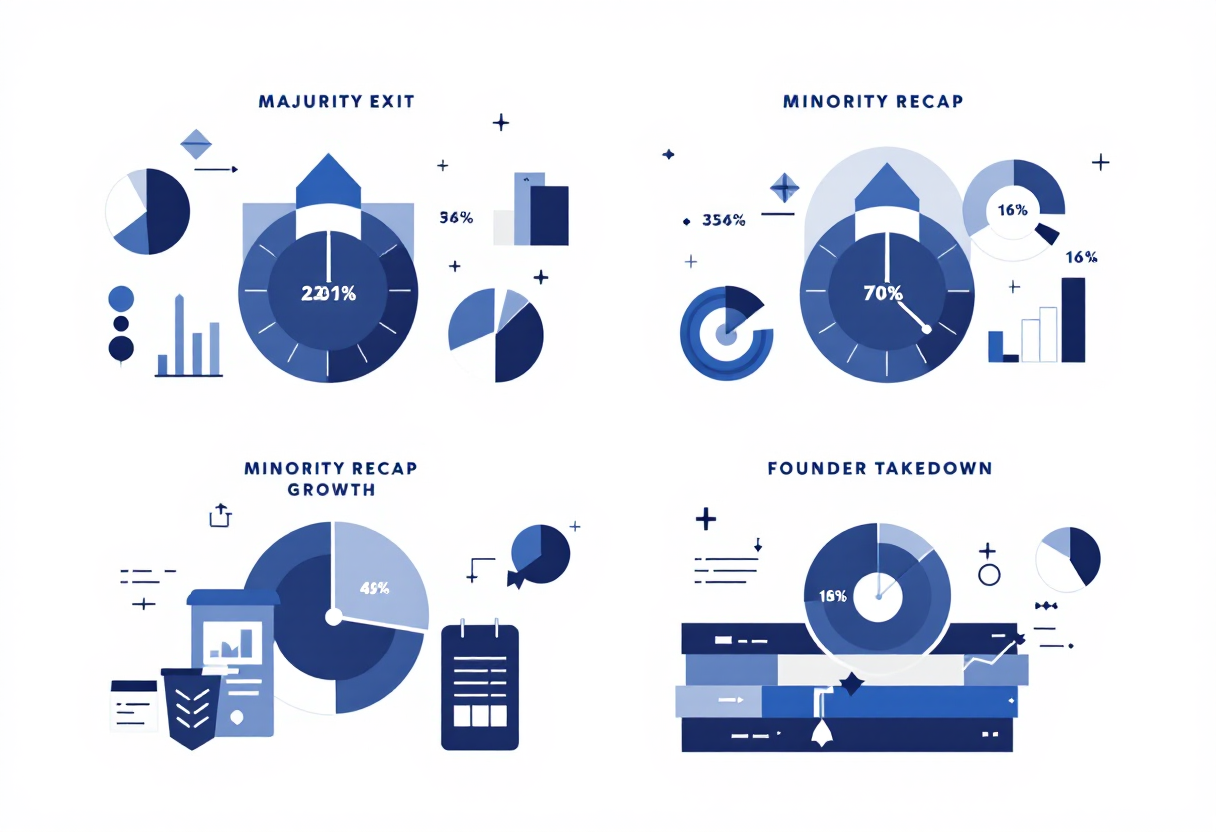
The answer to what is a good percentage to sell your business depends entirely on the owner’s intent: a full exit means 100%, a majority recapitalization runs 50.1% to 80%, a minority growth-equity raise typically lands at 20% to 40%, and a founder takedown for partial liquidity usually sits between 10% and 30%. There is no universal “good” number. There is only the right number for the owner’s goals, the company’s growth runway, and the buyer’s structure.
Context: Why This Question Matters
Owners who sell the wrong percentage either give up control they did not have to give up, or hand over too little to attract a real institutional buyer. Both mistakes are expensive. Picking the right stake size is a structural decision that drives valuation, tax treatment, governance, and how much the owner can pull off the table in a future “second bite.”
The 2025 Stanford GSB Search Fund Study and the SRS Acquiom 2025 Deal Terms Study both show that ownership percentage at close has a measurable effect on rollover economics, escrow exposure, and post-close control rights. The percentage sold is not a sentiment number, it is the cap table.
The Detailed Answer
There are four practical structures, and each implies a different ownership percentage. Below is how M&A advisors typically frame each lane for a lower-middle-market business.
1. Full Exit: 100%
A full exit transfers 100% of equity to the buyer at close. This is the default for owners who are retiring, lack a successor, or are timing a market peak. The 2025 Capstone Partners Lower Middle Market Survey reports that strategic buyers most often demand 100% to clear the cap table and integrate operations cleanly. Tax-wise, the full exit triggers capital-gain treatment on the entire equity stake, with no Section 199A QBI deduction continuing on remaining ownership because there is no remaining ownership. The owner walks with a single, taxable lump sum.
2. Majority Recapitalization: 50.1% to 80%
A majority recap is the dominant private-equity structure. The owner sells 60% to 80% and rolls the remaining 20% to 40% into the new entity alongside the PE sponsor. The PitchBook 2026 PE Deal Trends report shows rollover equity averaging 22% to 28% across lower-middle-market platform deals. The owner gets meaningful liquidity now, retains material upside, and stays involved long enough to drive a second exit in three to seven years. Control rights typically follow the equity: the PE sponsor takes majority board control once they cross 50.1%.
3. Minority Growth Equity: 20% to 40%
Minority growth investments suit founders whose businesses are growing fast and who want capital without giving up the wheel. The Bain 2025 Global Private Equity Report notes that minority growth activity hit a multi-year high in 2024 as founders increasingly chose dilution over majority sale. Pricing is usually a step lower than a full control deal because the buyer cannot force a sale and has limited governance rights. The founder keeps the keys and accepts a smaller check today in exchange for a bigger one later.
4. Founder Takedown / Partial Liquidity: 10% to 30%
The takedown is a small secondary purchase, often by an existing investor or a search fund, designed to take chips off the table without a control change. The 2025 Stanford GSB Search Fund Study documents these structures inside continuation deals and recapitalization waves. The owner sells 10% to 30%, the cap table absorbs the new investor, and operations carry on unchanged. This is the “I just want to derisk personally” lane.
Economics by Structure
| Structure | % Sold | Owner Rollover | Typical Multiple Band | Control Post-Close |
|---|---|---|---|---|
| Full exit | 100% | 0% | Top of range | Buyer |
| Majority recap | 50.1% to 80% | 20% to 40% | Mid to top of range | Buyer (board majority) |
| Minority growth | 20% to 40% | Not applicable | Below control-deal pricing | Founder |
| Founder takedown | 10% to 30% | Not applicable | Negotiated, often discounted | Founder |
Per SRS Acquiom’s 2025 Deal Terms Study, PE buyers in control deals typically issue preferred stock that ranks senior to the founder’s rolled common, which is a structural detail many owners miss until the second bite math gets ugly. The preferred stack sits on top of any sale proceeds at the next exit and gets paid first.
Tax Implications
A 100% sale is fully taxable in the year of close, at long-term capital-gain rates if the holding period is met. A partial sale spreads the event: the sold percentage is taxed now, and the rolled percentage continues to qualify for Section 199A QBI deduction treatment on pass-through income going forward (IRC Section 199A, subject to wage and threshold limits). For a profitable LLC or S-corp, the QBI deduction on the retained slice can be a real annual benefit. The rolled equity also defers capital-gain recognition on that piece until the second exit, which is why majority recaps are tax-efficient relative to full sales of equivalent gross proceeds.
Cap Table and Drag Thresholds
Ownership percentage determines who can force what. Most private-company agreements set a 51% majority drag-along for a sale-of-company vote, with a 75% supermajority threshold for amendments to the charter or for blocking-rights events. The SRS Acquiom 2025 study confirms these as the modal thresholds across lower-middle-market transactions. If the owner sells 80% to a PE sponsor, the sponsor can both drag the owner into a future sale and amend the charter without consent. If the owner sells 49%, the buyer can do neither, which is exactly why minority deals price lower.
Worked Example: $5M EBITDA Company, Four Structures
Assume a $5M EBITDA business worth a 7.0x multiple, so $35M enterprise value, with no debt. Here is how the owner’s economics break under each structure (illustrative, before fees and working-capital adjustments).
| Structure | % Sold | Cash at Close | Rolled Equity Value | Total Day-1 Position |
|---|---|---|---|---|
| Full exit (100%) | 100% | $35.0M | $0 | $35.0M cash |
| Majority recap (70/30) | 70% | $24.5M | $10.5M | $24.5M cash + $10.5M rollover |
| Minority growth (30%) | 30% | $10.5M (likely 6.0x = $9.0M after minority discount) | Not applicable | $9.0M cash, 70% of company retained |
| Founder takedown (15%) | 15% | $5.25M (often discounted to ~$4.5M) | Not applicable | $4.5M cash, 85% of company retained |
The 70/30 majority recap looks worse on Day 1 than the full exit by $10.5M of cash, but the rolled $10.5M typically grows at 2x to 3x by the next sale. If the next sale is at 7.0x on a grown EBITDA of $8M, the rolled 30% is worth around $16.8M pre-tax, plus any earnout. That is the “second bite” math that drives so many owners to choose 70/30 over 100/0.
What Most Owners Get Wrong
Misconception 1: “Selling less means I get less.” Not on a total-economics basis. The rolled equity in a majority recap has historically returned a second bite within three to seven years per PitchBook 2026 data, and that bite often equals 50% to 100% of the original cash-at-close on a present-value basis. Selling 70% can produce more total wealth than selling 100% if the business has real growth runway.
Misconception 2: “If I sell less than 50%, I keep full control.” Only on the cap table. Minority investors negotiate protective provisions, board seats, information rights, and consent rights over major decisions (debt, capex, hiring of executives, sale of company). The 2026 PitchBook data shows that even minority investors with 25% stakes routinely get 1 of 5 board seats and consent rights on transactions over a defined threshold. The founder runs the business, but inside a fence.
Misconception 3: “100% is cleaner.” It is cleaner emotionally. It is also more expensive in two ways: the full tax bill hits in one year, and the owner gives up all upside. The clean break has real value for some owners; it is not free.
How CT Acquisitions Approaches This
CT Acquisitions is an M&A advisor working both sides of the table. Owners do not pay us a retainer or success fee, the buyer pays the entire engagement. That alignment means we are not pushing owners toward whichever structure produces the biggest commission check, we are mapping the structure to the owner’s goals.
For owners who want maximum proceeds and a clean break, we run a full-exit process. For owners who still have operating energy and want a second bite, we structure majority recaps with PE sponsors who actively want founder rollover. For owners who just want some chips off the table, we run quiet takedown transactions that do not disturb the cap table or the employee base. The right percentage is the one that fits the owner’s life, the company’s runway, and the tax window.
Related Questions
Should I sell 100% or roll some equity?
Roll equity if the business is growing, you still have operating energy, and you trust the buyer. Sell 100% if you are retiring, the business has plateaued, or you do not want to work for a new owner. The PitchBook 2026 PE Deal Trends report shows rolled equity has historically produced a second exit at 2x to 3x the rollover basis within three to seven years, which is a real economic argument for the 70/30 structure if the business profile fits.
Can I sell less than 50% and still get a fair price?
Yes, but expect a minority discount of 10% to 25% versus a control-deal multiple. Bain’s 2025 Global Private Equity Report notes that minority growth investors price their checks below control deals because they cannot force a sale and have limited governance. The trade is liquidity now, with growth optionality retained.
Does selling 80% mean the buyer controls everything?
Yes on board votes, cap table, and sale decisions. No on day-to-day operations if the seller stays as CEO under an employment agreement, which is the standard PE recap structure. Owner-operators in 70/30 deals typically retain a board seat and a meaningful operational role for two to five years post-close.
What percentage do PE firms usually want?
Most lower-middle-market PE sponsors target 70% to 80% in a control deal, with the owner rolling 20% to 30%. PitchBook’s 2026 platform-deal data shows the 75/25 split as the modal outcome. Some funds go to 60/40 if the founder is critical to the business; some push for 85/15 if they want cleaner exit optionality. The 70/30 is the gravitational center.
Is there a tax reason to sell less than 100%?
Yes. Selling less than 100% spreads the capital-gain recognition across two events (the current sale and the future second exit), and any retained equity in a qualifying pass-through can continue to receive Section 199A QBI deduction treatment on its share of business income (IRC Section 199A). For owners with large gain positions, the partial sale can materially reduce total federal tax over the holding period.
What to Do Next
The right percentage to sell is a structural decision tied to goals, growth runway, tax timing, and successor planning. It is not a number an owner should pick alone or pick based on a benchmark from a different industry. The cleanest way to find the right number is to model all four structures against the actual business and see which one produces the best total-economics outcome on a multi-year horizon.
Get a Free Consultation
CT Acquisitions models full-exit, majority-recap, minority growth, and founder-takedown structures against the real numbers of your business. No fee to you on buy-side introductions; sell-side mandates are paid on success at closing.
Book a Free ConsultationRelated reading: how preferred stock works in M&A deals, where the proceeds actually go in a business sale, and the sell-your-business hub for owner-side resources by vertical.