Succession Planning vs Succession Management: What Buyers Look For (2026)
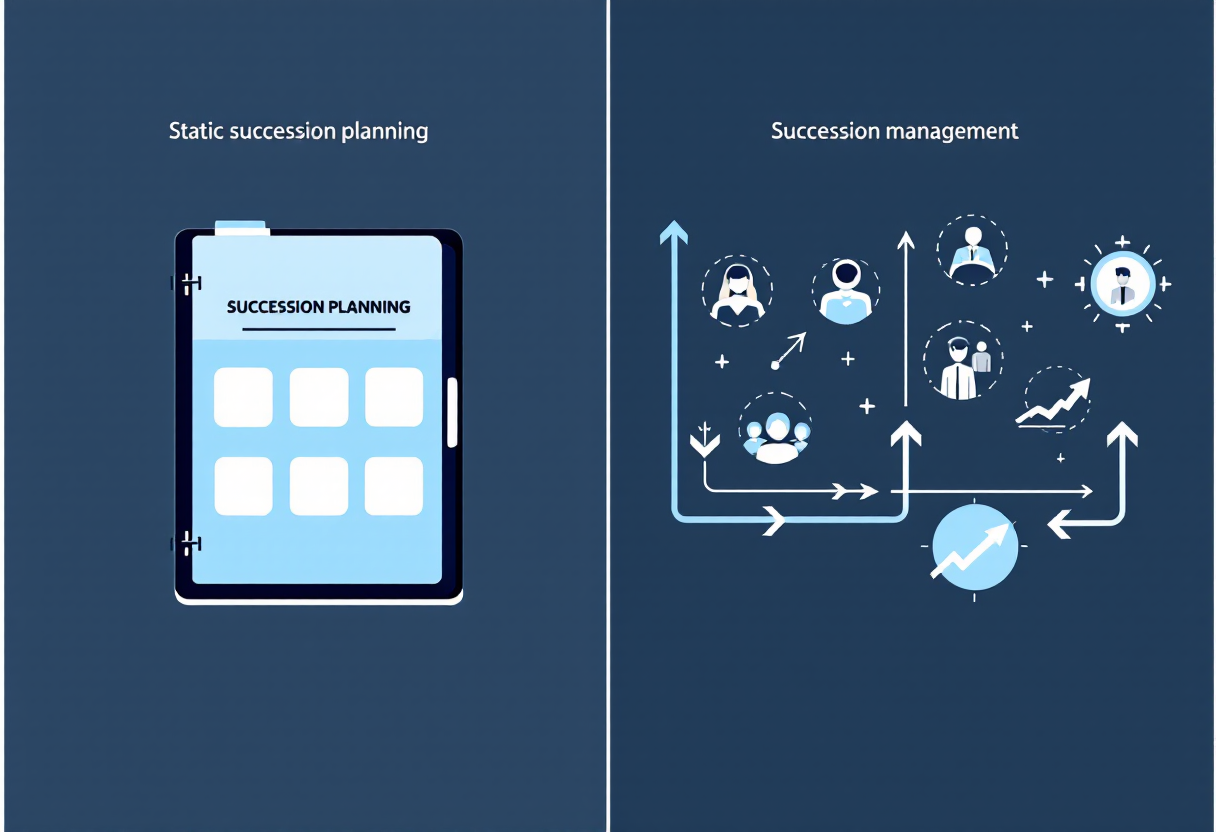
The difference between succession planning vs succession management is the difference between a binder on a shelf and a living talent system that actually produces ready successors when a CEO, COO, or general manager walks out the door. SHRM’s 2025 Talent and Succession Research Report found that 56 percent of organizations have a written succession plan for the C-suite, but only 21 percent run an ongoing program with quarterly reviews, development assignments, and named-and-tracked successor pipelines. That gap is exactly what private equity buyers price into a deal.
Selling and worried buyers will discount your business for thin management depth?
CT Acquisitions represents 500+ buyers, including PE platforms that pay premiums for sellers with real management bench strength. No fee to you on buy-side introductions; sell-side mandates are paid on success at closing.
Book a Free ConsultationWhat This Actually Means
Succession planning, in the strict sense most HR consultancies use it, is a documentation exercise. You list the critical roles. You name a successor or two per role. You note whether each successor is ready now, ready in one to two years, or ready in three-plus years. You drop the document into a shared drive, present it to the board once a year, and move on. It is point-in-time, static, and largely owned by HR with light input from the CEO.
Succession management is the operating program that sits underneath that plan and actually makes the named successors ready. It includes quarterly talent reviews, 9-box calibration sessions, individual development plans tied to specific capability gaps, stretch assignments, executive coaching, scenario drills for emergency departures, and a formal governance cadence at the executive committee. Heidrick and Struggles’ 2025 CHRO Survey reported that 73 percent of Fortune 500 CHROs say their company has a succession plan, but only 29 percent say they actually run succession management as a continuous program with named owners and measurable outcomes.
For business owners preparing for a sale, the distinction is not academic. A buyer doing diligence can read a succession plan in 20 minutes. Evaluating succession management takes a week, because the buyer wants to see meeting minutes, development plan progress reports, 9-box history across at least eight quarters, and evidence that internal promotions track to the plan. If that evidence does not exist, the buyer assumes key-person risk and prices the business accordingly.
The Six Things You Need to Understand
1. Planning Is Static, Management Is Continuous
Current state at most mid-market companies: A succession plan refresh happens once a year, usually six weeks before the board meeting. HR pulls last year’s deck, asks each direct report of the CEO who their successor is, updates the slide, and presents. Nothing changes between refreshes.
Target state with real management: A standing quarterly succession review on the executive committee calendar. Each critical-role owner presents the readiness status of their named successors, what development moves happened in the last 90 days, what gaps remain, and what the next 90-day development moves are. The CHRO maintains a live readiness scorecard that updates every quarter, not every 12 months.
Impact on outcome: When a key executive leaves unexpectedly, companies with continuous management fill the role internally in a median of 38 days according to DDI’s 2025 Global Leadership Forecast. Companies relying on planning alone average 184 days and fill externally 64 percent of the time, at a typical cost of 1.5 to 2x base salary in search fees plus 9 to 14 months of productivity drag.
2. Planning Is Owned by HR, Management Is Owned by the CEO
Current state: The CHRO or VP HR maintains the succession plan document. The CEO reviews it once a year and largely defers to the CHRO on who is on the list. Line leaders treat it as an HR exercise.
Target state: The CEO owns the succession outcome for the top two reporting layers. The CHRO owns the program mechanics (calendar, templates, talent review process, 9-box facilitation), but the named successors and their development moves are decisions the CEO and the relevant business unit leader make jointly. Line leaders are measured on bench strength as part of their annual performance review.
Impact: SHRM’s 2025 report found that organizations where the CEO is the named owner of succession management produce 2.4x more internal promotions to executive roles than organizations where HR owns the process. Buyers know this and ask directly in management meetings: “Who owns succession in this company?” If the answer is “HR,” that is a discount signal.
3. The 9-Box, Talent Reviews, and Development Assignments
Succession management without a 9-box is essentially impossible to run at scale. The 9-box is a grid that plots employees by current performance (low, medium, high) on one axis and future potential (low, medium, high) on the other. The top-right cell (high performance, high potential) is the successor pool. The middle cells are the development pool. The bottom-left cells trigger performance conversations.
The calibration meeting is the operating mechanic. Each business unit leader brings their team’s draft 9-box to a peer review. Peers challenge placements (“you have her in the top-right but she has not led anything outside her function, that is a high-potential not a high-performer-high-potential”). The CEO and CHRO facilitate. Outcomes drive development moves: who gets the next stretch assignment, who rotates into a new function, who gets the executive coach, who gets named to the high-potential leadership program.
Development assignments are the engine. Mercer’s 2025 Global Talent Trends survey reported that 78 percent of senior leaders promoted into C-suite roles credit a single stretch assignment, typically running a P&L for the first time or leading a transformation project, as the experience that made them ready. Without an active management program, those assignments do not get planned, they happen by accident.
4. M&A Buyer Evaluation: Plan-Only vs Real Management
This is where the distinction becomes a dollar-figure conversation. Private equity buyers, especially those running platform-and-add-on strategies, value management bench strength heavily because their thesis depends on the business running without the founder-CEO for at least three to five years post-close. If the seller is also the CEO and there is no clear successor with measurable readiness, the buyer either discounts the offer or structures a long earnout to keep the seller in seat.
A working CT estimate from buy-side mandates in 2025 and early 2026: businesses in the 5M to 25M EBITDA range with documented succession management (named successors with development plan progress, 9-box history, quarterly review minutes) close at multiples 0.5x to 1.0x higher than otherwise-comparable businesses with plan-only succession. On a 10M EBITDA business, that is 5M to 10M of enterprise value. KPMG’s 2025 Global Family Business Report found similar dynamics in family-business transitions: families that ran active succession management for at least three years pre-transition reported 31 percent higher final transaction values than those with documentation-only plans.
5. The Five-Stage Maturity Model
Most companies sit somewhere on this maturity curve. Buyers map sellers to it during diligence.
| Stage | What It Looks Like | Buyer Reaction |
|---|---|---|
| 1. Ad-hoc | No written plan. CEO has names in their head. No 9-box, no reviews. | Significant key-person discount. Earnout structure required. |
| 2. Basic plan | One-page document listing successors for C-suite roles. Updated annually if at all. | Mild discount. Buyer assumes successors are not actually ready. |
| 3. Formal plan | Multi-page plan covering top two layers, ready-now and ready-later labels, signed by CEO and board. | Neutral. Buyer treats as baseline expectation. |
| 4. Active management | Plan plus quarterly reviews, 9-box, development plans with measurable progress, evidence of internal promotions tracking to the plan. | Premium. Buyer credits management depth in valuation. |
| 5. Integrated talent system | Active management plus tie-ins to compensation, performance management, learning and development, and HRIS. Board-level talent committee. | Full premium. Often a strategic acquirer target. |
The jump from stage 3 to stage 4 is where the valuation lift happens. Heidrick and Struggles’ 2025 data suggests fewer than one in four mid-market companies sits at stage 4 or above. If you are at stage 3 and considering sale in 18 to 36 months, moving to stage 4 is one of the highest-return preparation projects you can run.
6. Tools and Cadence
Succession management does not require expensive software, but at scale it benefits from it. The common stack:
- HRIS module: Workday Succession Planning, SAP SuccessFactors Succession and Development, or Oracle HCM Succession. These hold the successor pools, readiness ratings, and 9-box placements as data, not a deck.
- Talent review platform: Companies above 5,000 employees often use a dedicated review tool (Reflektive, Lattice, or 15Five for performance feeds into talent reviews).
- Cadence: Quarterly talent review at the executive committee. Annual board-level succession review. Semi-annual 9-box calibration across all VP-plus roles. Monthly check-ins between successor and their development sponsor.
- Documentation: Individual development plans for every named successor, with capability gaps, learning interventions, stretch assignments, target completion dates, and quarterly progress notes.
A buyer’s diligence team will ask to see the last four quarterly review packets, the most recent 9-box, and three sample development plans. If those artifacts exist and show actual movement, that is the evidence that separates management from planning.
Worked Example: How the Valuation Math Plays Out
Consider a fictional managed services provider, NorthBay IT Services, doing 38M revenue and 7.2M EBITDA. Founder-CEO is 58 and wants to sell to a PE platform in the next 24 months. Two scenarios.
Scenario A, plan-only: NorthBay has a one-page succession plan listing the COO as the CEO successor, the VP Sales as the CRO successor, and the VP Engineering as the CTO successor. The plan is two years old. No 9-box, no quarterly reviews, no development plans. The COO has been COO for seven years and has never run a P&L independently. The VP Sales has never managed a region beyond his current scope.
PE buyer offers 8.5x trailing EBITDA, or 61.2M enterprise value, with 30 percent of consideration as a five-year earnout tied to the founder staying as CEO for at least 36 months post-close. The earnout effectively caps upside and locks the founder in.
Scenario B, active management: NorthBay spent the prior 18 months implementing succession management. The COO ran a P&L pilot for the Northeast region for 12 months and hit plan. The VP Sales completed an executive coaching engagement and was given direct ownership of the inside sales team plus the field team for the last nine months. Quarterly talent reviews show 9-box movement. Three internal promotions to VP roles in the last 24 months tracked to the plan.
Same PE buyer offers 9.4x trailing EBITDA, or 67.7M enterprise value, with only 15 percent of consideration as a two-year earnout. The founder-CEO transitions to executive chair after 12 months.
The delta: 6.5M of additional enterprise value, faster founder exit, less earnout risk. The cost of getting from Scenario A to Scenario B was approximately 180K in external coaching plus internal time. The ROI on succession management as a pre-sale preparation move was 35x.
Common Mistakes
Confusing Replacement Planning with Succession Management
Replacement planning identifies who would step in if a critical role suddenly opened. It is a continuity tool. Succession management develops people to be ready for those moves before they happen. Companies that conflate the two end up with a list of names but no development pipeline. For the deeper breakdown of replacement vs succession, see our guide on replacement planning vs succession planning.
Naming a Successor Without a Development Plan
Naming Jane as the successor to the COO is meaningless if Jane has the same skill gaps today she had two years ago when she was first named. The development plan, with measurable progress, is what turns a name on a slide into actual readiness.
Treating It as an HR Exercise
The CHRO owns the program mechanics. The CEO owns the outcome. If the CEO does not personally lead the quarterly review and is not measured on bench strength by the board, the program will atrophy within 18 months.
Only Covering the C-Suite
Real management covers the top two layers minimum, often three. The VP and director bench is where the next decade of executive talent comes from. Plans that stop at the C-suite ignore where the pipeline actually gets built.
Skipping the 9-Box Calibration
Without peer calibration, each leader rates their own team generously. The 9-box becomes worthless because everyone is a high-potential. Calibration meetings are uncomfortable by design and that is the point.
No Emergency Drill
Every program should run a tabletop exercise at least annually: “the CEO is incapacitated tomorrow, walk us through the first 30 days.” If the answer involves a panicked board meeting and a retained executive search, management is not actually in place.
Timeline: Moving from Planning to Management in 12 Months
For owner-CEOs preparing for sale in 18 to 36 months, here is the realistic timeline to move from stage 3 (formal plan) to stage 4 (active management).
- Month 1: Baseline. Audit current state. Inventory critical roles, current successors, and gaps. Establish executive sponsor (CEO) and program owner (CHRO or VP HR).
- Months 2 to 3: Framework. Build the 9-box template, talent review templates, individual development plan template. Train the executive committee on calibration. Schedule the quarterly review cadence on the standing executive committee calendar.
- Month 4: First calibration. Run the first 9-box across VP-plus roles. Expect it to be messy and inflated. The discipline comes from the second and third calibration, not the first.
- Months 5 to 6: Development plans. Build individual development plans for every named successor. Identify the stretch assignments, coaching engagements, and cross-functional moves needed in the next 12 months.
- Months 7 to 9: First development moves. Execute the first round of stretch assignments and rotations. This is where the real talent signal emerges, who steps up and who does not.
- Months 10 to 12: Second calibration and board review. Run the second 9-box, compare against the first, document the changes. Present an annual succession review to the board with quarterly cadence going forward.
By month 12 the company has four quarterly reviews, two 9-box calibrations, a documented set of development plans with progress notes, and at least one example of an internal promotion that tracks to the plan. That is the evidence package a buyer’s diligence team will want to see.
For the broader process of building succession into a sellable company, see our guide on effective succession planning. If you are preparing your business for sale generally, our sell-your-business hub covers the full pre-sale preparation framework.
Frequently Asked Questions
Is succession management the same as talent management?
Talent management is the broader discipline covering hiring, performance, development, and retention across the entire workforce. Succession management is the subset focused specifically on developing internal candidates ready to step into critical roles. The two are connected, succession management depends on healthy talent management data, but they are not interchangeable.
How much does it cost to run succession management at a mid-market company?
At a 200 to 500 employee company, the program typically costs 60K to 200K annually in external coaching, assessment tools, HRIS module fees, and consultant facilitation, plus internal time roughly equivalent to one quarter FTE of CHRO and half FTE of HR business partner support. The ROI on a future sale, in the range described above, generally pays back the investment many times over.
Can a small business with 30 employees run succession management?
Yes, but in a lighter form. The principles (named successors, development plans, stretch assignments, quarterly check-ins) apply at any size. The formal 9-box and HRIS module are overkill below 100 employees. A simple spreadsheet, quarterly meetings between the owner-CEO and each key successor, and documented development moves are sufficient.
What if I do not have an internal successor?
That is a finding, not a failure. Buyers prefer internal succession but will accept a planned external hire if the gap is documented, a search timeline exists, and the seller is willing to stay 12 to 24 months to onboard the new executive. The worst case is having no plan and no acknowledgement of the gap. Honest documentation is better than fictional bench strength.
How long before a sale should we start running succession management?
Eighteen to thirty-six months is the practical window. That gives time for at least four to eight quarterly reviews, two calibration cycles, and one or two development moves to actually pay off in measurable readiness. Starting six months out is too late, the buyer will see a freshly minted program with no track record and discount accordingly.
Do PE buyers actually pay more for businesses with strong succession management?
In CT’s experience across 2025 and early 2026 buy-side mandates, yes, typically 0.5x to 1.0x EBITDA at the 5M to 25M EBITDA range. The premium is paid not because PE buyers love HR programs but because management depth reduces their post-close execution risk. Their thesis depends on the business running without the founder, and visible succession management is the strongest evidence that it will.
How CT Acquisitions Sees This in Diligence
On the buy-side, CT works with private equity platforms, family offices, and strategic acquirers that screen 30 to 60 targets a quarter. Management bench depth is one of the first things we test, usually within the first management presentation. The screen is simple: ask the CEO who runs the business if they take three months off, then ask the same question of each direct report. If the answers do not match and there is no documented succession program, that is a flag we report back to our buyer with a recommended valuation adjustment.
For sellers, that means the buyer is forming a view of your management depth before LOI, not at diligence. The companies that get the cleanest LOIs and the fastest closes are the ones whose succession story holds together under five minutes of CEO questioning. The companies that go to retrade are the ones whose plan looked good on paper but fell apart when the COO could not describe a single development move from the last 12 months. Harvard Business Review’s Larcker and Tayan research on “How to Plan for a Succession” makes the same point from the board-governance angle: documented succession plans without operating programs are a governance risk, not a governance solution.
Why M&A Buyers Pay More for Companies That Manage Succession
The clearest commercial reason to move from succession planning to succession management is the price impact at sale. Private equity buyers and strategic acquirers price businesses on the durability of cash flow, and durability depends on whether the people who produce that cash flow can be replaced without disrupting the business. A target with documented planning gets a one-time question in due diligence: who would step into this role? A target with active management gets a different question: walk me through the last three internal promotions, the development plans that drove them, and the readiness scores on every key role today. The second answer is dramatically more convincing.
SRS Acquiom’s 2025 Deal Terms Study shows that key-person retention bonuses appear in 68 percent of lower-middle-market deals, with average pools of 1.6 to 3.2 percent of enterprise value. Those pools exist precisely because buyers cannot see succession depth and price the risk through cash escrow tied to people staying. A seller who can demonstrate a real succession management program reduces the size of that retention pool, because the buyer sees a back-up plan in place. On a $30 million deal, removing a 2.5 percent retention pool returns $750,000 to the seller at close, in addition to higher base price from reduced perceived risk.
Capstone Partners’ 2026 Lower Middle Market Survey reports that 41 percent of sub-$50 million transactions include a hold-back tied to founder transition, with a median 24-month vesting on that hold-back. Active succession management lets the seller negotiate the hold-back down by demonstrating that the business already runs without the founder. The combination of a smaller retention pool and a smaller hold-back can move 4 to 7 percent of enterprise value from contingent to cash-at-close, which on most deals is the difference between owning the next chapter of life on day one or waiting two years to find out.
Beyond price, succession management changes the deal type. PE platforms favor management-managed companies because the post-close integration is cleaner. Strategic acquirers favor them because the cultural risk is lower. ESOPs require them because the trustee fiduciary duty under ERISA Section 404 demands evidence of operational continuity. Search funders favor them because the entire search-fund thesis depends on owner-replaceability. In practice, an owner who runs a real succession management program is sellable to more buyer types at higher prices than an owner who has only a documented plan, and the gap shows up in real dollars on every term sheet.
The Three-Year Pre-Sale Build
Owners thinking about sale in three years should treat the succession management build as a deliberate workstream alongside financial cleanup and customer diversification. Year one focuses on identifying the eight to twelve roles that drive cash flow, building development plans for two successors per role, and instituting a quarterly talent review. Year two adds stretch assignments, formal coaching, and one inter-role rotation per quarter to test readiness under real conditions. Year three documents the system, captures outcomes (who got promoted, what gaps closed, what skills were built), and presents the program in the confidential information memorandum as a value driver.
The cost of this build is typically $80,000 to $180,000 in external coaching, talent assessment tools, and HR consulting fees, plus 4 to 8 percent of senior team time over three years. Against a $30 million deal where the program supports a 0.5x EBITDA multiple bump and removes $750,000 in retention pool, the ROI math works out at 20:1 or better. The investment is real but small relative to the price impact.
What to Do Next
If you are an owner-CEO planning to sell in the next 18 to 36 months and your succession is still at the documentation stage, the highest-impact move you can make right now is to start the quarterly review cadence and the first 9-box calibration. The valuation impact, evidenced by SHRM, DDI, Heidrick and Struggles, KPMG, Mercer, and Harvard Business Review’s research from Larcker and Tayan, is consistent: buyers pay premiums for active management and discount plan-only succession. CT Acquisitions works with sellers on the buyer-side of this evaluation every week. We see exactly what makes diligence teams flinch and what makes them lean in.
Want a buyer’s-eye view of your management depth before you go to market?
CT Acquisitions represents 500+ active buyers. We can tell you, in 30 minutes, what your current succession posture will cost you at the negotiating table and what the highest-ROI fixes are in the time you have before sale. No fee to you on buy-side introductions; sell-side mandates are paid on success at closing.
Book a Free ConsultationRelated reading: Replacement Planning vs Succession Planning | Effective Succession Planning | Sell Your Business