Function of an Investment Bank When Selling a Business: The Full Playbook (2026)
The function of an investment bank when selling a business is to run a controlled, competitive auction that turns a private company into a fully-priced transaction, and the data says it works: SRS Acquiom’s 2025 Deal Terms Study shows banker-run sell-side processes close 15 to 25 percent above bilateral negotiations on lower-middle-market deals. On a $5M EBITDA HVAC platform, that gap is roughly $10M of incremental enterprise value against a fee of $1M to $1.5M, a net premium of about $8.5M to $9M after the bank gets paid.
Considering a sale in the next 12 to 18 months?
No fee to you on buy-side introductions; sell-side mandates are paid on success at closing. We run sell-side processes for $1M to $25M EBITDA owners and the buyers cover our fee, never the seller.
Book a Free ConsultationWhat This Actually Means
An investment bank engaged on the sell-side is hired by the owner to be the general contractor on a transaction that has roughly 12 distinct workstreams running in parallel: financial cleanup, valuation, marketing materials, buyer outreach, NDA traffic, management presentations, indication-of-interest collection, LOI negotiation, due diligence coordination, definitive agreement drafting, closing mechanics, and post-close transition. None of those workstreams is hard in isolation. Running all twelve at once, over six to nine months, against 30 to 100 buyers with conflicting timelines, is the actual job.
The bank does not buy the business and does not finance it. The bank’s only product is a higher final clearing price plus better terms, delivered through process discipline and buyer competition that the owner cannot replicate alone. Capstone Partners’ 2026 Lower Middle Market Survey reports that unrepresented sellers close, on average, 20 percent below the price they could have achieved in a banker-run process. That is not a marketing claim from the bank, it is the realized cash gap measured against comparable transactions.
The other thing the bank is not is a broker. A business broker at the lower end of the market (under roughly $5M of enterprise value) lists a business, screens calls, and connects buyer to seller for a 10 to 12 percent commission. An investment bank at $5M EBITDA and up runs a closed-process auction with a tiered buyer universe, controls information flow, and earns a 3 to 7 percent success fee plus a small retainer. Different products, different fee mechanics, different deal sizes.
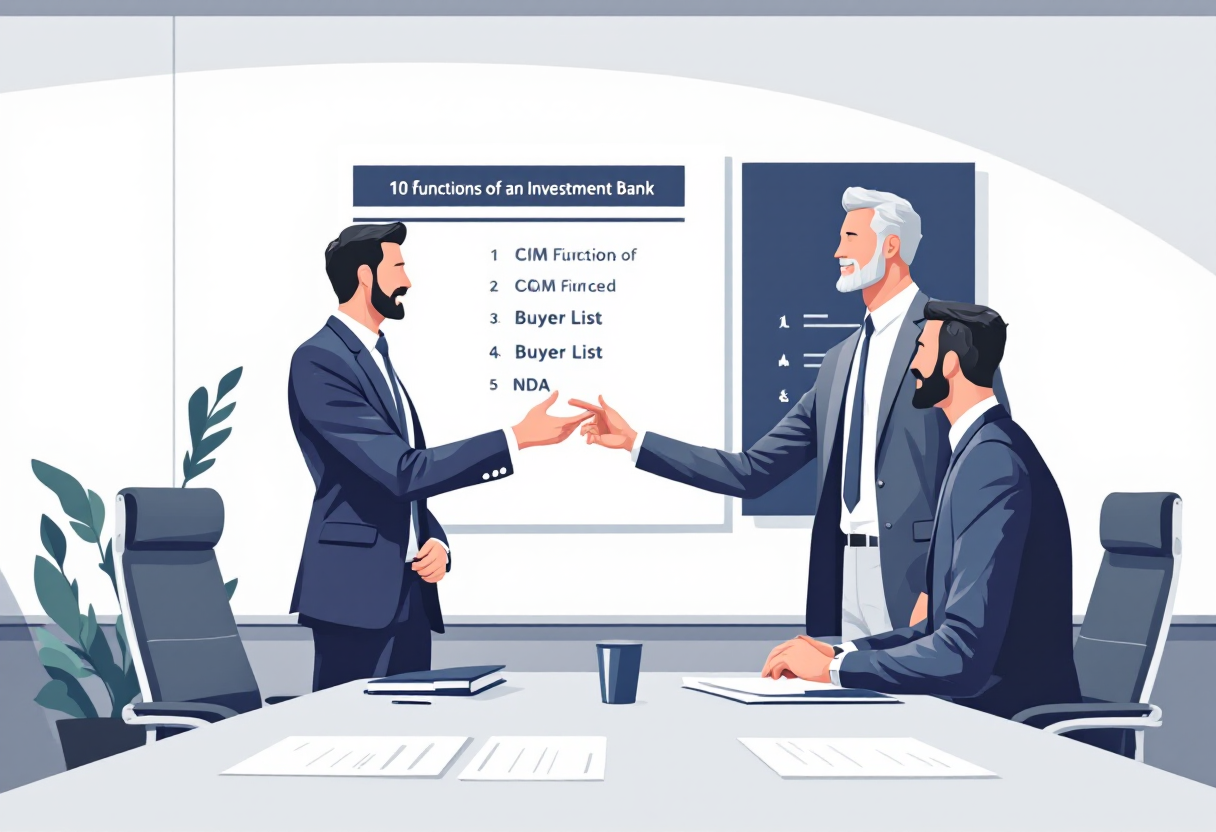
The 10 Functions an Investment Bank Performs on a Sell-Side Engagement
1. Initial advisory and sale-readiness assessment
The first 30 to 60 days of an engagement are diagnostic. The banker tears through the last three to five years of financials, customer concentration data, gross margin trends, working capital patterns, key-employee dependency, and any contingent liabilities. The output is a short memo on whether the business is sellable today, sellable in 12 months after specific fixes, or not sellable at any reasonable price until something structural changes (customer concentration above 30 percent, founder-dependent revenue, unresolved litigation, etc.). Roughly one in three engagements at this stage gets paused for six to twelve months of operational cleanup before the process formally launches. That pause usually adds a full multiple turn to the eventual price.
2. Pre-marketing: QoE, financial cleanup, and valuation
Before any buyer sees the business, the bank coordinates a sell-side quality-of-earnings report from a firm like CohnReznick, RSM, Baker Tilly, or Aprio. A sell-side QoE on a $5M EBITDA business runs $50K to $100K and takes four to six weeks. The deliverable normalizes EBITDA for owner add-backs, one-time costs, run-rate adjustments, and accounting policy choices that depress reported earnings. In Capstone Partners’ 2026 data, a clean sell-side QoE produces an average 8 to 12 percent EBITDA uplift versus the unscrubbed P&L, which translates directly to enterprise value at the eventual multiple.
Alongside the QoE, the bank builds a valuation triangulation: precedent transactions in the vertical (PitchBook, Refinitiv, GF Data), public company trading comps where relevant, and a discounted cash flow as a sanity check. The output is not a single number but a defensible range, typically a spread of one to two turns of EBITDA between the floor and the stretch. That range becomes the negotiating frame for every LOI later.
3. CIM and teaser preparation
The Confidential Information Memorandum is the 40 to 80 page document that tells the business’s story to qualified buyers under NDA. A real CIM contains a business overview, market and competitive positioning, customer and revenue analytics, financial summary, growth opportunities, management bios, and a transaction overview. It takes the bank three to six weeks of drafting with the management team and gets refined through five to ten rounds of edits before the first buyer sees it.
The teaser is the one-page anonymized version that goes out to the broader buyer universe before NDAs are signed. It identifies the business by region, vertical, revenue range, and EBITDA range without naming the company. A good teaser produces a 25 to 40 percent NDA-return rate from a curated buyer list, which is the first measurable signal of how the process will go.
4. Buyer universe identification
The bank’s network is the single most important asset on the engagement. A specialist lower-middle-market bank in HVAC, plumbing, electrical, MSP, or healthcare services maintains an active CRM of 200 to 500 buyers in the vertical: 60 to 120 private equity platforms actively acquiring, 30 to 60 strategic acquirers, 20 to 40 family offices, and a long list of search funds and independent sponsors. From that universe, the bank curates a target list of 30 to 100 names sorted into tiers: Tier 1 strategic fits (highest synergy potential), Tier 2 financial buyers with platform fit, and Tier 3 broader outreach. The owner reviews and approves the list and can red-line specific names (competitors, customers, suppliers) the seller wants excluded.
5. Outbound: staged teaser release, NDA traffic, CIM delivery
The outreach is sequenced, not blasted. The bank releases the teaser to Tier 1 first (typically 15 to 25 names), then Tier 2 a week later, then Tier 3 as needed. Each interested party signs a standard NDA, which the bank’s legal team has pre-negotiated for fast turnaround. NDAs that come back with material redlines (carve-outs for portfolio companies, residual knowledge clauses, no non-solicit) get pushed back or dropped. Once an NDA is executed, the CIM goes out along with a process letter that lays out the IOI deadline, the management presentation schedule, and the expected LOI timeline. NDA traffic on a healthy process runs 30 to 50 signed NDAs against a curated list of 60 to 100 contacted parties.
6. Management presentations
Buyers who return a written indication of interest at a level inside the bank’s valuation range get invited to a management presentation, typically held either in-person at a neutral location or via video. A typical sell-side process has 8 to 15 management presentations. The bank coaches the owner and CFO ahead of each one on what to disclose, what to defer, and what to avoid. These meetings serve two functions: they let the buyer test the management team’s credibility, and they let the owner test which buyer would be the right cultural fit if the deal closes. Capstone Partners reports that roughly 40 percent of post-LOI deal breaks are attributable to seller surprises about the buyer team that surfaced too late, almost always when the management presentation was skipped or compressed.
7. Indication of interest collection
IOIs are non-binding written letters from buyers stating their preliminary valuation range, structure (cash, equity rollover, earnout), key conditions, and timeline. A well-run sell-side process produces 5 to 15 IOIs from the curated funnel. The bank organizes these into a comparison grid for the seller and walks the owner through which numbers are real and which are anchored low to win a seat at the LOI table. IOI ranges typically have a $3M to $8M spread between top and bottom bidders on a $25M to $35M EV deal, which is exactly why the competitive process matters.
8. LOI negotiation and finalist selection
The bank invites three to five top IOI bidders to submit a definitive Letter of Intent. LOIs are still non-binding but contain specific price, structure, exclusivity terms (typically 45 to 90 days), and any conditions to close. The bank runs a final round of management calls, answers buyer-specific diligence questions on demand, and pushes each finalist for their best and final offer. The selected bidder signs the LOI with exclusivity and the process moves to confirmatory diligence. The non-winning finalists get a courtesy call from the bank and are kept warm as backup in case the primary LOI breaks.
9. Due diligence coordination
Once an LOI is signed, the bank stands up a virtual data room (Datasite, Intralinks, or Firmex are the common platforms) populated with 1,500 to 4,000 documents organized by diligence stream: financial, legal, tax, commercial, operational, IT, HR, environmental, and insurance. The bank manages all Q&A traffic between the buyer’s diligence teams and the seller, batching questions weekly, drafting responses with the CFO and outside counsel, and pushing back on requests that fall outside the agreed scope. Confirmatory diligence runs 45 to 75 days. The bank’s job during this window is to keep momentum, anticipate which findings will trigger retrade attempts, and prepare mitigation strategies before the buyer surfaces them.
10. Definitive agreement, closing, and post-close
The Asset Purchase Agreement or Stock Purchase Agreement is drafted by the buyer’s counsel, redlined by the seller’s counsel, and negotiated point-by-point with the bank at the table on the commercial terms. The bank’s value at this stage is in the working capital peg, escrow size and release schedule, indemnification caps and baskets, representation and warranty insurance structure, earnout mechanics, and rollover equity governance. Each of those terms can swing 3 to 8 percent of headline value individually. The bank coordinates the closing wire flow, escrow setup, signing, and day-one announcement to employees and customers. Post-close, the bank stays engaged for earnout monitoring, rollover equity board representation where applicable, and the first 12 months of transition support.
Worked Example: $5M EBITDA HVAC Sale
Consider a fictional but realistic example. Cascade Climate Services is a regional HVAC contractor with $32M of revenue, $5M of EBITDA, and 78 employees across two locations in the Pacific Northwest. The founder is 61, wants a clean exit with a 12-month transition, and has been approached twice in the last 18 months by a regional consolidator at what felt like a low number ($22M to $25M range). The founder engages Capstone Partners, a specialist lower-middle-market bank with a heavy book in trades and home services.
Months -10 to -1 (pre-process): Capstone runs a sale-readiness review and flags three issues: an aging dispatch software stack, two key supervisors on handshake deals instead of written employment agreements, and revenue concentration where the top two customers (both commercial property managers) are 28 percent of the book. The bank recommends a six-month operational cleanup, which the founder funds. Capstone refers the founder to CohnReznick for a sell-side QoE that takes six weeks and normalizes EBITDA from a reported $4.6M to a defensible $5.05M after add-backs for the founder’s compensation above market, one-time legal costs, and the discontinued residential install line.
Month 1 to 2 (CIM): Capstone drafts a 58-page CIM and a one-page teaser. The CIM emphasizes the recurring commercial maintenance contracts (38 percent of revenue, 2.3-year average term), the technician retention rate (89 percent over 3 years versus 64 percent industry average per Service Roundtable 2025 benchmarks), and the underpenetrated commercial new-construction pipeline in the region.
Month 3 (outbound): The teaser goes to a curated list of 72 buyers: 42 PE platforms in trades and home services, 18 strategic consolidators, and 12 family offices and search funds. NDAs come back from 31 parties, the CIM is delivered to all 31, and the IOI deadline is set for the end of Month 4.
Month 4 (IOIs): 12 IOIs come in. Range: $24M to $36M of enterprise value, blended median $30M (6x adjusted EBITDA). The bank screens the bottom four out for low price plus structure issues (large earnouts, low cash at close) and invites the top 8 to management presentations.
Month 4 to 5 (management presentations): Eight presentations happen across three weeks, two in-person at a Portland conference center and six via video. The founder, CFO, and operations VP present. Capstone debriefs after each meeting and tracks each buyer’s follow-up question quality as a signal of seriousness.
Month 5 (LOI): Four finalists submit LOIs. Range: $30M to $33.5M enterprise value with materially different structures. The winning bid: a PE-backed regional platform offering $32.5M cash at close, plus a $2M two-year earnout tied to revenue retention (not a stretch target), plus a 15 percent rollover into the buyer’s holdco at a fair pre-money. The founder signs LOI with 75-day exclusivity.
Month 6 to 8 (due diligence): Confirmatory diligence runs ten weeks. The buyer’s QoE provider (Baker Tilly) re-confirms the adjusted EBITDA within $80K of CohnReznick’s number. Legal diligence surfaces an unresolved customer dispute that Capstone negotiates into a $250K special escrow rather than a price reduction. The working capital peg is set at the trailing-twelve-month average of $1.85M.
Month 8 to 9 (definitive and close): The APA is signed at Month 8 week 3 and closing happens 18 days later after final consents and the R&W insurance binder. The R&W policy (5 percent of EV, $1.625M coverage, $325K retention) replaces a traditional 10 percent escrow and frees up roughly $1.6M of cash at close that would otherwise sit locked up for 18 months.
| Outcome Component | Banker-Run Process | Founder’s DIY Estimate | Delta |
|---|---|---|---|
| Enterprise value | $32.5M (6.5x) | $22M (4.5x est.) | +$10.5M |
| Cash at close | $28.5M | $18M (with seller note) | +$10.5M |
| Rollover equity | $2M (15%) | $0 | +$2M paper |
| Earnout | $2M (achievable) | $4M (stretch) | structure win |
| Escrow / R&W | $325K retention | $2.2M escrow (10%) | +$1.875M freed |
| Capstone fee (4.3%) | ($1.4M) | $0 | ($1.4M) |
| Net premium to seller | n/a | n/a | +$9.1M |
The $9.1M net premium is the realized return on the Capstone engagement. A 4.3 percent fee against a 35 to 45 percent uplift on the DIY base case is the math that makes sell-side advisory the highest-ROI single transaction in most owners’ lives.
Common Mistakes Owners Make
Treating the fee as a cost rather than a return on investment
The relevant question is not whether $1M of advisor fee is a lot of money, it is. The question is whether the advisor generates more than $1M of incremental enterprise value. For deals above $3M of EBITDA with multiple plausible buyers, the answer is almost always yes by a wide margin, typically 4x to 8x the fee in net incremental proceeds. Owners who anchor on the fee number lose sight of the bigger arithmetic. See the related guide on why hire an investment banker M&A advisor for the full eight-point breakdown.
Hiring the wrong tier of advisor
A bulge bracket bank like Goldman or Morgan Stanley does not run $20M to $50M deals. A local business broker should not run a $200M deal. The right tier of advisor for a $5M to $50M enterprise value transaction is a lower-middle-market specialist (Capstone Partners, Cascadia Capital, BMI M&A Advisors, Tequity). For $50M to $250M deals, mid-market boutiques like Lincoln International, William Blair, Houlihan Lokey, or Stifel are the fit. Above $250M EV, elite boutiques (Evercore, Lazard, Moelis) or bulge brackets enter scope.
Signing the engagement letter without negotiating tail and minimum fee
The headline success-fee percentage matters less than the tail period (how long after the engagement ends the bank is still owed a fee on a closed deal), the minimum fee floor (often $750K to $1.25M), the expense reimbursement language, and the carve-outs for buyers already in conversation with the seller. A 5 percent fee with clean terms is often cheaper in practice than a 3.5 percent fee with a 24-month tail, an aggressive minimum, and uncapped expenses.
Skipping the sell-side QoE to save $75K
No fee to you on buy-side introductions; sell-side mandates are paid on success at closing. The difference is that issues surfaced before the LOI become disclosure items and stay priced into the bid. Issues surfaced after the LOI become retrade ammunition and cost 10 to 25 percent of headline value. Capstone Partners’ 2026 data shows deals without a sell-side QoE close on average 14 percent below their LOI value, against 4 percent for deals with one.
Running the company poorly during the process
A sell-side process is genuinely 20 to 30 hours per week of the owner’s time from Month 1 through close. Owners who try to maintain full operational responsibility while running the process either let EBITDA slip (which gets re-measured at confirmatory diligence and triggers price reductions) or let the process slip (which costs deal momentum and bidder interest). The bank handles 80 percent of the process workload but cannot substitute for the owner’s time on management presentations, key decisions, and the final negotiation. Owners who delegate operations to a strong COO during the process close at 7 to 12 percent higher multiples than owners who try to do both.
Picking the buyer who paid the highest IOI instead of the buyer most likely to close
The highest IOI is not the highest LOI, and the highest LOI is not the highest closing price. Buyers who anchor high in IOI to win management-presentation access often retrade in diligence by 8 to 15 percent. A disciplined bank tracks each buyer’s track record on closed-to-LOI ratios and stretch-vs-final pricing across prior deals. A 5 percent lower LOI from a buyer with a clean closing record is usually worth more than a top-bid LOI from a buyer known for diligence-driven retrades.
Process Timeline: What 9 Months Actually Looks Like
A sell-side process on a $5M to $25M EBITDA business runs six to nine months from engagement letter to wire. The phases below assume a clean business and a competitive process; deals with hair on them or thin buyer interest can run 12 to 18 months.
- Month -10 to -1 (pre-engagement and prep): Sale-readiness review, operational cleanup, sell-side QoE, valuation triangulation. Roughly 30 percent of engagements pause here for 6 to 12 months of fixes before launching.
- Month 1 to 2 (materials): CIM drafting (40 to 80 pages), teaser one-pager, process letter, buyer universe build and tier sorting, target list approval by seller.
- Month 3 (outbound): Staged teaser release across Tier 1, 2, 3. NDA traffic and execution. CIM delivery to executed-NDA buyers. Buyer Q&A round one.
- Month 4 (IOIs and shortlist): IOI deadline, collection and comparison, shortlist of 6 to 10 buyers invited to management presentations. Bottom-bidder dismissals communicated.
- Month 4 to 5 (management presentations and LOI): 8 to 15 management presentations, post-meeting debriefs, LOI invitations to top 3 to 5, LOI redlines, exclusivity granted to winning bidder.
- Month 6 to 8 (confirmatory diligence): Virtual data room build, Q&A management, buyer-side QoE, legal diligence, commercial diligence, environmental and HR diligence, R&W insurance underwriting.
- Month 8 to 9 (definitive agreement and close): APA or SPA drafting and negotiation, working capital peg, escrow structure, indemnification terms, R&W policy bind, signing, closing wire, day-one announcement.
- Month 9 onward (post-close): Earnout tracking, rollover equity governance support, transition services agreement compliance, working capital true-up at 60 to 120 days.
Who to Hire by Deal Size and Vertical
The investment banking market for private company sales segments by enterprise value. Hiring the wrong tier of bank produces either inattentive coverage (too small a deal for the bank) or inadequate buyer-network depth (too large a deal for the broker).
| EBITDA Range | Enterprise Value | Advisor Tier | Example Banks |
|---|---|---|---|
| $1M to $5M | $5M to $25M | Lower middle-market boutique | Capstone Partners, Cascadia Capital, BMI M&A Advisors, Tequity, Synergy Business Advisors |
| $5M to $25M | $25M to $150M | Lower middle-market specialist | Capstone Partners, Cascadia Capital, Brown Gibbons Lang, Mesirow, Stout |
| $25M to $100M | $150M to $750M | Mid-market boutique | Lincoln International, William Blair, Houlihan Lokey (lower end), Stifel, Raymond James, Piper Sandler |
| $100M to $500M | $750M to $3B | Elite boutique or upper mid-market | Houlihan Lokey, Jefferies, Robert W. Baird, RBC Capital Markets |
| $500M+ | $3B+ | Elite boutique or bulge bracket | Evercore, Lazard, Moelis, Centerview, Goldman Sachs, Morgan Stanley, JPMorgan |
Vertical specialization matters as much as deal-size tier. In HVAC, plumbing, and electrical, Capstone Partners and Brown Gibbons Lang have the deepest closed-deal benches in 2025-2026 per Refinitiv league tables. In managed IT services, Corum Group and Equiteq are the dominant specialists. In healthcare services, Provident Healthcare Partners and Edgemont Capital lead. A generalist bank with no vertical book usually starts the buyer universe 80 percent smaller than a specialist, which directly compresses the eventual multiple. For specific verticals, see the prep pages on preparing an HVAC business for sale and preparing an MSP for exit.
Fees: What Investment Banks Actually Charge on Sell-Side
Sell-side fees come in three components: the success fee on closing, the retainer paid monthly during the engagement, and reimbursable expenses. The success fee is the dominant economic, and it almost always scales inversely with deal size.
| Deal Size (Enterprise Value) | Success Fee Range | Monthly Retainer | Minimum Fee Floor |
|---|---|---|---|
| $5M to $25M | 5% to 7% | $10K to $25K | $500K to $750K |
| $25M to $100M | 3% to 5% | $25K to $50K | $1M to $1.5M |
| $100M to $500M | 1.5% to 3% | $50K to $100K | $2.5M to $4M |
| $500M+ | 0.5% to 1.5% | negotiated | $5M+ |
Some banks use a Lehman-style modified scale or a Double-Lehman: 10 percent on the first $1M of EV, 8 percent on the second, and so on, sliding down to 1 to 2 percent on amounts above $10M. The blended effective rate on a $30M deal under Double-Lehman is roughly 4.5 to 5 percent. Other banks use a flat percentage with a stretch incentive: 4 percent on the base case, plus 10 percent of any value above an agreed threshold. The stretch incentive aligns the bank with maximum value and is increasingly the structure of choice on competitive engagements per the Capstone Partners 2026 LMM Survey.
Retainers are typically credited against the success fee at close, so they are effectively a deposit rather than a true cost. Expenses (legal review, data room, travel, printing) run $25K to $100K on a typical sell-side and are usually capped in the engagement letter.
When to Hire an Investment Bank and When to Skip It
The math of sell-side advisory works when three conditions are present: enough deal size for the fee to be small relative to the uplift, enough buyer competition to actually create the uplift, and enough complexity that the owner cannot reasonably run the process alone. When all three are present, the bank is the highest-ROI hire in the entire transaction. When one or more is missing, a different advisor model fits better.
Hire a bank when: EBITDA is above $3M to $5M, there are 20+ plausible buyers in the vertical, the industry is regulated (healthcare, financial services, environmental services) or has complex transaction structures (rollover equity, earnouts, R&W insurance), or the owner does not have an existing relationship with a credible buyer at a fair price.
Skip the bank when: EBITDA is below $1M of SDE (a broker is the right fit at 10 to 12 percent commission), the deal is a pre-negotiated sale to a known buyer at a known fair price (a transaction attorney plus a sell-side QoE handles the mechanics), or the buyer is a family member or management team (an appraiser plus a transaction attorney is sufficient).
For the borderline case of $1M to $3M EBITDA with one or two plausible buyers, the right answer is usually a smaller boutique or a regional bank with a specific vertical book rather than a full-blown lower-middle-market shop. The fee economics get tight at this size, and a specialist who can run a focused process on 15 to 25 buyers will often deliver more value than a larger bank running a perfunctory engagement.
Frequently Asked Questions
What does an investment bank actually do that an owner cannot do alone?
Three things that compound: maintain a live relationship with 200 to 500 buyers in the vertical (an owner knows 5 to 10), run a controlled auction that creates price competition (an owner negotiates one buyer at a time), and absorb the negotiating bad-cop role on price and terms so the seller preserves relationships with the buyer team post-close. Each function alone is worth 5 to 10 percent of headline value, and together they routinely produce 15 to 25 percent uplifts over bilateral deals per SRS Acquiom 2025 data.
How long does a sell-side process take from engagement to wire?
Six to nine months on a clean business with strong buyer interest. Twelve to eighteen months on businesses with hair (customer concentration, key-person risk, accounting issues) or thin buyer demand. The pre-engagement cleanup phase, when needed, can add another 6 to 12 months but typically adds a full multiple turn to eventual price, so it pays for itself many times over.
What is the difference between an investment bank and a business broker on the sell-side?
Deal size and process intensity. Business brokers handle SDE-band deals from $250K to $2M (typically $2M to $5M of enterprise value) at a 10 to 12 percent commission, with a listing-based model and direct buyer-seller introductions. Investment banks handle EBITDA-band deals from $1M to hundreds of millions of EBITDA at a 1 to 7 percent success fee with a closed-auction model. The economics, the buyer universe, the process design, and the legal complexity are categorically different. See business broker vs investment banker for the side-by-side breakdown.
Does the seller pay the bank’s fee or does the buyer?
On a traditional sell-side engagement the seller pays the bank’s success fee and retainer directly out of closing proceeds. No fee to you on buy-side introductions; sell-side mandates are paid on success at closing.
What happens if the deal does not close?
The bank keeps any retainers paid during the engagement and is typically owed reimbursable expenses, but the success fee (the dominant economic) is contingent on close and is not paid if the deal breaks. Engagement letters often have a tail provision (12 to 24 months is standard) under which the bank is owed the success fee if the seller closes with a buyer the bank introduced during the engagement, even after the engagement formally ends. This is the most-negotiated term in the engagement letter and the owner should push for a 12-month tail rather than 24, and a tail limited to actually-introduced buyers rather than the full process list.
How many buyers should a banker contact in a competitive process?
The right number is the smallest list that produces 5 to 15 IOIs at viable valuations, which usually means 30 to 100 contacted buyers on a lower-middle-market deal. Smaller lists (10 to 25 names) work for highly specialized businesses where the universe of qualified buyers is genuinely small. Larger lists (100 to 250 names) work for broadly attractive platforms where the bank wants maximum competitive pressure. The Capstone Partners 2026 survey shows the sweet spot for $25M to $75M EV deals is roughly 55 to 75 buyers contacted, producing 25 to 40 NDA executions and 8 to 14 IOIs.
What to Do Next
If a sale is on the horizon in the next 6 to 24 months, the highest-value first step is a sale-readiness review with an advisor who runs deals in the specific vertical. The review should produce a candid memo on whether the business is sellable now or needs operational cleanup first, a defensible valuation range based on current market multiples, and a tiered buyer list with realistic expectations on process timing and outcome. None of that requires committing to an engagement letter, and most reputable banks will do it for free or for a modest diagnostic fee that is credited against the eventual success fee if the engagement proceeds.
Want to know what your business is worth in a real process?
No fee to you on buy-side introductions; sell-side mandates are paid on success at closing. We assess sale-readiness, build the buyer universe, and run the auction.
Book a Free ConsultationRelated reading: Why hire an investment banker M&A advisor | The full M&A process | M&A valuation models