How to Prepare Your Advertising Agency for a Sale or Exit in 2026: The 36-Month Playbook
Preparing your advertising agency for exit in 2026 works best as a 36-month process. The first 12 months tighten the operating story around retainer mix and vertical specialization, the middle 12 fix pre-LOI diligence gaps around client concentration and consultant utilization, and the final 12 turn one offer into a competitive process where holding company aggregators (Stagwell, Publicis, WPP) bid against PE-backed platforms.
Exiting your advertising agency business is the single largest financial event most owners will ever face. This guide is the no-fluff playbook for advertising agency owners who are 12-36 months from sale, covering how PE-backed buyers actually value your business in 2026, the 12 levers that move your multiple, pre-LOI diligence, deal-killers to fix before going to market, and the full 36-month exit prep timeline.
Updated April 2026 · CT Acquisitions

Most advertising agency owners decide to sell, hire a broker, and find out 90 days later that a quality-of-earnings review has reclassified their gross media revenue to net, wiping 30% to 50% off their headline EBITDA before a single buyer call. The owners who get the top-quartile price start preparing 18 to 36 months before they ever talk to a buyer. This guide is the playbook for how to prepare your advertising agency for a sale or exit in 2026. It covers what private equity actually buys after the Omnicom-IPG close, the value levers that move multiples from 5x to 12x EBITDA, what holding companies and PE platforms diligence before they send an indication of interest, and the deal-killers that re-trade agency transactions during confirmatory diligence. Every multiple cites its source. Every recommendation comes from how the most active agency buyers in 2026 actually behave.
If you are 6 to 36 months from a possible exit, this is the work that turns a 5x EBITDA outcome into a 9x EBITDA outcome. On a $3M EBITDA agency, that is the difference between a $15M sale and a $27M sale. Whether you want to prepare your advertising agency for a sale to a PE-backed roll-up platform like Truelink Capital or AEA Investors, prepare your advertising agency for an exit to a holding company like Stagwell, Havas, or the combined Omnicom, or simply maximize value over the next 1 to 3 years before going to market, the work below applies.
Building toward an exit in 12 to 36 months?
CT Acquisitions runs sell-side advisory for advertising agency owners with $1M+ adjusted EBITDA. We also have agency operations specialists in our partner network who run pre-sale optimization engagements when the timeline is longer. No fee to you on buy-side introductions; sell-side mandates are paid on success at closing.
What Private Equity Actually Buys in Advertising (2026)
The advertising agency M&A market in 2026 is in the most active and structurally unusual phase since the 2007 holdco roll-ups. Three forces are colliding at once: the largest holding company merger in industry history (Omnicom-IPG, closed November 2025, final EU clearance March 2026) has reset every public-market comparable; private equity has discovered that creative agencies, properly structured, throw off cash like SaaS companies; and generative AI is compressing production cost by 60% to 90% and rewriting which agency capabilities are valuable. Five years ago there were essentially two buyer archetypes for a private agency. Today there are six: holding companies, consultancies, specialty PE platforms, generalist PE, AI-native roll-ups, and management buyouts backed by private credit.
The PE-attractive advertising agency profile
- EBITDA threshold for a platform-quality deal: $3M to $10M adjusted EBITDA is the PE sweet spot where sponsor-backed platforms run a competitive process. Below $1M EBITDA you are a tuck-in inside a roll-up at lifestyle multiples (3x to 5x). $10M to $25M EBITDA places you in platform-candidate territory. Above $25M you are a true platform play in the Brandtech, Monks, R/GA, Huge, and Dept range.
- Recurring retainer revenue: 60% or higher is the line between project-shop and platform-quality. Agencies with 60%+ recurring revenue sell for 25% to 40% higher multiples than otherwise comparable shops (cross-source synthesis: First Page Sage, Auxo Capital Advisors, FE International, Breakwater M&A 2026).
- Client concentration: No single client above 15% of revenue. Top 5 clients below 60%. Above 20% on a single client gets PE nervous; above 25% they price the discount or walk.
- Net revenue retention: Best-in-class agencies run 105% to 115% NRR (same-client revenue growing year over year). This is the single most diagnostic forward-looking metric.
- Average client tenure: Above 4 years on the top decile. Buyers model change-of-control churn at 30% to 40% in year one for creative agencies, which is why earn-outs typically run 24 to 36 months.
- Specialty or niche: A defined vertical (B2B SaaS, healthcare, financial services, automotive, government, CPG) commands a 1x to 3x EBITDA premium over generalist creative.
- AI moat: Proprietary AI workflow with documented gross-margin improvement and named model fine-tunes. Off-the-shelf prompt engineering is table stakes; owned tooling is what buyers pay platform multiples for.
- Owner role: Owner replaceable within 12 months. CCO or CEO #2 in place with the next 2 to 3 major pitches already won without owner involvement.
Active advertising agency buyers in 2026
The list below covers the most active buyers in the 2024-2026 cycle. This is who will see your teaser. Coverage spans holding companies, consultancy-owned shops, specialty PE platforms, AI-native roll-ups, and the rare strategic. Add-on counts and platform notes are point-in-time; sources include IPG investor relations, Stagwell annual report 2024, Carlyle press release, AEA Investors, Houlihan Lokey, Adweek, PitchBook, and PrivSource.
| Buyer | Type | Profile |
|---|---|---|
| Omnicom (NYSE: OMC) | Holding company | Combined with IPG Nov 2025 at $8.89B closing consideration; world’s largest agency holdco; selective tuck-ins above $10M EBITDA |
| Publicis Groupe | Holding company | $2.2B LiveRamp deal May 2026 signals data-first strategy; pays premium for shops with proprietary data assets |
| WPP | Holding company | Under pressure from client losses (Mars Wrigley, parts of Coca-Cola, Pfizer split); buying for capability gaps in data, retail media, AI-native production |
| Havas (Euronext: HAVAS) | Holding company | Listed Dec 16, 2024 at ~$2.6B debut; active buyer of mid-sized creative and data shops using newly liquid equity as currency |
| Stagwell (NASDAQ: STGW) | Holding company / challenger | $2.3B net revenue 2024 (+14% YoY); active sub-$50M creative shop acquirer; “anti-holdco” pitch with founder-friendly structures |
| Dentsu (4324.T) | Holding company | Selective outside Japan; AI-led media planning pivot; tuck-in focused |
| Accenture Song | Consultancy | Grew from $12.5B to $19B revenue in fiscal year ended August 2025; David Droga moved to Vice Chair; selective premium acquisitions |
| Deloitte Digital / IBM iX | Consultancy | Tuck-in cadence in data, experience, and digital-product agencies |
| Truelink Capital | Specialty PE | Acquired R/GA from IPG Oct 2024 with $50M Innovation Fund for generative AI; platform building |
| AEA Investors | Specialty PE | Acquired Huge from IPG Dec 5, 2024; combined with Hero Digital to form major experience-design platform |
| The Carlyle Group | Specialty PE | Majority stake in Dept Jan 2025; European-led digital-creative roll-up vehicle |
| New Mountain Capital | Specialty PE | Rolled Real Chemistry into 2024 continuation vehicle; long-hold healthcare-marketing platform |
| Insignia Capital | Specialty PE | Building digital-product / agency platform around Fueled and 10up |
| Attivo Group | Specialty PE | IPG carve-outs Hill Holliday and Deutsch NY Jan 2024; indie creative platform |
| The Brandtech Group | AI-native roll-up | $115M Series C at ~$4B valuation; world’s #1 digital-only marketing group; pays premium for AI-tooling fit |
| S4 Capital / Monks | AI-native roll-up | Sir Martin Sorrell vehicle; AI-first content and data tuck-ins |
Two more reference points matter. Wieden+Kennedy remains stubbornly, profitably independent and is widely used by M&A advisors as the “what excellent looks like” benchmark for founder-controlled creative agencies. Mother London (with its New York and LA offices) remains independent and employee-owned. Droga5, sold to Accenture in 2019 for $475M, now sits inside Accenture Song; David Droga stepped down as CEO and moved to Vice Chair of Accenture, raising open questions about creative continuity inside consultancy-owned shops. These are not buyers, but they shape how every other buyer benchmarks an independent’s value.
Advertising Agency Valuation Multiples in 2026 (What You Are Actually Worth)
The multiple a buyer pays comes down to your size, your revenue mix, your specialty, your AI moat, and your client concentration. Headline public-comp EV/EBITDA for advertising and marketing services ran around 14.3x trailing EBITDA across 2026, an unusually high reading driven partly by Omnicom-IPG synergy expectations and partly by AI-driven re-rating of Brandtech-style platforms. The private mid-market is a very different number. Here is the realistic range for closed transactions in late 2025 and the first half of 2026, cross-referenced from First Page Sage, Agencies.co, Auxo Capital Advisors, Axial, FE International, Breakwater M&A, Legacy Advisors, M&A Insights, and Capital A.
EBITDA multiples by size
| Adjusted EBITDA band | Typical multiple | Notes |
|---|---|---|
| Under $1M EBITDA | 3.0x to 5.0x | Lifestyle / owner-operated; high key-person risk; often asset deals, not stock sales |
| $1M to $3M EBITDA | 4.0x to 6.0x | Lower-mid; some buyer competition; structures usually 60% to 70% cash plus earn-out |
| $3M to $10M EBITDA | 6.0x to 9.0x | The PE sweet spot; multiple competing offers if the file is clean |
| $10M to $25M EBITDA | 8.0x to 12.0x | Platform candidates; retainer-heavy with specialty niche command the top of the range |
| $25M+ EBITDA | 10.0x to 14.0x+ | True platform deals; Brandtech, Monks, R/GA, Huge, Dept range; AI moat matters |
Roll-up platforms (“buy-and-build”) generally pay 1x to 2x EBITDA above standalone for tuck-in acquisitions because of synergy capture and multiple arbitrage. PE will pay platform multiples for the first deal in a sector and tuck-in multiples for every subsequent one.
Multiples by discipline
| Discipline | Typical multiple | Driver |
|---|---|---|
| Pure creative / brand strategy | 5x to 8x EBITDA | High-value work, project-based, high talent risk |
| Full-service / integrated | 6x to 9x EBITDA | Retainer mix and client tenure are the swing factors |
| Specialty (B2B, healthcare, FS, regulated) | 8x to 12x EBITDA | Real Chemistry continuation-fund pricing is the comp |
| Media buying / planning | 7x to 10x EBITDA | Recurring fees; principal-vs-agent ASC 606 hygiene critical |
| Production studios | 4x to 7x EBITDA | People-intensive, project-heavy, low recurring revenue |
| Post-production / VFX / motion | 4x to 7x EBITDA (5x to 8x with proprietary AI pipeline) | AI pipeline investment lifts the band |
| AI-native creative platforms | 10x to 14x+ EBITDA | Brandtech, Monks, and emerging challengers set the benchmark |
Recent disclosed advertising agency transactions (2024-2026)
| Acquirer | Target | Date | Value | Implied multiple |
|---|---|---|---|---|
| Omnicom (NYSE: OMC) | IPG (Interpublic) | Closed Nov 2025 (announced Dec 8, 2024) | $8.89B closing consideration; ~$13.25B EV at announcement | Holdco-on-holdco; 21.6% premium to IPG pre-announcement price |
| Publicis Groupe | LiveRamp (data infrastructure) | Announced May 17, 2026 | $2.2B all cash ($38.50/share; $2.546B equity; $2.167B EV) | Data infrastructure, not agency (for context) |
| Truelink Capital | R/GA (from IPG) | Oct 2024 | Undisclosed plus $50M Innovation Fund commitment | Carve-out with management equity roll |
| AEA Investors | Huge (from IPG) + Hero Digital | Dec 5, 2024 | Undisclosed | Carve-out plus combination with portfolio company |
| The Carlyle Group | Dept (majority stake) | Jan 2025 | Undisclosed | European digital-creative roll-up platform |
| Accenture (historical anchor) | Droga5 | 2019 | $475M | Still the reference comp for a premium creative shop sale to a consultancy |
Sources: Omnicom 8-K and 10-Q FY2026; LiveRamp 8-K and DEFA14A; eMarketer; MediaPost; Houlihan Lokey transaction pages; AEA Investors press release; Canaccord Genuity transaction page; Carlyle press release; Marketing Dive; Adweek; PrivSource; Accenture newsroom 2019.
The 12 Value Levers That Move Your Multiple (Ranked by Impact)

These are the levers that move advertising agency multiples in the 18 to 24 months before a sale. Each one has a current state, a target state, and an estimated financial impact. The ordering is by dollar impact per unit of effort, based on cross-source synthesis from First Page Sage, Auxo Capital Advisors, FE International, Breakwater M&A, Capstone Partners, MGO CPA, Withum, and Crowe LLP.
Lever 1: Clean up ASC 606 principal-vs-agent treatment
Current: Agency books gross revenue on media placements and production pass-throughs without a written principal-vs-agent policy; revenue recognition is inconsistent across clients; no Big-Four opinion on file. Target: Written ASC 606 policy applied consistently; principal vs. agent determined client-by-client and contract-by-contract using the five-step framework (control of the good or service before transfer, cancellation/credit liability, pricing authority, inventory exposure); two years of clean audited financials with a top-15 firm opinion. Impact: This is the single most common deal-killer in agency M&A. Agencies often book gross because it makes the top line look bigger; a buyer-side quality-of-earnings review then reclassifies revenue net, EBITDA drops on the multiple, and the headline price drops accordingly or the buyer walks. Fix two years before market and you protect every dollar of multiple downstream. How: Engage a Big-Four or top-15 firm; restate prior two years if needed; document the rationale for principal vs. agent on every revenue stream; produce GAAP audited financials annually.
Lever 2: Lift recurring retainer share to 60%+
Current: Under 40% of revenue from retainers; most work is project-based; verbal “handshake” arrangements with key clients. Target: 60%+ recurring revenue on contracted 12-month rolling agreements with 60-day cancellation; renewal 90 days before term ends. Impact: Agencies with 60%+ recurring revenue sell for 25% to 40% higher multiples than agencies with similar EBITDA but project-based revenue (First Page Sage; Breakwater M&A; FE International). On a $3M EBITDA agency at a 7x baseline, that is $5M to $8M of incremental sale price. How: Annualize all “always-on” deliverables (social content, performance creative, brand stewardship, monthly reporting). Bundle production capacity into a monthly fee with a stated number of executions; buyers treat this as recurring even if line items vary. Introduce a “brand subscription” tier and steer existing project clients onto it. Bill for strategy, governance, and IP separately from execution so even production-heavy clients have a retained strategic envelope. Paper everything; buyers will discount disclosed retainers if they do not see contracted termination language.
Lever 3: De-concentrate the client base
Current: Top client above 20% of revenue, or top 5 clients above 75% of revenue. Target: Top client below 15%; top 5 clients below 60%. Impact: Top-1 above 15% is yellow; above 25% is red and triggers either a 15% to 30% valuation discount or buyer withdrawal. Buyers also model change-of-control churn at 30% to 40% for creative agencies in year one. How: Aggressively win mid-sized accounts to dilute the top of the curve. Move project-based clients onto retainer to lock revenue. Move at least one major client account fully to a second-in-command to prove the owner is not the relationship. Get written client references the buyer can call.
Lever 4: Promote a CCO or CEO #2 and document succession
Current: Owner is chief creative on more than 50% of pitches; owner art-directs and presents the work; no named successor. Target: CCO or CEO #2 promoted 18 to 24 months pre-sale; the successor has won the next 2 to 3 major pitches without owner involvement (documented); creative leadership bench (group creative directors, executive creative directors) locked with multi-year contracts. Impact: Key-person risk is the single biggest hidden landmine in creative agency M&A. If you are the chief creative, the buyer is buying you, and the earn-out will be designed to keep you 5+ years. Documented succession breaks that trap and lets you actually exit. Estimated +0.5x to 1.5x EBITDA multiple lift. How: Internal promotion preferred over external hire because chemistry and client trust survive. Stage public credit for new business wins onto the successor. Step out of pitch decks 12 months pre-sale.
Lever 5: Declare and own a specialty niche
Current: Generalist “we do everything” creative agency; no defined vertical; awards spread across categories. Target: A declared specialty in B2B SaaS, healthcare, financial services, automotive (especially EV/mobility), CPG/FMCG with retail-media depth, DTC, government, or sustainability/ESG. Public POV, vertical-specific case studies, hires from inside the vertical, awards inside the vertical. Impact: A generalist creative agency at $5M EBITDA might sell at 6x to 7x. A regulated-vertical specialist at the same EBITDA can clear 10x to 12x (Real Chemistry’s continuation-fund pricing is the public comp for healthcare). Specialty premium is 1x to 3x EBITDA. How: Pick the vertical you already have client density in. Run a 12-month thought-leadership program (research, podcast, owned event) that establishes category authority. Win 1 to 2 awards inside the vertical (Cannes Lions category gold, Effies, WARC effectiveness). Hire 1 senior person from inside the vertical with a Rolodex.
Lever 6: Build proprietary AI workflow with documented margin gains
Current: Off-the-shelf prompt engineering on Midjourney, Runway, ChatGPT; no measured productivity gains; AI use undocumented; no client-side IP and indemnity clauses. Target: Owned tooling (fine-tunes on open models, brand-trained content engines, vector databases of client work, proprietary orchestration); year-over-year gross-margin uplift by service line documented before AI vs. after AI; named tool owners; client-side IP, indemnity, and data-use clauses on every active contract. Impact: Brandtech’s $4B valuation is the clearest market signal: buyers pay platform multiples for an agency that has built its own AI tooling and proprietary workflows. Estimated +1.0x to 3.0x EBITDA multiple for documented AI moat. AI compresses production cost 60% to 90% and expands production volume 5x to 10x; the agencies that capture that margin keep it. How: Hire or contract 1 senior ML engineer or AI product lead. Pick 2 to 3 highest-volume production workflows (versioning, localization, format adaptation) and rebuild them on owned tooling. Document gross margin by service line before and after. Build an “AI capability statement” with named tools, named owners, and measured productivity gains.
Lever 7: Lock senior creative talent with multi-year contracts and change-of-control retention
Current: Senior creatives on at-will employment; no non-competes that survive change of control; no retention bonus pool. Target: Multi-year contracts for the top 10 to 15 senior creatives (ECDs, GCDs, design directors, strategy directors) with non-competes that survive change of control; retention bonus pool of 3% to 5% of headline price vesting over 3 to 4 years; clear job architecture and leveling. Impact: Buyers underwrite change-of-control churn at 30% to 40% for creative agencies. Demonstrably locked talent reduces that estimate and protects the multiple. Estimated +0.5x to 1.0x EBITDA. How: Re-paper top-talent contracts 12 to 18 months pre-sale. Use restricted stock or phantom equity vesting through close and the earn-out period. Build a written job architecture and leveling document the buyer’s HR DD can validate.
Lever 8: Awards shelf with current-year wins and verifiable case studies
Current: Long list of regional, junior, or unverifiable awards on the website; case studies without client sign-off; some “scam ad” entries that never ran for a paying client. Target: 3 to 5 current-year awards in the last 24 months from currencies that move multiples (Cannes Lions Grand Prix, Titanium, or category Gold; Effies; D&AD Pencils; CLIO; The One Show; WARC Awards for Effectiveness; Andy Awards). A single source-of-truth awards register with verifiable case studies, client sign-off, and budget disclosure. Impact: Awards are balance-sheet items in disguise. Current-year Cannes Lions Grand Prix or Gold materially affects valuation in three ways: it makes new-business pitches close at higher rates (forward-revenue model uplift), it locks senior creative talent who joined for the shelf, and it signals to buyers that the agency competes at the top of its category. Estimated +0.25x to 1.0x EBITDA when paired with category specialty. How: Run a disciplined awards calendar 24 months pre-sale. Avoid “award stuffing” with junior or unverifiable wins. Maintain a single source-of-truth awards register; buyers verify against organization archives, not your website. The 2024 Cannes Lions disqualification incidents made buyers paranoid; clean documentation protects you.
Lever 9: File trademarks on proprietary methodologies and frameworks
Current: Internal “Method,” “Engine,” or “Framework” used in pitches but unregistered; annual research products published without IP filings; proprietary brand-tracking instruments unprotected. Target: Trademarks filed on every proprietary methodology and framework; annual studies and trend reports with copyright registrations; brand-tracking instruments documented as agency IP with client license terms. Impact: Durable IP assets convert the agency from a pure services business into a product-services hybrid, which is exactly what buyers pay platform multiples for. Trademarked frameworks survive the loss of any single client. Estimated +0.25x to 0.75x EBITDA. How: Trademark counsel runs the filings in months 24 to 18. Annual research products get a publishing cadence; mailing list and event franchise built around them as owned channels.
Lever 10: International capability in at least 2 regions
Current: Single-office, single-country footprint; no international clients; no partner network. Target: Offices or formal partner relationships in at least 2 regions (US + EMEA, or US + APAC); demonstrated multi-region client servicing on at least 1 anchor account. Impact: International capability is on every holding company and PE platform’s premium-driver list. Even a partner-network relationship that lets you service multi-region briefs counts. Estimated +0.25x to 0.75x EBITDA when paired with a multi-region anchor client. How: Cheap path: formal partnership agreements with 2 to 3 regional independents under a shared methodology and shared back office. Expensive path: open a small satellite office in London, Singapore, or Sao Paulo. Buyer signals: Havas, Stagwell, and the larger PE platforms all explicitly want multi-region tuck-ins.
Lever 11: Sweep IP assignment across all employees, contractors, and AI-generated assets
Current: Employment agreements lack explicit IP assignment language; contractor agreements have no “prior work” carve-out cleanup; music, stock footage, fonts, plugins, and AI-generated assets in recent work have unclear license terms. Target: Every employment and contractor agreement contains explicit IP assignment in favor of the agency, including “prior work” carve-outs cleaned up; every piece of music, footage, font, plugin, and AI-generated asset in the last 24 months of work has commercial-use, perpetual, and assignable license terms documented in a master IP register. Impact: This is a confirmatory-diligence deal-killer if not clean. Buyers find one unassigned masterwork or one stock-image lawsuit and re-trade or walk. Estimated impact: the difference between closing at the LOI price and a 5% to 15% price re-cut at confirmatory. How: Outside IP counsel runs a sweep in months 24 to 12. Master IP register built and maintained going forward. Every new client engagement audited as it begins.
Lever 12: Build a real monthly close, KPI dashboard, and management board
Current: QuickBooks plus spreadsheets; no monthly close discipline; no service-line P&L; no MRR/ARR/NRR tracking; no advisory or fiduciary board. Target: Monthly close within 15 days; service-line P&L (retainer, project, production, media, strategy); MRR, ARR, and NRR tracked and reported in a monthly board pack; advisory or fiduciary board with at least 1 industry veteran. Impact: Estimated +0.25x to 0.75x EBITDA multiple uplift, driven primarily by the speed and credibility of data-room responses during diligence. A buyer asked for a service-line P&L in week 1 of diligence and receiving it within 48 hours signals an operationally mature business. How: Upgrade from QuickBooks to a real GL system (NetSuite, Workday, Sage Intacct). Hire a controller or fractional CFO 24 months pre-sale. Establish the advisory board 12+ months pre-sale; meet quarterly.
Want to grow your business to maximize value before exiting?
We connect advertising agency owners with operations and finance specialists in our partner network who run 12 to 24 month pre-sale optimization engagements. The engagement pays for itself many times over in incremental sale price.
What PE and Holdco Buyers Ask Before They Send an LOI (The Pre-LOI Diligence Stack)
Before a PE firm or holding company commits to a letter of intent, they ask for a focused diligence package. The list below is the real ask from a 2026 PE-backed agency platform targeting a $4M EBITDA creative shop in CT Acquisitions’ pipeline. The “why” and “how to prepare” expand each item to what is typical across the industry.
1. Audited financials for the last 2 to 3 years plus latest trailing twelve months
Why PE asks: They are building the LTM adjusted EBITDA they will multiply. They want trend (growth rate, margin trajectory), seasonality, and any one-time movers. LTM bridges the most recent year-end to today, so the headline price reflects current run-rate, not stale data. Buyers above the $20M deal-size threshold expect audited financials, not reviewed; below that, reviewed plus a sell-side QoE is acceptable. How to prepare: Engage a Big-Four or top-15 firm 24+ months pre-sale. GAAP, accrual basis, consistent ASC 606 application. Reconcile to tax returns so there are no surprises in confirmatory diligence.
2. Revenue breakdown by client, by service line, by month (3 years plus LTM)
Why PE asks: This is the single most diagnostic exhibit. It tells them client concentration (top-1, top-5, top-10 share), revenue mix (retainer vs. project vs. production vs. media), service-line growth trajectory, and seasonality patterns. They also calculate net revenue retention (same-client revenue growth year over year), which feeds directly into their forward model. How to prepare: Pull from your accounting system. Three views minimum: revenue by client by year, revenue by service line by month, NRR by cohort. Benchmark NRR against best-in-class 105% to 115%.
3. Client contract register with assignability language
Why PE asks: Change-of-control churn is the largest risk in the model. Buyers want to see whether master services agreements have assignment clauses that survive change of control, what the termination notice periods are, and whether renewals are automatic. Verbal “handshake” arrangements are red flags. How to prepare: Build a single contract register with client name, contract type (MSA, SOW, retainer letter), start date, term, renewal mechanism, termination notice, assignment clause language, and any change-of-control trigger. Re-paper any handshake arrangements 12+ months pre-sale.
4. Anonymized employee roster (titles, start dates, comp, contracts)
Why PE asks: They are stress-testing key-person risk on senior creatives, plus W-2 vs. 1099 classification exposure on freelancers. Creative agencies frequently misclassify freelancers as 1099 when the working relationship would fail an IRS or Borello/AB5 test. Buyers also calculate retention and tenure metrics. How to prepare: Roster columns: role, hire date, full-time vs. part-time, W-2 vs. 1099 with classification rationale, comp structure (salary, commission, bonus, equity, phantom), non-compete and non-solicit terms, contract end date. Calculate 12-month and 24-month rolling retention by level.
5. Awards register with verifiable case studies and budget disclosure
Why PE asks: Awards are forward-revenue indicators (they make new-business pitches close at higher rates) and talent-retention indicators (they lock senior creatives who joined for the shelf). Buyers verify every cited award against the organization’s official archives, cross-check against the client to confirm the work was paid client work (not scam ads or unbriefed self-promotion), and discount any “award stuffing”. How to prepare: Single source-of-truth register with award name, year, category, client, brief budget, and client sign-off documentation. Current-year wins (last 24 months) are the threshold for “active creative agency”.
6. AI capability statement with named tools, owners, and measured productivity gains
Why PE asks: AI is the biggest 2026 valuation driver and the biggest 2026 risk. Buyers want to see proprietary tooling (not just off-the-shelf prompts), documented gross-margin uplift by service line before and after AI, AI-generated asset share of total output year over year, and proof that all AI usage has client-side IP, indemnity, and data-use clauses. They also stress-test for stock-image and copyrighted-training-data exposure (lawsuits ongoing). How to prepare: Written AI capability statement: tools, owners, training data sources, fine-tunes, vector databases, productivity benchmarks. Contract addenda with every client granting AI-usage permission. Sweep of the last 24 months of work to confirm no copyrighted-training-data exposure.
7. Proprietary IP and methodology register
Why PE asks: Durable IP is what converts a services business into a platform. They want trademarks on methodologies, copyrights on research products, patents (rare), owned software and AI workflows, and owned content franchises (events, podcasts, newsletters with mailing lists). How to prepare: Master IP register maintained by outside counsel. Filings refreshed annually. Mailing-list size and engagement metrics for any owned franchises.
8. Five-year operating model and growth plan
Why PE asks: PE underwrites a forward case (years 1 through 5 post-close). They want to see if you have a credible growth story and how aggressive you are. They will overlay their own model, but your plan tells them whether you understand your own levers. How to prepare: A simple operating model: revenue by service line, gross margin assumptions, overhead growth, EBITDA. Include capacity build (creatives, strategists, account leads), planned vertical expansion, pricing actions, AI-driven margin uplift, and commercial pipeline.
9. Top-10 client narratives with tenure, NRR, and risk flags
Why PE asks: They want to call your top 5 clients during exclusivity. Before they invest the diligence dollars they want a written narrative on each top-10 client: how the relationship started, who the relationship owner is, contract terms, expansion history, current health, and any known risks. How to prepare: Build a top-10 client one-pager pack 6 months pre-market. Refresh quarterly. Brief your client-side champions before any reference call.
10. Add-back schedule with documentation
Why PE asks: They want a preview of your adjusted EBITDA story before they sink diligence cost into the file. If your add-backs are aggressive or undocumented, they discount the rest of your numbers. How to prepare: Bridge from book EBITDA to adjusted EBITDA, line by line. Document every add-back with the underlying invoice or payroll record. Common agency add-backs that hold up: owner compensation above market, one-time legal fees, owner family-member payroll, owner vehicle and personal travel, owner health insurance, one-time office relocation, software conversion costs, related-party rent restruck to FMV. Aggressive add-backs that get rejected: “expected” new-business wins, “synergies” the seller pre-claims, normalized headcount the seller has not actually shed.
Confirmatory Diligence (After You Sign the LOI)
Once an LOI is signed and exclusivity starts (typically 60 to 90 days), the buyer runs seven parallel workstreams. This is the depth of inspection your business will undergo. If anything was hiding, it surfaces here. Reps and warranties insurance has become standard in agency deals above $20M; premiums run 2.5% to 4% of coverage limit and allow you to walk away cleanly at close.
- Quality of Earnings (QoE). Outside accounting firm runs revenue cut-off testing, ASC 606 principal-vs-agent validation (the single biggest agency-specific item), deferred revenue analysis on prepaid retainers and production deposits, expense normalization, add-back validation, working capital trends. Buyer QoE cost: $75K to $300K typical for $3M to $15M EBITDA agencies. Output: an adjusted EBITDA number the buyer locks into the model.
- Client and commercial DD. Client-by-client revenue analysis, calls with top 3 to 5 accounts, contract review (assignment clauses, change-of-control triggers, renewal dates, AI-usage permissions), NRR validation, pipeline review.
- IT and systems audit. Project management, time tracking, billing, GL, CRM, DAM, AI tooling. Data quality, integration capability with the platform’s stack, license counts, master data hygiene. PE platforms typically want acquired companies on the same project and finance stack as the rest of the portfolio.
- Legal. Entity good standing in every operating state and country, contracts assignment, IP (every methodology, framework, owned software, AI tooling), trademarks, copyrights, litigation history (active and threatened), former-employee claims, real estate leases.
- HR and payroll. W-2 vs. 1099 classification audit (the biggest agency-specific HR exposure), I-9 compliance, wage-and-hour exposure on creative and account staff, benefits, PTO accrual, any pending EEOC or DOL claims, non-compete enforceability in operating states (California, Massachusetts, and several others restrict).
- Tax. Federal income, payroll, sales/use (services taxability varies state by state and is a recurring agency exposure), property, international withholding on cross-border production. R&D credit review if proprietary AI workflow has been built.
- AI and data risk. A new 2026 workstream. Sweep of training data sources used by AI tools, indemnity and IP terms on stock-image and music libraries, client-side AI usage permissions on every active contract, bias and hallucination oversight documentation, brand-safety guardrails. Buyers are paranoid about copyright-infringement lawsuits and want a clean file.
Why You Should Pay for Your Own Quality of Earnings Before Going to Market
A sell-side QoE is your own outside accountant’s QoE, paid for by you, before you go to market. It does three things: pre-empts the buyer’s QoE by getting to the adjusted EBITDA number first with documentation; surfaces issues you can fix before the buyer sees them (ASC 606 principal-vs-agent treatment, deferred revenue on prepaid retainers, working capital, add-back documentation); tightens the EBITDA number you take to market, which directly drives the headline price.
Cost
- $35K to $50K for QoE on an agency with revenue below $10M and clean books.
- $50K to $100K typical range for sell-side QoE on a healthy agency with multiple service lines (retainer, project, production, media).
- $100K to $200K for agencies with complex ASC 606 issues (heavy media-buying revenue), multiple entities, international operations, or messy books.
ROI
Example: $15M revenue, $3M EBITDA creative agency at a 7x baseline ($21M sale price). Sell-side QoE surfaces $300K of legitimate add-backs the buyer-side QoE would also have validated but at a slower pace and with more skepticism. Adjusted EBITDA moves to $3.3M; sale price moves to $23.1M, a $2.1M lift on a $50K to $100K QoE investment, a 20x to 40x return. A real-world ASC 606 example: an agency booked $25M revenue gross on media placements; sell-side QoE reclassified $18M of that net, but the agency then restructured its media contracts to take control of pricing and inventory in time to be re-classified back to principal for the next reporting year, preserving $18M of top line and several million of headline EBITDA. The owner avoided a re-trade that would have killed 1.5x to 2x of multiple at confirmatory.
Deal-Killers That Re-Trade Advertising Agency Transactions (Avoid These)
These are the recurring kill-shots cited across agency M&A advisory content and confirmatory diligence checklists. Most are fixable in 12 to 24 months. None are fixable in 30 days.
1. ASC 606 principal-vs-agent reclassification
Agency books gross media revenue; buyer-side QoE reclassifies net; EBITDA drops 30% to 50%; headline price drops accordingly or buyer walks. The single most common agency deal-killer. Sources: MGO CPA, Withum, Mondaq, Crowe LLP, Deloitte, Creative Performance Inc, Weaver.
2. Single-client concentration above 25%
Top-1 above 15% is yellow; above 25% is red. Industry-average change-of-control churn for creative agencies is 30% to 40% in year one. PE either prices a 15% to 30% discount, builds a retention escrow, or walks. SBA-financed lower-mid-market lenders get uncomfortable at 20%.
3. Owner-as-chief-creative trap
If the owner pitches the work, art-directs the work, and presents the work, the earn-out gets designed to keep the owner 5+ years. Either accept that and stay, or promote a successor 18 to 24 months pre-sale with documented pitch wins under their lead.
4. W-2 vs. 1099 freelancer misclassification
Creative agencies frequently treat long-tenured production freelancers as 1099 when the working relationship would fail an IRS 20-factor or Borello/AB5 test. IRS settlements range $10K to $100K+ per misclassified worker once back taxes, penalties, interest, and legal cost are aggregated. A single SS-8 filing by a former contractor opens a workforce-wide audit. DOL and IRS renewed enforcement focus in 2025.
5. Unassigned IP in employee or contractor agreements
Missing or weak IP assignment language; “prior work” carve-outs that were never cleaned up. Buyer finds one unassigned masterwork in confirmatory and either escrows 5% to 15% of price or re-trades the deal.
6. Music, stock-footage, font, or AI-generated asset license gaps
Unclear or non-commercial-use licenses on work shipped in the last 24 months. AI-generated assets with no client-side IP, indemnity, or data-use clauses. Stock-image and copyrighted-training-data lawsuits ongoing across the industry are a buyer paranoia driver in 2026.
7. Verbal “handshake” client arrangements
Major client relationships with no MSA, no SOW discipline, no assignability language. Buyer cannot underwrite forward revenue and either discounts or walks.
8. Aggressive or undocumented add-backs
Owner compensation way above market with no documentation. Family-member payroll for unclear duties. “Synergies” the seller pre-claims. Normalized headcount the seller has not actually shed. All become QoE adjustments downward, but each one also erodes buyer trust in the rest of the numbers.
9. Awards stuffing or unverifiable case studies
Long lists of regional, junior, or unverifiable awards. Case studies without client sign-off or budget disclosure. Cannes Lions 2024 disqualification incidents made buyers paranoid; they verify every cited award against organization archives and cross-check against clients.
10. Year-on-year revenue decline in any of the last 3 years
Buyers treat any annual revenue decline as a structural red flag, especially in 2024-2026 when sector growth is positive. Even a one-year dip needs a clean narrative (lost a single non-strategic client; planned exit from an unprofitable service line) supported by the data.
11. Unresolved former-employee or client litigation
Active or threatened litigation from former senior creatives, account leads, or clients. Either resolve and document the release pre-market, or accept a price escrow.
12. Senior creative bench with no locked contracts
ECDs, GCDs, and strategy directors on at-will employment with no non-competes that survive change of control. Buyers price churn risk into the deal at 30% to 40% year-one assumed loss. Locked contracts at the top 10 to 15 senior creatives is the most efficient fix.
The 36-Month Exit Prep Timeline
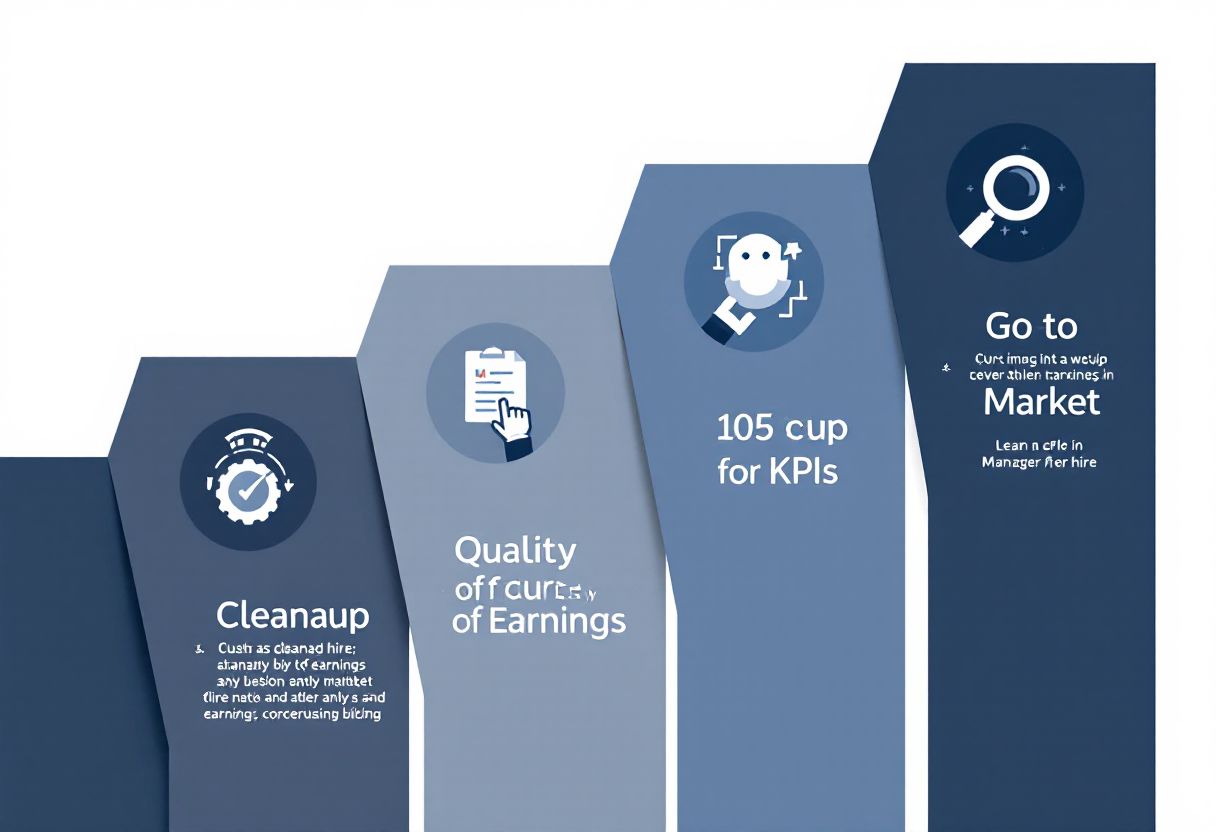
T-36 to T-24 months: Foundation
- Engage a Big-Four or top-15 accounting firm; clean up ASC 606 principal-vs-agent treatment; restate the prior two years if necessary; produce GAAP audited financials
- Convert all freelancers to either W-2 employees or properly papered 1099 contractors with no exclusivity (avoid Borello/AB5-style misclassification exposure)
- Sweep IP assignment, music/footage/font licensing, and AI-tool usage across all live work; remediate gaps
- Document succession plan with named CCO or CEO #2 and begin transitioning client relationships
- File trademarks on proprietary methodologies, frameworks, and research products
- Begin building proprietary AI workflow; hire or contract a senior ML engineer; document productivity gains
- Pick a specialty niche; begin to build category authority through research, thought leadership, and 1 to 2 vertical awards
T-24 to T-12 months: Operational de-risking
- Move project-based clients onto annual retainer agreements where possible; target 60%+ recurring revenue
- Push top-10 client share down by aggressively winning new mid-sized accounts
- Lock senior creative talent into multi-year contracts with non-competes and change-of-control retention
- Begin tracking and reporting NRR, MRR, and retention metrics monthly
- Establish an advisory or fiduciary board including at least 1 industry veteran
- Engage M&A counsel; begin to scope the buyer universe (holdcos, consultancies, specialty PE, generalist PE, AI-native roll-ups)
- Upgrade GL system (NetSuite, Workday, Sage Intacct); hire controller or fractional CFO; monthly close within 15 days
- Build the add-back bridge as a living document
T-12 to T-6 months: Process preparation
- Engage an investment bank or M&A advisor (Houlihan Lokey, Canaccord Genuity, Lincoln International, Raymond James, AdMission, Capstone Partners, or specialist agency M&A advisors like SI Partners or Results International)
- Run a sell-side QoE with a top-tier accounting firm (budget $50K to $100K); fix issues before the buyer’s QoE finds them
- Prepare a confidential information memorandum (CIM) and a teaser
- Build the virtual data room (corporate, financial, legal, HR, client, IP, tax, AI/data, ESG)
- Refresh awards entries; document pending wins; build the case-study library with client sign-off
- Final compliance scrub (IP assignment, AI-usage permissions, W-2/1099, sales/use tax, non-compete enforceability)
- Begin pre-marketing conversations with a short list of strategic buyers if relevant
T-6 to T-0 months: Marketing and close
- Run a structured process: solicit interest from 8 to 15 buyers, narrow to 3 to 5 for management presentations
- IOIs collected 2 to 3 weeks after CIM goes out
- Management meetings; LOIs solicited; select LOI; sign with exclusivity (typically 60 to 90 days)
- Confirmatory diligence runs in parallel; QoE, client DD, IT audit, legal, HR, tax, AI/data risk
- Negotiate definitive agreements, reps and warranties insurance (2.5% to 4% of coverage limit), escrow, earn-out terms
- Plan client communications (concurrent with announcement, never before)
- Plan employee communications, retention bonus rollout, and integration day-one plan
T+0 to T+36 months: The earn-out years
- Hit your earn-out targets; they are designed to be achievable but not certain
- Typical structure for a $5M EBITDA private creative agency: 60% to 70% cash at close, 15% to 25% earn-out over 24 to 36 months tied to revenue and EBITDA and client retention, 10% to 20% equity rollover into the PE platform, retention bonus pool of 3% to 5% of headline price vesting over 3 to 4 years
- Avoid the three-year trap: get more cash at close (push for 70% to 80%) and accept a smaller earn-out; negotiate explicit “buyer interference” carve-outs that protect you from earn-out misses caused by integration decisions; treat the earn-out as a put option on rolled equity rather than a contingent payment where possible
- Do not lose the founder energy that built the agency; if you do, client churn accelerates
- Document and report religiously
End-to-end from M&A engagement to close: 9 to 12 months in a well-run process. Total prep window from “decide to sell in 3 years” to “wire hits the account”: 36 to 48 months for the owners who get top-quartile pricing.
Frequently Asked Questions
How long should I plan for before selling my advertising agency to a private equity buyer?
The owners who get top-quartile pricing start preparing 18 to 36 months before going to market. The minimum useful prep window is 12 months, because most of the high-leverage levers (cleaning up ASC 606 principal-vs-agent treatment, lifting recurring retainer share from under 40% to above 60%, promoting a CCO or CEO #2 with documented pitch wins, building proprietary AI workflow with measured productivity gains, running a sell-side QoE) need 12+ months of clean trailing-twelve-months data to be credible to a buyer. Owners who try to sell in under 6 months typically leave 25% to 40% of enterprise value on the table.
What is a realistic EBITDA multiple for a $5M EBITDA advertising agency in 2026?
For a $5M adjusted EBITDA agency in 2026, the realistic range is 6x to 9x. The bottom of that range applies to generalist creative shops with under 40% recurring revenue, owner-as-chief-creative dependence, and a single client above 20% of revenue. The top applies to shops with 60%+ recurring retainer revenue, a CCO promoted 18 to 24 months pre-sale with documented pitch wins, a declared specialty (B2B SaaS, healthcare, financial services), proprietary AI workflow with measured margin gains, and client concentration under 15%. Specialty agencies in regulated verticals (healthcare, financial services) at the same $5M EBITDA can clear 10x to 12x; the Real Chemistry continuation-fund valuation is the public comp. Sources: First Page Sage, Auxo Capital Advisors, FE International, Breakwater M&A.
How does ASC 606 principal-vs-agent treatment affect my agency’s valuation?
Massively, and it is the single most common agency deal-killer. ASC 606 requires every agency to determine principal vs. agent status for every revenue stream, based on control of the good or service before transfer (who contracts with the media vendor or talent, who bears cancellation/credit liability, who has pricing authority, whose balance sheet the inventory or talent sits on). If the agency is the principal, revenue is recognized gross (full media spend hits the top line). If the agency is the agent, revenue is recognized net (only the agency fee is revenue). Agencies often book gross to make the top line look bigger; the buyer-side QoE reclassifies net, EBITDA drops 30% to 50%, and either the headline price drops accordingly or the buyer walks. Fix this 24 months before market with a Big-Four or top-15 firm opinion. Sources: MGO CPA, Withum, Crowe LLP, Deloitte.
What percentage of recurring retainer revenue do buyers want to see?
60% or higher is the threshold that moves an agency from project-shop into platform-quality. Agencies with 60%+ recurring revenue sell for 25% to 40% higher multiples than otherwise comparable shops. On top of that, buyers will discount disclosed retainers if they do not see contracted termination language, so paper the retainers properly with 12-month rolling terms, 60-day cancellation, and 90-day renewal triggers. Bundle production capacity into a monthly fee with a stated number of executions; buyers treat this as recurring even if line items vary. Bill for strategy, governance, and IP separately from execution so even production-heavy clients have a retained strategic envelope. Sources: First Page Sage, Auxo Capital Advisors, FE International, Breakwater M&A.
Do I need proprietary AI tooling to get a premium multiple in 2026?
Yes, if you want a platform multiple. Off-the-shelf prompt engineering on Midjourney, Runway, and ChatGPT is now table stakes; every agency does it. What buyers pay platform multiples for is proprietary tooling: fine-tunes on open models, brand-trained content engines, vector databases of client work, proprietary orchestration workflows, and documented gross-margin uplift by service line before AI vs. after AI. The Brandtech Group’s $4B valuation on a $115M Series C is the clearest market signal. Practically, the path is to hire or contract 1 senior ML engineer or AI product lead, pick 2 to 3 highest-volume production workflows (versioning, localization, format adaptation), and rebuild them on owned tooling. Document the margin uplift. Build an AI capability statement with named tools, named owners, and measured productivity gains. Ensure every active client contract has AI-usage permission, IP, indemnity, and data-use clauses.
Who is the most likely buyer for a $4M EBITDA creative agency in 2026?
Most likely a PE-backed roll-up platform doing tuck-ins, not a holding company directly. The 2024-2026 carve-out wave (R/GA to Truelink Capital, Huge plus Hero Digital to AEA Investors, Dept to Carlyle, Real Chemistry continuation vehicle to New Mountain, Hill Holliday and Deutsch NY to Attivo Group) reshaped the buyer universe. A $4M EBITDA creative agency is too small to be a standalone PE platform but is the right size for a tuck-in into one of those platforms or into Stagwell, Havas, or one of the AI-native roll-ups like Brandtech or Monks. Tuck-in multiples typically run 0.5x to 1.0x EBITDA below platform multiples but come with equity rollover (20% to 40% of consideration) into the larger platform that often becomes the single highest-IRR component of the deal, plus a “second bite at the apple” when the platform sells in 3 to 5 years.
What to Do Next
The advertising agency owners who get the top-quartile multiple all do the same five things. They start preparing 18 to 36 months before they want to be out. They clean up ASC 606 principal-vs-agent treatment 24 months pre-sale with a Big-Four or top-15 firm opinion. They convert project work to retainer to push recurring revenue above 60%. They promote a CCO or CEO #2 and have that successor win the next 2 to 3 major pitches without owner involvement. And they invest in proprietary AI tooling with documented margin gains and a written AI capability statement.
The buyer universe in 2026 is the broadest it has ever been: holding companies (the combined Omnicom, Publicis, WPP, Dentsu, Havas, Stagwell), consultancies (Accenture Song, Deloitte Digital, IBM iX), specialty PE platforms (Truelink, AEA, Carlyle, New Mountain, Insignia, Attivo), generalist PE in selected sub-sectors (KKR, Apax, EQT), AI-native roll-ups (Brandtech, Monks), and management buyouts backed by private credit. The right buyer for you depends entirely on the kind of agency you are. The work you do in 2026 should be designed around the buyer you want in 2028.
If you are 12+ months from a potential exit and want a structured pre-sale optimization roadmap, CT Acquisitions has agency operations and finance specialists in our partner network who run multi-quarter prep engagements (ASC 606 cleanup, retainer conversion, succession, AI moat build). If you are 6 to 12 months out and ready to start the sell-side process, our M&A advisory team runs the buyer outreach across holdcos, consultancies, PE platforms, and AI-native acquirers. No fee to you on buy-side introductions; sell-side mandates are paid on success at closing. Either way, the first 30 minutes are free.
Ready to talk?
Schedule a 30-minute exit-readiness call
Or read more: Sell Your Marketing Agency (active sale guide) | Book a call with a CT Acquisitions advisor
Ready to Explore Your Options?
A 30-minute confidential conversation is all it takes.