How to Prepare Your Document Destruction Business for Sale in 2026: The 36-Month Playbook
Preparing your document destruction business for exit in 2026 is a 36-month playbook. The first 12 months tighten the operating story around recurring shred customer percentage, route density, and NAID AAA certification. The middle 12 fix pre-LOI diligence gaps around customer contracts, truck fleet condition, and chain-of-custody compliance. The final 12 turn one offer into a real competitive process. Named consolidators include Iron Mountain, Stericycle Shred-it, Access Information, plus regional PE-backed platforms.
Exiting your document destruction business is the single largest financial event most owners will ever face. This guide is the no-fluff playbook for document destruction business owners who are 12-36 months from sale, covering how PE-backed buyers actually value your business in 2026, the 12 levers that move your multiple, pre-LOI diligence, deal-killers to fix before going to market, and the full 36-month exit prep timeline.
Updated April 2026 · CT Acquisitions

Most document destruction owners decide to sell, hire a broker, and find out 90 days later that their business is worth 30% to 40% less than they thought. The owners who get top-quartile pricing start the work 24 to 36 months before they ever talk to a buyer. This guide is the 36-month playbook for how to prepare your document destruction business for a sale or exit. It covers what private equity and strategic acquirers actually buy after the $7.2B Waste Management acquisition of Stericycle closed in November 2024, the 12 levers that move shredding multiples, the documents buyers ask for before they send an indication of interest, and the deal-killers that re-trade shredding transactions during confirmatory diligence. Every number cites its source. Every recommendation comes from how the most active shredding and records-storage buyers in 2026 actually behave.
If you are 6 to 36 months from a possible exit, this is the work that turns a 4x EBITDA outcome into a 6.5x EBITDA outcome. On a $1.5M EBITDA on-site shredding business, that is the difference between a $6M sale and a $10M sale. Whether you want to prepare your document destruction business for a sale to a national consolidator like Vital Records Control or Access Corp, prepare your document destruction business for an exit to a regional independent backed by lower middle market private equity, or simply maximize value over the next 1 to 3 years before going to market, the work below applies.
Building toward an exit in 12 to 36 months?
CT Acquisitions runs sell-side advisory for document destruction and records management owners $1M+ EBITDA. We also have operations specialists in our partner network who run pre-sale optimization engagements when the timeline is longer. No fee to you on buy-side introductions; sell-side mandates are paid on success at closing.
What Private Equity Actually Buys in Document Destruction (2026)
The global document shredding services market sat at roughly $3.37B in 2024 and is forecast to reach $5.73B by 2033 at a 6.08% CAGR (Verified Market Reports, 2025; Cognitive Market Research, “Document Shredding Services Market Analysis 2026”). Mobile shredding is the fastest-growing channel inside that envelope through 2035 (Vantage Market Research, “Mobile Shredding Services Market Valuation and Future Projections to 2035”). The single biggest event in the category was Waste Management’s $7.2B all-cash acquisition of Stericycle, closed November 4, 2024 at $62.00 per share, a 24% premium to the 60-day VWAP, with $1.4B of assumed Stericycle net debt rolled into enterprise value. Shred-it, Stericycle’s secure information destruction business, is now a Waste Management subsidiary inside WM Healthcare Solutions (Waste Management Form 8-K filings, June 3 and November 4, 2024, SEC EDGAR; CNBC; Investing.com). The downstream effect is that regional independents now negotiate with a single national consolidator that has both the regulated-medical-waste route base and the secure-shredding route base under one roof, which has reset the bid floor on tuck-in deals priced against Shred-it route density.
The PE-attractive document destruction profile
- EBITDA threshold for a tuck-in: $300K to $1M SDE for owner-operated. $1M to $3M EBITDA gets you into a competitive tuck-in process with VRC, Access Corp, or a regional independent. $3M to $10M EBITDA puts you in front of WM/Shred-it, Iron Mountain, and the LMM sponsor-backed platforms.
- Recurring scheduled service revenue: 75% or higher is the threshold buyers use to separate route businesses from purge operators. Operators that are 50%+ one-time purge get priced as commodity work (DeFoor Business Services 2025; Georgia Association of Business Brokers).
- Records storage archive base: 25,000+ archive boxes generating sticky monthly storage revenue at $0.20 to $0.50 per box per month is the multiple amplifier. Iron Mountain’s entire investor story is built on this earnings stream.
- NAID AAA certification: Current at every operating location and every service type. Loss or absence triggers a 1.0x to 2.0x multiple haircut (i-SIGMA; SecureScan; New York Shredding, March 2026).
- Customer concentration: No single account above 10% of revenue. Top 5 below 30%. Above 20% triggers buyer pushback; above 25% triggers a 15% to 30% valuation discount or buyer withdrawal (Beancount.io, May 2026; Strategex; Eagle Rock CFO; Morgan and Westfield).
- Geography: Tight, dense routes win. Stops per route mile is the single biggest operating-margin lever in the category (Shred Nations Partners, “Optimizing Your Revenue per Truck”; Octopussaas Scaling Framework).
- Owner role: Owner is in management, not driving routes or signing every check. GM in place 12+ months pre-sale.
Active document destruction acquirers in 2026
The list below covers the named strategic and PE acquirers most active in the 2024 to 2026 cycle. This is who will see your teaser. Sources include Vital Records Control press releases, Tracxn, PitchBook, Access Corp press releases, Iron Mountain 10-K and CORRESP filings on SEC EDGAR, Waste Management Form 8-K filings on SEC EDGAR, Shred-it press releases, and the Authority Brands PR Newswire release of January 2026.
| Acquirer | Sponsor / parent | Profile |
|---|---|---|
| Iron Mountain (NYSE: IRM) | Public REIT | Continues tuck-in records-storage acquisitions in North America; sold UK, Ireland, and Australia shredding to Shred-it; $1M to $50M+ EBITDA records storage |
| Shred-it / WM Healthcare Solutions | Waste Management (NYSE: WM); closed $7.2B Stericycle deal Nov 4, 2024 | Now WM subsidiary; integrating regulated medical waste plus secure shredding routes; $1M to $25M EBITDA on-site shredding |
| Vital Records Control (VRC) | Windjammer Capital Investors | Acquired Redishred/ProShred Feb 7, 2025; acquired 2-20 Records Management; 8+ disclosed acquisitions per Tracxn; $500K to $5M EBITDA |
| Access Corp | Privately held | 6 US records management deals closed Nov 2024 across Milwaukee, Boston, Portland, Beaumont, Minneapolis, Los Angeles; acquired Triyam Mar 2024; $1M to $10M EBITDA |
| ProShred Security | Authority Brands (Apax Partners + BCI); operating company now under VRC after Feb 2025 | Franchise expansion under Authority Brands; 40+ ProShred locations under VRC; $300K to $2M EBITDA franchise units |
| Confidata | Privately held regional consolidator | Active in mid-Atlantic; specialty in HIPAA-regulated healthcare destruction; $300K to $2M EBITDA |
| Diversified Storage Services | Privately held | Records storage roll-up; Midwest and Southeast; $500K to $5M EBITDA records storage |
| AAA Shredding (regional variants) | Multiple regional owners | Regional roll-ups under brand variants; $300K to $1M EBITDA |
| Windjammer Capital Investors (sponsor) | n/a | Sponsor of VRC platform; lower middle market specialist |
| Authority Brands | Apax Partners + BCI | Multi-brand franchise platform; added 246 new franchise owners and 340 new territories in 2025 alone; ProShred is the shredding brand inside the portfolio |
| Apax Partners (sponsor) | n/a | Co-sponsor of Authority Brands; indirectly exposed to ProShred franchise system |
| BCI Equity Partners (sponsor) | n/a | Co-sponsor of Authority Brands |
| Restore plc (LSE: RST) | Public, UK-listed | Largest UK records management and shredding consolidator; benchmark for valuing similar US route businesses (MoneyWeek, “Restore: Profits in document shredding”, 2024) |
| Regional LMM independents | Trivest, Riverside, and other LMM sponsors | Sporadic but rising activity in the $500K to $3M EBITDA band across the Sun Belt and Mountain West |
On the strategic side, Cintas (NYSE: CTAS) and Aramark (NYSE: ARMK) are not currently shredding consolidators in 2024 to 2026 but remain benchmarks for valuing recurring commercial route service revenue. Cintas historically entered document management with Smartshred, merged shredding into Shred-it, retained 42% of the joint venture, and later exited (Cintas company timeline; Shred-it UK press release on the Cintas combination). No major US OEM or industrial conglomerate has signaled a residential or one-time-purge shredding platform acquisition in 2024 to 2026. The dominant exit paths for sub-$5M EBITDA owners are (a) tuck-in to one of WM/Shred-it, Iron Mountain, VRC, or Access Corp, or (b) sale to a regional independent backed by lower middle market private equity. That concentration of buyers is itself an important seller risk factor because the bid pool tightens once you exclude the top four. Authority Brands added 246 new franchise owners and 340 new territories in 2025, a 140% increase in new franchise ownership 2023 to 2025 (Authority Brands PR Newswire, January 2026), which keeps ProShred on the map as a franchise-side exit option for owner-operators who fit the territory profile.
Document Destruction Valuation Multiples in 2026 (What You Are Actually Worth)
The multiple a buyer pays comes down to your size, the mix of scheduled route revenue vs. one-time purge, your records storage archive base, your NAID AAA certification status, and customer concentration. Here is the 2026 range, cross-referenced from the Georgia Association of Business Brokers shredding valuation guide, DeFoor Business Services, Tim Greene’s document shredding valuation series on LinkedIn, DealFlow OS, BizBite.io, and the strategic-buyer comp set (Iron Mountain, WM/Stericycle close, VRC and Access tuck-ins).
SDE multiples (smaller, owner-operated, typically under $2M revenue and under $1M SDE)
| SDE band or profile | SDE multiple | Source |
|---|---|---|
| Under $500K SDE | 2.5x to 3.5x | GABB; DeFoor Business Services |
| $500K to $1M SDE | 3.0x to 4.0x | GABB; DeFoor; Tim Greene LinkedIn |
| One-time purge dominant, no scheduled service base | 2.5x to 3.5x SDE | GABB; DeFoor |
| Route-based, 75%+ recurring scheduled service, NAID AAA certified, owner in management role | 4.0x to 5.5x SDE | GABB; DeFoor; DealFlow OS document shredding acquisition guide |
The headline industry rule of thumb from the shredding broker community: buyers multiply recast EBITDA by 4 to 5 to value an independent shredder, with a separate revenue-multiple cross-check at 1.5x to 1.7x revenue (DeFoor Business Services 2025; GABB 2025; Tim Greene LinkedIn series). The revenue multiple is derived from the EBITDA analysis, not a freestanding method.
EBITDA multiples (PE-attractive size)
| EBITDA band | On-site shredding (recurring route) | Records storage (archive boxes) | Combined / hybrid |
|---|---|---|---|
| Under $1M | 4x to 6x | 5x to 7x | 4.5x to 6.5x |
| $1M to $3M | 5x to 7x | 6x to 8x | 5.5x to 7.5x |
| $3M to $10M | 6x to 9x | 7x to 10x | 7x to 9.5x |
| $10M+ | 8x to 12x+ | 9x to 13x+ | 9x to 12x+ (estimate) |
Source: synthesized from GABB, DealFlow OS, LivePlan “Document Shredding Business Plan”, BizBite.io shredding business acquisition listings, DealFlowAgent “Business Exit Valuations 2025 to 2026: EBITDA Multiples Guide”, VRC and Access tuck-in benchmarks (industry estimate), Iron Mountain trading comp at roughly 13x EV/EBITDA, and the implied 11.7x trailing EBITDA on the $7.2B WM/Stericycle close in November 2024 (industry estimate calculated off the WM merger proxy). Key principle: records storage trades at a premium to on-site shredding because the archive box population produces sticky monthly storage fees that compound until the customer pulls or destroys the box. Scheduled on-site shredding route revenue trades close to records storage. One-time purge revenue is the lowest-quality earnings line and is often discounted or excluded entirely by sophisticated buyers (GABB; DeFoor; DealFlow OS).
Recent disclosed transactions (2024 to 2026)
| Acquirer | Target | Date | Value | Implied multiple |
|---|---|---|---|---|
| Waste Management (NYSE: WM) | Stericycle (parent of Shred-it) | Nov 4, 2024 | $7.2B EV (incl. $1.4B assumed net debt) | ~11.7x trailing EBITDA (estimate, calculated off WM merger proxy) |
| Vital Records Control | Redishred / ProShred Security | Feb 7, 2025 | Undisclosed; took TSXV: KUT private | Not officially disclosed |
| Vital Records Control | 2-20 Records Management | 2024 to 2025 | Undisclosed | Not officially disclosed |
| Access Corp | 6 US records management add-ons (Milwaukee, Boston, Portland, Beaumont, Minneapolis, Los Angeles) | Nov 2024 | Undisclosed | Not officially disclosed |
| Access Corp | Triyam (healthcare EHR data management software) | Mar 11, 2024 | Undisclosed | Not officially disclosed |
| Iron Mountain (historical comp) | Recall Holdings (320 facilities in 24 countries) | May 2016 | ~$2.0B | Largest single records-management transaction on record (Iron Mountain investor relations) |
Sources: Waste Management Form 8-K filings (June 3 and November 4, 2024) and Form 8-K/A on Stericycle acquisition, SEC EDGAR; Vital Records Control press releases (February 2025; 2-20 announcement); Tracxn VRC acquisitions list (April 2025); PitchBook VRC profile 2026; Access Corp press releases (November 2024); Businesswire on Access Triyam acquisition (March 11, 2024); Iron Mountain investor relations and Network Computing “Iron Mountain Opens M&A Pipeline”.
The 12 Value Levers That Move Your Multiple (Ranked by Impact)

These are the levers that move document destruction multiples in the 24 months before a sale. Each has a current state, a target state, and an estimated financial impact. The ordering is by dollar impact per unit of effort, synthesized from the shredding broker community (GABB, DeFoor, Tim Greene LinkedIn series), Shred Nations Partners, Octopussaas Scaling Framework, DealFlow OS, and i-SIGMA program documentation.
Lever 1: Tighten route density and stops per day
Current: 8 to 12 stops per truck per day; one-time purge dominates the schedule; trucks return half-full. Target: 15 to 25 stops per truck per day; routes geographically clustered; trucks consistently filled to capacity. Impact: Direct gross margin lift of 5 to 12 points on a route. On a $1M revenue route business that drops $50K to $120K of additional EBITDA. At a 6x multiple that is $300K to $720K of additional sale price. Route density is also the single biggest signal buyers use to predict their own post-close operating margin (Shred Nations Partners, “Optimizing Your Revenue per Truck”; Octopussaas Scaling Framework). How: Route optimization software (Routific, OptimoRoute, RoutOptix). Geographic pricing tiers that price out-of-zone stops higher. Sales-team comp tied to “fill the route” rather than “any new account”.
Lever 2: Convert one-time purge customers to scheduled service
Current: 30%+ of revenue is one-time purge. Target: 75%+ of service revenue is scheduled recurring; one-time purge is a customer-acquisition channel that converts at 25%+ to scheduled. Impact: Recurring scheduled service trades at 4x to 7x EBITDA; one-time purge revenue is heavily discounted, often valued at 1x to 3x or excluded entirely by sophisticated buyers (GABB; DeFoor). Lifting recurring mix from 50% to 75% on a $1M EBITDA business can move the multiple from 4.5x to 6.0x, worth $1.5M of sale price. How: Tech and CSR comp on conversion. Annual-renewal contract template with auto-pay default. Pricing one-time purge at a 30% premium to scheduled pickup, with first scheduled pickup discounted, so the math always favors conversion.
Lever 3: Earn and protect NAID AAA certification
Current: Not certified, or certified but with corrective actions outstanding from the last audit. Target: NAID AAA certified at every operating location and every service type the business performs (paper, hard drive, media, specialty); zero unresolved corrective actions; both announced and unannounced audits clean in the last 24 months. Impact: NAID AAA is the industry-standard secure-destruction certification, recognized in thousands of customer contracts as proof of due diligence under HIPAA, FACTA, GLBA, the New York SHIELD Act, and state privacy laws (i-SIGMA “NAID AAA Certification”; SecureScan; New York Shredding, March 2026; BitRaser). Loss or absence kills enterprise and healthcare bids and triggers a 1.0x to 2.0x multiple haircut in any buyer’s model. Maintaining certification is the price of admission to the premium-multiple band. How: Engage i-SIGMA for the initial certification process; budget $5K to $15K initial cost plus annual renewal. Set up an internal compliance lead who owns the file. Build the operating procedures manual that mirrors NAID requirements (chain-of-custody, employee screening, surveillance, destruction methods).
Lever 4: Build a records storage archive base
Current: Shredding only; no records storage. Target: Records storage archive of 25,000+ boxes generating sticky monthly recurring revenue. Impact: Records storage is the highest-multiple line in the category. Iron Mountain’s entire investor story is built on this earnings stream. Even 25,000 boxes at $0.30 average per box per month is $90K of pure recurring revenue with near-zero churn, valued separately at $125K to $375K on top of the operating EBITDA multiple (industry estimate from Iron Mountain disclosures and broker community). Adds 0.5x to 1.0x to the operating multiple per data quality (estimate). How: Co-locate storage with the shredding plant if real estate allows. Acquire a small records storage operator as a tuck-in 24 months before sale to seed the archive. Cross-sell storage to existing shredding customers; legal and healthcare verticals are the easiest conversion.
Lever 5: Stand up hard-drive destruction and e-waste cross-sell
Current: Paper only. Target: Hard-drive destruction with NAID AAA certified physical destruction plus e-waste recycling under R2v3 or e-Stewards downstream certifications. Cross-sell to existing paper-shredding customers at 30%+ penetration. Impact: Hard-drive destruction carries 40% to 60% gross margin vs. 25% to 35% on paper (industry estimate from broker community). Drops 5 to 10 points of blended gross margin. On a $2M revenue business that is $100K to $200K of EBITDA, worth $500K to $1.4M at a 5x to 7x multiple. Hard-drive destruction is also the gateway to financial-services and healthcare IT asset disposition relationships, which are sticky and command premium pricing. How: Acquire a hard-drive shredder (capex $30K to $100K). Train sales on the ITAD pitch. Get NAID AAA on hard-drive in addition to paper. Build the downstream agreement with a certified e-waste recycler.
Lever 6: Move owner out of the chair
Current: Owner sells, runs routes, schedules trucks, signs every check. Target: General Manager in place 12+ months before going to market. Owner doing under 30 hours/week of operational work. Sales has a dedicated leader; operations has a dedicated leader; finance has a controller or outsourced CFO. Impact: Owner-dependence is the single most cited multiple haircut in lower middle market deals. On a $500K to $1.5M EBITDA business, removing key-person risk moves the multiple from the 4x band into the 5x to 6x band, worth $500K to $1.5M of price. How: GM hire 18 to 24 months pre-sale ($110K to $160K typical comp for an LMM service business GM). Document SOPs. Transition customer relationships to a sales lead. Take a 2-week unplugged vacation as the stress test.
Lever 7: De-concentrate the customer base
Current: Top customer above 15% of revenue. Target: Top customer below 10%; top 5 below 30%. Impact: Concentration above 20% triggers buyer pushback; above 25% triggers a 15% to 30% valuation discount or buyer withdrawal (Beancount.io 2026 customer concentration guide; Strategex; Eagle Rock CFO; Morgan and Westfield). SBA financing tightens at the 20% line (Wall Street Prep, 2025). How: New-account focus on smaller-account-size verticals (small law firms, accounting practices, medical offices) vs. enterprise. Decline to renew non-strategic enterprise concentration. Diversify geography.
Lever 8: Lock in commercial multi-year contracts with assignment clauses
Current: Most accounts on month-to-month or 12-month auto-renew; no documented assignment-on-sale clause. Target: 60%+ of recurring revenue under 24 to 36 month contracts with assignment-on-sale or assignment-without-consent language. Impact: Contractually committed revenue with clean assignment is what makes the route base actually transferable. Without it, the buyer prices in attrition risk. Estimate: +0.25x to 0.75x multiple uplift on the operating business. How: New customer contract template with the assignment language. Renewal campaign that pushes existing accounts onto the new template at renewal time. Lawyer review of any major-customer contract for change-of-control restrictions.
Lever 9: Build clean digital chain-of-custody documentation
Current: Paper manifest in the cab of the truck; weighmaster tickets stored in a binder; no customer portal; certificates of destruction issued ad hoc. Target: Digital chain-of-custody system tracking every container barcode from customer pickup through plant or mobile shredding through paper baling. Customer portal showing pickup history, destruction events, and Certificate of Destruction PDFs. Indefinite retention of certificates (HIPAA audits can occur years later). Impact: Chain-of-custody quality is a direct multiple driver because buyers underwrite the post-close liability tail. A clean digital chain-of-custody supports the premium-multiple band; ad hoc documentation puts a ceiling on the multiple. Estimate: +0.25x to 0.5x multiple uplift, plus a major reduction in re-trade risk during confirmatory diligence (Accountable HQ; DES3 Tech; ARCOA “HIPAA-Compliant Data Destruction and Why It Matters”, December 2025). How: Implement VeriShred, RoutOptix, ShredYourBox, or similar. Train drivers on barcode-scan-on-pickup and barcode-scan-on-destruction. Auto-generate Certificate of Destruction and push to customer portal within 24 hours of event.
Lever 10: Lift commercial average monthly revenue per account
Current: $60 to $80 per account per month; no annual price increase; new container deliveries free. Target: $90 to $130 per account per month for standard commercial; annual 4% to 8% list-price increase passed through; container delivery and rotation priced as standalone line items. Impact: Direct EBITDA lift. A 5-truck operator with 1,000 active commercial accounts that lifts ARPU by $15 per month is $180K of additional revenue, with most of it dropping to EBITDA at high incremental gross margin. At a 6x multiple, that is $720K to $1M of incremental sale price. How: Annual price-letter campaign. Container-fee rationalization. New-customer pricing strategy that anchors at the higher tier.
Lever 11: Fleet modernization and capex catch-up
Current: Trucks 10+ years old; cutter rebuilds overdue; visible wear; previous DOT violations on file. Target: Average truck age under 7 years; cutter rebuild logs current; wraps and brand condition consistent; DOT compliance current. Impact: Buyer models replacement capex against post-close cash flow. A fleet that needs $400K of immediate truck replacement reduces purchase price by close to $400K. Older fleet also reduces uptime and route reliability, which shows up in revenue. Mobile shredding trucks run $80K to $280K depending on configuration, with $220K to $280K typical for new (Shred Nations Partners; goneforgoodfranchise). How: Strategic truck-replacement plan starting 24 months pre-sale, financing the replacements so the recurring revenue stream supports debt service. Avoid letting the fleet age out in the run-up.
Lever 12: Real estate decision (own or lease, separate LLC, sale-leaseback)
Current: Plant real estate held in operating LLC, or held in separate LLC at non-FMV rent. Target: Plant in separate LLC at FMV NNN lease; clear path for buyer to either assume the lease or buy the real estate. Impact: Separating real estate often lifts the implied multiple on the operating business because the buyer is not forced to underwrite real estate exposure. A sale-leaseback can convert up to 100% of property market value as cash vs. 70% to 80% LTV via traditional debt (Plante Moran; Northmarq sale-leaseback primers). Estimate: holding real estate separately at FMV typically adds 0.5x to 1.0x to the operating multiple. How: FMV market-rent appraisal now. Restrike rent. Decide before going to market whether real estate is in or out of the deal.
Want to grow your business to maximize value before exiting?
We connect document destruction and records management owners with operations specialists in our partner network who run 12 to 24 month pre-sale optimization engagements. The engagement pays for itself in incremental sale price.
What PE Asks Before They Send an LOI (The Pre-LOI Diligence Stack)
Before a strategic acquirer or PE-backed platform commits to a letter of intent, they ask for a focused diligence package. The list below is the standard ask from a 2026 buyer targeting a document destruction business. The “why” and “how to prepare” expand each item to what is typical across the category.
1. Three years of financials plus the latest trailing twelve months
Why buyers ask: To trend revenue growth, gross margin, and EBITDA over the cycle and confirm the recurring revenue base is intact. LTM is the bridge between the most recent year-end and today, so the headline price reflects current run-rate, not stale data.
How to prepare: Accrual-basis P&L by month. Service-line P&L showing on-site scheduled shredding vs. off-site or plant-based shredding vs. one-time purge vs. records storage vs. hard-drive destruction vs. media destruction vs. specialty (X-rays, uniforms). Buyers will not accept a single revenue line; the mix is the diagnostic. Reconcile to tax returns so there are no surprises in confirmatory diligence.
2. Balance sheet and working capital trend
Why buyers ask: To set the working capital peg in the SPA and identify net debt (cash minus interest-bearing debt minus debt-like items including unfunded customer deposits, deferred revenue on prepaid annual shred contracts, accrued bonuses, and capital lease balances). Both peg and net debt come out of the purchase price.
How to prepare: Tie the balance sheet to the trial balance. Flag any prepaid customer contracts (for example, annual shred service prepaid for the year) as a deferred revenue liability, since this becomes a debt-like item at close, the same way prepaid HVAC maintenance plans do.
3. Add-back estimates
Why buyers ask: To pre-vet your adjusted EBITDA story before sinking buy-side QoE cost.
How to prepare: Build the bridge from book EBITDA to adjusted EBITDA line by line. Common shredding add-backs that hold up under buy-side QoE: owner compensation above market, one-time legal fees, family payroll, owner vehicle, country club, one-time truck purchase or wreck-replacement insurance recovery (separate from recurring fleet capex), software conversion costs, prior-period startup losses on a second truck rolled before route fill. Sources: Morgan and Westfield QoE guide; Midstreet QoE primer.
4. Anonymized employee roster (titles, start dates, pay, CDL status)
Why buyers ask: Three risks. First, driver tenure and CDL retention (industry-wide commercial driver shortage). Second, owner dependence. Third, family payroll exposure that becomes an add-back conversation.
How to prepare: Roster columns: role, hire date, W-2 vs. 1099 (with classification rationale), comp structure, CDL class where applicable, DOT medical card status, non-compete and non-solicit on file. Calculate driver retention at 12 and 24 months. CDL drivers operating mobile shredding trucks above CDL weight thresholds are a key-person risk on the operational side.
5. Revenue breakdown by service mix (2022 to 2025 plus LTM)
Why buyers ask: This is the single most diagnostic exhibit in shredding M&A. It reveals route quality, customer mix, and growth source.
How to prepare: Six columns minimum: revenue by service line, number of accounts by service line, average monthly revenue per account by service line, year over year. Industry benchmark from Octopussaas Scaling Framework: a single-truck operator can realistically service 150 to 350 accounts within a compact geography at $80 to $120 per account per month, generating $144K to $504K ARR per truck. Route density determines whether the truck is at the bottom or top of that band.
6. Customer and account file (counts by year, recurring vs. one-time, vertical mix, contract length)
Why buyers ask: Recurring scheduled service base is the multiple driver. Records storage archive count is a separate multiplier on top.
How to prepare: Account count by month, last 36 months. Renewal rate (target 92%+ annual; healthy routes churn 5% to 8% per year, mostly from business closures rather than competitive losses per industry sources). Average revenue per account. Vertical mix (legal, healthcare, financial services, government, generic commercial, residential). Contract length distribution (typical commercial contracts run 12 to 36 months with monthly automatic billing, per Octopussaas).
7. Five-year business plan
Why buyers ask: To pressure-test the forward case and the operator’s understanding of their own levers.
How to prepare: Revenue by service line, gross margin, overhead, capex (trucks), EBITDA. Show route expansion plan (existing truck capacity utilization, then second-truck timing), records-storage capacity (warehouse cube available for archive expansion), and hard-drive destruction cross-sell penetration of existing accounts.
8. Fleet list and truck age schedule
Why buyers ask: Capex forecast and asset condition.
How to prepare: Truck-by-truck schedule: unit number, year, make, model, cutter type (mobile shredder vs. plant-fed shredder), gross vehicle weight, mileage, ownership status (owned, financed, leased), monthly payment, last DOT inspection, last cutter rebuild, condition. Plant equipment: feed conveyors, balers, weighing systems, pneumatic transport. Mobile shredding trucks run $80K to $280K depending on configuration, with $220K to $280K typical for new (Shred Nations Partners; goneforgoodfranchise).
9. NAID AAA certification audit history
Why buyers ask: Certification status is the single biggest deal-killer in the category. They want the i-SIGMA audit file, last unannounced audit, and any corrective action notices.
How to prepare: Pull the full i-SIGMA audit history, last announced and unannounced audit reports, any corrective action notices, and the operating procedures manual. Loss or downgrade of certification at any point in the last 36 months is a diligence flag (i-SIGMA “Why Use an i-SIGMA NAID AAA Certified Member?”; SecureScan; SEAM; New York Shredding, March 2026).
10. Sample chain-of-custody records and Certificates of Destruction
Why buyers ask: Chain-of-custody quality is the single most damaging finding in shredding diligence when it is weak. Buyers want to underwrite the post-close liability tail.
How to prepare: Sample of recent destruction events with full chain-of-custody records (container barcode, driver signature, vehicle, weighmaster ticket, destruction-event video where required, Certificate of Destruction issued to customer). Gaps in the chain are the single most damaging finding in confirmatory diligence (Accountable HQ “HIPAA-Compliant IT Asset Disposition: Secure PHI Data Destruction and Chain of Custody”; DES3 Tech “Data Destruction Certificates Explained”).
Confirmatory Diligence (After You Sign the LOI)
Once an LOI is signed and exclusivity starts (typically 45 to 90 days per Colonnade Advisors podcast 020), the buyer runs parallel workstreams. This is the depth of inspection your business will undergo.
- Quality of Earnings (QoE). Outside accounting firm runs revenue cut-off testing (especially on annual prepaid contracts), recurring vs. one-time revenue classification, deferred revenue analysis, expense normalization, add-back validation. Cost: $35K to $100K typical for $1M to $5M EBITDA shredder. Output: adjusted EBITDA the buyer locks into the model (Eton Venture Services 2025; Morgan and Westfield QoE guide; Midstreet QoE primer).
- Customer and contract DD. Account-by-account revenue analysis, calls with top accounts, contract review (assignment clauses, change-of-control triggers, renewal dates, indemnification language tied to data-breach exposure).
- NAID AAA certification audit trail. Full i-SIGMA audit history, last unannounced audit report, any corrective action notices, operating procedures manual.
- Chain-of-custody documentation. Sample of recent destruction events with full chain-of-custody records (barcode, driver signature, vehicle, weighmaster ticket, video where required, Certificate of Destruction PDFs).
- IT and data systems. VeriShred, RoutOptix, ShredYourBox, or custom Salesforce build. Data quality, integration capability, route optimization software, customer portal.
- Legal. Entity good standing, state-by-state business registration, contractor or other licensing where applicable, customer contracts, IP, litigation history including any data-breach or unauthorized-disposal claims, real estate leases, warranty exposure.
- HR and payroll. W-2 vs. 1099 classification audit on drivers and helpers, DOT compliance (driver qualification files, hours-of-service, drug and alcohol testing program), benefits, wage-and-hour exposure, EEOC or DOL history.
- DOT and safety compliance. For any vehicle above CDL weight thresholds: full driver qualification files, current MCS-150 filing, USDOT number active, biennial update on file, last DOT audit results if applicable.
- Environmental. Paper recycling tonnage records, downstream paper buyer agreements, e-waste downstream certifications (R2v3 or e-Stewards for hard-drive destruction operators), used-oil and battery disposal, any UST or vehicle-shop environmental exposure on owned real estate (Phase I ESA on any owned property).
- Cyber insurance and prior incidents. Cyber liability policy face amount and tower, any prior data-breach incidents, any unauthorized disposal claims, any HIPAA Office for Civil Rights complaints filed against the company.
- Tax. Federal, payroll, sales and use tax, property. Sales tax exposure on service revenue varies by state. Recycling rebates received from paper buyers can create taxable income at the operating company level.
Why You Should Pay for Your Own Quality of Earnings Before Going to Market
A sell-side QoE is your own outside accountant’s QoE, paid for by you, before you go to market. For a document destruction business it does four things: it pre-empts the buyer’s QoE by getting to the adjusted EBITDA number first with documentation; it surfaces issues you can fix before the buyer sees them (deferred revenue from prepaid annual contracts, recurring vs. one-time revenue cut-off, add-back documentation); it tightens the EBITDA number you take to market; and, specific to shredding, it forces a clean break-out of recurring scheduled service revenue, records storage revenue, hard-drive destruction revenue, and one-time purge revenue. Without that break-out, sophisticated buyers default to the lowest-quality multiple across all four lines.
Cost
- $25K to $35K for QoE if revenue is below $10M (Eton Venture Services 2025; Morgan and Westfield QoE guide).
- $35K to $75K typical range for sell-side QoE on a healthy shredding business with multiple service lines.
- Up to $150K for businesses with complex add-backs, multiple entities, or messy books (Eton 2025).
ROI
Standard example cited across QoE provider content: $25M revenue, $5M EBITDA business. Moving the multiple from 5x to 6x equals $5M of additional sale price. A $50K QoE investment that supports the 1x lift is a 100x return (Eton, “Quality of Earnings Report Cost”, 2025). Document destruction specific: a shredding business where 30% of revenue is one-time purge often shows reported EBITDA that includes purge revenue at full weight. A buyer’s QoE will discount purge revenue. A pre-sell QoE forces this conversation before the LOI, lets the seller restructure the conversation (purge customers as a marketing channel that converts to scheduled) and lock in the multiple on the recurring portion.
Deal-Killers That Re-Trade Document Destruction Transactions (Avoid These)
These are the recurring kill-shots specific to the secure-information-destruction category. They sit on top of the universal lower middle market deal-killers (customer concentration, owner dependence, W-2/1099 misclassification). Most are fixable in 12 to 24 months. None are fixable in 30 days.
1. Loss or absence of NAID AAA certification
Buyers walk if NAID AAA is not current at every operating location and every service type performed. Acceptable: certified with no open corrective actions. Marginal: certified with open corrective actions, priced as a remediation discount. Unacceptable: not certified, or certification lapsed in the last 24 months. Loss of certification is the single biggest deal-killer in the category because customer contracts often require it (i-SIGMA program documentation; SecureScan; SEAM; BitRaser; New York Shredding, March 2026).
2. Chain-of-custody gaps or unauthorized-disposal incidents
Any prior incident where containers were left unattended, picked up by an unauthorized party, or where Certificate of Destruction documentation is missing for a destruction event is treated as catastrophic during DD. Buyers will request a written incident log; a missing log is itself a red flag. Plaintiff exposure on a single HIPAA-PHI unauthorized disposal claim can exceed the EBITDA value of a small operator. HHS Office for Civil Rights penalties under HIPAA can exceed $2M per violation category per year after 2025 inflation adjustments (ARCOA “HIPAA-Compliant Data Destruction and Why It Matters”, December 2025; Accountable HQ; Data Destruction Inc. “How Data Destruction Prevents Regulatory Fines and Legal Liabilities”).
3. Data-breach insurance gaps or prior incidents
Cyber liability policy with face amount below $5M is a flag for any operator serving healthcare, legal, or financial services. Prior data-breach claim history surfaces in the underwriting review. Average cost of a single data breach is $4.44M (referenced across multiple ITAD industry sources including DES3 Tech, 2025). Inadequate insurance limits force the buyer to either raise the limits post-close, which is expensive, or hold escrow back at close for the indemnification tail.
4. State privacy law compliance gaps
California (CCPA and CPRA), New York (SHIELD Act), Massachusetts (Standards for the Protection of Personal Information), Illinois (PIPA, plus BIPA exposure if biometric data is in scope), Texas (TDPSA effective 2024), Florida (FDBR effective 2024), and now 19+ state comprehensive privacy laws have explicit data-disposal requirements. A buyer with national ambitions will run a state-by-state compliance scrub. Missing posted privacy notices on the company website, missing data-handling agreements with customers in regulated states, and missing employee privacy training records all generate diligence findings.
5. DOT compliance and CDL driver issues
Mobile shredding trucks above CDL weight thresholds put the operator in the regulated motor carrier world. Common DOT findings: missing or expired driver qualification files, hours-of-service violations, drug-and-alcohol testing program gaps, MCS-150 not updated biennially, USDOT number inactive, or worst case a “Conditional” or “Unsatisfactory” safety rating on file with FMCSA. A poor safety rating shrinks the bid pool dramatically.
6. Fleet age and overdue capex
Trucks over 10 years old with no documented cutter rebuild log get priced as immediate replacement capex against purchase price. A $200K replacement need on a $1.5M EBITDA business at a 6x multiple is a 2% to 3% price reduction at close.
7. W-2 vs. 1099 misclassification
Operators that run drivers or helpers as 1099 to dodge payroll tax are sitting on a liability. IRS settlement exposure runs $10K to $100K+ per misclassified worker once back taxes, penalties, interest, and legal cost are aggregated (Tax1099 W-2 vs. 1099 guide; ADP SPARK “The Risks of Misclassifying 1099 Contractors”, 2023; IRIS 2025; IRS “Worker Classification 101”). DOL and IRS renewed enforcement focus 2024 to 2026. Drivers are almost never defensibly 1099, especially with company-supplied trucks.
8. Customer concentration above 20%
Single account above 15% gets buyer attention; above 20% triggers discount pricing; above 25% triggers walk-away (Beancount.io 2026; Strategex; Eagle Rock CFO; Morgan and Westfield “Customer Concentration”). SBA financing tightens at the 20% line (Wall Street Prep, 2025).
9. Owner-personal license or compliance qualifier
In some states a security guard license, private investigator license, or hauler permit is held by the owner personally rather than the entity. Transfer at close requires either a new qualifier or a delayed effective date. Surfaces in legal DD.
10. Environmental and downstream paper-buyer issues
Paper recycling revenue is volatile and historically weak in 2024 to 2026. Buyers will model a conservative price per ton on the downstream and discount any large prior-period one-time recycling revenue. Operators that overstated their paper rebate revenue in add-backs face an unfavorable QoE adjustment. E-waste downstream certifications (R2v3 or e-Stewards) are required by enterprise and government accounts; absence is a sales-channel ceiling.
11. Territory restrictions if ProShred franchisee
ProShred Security operates as an Authority Brands franchise with the operating company now under VRC after February 2025. Franchise agreements include territorial restrictions, transfer-of-control provisions, post-VRC acquisition operating standards, and franchisor consent rights on any sale. A ProShred franchisee selling to a non-ProShred buyer needs franchisor consent under the franchise agreement; the franchisor has a right of first refusal in most cases. Franchisee owners should pull and review the FDD and franchise agreement 24 months pre-sale (ProShred franchise overview pages on Entrepreneur, Franchising.com, IFPG; ProShred acquisitions page).
12. Contracts with non-assignment clauses
Customer contracts, especially with hospitals, law firms, banks, and government agencies, often include change-of-control or assignment clauses. Without negotiated consent language, a sale can trigger termination rights or re-negotiation, which a buyer will price into the deal. Surfaces in legal DD.
13. Recycling-rebate revenue classified as core service revenue
Paper recycling rebates and electronic scrap recoveries should be classified as commodity revenue, not service revenue. Buyer QoE will reclass and discount. Operators that booked recycling rebates inside service revenue inflate their reported margins; the QoE finds the gap.
The 36-Month Exit Prep Timeline
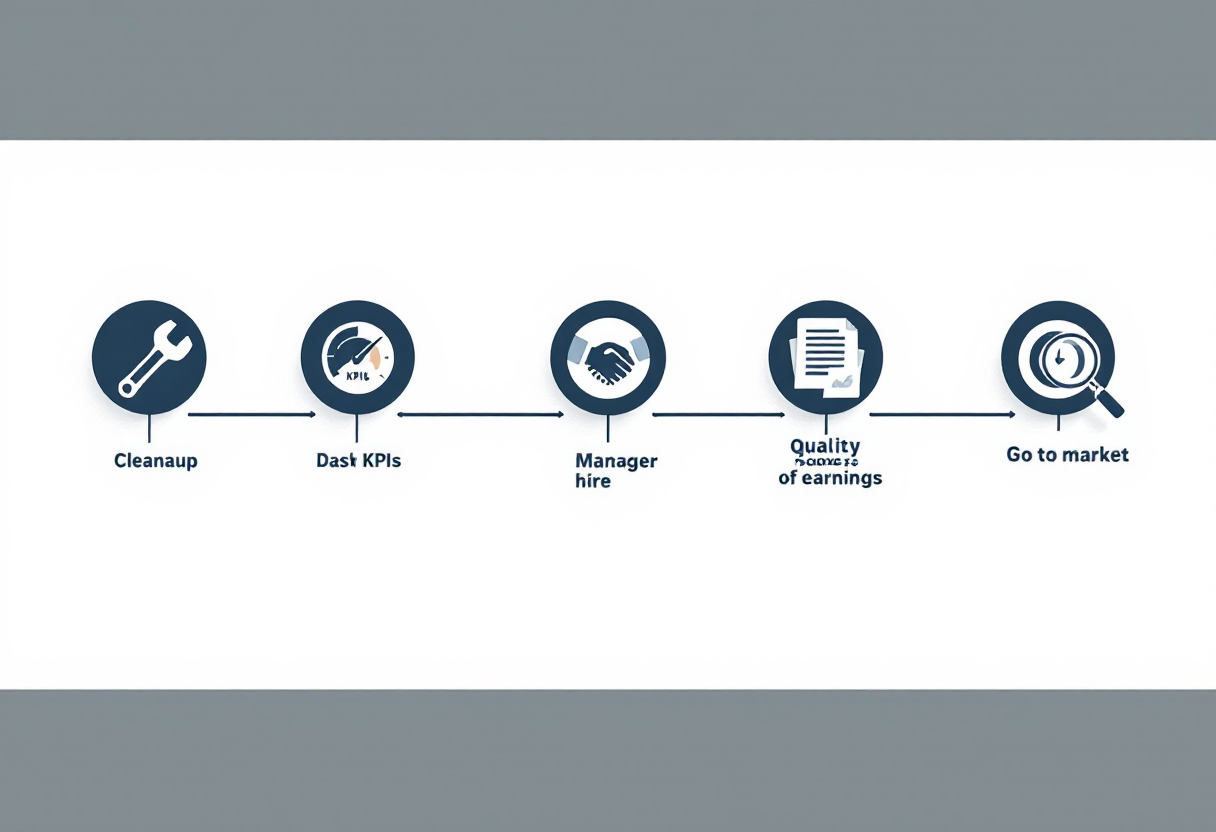
T-36 months: Cleanup phase
- Switch to accrual basis if still on cash basis
- Pick the FSM stack (VeriShred, RoutOptix, ShredYourBox, or a custom Salesforce build) and migrate
- Start the add-back log day one
- Apply for NAID AAA certification if not already certified; budget 6 to 12 months to readiness
- Conduct W-2/1099 audit on drivers and helpers; reclassify if needed
- Restrike related-party rent to FMV with appraisal
- DOT compliance scrub: driver qualification files, hours-of-service, drug and alcohol testing program, MCS-150 update
- Identify GM hire target (internal promotion or external recruit)
- Phase I ESA on any owned plant real estate
- State privacy law compliance review (CA, NY, MA, IL, TX, FL minimum)
T-24 months: Financial discipline and KPI infrastructure
- GM onboarded and taking operational load
- Monthly close in 15 days; service-line P&L every month (scheduled service, one-time purge, records storage, hard-drive destruction, recycling rebates broken out separately)
- KPI dashboard: revenue per truck, stops per day, average revenue per account, churn rate, recurring vs. one-time mix, records storage box count
- Launch one-time-to-scheduled conversion push
- Pricing review: 5% to 8% list increase, container fees rationalized
- Diversify customer base if any top account is above 15%
- Document SOPs for every operational role
- NAID AAA certification audit clean
- Build digital chain-of-custody system across all routes and destruction events
T-12 months: QoE-ready close discipline, eliminate owner dependence
- Owner steps out of daily operations; GM runs the shop
- Owner takes a 2-week unplugged vacation as the stress test
- Run the sell-side QoE (budget $35K to $75K)
- Tighten balance sheet: clean A/R, kill dormant inventory, isolate deferred revenue from prepaid contracts
- Final org-chart review; backfill gaps
- Final compliance scrub: NAID AAA current, EPA and state environmental records current, DOT current, W-2/1099 clean, state privacy law compliance verified, all customer contracts reviewed for assignment language
- Lock in 12 months of clean service-line P&L for the CIM
- Records storage archive count and roll-forward complete
T-6 months: Pre-marketing prep
- Engage M&A advisor (sell-side investment bank or industry-specialist M&A advisory firm). Typical fee structure: $25K to $75K monthly retainer credited against success fee of 4% to 8% of enterprise value, Lehman or modified Lehman scaling
- CIM drafted from the QoE and operating model
- Teaser drafted (anonymized 1-pager)
- Buyer list finalized: WM/Shred-it, Iron Mountain, VRC, Access Corp, regional independents, LMM PE sponsors with adjacent platforms
- Virtual data room populated with everything from the pre-LOI and confirmatory sections above
- Management presentation deck built and rehearsed
T-3 months: Go to market
- Teaser distributed; NDAs collected; CIMs distributed
- IOIs collected 2 to 3 weeks after CIM
- Narrow to 4 to 6 finalists for management meetings
- Management meetings; LOIs solicited
- Select LOI with exclusivity (45 to 90 days)
- Enter confirmatory diligence; close
End-to-end engagement to close: 9 to 12 months in a well-run process (Auxo Capital Advisors sell-side process guide 2025; Wall Street Prep sell-side primer).
Frequently Asked Questions
How long should I plan for before selling my document destruction business?
The owners who get top-quartile pricing start preparing 24 to 36 months before going to market. The minimum useful prep window is 12 months because most of the high-leverage levers (lifting recurring scheduled mix from 50% to 75%, earning NAID AAA certification, building a records storage archive base, installing a GM, running a sell-side QoE) need 12+ months of clean trailing-twelve-months data to be credible to a buyer. Owners who try to sell in under 6 months typically leave 15% to 30% of enterprise value on the table.
What is a realistic EBITDA multiple for a $1M EBITDA on-site shredding business?
For a $1M EBITDA on-site shredding business in 2026, the range is 5x to 7x. The bottom of that range applies to operators with under 50% recurring revenue, no NAID AAA certification, owner-dependence, and a concentrated customer base. The top applies to NAID AAA certified operators with 75%+ recurring scheduled service, a records storage archive of 25,000+ boxes, a GM in place, and customer concentration under 10% (synthesized from Georgia Association of Business Brokers; DeFoor Business Services 2025; DealFlow OS; DealFlowAgent “Business Exit Valuations 2025 to 2026”). Records storage at scale shifts the range up to 6x to 8x. The 36-month prep playbook moves you from the bottom of the band to the top.
Why is NAID AAA certification so important for valuation?
NAID AAA is the industry-standard secure-destruction certification, recognized in thousands of customer contracts as proof of due diligence under HIPAA, FACTA, GLBA, the New York SHIELD Act, and a growing list of state privacy laws (i-SIGMA “NAID AAA Certification”; SecureScan; New York Shredding, March 2026; BitRaser). Loss or absence kills enterprise and healthcare bids and triggers a 1.0x to 2.0x multiple haircut in any sophisticated buyer’s model. For an operator at $1M EBITDA, that haircut is worth $1M to $2M of sale price. Initial certification costs $5K to $15K plus annual renewal, which makes it the highest-ROI compliance investment in the category.
How much of my revenue should be from scheduled recurring service vs. one-time purge?
75% or higher of service revenue from scheduled recurring is the threshold buyers use to separate route businesses from purge operators (DeFoor Business Services 2025; Georgia Association of Business Brokers). Recurring scheduled service trades at 4x to 7x EBITDA. One-time purge revenue is the lowest-quality earnings line and is often discounted or excluded entirely by sophisticated buyers. Lifting recurring mix from 50% to 75% on a $1M EBITDA business can move the multiple from 4.5x to 6.0x, worth roughly $1.5M of sale price. The conversion playbook: price one-time purge at a 30% premium to scheduled pickup, discount the first scheduled pickup, and tie tech and CSR comp to conversion.
Will the Waste Management acquisition of Stericycle change what I can get for my business?
Yes, in two ways. First, WM closed the $7.2B Stericycle deal on November 4, 2024, which makes Shred-it a WM subsidiary inside WM Healthcare Solutions (Waste Management Form 8-K filings, SEC EDGAR; CNBC; Investing.com). That means regional independents are now negotiating with a single national consolidator that has both the regulated-medical-waste route base and the secure-shredding route base under one roof. The bid floor on tuck-in deals priced against Shred-it route density has reset, which is generally positive for sellers with tight, dense routes. Second, the strategic-buyer pool concentrates around four names (WM/Shred-it, Iron Mountain, VRC, Access Corp) plus regional independents backed by lower middle market PE. That concentration tightens once you exclude the top four, so seller leverage depends on running a competitive process across all four plus the LMM sponsor list to keep the pricing tension high.
Should I sell my plant real estate with the business or hold it back?
Holding the real estate separately is usually the higher-value path. Move it into a separate LLC at fair market value triple-net rent to the operating company. This often lifts the implied EBITDA multiple on the operating business by 0.5x to 1.0x because the buyer is not forced to underwrite real estate exposure (Plante Moran sale-leaseback primer; Northmarq). You then have three options at close: assign the lease to the buyer, sell the real estate to the buyer at appraised value, or execute a sale-leaseback with a triple-net REIT investor at the same time as the operating company sale. The sale-leaseback path can convert up to 100% of property market value as cash, vs. 70% to 80% LTV via traditional refinancing (Northmarq sale-leaseback guide).
What to Do Next
The document destruction owners who get the top-quartile multiple all do the same three things. They start preparing 24 to 36 months before they want to be out. They earn and protect NAID AAA certification on every service line and every operating location. And they invest in a sell-side QoE before any buyer sees a CIM, which forces a clean break-out of recurring scheduled service revenue, records storage revenue, hard-drive destruction revenue, and one-time purge revenue so the buyer cannot default to the lowest-quality multiple across all four lines.
If you are 12+ months from a potential exit and want a structured pre-sale optimization roadmap, CT Acquisitions has shredding and records management operations specialists in our partner network who run multi-quarter prep engagements. If you are 6 to 12 months out and ready to start the sell-side process, our M&A advisory team runs the buyer outreach across WM/Shred-it, Iron Mountain, VRC, Access Corp, the LMM sponsor list, and regional independents. No fee to you on buy-side introductions; sell-side mandates are paid on success at closing. Either way, the first 30 minutes are free.
Ready to talk?
Schedule a 30-minute exit-readiness call
Or read more: Sell Your Business (sell-side hub) | Talk to a CT Acquisitions advisor
Ready to Explore Your Options?
A 30-minute confidential conversation is all it takes.