
How to Prepare Your AV Integration Business for a Sale or Exit (2026)
Exiting your av integration business is the single largest financial event most owners will ever face. This guide is the no-fluff playbook for av integration owners who are 12-36 months from sale, covering how PE-backed buyers actually value your business in 2026, the 12 levers that move your multiple, pre-LOI diligence, deal-killers to fix before going to market, and the full 36-month exit prep timeline.
Updated April 2026 · CT Acquisitions

Most AV integration owners decide to sell, hire a generalist broker, and find out 120 days later that their business is worth 30% to 50% less than they thought. The owners who clear the top of the band start preparing 24 to 36 months before any banker books a meeting. This guide is the 36-month playbook for how to prepare your AV integration business for a sale or exit. It covers what private equity actually buys in commercial ProAV, the 12 levers that move EBITDA multiples, the documents PE will ask for before they send an indication of interest, the deal-killers that re-trade ProAV transactions during confirmatory diligence, and the named buyers active in 2026. Every multiple, named platform, and disclosed transaction traces to the source basket in the bibliography at the end.
If you are 6 to 36 months from a possible exit, this is the work that turns a 5x EBITDA outcome into a 10x EBITDA outcome. On a $3M EBITDA ProAV business, that is the difference between a $15M sale and a $30M sale. Whether you want to prepare your AV integration business for a sale to a PE platform like AVI-SPL, Diversified, Solutionz, or Conference Technologies, or prepare your AV integration business for an exit to a strategic acquirer like Resideo, Convergint, or Pavion, the disciplines below apply.
Building toward an exit in 12 to 36 months?
CT Acquisitions runs sell-side advisory for AV integration owners $1M+ EBITDA, including dedicated MAVMS recurring-revenue positioning and manufacturer change-of-control pre-clearance. We also have ProAV operations specialists in our partner network who run pre-sale optimization engagements when the timeline is longer. Buyers pay our fee, not you.
What Private Equity Actually Buys in AV Integration (2026)
At least 18 named PE-backed platforms are active in commercial AV integration in 2026, with PrivSource tracking 41+ disclosed ProAV integration transactions in 2024 and 47+ through Q4 2025 (PrivSource ProAV acquisition tracker, May 2026 pull; figures exclude pure manufacturer M&A and exclude residential CEDIA transactions). The single largest 2025 transaction in pure ProAV integration was 26North Partners’ acquisition of AVI-SPL from Marlin Equity Partners, announced June 25, 2025 and closed August 13, 2025, on an AVI-SPL revenue base of roughly $1.6B (Businesswire June 25, 2025; Sixteen-Nine June 25, 2025; Commercial Integrator June 25, 2025). That deal reset the upper-bound platform comparable in commercial ProAV and pulled fresh sponsor capital into the vertical.
The PE-attractive AV integration profile
- EBITDA threshold for a platform-quality deal: $1M to $3M is the entry band where add-on processes get competitive. $3M to $10M is where most sub-platform AV transactions occur. $10M+ is where you become an attractive bolt-on for AVI-SPL, Diversified, or Solutionz. $25M+ EBITDA puts you in platform-tier conversations at 11x to 15x EBITDA (estimate, implied by AVI-SPL / 26North 2025 comp).
- Recurring revenue mix: 25% or higher of revenue in fixed-fee Managed Audio Visual Services (MAVMS) contracts is the threshold that separates install-led integrators from recurring-led integrators. Install-only shops with under 10% recurring trade at 3x to 6x EBITDA. Shops with 25%+ MAVMS plus cloud-managed services trade at 9x to 13x EBITDA (estimate, Jahani & Associates “Smart Office and Audio-Visual Solutions Sector M&A Transactions and Valuations”, December 9, 2025; Commercial Integrator 2025).
- Vertical specialty: Corporate hybrid-work rooms, higher education, healthcare, houses of worship, broadcast, hospitality, government control rooms, museums, and data center NOCs are the demand verticals AVIXA IOTA 2025 calls out. Buyers pay premiums for integrators with 60%+ revenue concentrated in one or two of these verticals with credible references.
- Customer concentration: No single customer above 15% of revenue; top 5 customers below 40%; top 10 below 60%. Concentration above 25% in a single enterprise account or single university is the most common cause of late-stage re-trade.
- Technical certification depth: CTS-D on staff at 1 per $5M revenue minimum; CTS-I credentials on field leads; manufacturer partner tier breadth (Crestron Master, QSC Q-SYS Certified Gold, Extron Authorized Reseller, Biamp Tesira Master, Shure Channel Partner). 30%+ of technical staff CTS-credentialed is the threshold buyers track (estimate, AVIXA CTS program documentation; broker rule of thumb).
- Geography: National or multi-state coverage commands premium over single-metro shops. Northeast, Texas, California, Florida, Mountain West, and Mid-Atlantic concentrations are where 2024 to 2026 sponsor demand is highest.
- Owner role: Owner is in management, not running estimates or programming Crestron systems. GM and senior CTS-D in place 12+ months pre-sale.
Active AV integration PE platforms in 2026
The list below covers the most active sponsor-backed AV integration platforms in the 2024 to 2026 cycle. This is who will see your teaser. Add-on counts are point-in-time and shift quickly. Sources include PrivSource, PitchBook, Commercial Integrator, AV Network, Sixteen-Nine, Invidis, sponsor press releases, and Businesswire deal announcements.
| Platform | Sponsor | Profile |
|---|---|---|
| AVI-SPL | 26North Partners (acquired from Marlin Equity Partners Aug 2025; Marlin retained minority) | ~$1.6B revenue at closing; 35+ offices including 29 US plus Canada, UK, UAE; 12+ cumulative acquisitions under Marlin including the Whitlock merger; expected re-acceleration under 26North; $3M to $25M+ add-ons |
| Diversified | Bertram Capital working anchor plus other minority growth-equity holders (verify with PitchBook; PrivSource signal is mixed) | 2024 revenue $907M; projected 2025 revenue $940M; 2026 restructure announced; national US plus Canada, Europe, APAC; $3M to $20M commercial integrators |
| Solutionz Inc | Mountaingate Capital (acquired 2021) | 8+ disclosed acquisitions 2022 to 2026 including Audio Visual Innovations Atlanta (2023), AVS Group Las Vegas (2024); national US, Western and Southeastern bias; $1M to $8M EBITDA |
| Conference Technologies Inc (CTI) | Sterling Investment Partners (recap 2021 per PitchBook; founders retain stake) | 10+ cumulative acquisitions including AV Nation, ProVideo Ohio, Digital Meeting Solutions Indianapolis, AVSIGroup Houston (2022), Digital Technology Solutions San Antonio (2024); 2 to 3 add-ons per year; strong Midwest, Texas, Ohio footprint; $1M to $5M |
| IVCi | Atlantic Street Capital (acquired 2017, recap 2022) | 4+ acquisitions in last 36 months; positioned as integration plus managed services hybrid; Northeast US, Mid-Atlantic; $1M to $5M |
| Convergint Technologies | Leonard Green & Partners plus Ares Management (recap Sept 2021) | Primarily a security integrator but in 2024 and 2025 expanded AV-adjacent capabilities and is an active cross-sell buyer of commercial AV when bundled with security and life safety; national US plus Canada, Mexico, Europe, Asia Pacific; $2M to $25M+ tuck-ins |
| Pavion (formerly Corbett Technology Solutions) | Wind Point Partners (acquired 2021) | 15+ acquisitions 2022 to 2026 across fire, security, and AV-adjacent low-voltage convergence; national US; $2M to $15M |
| Everon (formerly ADT Commercial) | GTCR (acquired Aug 2023 for $1.6B) | 8+ disclosed since GTCR close; some bundled AV plus security plus fire integrations; national US commercial; $3M to $15M tuck-ins, security-led |
| LONG Building Technologies | BPOC (Beecken Petty O’Keefe) (acquired 2021) | 6+ acquisitions 2023 to 2025 in HVAC controls plus security plus AV / low-voltage; Mountain region; $2M to $10M |
| Genesis Integration | Yamana Capital growth investment 2023 (Canada) | 5+ disclosed Canadian and US Northeast acquisitions 2023 to 2025; $1M to $5M |
| Stampede Global | The Stephens Group (acquired 2022 from Audax Group) | Primarily a distribution platform with selective integration tuck-ins; national US |
| Centric Communications | Private growth-equity backed (sponsor not publicly confirmed; estimate) | Limited disclosed M&A; primary growth via organic plus small tuck-ins; Northeast US; $1M to $3M |
| Spinnaker AV | Founder-owned with growth capital partners (sponsor not publicly confirmed; estimate) | Active tuck-in program in Mountain West plus Colorado; $1M to $3M |
| Cinos | LDC private equity (UK) | 4+ disclosed enterprise AV integrations 2023 to 2025; UK primary with US expansion; $2M to $8M |
| Kinly | Bridgepoint Development Capital | Strong European enterprise AV integration platform with selective US activity 2024 to 2025; $5M to $25M |
| ImageQuest | Frontenac Company (acquired 2022) | 5+ acquisitions in IT plus AV convergence; Southeast US, expanding; $2M to $10M |
Add to that list the strategic acquirers. Resideo Technologies (NYSE: REZI) acquired Snap One for $1.4B (inclusive of net debt; $10.75/share cash) in a deal announced April 15, 2024 and closed June 14, 2024, folding Snap One into ADI Global Distribution and identifying $75M run-rate synergies by year three (Resideo press release April 15, 2024; PRNewswire June 14, 2024). Honeywell International (NASDAQ: HON) acquired Carrier Global’s Access Solutions (Onity, LenelS2, Supra) for $4.95B (announced June 24, 2024; closed Dec 17, 2024), implying roughly 19x to 21x EBITDA on a ~$700M revenue base. Samsung Electronics, through its Harman subsidiary, owns the AKG, AMX, BSS, Crown, dbx, JBL, Lexicon, Martin, Soundcraft, and Studer brands and is selectively active in AV-adjacent deals. Note that Crestron Electronics, Extron, Biamp, Shure, QSC, Logitech, Cisco, Microsoft, and Zoom are manufacturer or platform OEMs and have not been integrator acquirers in 2024 to 2026; PE remains the dominant exit channel for sub-$25M EBITDA commercial AV integration.
One correction worth flagging because broker decks still get it wrong: H.I.G. Capital is no longer the AVI-SPL sponsor. H.I.G. owned AVI-SPL from April 2016 through 2021, then sold to Marlin Equity Partners (which merged Whitlock into the platform), and Marlin sold to 26North Partners in August 2025. If a banker is still pitching “the H.I.G. AVI-SPL story”, they are using 2019 talking points (Businesswire June 25, 2025; PrivSource; Crunchbase historical AVI-SPL records).
AV Integration Valuation Multiples in 2026 (What You Are Actually Worth)
The multiple a buyer pays comes down to your size, your service mix, your recurring revenue percentage, your manufacturer partner tier, and your vertical specialty. Here is the 2026 range, cross-referenced from PrivSource, PitchBook, Jahani & Associates’ December 9, 2025 ProAV sector valuation report, IBBA Market Pulse Q4 2025, Commercial Integrator’s 2025 State of the Industry, and AVIXA IOTA 2025.
SDE multiples (smaller, owner-operated, typically under $3M revenue)
| SDE band | SDE multiple | Profile fit |
|---|---|---|
| Under $500K SDE | 2.0x to 3.0x | Owner-operator, install-led, no service base (IBBA Q4 2025; AV-specific data is sparse below $500K SDE, estimate) |
| $500K to $1M SDE | 2.5x to 3.5x | IBBA Q4 2025 lower main street baseline plus Commercial Integrator 2025 anecdotal seller data |
| Install-only, no service base | 2.0x to 3.0x SDE | Across Commercial Integrator plus Jahani & Associates 2025 (estimate) |
| Service-and-managed-services mix, 30%+ recurring revenue, 5+ CTS-certified techs, owner in management role only | 3.5x to 4.5x SDE | Jahani & Associates December 9, 2025 plus practitioner ranges (estimate) |
EBITDA multiples (PE-attractive size)
| EBITDA band | Install-led residential / SMB AV | Commercial ProAV with service contracts | Commercial ProAV with MAVMS plus cloud-managed |
|---|---|---|---|
| $1M to $3M | 4x to 6x | 5x to 8x | 7x to 9x |
| $3M to $10M | 5x to 7x | 7x to 10x | 9x to 11x |
| $10M+ commercial AV | 7x to 9x | 8x to 12x | 10x to 13x |
| Platform-tier $25M+ EBITDA with global delivery, MAVMS pillar, and proprietary software or differentiated managed services | n/a | 11x to 15x | 12x to 16x |
All ranges in the EBITDA table are estimates synthesized from Jahani & Associates’ December 9, 2025 report, IBBA Q4 2025, Commercial Integrator 2025 practitioner ranges, and the implied AVI-SPL / 26North 2025 comparable (terms undisclosed). IBBA’s blended industry numbers tend to print lower than ProAV-specific because commercial AV is a hot vertical within technology services and PE-attractive verticals (IBBA Q4 2025 Market Pulse Survey).
The Jahani & Associates 2025 report flagged a wide dispersion in the ProAV space: most ProAV companies trade at 2x to 5x EV/Revenue, with a small subset of AI-enabled, software-centric collaboration platforms trading at 20x to 95x EV/Revenue. EV/EBITDA dispersed from 3x to over 500x as profitability profiles vary. The right-tail multiples are software-only companies (Zoom-style platforms) and should not be quoted to an integrator seller as a comparable. Use the 5x to 13x EBITDA band for ProAV integration with recurring revenue.
Recent disclosed transactions
| Date | Target | Acquirer | Terms / notes |
|---|---|---|---|
| Aug 13, 2025 (close) | AVI-SPL | 26North Partners (from Marlin Equity Partners) | ~$1.6B revenue at closing; terms undisclosed; largest 2025 pure-ProAV integration deal (Businesswire June 25, 2025; AVI-SPL press release Aug 13, 2025) |
| June 14, 2024 (close) | Snap One | Resideo Technologies (NYSE: REZI) | $1.4B inclusive of net debt at $10.75/share cash; folded into ADI Global Distribution; $75M run-rate synergies year-three target; CD&R $500M convertible preferred (Resideo April 15, 2024; PRNewswire June 14, 2024) |
| Dec 17, 2024 (close) | Carrier Global Access Solutions (Onity, LenelS2, Supra) | Honeywell International (NASDAQ: HON) | $4.95B; implied ~19x to 21x EBITDA on ~$700M revenue base; building automation buyer (Honeywell press release June 24, 2024) |
| 2024 | Yorktel Government Services | Diversified | Government enterprise AV add-on; terms undisclosed (Commercial Integrator coverage) |
| 2024 | Digital Technology Solutions (San Antonio) | Conference Technologies Inc | Texas footprint expansion add-on; terms undisclosed (Commercial Integrator “CTI Acquires Digital Technology Solutions & Grows Texas Footprint”, 2024) |
| Aug 1, 2023 (close) | ADT Commercial (now Everon) | GTCR | $1.6B; security-led platform with AV adjacency (GTCR press release Aug 1, 2023) |
The 12 Value Levers That Move Your Multiple (Ranked by Impact)

Each lever follows a four-part format: Current state to assess, Target to hit before going to market, Impact on multiple, and How to execute. Multiple uplifts are estimates built from the source basket cited above and labeled as such.
Lever 1: Build the MAVMS recurring service pillar to 25%+ of revenue
Current: Most install-led integrators have under 10% of revenue in fixed-fee recurring contracts. The remainder is time-and-materials service plus break-fix.
Target: 25%+ of revenue in fixed-fee Managed Audio Visual Services (MAVMS) contracts, structured in tiers (Bronze for preventive maintenance plus remote help desk; Silver adds proactive monitoring plus same-business-day onsite; Gold adds 24x7x365, spare parts pool, SLA-backed MTTR, and room health reporting). AVIXA published its MAVMS Framework in 2024 to standardize this language across the industry.
Impact: +1.0x to +2.5x EBITDA depending on contract maturity (estimate, Jahani & Associates 2025 plus AVIXA MAVMS Framework 2024).
How: Audit your top 50 customers, identify which have multi-room deployments, build a Bronze/Silver/Gold proposal for each, convert time-and-materials to fixed-fee with auto-renew language, and track monthly recurring revenue separately on the P&L. This is an 18 to 24 month project to do well.
Lever 2: CTS, CTS-D, and CTS-I certification depth across the technical roster
Current: Many integrators have only the founder or one senior designer as CTS-D credentialed.
Target: At minimum one CTS-D on staff per $5M of revenue, plus CTS-I credentials on field leads. 30%+ of technical staff CTS-credentialed is the threshold buyers track (estimate, AVIXA CTS program documentation; broker rule of thumb).
Impact: +0.5x to +1.0x EBITDA.
How: Pay for CTS exam prep and exam fees for senior project engineers and field leads. Track certification expiration dates. List CTS-credentialed staff counts in proposals. Hire a second CTS-D 18+ months before exit so the founder is not the only certified designer.
Lever 3: Manufacturer partner tier elevation and breadth
Current: Most mid-size integrators are Crestron Authorized Dealer or one tier below Master, with mid-tier QSC and Extron status and limited Biamp or Shure depth.
Target: Crestron Master, QSC Q-SYS Certified Gold (Platinum where offered), Extron Authorized Reseller plus Certified Designer plus Certified Engineer, Biamp Tesira Master / Devio Premier, Shure Channel Partner Gold, Logitech for Business Gold, and Poly (HP) Diamond where applicable. Buyers value breadth (covers multiple manufacturer-specified specs) and depth (qualifies for highest discount tiers).
Impact: +0.5x to +1.0x EBITDA.
How: Map your current tier on every major manufacturer, identify the revenue and certification thresholds to hit the next tier, and put a 12-month plan in place. Warning: every manufacturer dealer agreement contains change-of-control language. Pre-clear with manufacturer reps 6 to 12 months ahead of LOI. This is the single most common late-stage surprise on ProAV deals.
Lever 4: Vertical specialty concentration with credible references
Current: Many integrators chase every vertical, with no documented case-study depth in any one.
Target: 60%+ of revenue in one to three of the demand verticals AVIXA IOTA 2025 calls out: corporate hybrid-work rooms, higher education (lecture capture, active learning rooms), healthcare (telemedicine, patient education), houses of worship (live streaming, IMAG), broadcast (control rooms, studios), hospitality (conference centers, signage), government control rooms, museums (immersive experiences), and data center NOCs.
Impact: +0.5x to +1.0x EBITDA.
How: Document 10 case studies per priority vertical with revenue, scope, manufacturer mix, and reference contact. Build a vertical-specific landing page on your website. Speak at vertical conferences. Get vertical-specific manufacturer certifications (for example, Crestron Education, QSC Houses of Worship).
Lever 5: Cloud-managed services and remote monitoring fleet
Current: Most integrators do reactive break-fix without a deployed cloud monitoring platform across the installed base.
Target: Crestron XiO Cloud, Q-SYS Reflect Enterprise Manager, Utelogy, Domotz, Aveo Systems Pro Maintenance Suite, Hark The Edge, Cisco Control Hub, or Microsoft Teams Rooms Pro Management deployed across the monitored customer fleet, with documented monitored device counts, MTTR statistics by room class, and ticket volume per room.
Impact: +1.0x to +1.5x EBITDA when paired with MAVMS contracts (see Lever 1).
How: Pick one primary cloud platform, build a deployment SOP, retrofit existing rooms with the monitoring agent, and bundle the dashboard view into Silver and Gold MAVMS tiers. Buyers value visibility into the customer fleet (sticky relationships) and the ability to sell room-health dashboards as a tier of MAVMS.
Lever 6: Design-build capability vs install-only
Current: Many smaller integrators resell and install someone else’s design, with limited in-house engineering.
Target: In-house CTS-D designers, AutoCAD or D-Tools or XTEN-AV documentation discipline, in-house Crestron SIMPL or SIMPL+ programming, QSC Q-SYS scripting (Lua), JavaScript for cloud control, and a dedicated commissioning crew.
Impact: +0.5x to +1.0x EBITDA.
How: Standardize on D-Tools System Integrator or XTEN-AV for documentation. Hire or train at least two Crestron and two Q-SYS programmers. Build a commissioning checklist. Document programming standards in writing.
Lever 7: Customer concentration cleanup
Current: One enterprise account or one university often accounts for 20% to 40% of revenue in smaller AV integrators.
Target: No single customer above 15% of revenue; top 5 customers below 40%; top 10 below 60%.
Impact: +0.5x EBITDA vs concentrated peers (standard M&A heuristic).
How: Run a 12 to 24 month diversification plan. Add 3 to 5 new enterprise accounts per year. If concentration cannot be reduced in time, lock multi-year MSAs with the concentrated account, with difficult termination clauses and stepped escalators.
Lever 8: Project backlog and signed MSA pipeline
Current: Many integrators rely on verbal commitments and ad-hoc POs.
Target: A buyer paying 8x to 10x EBITDA wants to see 8 to 12 months of signed backlog at closing, with documented revenue, gross margin estimate, customer, expected start, and expected completion.
Impact: Directly affects valuation through backlog-credit treatment in the working capital peg; not always quoted as a multiple uplift but materially increases purchase price via a reduced WC adjustment.
How: Convert verbal commitments to signed MSAs with task orders. Build a backlog tracker in your PSA (ConnectWise, Autotask, jonas Premier) and report it monthly. Tie sales-team comp to signed backlog, not just verbal pipeline.
Lever 9: State low-voltage licensure clean-up and multi-state expansion
Current: Many integrators do field work in states where they hold marginal licensure, with the qualifier role concentrated in one or two individuals.
Target: Correct license in every state where field work occurs (California C-7, Texas TDLR LVE, Florida ES, New York City DOB plus FDNY where applicable, Washington 06A or LEA, Illinois PERC for fire-alarm-adjacent, Connecticut L-5 or L-6). Identify a successor qualifier on payroll at least 18 months before exit.
Impact: Not a multiple driver in isolation, but a critical deal-killer prevention item.
How: Audit licensure by state and county. Identify gaps. File for new licenses where needed. Cross-train a second qualifier per major state license. Pre-file change-of-control notice with each state board where required.
Lever 10: Financial systems and ERP discipline
Current: Many sub-$10M revenue integrators run QuickBooks with no project-level gross margin reporting, no labor utilization tracking, and inconsistent revenue recognition.
Target: ConnectWise PSA, Autotask, jonas Premier, or D-Tools System Integrator paired with QuickBooks Online, NetSuite, or Microsoft Dynamics 365 Business Central. Clean ASC 606 revenue recognition for project plus service revenue. Clean ASC 842 lease accounting. 80%+ field-tech utilization tracked weekly (estimate, Commercial Integrator 2025 operations benchmark; below 65% is a flag).
Impact: Indirect (improves QoE adjustments and reduces buyer-imposed deductions).
How: Engage a CPA who is QoE-comfortable 24 months before exit. Implement project-level gross margin reporting. Track labor utilization in the PSA. Restate prior years for ASC 842 if needed.
Lever 11: Add-on adjacency: AV-over-IP, network, and IT services
Current: Many ProAV integrators stop at the wall plate and hand off to the customer’s IT team for the network layer.
Target: In-house ability to install and maintain AV-over-IP networks (Dante, AVB, AES67, NDI, SDVoE, IPMX, Crestron NVX) and to handle low-level network and IT support. Some integrators stack a managed IT services revenue stream on top of MAVMS.
Impact: +0.5x to +1.5x EBITDA depending on size of the IT pillar (estimate).
How: Hire a network engineer with Cisco CCNA or equivalent. Add AV-over-IP certification on key field staff (Dante Level 3, NDI integrator). Bundle managed network monitoring into Silver and Gold MAVMS tiers. Track IT-services recurring revenue separately on the P&L.
Lever 12: Employee retention and key-person de-risking
Current: Senior CTS-D designers and senior Crestron programmers are scarce; many integrators have one or two technical leaders who carry institutional knowledge.
Target: Documented compensation plans, 12 to 24 month retention agreements with material stay-bonuses on top 3 to 5 technical leaders, succession plan in writing, and key-person insurance on the owner-operator and top 1 to 2 technical leaders.
Impact: Indirect (closes a buyer concern that erodes price without being labeled as such).
How: Build a compensation band for each technical role. Sign retention agreements 12+ months pre-exit with cash bonus at closing plus stay-bonus 12 months after close. Bind key-person life insurance. Document the technical org chart and bench depth.
Want to grow your AV integration business to maximize value before exiting?
CT Acquisitions builds 36-month exit-prep roadmaps tailored to your size, vertical mix, manufacturer partner profile, and geography. We map the levers above against your trailing-twelve-months numbers and identify which moves get paid the most in your specific buyer pool.
What PE Asks Before They Send an LOI (The Pre-LOI Diligence Stack)
Once you sign an NDA and a buyer signals real interest, the first 4 to 8 weeks of pre-LOI diligence determines whether you get a competitive IOI or a low-ball one. Here is what the buyer’s diligence team will ask for, with the reasoning behind each request and the work you should do in advance.
Three-year audited or reviewed financial statements
Why PE asks: They need to confirm revenue, gross margin, and EBITDA quality. If you have compilations only, they will discount your numbers or demand you fund a sell-side QoE.
How to prepare: Engage a CPA to produce reviewed financials at minimum for the trailing three fiscal years 12+ months before exit. Above $5M EBITDA, audited is preferred.
Detailed revenue mix by service line
Why PE asks: Install revenue, service contract revenue, managed services revenue, equipment-resale revenue, and labor-only revenue each carry different multiples. Buyers want to know exactly what they are buying.
How to prepare: Tag every invoice line by service line in your PSA. Produce a 36-month service-line P&L. Be ready to explain mix shifts.
Recurring revenue schedule
Why PE asks: MAVMS contracts are the highest-multiple part of the business. Buyers want to verify every contract.
How to prepare: List every service contract with start date, end date, contract value, customer name, escalator clause, and auto-renewal terms. Reconcile to the P&L. Tie to executed agreements.
Customer concentration analysis
Why PE asks: Concentration above 25% in a single account is the most common trigger of price re-trade or buyer withdrawal.
How to prepare: Build a top-20 customer table by revenue for the last 3 years. Track churn. Document multi-year MSAs that lock concentrated accounts.
Project backlog and signed POs
Why PE asks: Backlog is forward-looking revenue. It supports the buyer’s pro-forma model and reduces deal risk.
How to prepare: Document contracted-but-uninvoiced work with revenue, gross margin estimate, customer, and expected start and completion dates.
Technician roster with certifications
Why PE asks: Buyers underwrite the technical depth of your delivery team. Certifications, tenure, and W-2 vs 1099 status all matter.
How to prepare: Build a roster with full names, role, employment type, CTS / CTS-D / CTS-I, manufacturer certifications (Crestron Master, QSC Gold, Extron Authorized, Biamp Tesira Master, Shure Channel Partner), and state low-voltage licensure.
Manufacturer partner letters and dealer agreements
Why PE asks: Tier status drives discount levels and qualifies you for manufacturer-specified opportunities. Buyers need to confirm change-of-control transferability.
How to prepare: Pull tier status documentation, year-to-date sales reports, and signed dealer agreements for every major manufacturer. Pre-clear change-of-control with manufacturer reps 6 to 12 months ahead of LOI.
State licensure documentation
Why PE asks: A license that does not transfer is a deal-killer or a 60 to 180 day delay item.
How to prepare: Pull active licenses by state and county. Document the qualifier on each license. Identify a successor qualifier 12+ months before exit.
Insurance certificates including cyber liability
Why PE asks: If you offer cloud-managed services, monitoring, or remote control, buyer will require cyber liability with breach-response endorsement, minimum $5M per occurrence (estimate; varies by buyer).
How to prepare: Pull current GL, workers comp, professional liability, cyber liability, and umbrella certificates. Bind cyber 12 months before exit if you do not have it. Document SOC 2 Type I or II if customer base demands it.
Equipment lease schedule under ASC 842
Why PE asks: Operating leases must be on the balance sheet under ASC 842 (effective 2019 for public, 2022 for private). Many sub-$10M revenue integrators have not adopted it correctly. QoE will surface this and EBITDA may shift by 1% to 3%.
How to prepare: Have your CPA implement ASC 842 12 months before exit. Restate prior years if needed.
Confirmatory Diligence (After You Sign the LOI)
Once you sign an LOI with 60 to 90 day exclusivity, the buyer’s diligence team will run a structured workstream that ends with the definitive agreement. Here is what to expect.
- Quality of Earnings (QoE): Detailed normalization of EBITDA, working capital peg, customer concentration deep-dive, revenue recognition review (ASC 606 for project plus service revenue), recurring revenue verification. Run by BDO, Grant Thornton, RSM, Plante Moran, Cherry Bekaert, Citrin Cooperman, Aprio, Marcum, CohnReznick, Withum, or a specialized M&A QoE shop like Riveron or FocalPoint Partners. 30 to 60 days, $50K to $150K cost paid by the buyer (or the seller if a sell-side QoE was already done).
- Customer reference calls: The buyer’s diligence team will call your top 5 to 10 customers. Prep your customers in advance with a written briefing on the transaction and a confidentiality reminder. Reference calls can swing the price up or down by 10% to 20%.
- IT and security audit: If you offer cloud-managed services, expect a SOC 2 readiness scan, penetration testing, and review of your monitoring and remote-access stack.
- Legal diligence: Contract review (customer MSAs, manufacturer dealer agreements, employment agreements, leases). Open litigation review. Corporate organization, equity ledger, and stockholder agreements.
- HR and W-2 / 1099 audit: Buyer will sample technician classifications, review employment agreements, and verify benefits compliance. Misclassified 1099 techs are a multi-million-dollar exposure under DOL and IRS rules (DOL Independent Contractor Final Rule, effective March 11, 2024).
- OSHA and fall protection compliance: Ceiling-mounted projectors, displays, speakers, and cameras mean ladder, lift, and harness work. Buyers want OSHA 30 documentation, harness inspection logs, lift operator certifications, recordable injury history, and Experience Modification Rate (EMR) trend below 1.0.
- Tax diligence including sales-tax nexus review: Wayfair v. South Dakota (2018) changed sales-tax economic-nexus rules. Most integrators owe tax in any state where they do field work above the threshold. Open exposure can be $200K to $2M for mid-size integrators (estimate). Buyer will require a nexus study and may demand a Voluntary Disclosure Agreement (VDA) filing pre-close where exposure is material.
On any deal above $5M EBITDA, expect reps and warranties insurance (RWI) to be part of the close. Premium is typically 2.5% to 4.5% of policy limit. Carve-outs typically include pre-closing tax matters, environmental, employee misclassification, IP infringement, and change-of-control on key dealer agreements.
Why You Should Pay for Your Own Quality of Earnings Before Going to Market
A sell-side QoE is a 30 to 60 day forensic financial review by an independent accounting firm before any buyer sees a CIM. It surfaces revenue recognition issues, working capital surprises, ASC 606 / 842 misapplication, sales-tax exposure, and recurring-revenue weaknesses while you can still fix them, rather than during exclusivity when the buyer re-trades the deal. Every issue caught early is worth roughly 5x to 10x its dollar value in price preserved.
Cost
Typically $50K to $150K for a $3M to $10M EBITDA target, completed in 30 to 60 days. Top providers include BDO, Grant Thornton, RSM, Plante Moran, Cherry Bekaert, Citrin Cooperman, Aprio, Marcum, CohnReznick, Carr Riggs & Ingram, and Withum. Specialized M&A QoE shops include Riveron, FocalPoint Partners, Founders Advisors, Houlihan Lokey FAS, and Lincoln International Transaction Services.
ROI
If your sell-side QoE supports a 1x multiple uplift on a $5M EBITDA business at a 7x baseline (because you fixed ASC 842 misclassification, normalized owner add-backs, and verified MAVMS recurring revenue), that is $5M of additional sale price for a $75K investment. Standard market practice for any deal above $3M EBITDA is to run a sell-side QoE. Below $3M EBITDA, weigh the cost against your ability to negotiate add-backs without a third-party report.
Deal-Killers That Re-Trade AV Integration Transactions (Avoid These)
State low-voltage license transfer fails or stalls
California C-7, Texas TDLR LVE, Florida ES, New York City DOB and FDNY, Washington 06A or LEA, Illinois PERC, Connecticut L-5 or L-6, and similar. On change of control, some states allow the qualifier to remain and the license to continue; other states require a new application with a new qualifier and may take 60 to 180 days. Mitigation: Identify successor qualifier on payroll at least 12 months ahead; pre-file change-of-control notice with state board where required.
CTS-D or CTS-I certification concentration in one or two individuals
If the only CTS-D in the company is the founder and the founder is exiting at closing, customers and buyers see this as a transition risk. Mitigation: Hire a second CTS-D 18+ months ahead of exit; cross-train senior project engineers toward the CTS-D exam (AVIXA CTS program documentation).
Manufacturer partner tier change-of-control consent
Crestron Master, QSC Q-SYS Certified Gold, Extron Authorized Reseller, Biamp Tesira Master, Shure Channel Partner. Each dealer agreement typically includes a change-of-control clause requiring manufacturer consent and may require re-certification of the new owner’s principals. Failure to pre-clear means the buyer assumes the manufacturer relationship is at risk and the price drops or the deal dies. Mitigation: Confidential conversation with each manufacturer rep 6 to 12 months ahead of LOI. Document the manufacturer’s process and timeline.
Customer concentration above 30% in a single account
Common in education (one university account) or enterprise (one corporate account). Mitigation: 12 to 24 month diversification plan; if you cannot diversify, document multi-year MSAs with long terms and difficult termination clauses.
W-2 / 1099 misclassification of installers
The DOL revised “economic reality” test (effective March 11, 2024) makes most 1099 install techs misclassified. Open exposure is 3 years of back wages plus employment taxes plus penalties, often material. Mitigation: Convert 1099 techs to W-2 12 to 18 months before exit, or use a compliant staffing partner.
OSHA fall protection and working-at-height non-compliance
Ceiling-mounted projectors, displays, speakers, and cameras mean lift work, ladder work, and fall arrest. Buyers want OSHA 30 training records, harness inspection logs, lift operator certifications, and EMR (Experience Modification Rate) trend. Mitigation: Clean up the safety program 18+ months ahead; document training; manage EMR below 1.0 (OSHA fall protection standards, 29 CFR 1926.501 construction and 29 CFR 1910 general industry).
Equipment lease accounting (ASC 842) errors
Operating leases must be on the balance sheet under ASC 842. Many sub-$10M revenue integrators have not adopted it correctly. QoE will surface this; EBITDA may shift by 1% to 3%. Mitigation: Have your CPA implement ASC 842 12 months before exit; restate prior years if needed (ASC 842 Leases, FASB).
Cyber liability insurance gap on cloud-managed services
If you offer MAVMS with cloud monitoring, remote control, or NOC services, the buyer will require cyber liability with breach-response endorsement, minimum $5M per occurrence (estimate; varies by buyer). Open gap means the buyer negotiates an escrow or backs out. Mitigation: Bind cyber insurance 12 months before exit; document SOC 2 Type I or II if customer base demands it.
Sales tax exposure under multi-state nexus
Wayfair v. South Dakota (2018) changed sales-tax nexus rules. Most integrators owe tax in any state where they do field work above the economic-nexus threshold. Open exposure can be $200K to $2M for mid-size integrators. Mitigation: Run a sales tax nexus study (Avalara, TaxJar, or Big-4 advisory) 18 months before exit; file VDAs where exposure is material; reserve for cleanup in working capital.
AR aging and project WIP discipline
Commercial AV projects often have 60 to 120 day cash cycles. WIP build-up and unbilled receivables can mask cash drag. The buyer’s working capital peg will be based on the 12-month trailing average; if your average is bloated by old WIP, you give it up at closing. Mitigation: Collect aggressively, write off uncollectible AR cleanly, document over-billings vs under-billings monthly.
Unrecognized warranty obligations
Most installs include 1-year manufacturer warranty plus 1-year labor warranty from the integrator. If labor warranty obligations are not accrued on the balance sheet, EBITDA is overstated. QoE will normalize. Mitigation: Accrue labor warranty reserves based on historical claims; document policy.
Founder dependence and undocumented programming IP
Crestron SIMPL programs, Q-SYS Designer files, Lua scripts, custom code modules, and customer-specific configurations often live on the founder’s laptop or in a personal Dropbox. The buyer will demand source code, version control (GitHub or Bitbucket), and a code-handoff plan. Mitigation: Establish source-control discipline 18+ months before exit; document programming standards; cross-train at least two programmers per major customer.
The 36-Month Exit Prep Timeline
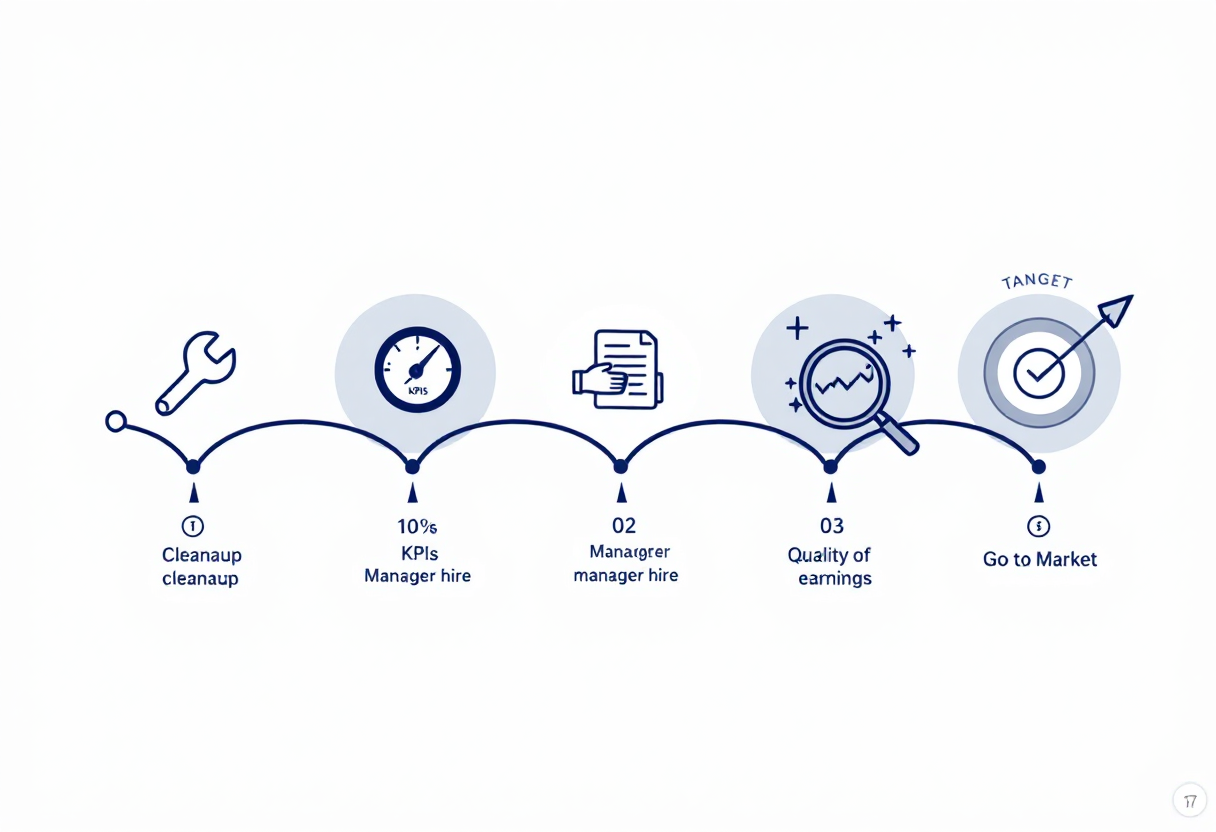
Here is the phased playbook from T-36 months (start) to T-0 (close). Multi-source synthesis from Section 2 valuation drivers, Section 4 levers, and Section 6 deal-killers.
T-36 to T-30 months: Foundation
- Engage a CPA who has done QoE work or who can prepare the financials to be QoE-ready
- Move to accrual-basis accounting if not already there
- Adopt ASC 842 (lease accounting) and ASC 606 (revenue recognition) properly
- Implement a PSA or ERP with project-level gross margin reporting (ConnectWise, Autotask, jonas Premier, NetSuite, D365 BC)
- Begin tracking field-tech utilization, MTTR, and ticket volume per room for MAVMS contracts
- Hire your second CTS-D if you do not have one already
- Begin succession planning for the state low-voltage license qualifier role
T-30 to T-24 months: Build the recurring pillar
- Roll out tiered MAVMS contracts (Bronze, Silver, Gold) and convert existing time-and-materials customers to fixed-fee contracts
- Target: 25%+ of revenue in recurring service or managed services by T-12 months
- Stand up cloud-managed monitoring platform (Crestron XiO, Q-SYS Reflect, Utelogy, Domotz, Aveo). Document monitored fleet.
- Achieve or upgrade manufacturer partner tier (Crestron Master, QSC Q-SYS Certified Gold, Extron Authorized Reseller, Biamp Tesira Master, Shure Channel Partner)
T-24 to T-18 months: Clean up exposure
- Run a sales tax nexus study; file VDAs where material
- Convert 1099 installers to W-2 or move to a compliant staffing model
- Adopt OSHA 30 training across the field team; document harness, lift, and ladder protocols
- Bind cyber liability with breach-response endorsement
- Begin diversification away from any customer above 25% of revenue
- Run a sell-side readiness diagnostic with an M&A advisor specializing in ProAV (FocalPoint Partners, Founders Advisors, Houlihan Lokey, William Blair, Capstone Partners, Citizens M&A, Configure Partners)
T-18 to T-12 months: Build the story
- Engage M&A advisor formally. Build CIM (Confidential Information Memorandum) draft.
- Run a sell-side QoE through a Top 50 audit firm or specialized M&A QoE shop. Target completion 6 to 9 months before LOI signing.
- Pre-clear manufacturer change-of-control with key OEM reps (Crestron, QSC, Extron, Biamp, Shure)
- Document programming source control and code-handoff plan
- Cross-train a second programmer on every major customer
- Lock in 12-month retention agreements with the top 3 to 5 technical leaders
T-12 to T-6 months: Market preparation
- Finalize the CIM. Build the buyer list with the M&A advisor (PE platforms from Section 1 plus strategics)
- Run management-presentation dry runs
- Tighten financial forecasting; ensure trailing 12-month EBITDA peaks at LOI signing
- Sign or extend customer MSAs to fortify backlog
- Resolve open legal items (lawsuits, OSHA, sales tax cleanup)
T-6 to T-3 months: Go to market
- Distribute teaser and CIM to the buyer list (typically 25 to 50 buyers for ProAV at this size)
- Manage the IOI process (typically 4 to 6 weeks)
- Select 3 to 6 finalists for management presentations
- Negotiate LOI; pick the winner
- Sign LOI with 60 to 90 day exclusivity. Confirmatory diligence begins.
T-3 to T-0 months: Confirmatory diligence and close
- QoE confirmation (buyer-side)
- Customer reference calls
- Manufacturer change-of-control consent finalized
- State license transfer applications filed
- Cyber insurance and RWI bound
- Working capital peg negotiated
- Definitive agreement signed
- Closing 60 to 120 days after LOI signing on a clean deal
Frequently Asked Questions
I do a mix of residential / CEDIA and commercial ProAV. Should I split the company before exit?
If residential is more than 25% of revenue, consider it. Commercial ProAV buyers (AVI-SPL, Diversified, Solutionz, CTI, PE platforms) generally do not want residential exposure. Residential CEDIA buyers (Snap One / Resideo, regional roll-ups, Vivint-adjacent acquirers) trade at different multiples, typically 4x to 7x EBITDA vs commercial 7x to 12x. If you can cleanly separate the residential book into a separate LLC 18+ months before exit, you can sell the two halves to different buyers and often clear more total proceeds.
My recurring service revenue is only 15% of total. Is it worth waiting 18 months to get it to 25%+?
Yes, almost always. Moving recurring from 15% to 30% typically lifts the EBITDA multiple by 1.0x to 1.5x (estimate, Jahani & Associates 2025). On a $3M EBITDA business that is $3M to $4.5M in additional enterprise value. Even after 18 months of organic growth and the opportunity cost of waiting, the math almost always favors waiting. This is the single biggest lever available to most install-led integrators.
I am a Crestron Master partner. Will Crestron block my sale?
Crestron rarely blocks a sale, but they will require change-of-control consent. The typical process is written notice to your Crestron rep 90+ days before closing, review of the buyer’s existing Crestron relationship and Master-tier qualification, and re-execution of the dealer agreement post-close. If the buyer is already a Crestron Master (likely for the larger PE platforms), the process is straightforward. If the buyer is new to Crestron Master, expect a longer review and possibly conditional approval pending re-certification. The same logic applies to QSC Q-SYS Certified Gold, Extron Authorized Reseller, Biamp Tesira Master, and Shure Channel Partner.
How long does an AV integration deal take from “decide to sell” to closed?
12 to 24 months for a well-prepared seller. Roughly 6 to 12 months of pre-marketing cleanup (financials, licensure, manufacturer consent, customer diversification, recurring revenue build), 3 to 6 months from CIM distribution to LOI signing, and 3 to 4 months from LOI to close. Unprepared sellers often take 24 to 36 months because they have to fix items on the diligence-stage clock, which is the most expensive place to fix anything.
My company has $1.2M EBITDA. Will PE platforms even look at me?
Yes, as an add-on. Most of the PE platforms listed in this guide (Solutionz, IVCi, CTI, Pavion’s AV adjacency, Genesis Integration, regional roll-ups) actively pursue $1M to $5M EBITDA add-ons. You will not get platform-tier multiples (10x+ EBITDA) at this size; expect 5x to 8x EBITDA depending on profile. Recurring revenue percentage and CTS-credentialed staff count are the two biggest drivers of where you land in that band.
Should I take rollover equity or push for all cash at closing?
Most PE platforms require 10% to 25% rollover equity from the seller. The pitch is “second bite of the apple” when the platform sells in 4 to 7 years at a higher multiple. The reality is that rollover equity is illiquid, junior to the platform’s senior debt, and may be worth significantly less than face value if the platform underperforms. The math typically favors rollover at 15% to 20% when the platform has strong organic plus add-on momentum (Apex Service Partners, AVI-SPL under 26North, Solutionz under Mountaingate). Beyond 25%, you are taking on platform risk you cannot diversify.
What to Do Next
The AV integration owners who get the top-quartile multiple all do the same three things. They start preparing 24 to 36 months before they want to be out. They build the MAVMS recurring pillar to 25%+ of revenue before any buyer sees a CIM. And they invest in a sell-side QoE plus manufacturer change-of-control pre-clearance so the deal does not re-trade in exclusivity.
Mid-2026 looks favorable for sellers. AVIXA IOTA 2025 reports strong corporate hybrid-work room demand continuing, higher education refresh cycles, and broadcast plus control-room modernization. AVI-SPL’s June 2025 sale at premium multiples reset the upper-bound comparable. PE platform appetite is sustained, with Resideo / Snap One showing strategic interest from public companies, and the interest-rate environment has stabilized vs the 2023 highs. The risk is execution: poorly prepared sellers give up most of the multiple at the diligence table.
If you are 12+ months from a potential exit and want a structured pre-sale optimization roadmap, CT Acquisitions has ProAV operations specialists in our partner network who run multi-quarter prep engagements covering MAVMS rollout, manufacturer tier elevation, CTS certification programs, and QoE readiness. If you are 6 to 12 months out and ready to start the sell-side process, our M&A advisory team runs the buyer outreach across the PE platforms and strategic acquirers listed in this guide. Buyers pay our fee, not you. Either way, the first 30 minutes are free.
Ready to talk?
Schedule a 30-minute exit-readiness call
Or read more: Sell Your Security Integration Business (closely related sell-side guide) | Talk to a ProAV M&A specialist
Ready to Explore Your Options?
A 30-minute confidential conversation is all it takes.