
How to Prepare Your Home Health Agency for a Sale or Exit in 2026: The 36-Month PE-Buyer Playbook
Preparing your home health agency for exit in 2026 is a 36-month playbook, and CMS rate cycles + the 80/20 rule mean the buyer set changes quickly. The first 12 months tighten the operating story around Medicare vs private-pay mix and readmission rates, the middle 12 fix pre-LOI diligence gaps around caregiver retention and licensing state coverage, and the final 12 turn one offer into a real competitive process.
Exiting your home health agency business is the single largest financial event most owners will ever face. This guide is the no-fluff playbook for home health agency owners who are 12-36 months from sale, covering how PE-backed buyers actually value your business in 2026, the 12 levers that move your multiple, pre-LOI diligence, deal-killers to fix before going to market, and the full 36-month exit prep timeline.
Updated April 2026 · CT Acquisitions

Most home health and hospice owners decide to sell, hire a broker, and find out 90 days later that their business is worth 30% to 50% less than they thought. The owners who get the top-quartile price start preparing 24 to 36 months before they ever talk to a buyer. This guide is the 36-month playbook for how to prepare your home health agency for a sale or exit. It covers what private equity actually buys, the 12 levers that move multiples, the documents PE will ask for before they send an indication of interest, and the deal-killers that re-trade home health, hospice, and personal care transactions during confirmatory diligence. Every multiple, named buyer, and statistic traces to a source. Every recommendation comes from how the most active home-based care buyers in 2026 actually behave.
If you are 6 to 36 months from a possible exit, this is the work that turns a 5x EBITDA outcome into a 9x or 11x EBITDA outcome. On a $2M EBITDA Medicare-certified home health business, that is the difference between a $10M sale and a $22M sale. The math is even more dramatic in hospice, where platform-tier multiples reach 12x to 17x. Whether you want to prepare your home health agency for a sale to private equity, prepare your home health agency for an exit to a strategic acquirer like UnitedHealth Optum or Humana CenterWell, or simply maximize value over the next 1 to 3 years before going to market, the work below applies. The single most important framing decision in this guide is segment. Medicare-certified home health, hospice, pediatric private duty nursing, and non-medical home care trade at very different multiples and face very different deal-killers. Apply HVAC or dental rules of thumb to home-based care and you will misprice your business by millions.
Building toward an exit in 12 to 36 months?
CT Acquisitions runs sell-side advisory for home health, hospice, and personal care owners $1M+ EBITDA. We also have home-based care operations specialists in our partner network who run pre-sale optimization engagements when the timeline is longer. Buyers pay our fee, not you.
What Private Equity Actually Buys in Home Health (2026)
US home health, home care, and hospice combined revenue is a $400B+ category in 2025, with the home health services subsegment specifically projected to reach $226B by 2027 at a 7.9% CAGR (Grand View Research, 2024; Mordor Intelligence, 2025). The 65-plus population grows from 56 million in 2020 to 80.8 million by 2040, and the 85-plus cohort doubles (US Census Bureau, 2023). PE-backed deals account for roughly 55% to 65% of all home health and hospice transactions, with the largest single deals going to strategic acquirers UnitedHealth Optum, Humana CenterWell, and BrightSpring Health Services (Mertz Taggart, Q4 2024). 88 transactions closed in 2024 against a 2021 peak of 124, and PwC, Bass Berry Sims, and The Braff Group all flag home-based care as a Tier 1 PE focus for 2025-2026 (Mertz Taggart Q1 2025; PwC Health Services Deals Insights Q1 2025).
The single biggest framing decision in this section is segment. Medicare-certified home health, hospice, pediatric private duty nursing, and non-medical home care attract different buyers at different multiples. PE buys specific profiles, and the profile you build determines the multiple you get.
The PE-attractive home health profile
- EBITDA threshold for a platform-quality deal: $1M to $3M is the entry band where sponsor-backed platforms run a competitive process for tuck-ins. Above $5M EBITDA, you are an attractive bolt-on for the larger home-based care platforms. Above $15M EBITDA in hospice or $20M+ in home health, you are a standalone platform candidate.
- Payer mix: Medicare share above 50% is the line between commodity and premium for home health. For hospice, Medicare share above 80% is the norm. Medicaid-heavy or commercial-heavy books trade at materially lower multiples because per-episode revenue under PDGM is less predictable.
- Segment-specific census: Hospice agencies want an average daily census of 100+ to qualify as a platform asset. Home health agencies want consistent month-over-month episode growth with no PEPPER outlier flags. Pediatric private duty nursing wants payer-mix stability plus a defensible nurse retention story.
- Geography: Florida, Texas, Arizona, North Carolina, Georgia, Tennessee, Pennsylvania, and Ohio are where 2026 sponsor demand concentrates. Sun Belt density is a meaningful multiple driver because of demographic tailwinds and Medicare Advantage penetration.
- Referral source diversification: No single hospital, SNF, physician group, or ACO above 25% of admissions. Top 5 referrers below 50%. Concentration above 25% triggers buyer pushback or a 1x to 2x multiple discount.
- Clinical depth and Administrator/DON readiness: Salaried Administrator and Clinical Director or DON in place 12+ months before going to market, with owner off the CMS 855A as Administrator of record.
- CMS Star Rating: Quality of Patient Care Star and Patient Survey Star at 4.0+, with HHCAHPS scores above national average. For hospice, Hospice Care Index above 8.5 of 10.
- Compliance posture: No open PEPPER outlier flags, no immediate-jeopardy survey findings in 36 months, no open ZPIC, UPIC, RAC, or TPE audits, no qui tam False Claims Act exposure.
Active home health, hospice, and personal care PE platforms in 2026
The list below covers the most active sponsor-backed home-based care platforms in the 2024-2026 cycle. This is who will see your teaser. Add-on counts are point-in-time. Sources: Mertz Taggart Home Health and Hospice M&A Report Q4 2024 and Q1 2025, Levin Associates Senior Care Acquisition Report 2024, The Braff Group reports 2024, KKR BrightSpring Form S-1 (January 2024), UnitedHealth Group 8-K filings, and sponsor press releases.
| Platform | Sponsor / Owner | Segment and footprint |
|---|---|---|
| UnitedHealth / Optum (LHC Group + Amedisys + Landmark) | UnitedHealth Group (NYSE: UNH) | Medicare home health, hospice, in-home risk; ~$5B+ home health and hospice revenue; integrated platform; selective platform-tier add-ons only |
| Humana / CenterWell Home Health | Humana (NYSE: HUM) | Medicare home health; rebranded Kindred at Home; 350+ locations, 38 states; ~$2.7B annual revenue; selective tuck-ins |
| BrightSpring Health Services | KKR (NASDAQ: BTSG, IPO January 26, 2024) | Home health, hospice, pharmacy, personal care, infusion; ~$11B+ revenue; national |
| Aveanna Healthcare | Bain Capital + J.H. Whitney (NASDAQ: AVAH) | Pediatric home health, private duty nursing, adult home health, hospice; 340+ locations, 33 states; ~30,000 caregivers |
| Help at Home | Centerbridge Partners + Vistria Group | Personal care, HCBS waiver; 180+ branches, 12 Medicaid-waiver-strong states |
| Addus HomeCare | Public (NASDAQ: ADUS) | Personal care, home health, hospice; $1.16B 2024 revenue; 22 states; acquired Gentiva personal care $350M (2024) and Tennessee Quality Care $109M (2024) |
| AccentCare | Advent International (acquired 2019, merged Seasons Hospice 2020) | Home health, hospice, personal care; 250+ locations, 32 states |
| Compassus | TowerBrook Capital + Ascension Health (JV closed 2020); Providence Health partnership 2024 | Hospice, home health, palliative, infusion; 220+ locations, ~$1.5B revenue |
| St. Croix Hospice | H.I.G. Capital (acquired from Vistria 2023) | Hospice; 40+ Midwest locations; active roll-up |
| Bristol Hospice + Three Oaks Hospice | Webster Equity Partners | Hospice; combined ~70 locations across 20+ states; active add-on cadence |
| Traditions Health | Dorilton Capital | Hospice + home health; 130+ locations, 19 states; multiple add-ons since 2018 entry |
| Charter Health Care Group | Pharos Capital Group | Hospice, home health, palliative; AZ, CA, NM, NV, TX, UT, CO; $1M to $8M EBITDA targets |
| Premier Hospice & Palliative Care | Lorient Capital | Hospice; multiple Midwest add-ons since 2019 (PA, OH, IN) |
| Choice Health at Home | New State Capital Partners | Home health, hospice; 100+ locations in 6 states by 2024 via 20+ add-ons; TX, OK, LA, KS, AR, NM |
| Modivcare | Public (NASDAQ: MODV) | Personal care, NEMT, RPM; $2.7B 2024 revenue; built personal care via CareFinders, Care Finders, Simplura |
| Enhabit Inc | Public (NYSE: EHAB) | Medicare home health, hospice; 250+ home health + 110+ hospice locations, 34 states; explored sale 2023-2024, terminated |
| Pennant Group | Public (NASDAQ: PNTG) | 102 home health and hospice agencies + 53 senior living; 14 states; FY2024 revenue $613M; active small-agency acquirer |
| VITAS Healthcare | Chemed (NYSE: CHE) | Largest US hospice provider; 51 programs across 15 states + DC; 6,000+ employees |
Add to that list the strategic acquirers. UnitedHealth Optum closed LHC Group February 22, 2023 for $5.4B and Amedisys August 8, 2024 for $3.3B after a DOJ delay resolved with divestitures (UnitedHealth Group 10-K FY2024). Humana acquired the remaining 60% of Kindred at Home for $5.7B in 2022, valuing the asset at ~$8.1B enterprise value across both legs (Humana 8-K April 2022). CVS Health entered the in-home assessment lane via Signify Health $8B (closed March 2023), which is in-home risk assessment, not skilled home health (CVS 8-K March 29, 2023). Walgreens acquired CareCentrix for $750M in October 2022 and later took a $5.8B impairment on CareCentrix and Summit Health (Walgreens 10-K FY2024). BrightSpring went public January 26, 2024 at $13 per share, raising $693M with KKR retaining majority (BrightSpring S-1 January 2024). Encompass Health spun Enhabit in July 2022 and Enhabit ended its strategic review in September 2024.
An important framing note: with UnitedHealth Optum and Humana CenterWell now integrating two of the largest historical platforms, the strategic-acquirer bid sheet at the platform tier is thinner than it was in 2021-2022. The next-best-bid for a $5M+ EBITDA home health platform is typically a PE buyer (BrightSpring, Aveanna, Addus, AccentCare, Compassus, Pennant, or one of the dedicated home-based care PE platforms in the table above). This shifts more bargaining power to sellers who can run a true auction across 10 to 15 named PE platforms. Managed care payers (Blue Cross plans, Anthem, regional MA plans) and large hospital systems (HCA, Tenet) participate as buyers in 5% to 10% of transactions, often where they want a captive home health arm for population health management.
Home Health Valuation Multiples in 2026 (What You Are Actually Worth)
Home-based care multiples are payer-mix dependent and segment dependent. A $2M EBITDA hospice agency commonly trades 50% to 100% higher than a $2M EBITDA non-medical home care agency. This section walks through the actual 2026 ranges by segment, by SDE band, and by EBITDA band, then anchors with disclosed transaction comps. Cross-referenced from Mertz Taggart Q4 2024 and Q1 2025, The Braff Group 2024 reports, Stoneridge Partners 2025 segment-specific multiples, HealthCare Appraisers, Levin Associates Senior Care Acquisition Report 2024, and IBBA Q4 2024 Market Pulse Survey.
Segment matters first (LMM EBITDA multiple ranges)
| Segment | Typical LMM EBITDA multiple ($1M to $10M EBITDA) | Source |
|---|---|---|
| Medicare-certified home health (skilled) | 5x to 11x | Mertz Taggart Q4 2024; Stoneridge Partners 2025; The Braff Group 2024 |
| Hospice (Medicare-certified) | 7x to 14x at platform tier; 5x to 9x for sub-$2M EBITDA | The Braff Group Hospice Q4 2024; Stoneridge Partners hospice 2025 |
| Pediatric home health / Private Duty Nursing | 8x to 13x | Aveanna investor presentations FY2024; The Braff Group pediatric coverage 2024 |
| Personal care / non-medical home care | 3x to 7x | The Braff Group personal care 2024; Stoneridge Partners personal care 2025 |
| Medicaid waiver / HCBS personal care | 4x to 8x | Help at Home recap commentary 2024; Modivcare segment disclosures |
| Home medical equipment (HME / DME) | 5x to 9x | VGM Group HME M&A 2024 |
SDE multiples (smaller, owner-operated agencies, below $1M SDE)
| SDE band and segment | SDE multiple range | Source |
|---|---|---|
| Below $500K SDE non-medical home care | 1.8x to 3.0x | BizBuySell Home Care Insight 2024; IBBA Q4 2024 Market Pulse |
| Below $500K SDE Medicare-certified home health | 3.0x to 5.0x (license premium) | Stoneridge Partners 2025 small home health agency guide |
| $500K to $1M SDE non-medical home care | 2.5x to 4.0x | The Braff Group personal care 2024; BizBuySell |
| $500K to $1M SDE Medicare home health | 4.0x to 6.0x | Stoneridge Partners 2025; HealthCare Appraisers 2024 |
| $500K to $1M SDE hospice | 5.0x to 8.0x | The Braff Group Hospice 2024; Levin Associates 2024 |
| Demand-only Medicare home health, single-county, owner-clinician | 3.0x to 5.0x SDE | Stoneridge Partners 2025 |
| Hospice with stable ADC of 75+ | 7.0x to 10.0x SDE | The Braff Group 2024 |
EBITDA multiples (PE-attractive size, $1M to $25M EBITDA)
Medicare-certified home health (skilled):
| EBITDA band | Multiple range | Source |
|---|---|---|
| $1M to $3M EBITDA | 5x to 8x | Mertz Taggart Q4 2024; Stoneridge Partners 2025 |
| $3M to $5M EBITDA | 6x to 9x | Mertz Taggart Q1 2025; HealthCare Appraisers 2024 |
| $5M to $10M EBITDA | 7x to 11x | The Braff Group 2024; Capstone Partners home health 2024 |
| $10M+ EBITDA (platform) | 9x to 14x | UnitedHealth/LHC Group close Feb 2023 implied 14x to 16x; UnitedHealth/Amedisys close August 2024 implied 13x to 15x (estimate) |
Hospice (Medicare-certified):
| EBITDA band | Multiple range | Source |
|---|---|---|
| $1M to $3M EBITDA | 6x to 10x | The Braff Group Hospice Q4 2024; Stoneridge Partners hospice 2025 |
| $3M to $7M EBITDA | 8x to 12x | The Braff Group Hospice 2024; Mertz Taggart 2024 |
| $7M to $15M EBITDA | 10x to 14x | Mertz Taggart 2024; Levin Senior Care 2024 |
| $15M+ EBITDA (platform) | 12x to 17x | Bristol Hospice and Three Oaks Hospice transaction comps; HealthCare Appraisers 2024 (estimate) |
Pediatric home health and Private Duty Nursing (PDN):
| EBITDA band | Multiple range | Source |
|---|---|---|
| $1M to $3M EBITDA | 7x to 10x | Aveanna add-on commentary FY2024; The Braff Group pediatric 2024 |
| $3M to $10M EBITDA | 9x to 13x | Aveanna add-on commentary FY2024 |
| $10M+ EBITDA platform | 11x to 15x | Pediatric Home Service comps; Care Options for Kids transactions (estimate) |
Personal Care and Non-Medical Home Care:
| EBITDA band | Multiple range | Source |
|---|---|---|
| Below $1M EBITDA | 2.5x to 4.5x | BizBuySell home care 2024; The Braff Group personal care 2024 |
| $1M to $3M EBITDA | 4x to 6x | The Braff Group personal care 2024; Modivcare segment commentary |
| $3M to $7M EBITDA | 5x to 7.5x | Help at Home 2020 recap commentary; The Braff Group 2024 |
| $7M+ EBITDA platform | 7x to 10x | Addus / Gentiva personal-care acquisition implied 7x to 8x (estimate) |
Recent disclosed home health, hospice, and personal care transactions
| Acquirer | Target | Date | Value | Implied multiple |
|---|---|---|---|---|
| UnitedHealth / Optum | LHC Group | Closed Feb 22, 2023 | $5.4B ($170/share cash) | Estimate 14x to 16x TTM EBITDA on ~$350M EBITDA |
| UnitedHealth / Optum | Amedisys | Closed Aug 8, 2024 | $3.3B ($101/share cash) | Estimate 13x to 15x TTM EBITDA on ~$235M EBITDA |
| Humana | Kindred at Home (remaining 60%) | Closed Aug 2022 | $5.7B for 60%; ~$8.1B EV across both legs | Estimate 12x to 14x TTM EBITDA |
| KKR (IPO) | BrightSpring Health Services | Jan 26, 2024 | $13/share IPO; raised $693M; ~$2.4B market cap at IPO | Implied ~10x to 12x adj EBITDA on $11B revenue |
| H.I.G. Capital | St. Croix Hospice (from Vistria) | Announced 2023 | Undisclosed (estimate $400M to $600M) | Estimate 12x to 15x EBITDA (platform hospice) |
| Addus HomeCare | Gentiva Health Services personal-care division | Closed Aug 1, 2024 | $350M | Estimate 7x to 8x EBITDA on ~$45M EBITDA |
| Addus HomeCare | Tennessee Quality Care | 2024 | $109M | Implied roughly 8x EBITDA |
| Pennant Group | Signature Healthcare at Home (4 OR/WA agencies) | March 2024 | Undisclosed | Estimate 7x to 9x EBITDA |
Sources: UnitedHealth 8-K Feb 22, 2023 and Aug 8, 2024; LHC 10-K FY2022; Amedisys 10-K FY2023; Humana 8-K April 2022; BrightSpring S-1 January 2024 and 10-K FY2024; Addus 8-K August 1, 2024 and 10-Q Q3 2024; Pennant 10-Q Q1 2024; Vistria Group press release; PE Hub hospice coverage 2023.
Most home health and hospice add-ons close at private multiples that are not publicly disclosed. The article anchors to the platform-tier comps above (LHC, Amedisys, Kindred, BrightSpring, St. Croix) for the upper bound and to Mertz Taggart and The Braff Group ranges for the lower middle market.
The 12 Value Levers That Move Your Multiple (Ranked by Impact)

These are the levers that move home health, hospice, and personal care multiples in the 24 months before a sale. Each one has a current state, a target state, and an estimated financial impact. The ordering is by dollar impact per unit of effort, based on cross-source synthesis from Mertz Taggart, The Braff Group, Stoneridge Partners, HealthCare Appraisers, and Activated Insights.
Lever 1: Shift payer mix toward Medicare and Medicare Advantage
Current: Medicaid-heavy or commercial-heavy book; below 30% Medicare share; or in hospice, below 60% Medicare share. Target: Medicare share above 50% for home health, or above 80% for hospice; blend Medicare FFS with preferred Medicare Advantage plans. Impact: Medicare share above 50% lifts the multiple 1.0x to 2.5x because of per-episode predictability under PDGM (Mertz Taggart Q4 2024; HealthCare Appraisers payer-mix analysis 2024). On a $3M EBITDA home health business, that is $3M to $7.5M of price uplift. How: Build a hospital and SNF outreach program; pursue MA-payer in-network status; chase 4+ star ratings to qualify for MA preferred-provider lists; consider geographic expansion into Medicare-dense counties; pursue ACO partnership status with Medicare Shared Savings Program participants.
Lever 2: Lift CMS Star Rating to 4.0+ (home health) or improve Hospice Care Index
Current: 3.0 to 3.5 star rating; HHCAHPS scores below national average; or HCI score below 8 of 10. Target: 4.0+ Quality of Patient Care Star and 4.0+ Patient Survey Star; HCI 8.5+ of 10. Impact: 4.5+ stars opens the door to Medicare Advantage preferred-provider status, drives census growth, and improves HHVBP payment adjustment. Estimate +0.5x to 1.0x multiple uplift. HHVBP adjusts Medicare home health payments by up to plus or minus 5% based on agency performance against peer cohort (CMS HHVBP rule, Federal Register November 2, 2022). How: Invest in OASIS and HOPE accuracy training; clinical case conferencing; HHCAHPS satisfaction process improvements; staff communication training; medication-management protocol; post-acute care transition coordination.
Lever 3: Move the owner out of the Administrator and DON chair 12+ months pre-sale
Current: Owner is the Administrator, the DON, or both. Owner signs every patient’s plan of care and is named on the CMS 855A as Administrator of record. Target: Salaried Administrator and Clinical Director or DON in place 12+ months before going to market. Owner not on CMS 855A as Administrator. Impact: Removes key-person risk and pre-empts CHOW friction (CMS treats Administrator change as a 30-day notice item; if the owner-Administrator exits on closing day, the buyer must re-staff that role instantly). Estimate +0.5x to 1.0x multiple. On a $2M EBITDA home health business that is $1M to $2M of price. How: Administrator hire 18 to 24 months pre-sale at $120K to $180K market rate; promote DON or hire a Clinical Director at $130K to $190K market rate; update CMS 855A; document all SOPs.
Lever 4: Get on a buyer-preferred EMR (Homecare Homebase, MatrixCare, Axxess, WellSky, KanTime)
Current: Paper charts, a non-standard EMR with poor data export, or generic patient-management software. Target: Homecare Homebase for home health and hospice, MatrixCare Homecare, Axxess for smaller agencies, WellSky CareInsights, or KanTime for pediatric and personal care. Monthly close within 15 days. Real KPI dashboard. Impact: Homecare Homebase holds roughly 25% market share and MatrixCare ~20% among large home health agencies. Buyers acquiring at the platform level typically standardize on HCHB or MatrixCare. Being on a buyer-preferred EMR removes integration risk and shortens the post-close integration timeline. Estimate +0.5x to 1.0x multiple uplift. How: Budget $50K to $250K implementation plus per-user license; align go-live to be 12+ months before going to market so the data room shows 12 months of stable run-rate.
Lever 5: Drive recurring referral diversification
Current: Top referrer is 30% or more of admissions, often a single hospital or SNF. Target: Top referrer below 15%, top 5 referrers below 50%. Impact: Above 25% concentration triggers a 1.0x to 2.0x multiple discount or buyer walk (HealthCare Appraisers 2024; The Braff Group; Stoneridge Partners 2025). On a $2M EBITDA home health agency, that is $2M to $4M of price. How: Dedicate a community liaison or outreach RN to each county or sub-market; pursue ACO contracts; pursue MA preferred-provider relationships; pursue assisted-living facility partnerships for hospice; build physician outreach by specialty (cardiology, oncology, geriatrics).
Lever 6: Build hospice ADC up to 100+ (for hospice agencies)
Current: Average daily census below 50, single-county operation. Target: ADC 100+ across multi-county operation. Impact: Hospice multiple stair-steps at ADC 50, 100, and 250 census thresholds. Moving from ADC 50 to ADC 100 typically moves the multiple from ~7x to 10x to 12x range (The Braff Group Hospice M&A Year-End 2024; Stoneridge Partners hospice 2025, estimate). That is the largest single lever in hospice exit prep. How: Hire a community liaison; build relationships with hospital case managers, SNF MDS coordinators, and assisted-living facility leadership; invest in marketing to physician referral sources; pursue Medicare Advantage hospice-carve-in payer contracts where available.
Lever 7: Caregiver retention (personal care and home health aide segment)
Current: Above 80% caregiver annual turnover (industry average 79.4% per Activated Insights 2024 Benchmarking Report). Target: Below 40% caregiver turnover (top quartile per Activated Insights 2024). Impact: Each percentage point of turnover reduction adds gross margin (less recruiting cost, less training, less unfilled shift) and is a defensible diligence-narrative point that the workforce is sticky. Estimate +0.5x to 1.0x multiple in personal care. On a $1M EBITDA personal care business, $500K to $1M of price. How: Pay above local median ($16 to $22 per hour depending on state and program type); offer benefits (health, PTO, retirement match); add Career-Path or Career-Ladder programs; offer free CNA / HHA training; recognize milestones; offer flexible scheduling; build a culture-of-recognition program.
Lever 8: Tighten clinical compliance and audit posture
Current: ADRs (Additional Documentation Requests) are common; PEPPER outlier reports show flags; survey deficiencies in last 36 months. Target: ADR rate at or below state average; no PEPPER outlier flags for last 4 quarters; no open Plans of Correction; no immediate-jeopardy or condition-level findings in last 36 months. Impact: Clean clinical compliance is the floor under any home-based care valuation. A single open ZPIC or UPIC audit can hold a deal up for 12+ months or cause the buyer to walk. Estimate: clean compliance allows the full multiple range; failed compliance can knock 1.0x to 3.0x off the multiple or kill the deal. How: Hire a compliance officer or outsource to SimiTree, Healthcare Provider Solutions, or Simione; run a mock CMS or accreditor survey 12 to 18 months before going to market; clean up OASIS, HIS, and HOPE accuracy; document face-to-face encounter compliance for home health; document hospice eligibility certifications rigorously.
Lever 9: EBITDA add-back hygiene
Current: Owner mixes personal expense through the business with no documentation; related-party rent at above FMV; no addback schedule. Target: Every potential addback is documented as it happens with the underlying invoice; related-party rent restruck to FMV with appraisal on file; clean payroll for owner-family. Impact: Every defensible dollar of adjusted EBITDA is multiplied by the buyer’s multiple. On a 7x home health multiple, $100K of clean addbacks equals $700K of sale price. On a 12x hospice multiple, $100K of clean addbacks equals $1.2M of sale price. How: Monthly addback log starting today; FMV rent appraisal if owner owns the real estate; documented business purpose for every owner expense; tag owner-family payroll and owner vehicle / travel / country-club expense as the bookkeeper enters them.
Lever 10: Working capital normalization (Medicare A/R management)
Current: Medicare and Medicare Advantage A/R aging at 60+ days; deferred Medicare Accelerated Advance Payment (AAP) balance still on balance sheet; episode-level RAP or NOA delays. Target: Medicare FFS A/R aging at 30 to 45 days; managed Medicare A/R at 45 to 60 days; AAP fully repaid; tight RAP and NOA submission discipline. Impact: Working capital peg in healthcare deals is typically set as TTM-average. Volatile A/R lets the buyer set a higher peg, subtracting from purchase price. Estimate: poor A/R management costs 3% to 7% of EV at close in home-based care because of payer cycle volatility. How: Dedicated billing and follow-up team; weekly A/R review by aging; coding QA before claim submission; RAP and NOA filed within 5 days of admission.
Lever 11: Settle CARES Act, PRF, AAP, and ERC exposure
Current: CARES Act Provider Relief Fund (PRF) grants still unreconciled; deferred Medicare AAP unrepaid; Employee Retention Credit (ERC) claims still open; possible recoupment exposure. Target: PRF reporting complete and final; AAP fully repaid; ERC claims either fully validated and closed, or backed out; no open HHS Office of Inspector General PRF audit. Impact: Any open CARES, PRF, AAP, or ERC balance is a debt-like item or contingent liability that comes out of purchase price. Settle now or carry it through diligence as an escrow line (HRSA PRF guidance 2024; CMS AAP repayment terms). How: Engage a CPA firm with home health PRF experience; document the use of PRF for qualifying expenses; complete HRSA reporting; track ERC voluntary disclosure status if any claim is in question.
Lever 12: License positioning, Certificate of Need (CON), and W-2 conversion in non-medical home care
Current: State license current but CON not pursued in CON states; in non-medical home care, caregivers still classified as 1099 independent contractors. Target: In CON states (NY, NJ, MA, MS, HI, plus DE, KY, MD, NC, AL, GA per NCSL CON Database 2024), CON held in good standing and not at risk of challenge; in non-CON states, additional licenses pursued in adjacent counties or states 12+ months pre-sale; all caregivers W-2 with classification compliant with the DOL January 2024 final rule and California AB5. Impact: A held CON in a closed-CON home health state is itself a valuable asset that often determines which acquisition target a buyer chooses. Estimate +0.5x to 1.5x multiple for a held CON in a closed-CON state. For 1099 misclassification in non-medical home care, the buyer prices EBITDA at the W-2-equivalent and demands an indemnity for back-tax and back-comp exposure. How: CON application 18 to 24 months pre-sale if the state is in moratorium; license additions in adjacent geographies; convert 1099 caregivers to W-2 18 to 24 months pre-sale (conversion cost is roughly 15% to 25% of payroll).
Want to grow your business to maximize value before exiting?
We connect home health, hospice, and personal care owners with operations experts in our partner network who run 12 to 24 month pre-sale optimization engagements. The engagement pays for itself in incremental sale price.
What PE Asks Before They Send an LOI (The Pre-LOI Diligence Stack)
Before a PE firm commits to a letter of intent, they ask for a focused diligence package. The list below is the real ask from a 2026 PE firm targeting a home-based care business in CT Acquisitions’ pipeline. The “why” and “how to prepare” expand each item to what is typical across the industry.
1. Income Statements for 2024, 2025, and the latest trailing twelve months
Why PE asks: Building the TTM EBITDA they will multiply; checking growth trajectory and seasonality (hospice is non-seasonal; home health admissions dip December to February and peak May to August). Looking for one-time CARES Act Provider Relief Fund grants, COVID-era Medicare Accelerated Advance Payments, and Public Health Emergency-tied flex payments that are not run-rate.
How to prepare: Accrual-basis P&L by month, mapped to a clean chart of accounts. P&L by service line (home health vs. hospice vs. personal care vs. private duty) where the agency is multi-line. Reconcile to tax returns. Pull out all CARES Act PRF that has been recognized as income and label it.
2. Balance sheet at the latest month
Why PE asks: Sizing the working capital peg and identifying net debt. Home health and hospice carry a meaningful Medicare and managed-Medicare A/R aging that the buyer will analyze; deferred Medicare Accelerated Advance Payment balances remain on many agencies’ balance sheets through 2025 (CMS extended repayment terms post-COVID).
How to prepare: Tie the balance sheet to the trial balance. Break out Medicare A/R by aging bucket vs. managed Medicare vs. Medicaid vs. commercial vs. self-pay. Identify all debt-like items: Medicare AAP unrepaid balance; any unpaid TPE, RAC, ZPIC, or UPIC audit assessment; PPP loan forgiveness status; CARES Act PRF unrecognized; deferred bonuses; capital lease balances; any owner-financing notes; any CMS bond or surety bond posting.
3. Adjusted EBITDA bridge with add-back documentation
Why PE asks: They want a preview of your adjusted EBITDA story before they sink diligence cost into the file. If your add-backs are aggressive or undocumented, they discount the rest of your numbers.
How to prepare: Build the bridge from book EBITDA to adjusted EBITDA, line by line. Common defensible add-backs for home-based care include owner compensation above market (typical home health owner who is also DON or Administrator takes $250K to $500K; market rate for a salaried Administrator plus Clinical Director is $180K to $250K combined; the delta adds back); owner family payroll with no defensible duties; owner vehicle, travel, and country-club; one-time legal cost for CMS audits (TPE, ZPIC, UPIC, ADRs) where the audit closed clean; EMR conversion one-time cost (HCHB, MatrixCare, Axxess implementations run $50K to $250K); COVID-era PPP and ERC if recognized in the year (label as non-recurring); pre-acquisition deal cost (broker retainers, sell-side QoE, legal); related-party rent at above-FMV.
4. Anonymized employee roster (titles, start dates, pay, classification)
Why PE asks: Stress-testing clinical staffing depth, caregiver retention, and W-2 vs. 1099 risk (the dominant non-medical home care deal-killer). Looking for owner-family concentration. Verifying that the Administrator and Clinical Director or DON are not owner-dependent.
How to prepare: Roster columns: role (RN, LPN, PT, OT, ST, MSW, HHA, CNA, scheduler, biller, admin, DON, Administrator), license number and expiration, hire date, full-time vs. part-time vs. PRN, W-2 vs. 1099 (with classification rationale), comp structure, active non-compete or non-solicit. Compute 12-month and 24-month rolling caregiver retention. The Activated Insights 2024 benchmark cites industry-average 79.4% caregiver turnover; top quartile runs below 40%.
5. Revenue breakdown by payer and service line
Why PE asks: Payer mix is the single most diagnostic exhibit in home-based care. Medicare per-episode revenue under PDGM is the most valuable; managed Medicare Advantage runs at 90% to 95% of Medicare rates with utilization-management friction; Medicaid waiver runs at 60% to 75% of Medicare rates; commercial and self-pay vary.
How to prepare: Exhibit columns by month for 36 months: revenue by payer (Medicare FFS, Medicare Advantage, Medicaid FFS, Medicaid managed care, commercial, self-pay), admissions by payer, episodes by payer, average revenue per episode, average length of stay. For hospice: ADC by month, admissions, discharges, length of stay by quartile, revenue per patient day. For personal care: hours billed, hours paid, billing rate, pay rate, gross margin by payer.
6. Active patient census, ADC, and episodes
Why PE asks: Recurring revenue is admissions-driven. The buyer wants to see active census trend, average daily census trajectory for hospice, and PDGM episode count for home health. They want admission source mix (hospital, SNF, physician, MA payer, self-referral).
How to prepare: Monthly snapshot of active patients by payer; monthly ADC for hospice; monthly admissions by source; readmission rate; live-discharge rate (hospice); average episodes per patient (home health).
7. Referral source breakdown
Why PE asks: Concentration above 25% with a single hospital, SNF, or physician group is a major risk. Hospital-system preferred-provider relationships that are not in writing are even worse.
How to prepare: 36 months of referral data: source name (de-identified by number for IOI stage), referral count, admission conversion rate, payer mix on those admissions. Note any preferred-provider relationships, any value-based-care or ACO contracts, any joint operating agreements.
8. CMS Star Ratings and quality scores
Why PE asks: Star rating drives Medicare Advantage in-network preference and HHVBP payment adjustment. A 4.5-star agency in HHVBP receives upward adjustment; a 2-star agency receives downward adjustment. Quality scores feed the buyer’s underwriting on managed-Medicare contract retention.
How to prepare: Pull Home Health Compare Quality of Patient Care Star, Patient Survey Star (HHCAHPS), and all individual outcome measures. For hospice: Hospice Care Index (HCI) score, CAHPS Hospice Survey scores. Bring 3 to 5 years of trend data to the data room.
9. Five-year business plan
Why PE asks: PE wants to see the seller’s view of admissions growth, payer mix shift, geographic expansion, and any planned new licenses (e.g., adding hospice to a home health agency, or expanding into a Medicaid-waiver-rich state). PE also wants to see how the seller models PDGM payment adjustments and HHVBP upside or downside.
How to prepare: Simple operating model: admissions and episodes by payer, average revenue per episode, gross margin by service line, overhead, EBITDA. Include geographic expansion plan (CHOW vs. branch addition vs. new license), planned hires (clinical, sales, intake), and any payer contracting wins.
10. Licensing, certifications, and provider number status
Why PE asks: CMS provider numbers and state licenses do not automatically transfer. The CHOW process (855A for home health and hospice) typically takes 6 to 12 months and the buyer needs to model that timing. The buyer also wants to confirm Medicare Conditions of Participation are current, no open survey deficiencies, and no immediate-jeopardy findings.
How to prepare: List every CMS provider number (CCN), state license (operating license, sometimes a separate license per service line per state), accreditation (CHAP, ACHC, Joint Commission), and any specialty designation. Provide last 3 years of survey results (state and accreditor). Compile any open Plans of Correction.
Confirmatory Diligence (After You Sign the LOI)
Once an LOI is signed and exclusivity starts (typically 45 to 120 days for healthcare, longer than HVAC because of CHOW), the buyer runs parallel workstreams. This is the depth of inspection your business will undergo. If anything was hiding, it surfaces here.
- Quality of Earnings (QoE). Outside accounting firm runs revenue cut-off testing, payer-level adjustments (Medicare bad-debt allowance vs. actual write-offs; Medicaid retro adjustments; managed Medicare RAP / NOA pre-billing impact), expense normalization, addback validation, working capital trends. Buyer’s QoE cost for $1M to $10M EBITDA home-based care: $60K to $150K typical, higher than HVAC because of payer-specific revenue testing.
- Clinical and regulatory DD. Outside healthcare counsel plus a clinical consultant (Simione, BlackTree, Healthcare Provider Solutions, SimiTree, or Fazzi Associates) runs the clinical and compliance review. They sample 100 to 300 charts to validate face-to-face encounter documentation (home health), hospice eligibility certifications, OASIS / HIS / HOPE accuracy, plan-of-care documentation, and overall coding and billing integrity. This is where buyers find ADR-risk patterns that lead to repayment exposure.
- Payer contract review. Each managed Medicare Advantage contract, Medicaid managed care contract, ACO arrangement, hospital-system preferred-provider agreement, and commercial payer agreement reviewed for change-of-control consent, rate, and term. Many MA and Medicaid managed-care contracts require payer consent on CHOW; the buyer wants 60 to 90 days to coordinate that.
- Customer concentration and referral concentration. Top 25 referral sources analyzed; calls to top sources to validate stickiness; review of any joint operating agreements.
- IT systems audit. EMR (Homecare Homebase, MatrixCare Homecare, Axxess, WellSky, KanTime, Alora, Brightree) data quality. License counts, integration capability with the platform’s stack. Buyers typically want acquired agencies on the same EMR.
- Legal. Entity good standing in every operating state, Medicare provider agreement, Medicaid provider agreement per state, all licenses, IP, litigation history (ADRs, RAC / ZPIC / UPIC audits, qui tam False Claims Act suits in any related entity, OCR HIPAA enforcement, OIG self-disclosures), employment litigation, contracts assignment, real estate leases.
- HR, payroll, and compliance. W-2 vs. 1099 caregiver classification audit (AB5 and federal DOL 2024 final rule), I-9, wage-and-hour exposure (overtime classification for live-in caregivers, sleep-time exclusion, mileage reimbursement), benefits, PTO accrual, any pending EEOC or DOL claims, non-compete enforceability in each state.
- OIG LEIE and SAM exclusion sweep. Every employee with any patient-facing or billing-touch role gets run through OIG LEIE and SAM exclusion databases. A single excluded individual on payroll is a billing-system-wide compliance failure.
- PEPPER and CASPER reports. Program for Evaluating Payment Patterns Electronic Report (PEPPER) and CASPER outlier reports pulled for the agency. PEPPER outlier status on metrics like Live Discharges Not to Hospice or Episodes per Beneficiary triggers deeper audit-risk pricing.
- Tax. Federal income, payroll, sales/use (limited in home-based care; some states tax specific items like DME), property, state and local franchise.
Why You Should Pay for Your Own Quality of Earnings Before Going to Market
A sell-side QoE is your own outside accountant’s QoE, paid for by you, before you go to market. Healthcare QoE is heavier than services QoE because the buyer must validate payer-level revenue, allowance for doubtful accounts vs. actual write-offs, RAP / NOA timing, hospice cap exposure, and the quality of deferred revenue and Medicare AAP balances. A sell-side QoE does three things: pre-empts the buyer’s QoE by getting to “adjusted EBITDA” first with documentation, including payer-specific normalizations; surfaces issues you can fix before the buyer sees them (revenue recognition, hospice cap exposure, working capital, addback documentation); tightens the EBITDA number you take to market, which directly drives the headline price.
Cost
- $35K to $50K for a focused QoE on a single-service-line agency below $10M revenue (Eton Venture Services 2024; HealthCare Appraisers QoE pricing notes 2024).
- $60K to $150K typical for sell-side QoE on a healthy home-based care business with multiple service lines or multi-payer complexity (CohnReznick healthcare M&A practice 2024; Riveron healthcare QoE notes).
- $150K+ for businesses with complex hospice cap exposure, multiple state licenses, or open audit issues.
ROI
Eton cites a generic $25M revenue / $5M EBITDA business example: moving the multiple from 5x to 6x equals $5M of additional sale price. A $50K QoE that supports the 1x lift is 100x ROI. In hospice specifically the math is larger because base multiples are higher: moving from 9x to 11x on a $5M EBITDA hospice equals $10M of additional price. Home-based care QoE providers commonly used: Riveron Healthcare M&A, CohnReznick Healthcare M&A, HealthCare Appraisers, Cherry Bekaert Healthcare M&A, KPMG healthcare deal advisory, Plante Moran, SimiTree (clinical and regulatory complement), BlackTree, and Healthcare Provider Solutions.
Deal-Killers That Re-Trade Home Health Transactions (Avoid These)
These are the recurring kill-shots cited across home health, hospice, and personal care M&A advisory content. Most of them are fixable in 12 to 24 months. None of them are fixable in 30 days.
1. CMS 855A Change of Ownership (CHOW) timing and provider number transferability
The Medicare Provider Number (CCN) does not automatically transfer in a CHOW. The buyer must file CMS 855A and the change typically takes 6 to 12 months for CMS to process, sometimes 12 to 18 months in heavy-volume MAC jurisdictions (Palmetto GBA, Noridian, NGS, CGS, WPS, First Coast). During that window, the buyer either operates under the seller’s CCN (asset purchase with continued billing under seller via a management services agreement) or experiences a billing pause. This makes the deal structure (asset vs. stock vs. CHOW asset) materially complex. Source: Polsinelli “Mergers and Acquisitions of Medicare-Certified Home Health and Hospice Providers”, 2023; CMS State Operations Manual Chapter 3; Hall Render home health CHOW guides.
2. State licensing transferability and Certificate of Need (CON)
11 states require Certificate of Need (CON) for new home health agencies (NY, NJ, MA, MS, HI, plus DE, KY, MD, NC, AL, GA per the National Conference of State Legislatures CON Database 2024; verify current status because CON laws are in flux). In CON states, a transfer of the CON is required at CHOW and can take 6 to 12 months separately from the federal CHOW. Source: NCSL CON Database 2024; Polsinelli home health CHOW guide 2023.
3. OIG LEIE and SAM exclusion exposure
Any employee on the OIG LEIE or SAM exclusion list invalidates Medicare and Medicaid billing for every service that employee touches. A single excluded individual can trigger global repayment. Source: HHS OIG LEIE search portal; Hall Render LEIE compliance memo.
4. False Claims Act qui tam exposure and DOJ settlements history
Home health and hospice are two of the most-pursued sectors by the DOJ Civil Frauds Division for False Claims Act litigation (DOJ FCA Statistics FY2024; OIG Work Plan FY2025). Common case patterns: improper hospice eligibility certifications, home health face-to-face encounter documentation failures, kickbacks to referring physicians, upcoding. Settlement examples: Amedisys FCA $150M (2014); Curo Health Services FCA $128M (2023); Care Alternatives FCA $14.5M (2018). The buyer will run a litigation and FCA sweep on the agency and any related entity.
5. CMS audits (RAC, ZPIC, UPIC, TPE) and Additional Documentation Requests
Active or recent CMS audit activity is a major DD finding. RAC and ZPIC / UPIC audits can take 24+ months to close and the buyer cannot model the assessment until then. Pending Additional Documentation Requests (ADRs) signal targeted review and can become claim denials. Source: CMS Program Integrity Manual Chapter 3; Hall Render CMS audit memo 2024.
6. Anti-Kickback Statute and Stark Law exposure on physician referral arrangements
Home health and hospice referrals from physicians implicate both AKS (42 USC 1320a-7b) and Stark (42 USC 1395nn). Any direct or indirect remuneration between the agency and a referring physician requires structure under a safe harbor or exception. Marketing personnel paid on commission for referrals is a recurring red flag. Source: OIG Special Fraud Alerts 2014 on home health marketing arrangements; King & Spalding AKS / Stark practice notes.
7. Hospice cap exposure
Medicare hospice has a per-beneficiary annual payment cap ($33,494 for FY2024, $34,465 for FY2025 per CMS). Agencies that exceed the cap must repay the excess. Cap exposure builds over multiple years and can be a 6 to 7 figure liability that the buyer prices into the deal. Source: CMS Hospice Payment Rates and Cap Amounts; NHPCO Hospice Cap Reference 2025; SimiTree hospice cap commentary 2024.
8. PEPPER outlier flags
The Program for Evaluating Payment Patterns Electronic Report (PEPPER) flags agencies that are outliers on metrics like Live Discharges Not to Hospice (LDNH), Long-Stay Hospice Patients, Episodes per Beneficiary (home health), and several others. PEPPER outlier status invites RAC / ZPIC / UPIC scrutiny and gives the buyer a documented reason to discount the multiple. Source: CMS PEPPER program; QualNet PEPPER guidance; SimiTree PEPPER commentary 2024.
9. W-2 vs. 1099 caregiver misclassification (critical in non-medical home care)
The DOL 2024 final rule (published January 9, 2024, effective March 11, 2024) tightened the test for independent contractor classification under FLSA. California AB5 (2019) further restricts contractor classification with very limited home-care carve-outs. Personal care agencies that run a 1099 caregiver model face federal back taxes (FICA, FUTA), state unemployment, workers’ compensation back premium, FLSA wage-and-hour back pay including overtime, and liquidated damages. Multiple high-six and seven-figure California PAGA settlements have been recorded for home-care 1099-misclassification cases 2019-2024 (CA DLSE enforcement records). Source: DOL Final Rule 29 CFR Part 795 (January 9, 2024); CA Labor Code 2750.3 (AB5); CA AB1672 (2022).
10. Overtime, live-in caregiver, sleep-time, and mileage compliance
Personal care has a wage-and-hour minefield: live-in caregivers (FLSA sleep-time deductions, since the 2013 Home Care Final Rule and 2015 effective date that brought third-party-employed home care workers under FLSA minimum wage and overtime); overtime calculation on multi-client shifts; mileage reimbursement under DOL guidance; meal-period deductions; spread-of-hours in New York. Common settlement size: $100K to $1M+. Source: DOL Home Care Final Rule effective October 13, 2015; 29 CFR 552; New York Home Care Worker Wage Parity Act; California Domestic Workers Bill of Rights.
11. Owner is a clinician with a personally tied license (Administrator and DON friction)
If the owner is the Administrator and the DON (common in small home health agencies), the agency may functionally lose its qualifier on close. CMS requires a qualified Administrator under 42 CFR 484.105 (Conditions of Participation for Home Health). Hospice has parallel requirements under 42 CFR 418.100. Many states layer additional Administrator and DON licensing or qualification rules. The buyer needs the qualifier in place before they can operate.
12. Survey deficiencies, Immediate Jeopardy, and open Plans of Correction
Active or recent immediate-jeopardy or condition-level survey deficiencies are a deal-killer until they are closed and the Plan of Correction is fully implemented. Repeat deficiencies in the same area suggest systemic issues. Source: CMS State Operations Manual Appendix B (Home Health Survey Protocol); CMS Appendix M (Hospice Survey Protocol).
13. Undisclosed related-party transactions and physician marketing payments
Marketing payments to referring physicians, sham consulting agreements, education sponsorships that are really referral incentives, ownership stakes by referring physicians in the agency. All of these are AKS / Stark issues that surface in legal DD. Source: OIG Special Fraud Alerts on home health and hospice marketing; King & Spalding AKS / Stark memos.
14. Deferred Medicare Accelerated Advance Payment (AAP) balances and CARES Act PRF recoupment
Many home health and hospice agencies still carry deferred Medicare AAP balances on their balance sheet from the COVID-era flex payments. CMS extended repayment terms post-COVID. Any unrepaid AAP comes out of purchase price as net debt. CARES Act Provider Relief Fund (PRF) grants are subject to HRSA reporting and audit; unrecognized PRF or PRF that does not meet qualifying-expense documentation is contingent recoupment exposure. Source: HRSA Provider Relief Fund Reporting Requirements 2024; CMS AAP Repayment Terms.
The 36-Month Exit Prep Timeline
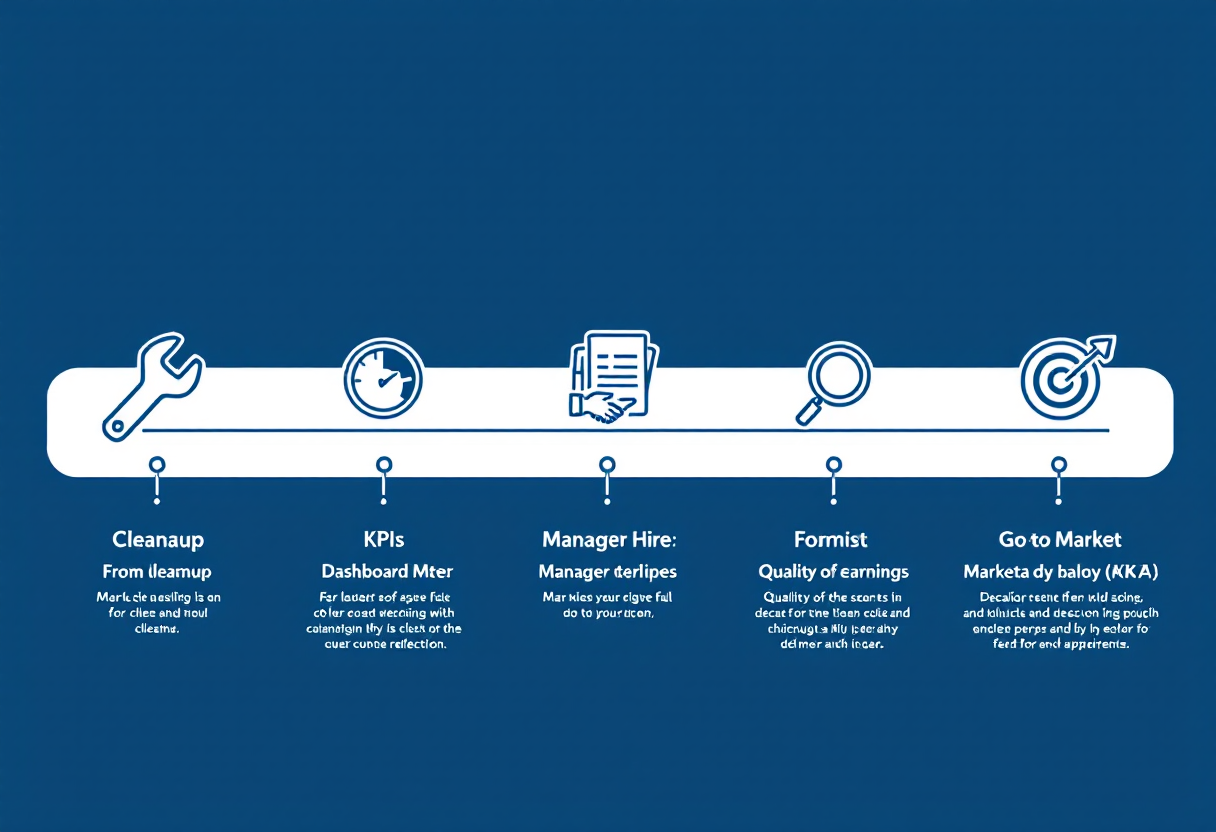
T-36 months: Cleanup phase
- Switch to accrual basis if not already (most home health agencies are accrual due to Medicare billing complexity)
- Pick an EMR (Homecare Homebase, MatrixCare, Axxess, WellSky, KanTime, Alora, Brightree) and migrate
- Start tagging every potential EBITDA add-back as it happens
- Conduct W-2 vs. 1099 audit; reclassify if needed (settle exposure while it is still small). Critical in non-medical home care
- Restruck related-party rent to FMV with appraisal
- Build the Administrator, DON, and Clinical Director hire plan
- Update CMS 855A if the Administrator changes
- Run a mock CMS or accreditor survey via SimiTree, BlackTree, Healthcare Provider Solutions, or Fazzi Associates
- Begin clinical compliance scrub: OASIS, HIS, and HOPE accuracy; face-to-face encounter documentation (home health); hospice eligibility certifications
- Settle CARES Act, PRF, AAP, and ERC items
- Pull PEPPER report and fix any outlier patterns
- Pull OIG LEIE and SAM exclusion sweep on entire roster
T-24 months: Financial discipline and KPI infrastructure
- Administrator and Clinical Director or DON onboarded and starting to take operational load
- Monthly close in 15 days; service-line and payer-line P&L every month
- KPI dashboard: admissions by payer and source, episodes (home health), ADC (hospice), live-discharge rate (hospice), average length of stay, average revenue per episode, gross margin by payer, caregiver retention, OASIS / HIS / HOPE timeliness
- Launch payer-mix shift program if Medicare share is below target
- Launch referral diversification program if top referrer is above 25%
- Launch caregiver retention initiative (top quartile equals below 40% turnover; industry average 79.4%)
- Hospice agencies: build ADC plan from current to 100+ if not there
- Document SOPs for every operational role
- Build the addback bridge as a living document
- Conduct W-2 conversion if any caregivers are still 1099 (non-medical home care)
- Verify OIG LEIE and SAM monthly process is in place
T-12 months: QoE-ready close discipline, eliminate owner dependence
- Owner steps out of daily operations; Administrator and Clinical Director run the agency
- Owner takes a 2-week unplugged vacation as the stress test
- Run the sell-side QoE (budget $60K to $150K for home health or hospice; $35K to $75K for smaller personal care)
- Tighten balance sheet: clean A/R, repay any AAP balance, reconcile PRF, isolate deferred revenue if any
- Final org-chart review; backfill any gaps
- Final compliance scrub (CMS provider numbers, state licenses, accreditation, W-2 / 1099, OIG LEIE, SAM, PEPPER, audit posture)
- Refresh CMS Star Rating posture
- Lock in 12 months of clean payer-level and service-line P&L for the CIM
T-6 months: Pre-marketing prep
- Engage M&A advisor with healthcare home services experience. Common names: The Braff Group, Stoneridge Partners, VERTESS, Mertz Taggart, BG Healthcare, Provident Healthcare Partners, Cain Brothers (TD Cowen Healthcare), Cross Keys Capital, Houlihan Lokey Healthcare, Capstone Partners Healthcare, BlackTree Capital Partners. Typical fee structure: $35K to $100K monthly retainer credited against success fee of 4% to 7% of enterprise value, with Lehman or modified Lehman scaling for larger deals
- CIM drafted from the QoE and operating model
- Teaser drafted (anonymized 1-pager)
- Buyer list finalized. From the platforms list above, 25+ named PE buyers form the starting list; add strategic acquirers (UnitedHealth Optum, Humana CenterWell, BrightSpring, Pennant, NHC) where size and geography fit
- Virtual data room populated with everything from the pre-LOI and confirmatory sections above
- Management presentation deck built and rehearsed
T-3 months: Go to market
- Teaser distributed; NDAs collected; CIMs distributed
- IOIs collected 2 to 3 weeks after CIM goes out
- Narrow to 4 to 6 finalists for management meetings
- Management meetings; LOIs solicited
- Select LOI; sign with exclusivity (45 to 120 days for healthcare; longer than HVAC because of CHOW)
- Enter confirmatory diligence; clinical and regulatory DD run in parallel
- Close. CHOW typically 6 to 12 months post-signing; closings can be structured to allow buyer to start operating before CHOW completes via a management services agreement
End-to-end from advisor engagement to close: 12 to 18 months in a well-run home-based-care process (Polsinelli home health CHOW guide 2023; The Braff Group sell-side process notes 2024; Stoneridge Partners 2025).
Frequently Asked Questions
How long should I plan for before selling my home health, hospice, or personal care business to a private equity buyer?
The owners who get top-quartile pricing start preparing 24 to 36 months before going to market. The minimum useful prep window is 12 months because most of the high-leverage levers (shifting payer mix toward Medicare, lifting CMS Star Rating from 3.0 to 4.0+, installing a salaried Administrator and Clinical Director, getting on Homecare Homebase or MatrixCare, running a sell-side QoE) need 12+ months of clean trailing-twelve-months data to be credible to a buyer. Owners who try to sell in under 6 months typically leave 15% to 30% of enterprise value on the table. Add 6 to 12 months on top of the prep window for the actual sell-side process, because CHOW filing post-LOI typically takes 6 to 12 months at CMS.
What is a realistic EBITDA multiple for a $2M EBITDA Medicare-certified home health business in 2026?
For a $2M EBITDA Medicare-certified home health business in 2026, the range is 5x to 8x. The bottom of that range applies to agencies with sub-50% Medicare share, top referrer above 25%, owner-as-Administrator, sub-3.5 star rating, and paper or non-standard EMR. The top applies to agencies with 50%+ Medicare share, top referrer below 15%, salaried Administrator 12+ months in seat, 4.0+ star rating, and a clean PEPPER and survey history (Mertz Taggart Q4 2024; Stoneridge Partners 2025; HealthCare Appraisers 2024). For hospice at the same $2M EBITDA, the range shifts to 6x to 10x. For pediatric private duty nursing, 7x to 10x. For non-medical home care, 4x to 6x. The 36-month prep playbook moves you from the bottom of the band to the top.
Should I get a quality of earnings report done before going to market?
For home health, hospice, or personal care businesses at $1M+ EBITDA, yes. A sell-side QoE costs $35K to $50K for a focused single-service-line agency below $10M revenue, $60K to $150K typical for a multi-service-line home-based care business, and $150K+ for businesses with complex hospice cap exposure or open audit issues (Eton Venture Services 2024; CohnReznick 2024; Riveron). The ROI is leverage. If your QoE supports a 1x multiple uplift on a $5M EBITDA business at a 6x baseline, that is $5M of additional sale price for a $50K to $150K investment. In hospice specifically, where multiples are higher, the math is even stronger: 1x lift on a $5M EBITDA hospice at 10x equals $5M to $10M of additional price. A pre-market QoE also surfaces payer-level revenue issues, hospice cap exposure, working capital surprises, and addback weaknesses while you can still fix them rather than during exclusivity when the buyer re-trades the deal.
What CMS Star Rating do private equity buyers want to see?
PE buyers want to see 4.0+ on Quality of Patient Care Star and 4.0+ on Patient Survey Star (HHCAHPS) on Home Health Compare. 4.5+ is the threshold that opens Medicare Advantage preferred-provider status, which drives census growth and improves HHVBP payment adjustment. HHVBP adjusts Medicare home health payments by up to plus or minus 5% based on agency performance against peer cohort (CMS HHVBP rule, Federal Register November 2, 2022). For hospice, the equivalent is a Hospice Care Index (HCI) score of 8.5+ of 10 and strong CAHPS Hospice Survey scores. Buyers will pull the full 3 to 5 year trend data, not just the current snapshot, so lifting your rating in the last 6 months before going to market is not enough.
How long does the CMS 855A Change of Ownership (CHOW) take and when does it happen in the deal timeline?
The CMS 855A CHOW process typically takes 6 to 12 months for CMS to process, sometimes 12 to 18 months in heavy-volume MAC jurisdictions like Palmetto GBA, Noridian, and NGS (Polsinelli home health CHOW guide 2023; Hall Render 2024). The buyer files the 855A after the LOI is signed, often parallel with confirmatory diligence. Closings can be structured to allow the buyer to start operating before CHOW completes, typically via a management services agreement where the seller continues to bill under the existing CCN while the buyer manages operations. The deal structure (asset purchase vs. stock purchase vs. CHOW asset) materially affects how CHOW timing is handled. This is one of the main reasons home health and hospice exclusivity periods run 45 to 120 days rather than the 45 to 90 days more typical of HVAC and other services deals.
Do I need a salaried Administrator and DON in place before I sell, or can the owner stay through transition?
For maximum price, yes, you need a salaried Administrator and Clinical Director or DON in place 12+ months before going to market, with the owner off the CMS 855A as Administrator of record. CMS requires a qualified Administrator under 42 CFR 484.105 for home health and 42 CFR 418.100 for hospice. If the owner is both the Administrator and the DON, the agency may functionally lose its qualifier on close, and CMS treats Administrator change as a 30-day notice item. A 12+ month tenure for the new Administrator and Clinical Director also lets the buyer’s clinical and regulatory DD team review the actual quality and compliance posture under the new leadership, not under the owner-clinician. Estimate: removing owner-Administrator dependence adds 0.5x to 1.0x to the multiple. On a $2M EBITDA home health business that is $1M to $2M of price. The owner can stay through a transition period as a consultant or board member, but should not be the Administrator of record at closing.
What to Do Next
The home health, hospice, and personal care owners who get the top-quartile multiple all do the same three things. They start preparing 24 to 36 months before they want to be out. They put a salaried Administrator and Clinical Director or DON in place 12+ months pre-sale, with the owner off the CMS 855A. And they invest in a sell-side QoE before any buyer sees a CIM, because payer-level revenue testing, hospice cap exposure, and AAP balances are where buyers re-trade home-based care deals.
If you are 12+ months from a potential exit and want a structured pre-sale optimization roadmap, CT Acquisitions has home-based care operations specialists in our partner network who run multi-quarter prep engagements covering payer-mix shift, CMS Star Rating lift, hospice ADC build, caregiver retention, and CHOW preparation. If you are 6 to 12 months out and ready to start the sell-side process, our M&A advisory team runs the buyer outreach to the 25+ named PE platforms in the table above plus the strategic acquirers where size and geography fit. Buyers pay our fee, not you. Either way, the first 30 minutes are free.
The segment-distinct multiples are the single most important framing in this guide. A $2M EBITDA hospice agency commonly clears $14M to $20M at platform-tier prep; a $2M EBITDA non-medical home care agency clears $8M to $12M at the same prep level. Knowing which segment you are, which buyer is the right next-best-bid, and which levers actually move your multiple is how the top-quartile outcome happens. The 12 levers, 10 pre-LOI items, 14 deal-killers, and 36-month timeline above are the blueprint.
Ready to talk?
Schedule a 30-minute exit-readiness call
Or read more: Sell Your Home Health Agency (active sale guide) | Healthcare Business Valuation Guide | Sell Your Business (full vertical index)
Our national data on home health valuation multiples shows what buyers actually pay by tier.
Ready to Explore Your Options?
A 30-minute confidential conversation is all it takes.