
How to Prepare Your Marketing Agency for a Sale or Exit in 2026: The 36-Month Playbook for Owners
Preparing your marketing agency for exit in 2026 works best as a 36-month process, and the phases matter: the first 12 months are about the value levers PE-backed agency platforms actually underwrite (client concentration, retainer mix, specialization moat), the middle 12 fix the diligence gaps buyers will surface, and the final 12 turn a single inbound offer into a competitive process with real pricing tension.
Exiting your marketing agency business is the single largest financial event most owners will ever face. This guide is the no-fluff playbook for marketing agency owners who are 12-36 months from sale, covering how PE-backed buyers actually value your business in 2026, the 12 levers that move your multiple, pre-LOI diligence, deal-killers to fix before going to market, and the full 36-month exit prep timeline.
Updated April 2026 · CT Acquisitions

Most marketing agency owners decide to sell, hire a banker, and find out 90 days later that the headline revenue number they were pricing themselves on is roughly 25% to 75% lower once a buyer normalizes gross media pass-through to net commission. The owners who get the top-quartile price start preparing 24 to 36 months before they ever talk to a buyer. This guide is the 36-month playbook for how to prepare your marketing agency for a sale or exit. It covers what private equity actually buys, the 12 levers that move multiples, the documents PE will ask for before they send an indication of interest, and the deal-killers that re-trade marketing-agency transactions during confirmatory diligence. Every multiple, named buyer, and stat below traces to a primary source.
If you are 6 to 36 months from a possible exit, this is the work that turns a 4x EBITDA outcome into an 8x EBITDA outcome. On a $2M EBITDA agency that delta is the difference between an $8M sale and a $16M sale. Whether you want to prepare your marketing agency for a sale to a PE-backed performance platform, prepare your marketing agency for an exit to one of the global advertising holdcos, or simply maximize value over the next 1 to 3 years before going to market, the work below applies. The audience is full-service shops, performance and PPC agencies, paid social, content, video, branding, PR, full-funnel, B2B SaaS marketing, healthcare marketing, and financial-services marketing.
Building toward an exit in 12 to 36 months?
CT Acquisitions runs sell-side advisory for marketing agency owners at $1M+ EBITDA. We also have agency operations specialists in our partner network who run pre-sale optimization engagements when the timeline is longer. No fee to you on buy-side introductions; sell-side mandates are paid on success at closing.
What Private Equity Actually Buys in Marketing Agencies (2026)
The marketing-agency M&A market is bifurcated. On one side, the global advertising holding companies (Omnicom, Publicis, WPP, Dentsu, IPG until the Omnicom merger closed November 26, 2025, Havas after spinning off from Vivendi December 9, 2024, and Stagwell) acquire creative, media, influencer, and AI-enabled shops to fill capability gaps. On the other side, PE-backed performance and digital platforms (Tinuiti, Wpromote, Power Digital, Bounteous, New Engen, Acceleration Partners, Real Chemistry, Klick, Dept) roll up specialty agencies with retainer-heavy, attribution-driven economics. Marketing services M&A activity rose 14% year to date in 2025 even while broader US M&A fell 14.2% and Business Services fell 1% (Capstone Partners, “Marketing Services Market Update”, 2025). Marketing and communications M&A overall was up 22% year over year in 2025 (The Drum, 2025).
The sponsor money flowing in is not random. PE and the holdcos buy specific profiles, and the profile you build determines the multiple you get.
The PE-attractive marketing agency profile
- EBITDA threshold for a platform-quality deal: $1M to $3M is the entry band where sponsor-backed platforms run a competitive process. Below $1M EBITDA, you are an add-on inside a roll-up. Between $3M and $10M EBITDA, you are an attractive bolt-on for the larger PE platforms (Tinuiti, Wpromote, Power Digital). Above $15M EBITDA, you are a platform candidate yourself.
- Recurring retainer revenue: 60% or higher is the line between commodity project work and premium pricing. Project-heavy agencies trade at 3x to 4.5x EBITDA. Agencies with 60% to 80%+ retainer trade at 5x to 7x EBITDA, and the top quartile reach 8x to 12x (Agencies.co, 2026; FE International, 2026; Auxo Capital Advisors, 2026).
- Specialty or vertical focus: B2B SaaS marketing, healthcare marketing, financial-services marketing, regulated industries, e-commerce, and DTC trade 1x to 2x higher than generalists (Agencies.co, 2026; FE International, 2026; MM+M, 2025). At least one-third of MM+M’s 2025 Agency 100 healthcare list has PE backing.
- Client retention: 92% annual retention is the 8-figure-agency benchmark vs. 78% at 7-figure agencies (Predictable Profits, “2025 Agency Growth Benchmark”). Top 8-figure agencies hold 97%+ monthly retention. Top-quartile retainer clients average a 56-month lifespan vs. 24 months for project clients (Focus Digital, 2026).
- Client concentration: No single client above 10% of revenue. Top 5 clients below 30%. Concentration above 20% triggers buyer pushback; above 30%, the multiple typically falls 1x to 2x or the buyer restructures heavily on earn-out (Agencies.co, 2025; Wall Street Prep customer concentration; Beancount.io, 2026; Strategex).
- Owner role: Owner is in a chairman or strategic role, not the chief creative officer running every client account and pitching every new logo. GM, President, or Managing Director in place 12+ months pre-sale.
- EBITDA margin: 20%+ is the threshold most buyers require for premium pricing (FE International, 2026; Empire Flippers, 2025).
Active marketing-agency PE platforms in 2026
The list below covers the most active sponsor-backed marketing-agency platforms in the 2024 to 2026 cycle. This is who will see your teaser. Add-on counts are point-in-time. Sources: PrivSource marketing services tracker (May 2026 pull); Tracxn acquisitions pages for Tinuiti, Wpromote, Power Digital, Bounteous, New Engen; Mountaingate, New Mountain, Insignia, Court Square, Frontenac portfolio pages; trade-press announcements cited in deal tables below.
| Platform | Sponsor | Profile |
|---|---|---|
| Tinuiti | New Mountain Capital (since 2020) | Performance marketing, paid social, paid search, CTV; acquired Ampush, Bliss Point Media, Prospect Point Media; $5M to $50M revenue performance targets |
| Wpromote | Audax Group (since 2022) | Performance marketing, paid media; 5 acquisitions cumulative per Tracxn including Giant Spoon (Nov 20, 2025 LBO), Metric Digital, Growth Pilots, DemandWave |
| Power Digital | Court Square Capital (since 2022) | Tech-enabled growth marketing, healthcare vertical; 6 acquisitions per Crunchbase including Cardinal Digital Marketing (Jan 21, 2026), Endrock Growth and Analytics, Sproutward |
| Bounteous x Accolite | Frontenac (original Bounteous sponsor) | Digital transformation, experience design; merged with Accolite Digital Feb 1, 2024 to form a 5,000-person firm; acquired Cartesian May 2026 |
| New Engen | Insignia Capital Group | Performance marketing, partner/affiliate, influencer; LT Partners, Donut Digital, Acorn Influence, Grapevine Solutions (Feb 2026) |
| Acceleration Partners | Mountaingate Capital (since Dec 2020) | Affiliate and partnership marketing, global; Simplify Marketing, Grovia, Influencer Response, Volt Agency |
| Real Chemistry | New Mountain Capital (since 2019; ~$3B continuation fund 2025) | Healthcare and pharma marketing; Greater Than One (July 2025), Spring & Bond (Oct 2025), Avant Healthcare (2024); ~4x return on 2019 investment per continuation fund valuation (estimate) |
| Klick Health | GIC + Linden Capital (minority stake July 2025; valuation $2B to $3B); GTCR exited | Pharma marketing; ~$660M est. 2024 revenue; acquired Peregrine Market Access (2025), Ward6 Singapore (March 2025) |
| Dept | The Carlyle Group (effective Jan 2025) | International digital agency network; ~4,000 people; Amsterdam HQ |
| Code3 | Graham Holdings Company (private parent; strategic, not PE) | Commerce, media, social, Amazon agency; acquired Marketplace Strategy 2020 |
| Podean + Commerce Canal | Mountaingate Capital (August 2025) | Amazon and marketplace agencies; Fund III simultaneous acquisition; reinforced with Ad Advance |
| Walker Sands | Mountaingate Capital (majority stake Oct 8, 2025) | B2B PR and communications |
| Direct Agents | Independent (PE-courted) | Performance media, growth marketing |
| Vendasta | Lighthouse Equity Partners | SaaS-enabled marketing platform with channel partners |
| Mountaingate Capital portfolio | Multi-platform sponsor | Acceleration Partners + Podean + Commerce Canal + Walker Sands; agency roll-up sponsor at $2M to $20M revenue |
| New Mountain Capital portfolio | Multi-platform sponsor | Tinuiti + Real Chemistry + Swoop AI marketing platform; $20M+ EBITDA platform-grade |
| Bregal Sagemount | Multi-platform sponsor | Performance marketing and martech investments; $10M+ EBITDA |
| Insignia Capital Group | Multi-platform sponsor | New Engen plus other LMM marketing services; $5M to $20M EBITDA |
Strategic acquirers. Add to that PE list the strategic acquirers. Omnicom Group (NYSE: OMC) closed its merger with Interpublic Group (NYSE: IPG) by close of business November 26, 2025, creating a $25B-revenue holding company in the largest agency deal in history at $13.5B (Omnicom 8-K filings; Adweek 2025; SEC Form S-4/A and Form 424B3). The combined entity announced over 4,000 immediate position eliminations and doubled cost-cutting targets to $1.5B. Publicis Groupe (Paris: PUB) completed 8 acquisitions in 2025 including Influential (~$500M July 2024), Mars United Commerce, Lotame (March 2025), Moov AI, AdgeAI (March 2026), and the $2.2B LiveRamp acquisition in May 2026 (Publicis press releases; Marketing Dive). WPP (NYSE: WPP) has 67 cumulative acquisitions per Tracxn and a 5-year average of 3.8 acquisitions per year, with 2024 to 2025 activity including New Commercial Arts, OH-SO Digital, Goat (influencer), and InfoSum (data clean room, April 2025). Dentsu Group (Tokyo: 4324) explored selling its international unit in 2025 with Mitsubishi UFJ Morgan Stanley and Nomura mandated to run the process, but both strategic and PE bidders walked from serious talks and Dentsu retained ownership and restructured instead (The Drum; Digiday; Forrester). Havas (Euronext Amsterdam: HAVAS) spun off from Vivendi December 9, 2024 with 97.5% shareholder approval, listed December 16, 2024, and completed 10+ acquisitions since 2024 including Wilderness (UK social) and Ledger Bennett (B2B). Stated medium-term acquisition target: 40 to 50 million euros annually in net revenue. Stagwell (NASDAQ: STGW) completed 8 acquisitions in 2024 and 3 more in 2025 including JetFuel Studio (May 2025). MDC Partners is now folded into Stagwell. Adobe, Salesforce, and HubSpot occasionally acquire marketing-tech-agency hybrids, but the dominant exit path for sub-$25M EBITDA agencies remains a PE platform or a holdco add-on.
Marketing Agency Valuation Multiples in 2026 (What You Are Actually Worth)
The multiple a buyer pays comes down to your size, your revenue mix (retainer vs. project), your client retention, your specialty, and your concentration profile. Here is the 2026 range, cross-referenced from FE International’s 2026 Agency Marketing M&A report, Agencies.co 2026 valuation guides, First Page Sage 2025, Capital A 2025, Anders CPA 2025, Auxo Capital Advisors 2026, and Breakwater M&A 2026.
SDE multiples (smaller, owner-operated, typically under $5M revenue)
| SDE band | SDE multiple | Profile fit |
|---|---|---|
| Under $500K SDE | 2.0x to 4.0x | Owner-operator generalist; project-heavy (Empire Flippers, 2025; First Page Sage, 2025) |
| $500K to $1M SDE | 3.0x to 4.5x | Owner-operated with some recurring base (Agencies.co, 2026; Capital A, 2025) |
| Demand-only / project-heavy under $1M | 2.5x to 3.5x | Project-driven shops with weak retention (Breakwater M&A, 2026) |
| Recurring retainer 60%+, owner not in seat | 4.0x to 6.0x SDE | Owner-light, retainer-driven shop (Anders CPA, 2025; Agencies.co, 2025) |
EBITDA multiples (PE-attractive size)
| EBITDA band | Generic full-service agency | Performance marketing / specialty |
|---|---|---|
| Under $500K EBITDA | 2x to 4x | 3x to 5x |
| $500K to $1M EBITDA | 4x to 6x | 5x to 7x |
| $1M to $2M EBITDA | 5x to 7x | 6x to 9x |
| $2M to $5M EBITDA | 6x to 9x | 8x to 11x |
| $5M to $15M EBITDA | 8x to 12x | 10x to 14x |
| $15M+ EBITDA (platform tier) | 10x to 14x+ | 12x to 16x+ |
Source: FE International 2026 (“digital marketing agency valuations in 2026 range from 3x to 12x adjusted EBITDA”); Agencies.co 2026; Capital A 2025; Capstone Partners 2025. Top-quartile pricing (8x to 12x and above) requires three years of double-digit top-line growth, low customer concentration, customer lifespans significantly higher than the 24-month project-client average, and EBITDA margin above 20% (Focus Digital, 2026; Predictable Profits, “2025 Agency Growth Benchmark”).
Recent disclosed marketing-agency transactions
| Acquirer | Target | Date | Value / Implied multiple |
|---|---|---|---|
| Omnicom Group | Interpublic Group (IPG) | Closed Nov 26, 2025 | $13.5B (largest agency deal in history); 0.344 OMC shares per IPG share plus cash for fractional |
| The Carlyle Group | Dept (international digital agency network) | Effective Jan 2025 | Terms undisclosed; ~4,000 people, est. 500M+ euros revenue |
| New Mountain Capital | Real Chemistry (continuation fund / single-asset vehicle) | 2025 | ~$3B EV; ~4x return on 2019 investment (estimate per Transacted, TLDR Bio Tech) |
| GIC + Linden Capital | Klick Health (minority stake) | July 2025 | $2B to $3B valuation on ~$660M 2024 revenue, implying ~13x to 22x EBITDA assuming 20% to 25% margins (estimate) |
| Publicis Groupe | LiveRamp | May 2026 | $2.2B |
| Publicis Groupe | Influential (largest influencer platform globally) | July 2024 | Est. $400M to $500M; terms undisclosed |
| Wpromote | Giant Spoon | Nov 20, 2025 | Buyout/LBO; terms undisclosed |
| Power Digital | Cardinal Digital Marketing | Jan 21, 2026 | Terms undisclosed (healthcare-focused vertical division) |
| Mountaingate Capital | Walker Sands | Oct 8, 2025 | Majority stake; B2B PR / communications |
| Stagwell | JetFuel Studio | May 2025 | Experiential and creative; terms undisclosed |
| WPP | InfoSum (data clean room) | April 2025 | Terms undisclosed; joined GroupM under WPP Open |
Sources: Omnicom 8-K filings 2025; SEC Form S-4/A; Form 424B3; Adweek 2025; FE International 2026; Crunchbase; Transacted 2025; TLDR Bio Tech 2025; Bloomberg 2025; PE Hub 2025; Publicis press releases; PitchBook; Tracxn; BusinessWire (Power Digital, Jan 21, 2026); MediaPost (Mountaingate / Walker Sands, Oct 8, 2025); Stagwell press releases; AdExchanger. Note that the vast majority of middle-market marketing-agency transactions do not disclose multiples or values; the implied numbers above are best available reporting.
The 12 Value Levers That Move Your Multiple (Ranked by Impact)

These are the levers that move marketing-agency multiples in the 24 months before a sale. Each one has a current state, a target state, and an estimated financial impact. The ordering is by dollar impact per unit of effort, based on cross-source synthesis from FE International 2026, Agencies.co 2026, Auxo Capital Advisors, Capstone Partners, Predictable Profits, Focus Digital, and Profitability Partners.
Lever 1: Convert project revenue to retainer revenue
Current: 30% retainer, 70% project. Target: 60% to 80% retainer with 90%+ annual client retention. Impact: Project-heavy agencies trade at 3x to 4.5x EBITDA. Agencies with 80%+ retainer trade at 5x to 7x EBITDA, and the highest-performing trade at 8x to 12x (Agencies.co, 2026; FE International, 2026). On a $1.5M EBITDA agency that delta is the difference between a $4.5M to $7M sale and a $7.5M to $18M sale. How: Restructure pricing toward monthly retainer (paid media management on percent of spend or percent of net revenue with a floor; SEO and content on monthly retainer; strategy and consulting on retainer). 12-month minimum annual contracts with auto-renewal. Quarterly business reviews baked into the retainer (15% to 20% higher retention per Swydo, 2025). Eliminate or migrate single-project clients.
Lever 2: Remove the owner from the seat (and from the brand)
Current: Owner is chief creative officer, runs top 5 clients personally, signs every estimate above $50K, is the only one pitching new business. Target: GM, President, or Managing Director in place 12+ months pre-sale. Owner doing under 25 hours/week of operational work. Senior account directors run all top client relationships. Impact: Owner-dependence is the most-cited deal-killer in agency M&A. If the owner is the lead contact for top 5 clients, buyers see 100% churn risk on exit. Typical multiple haircut is 1x to 2x EBITDA on $1M to $3M EBITDA agencies. Even at platform tier the discount can reach 10% to 20% (mergersandacquisitions.net, 2025; Imerge Advisors, 2025; Peninsula Road, 2024). How: GM/President hire 18 to 24 months pre-sale (typical comp $200K to $400K plus bonus plus equity). Document SOPs for the pitch process, client onboarding, account QBR cadence, and creative review. Transition all top-10 client relationships to senior account directors. Take a 2-week unplugged vacation as the stress test 12 months pre-sale.
Lever 3: De-concentrate the client base
Current: Top client is 25% to 40% of revenue. Top 5 clients are 60% to 80%. Target: Top client under 10%. Top 5 under 30%. Impact: Top client 20% to 30% triggers a 10% to 20% valuation discount. Above 30% the hit is 20% to 30% off or the buyer restructures heavily on earn-out. Above 40% many buyers walk (Agencies.co, 2025; Wall Street Prep customer concentration; Beancount.io, 2026; Strategex). How: Run a new-business push to add 5 to 10 new mid-size clients over 12 to 18 months. Drop the discount on the biggest account so the relative weighting shrinks naturally. Expand into new verticals or new service lines for existing big clients (so revenue per logo grows in places that are not already the largest client). The buyer concern is portfolio risk, not absolute revenue level; a $3M client is fine if it is 8% of a $40M business.
Lever 4: Lift EBITDA margin to 20%+
Current: Under 15% EBITDA margin, typical for sub-$5M agencies running lean on senior salary but heavy on freelance cost. Target: 20%+ EBITDA margin, the threshold most buyers require for premium pricing. Impact: Direct EBITDA growth plus multiple expansion. A $5M revenue agency at 12% margin produces $600K EBITDA, which at 5x equals a $3M sale. The same agency at 22% margin produces $1.1M EBITDA, which at 7x equals a $7.7M sale. Revenue did not change. The 10-point margin lift moved sale price roughly 150% (FE International, 2026; Profitability Partners, 2025). How: Push billable utilization on FTE staff to 70% to 80% (track via PSA). Move from cost-plus pricing to value-based pricing. Annual price increases of 5% to 8% on retainers. Cut freelancer cost on commoditized services where in-house staff adds margin. Eliminate unprofitable clients (the bottom decile by margin almost always loses money on a fully loaded basis).
Lever 5: Build a specialty or vertical moat
Current: Generalist full-service “we do everything” shop. Target: Recognized specialist in one or two verticals (B2B SaaS, healthcare, financial services, regulated, e-commerce, DTC) or in one service category (performance marketing, paid social, CTV, influencer, content). Impact: Specialist agencies trade 1x to 2x EBITDA higher than generalists. Healthcare marketing trades highest. Performance marketing trades highest among service categories because attribution and ROI are quantifiable (Agencies.co, 2026; FE International, 2026; MM+M, 2025 healthcare A100). How: Pick a vertical or service category where the agency has 3+ years of case studies and named clients. Refresh website, capabilities deck, and case-study library to be 70%+ that specialty. Hire vertical experts (former in-house marketers from that industry). Speak at vertical conferences. Land PR placements in vertical trade press. Buyers want 60%+ revenue from the named specialty for it to qualify as a true moat.
Lever 6: Achieve and maintain Google Premier Partner and Meta Business Partner status
Current: Standard Partner status. Target: Google Premier Partner (top 3% globally; $50K+ monthly ad spend management required, advanced certifications, proven outcomes). Meta Business Partner. TikTok Partner. Adobe Solution Partner Gold or Platinum. Microsoft Advertising Elite Partner. Amazon Ads Advanced Partner. Impact: Premier Partner agencies deliver 27% higher client retention and 23% better campaign performance (Clicks Geek, 2026). For a paid-media-heavy agency these are signaling moats that defend the retainer base during diligence. Estimated +0.5x to 1.0x multiple uplift for paid-media-heavy agencies (Medfluence Advisors, 2025; estimate). How: Track and report the partnership status as a KPI quarterly. Maintain the certifications. Defend the spend threshold. Renew on time.
Lever 7: Build proprietary tech, attribution, and data assets
Current: All client data lives in Looker or Tableau dashboards pulling from Google Analytics 4, Meta Ads, and Google Ads. Target: Proprietary attribution model, proprietary client dashboard, proprietary data set, or proprietary AI / ML tool that survives ownership change. Impact: AI integration creates a “1x to 2x EBITDA” multiple premium per FE International 2026. Tinuiti’s Mobius attribution platform, Power Digital’s SPRnova, and Klick’s proprietary AI tools are the named examples. How: Identify the one or two proprietary capabilities you can credibly defend (an attribution model that integrates first-party data, a vertical-specific media-mix model, an automated creative-testing framework). File for copyright protection on code and documentation. Recordation with the US Copyright Office is recommended (Venable LLP; LegalMatch).
Lever 8: Clean up IP and work-for-hire on every client engagement
Current: Some MSAs include work-for-hire and IP-assignment language; others do not. Freelance contractor agreements with designers, copywriters, and videographers are inconsistent on IP assignment. Target: Every client MSA and every contractor agreement uses a dual mechanism: “if this qualifies as work-for-hire, it is; if not, all rights are hereby assigned” (Berenzweig Leonard, 2022; OGC; Venable LLP). Recordation is in place for any proprietary tools the agency wants to ascribe value to. Impact: IP defects are confirmatory-DD deal killers. Buyers want clean title on every piece of delivered work. A single client claim of disputed ownership on a campaign asset can re-trade or kill the deal (LegalMatch). How: Pull every client MSA and freelancer agreement. Update the boilerplate. Re-paper any contract that does not have the dual mechanism. Run a chain-of-title audit on top 20 clients in the 12 months pre-sale.
Lever 9: Audit and clean up W-2 vs. 1099 classification
Current: 40%+ of headcount on 1099, with long-term, full-time-equivalent engagement, exclusive to the agency. Target: Genuinely independent contractors (multiple clients, project-based, own tools and process) classified as 1099. Anyone working 30+ hours/week, exclusively for the agency, using agency systems and processes, classified W-2. Impact: California penalties run $10K to $56K per misclassified worker; federal exposure runs $10K to $100K+ per worker once back taxes, penalties, interest, and legal cost aggregate (MGO CPA, 2025; KDA Inc., 2025; ADP). Any single SS-8 filing by a former contractor opens a workforce-wide audit. This shows up in HR / payroll DD and re-trades the deal or holds back escrow. How: Audit every 1099 against the IRS three-factor test (behavioral control, financial control, relationship type). Reclassify anyone who fails the test, ideally to W-2 with a retroactive payroll-tax true-up to cap settlement exposure. Consult employment counsel in every state where contractors live.
Lever 10: Build financial close discipline and put a PSA in place
Current: QuickBooks plus spreadsheets, no service-line P&L, no monthly close, billable utilization is anecdotal. Target: Workamajig, Magnetic, Mavenlink/Kantata, or FunctionPoint in place 24+ months pre-sale. Monthly close in 15 days. Real KPI dashboard: revenue per FTE, billable utilization, gross margin by client and service line, retainer ARR, retainer renewal rate, NRR. Impact: Estimated +0.5x to 1.0x multiple uplift, driven by the speed and credibility of data-room responses during diligence and the quality of the QoE output. How: Pick a PSA (typically $30K to $80K implementation plus per-seat license). Hire a controller if you do not have one. Move from cash to accrual if you have not. Track NRR, billable utilization, and gross margin by client every month.
Lever 11: EBITDA add-back hygiene
Current: Owner mixes personal expenses through the business with no documentation. Related-party rent runs well above FMV. Pitch costs and brand-marketing investment are commingled with operations. Target: Every potential add-back is documented as it happens with the underlying invoice. Related-party rent is restruck to FMV with appraisal on file. Brand-marketing is isolated as a line item (it does not add back, but cleanly tracking it lets the buyer model run-rate). Impact: Every defensible dollar of adjusted EBITDA gets multiplied by the buyer’s multiple. On a 7x multiple, $200K of clean add-backs equals $1.4M of sale price. Aggressive or undocumented add-backs that the buyer’s QoE knocks out reduce purchase price 1:1 against the multiple (Morgan & Westfield QoE guide; CT Acquisitions “Adjusted EBITDA Add-Backs”, 2026). How: Adopt a monthly add-back log starting today. Document the business purpose of every charge. Get an FMV rent appraisal if the owner owns the office real estate. Distinguish one-time pitch costs (a defensible add-back if isolated and documented) from ongoing brand marketing (not an add-back).
Lever 12: Privacy and compliance scrub (GDPR, CCPA, CPRA, HIPAA, TCPA)
Current: Data Processing Agreements (DPAs) signed with maybe half of clients. No documented privacy program. No consent management for analytics tracking. No HIPAA Business Associate Agreement (BAA) on healthcare engagements. Target: DPA in place with every client and every subprocessor (Google, Meta, HubSpot, Salesforce, etc.). Documented privacy program. Consent management platform on the agency website and standard practice on client deployments. BAAs on every healthcare engagement. Impact: Privacy compliance gaps surface in confirmatory DD. The buyer prices in the remediation cost. For agencies serving regulated verticals (healthcare, financial services), the absence of DPAs and BAAs is a hard re-trade. How: Engage privacy counsel for 30 to 60 days of audit and remediation. Standardize on a template DPA across all client and subprocessor relationships.
Want to grow your business to maximize value before exiting?
We connect marketing agency owners with operations specialists in our partner network who run 12 to 24 month pre-sale optimization engagements covering retainer conversion, GM hire, ASC 606 cleanup, IP and contractor audits, and PSA implementation. The engagement pays for itself in incremental sale price.
What PE Asks Before They Send an LOI (The Pre-LOI Diligence Stack)
Before a PE firm or holdco commits to a letter of intent, they ask for a focused diligence package. The list below is the real ask from a 2026 sponsor targeting a marketing agency in CT Acquisitions’ pipeline. The “why PE asks” and “how to prepare” expand each item to what is typical across the industry. End-to-end timeline from engagement to close: 9 to 12 months in a well-run process (Auxo Capital Advisors, 2026; Sampford Advisors, 2025; Wall Street Prep; M&A Institute).
1. Income statements for 2023, 2024, 2025, and the latest trailing twelve months
Why PE asks: They are building the LTM EBITDA they will multiply. They want trend (growth rate, gross margin trajectory by service line, EBITDA margin), seasonality (Q4 retail-driven peaks for performance and e-commerce agencies; quieter summer for B2B), and any one-time movers. LTM is the bridge between the most recent year-end and today, so the headline price reflects current run-rate, not stale data.
How to prepare: Accrual-basis P&L by month, mapped to a clean chart of accounts. Service-line P&L (retainer revenue vs. project revenue vs. pass-through media spend vs. production fees). For agencies that book gross media spend as revenue, prepare both gross-revenue and net-commission views so the buyer can normalize quickly (Crowe LLP; MGO CPA; Withum ASC 606 adtech 2025; Deloitte adtech accounting July 2025). Separate fee revenue from pass-through media spend on every line. Buyers routinely back media pass-through out of the revenue number even when the agency books it gross under ASC 606 principal accounting. The implied multiple on net revenue is what they pay.
2. Balance sheet at the latest month
Why PE asks: To start sizing the working capital peg they will set in the SPA, and to identify net debt (cash minus interest-bearing debt minus debt-like items). For agencies, the most-disputed debt-like items are deferred revenue on prepaid retainers, accrued bonuses to creative and account leadership, accrued media payables (large agencies float client media spend, sometimes 30 to 60 days), and capital-lease balances on office build-outs.
How to prepare: Tie the balance sheet to the trial balance. Isolate deferred retainer revenue as a separate line. Isolate accrued media payables. Document any related-party loans (owner draws booked as loans).
3. Add-back estimates and adjusted EBITDA bridge
Why PE asks: They want a sneak peek at your adjusted EBITDA story before sinking diligence cost into the file. If your add-backs are aggressive or undocumented, they discount the rest of your numbers.
How to prepare: Build the bridge from book EBITDA to adjusted EBITDA, line by line, documented. Common marketing-agency add-backs that hold up: excess owner compensation above market (owner takes $400K but a GM or President would cost $200K to $250K; the $150K to $200K is added back), one-time legal fees, owner family-member payroll, owner vehicle and personal travel, owner health insurance and country club, COVID-era ERC, software/tool conversion one-time costs (rolling off Asana onto Workamajig), related-party rent above FMV, and one-time pitch-pursuit costs (Morgan & Westfield QoE guide; CT Acquisitions “Adjusted EBITDA Add-Backs”, 2026; Lutz M&A normalizing adjustments). Marketing-agency-specific gotcha: marketing investment in the agency’s own brand (paid ads to acquire clients, conference sponsorships, podcasts) is NOT an add-back. Buyers consistently reject this because it is the cost of acquiring future clients. Same for sales commissions, employee bonuses, and routine pitch costs (Profitability Partners, 2025; CT Acquisitions, 2026).
4. Anonymized employee roster (titles, start dates, pay, W-2 vs. 1099)
Why PE asks: They are stress-testing three risks. First, senior-talent flight risk: agencies live or die on account directors, creative directors, strategists, and performance leads. If the senior team has portable books and weak non-competes, PE prices in major retention risk. Second, W-2 vs. 1099 mix: marketing agencies frequently run 30% to 70% contractor. A misclassification audit can trigger six-figure liability per worker. Third, owner dependence: if all senior account leads report directly to the founder, key-person risk hits the multiple.
How to prepare: Roster columns should include role, hire date, full-time vs. part-time, W-2 vs. 1099 (with classification rationale per IRS three-factor test: behavioral control, financial control, relationship type), comp structure (salary, bonus, commission, profit share), active non-compete and non-solicit with jurisdiction-specific enforceability noted, and any portable client books. Calculate 12-month and 24-month rolling senior-team retention. Target 85%+ for senior staff (MGO CPA 1099 compliance guide; DianaHR 1099 form employer guide; Cobb CPA, 2025; KDA Inc., 2025).
5. Revenue breakdown: retainer vs. project, by client, by service line, by month
Why PE asks: The single most diagnostic exhibit. It answers what percent of revenue is recurring retainer vs. one-time project, what is the client concentration (top 10 by revenue), what is the retainer renewal and churn rate, and what is the service-mix margin profile (paid media management vs. creative production vs. strategy / consulting all carry different gross margins).
How to prepare: Pull from Workamajig, FunctionPoint, Magnetic, HubSpot, Salesforce, or whatever the agency runs on. Columns: client name (anonymize as “Client A, B, C”), industry, monthly retainer dollars, project dollars, year started, contract length, renewal date, last 12-month dollars. Add a service-mix view: percent retainer revenue, percent project, percent pass-through media, percent production. Benchmark against the marketing-agency norm: top retainer agencies hold 92% annual retention; 8-figure agencies maintain 97%+ monthly retention; retainer clients average 56-month lifespan vs. 24 months for project clients (Predictable Profits, 2025; Focus Digital, 2026; Swydo, 2025).
6. Client contracts and master services agreements
Why PE asks: Three things. Assignment / change-of-control clauses: if the contract is non-assignable on change-of-control, the buyer has to re-paper every client at close. IP and work-for-hire language: does the agency assign IP automatically on payment, or is there a gap? Investors and acquirers flag missing assignments as title defects that must be cured before closing (Berenzweig Leonard, 2022; Venable LLP; LegalGPS). Termination notice and renewal terms: 30-day-out clauses look very different from 90-day or annual auto-renew.
How to prepare: Build a contract register with client name, contract type (MSA + SOW vs. single SOW), assignment clause status, IP clause status, termination notice period, auto-renewal yes/no, and expiration date. Identify any clients on month-to-month vs. annual term.
7. Five-year business plan
Why PE asks: PE underwrites a forward case (years 1 through 5 post-close). They want to see if there is a credible growth story (new service lines, geographic expansion, vertical expansion, M&A as add-on candidate).
How to prepare: A simple operating model: revenue by service line, gross margin assumptions, overhead growth, EBITDA. Include capacity build (FTE plan, billable utilization targets 70% to 80%+), new vertical or geographic expansion, pricing actions, and pipeline visibility.
8. Tech stack and IP inventory
Why PE asks: For agencies, the tech stack is the operational backbone and a buyer integration risk. PE platforms typically standardize on a single PSA (Workamajig, FunctionPoint, Mavenlink/Kantata) and a single attribution / reporting tool. They also want to know what proprietary tech, dashboards, prompts, or data sets the agency has built that survive ownership change.
How to prepare: Inventory of every tool, license count, monthly cost, and integration status. Identify any proprietary code, methodology, or dashboard with copyright assignment and IP chain of title clean. Recordation with the US Copyright Office is recommended for any proprietary tool the agency wants to ascribe value to (Venable LLP; LegalMatch).
Confirmatory Diligence (After You Sign the LOI)
Once an LOI is signed and exclusivity starts (typically 45 to 90 days), the buyer runs seven parallel workstreams. This is the depth of inspection your business will undergo. If anything was hiding, it surfaces here.
- Quality of Earnings (QoE). An outside accounting firm runs revenue cut-off testing (critical for agencies with deferred retainer revenue and pass-through media accounting), expense normalization, add-back validation, and working capital trends. No fee to you on buy-side introductions; sell-side mandates are paid on success at closing.
- Customer concentration and commercial DD. Customer-by-customer revenue analysis and calls with the top 5 to 10 clients (yes, the buyer calls your clients during diligence, a delicate moment for relationship continuity). Contract review (assignment, change-of-control, IP, termination).
- IT systems audit. PSA / time-tracking / billing software, CRM, attribution tools, and data warehouse if any. License counts, master data hygiene, integration capability with the platform’s stack.
- Legal. Entity good standing in every operating state, contracts assignment, IP chain of title (a top issue for agencies), litigation history (active and threatened, including former-employee disputes and copyright-infringement claims by stock-photo and music libraries), warranty exposure on past creative work.
- HR / Payroll. W-2 vs. 1099 classification audit (the single most common marketing-agency liability), I-9 compliance, wage-and-hour exposure (overtime classification for non-exempt staff), benefits, PTO accrual, any pending EEOC or DOL claims, and non-compete enforceability in operating states. California, Massachusetts, Oklahoma, and North Dakota essentially do not enforce post-employment non-competes for most roles; Florida and Texas do. The FTC’s 2024 federal non-compete ban was struck down in 2024 and the landscape remains in flux.
- Data privacy and compliance. GDPR (any EU client or EU-resident data subject), CCPA/CPRA (any California consumer data), state privacy laws (Colorado, Connecticut, Virginia, Utah, Texas, Tennessee, Iowa, Indiana, Montana, Oregon, Delaware effective 2024 to 2025), HIPAA (healthcare marketing only), CAN-SPAM, TCPA. Buyers want DPAs in place with every client and every subprocessor.
- Tax. Federal income, payroll, state apportionment (a major issue for remote-staff agencies operating across multiple states without nexus filings), sales tax in states that tax digital advertising services (recent expansion in Maryland, Connecticut, Hawaii).
Why You Should Pay for Your Own Quality of Earnings Before Going to Market
A sell-side QoE is your own outside accountant’s QoE, paid for by you, before you go to market. For marketing agencies a QoE does three important things. First, it pre-empts the buyer’s QoE on revenue recognition by getting to the right number first under ASC 606 with documentation. Marketing agencies have unique revenue-recognition issues (gross vs. net media pass-through, deferred retainer revenue, multi-period campaign revenue) that buyers will absolutely scrutinize. Second, it surfaces issues you can fix before the buyer sees them: 1099 misclassification exposure, IP chain-of-title gaps, deferred-revenue accuracy on prepaid retainers, working capital normalization. Third, it tightens the EBITDA number you take to market, which directly drives the headline price.
Cost
- $25K to $40K for QoE if revenue is below $10M and the books are clean (Eton Venture Services, 2025; Morgan & Westfield QoE guide).
- $50K to $100K typical range for sell-side QoE on a healthy marketing agency with multiple service lines, a mix of retainer and project, and any media pass-through complexity (Kahn Litwin Renza buy-side vs. sell-side QoE 2025; Iota Finance 2025).
- Up to $150K for businesses with multiple entities, international operations, or significant media-spend pass-through to normalize.
- Estimate: marketing-agency QoE costs sit at the higher end of the lower-middle-market QoE range because of the revenue-recognition complexity and the labor intensity of digging into PSA and time-tracking data.
ROI
Example: a $20M revenue, $4M EBITDA agency. Moving the multiple from 6x to 7x equals $4M of additional sale price. A $75K QoE investment that supports the 1x lift is roughly a 50x return (“for mid-six to seven-figure earnings, a sell-side QoE, even a scoped ‘lite’ version, can pay for itself”, Empire Flippers, 2025; Iota Finance, 2025). A marketing-agency-specific case synthesized from QoE provider content: an $8M revenue agency owner’s books showed $1.6M EBITDA. The QoE came back at $1.1M adjusted EBITDA after backing out gross-billed media that should have been booked net, restating deferred retainer revenue, and trimming aggressive owner add-backs. The owner got to fix the story pre-market rather than re-trading during confirmatory diligence.
Deal-Killers That Re-Trade Marketing Agency Transactions (Avoid These)
These are the recurring kill-shots cited across marketing-agency M&A advisory content and confirmatory diligence checklists. Most of them are fixable in 12 to 24 months. None of them are fixable in 30 days.
1. ASC 606 gross vs. net media revenue recognition
Agencies that book gross media spend as revenue on the P&L under ASC 606 principal accounting are a routine re-trade target. The buyer’s QoE normalizes the headline number to net commission (the actual fee revenue). On a $20M “revenue” agency where $15M is pass-through media, the buyer is paying multiples on $5M of actual fee revenue, not $20M. Sellers who have not pre-normalized walk into the management meeting talking $20M and leave the LOI conversation talking $5M (Crowe LLP; MGO CPA “Gross or Net? How to Recognize Revenue for Media Placement”; Withum ASC 606 adtech 2025; Deloitte adtech accounting July 11, 2025; RevenueHub principal/agent ASC 606).
2. Client concentration above 20%
Top client above 20% reliably triggers buyer pushback. Above 30% buyers price in a 20% to 30% valuation discount or restructure heavily on earn-out. Above 40% many buyers walk (Agencies.co, 2025; Wall Street Prep customer concentration; Beancount.io, 2026; Strategex). This is very common at $2M to $10M revenue agencies, where a single anchor client started small and grew with the agency to 25% to 35% of revenue.
3. Project-heavy revenue mix (the predictability problem)
Agencies with under 40% retainer revenue trade at 3x to 4.5x EBITDA. Agencies with 80%+ retainer trade at 5x to 7x or higher (Agencies.co, 2026). A project-heavy book is in itself a deal-killer at premium pricing, not because PE will not buy it, but because the multiple gap is so wide it makes the seller balk at the implied price.
4. Owner is chief creative officer / sales / face of the brand
If the founder is the brand, the lead creative voice, and the rainmaker on every new pitch, the agency is uninsurable. Buyers see 100% client churn risk on exit. This is the most-cited owner-dependence deal-killer in marketing-agency M&A literature (mergersandacquisitions.net, 2025; Imerge Advisors, 2025; Peninsula Road, 2024).
5. Client retention through ownership change
Industry benchmark: 30% to 40% of clients churn in year 1 post-sale at agencies where the founder was the relationship owner. This is why earn-outs (10% to 20% of purchase price tied to 12-to-24-month client retention) are nearly universal in agency M&A (FE International, 2026). If the seller insists on all-cash-at-close, the buyer prices in assumed churn and the offer comes in 1x to 2x lower.
6. 1099 / freelancer misclassification exposure
Marketing agencies often run 30% to 70% of headcount on 1099. Many of those workers fail the IRS three-factor test (work full-time, exclusively for the agency, using agency systems and processes). Settlement exposure runs $10K to $100K+ per worker in federal back taxes, penalties, interest, and legal cost. California penalties run $10K to $56K per worker. A single SS-8 filing by a former contractor triggers a workforce audit (MGO CPA 1099 compliance 2025; KDA Inc. California 2025; Cobb CPA IRS contractor compliance 2025; Brandon J. Broderick on NJ marketing-agency misclassification).
7. IP chain-of-title gaps
Client MSAs lack work-for-hire or assignment language. Freelancer agreements either do not exist or lack IP assignment. Stock-photo, music, font, or template licensing on past work was not properly cleared. Any single client claim of disputed asset ownership re-trades or kills the deal. Recordation gaps at the US Copyright Office surface in confirmatory legal DD. The fix is a dual-mechanism boilerplate (“if this qualifies as work-for-hire, it is; if not, all rights are hereby assigned”) on every client MSA and freelancer agreement (Berenzweig Leonard, 2022; Venable LLP; LegalMatch; OGC).
8. Key-person risk on senior creative and account leadership
Senior creative directors, account directors, and performance leads with weak or non-existent non-competes. In California, Massachusetts, Oklahoma, and North Dakota, post-employment non-competes are essentially unenforceable for most roles. Even in jurisdictions that enforce, very-broad scope or duration gets struck. If a senior person has a portable client book and walks within 12 months of close, the buyer eats the loss.
9. Data privacy compliance gaps (GDPR, CCPA, CPRA, HIPAA, TCPA)
No DPAs with clients or subprocessors. No consent management on analytics deployments. No HIPAA Business Associate Agreement on healthcare engagements. The buyer prices in remediation cost and any forward-looking regulatory exposure. For healthcare and financial-services marketing agencies, the absence of DPAs and BAAs is non-negotiable for close.
10. State tax nexus from remote staff
Post-COVID marketing agencies have W-2 staff distributed across 15 to 30 states. Many never registered for state payroll tax, income tax nexus, or sales tax on digital advertising services in states that tax them (Maryland, Connecticut, Hawaii). Confirmatory tax DD surfaces multi-state exposure that comes out of purchase price as holdback or escrow.
11. Award stuffing and case-study verification on the CIM
Sellers commonly list Effies, Cannes Lions, CLIO, and Webby awards on the CIM. The buyer’s CIM-verification process checks every award against the published winners list. Misrepresented or third-party-claimed awards (the agency “contributed” but the lead agency was someone else) erode trust in the whole CIM. Once buyer trust on one number is broken, every other number gets scrutinized harder.
12. Pitching-cost and brand-marketing add-back attempts
Founders often try to add back all pitch costs and brand-marketing investment as “growth investment”. Buyers consistently reject this on the basis that pitch and brand marketing are the ongoing cost of acquiring future revenue, not one-time items. Aggressive add-backs that the buyer rejects in QoE reduce purchase price 1:1 against the multiple (Profitability Partners, 2025; CT Acquisitions, 2026).
The 36-Month Exit Prep Timeline
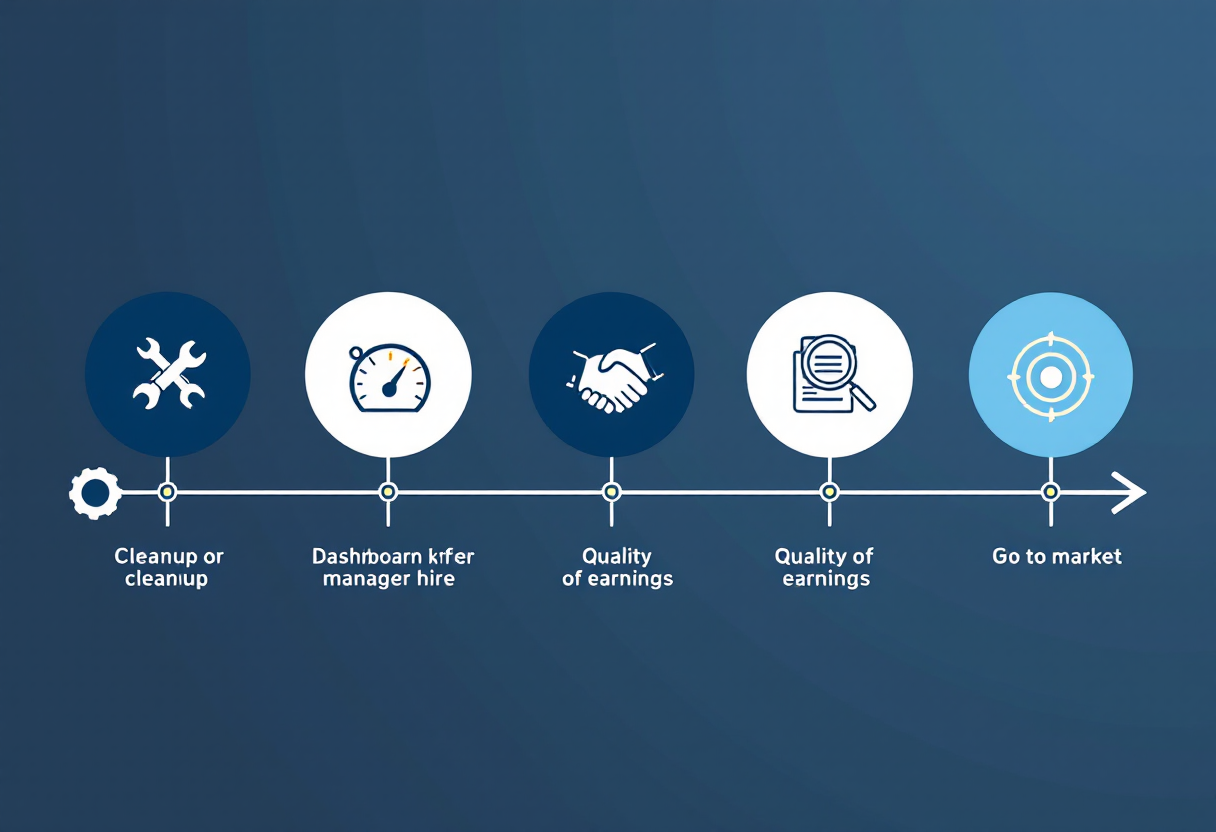
T-36 months: Cleanup phase
- Switch to accrual basis if still on cash basis. Move from QuickBooks to a PSA (Workamajig, Magnetic, Mavenlink/Kantata, FunctionPoint).
- Start tagging every potential EBITDA add-back as it happens, with documentation.
- Conduct W-2 / 1099 audit; reclassify if needed. Settle exposure now while it is small.
- Restruck related-party rent to FMV with appraisal.
- Build the org chart and identify the GM, President, or Managing Director hire (internal promotion target or external recruit).
- Update all client MSAs and freelancer agreements with dual work-for-hire + IP-assignment language.
- Begin building the client contract register with assignment, IP, termination, and renewal terms documented.
- Initial privacy compliance review: DPAs with clients and subprocessors; BAAs for any healthcare clients.
T-24 months: Financial discipline and KPI infrastructure
- GM, President, or Managing Director hire onboarded and starting to take operational load.
- Monthly close in 15 days; service-line P&L every month.
- KPI dashboard live: revenue per FTE, billable utilization, gross margin by client and service line, retainer ARR, retainer renewal rate, NRR, average retainer size, top-10 client concentration.
- Launch retainer conversion push: target 60% to 80% retainer revenue mix.
- Annual price increase of 5% to 8% on retainers; eliminate or migrate bottom-decile margin clients.
- Begin diversification of the client base if any top client is above 15%. Run an aggressive new-business push, especially in the named specialty vertical.
- Document SOPs for the pitch process, client onboarding, account QBR cadence, creative review, and escalation.
- Build the add-back bridge as a living document.
- Maintain or upgrade Google Premier Partner, Meta Business Partner, TikTok Partner, and Adobe Solution Partner status.
T-12 months: QoE-ready close discipline, eliminate owner dependence
- Owner steps out of daily operations; GM, President, or Managing Director runs the agency.
- Owner takes a 2-week unplugged vacation as the stress test.
- Transition all top-10 client relationships from owner to senior account directors.
- Run the sell-side QoE (budget $50K to $100K).
- Tighten the balance sheet: clean A/R (most agencies have $200K+ of over-90-day A/R that should be written off), isolate deferred retainer revenue and accrued media payables, kill dormant inventory and stale prepaid expenses.
- Final org-chart review; backfill any gaps in account leadership, creative leadership, and performance leadership.
- Final compliance scrub: 1099 audit, IP chain-of-title check on top 20 clients, GDPR / CCPA / state privacy compliance verification, HIPAA BAA confirmation, state tax nexus review.
- Lock in 12 months of clean service-line P&L for the CIM.
T-6 months: Pre-marketing prep
- Engage M&A advisor (sell-side investment bank or M&A advisory specializing in marketing services). Typical fee structure: $25K to $75K monthly retainer credited against a success fee of 4% to 8% of enterprise value, with Lehman or modified Lehman scaling. Specialists for agency M&A: SI Partners, R3 Worldwide, JEGI CLARITY, AdMedia Partners, Canaccord Genuity (CG Petsky Prunier), Ciesco, Marlin & Associates, Resound Partners.
- CIM drafted from the QoE and operating model.
- Teaser drafted (anonymized 1-pager).
- Buyer list finalized: 30 to 40 PE platforms (Tinuiti, Wpromote, Power Digital, New Engen, Bounteous, Acceleration Partners, Real Chemistry, Klick, Mountaingate, Insignia, Court Square, Frontenac, New Mountain, Audax, etc.) plus 10 to 15 strategic acquirers (WPP, Publicis, Omnicom post-IPG merger, Dentsu, Havas, Stagwell, Carlyle / Dept).
- Virtual data room populated with everything from the pre-LOI and confirmatory sections above.
- Management presentation deck built and rehearsed.
T-3 months: Go to market
- Teaser distributed; NDAs collected; CIMs distributed.
- IOIs collected approximately 2 to 3 weeks after the CIM goes out.
- Narrow to 4 to 6 finalists for management meetings.
- Management meetings; LOIs solicited.
- Select LOI; sign with exclusivity (typically 45 to 90 days).
- Enter confirmatory diligence: QoE (buyer’s), legal (IP chain of title, client contracts assignment, non-competes, IP recordation gaps), HR (W-2 / 1099 classification audit), data privacy (GDPR / CCPA / HIPAA where applicable), tax (multi-state nexus, sales tax on digital advertising services). Close.
End-to-end from engagement to close: 9 to 12 months in a well-run process (Auxo Capital Advisors, 2026; Sampford Advisors, 2025; Wall Street Prep; M&A Institute).
Frequently Asked Questions
How long should I plan for before selling my marketing agency to a private equity buyer or holding company?
The owners who get top-quartile pricing start preparing 24 to 36 months before going to market. The minimum useful prep window is 12 months, because most of the high-leverage levers (lifting retainer revenue from 30% to 60%+, installing a GM, normalizing ASC 606 media revenue recognition, running a sell-side QoE) need 12+ months of clean trailing-twelve-months data to be credible to a buyer. Owners who try to sell in under 6 months typically leave 20% to 40% of enterprise value on the table.
What is a realistic EBITDA multiple for a $2M EBITDA marketing agency in 2026?
For a generic full-service agency at $2M EBITDA in 2026, the range is 5x to 7x. The bottom of that range applies to project-heavy shops with weak retention, owner-dependence, and concentrated client base. The top applies to retainer-driven, specialty-focused agencies with 60%+ retainer mix, 90%+ annual client retention, GM in place, and client concentration under 10% (FE International, 2026; Agencies.co, 2026; Capstone Partners, 2025). For performance-marketing or specialty agencies (B2B SaaS, healthcare, financial services) at the same $2M EBITDA level, the range shifts up to 6x to 9x. The 36-month prep playbook moves you from the bottom of the band to the top.
Should I get a quality of earnings report done before going to market?
For marketing agencies at $1M+ EBITDA, yes. A sell-side QoE costs $50K to $100K typical, up to $150K for complex multi-entity or media-pass-through situations (Eton Venture Services, 2025). The ROI is leverage. If your QoE supports a 1x multiple uplift on a $4M EBITDA business at a 6x baseline, that is $4M of additional sale price for a $75K investment. More importantly, a pre-market QoE surfaces ASC 606 gross-vs-net revenue recognition issues, deferred-retainer-revenue treatment, 1099 misclassification exposure, and add-back weaknesses while you can still fix them, rather than during exclusivity when the buyer re-trades the deal.
What percentage of retainer (vs. project) revenue do PE buyers want to see?
60% or higher is the threshold that moves your business from commodity pricing into premium pricing. Project-heavy agencies trade at 3x to 4.5x EBITDA. Agencies with 60% to 80%+ retainer trade at 5x to 7x EBITDA, and the top quartile reach 8x to 12x (Agencies.co, 2026; FE International, 2026; Auxo Capital Advisors, 2026). Top retainer agencies also hold 92% annual client retention (8-figure benchmark) vs. 78% at 7-figure agencies, and retainer clients average a 56-month lifespan vs. 24 months for project clients (Predictable Profits, “2025 Agency Growth Benchmark”; Focus Digital, 2026).
Do I need to put a GM or President in place before I sell?
If your goal is to maximize price, yes, ideally 12+ months pre-sale. Owner-dependence is the most-cited multiple haircut in marketing-agency M&A literature (mergersandacquisitions.net, 2025; Imerge Advisors, 2025; Peninsula Road, 2024). On a $1M to $3M EBITDA agency, eliminating key-person risk moves the multiple from the 3x to 4.5x band into the 5x to 7x band, worth $1.5M to $6M of price. A GM, President, or Managing Director hire runs $200K to $400K plus bonus plus equity and needs 12 to 18 months to fully take operational load before the buyer’s diligence team will believe the transition. The 2-week unplugged-vacation test 12 months pre-sale is how you prove it stuck.
How do I know if my client concentration is too high to attract PE buyers?
The rule of thumb is no single client above 10% of revenue and no top 5 clients above 30%. Top client between 20% and 30% triggers a 10% to 20% valuation discount. Above 30% the hit is 20% to 30% off or the buyer restructures heavily on earn-out. Above 40% many PE buyers will not even sign an NDA (Agencies.co, 2025; Wall Street Prep customer concentration; Beancount.io, 2026; Strategex). If your top client sits at 25% to 40%, the fix is a 12-to-18-month new-business push to add 5 to 10 new mid-size clients so the relative weighting of the anchor account shrinks naturally, plus expansion of revenue per logo at smaller clients.
What to Do Next
The marketing agency owners who get the top-quartile multiple all do the same three things. They start preparing 24 to 36 months before they want to be out. They put a GM, President, or Managing Director in place 12+ months pre-sale. And they invest in a sell-side QoE that pre-normalizes ASC 606 media revenue recognition before any buyer sees a CIM.
Everything else (retainer conversion, client de-concentration, IP and contractor cleanup, Google Premier and Meta Business Partner upgrades, privacy compliance, EBITDA add-back hygiene) maps onto those three foundational moves. The 2026 market is favorable. Omnicom-IPG closed November 26, 2025. Publicis spent $2.2B on LiveRamp in May 2026. PE-backed performance platforms like Tinuiti, Wpromote, Power Digital, Bounteous, and Real Chemistry are actively buying. The window for specialty and retainer-heavy agencies to clear top-quartile pricing is open.
If you are 12+ months from a potential exit and want a structured pre-sale optimization roadmap, CT Acquisitions has agency operations specialists in our partner network who run multi-quarter prep engagements covering retainer mix, GM transition, ASC 606 cleanup, IP and contractor audits, and PSA implementation. If you are 6 to 12 months out and ready to start the sell-side process, our M&A advisory team runs the buyer outreach across the PE platforms and the holdcos. No fee to you on buy-side introductions; sell-side mandates are paid on success at closing. Either way, the first 30 minutes are free.
Ready to talk?
Schedule a 30-minute exit-readiness call
Or read more: Sell Your Marketing Agency (active sale guide) | Buying a Marketing Agency (buyer’s playbook) | Private Equity in Marketing Agencies 2026: Active Buyers + Multiples
Before going to market, start with our marketing agency business valuation guide to place your multiple.
Ready to Explore Your Options?
A 30-minute confidential conversation is all it takes.
