
How to Prepare Your Well Drilling Business for a Sale or Exit in 2026: The 36-Month PE-Buyer Playbook
Preparing your well drilling business for exit in 2026 is a 36-month playbook. The first 12 months tighten the operating story around residential vs commercial mix and geographic reach, the middle 12 fix pre-LOI diligence gaps around driller licensing, equipment condition, and environmental permits, and the final 12 turn one offer into a real competitive process. Water services consolidation is early enough that preparation matters, and PE-backed platforms competing with strategics create real pricing tension.
Exiting your well drilling business is the single largest financial event most owners will ever face. This guide is the no-fluff playbook for well drilling business owners who are 12-36 months from sale, covering how PE-backed buyers actually value your business in 2026, the 12 levers that move your multiple, pre-LOI diligence, deal-killers to fix before going to market, and the full 36-month exit prep timeline.
Updated April 2026 · CT Acquisitions

Most well drilling owners decide to sell, hire a broker, and find out 90 days later that their business is worth 30% to 40% less than they thought. Well drilling is a smaller and more fragmented private equity lane than HVAC or plumbing. The US has roughly 8,500 water well drilling businesses and only 4 to 6 directly identifiable PE-backed acquirers actively writing checks (SCWS Well Drilling Industry Statistics, 2026; IBISWorld Water Well Drilling Services in the US, 2025). That means fewer competing buyers, longer marketing cycles, and a much sharper premium on the owners who actually do the prep work. This guide is the 36-month playbook for how to prepare your well drilling business for a sale or exit. It covers what the active buyers actually buy, the 12 levers that move multiples, the documents PE will ask for before they send an indication of interest, and the deal-killers that re-trade well drilling transactions during confirmatory diligence.
If you are 6 to 36 months from a possible exit, this is the work that turns a 4x EBITDA outcome into a 7x EBITDA outcome. On a $2M EBITDA well drilling business, that is the difference between an $8M sale and a $14M sale. Whether you want to prepare your well drilling business for a sale to private equity, prepare your well drilling business for an exit to a strategic acquirer like Layne Granite or Coltala Water Holdings, or simply maximize value over the next 1 to 3 years before going to market, the work below applies. Every number cites its source. Estimates are flagged in line.
Building toward an exit in 12 to 36 months?
CT Acquisitions runs sell-side advisory for well drilling and pump-service owners $1M+ EBITDA. We also have water-services operations specialists in our partner network who run pre-sale optimization engagements when the timeline is longer. No fee to you on buy-side introductions; sell-side mandates are paid on success at closing.
What Private Equity Actually Buys in Well Drilling (2026)
Be honest with yourself about the buyer universe. Well drilling does not have the 27+ named PE platforms that HVAC has. The active buyer set is roughly 4 to 6 PE-backed water and drilling consolidators, a handful of public strategics (Granite Construction, Franklin Electric, Pentair, DXP Enterprises), and a longer list of environmental-services and industrial-water sponsors who occasionally cross over. The deals that have hit the wire in 2024 to 2026 are concentrated in industrial water, environmental drilling, and pump distribution, not residential demand drilling. Sellers who understand that universe price and position accordingly.
The PE-attractive well drilling profile
- EBITDA threshold for a platform-quality deal: $1.5M to $3M is the entry band where a sponsor-backed platform will run a competitive process. Below that, you are an add-on inside a roll-up or an SBA-bracket main-street sale. Above $5M, you become an attractive bolt-on for Coltala Water Holdings, Sylmar Group, Cascade Environmental, or Layne Granite. Above $15M EBITDA you are a platform candidate yourself.
- Service mix: The single biggest driver of multiple. Residential demand-only drilling trades at 3x to 5x EBITDA. Commercial and municipal drilling trades at 6x to 8x. Environmental (Phase II ESA, monitoring well, remediation) and geothermal installs trade at 7x to 11x. A shop that can document 30% to 50% of revenue in commercial, municipal, environmental, or geothermal work prices in a different universe than a pure residential operator.
- Pump-service recurring revenue: 25% to 40% annual maintenance contracts on submersible and jet pumps is where the multiple expands. Industry baseline is under 10%, so any shop that has built a real recurring book stands out.
- Geography: Texas, Florida, California, the Carolinas, Pennsylvania, New York, and the Mountain West are where 2026 sponsor demand concentrates. Texas in particular is hot because the Coltala / Alsay launch in August 2025 put a named buyer at the center of the state (Fort Worth Report, August 27, 2025).
- Customer concentration: No single customer above 10% of revenue. Top 5 customers below 30%. Builder-track residential drillers often have 30%+ revenue on a single homebuilder and municipal-track drillers often have 25%+ on one water district; either pattern triggers a 15% to 30% valuation discount or buyer walk above 25% (Beancount.io, May 2026; Eagle Rock CFO; Strategex; Wall Street Prep).
- License depth: At least one non-owner employee holds the state qualifier license in every operating state, with multiple years tenure. The owner is not the only person who can keep the doors open.
- Owner role: Owner is in management, not on the rig, not running every estimate, not signing every check. GM in place 12+ months pre-sale.
- Rig fleet: 3+ rigs, average age under 7 years, multiple modalities (rotary, sonic, cable-tool) with documented maintenance history. The buyer is going to model replacement capex, and an aging single-rig shop bleeds purchase price.
Active well drilling PE platforms and strategic acquirers in 2026
The table below mixes the PE-backed water and drilling consolidators with the public strategics and adjacent industrial-water sponsors that round out the buyer universe. This is who will see your teaser. Add-on counts are point-in-time; sources include Fort Worth Report (August 27, 2025), Smart Water Magazine, PrivSource, Sylmar Group press releases, Balance Point Capital, American Industrial Partners (April 11, 2024), Boart Longyear ASX Circular (January 29, 2024), Granite Construction news, Star Equity Holdings Form 8-K (March 3, 2025), Verdantas press release (November 13, 2024), BusinessWire, RESPEC press release (August 31, 2024), and Pentair Q3 2025 8-K.
| Platform / Acquirer | Sponsor / Owner | Profile |
|---|---|---|
| Coltala Water Holdings | Coltala Holdings (Fort Worth) with Gladstone Capital mezz and Bank United senior; Lone Star Investment Advisors retained minority | Launched August 2025 with the Alsay Inc. acquisition (Texas deep water well + pump + infrastructure); $100M+ backlog at acquisition; scaling national; $3M to $20M EBITDA municipal/industrial targets |
| Sylmar Group | Balance Point Capital; $130M refinancing led by Manulife / Comvest Credit Partners (2025) | Acquired Water Well Solutions (October 2024), ProChem Water (December 2025), Aquatrol Services (April 2026); national water and wastewater services; $1M to $10M EBITDA industrial water targets |
| Cascade Environmental | Bernhard Capital Partners (per PitchBook); previously TruArc Partners + PennantPark + Alston Capital | Largest US environmental drilling contractor per company materials; historical roll-up of Vironex, Panther Technologies, ZEBRA Environmental, Current Environmental Solutions, National EWP environmental drilling division; national environmental + geotechnical drilling |
| American Industrial Partners (Boart Longyear) | AIP Capital Fund VIII | Take-private of Boart Longyear closed April 11, 2024 at $383M EV (formerly ASX:BLY); largest disclosed drilling transaction of the cycle; global mining and drilling services and equipment |
| Layne Granite Company | Granite Construction (NYSE: GVA); acquired Layne Christensen 2018 for $536M final consideration | #1 position in US water well drilling per Granite materials; municipal, industrial, and water-resources drilling under the Layne Granite brand; large-diameter municipal wells and specialty rehab |
| Verdantas | Sterling Investment Partners | Acquired Groundwater Sciences Corporation (November 13, 2024, PA/NY environmental and groundwater); plus 5 environmental engineering add-ons in 2024 (Horizons Engineering, Aqua Engineering, Advanced Earth Sciences, Atlantic Resource Consultants, Atlantic Environmental Consulting); Northeast and national |
| Franklin Electric (NASDAQ: FELE) | Public | Acquired Barnes de Colombia (signed February 2025); Headwater Companies subsidiary acquired LCA Pump / Water Works Pump (closed December 31, 2023, Springfield, MO); active US groundwater distribution roll-up |
| Pentair (NYSE: PNR) | Public | Acquired Hydra-Stop September 17, 2025 for $292M plus $50M tax benefit; acquired G&F Manufacturing Q4 2024 for $108M; OEM and flow segments; lower-probability buyer for a residential drilling shop directly |
| DXP Enterprises (NASDAQ: DXPE) | Public | 8+ acquisitions in 2024 to 2026 across pump and water/wastewater distribution: Burt Gurney + MaxVac (November 2024, combined $11.7M sales / $1.6M adjusted EBITDA), Hennesy Mechanical, Kappe Associates, Pro-Seal, Pump Solutions Inc. (December 2025), PREMIERflow + Mid Atlantic Storage (Q1 2026); fits a pump-service-led drilling shop more than a pure drilling contractor |
| Star Equity Holdings (NASDAQ: STRR) | Holding company | Acquired Alliance Drilling Tools LLC (closed March 3, 2025) at $12.65M EV (cash-free, debt-free, including ~$3M real estate); rents and repairs downhole tools for O&G, geothermal, mining, water well |
| Baker Manufacturing Company | Private | Acquired the Pump Division of A.Y. McDonald Mfg. Co. effective November 1, 2024 (BusinessWire November 4, 2024); manufacturer-side acquisition that tightened the pump-distribution channel many drillers depend on |
| RESPEC Company | Employee-owned plus select institutional | Acquired Geothermal Resource Group Inc. effective August 31, 2024 for geothermal exploration and drilling management consulting; Western US and global |
| Workdry International (Holland Pump) | CVC Capital Partners (per industry trackers) | Acquired Holland Pump Company (Florida dewatering, Q3 2024) and Vanderkamp Group (Netherlands, Q1 2024); Holland separately acquired Florida Dewatering (Q2 2024); adjacent to drilling via dewatering and well-point installation |
| Dandelion Energy | Breakthrough Energy Ventures, GV, Comcast Ventures, NEA, LENX (Lennar), NGP ETP, Collaborative Fund; ~$170M cumulative raised including $40M Series C in 2024 | Vertically integrated residential geothermal drilling + heat pump install; builds in-house drilling crews vs. acquiring; the buy-side comp for geothermal residential drilling (Northeast US, expanding national) |
Strategic acquirers round out the universe. Granite Construction (NYSE: GVA) is the most likely public strategic for a large municipal-focused well drilling business, given the Layne Granite brand position. Comfort Systems USA (NYSE: FIX) is not a direct well drilling buyer but did acquire Right Way Plumbing & Mechanical in Florida on May 1, 2025, which is the precedent for how mechanical-services publics occasionally cross-buy water and well services. EMCOR and Quanta Services have no publicly disclosed water-well drilling strategy as of 2026. Major Drilling Group International (TSX: MDI) closed $727.6M revenue and $101.3M EBITDA in fiscal 2025 and acquired Explomin Perforaciones in Peru and Colombia, but its focus is mining exploration drilling, not residential or municipal water wells (Major Drilling Q4 FY25 release, June 11, 2025). Sumitomo Corporation acquired 100% of PT Resource Equipment Indonesia in Q4 2024 (large mining pump rental), indicating Japanese-trading-house appetite for water and pump infrastructure but no direct US residential exposure. The honest takeaway: a well drilling seller should expect 8 to 15 IOIs in a well-run process, vs. 20 to 40 typical for HVAC of comparable size, because the active buyer universe is genuinely smaller.
Well Drilling Valuation Multiples in 2026 (What You Are Actually Worth)
The multiple a buyer pays comes down to your size, your service mix, your recurring-revenue penetration, your rig fleet age, and your geographic fit. The honest baseline: well drilling multiples sit at the lower end of trade services because the business is rig-heavy and capital-intensive, residential demand work is project-cyclical, recurring-revenue penetration is structurally lower than HVAC, and there are far fewer competing PE buyers driving multiples up. Here is the 2026 range, cross-referenced from BizBuySell service-business benchmarks, Capstone Partners environmental and water services context, Sylmar Group portfolio context, well-drilling-specific broker listings (Truforte, BusinessBroker.net, Murphy Business, Sigma Mergers), and the disclosed multiples on Boart Longyear and Major Drilling. Note: there is no Capstone Partners “Well Drilling M&A Update” with a definitive annual multiple table the way HVAC has. The bands below are a defensible cross-source synthesis; treat as directional.
SDE multiples (smaller, owner-operated)
| SDE band | Estimated SDE multiple | Profile fit |
|---|---|---|
| Under $500K SDE | 2.0x to 3.5x | Demand-only, single-rig owner-operator (cross-source from BizBuySell water-businesses listings; Gaebler and Sigma Mergers well drilling broker content) |
| $500K to $1M SDE | 2.5x to 4.0x | Estimate from BizBuySell service-business benchmarks; Truforte Business Group SW Florida $4.6M revenue / $1.36M SDE listing as a real-market comp |
| $1M to $2M SDE | 3.0x to 4.5x | Estimate; platform-attractive size begins here. MA water service + well drilling listing at $7.1M revenue / $4.9M SDE / $4.7M EBITDA (BusinessBroker.net) is a real-market comp at the upper end of this band |
EBITDA multiples (PE-attractive size)
| EBITDA band | Residential / single-rig | Commercial / municipal | Environmental / geothermal specialty |
|---|---|---|---|
| Under $500K EBITDA | 2x to 4x | 3x to 5x | 4x to 6x |
| $500K to $2M EBITDA | 3x to 5x | 4x to 6x | 5x to 7x |
| $2M to $5M EBITDA | 5x to 7x | 6x to 8x | 7x to 9x |
| $5M+ EBITDA, platform-quality | 6x to 8x | 7x to 10x | 8x to 11x |
Source: CT Acquisitions Well Drilling PE Map 2026, cross-referenced with BizBuySell service-business benchmarks, well-drilling-specific broker listings, and the disclosed multiples on Boart Longyear (AIP take-private at $383M EV, April 11, 2024, implied roughly 6x to 8x trailing EBITDA per public commentary, estimate), Major Drilling (TSX: MDI trades in the 6x to 8x EV / EBITDA range on public markets), and Granite Construction / Layne Christensen (the 2018 acquisition at $536M final consideration on $617M revenue implied roughly 7x to 9x EBITDA on a normalized basis, estimate).
Recent disclosed well drilling and water-services transactions (2024-2026)
| Acquirer | Target | Date | Value | Implied multiple |
|---|---|---|---|---|
| American Industrial Partners | Boart Longyear | Apr 11, 2024 | $383M EV | 6x to 8x EBITDA (estimate per public commentary) |
| Coltala Water Holdings (Coltala + Gladstone + Bank United) | Alsay Inc. | Aug 27, 2025 | Not disclosed; $100M+ backlog, 25% prior 5-year CAGR | 7x to 9x EBITDA (estimate based on scale, growth, Texas position) |
| General Pump Company (Sylmar Group platform) | Water Well Solutions of WI/IL | Oct 10, 2024 | Not disclosed | 6x to 8x EBITDA (estimate based on Sylmar thesis) |
| Star Equity Holdings | Alliance Drilling Tools LLC | Mar 3, 2025 | $12.65M EV (cash-free, debt-free, including ~$3M real estate) | 5x to 7x typical for tool-rental (not disclosed) |
| Verdantas (Sterling Investment Partners) | Groundwater Sciences Corporation | Nov 13, 2024 | Not disclosed | Not disclosed; environmental and water consulting |
| Baker Manufacturing | A.Y. McDonald Pump Division | Nov 1, 2024 | Not disclosed | Manufacturer divestiture |
| RESPEC Company | Geothermal Resource Group Inc. | Aug 31, 2024 | Not disclosed | Geothermal exploration / drilling management consulting |
| Sylmar Group | ProChem Water | Dec 2, 2025 | Not disclosed | Industrial/commercial water and wastewater |
| Pentair | Hydra-Stop | Sep 17, 2025 | $292M + $50M tax benefit | Not disclosed publicly |
| DXP Enterprises | Burt Gurney & Associates + MaxVac | Nov 1, 2024 | Combined LTM Sep 30, 2024: $11.7M sales / $1.6M adjusted EBITDA | 6x to 8x typical for distribution roll-up (estimate) |
Sources: American Industrial Partners press release (April 11, 2024); Boart Longyear ASX Circular (January 29, 2024); Utah Money Watch; InvestMETS; Fort Worth Report (August 27, 2025); PrivSource; Smart Water Magazine; ION Analytics; BusinessWire (October 10, 2024; November 4, 2024); Star Equity Holdings Form 8-K (March 3, 2025); Verdantas press release (November 13, 2024); RESPEC press release (August 31, 2024); McDonald Hopkins; Pentair Q3 2025 8-K; DXP Enterprises press releases. Honest flag: only Alsay is a true residential-and-municipal water well drilling contractor sale in the public set. The rest are pump distribution, environmental consulting, tool rental, or industrial water services. Direct well drilling M&A is thin, and sellers should plan accordingly.
The 12 Value Levers That Move Your Multiple (Ranked by Impact)
These are the levers that move well drilling multiples in the 24 months before a sale. Each one has a current state, a target state, and an estimated financial impact. The ordering is by dollar impact per unit of effort, based on cross-source synthesis from BizBuySell, Capstone Partners, Sylmar Group portfolio data, well-drilling broker content (Sigma Mergers, Truforte, Murphy Business), and the cross-trade pattern from ServiceTitan, Brentwood Growth, and Morgan & Westfield QoE guides.
Lever 1: Shift mix from residential demand drilling toward commercial, municipal, environmental, or geothermal
Current: 80%+ residential demand-only well drilling. Target: 30% to 50% revenue from commercial, municipal, environmental Phase II, or closed-loop geothermal work. Impact: This is the single biggest multiple-mover in well drilling. Residential demand drilling sells at 3x to 5x EBITDA. Commercial and municipal sells at 6x to 8x. Environmental (Phase II ESA, monitoring well, remediation drilling) sells at 7x to 11x. On a $2M EBITDA business, a real mix shift can move headline value from $6M to $10M up to $14M to $22M. How: Bid local municipal water-system contracts; build environmental consulting partnerships (Phase II ESA work flows through Verdantas, AECOM, Geosyntec, and regional environmental firms who hire drilling subs); pursue state geothermal endorsements (Texas TDLR “C” closed-loop, equivalent in CA, FL, NY); build relationships with regional geothermal HVAC installers and Dandelion-style integrators where they operate.
Lever 2: Build a pump-service recurring-revenue book
Current: Under 10% revenue from recurring agreements; pump service is purely demand-call repair. Target: 25% to 40% recurring revenue via annual pump-service plans on residential and small-commercial customers. Impact: Recurring revenue is the single biggest deviation from baseline well drilling valuation, same dynamic as HVAC maintenance plans. Estimate 0.5x to 1.5x multiple uplift on the operating business, plus the buyer attaches a 1.5x to 2x annual-recurring-revenue premium on top of enterprise value (cross-reference from HVAC maintenance plan research; Profitability Partners 2026). On a 1,500-pump installed base at $250/year service plan, that is $375K ARR worth $560K to $750K of separate value on top of the EBITDA multiple. How: At every install and every callout, offer an annual service plan covering one pre-emptive inspection (pressure tank, motor amp draw, casing seal, water quality), priority dispatch, and a parts discount. Tie tech comp to plan sales. Auto-renew with stored payment. Upsell a premium tier that includes an annual water-quality test.
Lever 3: Move the owner out of the chair and get the GM hire right
Current: Owner runs estimates, dispatches the rigs, signs every check, and is the qualifying licensee on the state water-well drilling license. Target: GM in place 12+ months pre-sale. At least one non-owner senior driller and pump installer with multi-year tenure. Owner under 30 hours/week operational. Impact: Owner dependence is the standard deal-killer pattern, with the added well-drilling wrinkle that the owner often personally holds the state qualifier license. Moving the multiple from the 3x to 5x band into the 5x to 7x band on a $1M to $3M EBITDA business is worth $2M to $6M of price. How: Hire a GM 18 to 24 months pre-sale at typical comp $130K to $200K plus bonus. Identify two non-owner senior drillers ready to qualify as state license holder; start them on the exam track immediately (Texas TDLR exam requires 70%+ pass; California requires C-57 well drilling contractor license; Florida requires 2 years experience plus 12 hours coursework). Document SOPs for every operational role. Take a 2-week unplugged vacation as the stress test.
Lever 4: Drive average ticket and pricing discipline on residential drilling and pump service
Current: $/foot pricing has not moved in 3 to 5 years; pump install average ticket below $2,500; no annual pricing review; no surcharge mechanism for steel casing, mud, or fuel. Target: 5% to 8% annual list-price increase; mud, casing, and fuel surcharges flowing through; pump install average ticket $2,500 to $4,000; dispatch fee held on every call. Impact: Direct EBITDA growth, multiplied at sale. A $4M revenue shop that lifts blended average ticket by 10% adds $400K of revenue; at 50% drop-through that is $200K of additional EBITDA; at a 6x multiple, $1.2M of incremental sale price. Industry reference: average US residential well drill runs $3,000 to $15,000 (Angi 2026; CostHelper) and average pump replacement runs $1,500 to $3,500 (cross-source residential plumbing and well comps). How: Flat-rate pricing book for pump service. Quarterly price-book refresh. Surcharge mechanism for steel-casing price spikes. Technician training on options-based presentations. Kill technician discretion on pricing.
Lever 5: De-concentrate the customer base
Current: Top customer above 20% of revenue (typically a single homebuilder, a single municipal water district, or a single school district). Target: Top customer below 10%; top 5 below 30%. Impact: Concentration above 20% triggers PE pushback. Above 25%, 15% to 30% valuation discount or buyer walk (Beancount.io May 2026; Eagle Rock CFO; Strategex; Wall Street Prep). On a $3M EBITDA business, concentration discount can cost $1M to $4M of purchase price. How: Bid additional municipal contracts; diversify into agricultural irrigation wells if regulatory permits allow in your basin; expand into adjacent counties; bid environmental drilling work; intentionally trim discount on the largest account so the relative weighting shrinks naturally over 12 to 24 months.
Lever 6: Fleet age and rig modality diversification
Current: 1 to 2 rigs, average age 12+ years, single modality (rotary only or cable-tool only), maintenance log lives in the owner’s head. Target: 3+ rigs, average age under 7 years, multiple modalities (rotary plus sonic, or sonic plus cable-tool plus reverse-circulation), documented maintenance log per rig with engine hours and mud-pump hours. Impact: Direct effect on enterprise value at close because buyers price near-term replacement capex straight out of purchase price. SCWS benchmark drill rig cost is $450K (SCWS 2026); rotary rigs run $350K to $1M (SOSS USA; Versa-Drill listings); sonic rigs run $700K to $1.2M; cable-tool rigs run $200K to $500K (Heavy Equipment Appraisal 2026). A $450K rig that needs replacement in year 1 is roughly $450K out of purchase price. Modality diversification lets you bid environmental and geothermal jobs that command premium hourly rates. Estimate +0.5x to 1x multiple uplift for a multi-modality, modern fleet. How: Capex planning on a 12 to 15 year rig replacement cycle rather than running rigs to failure. Document every overhaul. Consider sonic acquisition if you have a credible environmental drilling pipeline to fill it.
Lever 7: Get on a real ERP/FSM and run a monthly close
Current: QuickBooks plus spreadsheets, no service-line P&L, no monthly close inside 30 days, rig utilization tracked anecdotally. Target: ServiceTitan (residential), Aspire, BuildOps, or a vertical-specific tool like RigER or eLogger, with monthly close in 15 days and a real KPI dashboard covering rig utilization, revenue per rig per day, jobs per crew per day, pump-service conversion rate, average ticket by service line, and recurring-revenue penetration. Impact: Estimate +0.5x to 1x multiple uplift. The bigger win is data-room speed during diligence: clean data lets you respond to buyer questions in days rather than weeks, which keeps multiple buyers competing rather than dropping out. How: Budget $30K to $100K implementation cost plus per-tech license. Force adoption by tying crew payroll to job-completion-in-system compliance.
Lever 8: License stack discipline (state-by-state)
Current: State qualifier license in owner’s name only; no plan for license transfer at close; no documentation of which state endorsements (water well, monitoring, injection, dewatering, closed-loop geothermal) are active and who holds them. Target: At least one non-owner employee holds the state qualifier in every operating state; all relevant endorsements (e.g. Texas TDLR “WA” master driller plus “C” geothermal plus “PI” pump installer) are held by employees, not contractors; license-renewal calendar is documented with CEU credit tracking; a clean license-transferability path is established before going to market. Impact: License tied to owner is one of the most common lower-middle-market deal-killers in well drilling. Estimate worth 0.5x to 1x multiple, but the real impact is binary: if the buyer cannot operate post-close, there is no deal at any price. How: Identify two senior drillers ready to qualify as state license holder. Each takes the state exam (Texas TDLR General Exam requires 70%+ pass). Document CEU compliance (Texas requires 8 hours every 2 years including 1 hour on statutes and rules). Repeat in every state you operate.
Lever 9: EBITDA add-back hygiene
Current: Owner mixes personal expenses through the business with no documentation; related-party rent at well-above FMV; owner-family members on payroll for unclear duties; no add-back schedule. Target: Every potential add-back is documented monthly with the underlying invoice; related-party rent restruck to FMV with appraisal on file; clean payroll for owner-family members with documented duties. Impact: Every defensible dollar of adjusted EBITDA gets multiplied. On a 6x multiple, $100K of clean add-backs equals $600K of sale price (Morgan & Westfield QoE guide). How: Adopt a monthly add-back log starting today. Document the business purpose of every charge. Get an FMV rent appraisal if the owner owns the shop or casing-yard real estate. Common well-drilling-specific add-backs: owner compensation above market (typical GM for a $3M to $10M shop runs $130K to $200K, so an owner taking $350K to $400K may have $150K to $250K of defensible add-back), one-time legal fees, owner family-member payroll, owner truck and fuel, owner health insurance, ERC, software-conversion costs, related-party rent above FMV.
Lever 10: Working capital normalization
Current: A/R wildly seasonal, especially with municipal customers on 60 to 90 day terms; large casing, pipe, and pump inventory swing; prepaid pump-service plan liability not isolated on the balance sheet. Target: TTM-average working capital is stable and predictable; deferred revenue on prepaid pump-service plans is separately tracked; inventory turn 4x to 6x. Impact: The working capital peg is set off the trailing 6 to 12 months (most commonly TTM average per BDO and Morgan & Westfield). A volatile working capital pattern lets the buyer set a higher peg, which subtracts from purchase price. Estimated: poorly managed working capital can cost 2% to 5% of enterprise value at close. How: Tighten A/R collection on commercial and municipal accounts (consider net-30 with 1.5% per month past 30). Inventory discipline on casing, pipe, and pump SKUs. Isolate prepaid pump-service liability on the GL.
Lever 11: Real estate decision (own or lease, and the sale-leaseback option)
Current: Owner-occupied shop, casing yard, and rig parking held in the same entity as the operating business, or in an LLC at above-FMV rent. Target: Real estate in a separate LLC at FMV NNN lease to the operating company, with a clear path for the buyer to either assume the lease or buy the real estate. Impact: Separating real estate often lifts the implied EBITDA multiple on the operating business because the buyer is not forced to underwrite real estate exposure (Plante Moran, Northmarq sale-leaseback primers). A sale-leaseback can convert up to 100% of property market value as cash, vs. 70% to 80% LTV via traditional financing (Northmarq). Estimated impact: holding real estate separately at FMV typically adds 0.5x to 1x to the operating company multiple. Specific to well drilling: shop real estate often has environmental exposure (used oil from rigs, mud-pit residue, drilling-fluid storage) that should be assessed with a Phase I ESA before any sale-leaseback. How: Get an FMV market rent study now. Restruck rent to FMV. Run the Phase I ESA. Decide before going to market whether the real estate is in the deal or held back.
Lever 12: Compliance scrub (the well-drilling-specific stack)
Current: State licenses in owner’s name; permit and well-completion records in paper file boxes; no OSHA silica exposure assessment; no confined-space program; no Phase I ESA on owned property; W-2 vs. 1099 mix unaudited on driller helpers and pump-service techs; sales/use tax compliance uneven on pump-service labor. Target: Licenses transferable; permit and State Well Report (SWR) records in a digital system with 10-year retention; silica exposure assessment per OSHA Table 1 (29 CFR 1926.1153) complete with written exposure control plan and medical surveillance baseline; confined-space program documented and crew-trained; W-2/1099 audit complete; Phase I ESA on file for any owned property; state-by-state compliance audit (TX, CA, FL, NY, plus any other operating states) by outside counsel. Impact: Each of these can kill or re-trade the deal at confirmatory diligence. See the deal-killer section below for specifics. How: Cover this in months 24 to 12 of the run-up, before the QoE.
Want to grow your business to maximize value before exiting?
We connect well drilling and pump-service owners with operations experts in our partner network who run 12 to 24 month pre-sale optimization engagements. The engagement pays for itself in incremental sale price.
What PE Asks Before They Send an LOI (The Pre-LOI Diligence Stack)
Before a PE firm commits to a letter of intent, they ask for a focused diligence package. The list below is the real ask from a 2026 PE-backed water-services platform targeting a well drilling business in CT Acquisitions’ pipeline. The “why” and “how to prepare” expand each item to what is typical across the industry.
1. Income statements for 2023, 2024, and the latest trailing twelve months
Why PE asks: They are building the LTM EBITDA they will multiply. They want trend (growth rate, margin trajectory), seasonality, and any one-time movers. Well drilling has more seasonal swing than HVAC because drilling demand spikes in dry season and during construction season; PE wants to see how the owner normalizes the swing. LTM is the bridge between the most recent year-end and today, so the headline price reflects current run-rate, not stale data.
How to prepare: Accrual-basis P&L by month, mapped to a clean chart of accounts. Service-line P&L (new well drilling, well rehab, pump install, pump service/repair, water testing, environmental drilling, geothermal install) where possible. Reconcile to tax returns so nothing surprises the buyer in confirmatory diligence.
2. Balance sheet at the latest month
Why PE asks: Two reasons. First, to start sizing the working capital peg they will set in the purchase agreement. Well drilling typically carries higher A/R (60 to 90 day terms on commercial and municipal work) and significant truck and rig book value. Second, to identify net debt (cash minus interest-bearing debt minus debt-like items including unfunded customer deposits, deferred revenue on prepaid pump-service plans, accrued bonuses, and capital lease balances on rigs and trucks). Both peg and net debt come out of the purchase price.
How to prepare: Tie the balance sheet to the trial balance. Separate the prepaid pump-service plan deferred revenue. Schedule out every rig and vehicle financing arrangement (capital lease, financed purchase, owned outright). Identify any rig insurance shortfall as a known item.
3. Adjusted EBITDA bridge with add-back documentation
Why PE asks: They want a preview of your adjusted EBITDA story before they sink diligence cost into the file. Aggressive or undocumented add-backs make buyers discount the rest of your numbers.
How to prepare: Build the bridge from book EBITDA to adjusted EBITDA, line by line, with the underlying invoice or payroll record for every add-back. Defensible well-drilling add-backs typically include owner compensation above market, one-time legal fees, owner family-member payroll, owner truck and fuel, owner health insurance, ERC, software-conversion one-time costs, related-party rent at above-FMV (added back to the FMV delta). Source: Morgan & Westfield QoE guide; KMCO sell-side QoE benefits; Eton Venture Services.
4. Anonymized employee roster (titles, start dates, pay structure, license status)
Why PE asks: Well drilling specifically has license-concentration risk on top of standard key-person risk. Buyers want to see which employees hold the state qualifier license, which hold pump installer license, which hold geothermal endorsement, and who has the CDL for the rig truck. They also want to stress-test driller-helper retention against industry churn: SCWS reports labor shortage runs 15% to 20% of positions unfilled (SCWS Well Drilling Industry Statistics, 2026).
How to prepare: Roster columns should include role, hire date, full-time vs. part-time, W-2 vs. 1099 (with classification rationale), comp structure (hourly, salary, commission, per-foot bonus), license type and number (e.g. Texas TDLR “WA” master driller, “C” closed-loop geothermal endorsement, “PI” pump installer), CDL class, EPA certifications, OSHA training (silica, confined space), and any non-compete or non-solicit. Calculate 12-month and 24-month rolling retention.
5. Revenue breakdown by service line (2022 to 2025 plus LTM, with job counts and average ticket)
Why PE asks: This is the single most diagnostic exhibit. It tells the buyer what mix of residential, commercial, municipal, environmental, geothermal, and pump-service revenue the business runs. Mix is the single biggest valuation driver. A 70% residential / 30% pump-service shop trades at a very different multiple than a 30% residential / 30% commercial / 20% environmental / 20% pump-service shop.
How to prepare: Pull from QuickBooks, Aspire, FieldEdge, RigER, or whatever ERP or FSM is in place. Columns at minimum: service line, total revenue, job count, average ticket per service line, gross margin per service line, year over year. Reference benchmarks: average US residential well drill cost $3,000 to $15,000 (Angi 2026; CostHelper); average pump replacement $1,500 to $3,500 (cross-source residential plumbing and well comps).
6. Customer concentration (top 10 customers by revenue, last 3 years)
Why PE asks: Well drilling shops with big developer or municipal accounts often have 30%+ revenue on a single customer. Even one school district or one homebuilder can be 25% of revenue. Above 20%, multiple haircut. Above 30%, deal restructure or walk.
How to prepare: Customer-by-customer revenue for top 10, with contract terms (master service agreement, change-of-control clauses, renewal dates). For municipal customers, the bidder qualification list and bid-win rate over 3 years. Calculate top-1, top-5, and top-10 concentration as a percent of total revenue.
7. Pump-service and maintenance-contract recurring revenue snapshot
Why PE asks: Same logic as HVAC maintenance plans. A pump on a 12-month service plan is recurring revenue. PE buyers attach a separate premium to the contract base on top of the EBITDA multiple. Well drilling baseline penetration is much lower than HVAC: most shops have under 10% recurring vs. HVAC’s 30% to 50% norm.
How to prepare: Contract count by month for 24 months. Renewal rate calculation. Average revenue per contract. ARR snapshot. Deferred revenue on prepaid annual plans (which becomes a debt-like item at close).
8. Rig and vehicle/fleet list
Why PE asks: Well drilling is the most capex-heavy of the home-services adjacencies. New rotary rig: $350K to $1M+. SCWS benchmark: $450K average drill rig cost (SCWS 2026). Sonic rigs at the high end ($700K to $1.2M). Useful life 15 to 20 years but engine and mud-pump overhauls every 5 to 8 years. Buyers model replacement capex against post-close cash flow.
How to prepare: Rig schedule with rig number, make/model/year (e.g. Versa-Drill V-100, Schramm T660, GEFCO, Atlas Copco TH60, Sonic G-50), engine hours, mud-pump hours, last major overhaul, ownership status (owned, financed, leased, capital lease), monthly payment if any, residual, condition. Same schedule for support trucks (rig trucks, water trucks, pump-service trucks), compressors, water tanks, and casing-storage trailers.
9. Permit and well-completion records audit
Why PE asks: State regulators audit on well-abandonment and decommissioning. If past wells were drilled without proper permits or abandoned without filing, the buyer inherits the liability. Texas TDLR requires the State of Texas Well Report (SWR) for every well within 60 days. California requires DWR Well Completion Reports. Florida requires WMD-filed reports. New York requires DEC-filed reports.
How to prepare: 5-year (preferably 10-year) digital archive of permits, SWRs, well-completion reports, and abandonment records. Sample 25 wells and verify each report was filed. Reconstruct anything missing while you still have time.
10. Five-year business plan
Why PE asks: PE underwrites years 1 through 5 post-close. They want a credible model: rig utilization, average ticket trend, capacity additions, pump-service program growth, geothermal pivot if applicable, geographic expansion plans.
How to prepare: Simple operating model: revenue by service line, gross margin assumptions, overhead growth, EBITDA. Include capacity build (rigs and crews), planned territory adds, pricing actions, and any commercial or municipal pipeline you can document.
Confirmatory Diligence (After You Sign the LOI)
Once an LOI is signed and exclusivity starts (typically 45 to 90 days per Colonnade Advisors podcast 020), the buyer runs parallel workstreams. This is the depth of inspection your business will undergo. If anything was hiding, it surfaces here.
- Quality of Earnings (QoE). Outside accounting firm runs revenue cut-off testing, deferred revenue analysis (pump-service prepaid contracts and any customer-deposited drilling work), expense normalization, add-back validation, and working capital trends. Buyer’s QoE cost: $35K to $150K typical for $1M to $10M EBITDA well drilling target. Output: an adjusted EBITDA number the buyer locks into the model.
- Customer concentration and commercial DD. Customer-by-customer revenue analysis, calls with top municipal, developer, and agricultural customers, contract review (assignment clauses, change-of-control triggers, MSA renewal dates). For municipal accounts: bidder qualification status and bid-list standing.
- IT systems audit. Field-service software, dispatch system, rig-utilization tracking, customer database. Most well drilling shops are still on paper or QuickBooks; this is itself a flag. PE platforms typically want acquired companies migrated to the platform’s standard stack post-close.
- Legal. Entity good standing in every operating state; state water-well drilling license plus pump installer license verified; well-completion records audit (random sample); contracts assignment; IP; litigation history (active and threatened); warranty and well-failure callback liability; real estate leases.
- HR/Payroll. W-2 vs. 1099 classification (driller helpers and pump-service techs often misclassified); I-9 compliance; wage-and-hour exposure (drilling crews on multi-day jobs often work overtime that gets misclassified); benefits; PTO accrual; any pending EEOC or DOL claims; non-compete enforceability in operating states.
- Environmental. Silica exposure plan plus monitoring records (OSHA 29 CFR 1926.1153); confined-space program; mud-pit and drilling-fluid disposal records; used-oil and battery disposal; spill-response plan; if any drilling has happened on contaminated sites (Phase II ESA work, MTBE sites, PFAS sites) the historical exposure to contractor liability claims; Phase I ESA on any owned shop real estate.
- State regulatory. Water-well drilling license in every operating state with the qualifier identified; permit-filing history audit; well-abandonment records audit; EPA UIC (Underground Injection Control) compliance if any injection wells; state-level groundwater management compliance (in CA: SGMA basin compliance and AB 2201 permit requirements; in TX: groundwater conservation district registration).
- Tax. Federal income, payroll, sales/use, property. Sales tax on drilling labor varies by state. Texas treats most well-drilling labor as a real-property improvement (non-taxable) but pump-service labor on tangible personal property is taxable; this is a recurring exposure where contractors under-collect. Outside counsel review required in every operating state.
- Insurance and bonding. Rig insurance schedule (industry norm is $2M to $5M+ per rig; many small drillers under-cover at $500K to $1M per rig), commercial auto, pollution liability (critical for environmental drilling), workers comp (high mod factor in drilling). Bonding capacity and current bond schedule.
Why You Should Pay for Your Own Quality of Earnings Before Going to Market
A sell-side QoE is your own outside accountant’s QoE, paid for by you, before you go to market. It does three things: pre-empts the buyer’s QoE by getting to the adjusted EBITDA number first with documentation; surfaces issues you can fix before the buyer sees them (revenue recognition on long-cycle municipal jobs, working capital, add-back documentation, deferred pump-service revenue); tightens the EBITDA number you take to market, which directly drives the headline price.
Cost
- $20K to $30K for QoE if revenue is below $5M and books are clean (Eton Venture Services 2025; EBIT Community small-business QoE guide).
- $35K to $75K typical range for sell-side QoE on a $1M to $5M EBITDA well drilling business with multiple service lines (cross-source from Kahn Litwin Renza buy-side vs. sell-side QoE 2025; Eton 2025; Midwest CPA; KMCO).
- Up to $150K for businesses with complex add-backs, multiple entities, environmental drilling exposure, or messy books (Eton 2025).
Honest flag: there is no well-drilling-vertical-specific QoE price publication. The range above is synthesized from cross-source lower-middle-market QoE provider content and treats well drilling as a typical service-business scope.
ROI
Standard QoE provider example: $25M revenue, $5M EBITDA business. Moving the multiple from 5x to 6x equals $5M of additional sale price. A $50K QoE investment that supports the 1x lift is a 100x return (Eton, “Quality of Earnings Report Cost”, 2025). Well-drilling-specific case (estimate, not from a single citation): a $4M revenue / $750K stated EBITDA well drilling shop runs the QoE and finds (a) $80K of defensible owner-vehicle, family-payroll, and related-rent adjustments to add back, (b) $40K of revenue-recognition timing on long-cycle municipal jobs that needs to be reclassified, and (c) $60K of pump-service prepaid deferred revenue to isolate. Net adjusted EBITDA defensible at $830K. At a 5x multiple, the $80K of clean add-backs alone is $400K of additional sale price for a $30K to $50K QoE investment.
Deal-Killers That Re-Trade Well Drilling Transactions (Avoid These)
These are the recurring kill-shots cited across well drilling M&A advisory content, state regulator materials, and confirmatory diligence checklists. Most are fixable in 12 to 24 months. None are fixable in 30 days.
1. State water-well drilling license tied to the owner personally
Every operating state requires a master qualifier license. Texas TDLR requires 2+ years experience under a licensed driller plus exam pass at 70%+ (Texas TDLR Apply for New Water Well Driller/Pump Installer License). Florida requires 2 years experience plus 12 hours coursework with at least 6 hours on construction practices (Florida DEP Water Well Contractor Licensing). California requires the C-57 well drilling contractor license with $15K surety bond plus $25K contractor’s bond (additional $100K LLC bond for LLC contractors per SuretyNow California Contractor License Bond Guide). New York requires DEC registration and bonding. If the qualifier is the owner and there is no plan to transfer the license at close, the buyer cannot operate post-close. The deal restructures (owner stays on as licensed qualifier for 12 to 24 months at a salary) or walks. This is the single most common well-drilling-specific deal-killer.
2. Missing or incomplete well-completion records (state regulator audit risk)
Texas TDLR requires the State of Texas Well Report (SWR) within 60 days of completion. California requires DWR Well Completion Reports. Florida requires WMD-filed completion reports. New York requires DEC-filed reports. Buyer’s legal DD samples 25 to 50 wells from past 5 years and verifies SWRs were filed. Gaps trigger remediation obligation that the buyer prices in or walks. Worst case: state regulator audit triggers fines $500 to $10K per well plus mandatory abandonment-record reconstruction.
3. EPA Underground Injection Control (UIC) Class V well violations
Under the Safe Drinking Water Act, the UIC program regulates well construction, operation, permitting, and closure for injection wells (Class V includes shallow disposal, geothermal return, recharge). EPA can pursue civil penalties under SDWA Section 1423(c). SDWA federal-agency penalties run up to $48,586 per day per violation (EPA enforcement records). Shops doing geothermal closed-loop, monitoring well, or any injection-classified work must have UIC registration on file. Missing UIC documentation surfaces in confirmatory environmental DD.
4. OSHA respirable silica violations on construction sites
OSHA’s Respirable Crystalline Silica standard for construction (29 CFR 1926.1153) sets the permissible exposure limit at 50 micrograms per cubic meter over an 8-hour TWA, with an action level at 25 micrograms per cubic meter that triggers medical surveillance. Drilling generates respirable silica from cuttings and air-rotary operations. Most drillers are out of compliance on the written exposure control plan, medical surveillance, and air monitoring. Penalties per OSHA 2026 schedule: up to $16,550 per serious violation, up to $165,514 per willful or repeat violation. Citations for silica violations at construction sites rose 15%+ in the first year after the new rule (Worksite Medical; SOSS USA).
5. Worker classification (W-2 vs. 1099) on driller helpers and pump-service techs
DOL final rule effective March 11, 2024 revised independent contractor analysis under FLSA. Receiving a 1099 does not make you an independent contractor; the economic-dependence test applies. Drilling helpers, pump-service techs, and rig hands who work for one operator with company-supplied truck, tools, and uniform are almost certainly W-2 employees. IRS settlements range $10K to $100K+ per misclassified worker once back taxes, penalties, interest, and legal cost aggregate (Tax1099; BoomTax misclassification penalties guide). Any single SS-8 filing by a former contractor opens a workforce-wide audit.
6. PFAS, MTBE, or other contaminated-site drilling exposure
For environmental drilling specifically: contractors who drilled monitoring wells on PFAS, MTBE, TCE, or other contaminated sites carry residual liability for drilling-fluid-related contamination spread. PFAS litigation context: 3M $10.5B to $12.5B global settlement (2024 to 2036); Tyco Fire Products $750M (November 2024); BASF $316.5M (November 2024); New Jersey 3M $450M (multi-source 2025). Environmental drilling contractors should expect buyer’s confirmatory environmental DD to specifically test for PFAS-site exposure history.
7. California SGMA and AB 2201 compliance burden (CA-operating shops only)
Sustainable Groundwater Management Act (signed 2014, now enforced through Groundwater Sustainability Agency plans) requires new wells in priority basins to obtain GSA permit, flow meter installation, annual reporting, and basin-sustainability-plan compliance (California Water Impact Network SGMA Explainer; California Department of Water Resources Well Standards). AB 2201 layered on additional requirements: 30-day public comment period on permit applications, licensed engineer or geologist report on impacts to nearby wells and infrastructure (California Legislative Info AB 2201; Cox Castle “Going to the Well”). For a California well drilling acquirer, the burden is real and the regulatory risk is priced in. But the other side: CA-licensed drillers with documented permit-handling expertise actually have a moat because the compliance complexity is a barrier to entry. Position it as an asset, not just a liability.
8. Rig fleet age and immediate replacement capex liability
A 12+ year old fleet without maintenance documentation can trigger $500K to $2M+ of immediate replacement capex assessment, which comes straight off purchase price. Rig replacement costs: rotary $350K to $1M, sonic $700K to $1.2M, cable-tool $200K to $500K per unit (cross-source from Versa-Drill listings; SOSS USA; Heavy Equipment Appraisal 2026; SCWS $450K average benchmark). A documented maintenance log per rig (engine hours, mud-pump hours, last major overhaul) is the cheapest way to push back on the buyer’s capex assumption.
9. Bonding capacity and rig insurance gaps
Many small drillers run with under-coverage on rig insurance ($500K to $1M per rig is below industry norm of $2M to $5M+). For commercial and municipal work, bonding capacity often caps the size of jobs the company can bid. Buyer’s confirmatory insurance review will surface coverage gaps and price the necessary upgrade (typically $25K to $100K additional annual premium) into the underwriting. Pollution liability is a separate must-have for environmental drilling exposure (Amwins Water Well Contractors Insurance Program; EK Insurance; Leavitt Group).
10. Sales/use tax exposure on pump-service labor
Texas treats most well-drilling labor as a real-property improvement (non-taxable) but pump-service labor on tangible personal property (a submersible pump that can be removed) is taxable; this is a recurring exposure where contractors under-collect (cross-source state tax guidance per Texas Comptroller treatment). Buyer’s confirmatory tax DD surfaces multi-year exposure that becomes a holdback or escrow at close. Get outside counsel review in every operating state 18+ months pre-sale.
11. Customer concentration with a developer or single municipal account
Builder-track residential drillers often have 30%+ revenue on a single homebuilder. Municipal-track drillers often have 25%+ on a single water district or school district. Above 20%, multiple haircut. Above 25%, 15% to 30% valuation discount or buyer restructure/walk (Beancount.io May 2026; Eagle Rock CFO; Strategex; Wall Street Prep). SBA lenders, who finance much of the lower-middle-market drilling deal universe, get uncomfortable at 20% concentration (Wall Street Prep 2025).
12. Drilling-fluid and mud-pit disposal records
Mud-pit residue, used drilling fluid, used hydraulic oil from rigs, and well-development water from contaminated zones all create regulated waste streams. Lack of disposal manifests is a Phase II ESA red flag on the shop property and a regulator-audit liability on past job sites. Buyer’s environmental DD will ask for the disposal manifests; if you do not have them, the buyer either holds back purchase price as escrow or walks.
The 36-Month Exit Prep Timeline
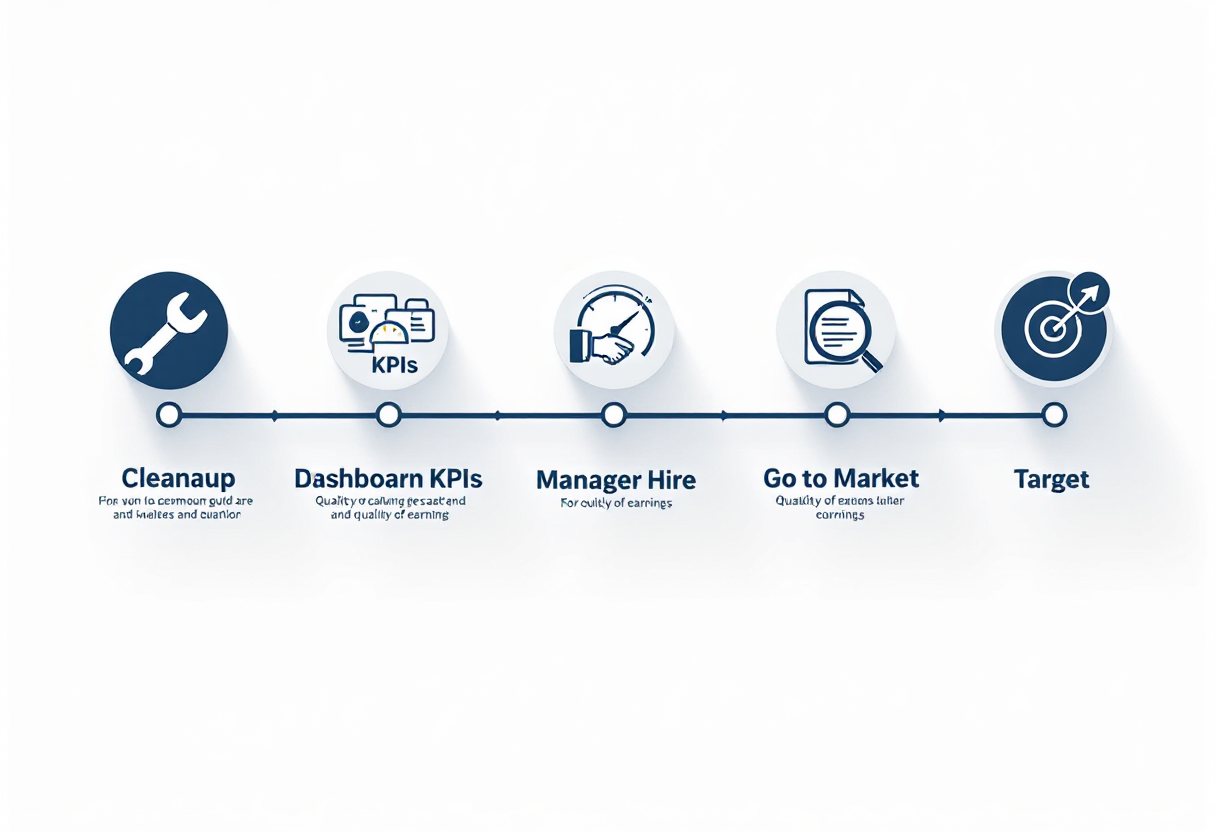
T-36 months: Cleanup phase
- Switch from cash to accrual basis if not already
- Pick an ERP / FSM and migrate (residential: ServiceTitan, FieldPulse, FieldEdge; commercial: BuildOps, Aspire; drilling-specific: RigER, eLogger)
- Start tagging every potential EBITDA add-back as it happens
- Conduct W-2/1099 audit on driller helpers and pump-service techs; reclassify if needed (settle exposure now while it is small)
- Restruck related-party rent to FMV with appraisal
- Phase I ESA on owned shop and casing-yard real estate
- Sales/use tax compliance review by outside counsel in every operating state (pump-service labor flag)
- Begin digital archival of permits, SWRs, and abandonment records (10-year retention target)
- Identify two non-owner senior drillers ready to qualify as state license holder; start them on the exam track
- Build the org chart and identify the GM hire target (internal promotion or external recruit)
T-24 months: Financial discipline and KPI infrastructure
- GM hire onboarded and starting to take operational load
- Monthly close in 15 days; service-line P&L every month (new well drill, well rehab, pump install, pump service, water testing, environmental drilling, geothermal install)
- KPI dashboard: rig utilization, revenue per rig per day, jobs per crew per day, pump-service conversion rate, average ticket by service line, recurring-revenue penetration
- Launch pump-service maintenance program if penetration is under 20%
- Annual price increase 5% to 8%; fuel, casing, and mud surcharge mechanism in place
- Customer-base diversification: identify and start displacing the top customer if above 15% of revenue
- OSHA silica exposure assessment per Table 1; written exposure control plan; medical surveillance baseline
- Confined-space program documented and crew-trained
- Document SOPs for every operational role
- Build the add-back bridge as a living document
T-12 months: QoE-ready close discipline, eliminate owner dependence
- Owner steps out of daily operations; GM runs the shop
- Owner takes a 2-week unplugged vacation as the stress test
- Run the sell-side QoE (budget $35K to $75K for a $1M to $5M EBITDA well drilling shop)
- Tighten balance sheet: clean A/R on commercial and municipal accounts, kill dormant inventory, isolate deferred revenue on pump-service prepaid plans
- Final org-chart review; backfill any gaps
- Final compliance scrub (license transferability, well-completion records, OSHA silica, W-2/1099, sales/use tax, environmental)
- Lock in 12 months of clean service-line P&L for the CIM
- License-transfer plan locked in: the non-owner state qualifier is in place with at least 12 months of tenure
T-6 months: Pre-marketing prep
- Engage M&A advisor. For well drilling specifically, this is more likely to be a generalist lower-middle-market advisor (Auxo Capital Advisors, The Advisory, MidStreet, Sigma Mergers Acquisitions, Truforte for SBA-bracket deals) than a vertical-specialist boutique. Typical fee: $25K to $75K monthly retainer credited against 4% to 8% success fee on a modified Lehman scale
- CIM drafted from the QoE and operating model
- Teaser drafted (anonymized 1-pager)
- Buyer list finalized. Realistic universe: Coltala Water Holdings, Sylmar Group / Balance Point Capital, Cascade Environmental / Bernhard Capital, Layne Granite / Granite Construction, Verdantas / Sterling Investment Partners, General Pump Company (Sylmar portfolio), Workdry / Holland Pump, Franklin Electric / Headwater Companies, DXP Enterprises, Pentair, Baker Manufacturing, RESPEC, plus 10 to 15 regional water-services platforms and family-office buyers
- Virtual data room populated with everything from the pre-LOI and confirmatory sections above
- Management presentation deck built and rehearsed
T-3 months: Go to market
- Teaser distributed; NDAs collected; CIMs distributed
- IOIs collected 2 to 3 weeks after CIM goes out. Honest expectation for a well drilling target: 8 to 15 IOIs vs. 20 to 40 typical for HVAC of comparable size, because the active buyer universe is genuinely smaller
- Narrow to 4 to 6 finalists for management meetings
- Management meetings; LOIs solicited
- Select LOI; sign with exclusivity (typically 45 to 90 days)
- Enter confirmatory diligence; close
End-to-end from engagement to close: 9 to 14 months in a well-run well drilling process (estimate; tracks the general lower-middle-market timeline per Auxo Capital Advisors and Wall Street Prep sell-side primer, with a slight upward bias because fewer buyers means more time per buyer in the management-meeting phase).
Frequently Asked Questions
How long should I plan for before selling my well drilling business to a private equity buyer?
The owners who get top-quartile pricing start preparing 24 to 36 months before going to market. The minimum useful prep window is 12 months, because most of the high-leverage levers (shifting mix toward commercial/environmental, lifting pump-service recurring revenue to 25%+, installing a GM, transferring the state qualifier license off the owner, running a sell-side QoE) need 12+ months of clean trailing-twelve-months data to be credible to a buyer. Owners who try to sell in under 6 months typically leave 20% to 35% of enterprise value on the table, and well drilling sellers face the additional headwind that the buyer universe is smaller than HVAC, so compressed timelines further thin the bid sheet.
What is a realistic EBITDA multiple for a $1M EBITDA well drilling business in 2026?
For a residential demand-focused well drilling business at $1M EBITDA in 2026, the realistic range is 3x to 5x. The bottom of that range applies to single-rig, owner-operator shops with under 10% recurring revenue, owner-dependence, and concentrated customer base. The top applies to multi-rig shops with 25%+ pump-service recurring revenue, a GM in place, ERP in place, and customer concentration under 15%. For commercial or municipal-focused well drilling at the same $1M EBITDA level, the range shifts to 4x to 6x. For environmental Phase II or geothermal specialty work at $1M EBITDA, the range shifts to 5x to 7x. The 36-month prep playbook is what moves you from the bottom of the band to the top. Source synthesis: BizBuySell service-business benchmarks; well-drilling-specific broker listings; Boart Longyear public-market commentary; Major Drilling public-market range.
How much pump-service recurring revenue do PE buyers want to see on a well drilling business?
25% to 40% of revenue from annual pump-service plans is the threshold that moves a well drilling business from baseline pricing into a premium band. Industry baseline is under 10%, so any shop that has built a real recurring book stands out hard. The dynamic mirrors HVAC maintenance plans: PE buyers attach a separate 1.5x to 2x annual-recurring-revenue premium on top of the EBITDA multiple (cross-reference from HVAC research; Profitability Partners 2026). On a 1,500-pump installed base at $250/year service plan, that is $375K ARR worth $560K to $750K of separate value on top of the EBITDA multiple. Beyond the math, recurring revenue tells the buyer the business has a defensible customer relationship rather than a one-time-transaction model, which is the biggest narrative shift you can make in well drilling diligence.
Will my state water-well drilling license transfer to the new owner, or do I need to stay involved post-close?
State water-well drilling licenses do not transfer with the entity sale in any state. Texas TDLR, California DWR, Florida DEP, and New York DEC all require an individual qualifier license tied to a named person, with experience requirements (typically 2 years under a licensed driller) and exam pass-rate thresholds (typically 70%+). If the owner is the qualifier and no employee is licensed, the buyer has three options: keep the owner on as licensed qualifier for 12 to 24 months at a salary (the most common restructure), find an outside qualifier to hire on day one (hard in tight labor markets), or walk. The fix is to identify two non-owner senior drillers 24+ months pre-sale and put them on the exam track immediately. This is the single most common well-drilling-specific deal-killer; solve it before you go to market.
Do I need a general manager in place before I sell my well drilling business?
If your goal is to maximize price, yes, ideally 12+ months pre-sale. Owner-dependence is the standard deal-killer pattern in trade services, and well drilling adds the wrinkle that the owner often also holds the state qualifier license personally, doubling the key-person risk. On a $1M to $3M EBITDA business, eliminating owner-dependence moves the multiple from the 3x to 5x band into the 5x to 7x band, worth $2M to $6M of price. A GM hire runs $130K to $200K plus bonus for a $3M to $10M revenue well drilling shop and needs 12 to 18 months to fully take operational load before the buyer’s diligence team will believe the transition. Pair the GM hire with the license-qualifier handoff (Lever 8) and you have solved the two biggest deal-killers in one motion.
Is residential well drilling sellable to private equity, or only commercial, municipal, and environmental?
Residential demand-only well drilling is sellable but at much lower multiples than commercial, municipal, or environmental work, and to a narrower buyer universe. Residential demand drilling trades at 3x to 5x EBITDA. Commercial and municipal trades at 6x to 8x. Environmental Phase II and geothermal specialty work trades at 7x to 11x. The realistic buyer set for a pure residential shop is generalist lower-middle-market PE, regional water-services platforms, and individual buyers using SBA financing, vs. the named PE platforms (Coltala Water, Sylmar Group, Cascade Environmental, Layne Granite, Verdantas) which concentrate on commercial, municipal, industrial, and environmental work. The highest-leverage move for a residential shop in a 24 to 36 month prep window is mix-shift: bid municipal contracts, build pump-service recurring revenue, pursue geothermal endorsements, and develop environmental consulting partnerships. Even a partial mix shift (20% to 30% non-residential) can move a shop from the 3x to 5x band into the 5x to 7x band.
What to Do Next
The well drilling owners who get the top-quartile multiple all do the same three things. They start preparing 24 to 36 months before they want to be out. They put a GM in place 12+ months pre-sale and they transfer the state qualifier license off the owner in that same window. And they invest in a sell-side QoE before any buyer sees a CIM. They are also realistic about the buyer universe: there are 4 to 6 directly identifiable PE-backed buyers of well drilling targets, not 27 like HVAC, which means positioning, buyer-list quality, and process discipline matter more, not less.
If you are 12+ months from a potential exit and want a structured pre-sale optimization roadmap, CT Acquisitions has water-services operations specialists in our partner network who run multi-quarter prep engagements covering mix-shift to commercial and environmental, pump-service recurring-revenue build, GM and license-qualifier handoff, and ERP/FSM implementation. If you are 6 to 12 months out and ready to start the sell-side process, our M&A advisory team runs the buyer outreach against the named platforms above plus the regional water-services and family-office universe. No fee to you on buy-side introductions; sell-side mandates are paid on success at closing. Either way, the first 30 minutes are free.
Ready to talk?
Schedule a 30-minute exit-readiness call
Or read more: Sell Your Well Drilling Business (active sale guide) | Buying a Well Drilling Business (buyer’s playbook) | Private Equity in Water Services 2026: Active Buyers + Multiples
Ready to Explore Your Options?
A 30-minute confidential conversation is all it takes.
