How to Prepare Your Chiropractic Practice for a Sale or Exit in 2026: The 36-Month PE-Buyer Playbook
Preparing your chiropractic practice for exit in 2026 works best as a 36-month process, not a decision you make in the LOI. The first 12 months are about the value levers PE-backed chiropractic platforms actually underwrite (visit frequency, provider retention, insurance mix), the middle 12 fix the diligence gaps auditors will find, and the final 12 turn a single inbound offer into a real competitive process.
Exiting your chiropractic practice business is the single largest financial event most owners will ever face. This guide is the no-fluff playbook for chiropractic practice owners who are 12-36 months from sale, covering how PE-backed buyers actually value your business in 2026, the 12 levers that move your multiple, pre-LOI diligence, deal-killers to fix before going to market, and the full 36-month exit prep timeline.
Updated April 2026 · CT Acquisitions

Most chiropractic owners decide to sell, hire a broker, and find out 90 days later that their practice is worth 30% to 50% less than they thought. The owners who get top-quartile pricing start preparing 24 to 36 months before they ever talk to a buyer. This guide is the 36-month playbook for how to prepare your chiropractic practice for a sale or exit. It covers what private equity, MSOs, and franchise platforms actually buy in chiropractic in 2026, the 13 levers that move multiples, the documents PE will ask for before they send an indication of interest, and the deal-killers that re-trade chiropractic transactions during confirmatory diligence. Every multiple, named buyer, and stat below cites its source. Every recommendation comes from how the most active chiropractic buyers in 2025 and 2026 actually behave.
If you are 6 to 36 months from a possible exit, this is the work that turns a 2.5x EBITDA outcome into a 5x EBITDA outcome. On a $750K EBITDA chiropractic practice, that is the difference between a $1.9M sale and a $3.75M sale. Whether you want to prepare your chiropractic practice for a sale to a PE-backed MSO, prepare your chiropractic practice for an exit to a franchise platform, or simply maximize value over the next 1 to 3 years before going to market, the work below applies. One important seller-expectation correction up front: The Joint Chiropractic (NASDAQ: JYNT) is now primarily a refranchiser, not an acquirer of independent multi-location practices. The active buyer universe sits with PE-backed MSOs (Champion Wellness Centers, Chiropractic Health Partners, Chiro One), franchise platform sponsors (Red Iron Group, Franworth, Vistria), and integrated spine and IPM buyers (Trive Capital, Thrive Physical Therapy Partners). More on each below.
Building toward an exit in 12 to 36 months?
CT Acquisitions runs sell-side advisory for chiropractic owners with $500K+ EBITDA. We also work with chiropractic operations specialists in our partner network who run pre-sale optimization engagements when the timeline is longer. No fee to you on buy-side introductions; sell-side mandates are paid on success at closing.
What Private Equity Actually Buys in Chiropractic (2026)
Chiropractic PE consolidation is real, but smaller-scale than dental DSOs or vet roll-ups. The US chiropractic services market is estimated at $13.75B (Zion Market Research, 2024) and as high as $24.3B in broader IBISWorld scoping, with roughly 65,297 chiropractic businesses operating nationally at a flat 0.0% CAGR 2020 to 2025 (IBISWorld 2025). About 15% to 20% of the market is corporately aligned today across franchise, MSO, and PE-backed multi-site operators, and the franchise segment is projected to grow at 28.5% CAGR through 2030 (Grand View Research, republished by Yahoo Finance 2024). What that means for sellers: the buyer pool is real and growing, but tighter than other healthcare verticals, multiples sit meaningfully below dental DSO and vet, and profile differentiation drives almost all of the multiple expansion.
The PE-attractive chiropractic profile
- EBITDA threshold for a competitive process: $500K to $1M is the entry band where a chiropractic MSO add-on conversation starts. $1M to $2M EBITDA with multi-doc, multi-location is the sweet spot for active PE-backed MSO platforms. $5M+ EBITDA is platform-candidate territory, with multiples drawing on broader PE healthcare MSO comparables (Sofer Advisors 2025 to 2026; Cherry Bekaert PE Healthcare 2025).
- Care plan and membership penetration: 35% to 55% of revenue from pre-paid 12 or 24 visit packages and monthly maintenance memberships is the threshold that breaks out from base multiples. Under 15% recurring trades at the bottom of the band; above 35% trades at the top.
- Cash vs. insurance mix: 40% to 70% cash-pay practices command premiums over insurance-heavy practices because of payment certainty and no carrier change-of-control risk. Insurance-dependent practices over 70% on commercial payers get discounted (Arrowfish Consulting 2026; Eton Venture Services chiropractic guide; Exitwise 2025).
- Geography: Florida (Tampa, Boca Raton, Brandon), Texas, the Carolinas, Arizona, Nevada, and Tennessee are where 2026 active acquirer demand concentrates. Champion Wellness Centers is Tampa-focused. Chiropractic Health Partners is Lakewood Ranch FL and Mid-Atlantic. 100% Chiropractic targets AZ, NV, TX, NC, SC.
- Payer concentration: Top payer below 20% of revenue. Top 3 payers below 50%. Concentration above 25% on any single carrier (often a regional BCBS contract) triggers buyer pushback, with typical haircut of 15% to 30% above that threshold (Beancount.io 10% rule 2026; Strategex; Wall Street Prep customer concentration formula).
- Associate DC depth: Owner-DC handles under 30% of patient visits; 2 to 4 associate DCs credentialed and producing; owner in operator or GM role 12+ months pre-sale. The US has a recognized DC shortage with 10% projected employment growth 2024 to 2034 (BLS Occupational Outlook 2024) and 52% of chiropractic small-business owners reporting hiring difficulty in 2024 (Chiro Match Makers 2024). Practices that have solved the associate problem trade at a meaningful premium.
Active chiropractic acquirers in 2026
The list below covers the most active franchise platforms, PE-backed MSOs, and PE buyers tracked through public filings, sponsor press releases, PitchBook, PrivSource, and trade press as of May 2026. Add-on counts are point-in-time. This is who will see your teaser if you take a chiropractic practice to market today.
| Platform / Acquirer | Owner / Sponsor | Profile |
|---|---|---|
| The Joint Chiropractic (NASDAQ: JYNT) | Public company | 962 total clinics at 9/30/2025 (884 franchised, 78 corporate). Now a refranchiser, not an independent-practice acquirer. Sold 31 AZ/NM corporate clinics to franchisee Joint Ventures LLC for $8.3M + Northwest RD rights in July 2025; signed $1.5M APA for 22 Southeast corporate clinics December 11, 2025; terminated APA for 45 CA corporate clinics November 2, 2025 |
| Chiro One Wellness Centers / TVG Medulla | The Vistria Group (Chicago) | ~70 wholly-owned clinics across IL, IN, WI and select states; not franchised; operated by TVG-Medulla MSO |
| HealthSource Chiropractic | Franworth (PE-backed franchise platform) | 132 total franchise units at year-end 2024; estimated $310K to $390K total investment per FDD (Franchise Chatter HealthSource Chiropractic Review 2025; 1851 Franchise 2025) |
| 100% Chiropractic | Red Iron Group (Menlo Park, growth investment June 2024) | Peaked ~125 units mid-2024, declined to under 90 by early 2026 (Unhappy Franchisee tracking 2025 to 2026); target markets AZ, NV, TX, NC, SC |
| MaxLiving | Private, founder-controlled | 1,000+ doctors in network; FDD investment range $167,600 to $361,500 per franchise (2025 FDD); holistic wellness positioning |
| AlignLife Chiropractic & Natural Health Centers | Private franchise | Mid-sized regional franchise; smaller-scale national footprint (Entrepreneur Franchise Directory 2025) |
| Chiropractic Health Partners (CHP) | The Brydon Group (PE) | MSO founded 2023; HQ Lakewood Ranch FL; partnered with Health Quest Chiropractic & Physical Therapy (Owings Mills MD, founded 1998) on May 31, 2024; pipeline of Florida and Mid-Atlantic add-ons |
| Champion Wellness Centers | Monument MicroCap Partners (recap March 20, 2024) | 7 Tampa-area clinics at recap; 4+ disclosed add-ons in 18 months including Boca Chiropractic Spine & Wellness (Boca Raton, Jan 30, 2025), Dr. Lichter & Associates (Tampa, founded 1995), Brandon Spine & Injury Center (Feb 2025), and NuVita Chiropractic (Tampa, Aug 2025); most active disclosed chiropractic MSO acquirer 2024 to 2025 |
| Florida Spine and Joint Institute / iRISE Spine & Joint | Trive Capital (Dallas) | Original Trive investment Dec 2018; rebranded iRISE in 2020; 14 Florida clinics at investment; actively seeking IPM, orthopedic, chiropractic, and PT add-ons (Trive Capital portfolio update 2024 to 2025); building first national fully integrated personal injury and workers comp focused healthcare provider |
| RxWellness Spine & Health | Private; multi-region operator | Acquired AllCare Chiropractic & Injury (four Maryland clinics) per Yahoo Finance 2024 to 2025; DC, MD, VA region |
| ChiroHD (vertical SaaS, not a clinic acquirer) | Mainsail Partners ($26M growth equity, April 29, 2025) | PE-backed practice management software; tracked here because PE-backed software consolidation drives M&A diligence expectations and the data-room speed bar across the industry |
| Mainsail Partners | n/a (multi-platform sponsor) | $2.2B+ committed capital across 100+ companies; chiropractic exposure via ChiroHD |
| Authority Brands | Apax Partners + BCI | PE-backed franchise platform; primary footprint home services but referenced in PE healthcare comparables as a model for franchise roll-up scale; cross-vertical context for sellers evaluating franchise-platform paths |
| Neighborly / KKR | KKR | Multi-vertical franchise platform; no direct chiropractic brand today but provides a comparable for PE thinking on franchise multiples (estimate) |
Sources for the table: The Joint Corp 8-K filings dated June 25, 2025, July 7, 2025, and December 11, 2025; The Joint Corp Q3 2025 press release November 6, 2025; PitchBook Chiro One profile; PrivateEquityInfo Chiro One company profile; The Vistria Group portfolio page; PRNewswire “Red Iron Group Announces Strategic Investment in 100% Chiropractic” June 2024; International Franchise Association “100% Chiropractic Celebrates Exceptional First Half of 2024” August 2024; Franchise Chatter HealthSource Chiropractic Review 2025; Monument MicroCap Partners news pages 2024 to 2025; BusinessWire / Generational Group “Generational Group Advises Health Quest Chiropractic & Physical Therapy” June 11, 2024; The Brydon Group portfolio page; Trive Capital “Actively Seeking IPM, Orthopedic, Chiropractic and Physical Therapy Opportunities” 2024; PRWeb “ChiroHD Raises $26M of Growth Capital from Mainsail Partners” April 29, 2025; Dynamic Chiropractic “Private Equity and the Future of Chiropractic” 2024 to 2025; PrivSource chiropractic deal records 2024 to 2026.
Strategic acquirers are limited in chiropractic. Cross-vertical IPM, orthopedic, and PT platforms like Trive Capital (iRISE Spine & Joint) and Thrive Physical Therapy Partners (Tyree & D’Angelo) occasionally acquire integrated chiropractic plus PT plus pain management practices where chiropractic is one service line within a broader spine and musculoskeletal practice. Integrated practices command 1.5x to 3x the chiropractic-only multiple per cross-references in Dynamic Chiropractic 2024 to 2025 and Trive Capital portfolio focus content. Hospital systems rarely acquire standalone chiropractic; estimate is under 5% of chiropractic exit pathways today, primarily limited to outpatient rehab integration in value-based-care markets. The bulk of chiropractic-only deals route to PE-backed MSOs (Champion, CHP, Chiro One) and franchise platforms (HealthSource, 100% Chiropractic, MaxLiving, AlignLife), not strategic operators.
Chiropractic Valuation Multiples in 2026 (What You Are Actually Worth)
Chiropractic multiples sit meaningfully below dental DSO, vet, and HVAC because the buyer pool is smaller, recurring-revenue penetration is lower industry-wide, and key-person risk is high (most clinics still revolve around the owner-DC’s clinical book). The premium tier (multi-location, cash-pay, owner-out, integrated) breaks out hard from the base tier. Here is the 2026 range, cross-referenced from Peak Business Valuation chiropractic content, Arrowfish Consulting 2026 chiropractic valuation guide, Sofer Advisors Medical Practice Valuation Multiples Guide 2025 to 2026, Eton Venture Services chiropractic guide, BizWorth, ValuAdder, IBBA Q4 2025 Market Pulse, and PrivSource deal records.
SDE multiples (small, owner-operated practices, typically under $1M SDE)
| Profile | SDE multiple | Source / notes |
|---|---|---|
| Single-location, owner-DC dependent, demand-visit model | 1.75x to 2.27x SDE | Peak Business Valuation chiropractic 2025 to 2026 |
| Revenue multiple range, single location | 0.69x to 0.87x annual revenue | Peak Business Valuation 2025 to 2026 |
| Asset-sale comp for tiny practices under $500K collections | 50% to 70% of collections | Strategic Chiropractor / ChiroEquity / Progressive Practice Sales 2024 to 2025 |
| Small practice rule-of-thumb | 50% to 60% of 3-year average collections plus 20% to 30% of last-year AR | Progressive Practice Sales “How Chiropractic Practices Are Valued” 2025 |
EBITDA multiples (PE-attractive size)
| EBITDA band | Typical multiple range | Profile / notes |
|---|---|---|
| Under $250K EBITDA (single-doc, owner-dependent) | 2.0x to 3.0x EBITDA (or use SDE) | Peak Business Valuation; ValuAdder chiropractic 2025 |
| $250K to $500K EBITDA | 2.86x to 3.83x EBITDA | Peak Business Valuation chiropractic-specific range 2025 to 2026 |
| $500K to $1M EBITDA, multi-doc | 3.0x to 5.0x EBITDA | Sofer Advisors Medical Practice 2025 to 2026; Arrowfish Consulting 2026 |
| $1M to $2M EBITDA, multi-location, 30%+ recurring | 4.0x to 6.0x EBITDA | Cross-source synthesis (Sofer Advisors; Arrowfish; PitchBook Champion Wellness Centers profile) |
| $2M to $5M EBITDA, multi-location, owner-out, GM in place | 5.0x to 8.0x EBITDA | Cross-source synthesis comparable to single-specialty medical practice MSO add-on tier (Sofer Advisors 2025 to 2026; PrivSource Champion + Health Quest comps) |
| $5M+ EBITDA platform candidate (MSO-ready, integrated, multi-state) | 8.0x to 12.0x EBITDA (estimate) | Estimate based on PE healthcare MSO platform comps (Sofer Advisors 2025 to 2026; Cherry Bekaert PE Healthcare Outlook 2025 to 2026); no single confirmed chiropractic-only platform-tier deal publicly disclosed in 2024 to 2026 |
IBBA Q4 2025 Market Pulse cross-reference: lower middle market healthcare deals at $1M to $2M EBITDA broadly print around 3.0x to 3.3x and $2M to $5M around 4.1x EBITDA (IBBA / M&A Source Q4 2025 Market Pulse Survey, PR Newswire January 2026). Chiropractic-specific premium over IBBA blended runs +0.5x to +1.5x for true PE-attractive practices, mostly driven by recurring care plans, cash mix, and associate-DC depth.
Recent disclosed chiropractic transactions (2024 to 2026)
| Acquirer | Target | Date | Value / structure | Source |
|---|---|---|---|---|
| Joint Ventures, LLC (largest JYNT franchisee) | 31 corporate JYNT clinics in AZ/NM + Northwest RD rights | Closed July 7, 2025 | $8.3M cash + Northwest RD rights; implied roughly $268K per clinic (not directly EBITDA-multiple comparable since these are refranchise transactions, not standalone businesses) | The Joint Corp 8-K July 7, 2025; GlobeNewswire July 7, 2025 |
| Existing JYNT franchisee | 22 JYNT corporate clinics in Southeast (VA / NC / SC) | APA signed Dec 11, 2025 | $1.5M total cash; roughly $68K per clinic; reflects under-performing footprint | The Joint Corp 8-K Dec 11, 2025; GlobeNewswire Dec 11, 2025 |
| The Joint Corp (terminated) | 45 California corporate clinics APA | Notice to terminate Nov 2, 2025 | Terminated; signal that California corporate footprint is harder to refranchise than AZ/NM/SE | The Joint Corp 8-K Dec 11, 2025 |
| Chiropractic Health Partners (Brydon Group) | Health Quest Chiropractic & Physical Therapy (Owings Mills MD, multi-location, founded 1998) | May 31, 2024 | Not disclosed | BusinessWire / Generational Group June 11, 2024; PrivSource deal page |
| Champion Wellness Centers (Monument MicroCap) | Boca Chiropractic Spine & Wellness, LLC (Boca Raton FL) | January 30, 2025 | Not disclosed | Monument MicroCap Partners press Feb 2025; PE Hub |
| Champion Wellness Centers | Brandon Spine & Injury Center (Brandon FL) | February 2025 | Not disclosed | Monument MicroCap Partners press |
| Champion Wellness Centers | NuVita Chiropractic (Tampa FL, founded 2019) | August 2025 | Not disclosed | Monument MicroCap Partners press Aug 2025; Healthcare Deal Flow; PE Hub |
| Mainsail Partners | ChiroHD (vertical SaaS, not a clinic) | April 29, 2025 | $26M growth equity | PRWeb April 29, 2025; Mainsail Partners portfolio; Founders Advisors |
| Red Iron Group | 100% Chiropractic (growth investment) | June 2024 | Not disclosed (growth equity round, not acquisition); 12 new clinic openings in H1 2024 | PRNewswire June 2024; IFA press Aug 2024 |
Most chiropractic add-ons are sub-$5M total deal value, paid for in seller notes plus cash plus earn-out plus equity rollover, and are not publicly disclosed with EBITDA multiples. The Champion Wellness Centers cadence (4+ disclosed add-ons in 18 months) is the closest public proxy for the going PE roll-up pace in chiropractic today. Note also: no chiropractic-only platform-tier ($5M+ EBITDA) deal has been publicly disclosed with a multiple in 2024 to 2026, so the 8x to 12x platform-tier range is an estimate drawn from PE healthcare MSO comparables and integrated spine deals like Trive Capital’s iRISE.
The 13 Value Levers That Move Your Multiple (Ranked by Impact)

These are the levers that move chiropractic multiples in the 24 months before a sale. Each one has a current state, a target state, and an estimated financial impact. The ordering is by dollar-impact per unit of effort, synthesized from Peak Business Valuation, Arrowfish Consulting 2026, Strategic Chiropractor, Progressive Practice Sales, Eton Venture Services chiropractic guide, ChiroSpring subscription content, MyZHealth membership content, PatientPayments membership benchmarks, and Dynamic Chiropractic 2024 to 2025 PE content.
Lever 1: Lift care plan and membership penetration to 35%+ recurring
Current: Pay-per-visit demand model; under 15% revenue from recurring plans or memberships. Target: 35% to 55% recurring revenue with tiered plans (maintenance $99 to $135/mo for 2 adjustments, wellness $150 to $200/mo for 4 adjustments plus therapy, performance $250 to $350/mo unlimited adjustments plus premium services), auto-renewal on card-on-file. Impact: This is the single biggest multiple driver in chiropractic. Estimate +1.0x to 2.5x EBITDA multiple uplift (synthesized from ChiroSpring, MyZHealth, PatientPayments membership content cross-referenced to recurring-revenue multiple deltas in HVAC and dental). On a $750K EBITDA practice, that is $750K to $1.875M of additional sale price at exit. How: Tech-led membership rollout via ChiroHD, ChiroSpring, or PatientPayments. DC and front-desk comp tied to membership conversion. Two-week new-patient conversion target above 60%. Track active member count by month, renewal rate, and average revenue per member as a standing KPI.
Lever 2: Build the associate DC bench and move owner out of the chair
Current: Owner-DC handles 70%+ of patient visits and is the only credentialed Medicare biller. Target: Owner-DC handles under 30% of visits; 2 to 4 associate DCs credentialed and producing; owner in operator or GM role 12+ months before going to market. Impact: Removes key-person risk, the most-cited multiple haircut in chiropractic valuation literature (Strategic Chiropractor 2025; Progressive Practice Sales 2025; Eton chiropractic valuation guide). On a $500K to $1.5M EBITDA practice, this shifts the multiple from the 2.5x to 3.5x band into the 4x to 6x band, worth $750K to $3.75M of price. How: Associate DC hire 18 to 24 months pre-sale. Typical associate DC comp $80K to $130K base plus 25% to 35% of personal collections (Chiro Match Makers 2024; Chiro Jobs market trends 2025). Document all SOPs. Build associate-to-partner or equity-track plan to retain talent in a shortage market (52% of chiropractic small-business owners report hiring difficulty per Chiro Match Makers 2024).
Lever 3: Shift the mix toward cash
Current: 70%+ insurance-dependent revenue, exposed to single-payer change-of-control or fee schedule cuts. Target: 40% to 70% cash mix through memberships, supplements, decompression, cold laser, and massage therapy. Impact: Cash-pay practices trade at the high end of the multiple band because of payment certainty and no carrier change-of-control risk. Estimate +0.5x to 1.5x multiple uplift (Arrowfish Consulting 2026; Exitwise selling-chiropractic-practice 2025; Eton chiropractic valuation 2025). How: Membership plan rollout (Lever 1); supplement penetration to 7% to 15%+ of revenue; decompression and laser packages priced as 12 to 24 session bundles at $1,500 to $4,500; massage therapy lane.
Lever 4: De-concentrate the payer mix
Current: Top payer (often a regional BCBS or one workers comp carrier) above 30% of revenue. Target: Top payer below 20%, top 3 payers below 50%. Impact: Concentration above 25% triggers buyer pushback in healthcare M&A and SBA lending alike (Beancount.io 10% rule 2026; Wall Street Prep customer concentration 2025; Strategex 2024). Above 40%, multiple haircut of 1.0x to 2.0x is typical. How: Credentialing push on under-represented payers (Aetna, Cigna, UnitedHealthcare, Medicare, regional workers comp panels); cash growth via Lever 3; PI and WC lane diversification.
Lever 5: Adopt a modern EHR and run a real monthly close
Current: Paper or sub-scale EHR, or ChiroTouch / Genesis in place but not running clean monthly reports. Target: ChiroTouch (36,000+ providers per 6sense EHR market share data), Genesis Chiropractic Software, ChiroFusion (14,000+ subscribers, 1.6M monthly claims), or ChiroHD (PE-backed SaaS, $26M Mainsail growth round April 2025) with monthly close inside 15 days and a real KPI dashboard. Track new patients per month, conversion rate, average revenue per visit, visit count per DC per day, membership conversion, AR aging. Impact: Estimate +0.25x to 0.75x multiple uplift, driven primarily by data-room speed during diligence. Also lifts internal KPI discipline, which compounds into EBITDA over the run-up. How: Budget $5K to $25K implementation. Force tech adoption with practice-management workflow standards and DC comp tied to clean documentation.
Lever 6: Tighten supplement and modality cross-sell
Current: Spinal manipulation only; no retail product line; no decompression or laser. Target: Supplements 7% to 15%+ of revenue; decompression, laser, and massage 10% to 20% of revenue; total non-CMT 20% to 30% of revenue. Impact: 66% of chiropractors sell nutritional supplements per Chiropractic Economics Supplemental Income coverage. Supplements alone average 7.5% of revenue across the profession (Chiropractic Economics Salary & Expense Survey); product revenue can reach 9% to 26% in optimized practices (KlinDeck practice margins 2025). Adding a decompression program with a 12 to 24 session package at $1,500 to $4,500 can add $50K to $250K of cash revenue per location per year, most of which falls through to EBITDA at 60% to 75% gross margin. How: Train front desk and DCs on supplement protocols. Vet supplement vendor with FDA-compliant labeling per the FDA Dietary Supplement Labeling Guide. Decompression program priced as a package with care-plan integration.
Lever 7: Lock in PI lien quality (or back away from PI entirely)
Current: Personal injury lien portfolio aged, undocumented, with unclear attorney-fee arrangements; large balance of case-pending AR over 18 months old. Target: PI lien aging report tight (over 80% under 12 months); every attorney arrangement on paper and AKS-compliant; written policy on attorney-referral fees (which are illegal under the Anti-Kickback Statute per Illinois Chiropractic Society and Dynamic Chiropractic “Why PI Liens Work” content). Impact: PI liens are the single most-cited deal-killer in chiropractic M&A. Buyer confirmatory discounts or removes uncollectible PI AR. A clean PI lien book vs. a messy one can be the difference between selling and not selling. Estimate: a messy PI book can cut purchase price by 10% to 25% as the buyer escrows or removes questionable balances. How: PI lien audit by an outside billing consultant. Written attorney-referral protocol. State bar review of any kickback-adjacent arrangement. Federal AKS penalties run up to $50,000 per kickback plus 3x the remuneration per OIG HHS Fraud & Abuse Laws.
Lever 8: Add a non-DC service line (PT, MD, massage, acupuncture)
Current: Chiropractic-only. Target: Integrated DC + PT + MD pain management or massage therapy plus acupuncture. Impact: Integrated practices command 1.5x to 3x the chiropractic-only multiple (Dynamic Chiropractic 2024 to 2025; Trive Capital iRISE model is integrated spine, extremity, IPM, and chiropractic across 14+ Florida clinics). Adds buyer pool by opening PT, orthopedic, and spine roll-up buyers (Thrive Physical Therapy Partners, Trive Capital, similar). How: PT or MD hire 18 to 24 months pre-sale. Establish appropriate corporate structure for the state (PA, PLLC, MSO) so the integration survives CPOM scrutiny.
Lever 9: EBITDA add-back hygiene
Current: Owner-DC mixes personal expenses through the practice with no documentation; spouse and family on payroll for unclear duties; related-party rent at above-FMV. Target: Every potential add-back is documented as it happens; spouse and family payroll documented to real work; related-party rent re-struck to FMV with appraisal on file. Impact: At a 4x to 6x multiple, every $100K of clean defensible add-backs is worth $400K to $600K of sale price (Morgan & Westfield QoE guide; Eton chiropractic valuation guide). Owner-DC compensation re-leveling is the single largest add-back in chiropractic per both sources (e.g. owner takes $400K all-in but a hired DC plus practice manager would cost $220K, so $180K adds back). How: Monthly add-back log starting today. Document business purpose of every charge.
Lever 10: Working capital and pre-paid plan normalization
Current: Pre-paid plan liability buried inside general AR; unpredictable cash conversion. Target: Deferred revenue on pre-paid plans separately tracked with a roll-forward schedule; AR aging under 45 days for current insurance; PI lien aging buckets transparent; working capital TTM-average stable. Impact: The working capital peg is set off TTM (BDO NWC primer; Morgan & Westfield NWC guide; Auxo Capital working capital peg article). A volatile WC pattern lets the buyer set a higher peg, which subtracts from purchase price. Estimate: 2% to 5% of enterprise value at close. How: Tighten 30-60-90 AR. Isolate pre-paid plan deferred revenue as a distinct balance-sheet line. Document write-off policy on stale PI liens.
Lever 11: Real estate decision
Current: Owner-occupied real estate held inside the same entity, or in an owner LLC at above-FMV rent. Target: Real estate in a separate LLC at FMV NNN lease to the operating company, with a clear path for the buyer to assume the lease or buy the real estate separately. Impact: Holding real estate separately typically adds 0.5x to 1.0x to the operating company multiple (cross-referenced from Plante Moran sale-leaseback primer 2023; Northmarq sale-leaseback guide; W.P. Carey sale-leaseback content). Sale-leaseback can convert up to 100% of property market value as cash vs. 70% to 80% LTV via traditional refinancing. How: FMV market rent study. Re-struck rent. Decide pre-market whether the real estate is part of the deal, held back, or sale-leaseback’d at closing.
Lever 12: Marketing and referral diversification
Current: 60%+ of new patients from owner’s word-of-mouth or one attorney referral source. Target: Balanced mix of Google and LSA, SEO, direct mail, MD referral, attorney referral (if PI), insurance directory listings; under 30% concentration on any single source. Impact: Concentrated lead source through the owner is key-person risk by another name. Diversified, trackable marketing is what makes the demand engine transferable in the buyer’s underwriting. Estimate: +0.25x to 0.75x multiple uplift. How: Branded post-visit review request flow (4.5+ Google rating with 250+ reviews target). Marketing manager (not the owner) running paid and organic. Tracked attribution by source.
Lever 13: Compliance and licensing scrub
Current: DC license in owner’s name as the practice qualifier; PECOS and OIG LEIE never run on staff; Medicare ABN file incomplete; supplement sales tax under-collected; AT modifier discipline uneven. Target: Licensing transferable or with a clear post-close qualifier path; PECOS active and OIG LEIE clean for every DC and CA; ABN files complete for every Medicare maintenance visit; sales tax compliant in every operating state; AT modifier and CMT documentation auditable. Impact: Each of these can kill or re-trade the deal at confirmatory diligence. CMS CERT improper-payment rate on chiropractic CMT codes 98940, 98941, and 98942 was 41% in earlier audits and 33.6% in more recent reviews, with 88.3% of errors due to insufficient documentation (ACDIS CERT review; CMS LCD L34585). At the federal level, FY2025 False Claims Act settlements crossed $6.8B with $5.7B in healthcare per DOJ press release January 12, 2026. How: Cover this in months 24 to 12 of the run-up, before the QoE. Hire a chiropractic compliance consultant (KMC University and similar publish ABN, AT-modifier, and CMT documentation playbooks).
Want to grow your practice to maximize value before exiting?
We connect chiropractic owners with operations experts in our partner network who run 12 to 24 month pre-sale optimization engagements focused on the levers above. The engagement pays for itself in incremental sale price.
What PE Asks Before They Send an LOI (The Pre-LOI Diligence Stack)
Before a PE-backed MSO or franchise platform commits to a letter of intent, they ask for a focused diligence package. The list below mirrors the real ask from a 2026 chiropractic MSO targeting a multi-doc practice. The why and how to prepare expand each item to what is typical across the industry.
1. Income statements for 2023, 2024, 2025, and the latest trailing twelve months
Why PE asks: They are building the LTM EBITDA they will multiply. They want trend, seasonality (chiropractic is generally less seasonal than HVAC but flexes with PI claim cycles and benefit-year resets), and one-time movers. LTM bridges the most recent fiscal year-end to today.
How to prepare: Accrual-basis P&L by month, mapped to a clean chart of accounts. Service-line P&L where possible (spinal manipulation 98940 / 98941 / 98942 vs. evaluation 99202 / 99203 vs. therapy procedures 97014 / 97035 / 97140 vs. supplements vs. memberships). Reconcile to tax returns so there are no surprises in confirmatory.
2. Balance sheet at the latest month
Why PE asks: Two reasons. First, to start sizing the working capital peg they will set in the purchase agreement. Second, to identify net debt (cash minus interest-bearing debt minus debt-like items). The largest chiropractic-specific debt-like item is deferred revenue on pre-paid care plans. If a patient pre-paid a $1,200 12-visit package and has used only 6, the unearned balance is a liability that comes out of purchase price.
How to prepare: Isolate deferred revenue from pre-paid packages and memberships as a distinct balance-sheet line, with a roll-forward schedule. Document the recognition policy: per visit consumed, per month elapsed, or up-front (the last is generally non-GAAP and will be normalized at QoE).
3. Adjusted EBITDA bridge with add-back documentation
Why PE asks: They want a preview of the adjusted EBITDA story. Aggressive or undocumented add-backs erode trust in every other number you provide.
How to prepare: Line-by-line bridge from book EBITDA to adjusted EBITDA, with the underlying invoice or payroll record for every add-back. Chiropractic add-backs that hold up: owner-DC compensation above market, owner spouse or family on payroll for unclear duties, owner vehicle, country club, personal travel, one-time legal fees, CE conference cost above $5K to $10K per DC, ERC, EHR conversion one-time costs, related-party rent at above-FMV. Owner-DC compensation re-leveling is the single largest add-back in chiropractic per Morgan & Westfield and Eton chiropractic guides.
4. Anonymized employee roster (titles, start dates, pay structure)
Why PE asks: Two risks. First, associate DC retention is the practice’s growth lever, and high churn is a kill-shot. Chiropractic staffing pressure is real, with 52% of small-business owners reporting hiring difficulty (Chiro Match Makers 2024). Second, key-person risk: if the only credentialed Medicare-billing DC is the owner and all 1099 contractors are off the books, that is a fatal flaw at confirmatory.
How to prepare: Roster columns: role (DC, CA, billing, massage therapist, PT, front desk), hire date, full-time vs. part-time, W-2 vs. 1099 with classification rationale, comp structure, current PIP / Medicare / insurance credentialing status, and any active non-compete or non-solicit. Calculate 12-month and 24-month rolling DC retention.
5. Revenue breakdown by service line and payer
Why PE asks: The single most diagnostic exhibit in chiropractic. It tells them install-vs-recurring mix (new-patient evaluation vs. care plan vs. maintenance membership vs. cash extras), cash vs. insurance vs. PI vs. workers comp mix, whether revenue per patient visit is growing, flat, or declining, and supplement and modality cross-sell penetration.
How to prepare: Pull from ChiroTouch, Genesis, ChiroFusion, ChiroHD, or whatever EHR runs the practice. Three columns minimum: revenue by CPT code family, visit count, average revenue per visit, year over year. Benchmark against industry norms: revenue per visit $60 to $90 for heavy insurance and WC practices, $120 to $200+ for cash-pay-heavy practices (KlinDeck practice margins 2025; ProjectionHub 9 Chiropractor Industry Financial Statistics 2024). Supplement share averages 7.5% of revenue per Chiropractic Economics.
6. Care plan and membership roster
Why PE asks: Care plans and monthly memberships are the chiropractic equivalent of HVAC maintenance contracts: the single biggest multiple driver. They want absolute count of active members, growth rate, churn or renewal rate, plan-mix (basic $99 to $175/mo, premium $200 to $350/mo per PatientPayments 2026), average revenue per member, and the deferred revenue liability from pre-paid plans (which becomes a debt-like item at close).
How to prepare: Member count by month, last 24 to 36 months. Renewal rate calculation. ARPU. Plan mix. ARR snapshot.
7. Patient and payer concentration
Why PE asks: Top payer concentration (one BCBS contract may represent 25% to 40% of revenue) is the chiropractic analog of customer concentration. In PI-heavy practices, top referring attorney can dominate case flow, which is another concentration vector.
How to prepare: Top 10 payer revenue table for the last 3 years. Top 10 referral source table (especially attorneys for PI practices, primary-care MDs for integrated practices). PI lien aging report by attorney.
8. Five-year operating plan
Why PE asks: PE underwrites a forward case. They want to see a credible growth story: de novo clinic builds, associate DC hires, care plan penetration ramp, supplement up-sell.
How to prepare: Operating model: revenue by service line, associate DC ramp curve, gross margin assumptions, overhead growth, EBITDA.
9. Equipment, modality, and lease schedule
Why PE asks: CapEx forecast (decompression tables $15K to $40K, cold laser units $5K to $25K, X-ray units $30K to $80K, digital X-ray retrofits all have multi-year useful lives). Capital-lease vs. owned vs. financed status (leased equipment is debt-like and comes out of purchase price). Real estate lease change-of-control language, which can block assignment without explicit landlord consent.
How to prepare: Equipment list with make / model / year, purchase date, ownership status, monthly payment, useful life remaining. Lease abstract for every real estate lease with assignment and change-of-control language flagged.
10. Credentialing and license roster
Why PE asks: Chiropractic license transferability is state-by-state and the DC qualifier for the business entity often does not transfer automatically. PE buyer wants to know on day one whether the LLC or PA license follows the deal or whether a new DC qualifier must be installed at close.
How to prepare: Roster: every DC, license number, issuing state, expiration date, NPI, PECOS Medicare credentialing status, all in-network commercial insurance panels (BCBS, Aetna, Cigna, UnitedHealthcare, Medicare, workers comp, PIP). Note any state X-ray supervisor license.
Confirmatory Diligence (After You Sign the LOI)
Once an LOI is signed and exclusivity starts (typically 45 to 90 days per Colonnade Advisors podcast 020), the buyer runs parallel workstreams. This is the depth of inspection your practice will undergo. If anything was hiding, it surfaces here.
- Quality of Earnings (QoE). Outside accounting firm runs revenue-recognition testing on care plans and PI liens (cut-off, accrual policy on unfulfilled pre-paid visits), expense normalization, add-back validation, working capital trends. Buyer’s QoE cost typically $40K to $80K for $1M to $5M EBITDA chiropractic per SovDoc healthcare QoE guide 2025, Eton Venture Services QoE Cost guide 2025, and Coker Group QoE practice content.
- Customer, payer concentration, and commercial DD. Chart audit on a sample of patients, payer-by-payer revenue analysis, denied-claim review, in-network contract assignment language.
- IT systems audit. ChiroTouch, Genesis, ChiroFusion, or ChiroHD data quality, integration capability with the platform’s stack, HIPAA security risk assessment, backup and disaster recovery.
- Legal. Entity good standing in every state, DC licenses, X-ray licenses, malpractice insurance history (ChiroSecure or competitors), contracts assignment, IP, litigation history (active and threatened, especially patient malpractice claims and PI lien disputes), real estate leases.
- Compliance and regulatory. Medicare PECOS status and OIG LEIE exclusion screening on every DC and CA, AT modifier compliance and Medicare ABN file completeness, CMT documentation sufficiency, Anti-Kickback Statute and Stark scrub on any MD-DC referral arrangement.
- HR and payroll. W-2 vs. 1099 classification audit (massage therapists are commonly miscategorized 1099), I-9 compliance, wage-and-hour exposure, benefits, PTO accrual, non-compete enforceability state by state (especially after the FTC noncompete rule was vacated and the FTC abandoned its appeal September 5, 2025 per FTC press release).
- Environmental and OSHA. Minimal in chiropractic vs. dental, but X-ray equipment and any decompression or laser modality has device-tracking and patient-safety implications.
- Tax. Federal income, payroll, sales tax on supplement sales (most states tax retail supplement sales, and many chiropractic practices under-collect because they treat supplements as medical rather than retail).
Why You Should Pay for Your Own Quality of Earnings Before Going to Market
A sell-side QoE is your own outside accountant’s QoE, paid for by you, before going to market. It does three things: pre-empts the buyer’s QoE by getting to adjusted EBITDA first with documentation; surfaces issues you can fix before the buyer sees them (pre-paid plan revenue recognition, PI lien aging, owner-DC compensation re-leveling, sales-tax exposure on supplements); tightens the EBITDA number you take to market, which directly drives the headline price.
Cost
- $25K to $50K for QoE on a single-location chiropractic practice with revenue under $5M (Eton Venture Services QoE Cost guide 2025; Coker Group QoE for Healthcare).
- $40K to $80K typical range for sell-side QoE on a multi-location chiropractic with multiple service lines, payer credentialing, and supplement retail (SovDoc Quality of Earnings for Healthcare 2025; DueDilio QoE Guide 2025).
- Up to $150K for complex multi-entity structures or integrated DC + PT + MD practices (Eton Venture Services 2025; Kahn Litwin Renza buy-side vs. sell-side QoE 2025).
ROI
Example commonly cited across QoE provider content: $5M revenue, $1.2M EBITDA chiropractic practice. Lifting the defensible multiple from 4.0x to 5.0x is $1.2M of additional sale price. A $50K QoE that supports the lift is a 24x ROI (Eton QoE Cost guide 2025; SovDoc Healthcare QoE 2025). Chiropractic-specific case pattern: many owner-DC practices come into the process with seller-prepared adjusted EBITDA of $900K. A real QoE typically brings that to $650K to $750K after correcting deferred revenue on pre-paid plans, owner-DC comp re-leveling, and rejection of soft add-backs. Pre-empting that haircut pre-market rather than during exclusivity is the whole point of the sell-side QoE (Anders QoE Report Analysis & Due Diligence Guide; Coker Group QoE for Healthcare).
Deal-Killers That Re-Trade Chiropractic Transactions (Avoid These)
These are the recurring kill-shots cited across chiropractic M&A advisory content, OIG enforcement records, and confirmatory diligence checklists. Most of them are fixable in 12 to 24 months. None of them are fixable in 30 days.
1. PI lien portfolio messiness and undisclosed attorney-referral fees
Personal injury liens are the single most-cited chiropractic deal-killer. Aged liens over 18 months old are presumed uncollectible. Worse: attorneys sometimes send checks at 50% to 80% of the billed amount with advertising-cost or marketing-need language, which functions as an illegal kickback (Dynamic Chiropractic “Why PI Liens Work”; Steel & Eisner LLP PI Liens article; Illinois Chiropractic Society Anti-Kickback Statute content). Buyer’s legal DD scrubs specifically for these arrangements. Federal Anti-Kickback Statute penalties run up to $50,000 per kickback plus 3x the remuneration per OIG HHS Fraud & Abuse Laws.
2. Medicare AT-modifier and CMT documentation gaps
CMS CERT improper-payment rate on CPT 98940 / 98941 / 98942 was 41% in the 2018 review and 33.6% in more recent reviews, with 88.3% of errors due to insufficient documentation (ACDIS CERT chiropractic review; CMS LCD L34585 Chiropractic Services). Common failure modes: AT modifier missing or misused, no Initial Treatment Date documented, lack of subjective and objective change documentation, ABN missing when treatment transitions from active to maintenance care (KMC University Medicare ABN guidance; 24/7 Medical Billing Services Chiropractic Billing 2026).
3. Owner-DC license tied to the business entity
Most states require a licensed DC to qualify the business entity. If the qualifier license is the owner-DC, the buyer must install a new qualifier on day one or restructure the deal. State portability varies widely (NBCE state licensing boards directory; FCLB jurisdictional differences; California Board of Chiropractic Examiners 16 CCR 302). California is the strictest scope-of-practice state and a strict Corporate Practice of Medicine state; Texas also enforces CPOM strictly (HCH Lawyers CPOM article 2025; Holt Law CA CPOM Guide). Oregon and Washington are most permissive, allowing minor surgery, venipuncture for lab tests, and on-site supplement dispensing under DC license (Quackwatch chiropractic licensure overview).
4. OIG LEIE exclusion screening
Any DC or CA on the OIG exclusion list creates Medicare false claims exposure for every claim they touched. Buyers run LEIE checks on every clinical and billing staff member at confirmatory. Real settlement examples: an Oklahoma chiropractic clinic plus owner plus referring physicians paid $465,000 in OIG settlement for False Claims Act and kickback allegations (OIG HHS settlement record); New Jersey chiropractor David Podell paid $2M to resolve FCA allegations of medically-unnecessary knee injections and braces plus kickbacks (DOJ press release); the related Osteo Relief Institutes settlement totaled $7.1M+ across seven entities.
5. W-2 vs. 1099 misclassification
Massage therapists, acupuncturists, and front desk staff are commonly mis-classified 1099 in chiropractic. IRS exposure ranges $10K to $100K+ per misclassified worker once back taxes, penalties, interest, and legal cost are aggregated (Tax1099 W-2 vs 1099 guide; ADP SPARK 1099 misclassification 2023). Any SS-8 filing by a former contractor opens a workforce-wide audit.
6. Sales tax exposure on supplement and retail product sales
Most states tax retail sales of supplements. Chiropractic practices commonly treat supplements as medical and under-collect. Buyer’s tax DD will surface multi-year exposure. A practice doing $300K per year in supplements with 3 years of under-collection at a 7% blended state rate is $63K of base tax exposure plus penalties and interest.
7. Deferred revenue on pre-paid care plans
Pre-paid 12-visit, 24-visit, or annual unlimited packages create a balance-sheet liability. Unfulfilled visits at close are debt-like and reduce purchase price. Buyer often disputes the recognition policy: visit-based recognition vs. time-based recognition vs. up-front (the last is generally non-GAAP). QoE will normalize.
8. Insurance carrier change-of-control and contract assignment
BCBS, Aetna, Cigna, UnitedHealthcare, and Medicare PECOS credentials do not transfer automatically on equity change. Many in-network contracts require re-credentialing or carrier consent. Without a credentialing transition plan, the practice can lose 30% to 50% of revenue for 60 to 120 days while re-credentialing. Workers comp panel participation is state-by-state and may also require re-paneling.
9. Real estate lease change-of-control and equipment lease assignment
Many chiropractic leases have landlord-consent or change-of-control clauses that block assignment without explicit consent. Equipment leases on decompression tables, laser units, X-ray, and EHR can also have change-of-control language. Buyer will require either lease estoppels and assignment consents or a holdback.
10. State scope-of-practice limits constrain service-line expansion
California limits chiropractic to spinal manipulation and conservative care without drugs or surgery (16 CCR 302; California Board of Chiropractic Examiners). Florida and Texas are moderate. Oregon and Washington are most permissive, allowing minor surgery, venipuncture for lab tests, and on-site supplement dispensing (Quackwatch state-by-state scope overview; FCLB jurisdictional notes). A buyer rolling up a multi-state platform must price the scope-of-practice limits in.
11. Non-compete enforceability post-FTC vacatur
The FTC noncompete rule was vacated August 2024 in Ryan, LLC v. FTC (US District Court for the Northern District of Texas). The FTC abandoned its appeal September 5, 2025 per FTC press release, and the rule is now formally dead. Non-competes return to state-by-state enforceability (Faegre Drinker; Foley & Lardner “Five Takeaways”; McLane Middleton; Ogletree). California still invalidates virtually all chiropractic non-competes (Chelle Law); Illinois requires $75K+ income for enforceability (Illinois Chiropractic Society); most states enforce reasonable 2-year geographic limits. Buyers require DC non-competes that are actually enforceable in the operating state. Weak or unenforceable agreements get priced down.
12. Equipment financing, X-ray licensing, and supplement labeling compliance
X-ray supervisor and equipment registration is state-specific. Failure to keep current X-ray registration can trigger fines and impair the deal at confirmatory. Decompression and laser equipment financed via vendor leases needs to be assigned at close, with landlord and lessor consent. Supplement labeling must comply with the FDA Dietary Supplement Labeling Guide. False or unsupported structure / function claims on retail supplements create FDA enforcement exposure that a tax-and-compliance DD reviewer will surface.
The 36-Month Exit Prep Timeline
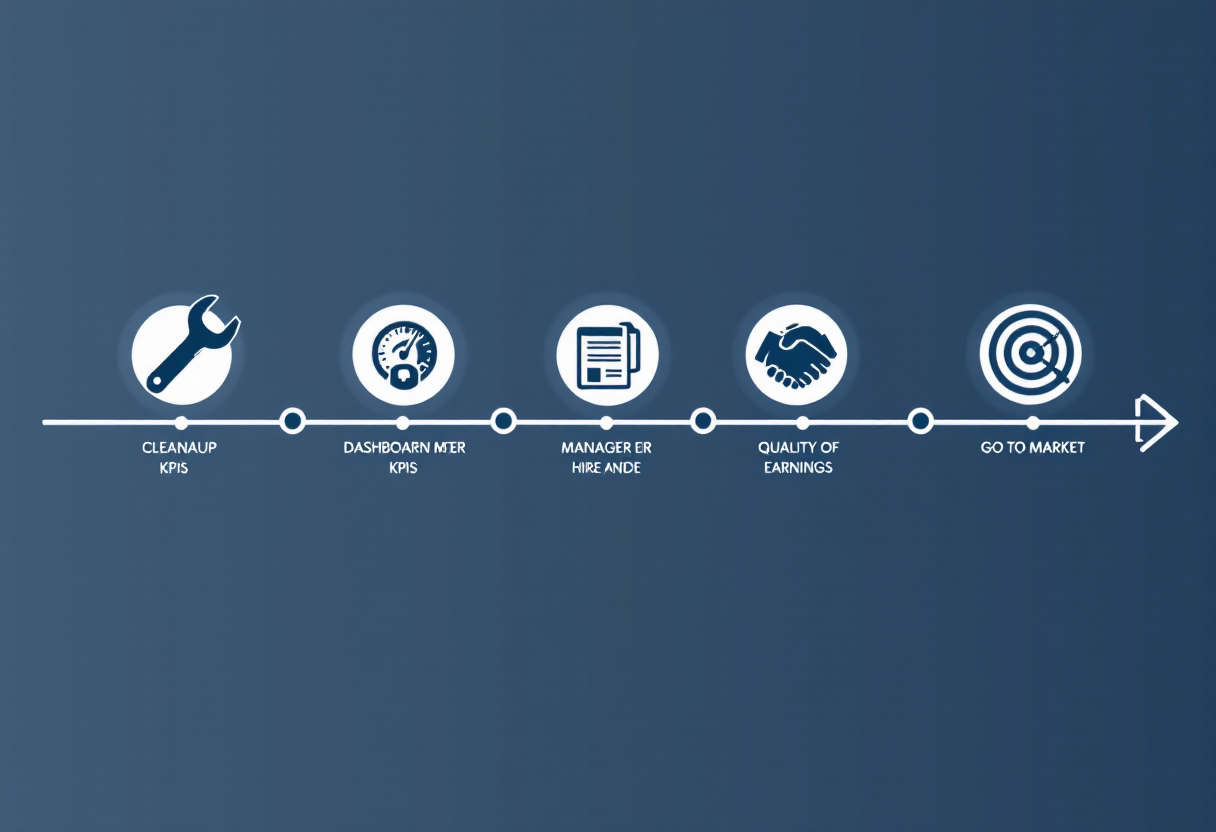
T-36 months: Cleanup phase
- Switch to accrual basis if still on cash basis
- Adopt or upgrade EHR (ChiroTouch, Genesis, ChiroFusion, or ChiroHD) with practice-management workflows that produce monthly reports
- Start tagging every potential EBITDA add-back as it happens
- W-2 / 1099 audit with focus on massage therapists, acupuncturists, and front desk
- Re-struck related-party rent to FMV with appraisal
- Build the org chart and identify the associate DC and GM hires
- PI lien aging audit and attorney-referral arrangement review for Anti-Kickback Statute compliance
- Run PECOS and OIG LEIE check on every DC and clinical staff member
- Begin sales-tax compliance review on supplement sales in every operating state
- Compliance audit on Medicare AT-modifier discipline, ABN file completeness, CMT documentation
T-24 months: Financial discipline and KPI infrastructure
- Associate DC hires onboarded; owner-DC visit share declining toward under 40% by end of period
- Monthly close in 15 days; service-line P&L every month
- KPI dashboard: new patients per month, conversion rate, average revenue per visit, visit count per DC per day, membership conversion rate, supplement attach rate, AR aging by payer, PI lien aging
- Launch or relaunch membership program if penetration is under 30%, targeting 35% to 50% recurring by close
- Pricing review: 5% to 10% list increase on cash services, 4% to 6% on chargemaster
- Begin payer-mix diversification: re-credential with under-represented carriers; grow cash mix via membership and modality cross-sell
- Document SOPs for clinical and back-office workflows
- Build the add-back bridge as a living document
T-12 months: QoE-ready close discipline, eliminate owner dependence
- Owner-DC steps out of full clinical schedule; visit share under 30%
- Owner takes a 2-week unplugged vacation as the stress test
- Run the sell-side QoE (budget $40K to $80K typical for chiropractic)
- Tighten balance sheet: clean AR, write off uncollectible PI liens, isolate deferred revenue on pre-paid plans
- Final compliance scrub: PECOS, LEIE, AT-modifier audit on 30 random Medicare visits, ABN file completeness, X-ray license current in every state
- Final non-compete review for every DC and associate with state-by-state enforceability check post-FTC vacatur (Sept 5, 2025)
- Lock in 12 months of clean service-line P&L for the CIM
T-6 months: Pre-marketing prep
- Engage M&A advisor or chiropractic-specialist broker. Options include Progressive Practice Sales (300+ chiropractic sales completed, 80% to 85% close rate per their public stats), Strategic Chiropractor (Dr. Tom Necela, Certified Business Broker), ChiroEquity (Dr. Greg Kingsbury). For $5M+ EBITDA platform-tier deals: healthcare-focused sell-side investment banks like Generational Group (advised Health Quest Chiropractic in the 2024 CHP deal) and Founders Advisors (advised ChiroHD on the Mainsail $26M growth round). Typical fee structure: success fee 5% to 10% Lehman scaling on smaller deals; modified Lehman on $5M+ EBITDA platform deals
- CIM drafted from QoE and operating model
- Teaser drafted (anonymized 1-pager)
- Buyer list finalized. At least 25 named acquirers to target depending on profile: franchise platform candidates (The Joint Chiropractic, HealthSource, 100% Chiropractic, MaxLiving, AlignLife); PE-backed MSO candidates (Chiropractic Health Partners, Champion Wellness Centers, Chiro One); integrated spine, PT, IPM acquirers (Trive Capital iRISE, Thrive Physical Therapy Partners, RxWellness Spine & Health); cross-vertical PE sponsors (Mainsail Partners, Red Iron Group, Franworth, Vistria Group, Apax / BCI, KKR)
- Virtual data room populated with everything from the pre-LOI and confirmatory sections above
- Management presentation deck built and rehearsed
T-3 months: Go to market
- Teaser distributed; NDAs collected; CIMs distributed
- IOIs collected 2 to 3 weeks after CIM goes out
- Narrow to 3 to 5 finalists for management meetings
- Management meetings; LOIs solicited
- Select LOI; sign with exclusivity (typically 45 to 90 days)
- Enter confirmatory diligence; close
End-to-end from engagement to close: 12 to 18 months in a well-run chiropractic practice sale per IBBA chiropractic broker stats (Crystal Misenheimer / IBBA Platinum Chairman’s Circle 2023; Strategic Chiropractor and Progressive Practice Sales process content).
Frequently Asked Questions
How long should I plan for before selling my chiropractic practice to a PE firm, franchise platform, or MSO?
The owners who get top-quartile pricing start preparing 24 to 36 months before going to market. The minimum useful prep window is 12 months, because most of the highest-impact levers (lifting care plan and membership penetration from under 15% to 35%+, installing associate DCs and moving the owner-DC out of the chair, getting clean on Medicare AT-modifier and ABN compliance, running a sell-side QoE) need 12+ months of clean trailing-twelve-months data to be credible to a buyer. Chiropractors who try to sell in under 6 months typically leave 20% to 40% of enterprise value on the table.
What is a realistic EBITDA multiple for a $1M EBITDA chiropractic practice in 2026?
For a $1M EBITDA chiropractic practice in 2026, the range is 4.0x to 6.0x EBITDA assuming multi-doc and 30%+ recurring revenue (Sofer Advisors Medical Practice Valuation Multiples 2025 to 2026; Arrowfish Consulting 2026; cross-source synthesis with PitchBook Champion Wellness Centers comparables). The bottom of that range applies to owner-DC-dependent practices with under 15% recurring revenue, insurance-heavy mix, and concentrated payer base. The top applies to practices with 35%+ recurring, 40%+ cash mix, associate DCs handling 60%+ of visits, and top-payer concentration under 20%. The 36-month prep playbook moves you from the bottom of the band to the top. For context, single-doc owner-dependent practices under $500K EBITDA trade at 2.0x to 3.0x EBITDA (or use SDE at 1.75x to 2.27x per Peak Business Valuation chiropractic 2025 to 2026).
Should I get a quality of earnings report done before going to market?
For chiropractic practices at $500K+ EBITDA, yes. A sell-side QoE costs $25K to $50K for a single-location practice under $5M revenue, $40K to $80K for a multi-location practice with multiple service lines, and up to $150K for integrated DC + PT + MD structures (Eton Venture Services QoE Cost guide 2025; SovDoc Healthcare QoE 2025; DueDilio 2025). The ROI math is straightforward. If your QoE supports a 1x multiple uplift on a $1.2M EBITDA practice at a 4x baseline, that is $1.2M of additional sale price for a $50K investment. More importantly, a pre-market QoE surfaces pre-paid plan revenue recognition issues, PI lien aging, owner-DC comp re-leveling, and sales-tax exposure on supplements while you can still fix them, rather than during exclusivity when the buyer re-trades the deal.
What percentage of care plan and membership revenue do PE and MSO buyers want to see?
35% or higher recurring revenue from pre-paid care plans and monthly memberships is the threshold that moves your practice from base multiples into premium multiples. Under 15% recurring is the baseline (pay-per-visit demand model) and trades at the bottom of the band. 35% to 55% recurring is the target for a competitive PE process. Tiered plans benchmark at $99 to $135 per month for maintenance (2 adjustments), $150 to $200 per month for wellness (4 adjustments plus therapy), and $250 to $350 per month for performance tiers (unlimited adjustments plus premium services) per PatientPayments 2026. Estimate +1.0x to 2.5x EBITDA multiple uplift on a 35%+ recurring practice vs. a demand-only practice (synthesized from ChiroSpring, MyZHealth, and PatientPayments subscription content cross-referenced to recurring-revenue deltas in HVAC and dental).
Do I need to put a general manager or associate DC bench in place before I sell?
If your goal is to maximize price, yes, ideally 12 to 18 months pre-sale. Owner-DC dependence is the most-cited multiple haircut in chiropractic valuation literature (Strategic Chiropractor 2025; Progressive Practice Sales 2025; Eton chiropractic valuation guide). On a $500K to $1.5M EBITDA practice, eliminating key-person risk by moving the owner-DC out of the chair shifts the multiple from the 2.5x to 3.5x band into the 4x to 6x band, worth $750K to $3.75M of price. An associate DC hire runs $80K to $130K base plus 25% to 35% of personal collections (Chiro Match Makers 2024; Chiro Jobs 2025) and needs 12 to 18 months to fully take clinical load before the buyer’s diligence team will believe the transition. In a chiropractic shortage market (52% of small-business chiropractic owners reporting hiring difficulty per Chiro Match Makers 2024), allow extra time to recruit and retain.
Should I sell my practice’s real estate with the business or hold it back?
Holding the real estate separately is usually the higher-value path. Move it into a separate LLC at fair market value triple-net rent to the operating company. This often lifts the implied EBITDA multiple on the operating business by 0.5x to 1.0x because the buyer is not forced to underwrite real estate exposure (Plante Moran sale-leaseback primer 2023; Northmarq sale-leaseback guide; W.P. Carey sale-leaseback content). You then have three options at close: assign the lease to the buyer, sell the real estate to the buyer at appraised value, or execute a sale-leaseback with a triple-net REIT investor at the same time as the operating company sale. The sale-leaseback path can convert up to 100% of property market value as cash, vs. 70% to 80% LTV via traditional refinancing.
What to Do Next
The chiropractic owners who get the top-quartile multiple all do the same three things. They start preparing 24 to 36 months before they want to be out. They lift care plan and membership penetration above 35% of revenue and move the owner-DC out of the chair into a GM role 12+ months pre-sale. And they invest in a sell-side QoE before any buyer sees a CIM.
The buyer universe is real but tighter than dental or vet, so profile differentiation matters more in chiropractic than in many other healthcare verticals. A multi-doc practice in Florida or Texas with 40%+ recurring revenue, 40% to 70% cash mix, clean Medicare AT-modifier and ABN files, and a documented PI lien aging report will see a competitive process from PE-backed MSOs (Champion Wellness Centers, Chiropractic Health Partners, Chiro One) and franchise platforms (HealthSource, 100% Chiropractic). A single-doc owner-dependent insurance-heavy practice with messy PI liens and no membership program will struggle to clear 2.5x EBITDA, regardless of headline revenue.
If you are 12+ months from a potential exit and want a structured pre-sale optimization roadmap, CT Acquisitions works with chiropractic operations specialists in our partner network who run multi-quarter prep engagements focused on the 13 levers above. If you are 6 to 12 months out and ready to start the sell-side process, our M&A advisory team runs the buyer outreach. No fee to you on buy-side introductions; sell-side mandates are paid on success at closing. Either way, the first 30 minutes are free.
Ready to talk?
Schedule a 30-minute exit-readiness call
Or read more: Healthcare Business Valuation Guide | Dental DSO PE Roll-Up Tracker 2026 | Buying a Healthcare Business (buyer’s playbook)
Ready to Explore Your Options?
A 30-minute confidential conversation is all it takes.