
How to Prepare Your Insurance Agency for a Sale or Exit in 2026: The 36-Month Consolidator Playbook
Preparing your insurance agency for exit in 2026 is a 36-month playbook, and the aggregator cycle is deep enough that the buyer set (Acrisure, Hub, Inszone, Risk Strategies) changes materially every quarter. The first 12 months tighten the operating story around book retention and carrier diversification, the middle 12 fix pre-LOI diligence gaps around producer non-competes and E&O history, and the final 12 turn one offer into a real competitive process.
Exiting your insurance agency business is the single largest financial event most owners will ever face. This guide is the no-fluff playbook for insurance agency owners who are 12-36 months from sale, covering how PE-backed buyers actually value your business in 2026, the 12 levers that move your multiple, pre-LOI diligence, deal-killers to fix before going to market, and the full 36-month exit prep timeline.
Updated April 2026 · CT Acquisitions

Most insurance agency owners decide to sell, hire a broker, and find out 90 days later that their agency is worth 35% less than they thought. The owners who get the top-quartile price start preparing 24 to 36 months before they ever talk to a buyer. This guide is the 36-month playbook for how to prepare your insurance agency for a sale or exit. It covers what private equity actually buys, the 12 levers that move multiples, the documents PE will ask for before they send an indication of interest, and the deal-killers that re-trade insurance brokerage transactions during confirmatory diligence. Every multiple and named buyer cites its source. Every recommendation comes from how the most active broker M&A buyers in 2026 actually behave.
If you are 6 to 36 months from a possible exit, this is the work that turns a 7x EBITDA outcome into an 11x EBITDA outcome. On a $2M EBITDA agency, that is the difference between a $14M sale and a $22M sale. Whether you want to prepare your insurance agency for a sale to a private-equity-backed broker platform, prepare your insurance agency for an exit to a strategic acquirer like Marsh McLennan Agency or Brown & Brown, or simply maximize value over the next 1 to 3 years before going to market, the work below applies.
Building toward an exit in 12 to 36 months?
CT Acquisitions runs sell-side advisory for insurance agency owners $1M+ EBITDA. We also have insurance brokerage operations specialists in our partner network who run pre-sale optimization engagements when the timeline is longer. No fee to you on buy-side introductions; sell-side mandates are paid on success at closing.
What Private Equity Actually Buys in Insurance Agencies (2026)
Insurance brokerage is the most active corner of financial services M&A in absolute deal volume. OPTIS Partners tracked 750 announced US and Canadian insurance brokerage transactions in 2024, 833 in 2023, and an all-time-record 1,036 in 2021, with PE-backed acquirers driving 70% of 2024 deal volume (OPTIS Partners 2024 Year-End Report, January 2025; OPTIS Partners 2023 Year-End Report). The top 10 buyers alone closed 358 of 750 deals in 2024, or roughly 48% of the market (OPTIS Partners 2024 Year-End Report). MarshBerry, Sica Fletcher, and Reagan Consulting tracked broadly the same trend with slightly different methodologies (MarshBerry “Counterpoint” monthly tracker; Sica Fletcher Agency & Broker Buyer Index Q3 2024; Reagan Consulting Value Index Q4 2024).
The headline anchor of the current cycle is Aon plc’s acquisition of NFP Corp for $13.4B (announced December 20, 2023; closed April 25, 2024), at roughly 3.7x trailing revenue and an estimated 15x EBITDA on $850M to $900M of disclosed EBITDA (Aon plc Form 8-K April 25, 2024; Reuters December 20, 2023). The sponsor money flowing in is not random. PE buys specific profiles, and the profile you build determines the multiple you get.
The PE-attractive insurance agency profile
- EBITDA threshold for a platform-quality deal: $1.5M to $3M is the entry band where sponsor-backed platforms run a competitive process. Below that, you are a tuck-in inside a regional roll-up. Above $5M, you become an attractive bolt-on for the larger platforms. Above $15M, you are a platform candidate yourself.
- Recurring renewal commission: 75% or higher of total commission revenue from renewals is the line between commodity and premium. Agencies below 60% renewal mix trade at 5x to 7x EBITDA. Agencies above 80% renewal trade at 10x to 13x EBITDA in the $3M to $10M EBITDA band (Reagan Consulting Q4 2024 Value Index).
- Book mix: Commercial-heavy P&C agencies trade 1.0x to 2.0x revenue higher than personal-lines-dominant peers. Specialty books (cyber, transportation, healthcare professional liability, construction, contract surety, MGA program business) command additional premium (MarshBerry Counterpoint; Sunbelt Network).
- Carrier mix: No single carrier above 25% of commission revenue. Top 3 carriers below 55%. Top-carrier concentration above 35% triggers buyer pushback and a 0.5x to 1.5x EBITDA multiple haircut (Reagan Consulting; MarshBerry).
- Producer depth: 5+ producers with documented book size, all on current non-piracy agreements. Top producer below 25% of agency revenue. Owner-producer below 10% of agency revenue.
- Owner role: Owner is in management, not the producer of record on the top 10 commercial accounts. Agency President or General Manager in place 12 to 24 months pre-sale.
Active insurance agency PE platforms in 2026
The list below covers the most active sponsor-backed insurance brokerage platforms in the 2024 to 2026 cycle. This is who will see your teaser. Add-on counts are point-in-time and shift weekly; sources include OPTIS Partners 2024 Year-End Report top buyer rankings, MarshBerry Counterpoint, Insurance Journal weekly M&A column, Business Insurance, sponsor press releases, and SEC filings.
| Platform | Sponsor | Profile |
|---|---|---|
| Hub International | Hellman & Friedman (lead), Leonard Green, Altas Partners, ADIA, GIC | 60+ add-ons in 2024 per OPTIS; ~$5B revenue 2024; valued at ~$23B in April 2023 secondary; $2M to $50M target revenue |
| Acrisure | Stone Point, BDT Capital, BlackRock, Guggenheim Investments | 50+ add-ons in 2024 per OPTIS; ~$5B revenue 2024; $32B valuation on Nov 2024 capital raise; $1M to $100M target revenue |
| BroadStreet Partners | Century Equity Partners, Penfund, OTPP, NSI | 30+ partner additions 2024 to 2025; national US, expanding; $3M to $25M target revenue |
| AssuredPartners | GTCR + Apax Partners (Aug 2024 recap at ~$15B); acquired by Arthur J. Gallagher April 2025 at $13.45B EV | 30+ add-ons in 2024; $2.4B revenue at recap; $2M to $40M target revenue |
| Alera Group | Genstar Capital (lead), Flexpoint Ford | 20+ add-ons in 2024; founded 2017 as 24-agency rollup; ~$1.1B+ revenue; $2M to $30M target revenue |
| Risk Strategies | Kelso & Company (lead), Aquiline Capital | 25+ add-ons in 2024; ~$1.2B revenue 2024; $1M to $30M target revenue |
| World Insurance Associates | Charlesbank Capital Partners, Goldman Sachs Asset Management | 60+ add-ons in 2024; consistent top OPTIS buyer 2020 to 2024; $500K to $20M target revenue |
| Hilb Group | Carlyle (lead, April 2024 recap from BDT/MSD) | 25+ add-ons in 2024; ~$3B reported EV on Carlyle recap; Eastern US; $1M to $25M target revenue |
| Patriot Growth Insurance Services | GTCR (recap 2023), Summit Partners (earlier) | 20+ add-ons in 2024; national US; $1M to $20M target revenue |
| Foundation Risk Partners | Warburg Pincus (lead), Centerbridge Partners (Dec 2024 recap at ~$5B) | 30+ add-ons in 2024; national US; $1M to $25M target revenue |
| Higginbotham | Frontline Insurance, employee-owned, BDT (minority) | 15+ add-ons in 2024; ~$800M revenue; Texas-anchored, national; $1M to $30M target revenue |
| Inszone Insurance Services | BHMS Investments | 20+ add-ons in 2024; rapid serial acquirer; California-heavy, national; $500K to $15M target revenue |
| EPIC Insurance Brokers | Galway Holdings (Harvest Partners + Genstar + Onex) | 10+ add-ons in 2024; ~$700M revenue 2024; $2M to $30M target revenue |
| One80 Intermediaries | Aquiline Capital, Spectrum Equity, RedBird Capital | 15+ add-ons in 2024; specialty MGA and wholesale focus; $1M to $50M target revenue |
| Relation Insurance Services | Madison Dearborn Partners, Aquiline Capital | 15+ add-ons in 2024; national US; $1M to $20M target revenue |
| Oakbridge Insurance | Corsair Capital | 15+ add-ons in 2024; Southeast US; $1M to $15M target revenue |
Add to that list the strategic acquirers, who are sponsor-backed in capital structure but operate as platforms in their own right. Marsh McLennan Agency (NYSE: MMC) closed McGriff Insurance Services from Truist Insurance Holdings for $7.75B announced September 30, 2024 and closed November 15, 2024, at roughly 4.0x revenue on $1.9B McGriff revenue (Marsh McLennan press release September 30, 2024; Marsh McLennan Form 8-K November 15, 2024). MMC’s middle-market arm closed 11 additional acquisitions in calendar 2024. Arthur J. Gallagher (NYSE: AJG) announced 51 mergers and acquisitions in 2024 representing $1.7B in annualized revenue and agreed to acquire AssuredPartners for $13.45B (announced December 9, 2024; closed April 16, 2025), per Arthur J. Gallagher 2024 Form 10-K and Form 8-K. Brown & Brown (NYSE: BRO) closed 26 acquisitions in 2024 representing approximately $158M of annualized revenue (Brown & Brown 2024 Form 10-K). Ryan Specialty Holdings (NYSE: RYAN) acquired US Assure for ~$1.1B in October 2024 at roughly 4.7x revenue (Ryan Specialty Form 8-K October 2024). Aon plc (NYSE: AON) is the cycle anchor with the $13.4B NFP close. Truist Insurance Holdings itself was acquired by a Stone Point + Clayton Dubilier & Rice consortium in two stages for a $19.5B implied total EV by May 2024 (Truist Financial Form 8-K February 21, 2023 and May 6, 2024), the highest disclosed cycle multiple at ~5.7x revenue.
Insurance Agency Valuation Multiples in 2026 (What You Are Actually Worth)
The insurance brokerage M&A market uses two parallel multiples: a revenue multiple (more common in micro and small deals) and an EBITDA multiple (the standard for $1.5M+ EBITDA platform candidates). Both are heavily size-dependent and revenue-quality-dependent. Below is the 2026 range, cross-referenced from Reagan Consulting Q4 2024 Value Index, Sica Fletcher Agency Buyer Index Q3 2024, MarshBerry Counterpoint, Capstone Partners insurance brokerage reports, OPTIS Partners commentary, and Sunbelt Network.
SDE multiples (smaller, owner-producer agencies)
| Revenue band | Revenue multiple | SDE / EBITDA multiple |
|---|---|---|
| Sub-$500K commission revenue, owner-producer-dependent | 1.0x to 1.5x | 2.5x to 4.0x SDE (Sunbelt Network “How to Value an Insurance Agency” 2025; BizBuySell Insight Report Q4 2024) |
| $500K to $1M revenue, mixed book | 1.25x to 1.75x | 3.0x to 5.0x SDE (Reagan Consulting; Capital Resources 2025) |
| $1M to $3M revenue, owner-managed | 1.5x to 2.5x | 5.0x to 7.0x EBITDA (Sica Fletcher Q3 2024; OPTIS Partners) |
EBITDA multiples (PE-attractive size)
| EBITDA band | EBITDA multiple range | Revenue multiple equivalent |
|---|---|---|
| $1M to $3M EBITDA | 7.0x to 11.0x | 2.0x to 3.0x revenue |
| $3M to $10M EBITDA | 10.0x to 13.0x | 2.5x to 4.0x revenue |
| $10M to $25M EBITDA | 12.0x to 16.0x | 3.0x to 4.5x revenue |
| $25M+ EBITDA platform candidate | 14.0x to 18.0x | 3.5x to 5.0x revenue |
Source: Reagan Consulting Q4 2024 Value Index (median public broker EV ~12.6x EBITDA); Sica Fletcher Agency Buyer Index Q3 2024; MarshBerry Counterpoint; Capstone Partners insurance brokerage commentary; cross-referenced against named-transaction precedents below. Commercial-heavy P&C agencies and specialty platforms trade at the top of each band. Personal-lines-dominant agencies and generalist commercial books trade at the bottom.
Recent disclosed insurance brokerage transactions (2024-2025)
| Acquirer | Target | Date | Value | Implied multiple |
|---|---|---|---|---|
| Stone Point + CD&R | Truist Insurance Holdings (remaining 80%) | Closed May 6, 2024 | $15.5B for 80%; ~$19.5B implied total EV | ~5.7x revenue |
| Aon plc | NFP Corp | Closed April 25, 2024 | $13.4B | ~3.7x revenue / ~15x EBITDA (estimate on $850M-$900M EBITDA) |
| Arthur J. Gallagher | AssuredPartners | Announced Dec 9, 2024; closed April 16, 2025 | $13.45B | ~3.5x to 4.0x revenue |
| Marsh McLennan Agency | McGriff Insurance Services (from Truist Insurance Holdings) | Closed November 15, 2024 | $7.75B | ~4.0x revenue |
| Carlyle | Hilb Group (recap from BDT/MSD) | April 2024 | Reported ~$3B EV | ~7x revenue (estimate per Bloomberg) |
| Ryan Specialty Holdings | US Assure | October 2024 | ~$1.1B | ~4.7x revenue |
| Centerbridge Partners | Foundation Risk Partners (alongside Warburg Pincus) | December 2024 | ~$5B reported valuation | ~4.5x revenue (estimate) |
Sources: Aon plc Form 8-K April 25, 2024; Marsh McLennan Form 8-K November 15, 2024 and press release September 30, 2024; Arthur J. Gallagher Form 8-K December 9, 2024 and press release April 16, 2025; Truist Financial Form 8-K May 6, 2024; Carlyle press release April 2024 (Bloomberg April 2024 for EV estimate); Ryan Specialty Form 8-K October 2024; Centerbridge press release December 2024.
The 12 Value Levers That Move Your Multiple (Ranked by Impact)

These are the levers that move insurance agency multiples in the 24 months before a sale. Each one has a current state, a target state, and an estimated financial impact. The ordering is by dollar impact per unit of effort, based on cross-source synthesis from Reagan Consulting Q4 2024 Value Index, MarshBerry Counterpoint and M&A workshop content, OPTIS Partners commentary, Sica Fletcher Buyer Index, and Capstone Partners insurance brokerage reports.
Lever 1: Shift book mix toward commercial lines and specialty
Current: 60%+ personal lines revenue mix, generalist commercial. Target: 70%+ commercial lines, with a specialty niche representing 15%+ of revenue (cyber, transportation, healthcare professional liability, construction, contract surety, or MGA program business). Impact: Commercial-heavy agencies trade 1.0x to 2.0x revenue higher than personal-lines peers (MarshBerry Counterpoint; Sunbelt Network). Specialty books can lift the EBITDA multiple by 1x to 3x because they are harder to replicate and carry higher producer-retention barriers. The Ryan Specialty acquisition of US Assure at ~4.7x revenue (October 2024) anchors the specialty premium. How: Hire a producer with an existing commercial book (typical 2-year ramp); acquire a small commercial agency in a target specialty as a tuck-in; partner with a wholesaler or MGA in a specialty line to build expertise; redirect new-business commission incentive away from monoline personal lines.
Lever 2: Build renewal retention rate above 92%
Current: 82% to 87% annual retention rate on commercial book. Target: 92%+ annual retention. Impact: Each 1% of retention above 90% historically adds approximately 0.25x to the EBITDA multiple per Reagan Consulting Q4 2024 Value Index commentary. A move from 85% to 92% is worth ~1.75x EBITDA. On a $2M EBITDA agency that is $3.5M of incremental sale price. Retention is the underlying engine of broker valuations because it converts the commission book from an episodic asset into a forecastable annuity. How: Implement a retention scorecard per CSR and account manager; tighten the renewal review process to a 90-day pre-renewal touch on every commercial account; track and intervene on at-risk accounts using AMS data; build service-level agreements with the top 50 commercial accounts.
Lever 3: De-concentrate top carrier mix below 25%
Current: Top carrier represents 35%+ of commission revenue; top 3 carriers represent 70%+. Target: Top carrier below 25%; top 3 carriers below 55%. Impact: Carrier concentration above 35% triggers buyer pushback because the buyer’s platform may not hold that carrier’s appointment, or the platform may already be over-concentrated with that carrier. Some buyers walk if top carrier is above 40%. Estimated impact: removing top-carrier concentration from 40% to 25% can recover 0.5x to 1.0x EBITDA multiple (Reagan Consulting; MarshBerry talking points). How: Pursue appointment with 2 to 3 additional commercial carriers (the appointment process takes 6 to 18 months and typically requires demonstrating premium production capacity); proactively shift new business away from the top carrier even if the contingent contract is favorable; resist the natural pull toward the most generous contingent carrier when it creates concentration.
Lever 4: Move owner out of the producer-in-chief role
Current: Owner produces 30%+ of agency commission revenue; owner is the producer of record on top 10 commercial accounts; no Agency President or General Manager in place. Target: Owner produces under 10% of revenue; top 10 commercial accounts have been transitioned to other producers with documented handoff letters; Agency President or General Manager role separate from the owner-producer role and in seat 12 to 24 months pre-sale. Impact: Owner-producer concentration is the single most-cited deal-killer in insurance agency M&A per MarshBerry and OPTIS Partners commentary. On a $1.5M to $3M EBITDA agency, removing owner-producer risk moves the multiple from the 7x to 9x band into the 9x to 11x band, worth $3M to $6M of price. How: 18 to 24 months pre-sale, hire or promote an Agency President or General Manager at $200K to $350K plus bonus; transition the owner’s book to other producers with formal introduction letters to each account and joint meetings with the new producer; consider a perpetuation plan structure where the owner takes equity-equivalent compensation but transitions the production responsibility.
Lever 5: Update producer non-piracy and non-solicit agreements post-FTC ruling
Current: Producer contracts from 2010 to 2018 with non-competes that may or may not be enforceable in current operating states; some producers have no contract at all. Target: Every producer signed onto an updated 2025-compliant contract with non-piracy and non-solicit provisions tailored to each state’s current law, with consideration paid where state law requires it, and with confidentiality and trade-secret provisions enforceable independently of any non-compete. Impact: The FTC’s final rule banning most non-competes (effective September 4, 2024) was vacated nationwide by the US District Court for the Northern District of Texas on August 20, 2024 in Ryan LLC v. FTC; the 5th Circuit appeal was paused under the new administration in 2025 and the rule remains vacated as of May 2026 (FTC website; Ryan LLC v. FTC Case No. 3:24-cv-00986; Ogletree Deakins regulatory update 2025). Producer non-piracy and non-solicit agreements (distinct from non-competes) are generally more enforceable but still subject to state-specific limits. Weak or absent producer agreements can cut the multiple by 1x to 2x EBITDA or trigger 10% to 30% of purchase price held in escrow against book attrition. Books “rolling” with a departing producer at 30% to 70% attrition is a documented outcome when these agreements are missing (MarshBerry workshop content; OPTIS Partners commentary). How: Engage outside counsel specializing in insurance agency M&A and employment law in each state of operation; rewrite producer agreements with state-specific compliance; offer modest consideration ($1,000 to $10,000 retention payment) where state law requires it for enforceability; refresh all agreements within 12 months of going to market.
Lever 6: Stabilize and document contingent commission methodology
Current: Contingent commissions swing 50%+ year over year; no documentation of carrier-by-carrier methodology; buyer treats contingents as unreliable and may exclude them from core EBITDA entirely. Target: 3-year rolling average contingent commission with carrier-by-carrier reconciliation; documented methodology for each carrier; clear understanding of which contingents are profit-share based (most volatile) versus premium-volume based (most stable). Impact: Stabilizing contingent revenue can recover 0.5x to 1.0x of EBITDA multiple. On a $2M EBITDA agency that is $1M to $2M of incremental sale price. Contingent concentration above 60% on a single carrier creates additional single-carrier-risk discount. How: Build a carrier-by-carrier contingent schedule with formulas (typically Travelers, Hartford, Liberty Mutual, Chubb, CNA, Progressive, Nationwide, and regional carriers); smooth volatility by shifting business to carriers with premium-volume-based contingents; maintain loss-ratio discipline on profit-share carriers; reconcile contingent payments to 1099-MISC totals from each carrier annually.
Lever 7: Get on a top-tier agency management system
Current: Legacy AMS (older Vertafore products like Sagitta if not upgraded, in-house systems, or Excel-driven workflows); manual carrier downloads; no real-time policy data. Target: AMS360, Applied Epic, EZLynx, NowCerts, or HawkSoft running with automated carrier downloads, clean policy and customer data, and reportable book metrics on demand. Impact: Estimated +0.5x to 1.0x multiple uplift, driven mostly by the speed and credibility of data-room responses during diligence. PE platforms typically want acquired agencies on the same AMS as the rest of the portfolio. Hub International runs Applied Epic; Acrisure runs both AMS360 and Applied Epic; Brown & Brown runs Applied Epic. Most platforms will require AMS conversion within 6 to 18 months post-close. How: Migrate to AMS360 or Applied Epic at least 12 to 24 months before going to market; budget $50K to $200K for implementation depending on agency size; force adoption with month-end close discipline tied to AMS data; build commission revenue reporting by line, by carrier, and by producer straight out of the AMS.
Lever 8: EBITDA add-back hygiene specific to agencies
Current: Owner-producer commission is paid to the owner at a market commission rate or above; family members on payroll with unclear duties; related-party rent at above-FMV; personal expenses run through the business with no documentation. Target: Owner-producer commission restated to market level for the production-only portion; owner-executive comp restated to market for the management portion (typical breakout: $200K to $350K for principal management plus market commission on whatever book the owner actually produces); family payroll cleaned up; FMV rent appraisal on file. Impact: Every defensible dollar of adjusted EBITDA gets multiplied by the buyer’s multiple. On a 10x EBITDA multiple, $200K of clean add-backs equals $2M of sale price (Morgan & Westfield QoE guide). Common insurance agency add-backs that hold up in QoE include owner compensation above market, personal expenses through the business (auto, country club, family travel), related-party rent at above-FMV, one-time legal and professional fees, software conversion one-time costs (AMS migration), and one-time E&O claim deductible costs. Common add-backs that do not stick include producer comp paid to non-producing family members, contingent commissions that are abnormally high in a single year (buyer normalizes to a 3-year average), and phantom commissions on policies that have since cancelled. How: Adopt a monthly add-back log; document business purpose of every charge; obtain FMV rent appraisal if owner owns the real estate; reclassify family payroll where producers do not produce.
Lever 9: Working capital normalization with attention to premium trust
Current: Premium trust account commingled with operating cash; no monthly reconciliation; unearned commission on cancellations not tracked. Target: Premium trust account separately maintained and reconciled monthly to carrier statements; unearned commission liability tracked on the balance sheet; net working capital peg defensible based on a stable trailing 6 to 12 month average. Impact: State insurance laws require agency-bill premium to be held in a separate trust account, segregated from operating cash (Insurance Information Institute; NAIC Producer Licensing Model Act). The working capital peg is set off the trailing 6 to 12 months per BDO and Morgan & Westfield. A poorly managed premium trust can cost 2% to 5% of enterprise value at close, and a comingling issue can trigger a state insurance department inquiry that is fatal in confirmatory diligence. How: Establish a separate premium trust account at a bank that supports the use case; reconcile monthly to carrier statements; calculate unearned commission liability on agency-bill business not yet earned; engage outside accountant review at least annually.
Lever 10: Diversify producer base and document succession
Current: 1 or 2 producers control 60%+ of agency revenue; no documented succession plan; no producer development program. Target: 5+ producers with documented book size, all with current non-piracy agreements; producer development program that has graduated at least 1 new producer in the last 24 months; identified successors for any producer over age 60. Impact: Producer diversification is multiple-protective rather than multiple-expansive, but it eliminates 1x to 2x of key-person discount. If the top producer is age 60+ with no successor, no enforceable non-piracy agreement, and 25%+ of agency revenue, the buyer assumes the book “rolls” with the producer post-close (30% to 70% attrition over 24 months per MarshBerry workshop commentary). How: Hire 1 to 2 producers per year in the run-up; mentor existing CSRs into producer roles; document the book per producer monthly; establish a producer development comp structure that incentivizes book growth (typical commercial producer split is 40% to 50% on new business and 25% to 35% on renewals per Reagan Consulting compensation surveys).
Lever 11: Convert agency-bill to direct-bill where possible
Current: 60%+ of personal lines or small commercial book is agency-bill, requiring the agency to collect premium, hold in trust, and remit to the carrier. Target: 80%+ of personal lines and small commercial book is direct-bill (carrier bills client directly and remits commission to the agency). Impact: Direct-bill is operationally cleaner, eliminates premium trust risk, and reduces accounts receivable working capital tie-up. Most PE buyers prefer direct-bill heavy books because they integrate more cleanly into the platform’s billing and trust account infrastructure. Estimated impact: 0.25x to 0.5x EBITDA multiple uplift on personal-lines-heavy agencies. How: Work with carriers to convert eligible accounts to direct-bill at renewal; this is a 12 to 24 month transition that follows the renewal calendar; train CSRs on the conversion conversation with insureds.
Lever 12: Build out fee-based revenue from consultative services
Current: 100% commission-based revenue. Target: 5% to 15% of revenue from fee-based consulting (claims advocacy, risk management consulting, employee benefits broker-of-record fees for large accounts). Impact: Fee revenue trades at the same or higher multiple as commission revenue and is less subject to carrier commission-rate compression. Larger agencies (Marsh, Aon, Brown & Brown) have shifted toward fee-based revenue for this reason. Estimated impact: 0.25x to 0.75x EBITDA multiple uplift if fee revenue is meaningful (above 10% of total). How: Identify the largest 20 commercial accounts; propose a broker-of-record fee structure replacing commission for those accounts; document scope of services and SLAs; verify sales tax treatment of fees in operating states (Texas, Connecticut, and New York have specific rules, see deal-killer section).
Want to grow your business to maximize value before exiting?
We connect insurance agency owners with operations experts in our partner network who run 12 to 24 month pre-sale optimization engagements. The engagement pays for itself in incremental sale price.
What PE Asks Before They Send an LOI (The Pre-LOI Diligence Stack)
Before a PE-backed broker platform or strategic acquirer commits to a letter of intent, they ask for a focused diligence package. The list below is the standard pre-LOI ask for an insurance agency in CT Acquisitions’ pipeline, with vertical-specific items unique to brokerage on top of the universal financial-diligence core (Reagan Consulting Sell-Side Workshop; MarshBerry sell-side process guide; OPTIS Partners DD content; Capstone Partners broker DD frameworks).
1. Income statements for 2024, 2025, and the latest trailing twelve months
Why PE asks: They are building the LTM EBITDA they will multiply. For an insurance agency they specifically want to see commission revenue broken into new business commission, renewal commission, contingent commission, supplemental commission, and fee income. They will also separate premium volume from commission revenue because changes in carrier commission rates can mask underlying revenue trends.
How to prepare: Accrual-basis P&L by month for 36 months. Commission revenue by line of business (commercial P&C, personal P&C, life, accident and health, employee benefits). Reconcile to commission downloads from carriers via AMS360 or Applied Epic. Reconcile commission revenue to 1099-MISC totals from each carrier.
2. Balance sheet at the latest month
Why PE asks: To size the working capital peg and identify net debt. For agencies, the premium trust account (the segregated bank account holding client premiums collected agency-bill that are owed to carriers) is a critical balance sheet item that is NOT working capital and is NOT cash available to the seller. Unearned commission on cancellations is a debt-like item that comes out of purchase price.
How to prepare: Tie the balance sheet to the trial balance. Separate premium trust account from operating cash. Reconcile the premium trust account to carrier statements monthly. Calculate unearned commission liability on agency-bill business not yet earned.
3. Add-back estimates
Why PE asks: They want a preview of your adjusted EBITDA story before they sink diligence cost into the file. If your add-backs are aggressive or undocumented, they discount the rest of your numbers.
How to prepare: Build the bridge from book EBITDA to adjusted EBITDA, line by line, with documentation. Typical owner-producer comp restructuring of $400K to $1M in headline owner pay reduces to a market-rate producer of $150K to $250K plus a market-rate principal of $200K to $350K, generating $200K to $400K of clean add-back. See Lever 8 above for what holds up and what does not.
4. Anonymized employee roster (titles, start dates, pay, classification, designations)
Why PE asks: Producer retention is the single biggest risk in any insurance agency acquisition. The buyer wants to see producer tenure (target 5+ year average), book size per producer, commission split or compensation method per producer, whether each producer has a non-piracy and non-solicit agreement and when it was last updated, and whether any producer has an unvested deferred comp or phantom equity that could create retention or exit issues.
How to prepare: Roster columns should include role, hire date, classification (W-2 producer, 1099 producer, CSR, account manager, admin), commission split, book of business under management, line of business specialty, active non-compete and non-solicit (date signed, governing state), state licenses held by each producer, and designations held (CIC, CPCU, CISR, ARM, AAI, AINS). The book size per producer column is what the buyer reviews first.
5. Revenue breakdown by line of business, carrier mix, and producer mix
Why PE asks: Triple-axis view. Line-of-business mix tells them the multiple band (commercial P&C trades higher than personal lines; specialty trades higher than commercial). Carrier mix tells them concentration risk (top carrier above 35% of commission revenue signals a single-point-of-failure risk because that carrier can re-rate the agency’s commission schedule or cancel the appointment). Producer mix tells them book concentration (top producer above 25% of agency revenue means the buyer is paying for that producer’s relationships, not the agency).
How to prepare: Three exhibits. Exhibit A: commission revenue by line of business by year (2023, 2024, 2025, LTM). Exhibit B: commission revenue by carrier (top 10 by year). Exhibit C: commission revenue by producer (top 10 by year). Use AMS360 or Applied Epic reports; do not reconstruct from spreadsheets. Industry benchmark per MarshBerry: top 3 carriers typically represent 40% to 60% of commission revenue for healthy commercial agencies.
6. Customer concentration (top 10 commercial accounts)
Why PE asks: For commercial-heavy agencies, customer concentration is a deal-killer if a single account is above 10% of agency revenue. The buyer also wants to see average policy tenure of the top 10, lines placed for each (multi-line is sticky, monoline is at higher churn risk), the producer of record, and any pending RFP or renewal action by that client.
How to prepare: Top 10 commercial accounts by commission revenue trailing 12 months. For each: account name (anonymized for pre-LOI), industry, lines placed, total revenue contribution, percentage of agency revenue, producer of record, account inception date, last renewal date.
7. Recurring revenue snapshot (renewal commission run-rate, ARR analog)
Why PE asks: Insurance agencies have a built-in recurring revenue engine because most P&C and benefits policies renew annually. The buyer wants to see renewal commission as a percentage of total commission revenue (target 75%+ on commercial book), retention rate (target 90%+), and rolling 12-month run-rate of renewal commissions.
How to prepare: Renewal commission dollars trailing 12 months. Renewal retention rate calculation. New business commission as a separate line. Lost business (accounts cancelled or non-renewed) trailing 12 months, with reason codes if available.
8. Contingent and supplemental commission detail
Why PE asks: Contingents are the most volatile and most disputed line in agency EBITDA. They depend on book profitability, loss ratios, premium volume thresholds, and carrier-specific formulas. The buyer wants 3 to 5 years of contingent commission history by carrier, with calculation methodology, so they can normalize.
How to prepare: Carrier-by-carrier contingent schedule. For each: contingent contract terms, premium volume thresholds, loss ratio thresholds, profit-share percentages, actual contingent paid each year, and your loss ratio with that carrier each year. The 3-year average becomes the normalized contingent number used in EBITDA.
9. Five-year business plan
Why PE asks: PE underwrites a 5-year hold. They want to see your growth assumptions on organic new business growth, producer hiring plan, M&A pipeline if you have one, cross-sell opportunities into the book, and carrier appointment expansion.
How to prepare: Operating model with new business, renewal commission, contingent commission, fee income, producer comp, overhead, and EBITDA. Include producer hiring plan with payback period assumptions (typical new producer payback in commercial is 3 to 5 years per MarshBerry “Producer Production” research).
10. State licensing footprint and OFAC compliance
Why PE asks: Insurance is state-regulated, not federally regulated. The buyer wants to see the agency entity’s resident license, all non-resident state licenses, every producer’s resident and non-resident licenses, the agency’s appointment with each carrier in each state, surplus lines license status (if the agency writes E&S business), and the OFAC compliance program (required for any producer screening clients, and stricter for life and annuity producers under FinCEN AML rules).
How to prepare: State-by-state license inventory (agency plus each producer). Pull NIPR (National Insurance Producer Registry) reports for the agency and each producer. List of carrier appointments by state. Surplus lines license status. OFAC screening procedures documented.
Confirmatory Diligence (After You Sign the LOI)
Once an LOI is signed and exclusivity starts (typically 45 to 90 days per Colonnade Advisors podcast 020), the buyer runs five to seven parallel workstreams. Insurance agency deals tend to close faster than other verticals because the diligence stack is relatively standardized and the buyer universe is concentrated.
- Quality of Earnings (QoE). Outside accounting firm runs commission revenue cut-off testing, contingent commission normalization, addback validation, producer compensation analysis, and working capital trends. Cost paid by buyer for buy-side QoE: $50K to $250K typical for $1M to $10M EBITDA agency (Eton Venture Services 2025; CBIZ QoE practice; Riveron QoE practice).
- Commercial DD and customer concentration. Top 25 to 50 commercial account review. Calls with selected top clients (after disclosure to the seller). Contract review for any larger fee-based engagements. Cancellation analysis.
- Carrier appointment DD. Confirmation letters from each major carrier confirming the agency’s appointment in good standing. Review of any carrier watch or cancellation for cause history (this is a major deal-killer if present; see Deal-Killers section).
- Producer agreement DD. Every producer’s employment agreement, non-compete, non-piracy, non-solicit, and any deferred comp or phantom equity arrangement. Special attention to post-September 2024 enforceability in each operating state.
- Legal. Entity good standing in every state. State insurance department complaint history (NAIC CCSC plus state DOI lookups). Pending E&O claims (buyer obtains current loss run from agency’s E&O carrier). Litigation. Trademark and trade name issues. Real estate leases.
- HR and Payroll. W-2 versus 1099 producer classification (recurring issue in P&C agencies; IRS has tightened on producer classification, and DOL Independent Contractor Final Rule took effect March 11, 2024). I-9 compliance. Wage-and-hour exposure. Benefits and PTO accrual.
- Premium trust and fiduciary DD. Reconciliation of the premium trust account to carrier statements for 12 to 24 months. Any unrecorded liability for premium collected and not remitted. Any mishandling of return premium or commissions on cancellations.
- Tax. Federal, state income, state premium tax (where the agency self-procures), payroll, and sales tax on broker fees in states that tax insurance services (Texas Tax Code Section 151.0039; Connecticut; New York Tax Bulletin TB-ST-275).
Why You Should Pay for Your Own Quality of Earnings Before Going to Market
A sell-side QoE is your own outside accountant’s QoE, paid for by you, before you go to market. For an insurance agency it does four things: pre-empts the buyer’s QoE by getting to the adjusted EBITDA number first with documentation; surfaces contingent commission normalization issues you can address before the buyer sees them; validates producer compensation restructuring (especially owner-producer comp) so it survives the buyer’s QoE; documents premium trust account reconciliation and unearned commission liability, both of which buyer QoE teams scrutinize.
Cost
- $35K to $50K for a preliminary QoE if revenue is below $10M and books are relatively clean (Eton Venture Services 2025; Morgan & Westfield QoE guide).
- $50K to $90K typical range for a comprehensive sell-side QoE on a healthy agency with multiple lines of business, multiple carriers, and a meaningful contingent commission base (CBIZ QoE practice; Riveron QoE practice; Kahn Litwin Renza 2025).
- Up to $200K for agencies with complex add-backs, multiple entities, MGA or wholesale operations, or complicated producer comp structures (Eton 2025).
ROI
Example: $20M revenue, $4M EBITDA agency. Moving the multiple from 9x to 11x equals $8M of additional sale price. A $75K QoE investment that supports the 2x lift is over a 100x return (Eton Venture Services, “Quality of Earnings Report Cost”, 2025). Insurance-agency-specific example from OPTIS Partners workshop content: a $3M revenue commercial agency where the seller’s tax returns showed $700K EBITDA but undocumented owner add-backs and producer comp normalization were not built into the seller’s number. The sell-side QoE came back at $1.05M of supportable adjusted EBITDA. The owner went to market at $1.05M EBITDA and closed at $10.5M (10x) rather than the $5.6M (8x on $700K) the original number would have justified (OPTIS Partners workshop content; cross-referenced from Morgan & Westfield QoE case studies).
Deal-Killers That Re-Trade Insurance Agency Transactions (Avoid These)
These are the recurring kill-shots cited across insurance brokerage M&A advisory content, OPTIS Partners commentary, MarshBerry workshops, and confirmatory diligence checklists. Most are fixable in 12 to 24 months. None are fixable in 30 days.
1. Producer non-piracy and non-solicit not enforceable post-FTC ruling
The FTC’s final rule banning most non-competes (effective September 4, 2024) was vacated nationwide by the US District Court for the Northern District of Texas on August 20, 2024 in Ryan LLC v. FTC. The 5th Circuit appeal was paused under the new administration in 2025 and the rule remains vacated as of May 2026 (FTC website; Ryan LLC v. FTC Case No. 3:24-cv-00986; Ogletree Deakins regulatory update 2025). However, state-level non-compete restrictions have continued to tighten: California, Minnesota, North Dakota, and Oklahoma ban non-competes broadly; Colorado, Illinois, Maine, Maryland, Massachusetts, Nevada, New Hampshire, New Jersey, Oregon, Rhode Island, Virginia, and Washington have wage-threshold or other limits (Beck Reed Riden noncompete state survey 2025). If producer agreements are weak or absent, the buyer either walks, restructures the deal with 20% to 40% of purchase price held in escrow for 24 to 36 months pegged to book retention, or insists the seller refresh producer agreements pre-close (which creates awkward producer dynamics).
2. Carrier appointment cancellation or watch history
Each carrier issues an appointment to the agency that allows the agency to write business on behalf of that carrier. Cancellations for cause (as distinct from cancellations for non-production, which are routine) are major red flags. Examples that trigger appointment cancellations for cause: missed premium remittance, persistent loss-ratio overage, claims-handling complaints, undisclosed agency ownership changes, OFAC violations. The buyer requests a carrier confirmation letter from each major carrier in confirmatory DD. A cancellation for cause within 24 months of close, even if resolved, can trigger 0.5x to 1.5x EBITDA multiple haircut or buyer withdrawal. Active watch status (where the carrier has notified the agency of performance issues) is essentially fatal until cured.
3. E&O claims history and active litigation
Every agency’s E&O carrier issues a loss run showing claims history. The buyer reviews the trailing 5 years of claims, including settled claims, open claims, and reserves. Pattern claims (multiple failure-to-procure claims, multiple inadequate-coverage claims, multiple claims involving the same producer) signal systemic issues. Active E&O claims become an escrow item or a price reduction. The agency’s E&O policy will need to be replaced or tail purchased to cover the seller’s prior acts post-close (typically 3 to 7 year tail at $25K to $150K cost). Pattern claims can derail a deal entirely.
4. State insurance department complaints and examinations
Each state’s Department of Insurance maintains a public complaint history for licensed agencies. The buyer reviews this in confirmatory DD via NAIC’s Complaints Database (CCSC) and state DOI lookups. High complaint volumes, any market conduct examination findings, any unresolved consumer complaints, or any active investigations are deal-killers. Open investigations stop the deal until resolved. Recent market conduct findings (last 24 months) reduce price by 0.5x to 1.0x EBITDA multiple.
5. Producer license lapses or undisclosed disciplinary history
Every producer’s license must be current in every state where they write business. The buyer pulls NIPR records on each producer. Lapsed CE, undisclosed disciplinary actions (suspensions, revocations, fines), and undisclosed prior license terminations for cause all surface immediately. Lapsed CE for active producers is fixable but signals operational sloppiness. Undisclosed disciplinary history is a misrepresentation and a deal-killer.
6. OFAC and AML compliance gaps
Producers writing life and annuity business are subject to federal AML rules under FinCEN regulations (31 CFR 1025). Producers writing any business with any client are subject to OFAC sanctions screening. The buyer reviews OFAC screening procedures, AML training records (for life and annuity producers), and Suspicious Activity Report history. Absence of OFAC procedures is a finding that requires remediation pre-close. Documented AML gaps for life and annuity producers can result in fines that the buyer prices into the deal.
7. Sales tax exposure on broker fees in service-revenue states
A small number of states tax broker fees (separate from commissions) as a taxable service. Texas taxes insurance services under Tax Code Section 151.0039 (Texas Comptroller “Insurance Services” rulings). Connecticut taxes certain insurance-related fees. New York taxes certain consulting fees adjacent to insurance brokerage (NY Department of Taxation and Finance Tax Bulletin TB-ST-275). Multi-year sales tax exposure on undisclosed broker fee revenue becomes a holdback or escrow against past liabilities, and has killed multiple insurance agency deals at confirmatory.
8. W-2 versus 1099 producer misclassification
Many agencies historically treated producers as 1099 independent contractors. The IRS and DOL have tightened on producer classification in 2024 to 2025 (DOL final rule on independent contractor classification effective March 11, 2024). The IRS uses a 20-factor test; California’s AB-5 / Dynamex ABC test is stricter. 1099 producer classification can be defensible (especially for true independent producers with their own books, multiple carriers, and minimal supervision), but agencies that pay set commission splits, provide office space, supervise activity, and require exclusivity are at risk. Misclassification exposure typically becomes a per-producer escrow ($25K to $150K per producer) or a price reduction. In some cases the buyer requires the seller to reclassify all producers as W-2 before close, which creates payroll tax and producer compensation issues.
9. Premium trust account commingling or shortfall
State insurance laws require agency-bill premium to be held in a separate trust account, segregated from operating cash (Insurance Information Institute; NAIC Producer Licensing Model Act). Commingling is a state insurance department violation. A trust shortfall (premium collected but not remitted to carriers in a timely manner) is a fiduciary breach. Any commingling or shortfall surfaces in QoE and triggers state DOI inquiry concern. Significant shortfalls can result in license suspension. Deals do not close with active trust shortfalls.
10. Book roll risk from departing key producer
If the top producer is age 60+ with no succession plan, no enforceable non-piracy agreement, and 25%+ of agency revenue, the buyer assumes the book rolls with the producer post-close. Documented roll outcomes when a key producer departs: 30% to 70% of that producer’s book typically follows the producer over 24 months if non-piracy is unenforceable or absent (MarshBerry workshop commentary; OPTIS Partners commentary). Buyer response is either a 24 to 36 month earnout pegged to producer retention and book retention, a substantial purchase price reduction (15% to 30% off headline), or no deal.
11. Contingent commission concentration on a single carrier
If 60%+ of contingent commissions come from one carrier, the buyer treats those contingents as essentially a single-carrier earnings stream with concentration risk. The buyer may exclude or heavily discount that portion of contingent revenue in their adjusted EBITDA, with corresponding direct multiple impact (typically 0.5x to 1.5x EBITDA multiple haircut).
12. Unprofitable lines of business not separated for treatment
Some agencies carry lines (small subset of personal lines, small flood book, small life and annuity book) that lose money on a fully-allocated basis. If these lines are not separated and the buyer’s QoE catches it, the buyer reprices. Loss-making lines can be excluded from the deal (with the seller retaining or running off the book) or repriced into the purchase price.
The 36-Month Exit Prep Timeline
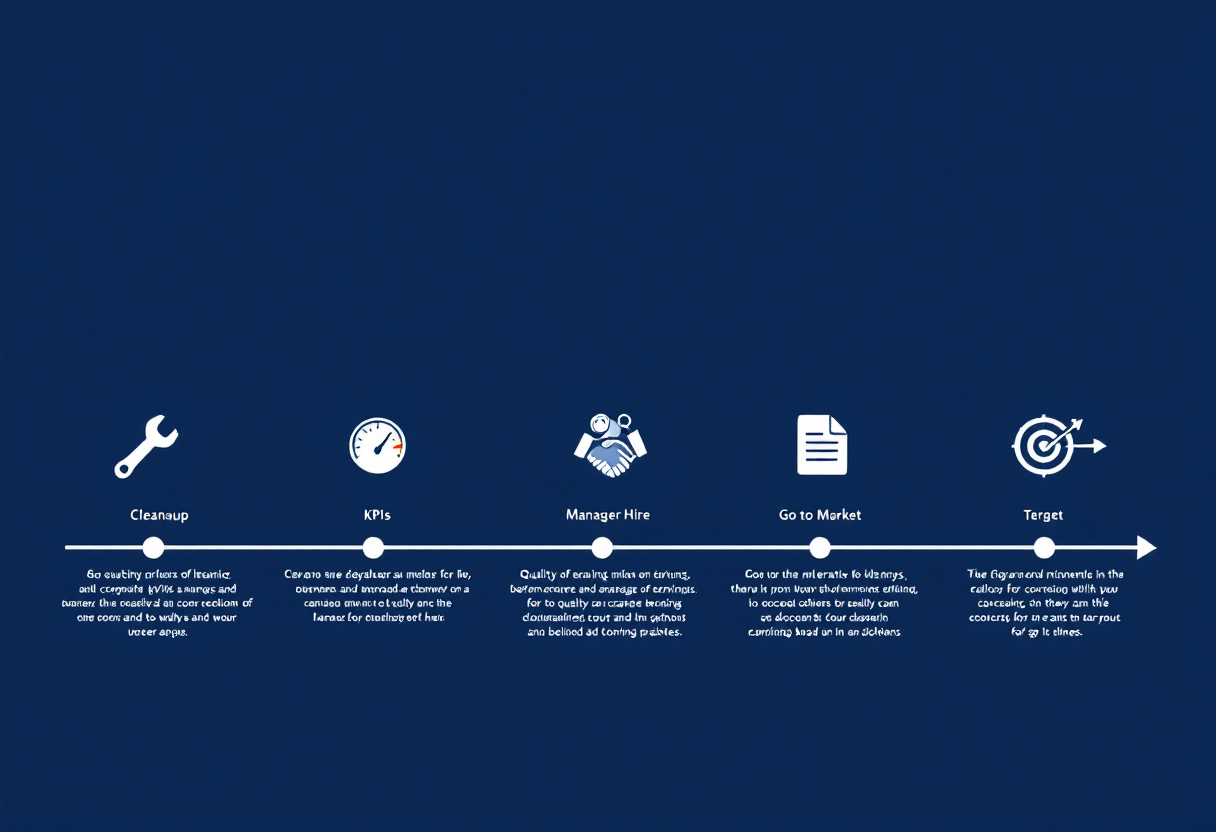
T-36 months: Cleanup phase
- Switch to a tier-1 AMS (AMS360, Applied Epic, EZLynx, NowCerts, or HawkSoft) if still on legacy or Excel-driven workflows
- Begin contingent commission methodology documentation by carrier
- Conduct W-2 versus 1099 producer classification audit; reclassify if needed (settle exposure now while it is small)
- Restructure related-party rent to FMV with appraisal
- Build the org chart and identify the Agency President or General Manager (internal promotion or external hire)
- License audit (NIPR) for agency and every producer in every state
- Begin EBITDA add-back log (monthly)
- Sales tax exposure review by outside counsel in operating states (especially TX, CT, NY)
T-24 months: Financial discipline and KPI infrastructure
- Agency President or GM hire onboarded; owner begins transitioning operational responsibility
- Monthly close in 15 days; commission revenue reporting by line of business, carrier, and producer
- KPI dashboard: retention rate, revenue per producer, revenue per employee, book size per producer, new business commission, contingent run-rate
- Producer agreement refresh: every producer signs onto updated 2025-compliant contracts with non-piracy and non-solicit provisions tailored to each operating state
- Begin carrier de-concentration if top carrier is above 35% (pursue 2 to 3 new appointments)
- Begin book mix shift toward commercial and specialty if personal-lines-heavy
- Owner begins transitioning top 10 commercial accounts to other producers (introduction letters, joint meetings, formal handoff)
- Document SOPs for every operational role
T-12 months: QoE-ready close discipline, eliminate owner dependence
- Owner produces under 10% of agency revenue; GM runs the shop
- Owner takes a 2-week unplugged vacation as the stress test
- Run the sell-side QoE (budget $50K to $90K)
- Tighten balance sheet: clean A/R, isolate premium trust, reconcile unearned commission liability
- Final compliance scrub (license, CE, OFAC, AML, E&O, state DOI complaint history)
- Lock in 12 months of clean commission revenue reporting by line, carrier, and producer for the CIM
- Pre-clear any open E&O claims; settle or document reserves
- Confirm carrier appointments in good standing (request confirmation letters from top 10 carriers)
T-6 months: Pre-marketing prep
- Engage an M&A advisor specializing in insurance brokerage (Reagan Consulting, MarshBerry, Sica Fletcher, OPTIS Partners, or Capstone Partners). Typical fee structure: $50K to $150K monthly retainer credited against success fee of 2% to 5% of enterprise value on platform deals, with Lehman or modified Lehman scaling
- CIM drafted from the QoE and operating model
- Teaser drafted (anonymized 1-pager)
- Buyer list finalized. Start with the 16 platforms in the PE table above (Hub, Acrisure, BroadStreet, AssuredPartners, Alera, Risk Strategies, World Insurance, Hilb, Patriot, Foundation Risk, Higginbotham, Inszone, EPIC, One80, Relation, Oakbridge), plus strategics Marsh McLennan Agency, Arthur J. Gallagher, Brown & Brown, and Ryan Specialty
- Virtual data room populated with everything from the pre-LOI and confirmatory sections above
- Management presentation deck built and rehearsed
T-3 months: Go to market
- Teaser distributed; NDAs collected; CIMs distributed
- IOIs collected 2 to 4 weeks after CIM goes out
- Narrow to 5 to 8 finalists for management meetings
- Management meetings; LOIs solicited
- Select LOI; sign with exclusivity (typically 60 to 90 days)
- Enter confirmatory diligence; close
End-to-end from engagement to close: 6 to 10 months in a well-run insurance agency process (MarshBerry M&A workshop content; Reagan Consulting Capital Workshop; OPTIS Partners sell-side commentary). Insurance brokerage deals tend to close faster than other verticals because the diligence stack is relatively standardized and the buyer universe is concentrated.
Frequently Asked Questions
How long should I plan for before selling my insurance agency to a private equity buyer or strategic broker?
The owners who get top-quartile pricing start preparing 24 to 36 months before going to market. The minimum useful prep window is 12 months, because most of the high-leverage levers (lifting renewal retention from 85% to 92%, installing an Agency President or General Manager, de-concentrating carrier mix, running a sell-side QoE) need 12+ months of clean trailing-twelve-months data to be credible to a buyer. Owners who try to sell in under 6 months typically leave 15% to 30% of enterprise value on the table because the multiple sits at the bottom of the band rather than the top. End-to-end from advisor engagement to close runs 6 to 10 months in a well-run insurance brokerage process per MarshBerry and Reagan Consulting workshop content.
What is a realistic EBITDA multiple for a $2M EBITDA insurance agency?
For an insurance agency at $2M EBITDA in 2026, the range is 7x to 11x EBITDA. The bottom of that range applies to personal-lines-heavy, owner-producer-dependent generalist agencies with weak producer contracts and concentrated carrier mix. The top applies to commercial-heavy agencies with 80%+ renewal commission mix, an Agency President in place, top carrier under 25%, top producer under 25%, and current producer non-piracy agreements (Reagan Consulting Q4 2024 Value Index; Sica Fletcher Agency Buyer Index Q3 2024; MarshBerry Counterpoint). For specialty agencies (cyber, transportation, healthcare professional liability, construction, MGA program business) the top end shifts higher because of the scarcity premium the Ryan Specialty acquisition of US Assure at 4.7x revenue helped establish in October 2024. The 36-month prep playbook moves you from the bottom of the band to the top.
Should I get a quality of earnings report done before going to market?
For insurance agencies at $1M+ EBITDA, yes. A sell-side QoE costs $35K to $90K for a typical agency, up to $200K for agencies with multiple entities, MGA operations, or complex producer comp (Eton Venture Services, 2025). The ROI is leverage. If your QoE supports a 1x to 2x multiple uplift on a $4M EBITDA agency at a 9x baseline, that is $4M to $8M of additional sale price for a $75K investment. More importantly, a pre-market QoE surfaces contingent commission normalization, owner-producer comp restructuring, premium trust reconciliation, and unearned commission liability issues while you can still fix them, rather than during exclusivity when the buyer re-trades the deal.
What percentage of recurring commission revenue do PE buyers want to see?
75% or higher of total commission revenue from renewals is the threshold that moves your agency from commodity into premium pricing on the commercial book. Reagan Consulting Q4 2024 Value Index commentary notes that each 1% of retention above 90% adds approximately 0.25x to the EBITDA multiple, and the difference between 60% and 85% recurring commission mix drives 1.0x to 2.0x EBITDA multiple by itself. On a $2M EBITDA agency that is $2M to $4M of incremental sale price purely from the renewal mix shift. The 92%+ retention target is the line where the platform buyers (Hub, Acrisure, AssuredPartners, MMC, AJG) compete most aggressively because the book becomes a forecastable annuity rather than an episodic asset.
Do I need to put an Agency President or General Manager in place before I sell?
If your goal is to maximize price, yes, ideally 12 to 24 months pre-sale. Owner-producer concentration is the single most-cited deal-killer in insurance agency M&A per MarshBerry and OPTIS Partners commentary. On a $1.5M to $3M EBITDA agency, eliminating owner-producer risk moves the multiple from the 7x to 9x band into the 9x to 11x band, worth $3M to $6M of price. An Agency President or General Manager hire runs $200K to $350K plus bonus and needs 12 to 18 months to fully take operational load before the buyer’s diligence team will believe the transition. During that window the owner should also transition the top 10 commercial accounts to other producers with formal handoff letters and joint meetings.
Should I refresh my producer non-piracy and non-solicit agreements before going to market?
Yes, within 12 months of going to market. The FTC’s non-compete rule was vacated nationwide by the US District Court for the Northern District of Texas on August 20, 2024 in Ryan LLC v. FTC, and the rule remains vacated as of May 2026 (Ogletree Deakins regulatory update 2025). However, state-level rules have tightened (California, Minnesota, North Dakota, and Oklahoma ban non-competes broadly; Colorado, Illinois, Massachusetts, Oregon, Virginia, Washington, and others impose wage-threshold limits per Beck Reed Riden noncompete state survey 2025). Producer non-piracy and non-solicit agreements (distinct from non-competes) remain generally enforceable but must be drafted to each state’s current law. Weak or absent producer agreements can cut the multiple by 1x to 2x EBITDA or trigger 10% to 30% of purchase price held in escrow against book attrition, because the buyer assumes 30% to 70% of a departing producer’s book rolls with the producer (MarshBerry workshop content; OPTIS Partners commentary). Engage outside counsel specializing in insurance agency M&A and employment law in each operating state; offer modest consideration ($1,000 to $10,000 retention payment) where state law requires it for enforceability.
What to Do Next
The insurance agency owners who get the top-quartile multiple all do the same three things. They start preparing 24 to 36 months before they want to be out. They put an Agency President or General Manager in place 12 to 24 months pre-sale and move the owner out of the producer-of-record role on the top accounts. And they invest in a sell-side QoE before any buyer sees a CIM, so the contingent commission methodology, owner-producer comp restructuring, premium trust reconciliation, and unearned commission liability are documented before the buyer’s QoE team can re-trade them.
The 2024 to 2026 cycle has been the most active in disclosed insurance brokerage transaction value since 2021. Aon plus NFP at $13.4B, Marsh McLennan plus McGriff at $7.75B, Arthur J. Gallagher plus AssuredPartners at $13.45B, and Stone Point plus CD&R plus Truist Insurance Holdings at $19.5B implied total EV form the anchors. Sixteen PE-backed platforms and four large public strategics are bidding concurrently on every quality middle-market agency. The buyer universe is concentrated and well-capitalized; the diligence stack is standardized. Your job in the 36 months before a sale is to give that buyer universe nothing to discount.
If you are 12+ months from a potential exit and want a structured pre-sale optimization roadmap, CT Acquisitions has insurance brokerage operations specialists in our partner network who run multi-quarter prep engagements covering producer agreement refresh, carrier de-concentration, AMS migration, contingent commission documentation, and Agency President search. If you are 6 to 12 months out and ready to start the sell-side process, our M&A advisory team runs the buyer outreach to the 16 PE platforms and the public strategics named above. No fee to you on buy-side introductions; sell-side mandates are paid on success at closing. Either way, the first 30 minutes are free.
Ready to talk?
Schedule a 30-minute exit-readiness call
Or read more: Sell Your Insurance Agency (active sale guide) | Sell Your Insurance Brokerage | Buying an Insurance Agency (buyer’s playbook)
Our national data on insurance agency valuation multiples shows what buyers actually pay by tier.
Ready to Explore Your Options?
A 30-minute confidential conversation is all it takes.
