How to Prepare Your Elevator Business for a Sale or Exit in 2026: The 36-Month PE-Buyer Playbook
Preparing your elevator business for exit in 2026 is a 36-month playbook, and the sector economics favor the prepared: recurring maintenance revenue is the value driver PE-backed elevator platforms underwrite hardest. The first 12 months tighten the operating story around maintenance-contract density, the middle 12 fix pre-LOI diligence gaps around technician licensing and safety records, and the final 12 turn one offer into a real competitive process.
Selling an elevator company is a sale of promises: monthly maintenance visits owed to building owners, safety tests owed to state inspectors, and the know-how of licensed mechanics who can keep a mix of equipment brands running. A buyer will put a price on those promises only when it can see them in writing and trust that they will be kept after the founder leaves. This playbook covers the three years before a sale, from building the contracted-unit schedule to choosing between a strategic and a private equity buyer.
Reviewed October 2026 · CT Acquisitions

The largest elevator companies in the world make most of their profit from servicing equipment that is already installed, and that is the business model a buyer wants to own when it looks at an independent. Otis reported in its fiscal 2025 annual report that service produced 65% of its net sales but 91% of its segment operating profit, at a 25.1% margin against 4.8% on new equipment. An independent with a dense, contracted maintenance base is a smaller version of that profit engine. An independent that lives on one-off repairs and installation work is something else, and a buyer will price it accordingly.
The difference between the two is rarely the quality of the mechanics. It is usually paperwork: whether contracts are written and current, whether each unit’s test history is on file, whether the state licence sits with someone who will stay, and whether the numbers separate maintenance from repair from modernization. Owners who fix those things before a buyer arrives sell on their own terms. Owners who fix them during diligence sell on the buyer’s.
Planning an elevator exit in the next three years?
CT Acquisitions advises founder-owned businesses on selling, buying and planning an exit. For elevator owners we start with the contracted-unit schedule and the licence position, then map the buyers that fit. No fee to you on buy-side introductions; sell-side mandates are paid on success at closing.
Why buyers want elevator maintenance portfolios
Elevators are regulated machines that building owners cannot legally run without periodic inspection and testing, and they cannot be serviced by just anyone. That combination of compulsory demand and restricted supply is the reason maintenance contracts trade at a premium to most other building services.
The economics at the top of the industry show where the value sits. Otis’s fiscal 2025 annual report puts total net sales at $14,431 million, of which service accounted for $9,442 million. The company maintains about 2.5 million units around the world, and that figure includes equipment built by other manufacturers. It employs about 37,000 service mechanics out of roughly 72,000 staff. KONE, the other large listed manufacturer, reported 2025 sales of EUR 11.2 billion and more than 60,000 employees. Both companies sell new elevators partly to win the decades of maintenance that follow.
For an independent, the lesson is that a buyer looks past your revenue line to three questions. How many units do you maintain under written contract? How profitable is each visit once mechanic time and travel are counted? How many of those units are old enough to need modernization in the next few years? Strategic buyers pay for units that fit their routes. Private equity platforms pay for a base they can grow by adding more independents. Both discount revenue that cannot be tied to a specific unit and a specific contract.
Mechanics are the constraint
The US Bureau of Labor Statistics counted 24,700 elevator and escalator installer and repairer jobs in 2025, with median pay of $109,910 in May 2025. It projects 6% growth from 2025 to 2035 and about 1,900 openings a year, most of them replacing people who retire or leave the trade. A mechanic takes years to train. The National Elevator Industry Educational Program runs four to five year apprenticeships that combine 2,000 hours of supervised work a year with classroom time, and apprentices become eligible for the mechanic exam only after finishing coursework and 8,000 working hours. Any buyer knows it cannot hire its way into a new territory quickly. Buying a company with a settled mechanic team is often the only practical way in, which is why your people are part of the price.
That scarcity shapes how buyers protect themselves. Expect requests for retention agreements with your most experienced mechanics and supervisors, sometimes funded partly from the purchase price, and for a list of who trained whom so the buyer can see how knowledge is spread across the team. Owners who have already put simple retention or bonus arrangements in place, documented pay progression and kept apprentices moving through training can show a buyer that the team is likely to stay. That evidence often matters more than any single financial ratio, because a maintenance portfolio without the mechanics to service it loses value quickly.
The buyers an independent elevator company will meet
Elevator buyers fall into three groups, and each reads the same company differently.
Manufacturers with service networks
Otis and KONE run large service businesses alongside their factories. A manufacturer buying an independent wants units in places where it already has mechanics, or a foothold in a city where it is thin. It will look closely at how many of your units run on its own equipment, which it can service with in-house parts and diagnostic tools, and how many run on competitors’ proprietary controllers, which may be harder for it to support. A manufacturer can often pay well for route fit, but it may plan to fold your brand and office into its own, which matters if you care about what happens to your team and name.
Private equity backed elevator platforms
Several sponsor-backed groups are building multi-state independents by acquisition. Specialized Elevator, based in Canton, Massachusetts, received a management recapitalization from Berkshire Partners in 2021, merged with 3Phase Elevator in January 2022, and now serves customers in 18 states and the District of Columbia, according to Berkshire. Axxiom Elevator, headquartered in Pompano Beach, Florida, appears in Gauge Capital’s portfolio and invites service companies to join its national network. Total Access Elevator, founded in 2008 in Santa Fe Springs, California, is a Century Park Capital Partners portfolio company focused on commercial modernization, maintenance and repair in Southern California. Platforms like these want maintenance density, modernization capability and a local management team that will stay. They often let the acquired company keep its name and ask the founder to roll part of the proceeds into the platform’s equity.
Independents and family buyers
Larger independents, regional groups and family offices also buy elevator companies, especially smaller ones that sit below a platform’s size threshold. These buyers usually pay with a mix of cash, seller notes and earn-outs, and they rely heavily on the seller staying through a transition. They can be the best fit for an owner who wants the business to stay local and independent.
Which group fits depends on your size, your geography and your equipment mix. A shop with most of its units on one manufacturer’s equipment in that manufacturer’s weak territory is a natural strategic target. A shop with mixed equipment, a good modernization team and an owner willing to stay on as a regional leader is a natural platform add-on. Knowing which story you are telling shapes how you prepare.
What makes an elevator maintenance contract valuable
Buyers rarely value an elevator company on headline maintenance revenue. They build a unit-by-unit picture, and every line in that picture depends on the type of contract behind it.
Contract scope
Full maintenance contracts that cover parts and labour for most components give the contractor steady revenue and control over the equipment, but they also carry the risk of expensive failures. Narrower contracts that cover examination, lubrication and minor adjustments leave major repairs billable, which can raise repair revenue but makes the monthly income less predictable. Buyers want to see each contract classified by scope, because a portfolio full of full-coverage contracts on ageing equipment can be a liability rather than an asset.
Term, renewal and termination
A written multi-year contract with automatic renewal and a clear notice window is worth more than a handshake arrangement or a month-to-month account. Check how many of your contracts are signed by the current building owner, because a building sale can void an old agreement. Check how many allow termination for convenience on short notice. A buyer will count units with weak termination terms at a discount or exclude them.
Price adjustment
Contracts that allow annual price increases tied to labour costs or an index protect the margin as mechanic wages rise. Contracts that have not been repriced in years, often for long-standing customers, depress the margin on the units the owner thinks of as the most loyal. A buyer will spot that pattern immediately in the per-unit data.
Equipment mix and age
Hydraulic and traction units, low-rise and high-rise, passenger and freight, escalators and platform lifts all carry different service time and parts costs. Ageing equipment is a double-edged sword: it is more expensive to maintain, but it is also the source of modernization projects. Buyers want each unit tagged with its type, manufacturer, controller and approximate installation year so they can forecast both maintenance cost and modernization opportunity.
Testing obligations
Most jurisdictions require periodic safety tests in addition to routine maintenance, and the contractor usually performs or witnesses them. A buyer will ask whether each test was done on time, whether the results were filed with the authority having jurisdiction, and whether any unit has outstanding violations. Missed tests and open violations transfer to the buyer as risk; a clean test record transfers as goodwill.
Licensing: a state-by-state issue that can stall a sale
The Bureau of Labor Statistics notes that most states require elevator workers to be licensed, and many also license the contracting business. The rules differ enough from state to state that a multi-state seller needs a licence map before it talks to buyers.
New York is a clear example of a two-level system. Section 952 of the New York Labor Law says a business may not do elevator and conveyance work, or hold itself out as an elevator contractor, without an elevator contractor’s licence. Mechanics need their own licence and must work for a licensed contractor or a public entity, and inspection work requires a separate inspection contractor’s licence. License holders must also make sure their employees and subcontractors comply. A buyer of a New York elevator company will check that the company’s contractor licence is current, that every mechanic doing the work is individually licensed, and that the licence will survive the change in ownership.
Texas runs its programme through the Texas Department of Licensing and Regulation under Chapter 754 of the Health and Safety Code and Chapter 74 of the Texas Administrative Code, title 16. TDLR registers elevator contractors and inspectors, and its registration materials address contractor insurance and the company’s responsible party. If the responsible party named on your registration is the owner who is leaving, the buyer will want a successor in place and accepted before closing.
California licenses elevator contractors under the Contractors State License Board’s C-11 classification, which covers fabricating, erecting, installing and repairing elevators, from sheave beams and motors to cabs, doors, controls and signal systems. California contractor licences depend on a qualifying individual, so the same succession question applies.
The common thread is that elevator licences tend to depend on a named person, whether that is a qualifier, a responsible party or a licensed mechanic. On a sale, the buyer’s lawyers will ask what happens to each licence if that person leaves, and whether a share sale keeps the licence intact or whether the buyer must apply in its own name. The answers differ by state and sometimes by city. Build a table listing every jurisdiction you work in, the licences held, the person each licence depends on, the renewal date and the successor. It is one of the most useful documents in an elevator data room.
Union shops and the 2027 bargaining calendar
Many elevator mechanics belong to the International Union of Elevator Constructors, which was founded in 1901 and says it has more than 30,000 members in the US and Canada. For a signatory company, the union relationship shapes wages, benefits, apprenticeship intake and how quickly a buyer can move mechanics between territories.
The bargaining calendar matters for timing. Otis disclosed in its fiscal 2025 annual report that about 64% of its US workforce is covered by a collective bargaining agreement, and that the agreement covering most of its US bargaining-unit employees was renewed in July 2022 and runs to July 2027. If your own labour agreement follows the same calendar, a sale that closes shortly before a new agreement is settled leaves the buyer uncertain about labour costs, and buyers price uncertainty. If your contracts let you pass wage increases through to customers, document it; it reassures a buyer that a new agreement will not squeeze the margin.
Signatory status also brings benefit plan questions. Contributions to multiemployer pension and welfare plans should be reconciled to payroll for every month in the diligence period, and the buyer’s advisers will ask about any withdrawal liability that could arise if the company ever leaves a plan. A share sale normally leaves the company’s participation unchanged; an asset sale needs careful handling so that it does not trigger a withdrawal. Get a plan statement and a withdrawal liability estimate early, so the number is known rather than discovered.
Non-union shops face a different question: whether a union-signatory buyer will want to organise or merge the workforce, and how mechanics will react to that prospect. Either way, a buyer will ask for a mechanic roster with licence status, tenure, pay and the equipment each person is trained on, so build it before you are asked.
Hydraulic units and environmental exposure
Older hydraulic elevators with in-ground cylinders can leak oil into the surrounding soil, and replacing a failed cylinder is one of the most expensive repairs a building owner faces. Buyers will ask how many hydraulic units in your portfolio still run on older in-ground cylinders, whether any have had leaks, who paid for clean-up, and whether your contracts make you responsible for cylinder failure. Full-coverage contracts that include cylinder replacement on old units can turn into a large liability for a new owner. Identify those contracts early and decide whether to reprice, exclude cylinders at renewal, or disclose the exposure clearly so it does not surprise a buyer.
Reading your own numbers the way an elevator buyer will
Buyers convert an elevator company into a handful of ratios within days of receiving the data. Calculating them yourself, a year or more before a sale, shows you where the price will be won or lost.
- Revenue per contracted unit per month. Total maintenance billing divided by units under contract. Compare it across customers and routes; a wide spread usually means old contracts that were never repriced.
- Units per mechanic. Contracted units divided by the mechanics assigned to maintenance routes. Too few units per mechanic means idle time or travel; too many means rushed visits and rising callbacks.
- Callbacks per unit. Unscheduled trouble calls in a year divided by units under contract. A rising rate tells a buyer the equipment is ageing faster than the maintenance programme is keeping up, or that visits are being skipped.
- Repair revenue per unit. Billable repair work generated by contracted units, divided by those units. It shows how much additional work the portfolio throws off.
- Renewal and loss rate. Units that renewed, units that were lost and the reason for each loss, by year. Buyers care as much about why units left as about how many did.
- Modernization conversion. Proposals issued, proposals won and the time from first conversation to signed contract.
- Gross margin by service line. Maintenance, repair, modernization and new installation each carry different margins, and a buyer values each stream separately.
None of these ratios needs specialist software, but all of them depend on recording visits, callbacks and invoices against a specific unit. That is why the field service system and the contracted-unit schedule come first in the timeline below.
Customer types and how buyers view each
Two elevator companies with the same revenue can attract very different offers because of who their customers are.
Property management firms
Management companies often control dozens of buildings and can move all of them to a competitor with one decision. They are valuable relationships, but they create concentration that is easy to miss when revenue is reported by building. Buyers will ask who signs each contract, whether a master agreement exists, and how long the relationship has lasted.
Hospitals and healthcare campuses
Healthcare buildings run elevators around the clock and cannot tolerate long outages, so they tend to buy full-coverage maintenance with fast response commitments. Those contracts are attractive, but they also require proof that the contractor can staff emergencies at any hour. Buyers will check how you meet response obligations and whether any penalty clauses apply.
Public agencies and housing authorities
Government work is usually won by bid, often carries prevailing wage requirements, and may require the agency’s consent before the contract can be assigned to a new owner. It can be steady, but buyers discount contracts that must be rebid soon or that cannot transfer without approval.
Condominiums and cooperatives
Residential boards change members regularly and may rebid contracts when a new board arrives. Long tenure with a building helps, but buyers know that board-run customers can be less predictable than institutional owners.
Commercial office and retail owners
Large owners may use national purchasing agreements and prefer suppliers with multi-state coverage. A platform buyer with national reach can sometimes keep or grow these accounts more easily than a local independent, which can work in your favour in negotiations.
Summarise your revenue by customer type, contract signatory and contract term. A buyer will build that table anyway; presenting it first lets you explain the story behind each group.
Escalators, accessibility lifts and other conveyances
Many elevator companies also service escalators, moving walks, wheelchair and platform lifts, dumbwaiters and material lifts. Each of these lines carries different value for a buyer.
Escalators in retail centres, airports and transit stations are labour-intensive and often covered by demanding response terms, but they produce steady maintenance and sizeable repair and modernization work. A team that can handle escalator step chains, handrails and comb plates is a scarce skill that buyers notice.
Accessibility lifts in homes, schools and small commercial buildings are smaller tickets with many more customers. Some states license this work separately: New York’s Labor Law section 952 requires accessibility lift technicians to hold their own licence and to work for a licensed elevator contractor or public entity. A large book of residential lifts can add useful recurring revenue, but buyers will want to see that visits are efficient and that warranty obligations on recent installations are understood.
Freight elevators, dumbwaiters and material lifts in industrial and hospitality settings tend to be older and harder on parts. They can be profitable if priced correctly, and they often lead to modernization work. Show each conveyance type separately in the contracted-unit schedule so a buyer can value them on their own terms rather than averaging them together.
The value levers that matter most in the 36 months before a sale
The items below are ordered roughly by how much they move a buyer’s view of an elevator company, starting with the maintenance base and ending with the tidy-up items that prevent late price cuts.
1. Convert repair customers into maintenance contracts
Every building you service on a call-out basis is a potential contract. Offer those customers a written maintenance agreement with a defined scope, a response time commitment and a test schedule. Even a modest conversion rate over two years changes the shape of your revenue from occasional to recurring, which is the single shift buyers reward most. Track the conversions by month so a buyer can see the trend, not just the end point.
2. Build route density
A mechanic who spends half the day driving between widely scattered buildings costs the same as one who walks between neighbouring towers but completes far fewer visits. Map every contracted unit and look for clusters. Price new contracts in dense areas competitively, and consider whether isolated accounts far from your routes are worth renewing at current prices. Buyers calculate units per mechanic and travel time per visit; improving both lifts the margin they will underwrite.
3. Track repair revenue by unit
Maintenance visits generate repair work: worn door operators, failing hydraulic seals, tired controllers. A buyer wants to see repair revenue tied to the contracted units that produced it, because that shows how much billable work the portfolio throws off each year. If your accounting system lumps all repairs together, start tagging repair invoices by unit now.
4. Document the modernization pipeline
Older units eventually need new controllers, door equipment, machines or complete modernization, and those projects are some of the most profitable work an elevator company does. Tag every unit you maintain with its likely modernization window and any code changes that might trigger work. A buyer will value a documented pipeline of proposals and building owner conversations far more than a general claim that “a lot of our units are old.”
5. Make the owner optional
In many independents the founder estimates modernization jobs, handles the largest customers, deals with inspectors and settles disputes with the union. A buyer sees that as key-person risk. Over the three years before a sale, put a general manager or operations lead in charge of daily decisions, delegate customer relationships to named account managers, and make sure inspectors and union representatives know who else to call. The goal is that a buyer can meet your team and see the business running without you in the room.
6. Install a field service system and a monthly close
Buyers trust data from systems more than data from spreadsheets. A field service management platform that records each visit, test and callback by unit lets you prove what a buyer would otherwise have to estimate. Pair it with a monthly accounting close that splits revenue and gross margin into maintenance, repair, modernization and new installation.
7. Reprice grandfathered contracts
Review contracts that have not had a price increase in years. Some customers will accept an increase tied to a clear explanation of rising labour and parts costs; others may leave. Either outcome helps: a repriced contract improves the margin, and an unprofitable contract that leaves frees mechanic time for better work. Do this early so the effect is visible in the trailing figures a buyer reviews.
8. Broaden mechanic skills across equipment brands
If only one or two mechanics can troubleshoot a particular manufacturer’s controller, those units depend on them. Rotate training so that more of your team can handle each major equipment type, and record who is qualified on what. A buyer will ask how many units would be at risk if a specific mechanic left, and you want the answer to be few.
9. Clean up the add-backs
Personal vehicles, family members on payroll, one-off legal costs and similar items inflate expenses and lower reported earnings. Buyers accept genuine add-backs if they are documented and consistent. Start separating personal and business costs at least two years before a sale, and keep a written schedule with invoices for every adjustment you plan to claim.
10. Understand prepaid maintenance and working capital
Many maintenance contracts are billed quarterly or annually in advance. That cash sits on your balance sheet as a liability until the service is delivered, and a buyer will expect the business to be handed over with enough working capital to cover the visits it still owes. Sellers who do not understand this can lose part of the price at closing. Calculate your deferred maintenance revenue each month and agree how it will be treated before you sign a letter of intent.
11. Decide on real estate
If you own the shop and yard in the same company as the operating business, decide whether to sell the property with the business, keep it and lease it to the buyer, or move it into a separate entity before the sale. Each option has tax and valuation consequences, and buyers want to know the plan early.
12. Close compliance gaps
Review licences, insurance certificates, safety training records, injury logs, permits for any hoisting work and the status of every unit’s required tests. Fix what you can before a buyer finds it. A clean compliance file shortens diligence and reduces the indemnities a buyer will ask for.
Want help sequencing the preparation work?
We help elevator owners decide which of these levers to pull first, given their timeline and the buyers most likely to fit, and we can introduce operating specialists for longer preparation projects.
The information pack a buyer expects before making an offer
Before a serious buyer puts a price in writing, it will ask for a set of documents. Having them ready speeds the process and signals that the business is well run.
Three years of financial statements
Income statements and balance sheets for the last two full years and the trailing twelve months, prepared consistently. Show revenue and gross margin split by maintenance, repair, modernization and new installation. If your accountant prepares statements on a cash basis, consider moving to accrual reporting well before the sale, because buyers measure earnings on that basis.
An adjusted earnings bridge
A schedule that starts with reported profit and walks to the adjusted figure, with every add-back explained and documented. Buyers will test it line by line.
The contracted-unit schedule
The most important document in an elevator sale. For every unit under contract, list the building, address, customer, equipment type, manufacturer, controller, installation year if known, contract scope, monthly or annual price, start date, renewal date, notice period, last price increase, last periodic test, any open violations and the mechanic or route assigned. Totals by customer, by route and by equipment type let a buyer see concentration and density at a glance.
Modernization pipeline
Each open proposal and each unit flagged for future work, with estimated value, timing and the customer’s stage of decision.
Employee roster
Names removed, with role, hire date, pay, licence status, union status, training on each equipment type and any non-compete or retention agreements.
Licence and insurance map
Every licence and registration by jurisdiction, the person it depends on, its renewal date and the planned successor, plus current insurance policies and five years of claims history.
Fleet and equipment
Vehicles, tools and test equipment, owned or leased, with age and replacement plans.
Forward plan
A realistic plan for the next three to five years covering contract growth, modernization conversion, hiring and pricing. Buyers do not expect a seller to be exact, but they do want to see that the owner understands what drives the business.
What happens after a letter of intent
Once a letter of intent is signed and exclusivity begins, the buyer’s advisers test everything in the information pack. In an elevator deal that usually means:
- Sampling contracted units and matching them to signed contracts, invoices and visit records in the field service system.
- Calling a selection of major customers, often with the seller’s agreement, to confirm the relationship and the likelihood of renewal.
- Reviewing test and inspection records for a sample of units, and checking public records for open violations where the jurisdiction publishes them.
- Confirming each licence and registration with the issuing authority and reviewing what is needed to keep it after the change of ownership.
- Reconciling union benefit contributions to payroll and obtaining withdrawal liability estimates where relevant.
- Reviewing insurance claims, injury logs and any litigation involving entrapments, falls or equipment failures.
- Testing deferred revenue, work in progress on modernization jobs and the working capital the buyer expects at closing.
- Reviewing sales and use tax treatment of maintenance and repair invoices in each state where you work.
Each issue found here becomes either a price adjustment, a special indemnity or a closing condition. The more of them you resolve beforehand, the closer the final price stays to the number in the letter of intent.
Exclusivity also changes the balance of power. Once you have stopped talking to other buyers, every issue found in diligence is negotiated with only one party at the table. That is the strongest reason to find and disclose problems yourself before signing: a known issue priced into the letter of intent costs less than the same issue discovered by the buyer’s accountants a month before closing.
Why a sell-side quality of earnings review pays off
A quality of earnings review commissioned by the seller, before going to market, puts an independent accountant’s view of your adjusted earnings in front of buyers from the start. In an elevator company it should cover the split between maintenance and other revenue, deferred maintenance revenue, the margin on modernization jobs under percentage-of-completion accounting, union benefit costs and the add-back schedule. Buyers will still run their own review, but a credible seller report narrows the areas they challenge and makes it harder to justify a late price reduction.
Issues that most often cut the price late in an elevator deal
- A large customer hidden inside a property manager. Twenty buildings may look like twenty customers until a buyer notices they are all managed by one firm under one master agreement. Group revenue by the party that signs and can terminate.
- Contracts that can be cancelled on short notice. Units on month-to-month or short-notice terms are counted at a discount, or not at all.
- A licence that depends on the departing owner. If the qualifying person leaves at closing and no successor is approved, the buyer may delay closing or hold back part of the price.
- Missed tests and open violations. These become the buyer’s problem after closing, so buyers price them in.
- One inspector or one mechanic who knows a key controller. Single points of failure on critical skills are treated as retention risk.
- Union and benefit plan surprises. Unreconciled contributions or an unexpected withdrawal liability estimate can move the price significantly.
- Proprietary equipment you cannot fully support. Units on controllers that need manufacturer diagnostic tools or parts you cannot readily obtain carry more risk for a buyer that also lacks access.
- Injury history. Falls in hoistways and entrapment claims draw scrutiny of training, procedures and insurance coverage.
- Sales tax on service invoices. States differ on whether elevator maintenance and repair are taxable, and uncollected tax becomes a liability in a share sale.
- Modernization revenue recognised too early. Long projects booked ahead of progress inflate earnings and get reversed in diligence.
New installation work: asset or distraction?
Installing new elevators brings in large contracts, but the margins are thin and the risks are real. Otis’s own fiscal 2025 figures show the gap: a 4.8% operating margin on new equipment against 25.1% on service. Manufacturers accept that because each new unit can become a maintenance contract for decades. An independent that installs equipment faces the same trade-off with less scale, plus bonding requirements, general contractor payment delays, liquidated damages for late completion and warranty obligations.
Buyers look at new installation through one lens: does it feed the maintenance base? If your installations reliably convert to maintenance contracts once the warranty period ends, show the conversion record unit by unit. If installation is a separate business that rarely produces service contracts, expect buyers to value it at a much lower multiple than maintenance, or to ask for it to be wound down before the sale. Either way, separate the two in your reporting, track installation jobs with proper percentage-of-completion accounting, and list any open warranty or punch-list obligations so a buyer can size them.
How code adoption feeds modernization demand
Elevator safety codes are revised periodically, and each state or city adopts new editions on its own timetable, sometimes with local amendments. Existing equipment is often allowed to continue under the rules in force when it was installed, but alterations, major repairs and modernizations usually have to meet the newer requirements. That link between code adoption and upgrade work is one reason modernization pipelines vary so much from one market to another.
For a seller, the practical step is to know which code editions apply in each jurisdiction you serve, which requirements are triggered when a unit is altered, and which of your customers’ units are likely to need upgrades in the next few years. Buyers will treat a pipeline grounded in specific code requirements and specific units as far more credible than a general expectation of future work. Where a jurisdiction is about to adopt a newer edition, note it in your forward plan and in the modernization schedule.
Telling employees and customers about a sale
Elevator companies are small worlds. Mechanics talk to each other across companies, and building managers talk to several contractors. News of a sale that leaks too early can unsettle both groups and invite competitors to approach your best people and customers.
Most sellers keep the process confidential until a letter of intent is signed, then bring in a small group of key managers who will help with diligence, often with retention bonuses that pay out after closing. Mechanics and customers usually hear the news close to or at closing, ideally from the owner and the buyer together, with a clear message about what will stay the same: the people on the route, the response commitments and the contract terms. If any contracts require customer consent to an assignment, plan those conversations with the buyer so that each customer hears a consistent story.
Comparing offers from different elevator buyers
When more than one buyer is interested, the headline price is only part of the comparison. Elevator deals vary widely in how the price is paid and what the seller commits to after closing.
- Cash at closing. Manufacturers and larger platforms often pay most of the price in cash. Smaller buyers may rely on seller notes or bank debt that depends on the business continuing to perform.
- Rollover equity. Platform buyers frequently ask the seller to reinvest part of the proceeds in the buyer’s holding company. That stake can be worth more later if the platform grows and sells, but it is illiquid and depends on decisions you no longer control. Ask how earlier sellers’ rollover stakes have performed and what rights the rollover shares carry.
- Earn-outs. Payments tied to future results, such as retaining contracted units or converting modernization proposals, shift risk to the seller. Define the measures precisely and make sure you keep enough influence over the business to meet them.
- Employment and transition. Buyers usually want the owner to stay for a period. Agree the role, the length, the pay and what happens if the buyer changes the business in ways that make the earn-out harder to reach.
- Non-compete scope. Elevator buyers will ask for a non-compete. Check the territory and duration, especially if you plan to stay in the industry in another form.
- Treatment of the team and the name. Some buyers keep the local brand and office; others integrate quickly. If your mechanics and customers matter to you, ask for specifics and, where possible, put them in the agreement.
Model each offer on an after-tax, risk-adjusted basis. A slightly lower offer with more cash at closing and a clear plan for your team can be worth more than a higher number built on earn-outs and rollover.
Safety record and insurance in an elevator sale
Elevator work involves hoistways, moving equipment and high-voltage controls, and buyers treat a company’s safety culture as part of its value. Expect requests for written safety procedures covering hoistway access, lockout and tagout, working on top of cars and in pits, and fall protection. Buyers will review injury logs, workers’ compensation claims and experience modification history, and they will ask how new mechanics and apprentices are supervised.
Insurance gets the same attention. Liability claims from entrapments, door strikes or falls can surface years after the event, so buyers want to see policy limits, deductibles, claims history and whether coverage is written on an occurrence or claims-made basis. If your policy is claims-made, discuss tail coverage before closing. Customers increasingly ask contractors for higher limits, and a buyer will want to know whether any major contract requires coverage you do not currently carry.
Tax structure for an elevator seller
The structure of the sale can change what you keep as much as the price does. Buyers often prefer to buy assets because they can depreciate the purchase price and leave behind historic liabilities. Sellers often prefer to sell shares because the gain may be taxed more favourably and the licences, contracts and union relationships stay with the company. In an elevator company the second argument is unusually strong, because licences and public contracts may not transfer easily in an asset deal.
Other issues to raise with your tax adviser early include whether the company is taxed as a C corporation or a pass-through entity, how rollover equity will be taxed, how an earn-out or seller note will be treated, how the price will be allocated among equipment, goodwill and non-compete payments, and whether state taxes differ across the states where you work. These decisions are much easier to shape before a letter of intent than during the drafting of the purchase agreement.
The 36-month exit preparation timeline
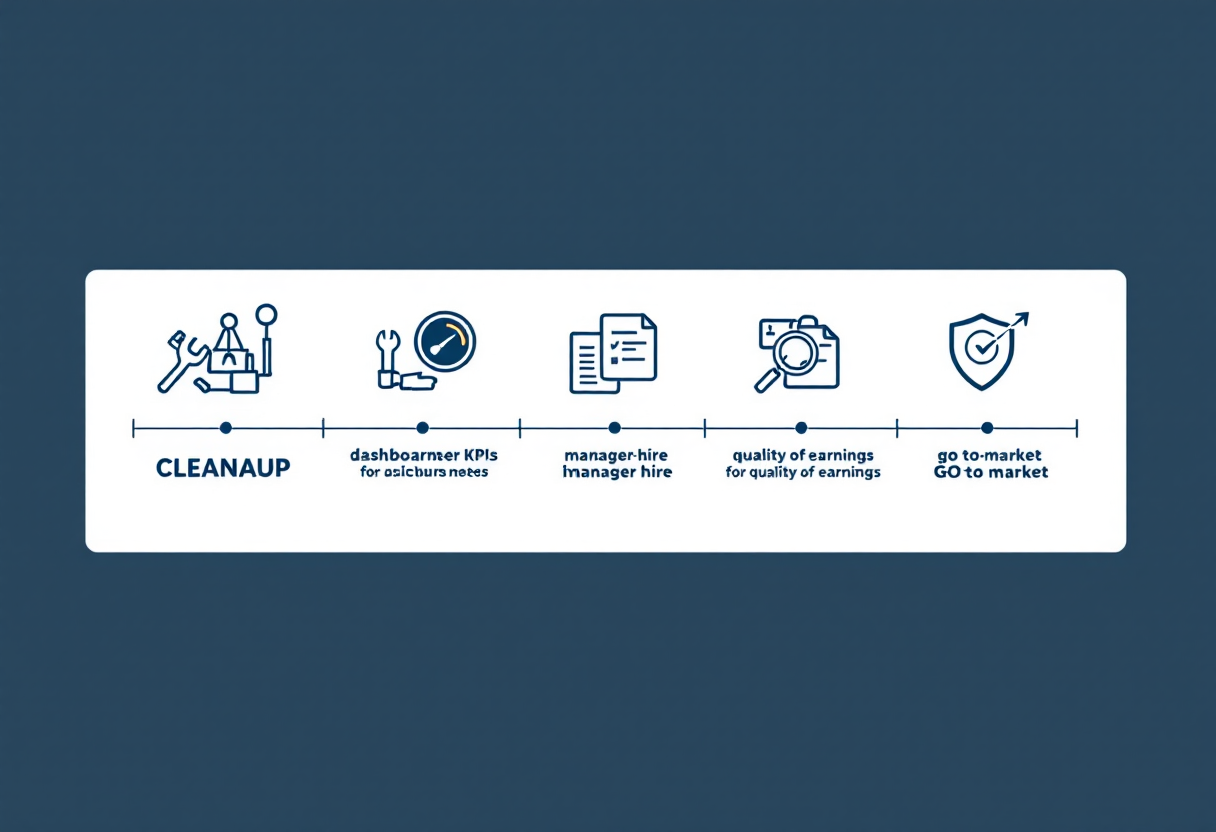
T-36 months: Get the facts straight
- Build the first version of the contracted-unit schedule from contracts, invoices and the field service system, and reconcile it to revenue.
- Move financial reporting to an accrual basis with revenue split by service line.
- Draw up the licence map for every state and city you work in, and identify a successor for each licence that depends on you.
- Obtain a benefit plan statement and a withdrawal liability estimate if you are a union signatory.
- Start separating personal expenses from the business.
- Decide what you want from a sale: a full exit, a partial sale with rollover, or a sale to a local buyer who keeps the name.
T-24 months: Build the operating base
- Appoint or develop the general manager who will run daily operations.
- Launch the drive to convert repair customers to maintenance contracts and to reprice old agreements.
- Tag every contracted unit with its modernization window and start building the proposal pipeline.
- Rotate mechanic training across equipment brands and record qualifications.
- Review route density and decide which isolated accounts to keep.
- Put a monthly dashboard in place: units under contract, units per mechanic, callbacks per unit, repair revenue per unit and contract renewals.
T-12 months: Prove the business runs without you
- Step back from daily decisions and let the general manager handle customers, inspectors and the union.
- Commission a sell-side quality of earnings review.
- Close remaining compliance gaps: licences, tests, violations, insurance and safety records.
- Calculate deferred maintenance revenue monthly and agree an approach to working capital with your adviser.
- Finalise the real estate decision.
T-6 months: Prepare the market materials
- Choose an adviser and agree the buyer list across manufacturers, platforms and independent buyers.
- Prepare the confidential information memorandum and a short anonymous teaser.
- Load the data room with the information pack described above.
- Rehearse a management presentation with your general manager taking a leading role.
T-3 months: Run the process
- Approach the buyer list under NDA and share the memorandum with those who sign.
- Collect indications of interest, hold management meetings with the best fits and invite letters of intent.
- Choose a buyer on price, structure, treatment of your team and certainty of closing, then enter exclusivity and confirmatory diligence.
Every elevator company starts this timeline from a different place. Some already have clean contracts and a strong general manager and can go to market within a year; others need the full three years. The point is to know which you are before a buyer tells you.
How CT runs an elevator company sale
We begin with the contracted-unit schedule and the licence map, because they answer the first two things every elevator buyer wants to know: how much of the revenue recurs under contract, and whether the company can legally keep working the day after closing. We then help you decide which buyer group fits your size, equipment mix and personal goals, approach a short list under NDA, and keep you in control of price, structure and timing. When the preparation window is longer, we work with you on the sequence of improvements above so that each one shows up in the numbers a buyer reviews.
In the first conversation we usually ask for four things: a rough count of units under written contract, the states and cities you work in and the licences you hold there, whether your mechanics are union members, and what you want your own role to be after a sale. Those answers tell us which buyer group is likely to pay the most and treat your team well, and which parts of the preparation plan deserve attention first. Everything you share stays under NDA, and no buyer hears about your company until you agree.
Frequently Asked Questions
How long should I plan for before selling my elevator service business to a private equity buyer?
The owners who get top-quartile pricing start preparing 24 to 36 months before going to market. The minimum useful prep window is 12 months, because most of the high-leverage levers (converting month-to-month contracts to multi-year evergreens, lifting route density from 60 to 100+ units per mechanic, installing a GM, getting on a real FSM with a clean unit master, running a sell-side QoE) need 12+ months of clean trailing-twelve-months data to be credible to a buyer. Owners who try to sell in under 6 months typically leave 20% to 40% of enterprise value on the table because the contracted-unit portfolio data, the modernization pipeline, and the addback bridge are not ready to defend.
What is a realistic EBITDA multiple for a $2M EBITDA elevator service business in 2026?
For an independent elevator service business at $2M EBITDA in 2026, the range is 7x to 10x. The bottom of that range applies to install or modernization-heavy shops with under 20% maintenance revenue, 30-day cancellation contracts, owner-dependence, and concentrated customer base. The top applies to shops with 40%+ recurring maintenance revenue, 750+ contracted units at 90%+ renewal rate, dense routes at 75 to 125 units per mechanic, a GM in place, and a real FSM running with clean per-unit data (CT Acquisitions 2026; Eilla.ai Elevator and Escalator Valuation Playbook 2025). For platform-quality $10M+ EBITDA shops with IUEC signatory status and OEM authorizations on multiple brands, the range moves into 12x to 18x+. The 36-month prep playbook moves you from the bottom of the band to the top.
Should I get a quality of earnings report done before going to market?
For elevator service businesses at $1M+ EBITDA, yes. A sell-side QoE costs $50K to $100K typical for elevator service with multiple service lines, up to $150K for complex addback situations or large modernization WIP (Eton Venture Services 2025; Kahn Litwin Renza; Citrin Cooperman). The ROI is leverage. On a $25M revenue, $5M EBITDA elevator service business, supporting a 1x multiple uplift from 8x to 9x equals $5M of additional sale price for a $75K investment, a 67x ROI (Eton 2025; Insero Advisors). More importantly, a pre-market QoE validates your contracted-unit portfolio MMR data and renewal rate (the single most-scrutinized metric in elevator service diligence) before the buyer’s QoE finds problems and re-trades the deal during exclusivity.
How many maintenance contracts and what renewal rate do PE buyers want to see?
The entry point for a real sponsor process is 750+ units under maintenance contract at 90%+ annual renewal rate. Platform-eligible is 2,000+ units. Within the unit count, buyers care about contract term (multi-year evergreen beats 1-year beats month-to-month), cancellation provisions (60- to 90-day with material penalty beats 30-day with no penalty), and MMR per unit benchmarked against local market (residential $25 to $125 per month; small commercial $85 to $420 per month; high-rise / specialty $170 to $1,250 per month per Toledo Elevator, Elevator Blueprint, Action Elevator 2026 data). Buyers will frequently layer a Monthly Maintenance Revenue (MMR) multiple onto the EBITDA multiple, valuing the contracted book at an estimated 20x to 36x of monthly fee added to EV (which equates to 1.7x to 3.0x annual maintenance revenue), depending on contract term length and cancellation provisions.
Do I need to put a general manager in place before I sell?
If your goal is to maximize price, yes, ideally 12+ months pre-sale. Owner-dependence is the second-most-cited multiple haircut in elevator service after contract quality. On a $1M to $3M EBITDA business, eliminating key-person risk moves the multiple from the 7x to 8x band into the 9x to 11x band, worth $1M to $6M of price (CT Acquisitions 2026). A GM hire runs $175K to $275K plus bonus depending on metro and IUEC environment, and needs 12 to 18 months to fully take operational load before the buyer’s diligence team will believe the transition. The 2-week unplugged vacation by the owner is the canonical stress test buyers use to validate the handoff.
Will my state elevator contractor license and QEI certification transfer to the new owner?
Usually not automatically. Most state regimes require a Responsible Party or Certificate of Competence holder for the elevator contractor license. Texas TDLR requires a Responsible Party with 3+ years of elevator contractor experience. California Cal/OSHA requires a Certificate of Qualified Conveyance Company (CQCC) or Certificate of Competence under DIR with 3+ years of conveyance experience. New York DOL requires elevator contractor license (effective Jan 1, 2022) with $1M per occurrence insurance minimums. Florida DBPR requires a registered elevator company employing a certified inspector, technician, or certificate of competency holder with $100K / $300K minimum liability insurance. If the owner personally holds the qualifying credential and there is no successor on staff, the license does not transfer at close and the buyer either finds a new qualifier or restructures the deal. The same applies to QEI certification, which is certified by NAESA International under the ASME QEI-1 Standard and is tied to specific individuals, not the company. Identify and certify successor Responsible Parties and QEI holders in months 36 to 24 of the run-up, not at month 3.
What to Do Next
The elevator service owners who get the top-quartile multiple all do the same three things. They start preparing 24 to 36 months before they want to be out. They build the contracted-unit portfolio (count, renewal rate, MMR per unit, cancellation provisions) as the single most defensible asset in the business. They put a GM in place 12+ months pre-sale, certify a second QEI through NAESA, and document succession on every long-tenured mechanic so no single individual carries the keys.
The KONE / TK Elevator megadeal announced April 29, 2026 at $34.4B EV (roughly 17x to 18x EBITDA) is the freshest, most-cited comp in elevator services M&A and resets the market for any seller currently considering a process. Schindler has already signaled it will challenge the deal at antitrust, which means a multi-quarter slog before the close. The sponsor buyer set (Arcline, Berkshire, Gauge, Century Park, TSCP, Carroll Capital, Haven + Altaline, Thayer Street) is deeper than it has ever been, and Big 4 strategic interest will not let up.
If you are 12+ months from a potential exit and want a structured pre-sale optimization roadmap, CT Acquisitions has elevator operations specialists in our partner network who run multi-quarter prep engagements. If you are 6 to 12 months out and ready to start the sell-side process, our M&A advisory team runs the buyer outreach. No fee to you on buy-side introductions; sell-side mandates are paid on success at closing. Either way, the first 30 minutes are free.
Ready to talk?
Schedule a 30-minute exit-readiness call
Or read more: Sell Your Elevator Service Business (active sale guide) | Buying an Elevator Service Business (buyer’s playbook) | Private Equity in Elevator Services 2026: Active Buyers + Multiples
Ready to Explore Your Options?
A 30-minute confidential conversation is all it takes.