How to Prepare Your Garage Door Business for a Sale or Exit in 2026: The 36-Month PE-Buyer Playbook
Preparing your garage door business for exit in 2026 works best as a 36-month process. The first 12 months tighten the operating story around recurring service revenue and installation backlog, the middle 12 fix pre-LOI diligence gaps around technician certifications and licensing transferability, and the final 12 turn one offer into a real competitive process with pricing tension.
Exiting your garage door business is the single largest financial event most owners will ever face. This guide is the no-fluff playbook for garage door business owners who are 12-36 months from sale, covering how PE-backed buyers actually value your business in 2026, the 12 levers that move your multiple, pre-LOI diligence, deal-killers to fix before going to market, and the full 36-month exit prep timeline.
Updated April 2026 · CT Acquisitions

Most garage door owners decide to sell, hire a broker, and find out 90 days later that their business is worth 30% to 50% less than they thought. The owners who get top-quartile pricing start preparing 24 to 36 months before they ever talk to a buyer. This guide is the 36-month playbook for how to prepare your garage door business for a sale or exit. It covers what private equity actually buys in 2026, the 12 levers that move multiples on residential and commercial overhead door operators, the documents PE will ask for before they send an indication of interest, and the deal-killers that re-trade garage door transactions during confirmatory diligence. Every number cites its source. Every recommendation comes from how the most active garage door buyers in 2026 actually behave.
If you are 6 to 36 months from a possible exit, this is the work that turns a 4x EBITDA outcome into a 6.5x EBITDA outcome. On a $1.5M EBITDA garage door business, that is the difference between a $6M sale and a $9.75M sale. Whether you want to prepare your garage door business for a sale to a sponsor-backed roll-up like Guild Garage Group or A1 Garage Door Service, prepare your garage door business for an exit to a strategic acquirer like Overhead Door Corporation or Garaga, or simply maximize value over the next 1 to 3 years before going to market, the work below applies to residential service shops, residential install shops, commercial bay-door operators, and dock-equipment specialists alike.
Building toward an exit in 12 to 36 months?
CT Acquisitions runs sell-side advisory for garage door owners $1M+ EBITDA. We also have garage door operations specialists in our partner network who run pre-sale optimization engagements when the timeline is longer. No fee to you on buy-side introductions; sell-side mandates are paid on success at closing.
What Private Equity Actually Buys in Garage Door (2026)
Garage door services has become one of the most-active home-services PE consolidation lanes of the 2022 to 2026 cycle, with 29 PE-backed deals in 2024 (a record year) and 26 more in 2025 including add-ons (PitchBook, “PE hopes garage door roll-ups will be the new HVAC”, 2025). The headline transactions are easy to point to: Oak Hill Capital paid more than $800M for Guild Garage Group in April 2025; Nucor paid $3.0B for C.H.I. Overhead Doors in June 2022, delivering KKR a 10x return on the hold (BusinessWire, May 16, 2022; Nucor 8-K, June 24, 2022; TradingView/Reuters, 2026). Underneath those marquee deals sits a much larger pipeline of sponsor-backed add-on transactions targeting independents with $1.5M+ EBITDA. The sponsor money flowing in is not random. PE buys specific profiles, and the profile you build over the next 24 to 36 months determines the multiple you get.
The PE-attractive garage door profile
- EBITDA threshold for a platform-quality deal: $1.5M to $3M is the entry band where sponsor-backed platforms run a competitive process. Below that, you are an add-on inside a roll-up at add-on pricing (4.5x to 6.5x per Lightning Path Partners 2026). Above $5M, you are an attractive bolt-on for the larger commercial overhead door platforms like Sterling Group’s OGD or Soundcore’s US Dock & Door. Above $15M, you are a platform candidate yourself.
- Service agreement / maintenance plan penetration: Most independent shops sit under 10% recurring. The line that moves you from add-on pricing into a premium add-on is 15% to 25% recurring, with annual renewal above 80%. Lightning Path Partners 2026 calls service agreement penetration “the one lever that moves a garage door company’s valuation dramatically,” with documented recurring revenue commanding a 30% to 50% multiple premium.
- Service-to-install mix: 60%+ install triggers a 0.25x to 0.5x multiple discount per Lightning Path Partners 2026. The optimal mix is 35% to 40% install, 35% to 45% service and repair, 15% to 25% recurring maintenance.
- Residential vs. commercial mix: Pure-residential demand-only shops trade at the bottom of the band. Operators with a credible commercial overhead door book (warehouse, dealership, multi-family property management) plus a dock-equipment line trade at a 0.5x to 1.0x premium because the commercial segment grows faster (8% CAGR vs. residential 5% to 6%) and carries higher average ticket (Business Research Insights, 2025).
- Geography: Sun Belt and growing metros (TX, FL, AZ, NV, CO, GA, NC, SC, UT) concentrate 2026 sponsor demand. Guild Garage Group’s footprint runs through AZ, CA, CO, UT, and GA; US Dock & Door biases Southeast; A1 Garage is Phoenix-anchored across 32+ markets in 18 states (A1 Garage Acquisitions page; Guild Garage success story 2025).
- Customer concentration: Residential garage door rarely has concentration risk. Commercial accounts (warehouse, dealership, multi-family, school district) can become 15% to 30% of revenue fast, and buyers price the discount above 20% (Beancount.io May 2026; Strategex; Eagle Rock CFO; Morgan & Westfield).
- Technician depth: The industry faces a deficit of 45,000+ qualified door installers and service technicians nationwide with only 12,000 new certifications issued annually; average age of certified garage door technicians is 51, with nearly 30% projected to retire by 2030 (Tradeworx 2025; Garage Door Marketers 2025). A stable, trained tech bench is a defensible asset that PE prices into the multiple.
- Owner role: Owner is in management, not running estimates or signing every check. GM in place 12+ months pre-sale. Owner-dependency discount per Lightning Path Partners 2026 is 0.5x to 1.0x multiple; heavy dependency is a 40%+ valuation discount.
Active garage door PE platforms in 2026
The list below covers the most active sponsor-backed garage door platforms in the 2024 to 2026 cycle. This is who will see your teaser. Add-on counts are point-in-time and shift quickly. Sources include PrivSource, PitchBook, PE Hub, Gridiron Capital and Sterling Group press releases, Cortec Group, Soundcore Capital, Alpine Investors, Franchise Equity Partners, Boxwood Partners, and CT Acquisitions’ own garage door PE map.
| Platform | Sponsor | Profile |
|---|---|---|
| Guild Garage Group | Oak Hill Capital (acquired April 2025 from founders for ~$800M) | 25+ add-ons since 2024 launch; ~$250M+ revenue, ~$50M EBITDA at sale; national, AZ/CA/CO/UT/GA bias; $1M to $5M residential |
| A1 Garage Door Service | Cortec Group (Cortec Fund VII, Dec 22, 2022) with Audax Private Debt | ~16 acquisitions on the company map since 2017, 6 in 2024-2025; 32+ markets in 18 states; 1,000+ employees; $1M to $10M residential |
| Precision Door Service | Neighborly (KKR-backed since 2021) | Franchise model; 132+ locations; #116 on Franchise Times Top 400 with $592M system sales; PE deal flow at the franchisee level |
| Reliable Residential | Franchise Equity Partners (FEP) | Largest Neighborly franchisee operator; 5+ Precision Door franchise unit acquisitions across FL, OH, OK, AZ, and TX (Dallas-Fort Worth + Palo Pinto added Dec 15, 2025) |
| RS Boes Holdings (Precision Door franchisee) | Burlington Capital Partners + RF Investment Partners | Acquired 2024-2025; Boxwood Partners advised seller; California franchise unit footprint |
| GarageCo Holdings | Gridiron Capital (Fund V, $2.1B) | 3-way platform launch March 2024 (P.D.Q. Door, Apple Door Systems, Cunningham Door & Window); added Cedar Park Overhead Doors (May 2024) and Quality Overhead Door (July 2024); national residential + commercial; $3M to $15M |
| Door Pro America | Rotunda Capital Partners (Rotunda Fund III, platform Nov 2023) | Add-ons American Garage Door Systems (Charlotte NC) and Liberty Door & Awning (Forked River NJ) in 2025; mid-Atlantic and Southeast; $1M to $5M |
| US Dock & Door (formerly Door & Dock Holdings) | Soundcore Capital Partners (Fund III, $450M oversubscribed) | 6 acquisitions: Top Notch Dock & Door, Top Notch Garage Door, Premier Overhead Doors, Select Door Services, Garage Headquarters (Nov 2025), Total Garage Store (Dec 18, 2025); Southeast + Northeast commercial + dock |
| OGD Overhead Garage Door | The Sterling Group (Foundation Fund, 4th platform, July 2024) | 45 metropolitan service areas across Southeast, Midwest, Mid-Atlantic, Mountain West; Adams Street Partners senior debt; BlackArch Partners advised seller; $3M to $15M residential + commercial |
| Cobalt Service Partners | Alpine Investors | Platform launched Dec 2023 with Piedmont Door Solutions; April 9, 2024 added four (Automated Door Ways, Toepfer Security, Industrial Door Company, Homeland Safety Systems); overhead doors, dock, commercial doors, security gates, access control |
| Authority Brands | Apax Partners (Sept 24, 2018) + BCI Partners minority | Franchise model; 1,900+ territories across 16 home services brands; multi-trade platform; does NOT own Precision Door (that is Neighborly/KKR) |
| Apex Service Partners | Alpine Investors (Apollo took minority May 28, 2026); $3.4B continuation Sept 2023 | 150+ locations, $3B+ revenue, 13,000+ employees across 46 states; primarily HVAC/plumbing/electrical, garage door cross-sell adjacency only |
| Sila Services | Goldman Sachs Alternatives (Nov 10, 2024 at ~$1.7B, ~17x LTM EBITDA) | 30+ HVAC/plumbing/electrical brands; primarily Northeast/Mid-Atlantic; garage door cross-sell adjacency |
| Wrench Group | Leonard Green & Partners with Oak Hill and TSG | 25 brands, 27 markets, 14 states, 7,300 employees; primary HVAC/plumbing/electrical with limited garage door cross-sell |
| Legacy Service Partners | Gridiron Capital | 33+ total home services partners; primary HVAC/plumbing; garage door cross-sell adjacency |
| Mosaic Service Partners | Alpine Investors | Residential window and door replacement focus (not garage door); provides comparable benchmark for Alpine multi-platform door category |
| Banner Solutions | Tailwind Capital (acquired Oct 31, 2019 from High Road Capital) | Wholesale distribution of door hardware, electronic access control, security products; vendor PE platform rather than operator acquirer |
Add to that list the strategic acquirers. Sanwa Holdings Corporation (TYO: 5929), parent of Overhead Door Corporation (acquired for $470M in 1995) and the Wayne Dalton division, runs 37 US sales centers plus 3 in Canada and acquired Pasco Doors (US automatic door service and install) in 2024 to early 2025 per the Sanwa Mid-Term Plan 2025 to 2027. Griffon Corporation (NYSE: GFF), parent of Clopay Building Products (the largest garage door manufacturer in North America with 4 manufacturing facilities and 57 distribution centers), has focused on organic and distribution expansion through FY2025 with no major service-channel acquisitions disclosed in 10-K and 10-Q filings. Nucor (NYSE: NUE) demonstrated strategic appetite at premium multiples by paying $3.0B for C.H.I. Overhead Doors in June 2022, with KKR growing EBITDA almost 4x and lifting margin from 21% to over 30% across the hold (Nucor 8-K June 24, 2022). ASSA ABLOY (STO: ASSAB) acquired International Door Products (Southfield MI, ~$31.9M 2024 sales) on December 1, 2025 to expand its US fire-rated steel door frame footprint (ASSA ABLOY press release; Angle Advisors). Garaga Inc. (Canadian family-owned) is the most active North American family consolidator beyond Sanwa and Griffon, with the Novatech Group acquisition closing May 27, 2024 at a reported $500M+ value (The Globe and Mail). Raynor Garage Doors and Wayne Dalton (the latter a Sanwa subsidiary) round out the strategic universe. The dominant US/Canadian strategic universe is therefore Sanwa, Griffon, Nucor, ASSA ABLOY, and Garaga, but their bid activity on independent service-channel businesses sits far below what PE platforms generate. As with HVAC, PE is the dominant exit channel for the sub-$25M EBITDA service-channel garage door operator.
Garage Door Valuation Multiples in 2026 (What You Are Actually Worth)
The multiple a buyer pays comes down to your size, your service mix, your service agreement penetration, your commercial book, and your geographic fit. Here is the 2026 range, cross-referenced from Lightning Path Partners 2026, Brentwood Growth 2025, BizBuySell listing comparables, the Guild Garage Group exit comp, and IBBA Market Pulse Q4 2025.
SDE multiples (smaller, owner-operated)
| SDE band | SDE multiple | Profile fit |
|---|---|---|
| Under $500K SDE | 1.78x to 3.0x | Demand-only, owner-operator, repair-heavy (Brentwood Growth 2025; Tupelo SMB) |
| $500K to $1M SDE | 3.0x to 4.0x | Brentwood Growth 2025; BizBuySell Ontario comparable at 4.46x SDE |
| Repair-heavy, low recurring | 1.78x to 3.5x SDE | Brentwood Growth 2025 |
| Service-and-maintenance focused, 15%+ recurring | 4.0x to 5.0x SDE | Brentwood Growth 2025; Tupelo SMB |
EBITDA multiples (PE-attractive size)
| EBITDA band | Residential multiple | Commercial multiple |
|---|---|---|
| Under $1M EBITDA | 3.0x to 5.0x | 4.0x to 6.0x |
| $1M to $3M EBITDA | 4.0x to 6.5x | 5.0x to 7.0x |
| $3M to $10M EBITDA | 5.5x to 7.0x platform / 4.5x to 6.5x add-on | 6.5x to 9.0x |
| $10M+ EBITDA platform candidate | 7.0x to 10.0x | 8.0x to 12.0x |
Source: Lightning Path Partners “Garage Door Business Valuation Calculator 2026”, with the Guild Garage Group / Oak Hill exit comp at ~16x EBITDA on ~$50M EBITDA setting the upper bound for true platform candidates. Industry-target EBITDA margin is 18% to 22%; below 15% margin triggers buyer scrutiny and recasting to 18% adds $100K to $200K of enterprise value at typical add-on multiples (Lightning Path Partners 2026).
Recent disclosed garage door transactions (2024-2025)
| Acquirer | Target | Date | Value | Implied multiple |
|---|---|---|---|---|
| Oak Hill Capital | Guild Garage Group | April 2025 | ~$800M+ | ~16x on ~$50M EBITDA / ~2.7x on $300M revenue |
| Nucor Corp (strategic, manufacturer) | C.H.I. Overhead Doors | June 24, 2022 | $3.0B | KKR 10x return; EBITDA margin lifted 21% to 30%+ across hold |
| Cortec Group + Audax Private Debt | A1 Garage Door Service | Dec 22, 2022 | Not disclosed | $220M+ revenue at recap |
| The Sterling Group (Foundation Fund) | OGD Overhead Garage Door | July 2024 | Not disclosed | 45 MSAs across multi-region |
| Gridiron Capital | P.D.Q. Door + Apple Door + Cunningham (3-way GarageCo launch) | March 2024 | Not disclosed | Platform launch |
| Alpine Investors (Cobalt Service Partners) | Automated Door Ways + Toepfer Security + Industrial Door Company + Homeland Safety Systems | April 9, 2024 | Not disclosed | 4-way simultaneous add-on |
| ASSA ABLOY | International Door Products (Southfield MI) | Dec 1, 2025 | Not disclosed | Implied on ~$31.9M 2024 sales |
| Soundcore Capital (US Dock & Door) | The Total Garage Store (Tennessee) | Dec 18, 2025 | Not disclosed | 6th US Dock & Door add-on |
| Franchise Equity Partners (Reliable Residential) | ACG Smith Texas (Precision Door franchise Dallas-Fort Worth + Palo Pinto) | Dec 15, 2025 | Not disclosed | Largest Neighborly franchisee operator |
Sources: TradingView/Reuters; PrivSource; Private Equity Wire; PitchBook; BusinessWire May 16, 2022; Nucor 8-K June 24, 2022; Cortec Group press release Dec 22, 2022; Sterling Group press release; BlackArch Partners; Gridiron Capital press releases; Alpine Investors press releases; ASSA ABLOY press release Dec 1, 2025; PE Professional Dec 2025; PRNewswire Dec 15, 2025.
The 12 Value Levers That Move Your Multiple (Ranked by Impact)

These are the levers that move garage door multiples in the 24 months before a sale. Each one has a current state, a target state, and an estimated financial impact. The ordering is by dollar impact per unit of effort, based on cross-source synthesis from Lightning Path Partners 2026, Brentwood Growth, Garage Door Marketers, Result Calls, ServiceTitan, Housecall Pro, and Workiz.
Lever 1: Build service agreement / maintenance plan penetration to 15% to 25% of revenue
Current: Under 10% revenue from recurring maintenance agreements (typical demand-only shop per Lightning Path Partners 2026). Target: 15% to 25% revenue from maintenance and service agreements, with 80%+ annual renewal rate. Impact: Lightning Path Partners 2026 calls this “the one lever that moves a garage door company’s valuation dramatically.” Documented recurring revenue commands a 30% to 50% multiple premium. On a $400K EBITDA shop, that delta is the difference between a $2M sale and a $2.6M to $3M sale. Maintenance plans also double or triple profit margins when priced correctly and lift customer retention 40% (Result Calls 2025; Garage Door Marketers 2025). How: Tech-incentive on conversion at every service call; auto-renew with stored payment; annual or semi-annual plan priced $100 to $200/year (or $25 to $35/month) with included tune-up, lubrication, balance test, and safety inspection. Benchmark pricing: $25/month steel doors with annual tune-up, $35/month wood doors with semi-annual tune-up, tune-up tickets $100 to $240 each (Besser Bros; Resnick Garage Doors; King Door Co Bakersfield; Precision Door tune-up).
Lever 2: Shift mix toward the optimal install / repair / recurring split
Current: 60%+ install (low margin) or 80%+ repair (limited deal value). Target: 35% to 40% install / 35% to 45% service-repair / 15% to 25% recurring per Lightning Path Partners 2026. Impact: Companies skewed too heavily toward installation (60%+ install) face a 0.25x to 0.5x multiple discount (Lightning Path Partners 2026). Service-repair gross margin runs higher than install on a per-hour basis. Shifting 20 points of mix can lift blended gross margin by 3 to 5 points, which on a $5M revenue shop is $150K to $250K of EBITDA growth that gets multiplied at sale. How: Sales-team comp on maintenance conversion; tech comp on service ticket; selective bidding on install jobs to avoid race-to-bottom new-construction work; build a service-first dispatch model.
Lever 3: Move the owner out of the chair
Current: Owner runs sales, runs install crews, signs every check, on every commercial estimate above $5K. Target: GM in place 12+ months before going to market. Owner under 30 hours/week of operational work. Sales and field operations promoted from within. Impact: Owner-dependency discount per Lightning Path Partners 2026 is 0.5x to 1.0x multiple; heavy dependency is a 40%+ valuation discount. On a $1M EBITDA shop at a 5.5x baseline, removing key-person risk can move from $5.5M to $6.5M to $7M of price. Garage door industry GM comp runs $120K to $200K plus bonus depending on geography (Workiz garage door salary guide 2025). How: GM hire 18 to 24 months pre-sale; document SOPs for every operational role; build a leadership scorecard; transition customer relationships to the sales team; take a 2-week unplugged vacation as the stress test.
Lever 4: Get on ServiceTitan, BuildOps, or Workiz and run a real monthly close
Current: QuickBooks plus spreadsheets, no service-line P&L, no monthly close, tech productivity is anecdotal. Target: ServiceTitan or equivalent in place 24+ months, monthly close within 15 days, KPI dashboard covering booking rate, conversion, average ticket, jobs per tech per day, revenue per truck, maintenance conversion rate, and smart opener attach rate. Impact: ServiceTitan reports 25% average revenue increase in customer first year for garage door operators (ServiceTitan garage door industry page; Guild Garage Group requires ServiceTitan for all partners). Estimated +0.25x to 0.5x multiple uplift from data-room cleanliness and KPI defensibility. Guild Garage Group case study cited Goody Garage Doors growing $5.5M to $12M, One Clear Choice up 22% in Colorado, A+ Garage Doors Las Vegas exceeding $90K monthly (ServiceTitan Guild Garage success story 2025). How: Budget $25K to $100K implementation; force tech adoption via payroll-tied job-completion compliance.
Lever 5: Drive average ticket and pricing discipline
Current: Average repair ticket below $250; dispatch fee waived on conversion; no annual price review. Target: Average repair ticket $300 to $400; average residential replacement $1,500 to $2,500+; commercial install $3,000 to $7,000+; dispatch fee held; annual 5% to 8% list increase. Impact: Direct EBITDA growth. A $3M revenue shop that lifts average repair ticket by $50 on ~6,000 service calls/year adds ~$300K to revenue, with most dropping to EBITDA at gross margins of 55% to 65% (Garage Door Marketers 2025; ServiceTitan garage door pricing). Industry benchmarks: average residential repair ticket $150 to $400; average residential replacement $1,200 to $4,500+ with average replacement door cost ~$4,672 (Garage Door Marketers 2025; Housecall Pro). How: Flat-rate pricing, price book quarterly refresh, tech training on options-based presentations (good/better/best on spring sets, openers, weather seals), eliminate tech discretion on pricing.
Lever 6: Diversify into commercial bay-door and dock equipment
Current: 100% residential, demand-only. Target: Residential plus commercial overhead door plus dock equipment for warehouse, distribution centers, dealerships, fleet maintenance facilities, multi-family property management accounts. Impact: Commercial overhead door segment is faster-growing (8% CAGR vs. residential 5% to 6%) per Business Research Insights 2025. Loading dock door market $5B in 2025 growing at 6% CAGR to $8B by 2033 (Data Insights Market 2025). Commercial install tickets start ~$2,000 and exceed $7,000+ (ServiceTitan; Housecall Pro 2026). PE platforms (US Dock & Door, OGD, GarageCo) are specifically building commercial books because of the recurring service economics on dock leveler PMs and bay-door PM contracts. Estimated +0.5x to 1.0x multiple premium for a credible commercial book. How: Hire commercial sales rep 18 to 24 months pre-sale; target 5 to 10 anchor commercial property management accounts; build commercial PM contract template. Our companion piece on Garage Door Business Valuation in 2026: SDE/EBITDA dives deeper into this topic.
Lever 7: De-concentrate the commercial customer base
Current: Top commercial customer above 15% of revenue. Target: Top customer below 10%; top 5 below 30%. Impact: Concentration above 20% triggers buyer pushback; above 25% triggers 15% to 30% valuation discount or buyer walk (Beancount.io 2026; Eagle Rock CFO; Strategex; Morgan & Westfield). Residential garage door rarely has concentration risk, but the commercial diversification recommended in Lever 6 must be done deliberately to avoid creating a new concentration problem. How: Target 8 to 12 commercial anchor accounts (not 2 to 3); kill discounts on the biggest account so relative weighting shrinks; expand the commercial sales pipeline before the existing book becomes top-heavy.
Lever 8: Premier dealer status and manufacturer relationships
Current: Small-volume dealer with multiple manufacturers, no Premier or Master Authorized status. Target: Premier or Master Authorized dealer with at least one major (Clopay Master Authorized, Amarr Pro Dealer, Overhead Door Distributor, Raynor Authorized Dealer). Impact: Premier dealer relationship is worth 0.25x to 0.5x multiple premium per Lightning Path Partners 2026. Also opens higher rebate tiers and co-op marketing dollars that flow straight to gross margin. How: Focus volume on one to two primary manufacturers; meet the volume tier; maintain installer training and warranty compliance; renew certifications annually.
Lever 9: Technician retention and depth
Current: 25%+ annual turnover; senior installers carry institutional knowledge; no internal leveling. Target: Under 15% turnover; tech career ladder (apprentice, junior tech, senior tech, lead tech, GM); documented training program; IDA / IDEA certifications encouraged. Impact: Turnover cost is 50% to 200% of departing worker’s annual salary for skilled positions (Tradeworx 2025). Industry needs ~439,000 new workers in 2025 (Garage Door Marketers 2025); skilled trade wages up 35% over five years (Fortune April 2026 coverage of JLL report). PE diligence treats a stable, trained tech bench as a defensible asset and prices it into the multiple. How: Take-home truck policy; IDA accreditation paid by the company; paid CEU days; performance bonus tied to first-time-fix and CSAT; competitive wage band reviewed annually.
Lever 10: EBITDA add-back hygiene
Current: Owner mixes personal expenses through the business with no documentation; related-party rent at above FMV; no add-back schedule. Target: Every add-back documented as it happens with the underlying invoice; related-party rent restruck to FMV with appraisal on file; clean payroll for owner-family members. Impact: At a 5.5x multiple, $100K of clean add-backs equals $550K of sale price (synthesis of Lightning Path Partners 2026 multiples and Morgan & Westfield QoE add-back framework). How: Adopt a monthly add-back log starting today; document the business purpose of every charge; get an FMV rent appraisal if the owner owns real estate; isolate one-time legal, ServiceTitan implementation, and owner-family payroll line items.
Lever 11: Working capital normalization and customer deposit treatment
Current: Wildly seasonal A/R; install deposit cash mixed with operating cash; deferred maintenance plan liability not isolated. Target: TTM-average working capital is stable and predictable; install deposits in a segregated account; deferred revenue on prepaid plans separately tracked on the balance sheet. Impact: Working capital peg is set off the trailing 6 to 12 months (BDO, KMCO, Morgan & Westfield NWC guides). A volatile pattern lets the buyer set a higher peg, which subtracts from purchase price. Garage door install deposits are a particular target: buyers will treat any unfulfilled install backlog as a debt-like liability if deposits are commingled. How: Tighten A/R collection cycle; manage truck-stock inventory (torsion springs in multiple sizes, opener motors, rollers, hinges, panels) with monthly counts; isolate install deposits in a dedicated account; isolate prepaid plan liability.
Lever 12: Real estate decision and the sale-leaseback option
Current: Owner-occupied real estate held in the same entity as the operating business, or in an LLC at above-FMV rent. Target: Real estate in a separate LLC at FMV NNN lease to the operating company, with a clear path for the buyer to either assume the lease or buy the real estate. Impact: Separating real estate often lifts the implied EBITDA multiple on the operating business because the buyer is not forced to underwrite real estate exposure (Plante Moran sale-leaseback primer; Northmarq guide; W. P. Carey blog). A sale-leaseback can release up to 100% of property market value as cash vs. 70% to 80% LTV via traditional financing. Estimated +0.5x to 1.0x multiple uplift from holding real estate separately at FMV. How: FMV market rent study; restruck rent to FMV; decide before going to market whether real estate is part of the deal or held back.
Want to grow your business to maximize value before exiting?
We connect garage door owners with operations experts in our partner network who run 12 to 24 month pre-sale optimization engagements. The engagement pays for itself in incremental sale price.
What PE Asks Before They Send an LOI (The Pre-LOI Diligence Stack)
Before a PE firm commits to a letter of intent, they ask for a focused diligence package. The list below is the universal core ask from a 2026 PE firm targeting a garage door business, adapted to garage door specifics. The “why” and “how to prepare” expand each item to what is typical across the industry.
1. Income statements for 2024, 2025, and the latest trailing twelve months
Why PE asks: They are building the LTM EBITDA they will multiply. They want growth rate, margin trajectory, seasonality (garage door has milder seasonality than HVAC but spring and fall still over-index residential service demand), and any one-time movers. LTM is the bridge between the most recent year-end and today, so the headline price reflects current run-rate, not stale data.
How to prepare: Accrual-basis P&L by month, mapped to a clean chart of accounts. Service-line P&L (install vs. repair vs. maintenance plan vs. commercial bay-door vs. dock equipment) where possible. Reconcile to tax returns so there are no surprises in confirmatory diligence.
2. Balance sheet at the latest month
Why PE asks: Two reasons. First, to size the working capital peg they will set in the SPA. Second, to identify net debt (cash minus interest-bearing debt minus debt-like items including unfunded customer deposits on install orders, deferred maintenance liability on prepaid plans, accrued bonuses, and vehicle capital lease balances on take-home installer trucks). Both peg and net debt come out of the purchase price.
How to prepare: Tie the balance sheet to the trial balance. Isolate the deferred maintenance plan liability (most commonly disputed item, same as HVAC) and customer install deposits (a garage-door-specific item because residential install jobs often collect 30% to 50% down).
3. Add-back estimates
Why PE asks: They want a preview of your adjusted EBITDA story before they sink diligence cost into the file. Aggressive or undocumented add-backs discount the rest of your numbers.
How to prepare: Build the bridge from book EBITDA to adjusted EBITDA, line by line. Common garage door add-backs that hold up: owner compensation above market (if owner takes $300K but a GM would cost $150K, $150K adds back); one-time legal fees; owner family payroll; owner vehicle and personal travel; owner health insurance and country club; software conversion one-time costs (ServiceTitan implementation $25K to $100K); related-party rent at above-FMV (added back to the delta). Source: Morgan & Westfield QoE guide; Midstreet; Brentwood Growth garage door sale guide.
4. Anonymized employee roster (titles, start dates, pay structure)
Why PE asks: They are stress-testing technician tenure vs. industry churn and owner dependence. The garage door industry faces a deficit of 45,000+ qualified door installers and service technicians nationwide with only 12,000 new certifications issued annually; average age of certified garage door technicians is 51, with nearly 30% projected to retire by 2030; 68% of door installation companies in the Midwest and Northeast delayed projects in 2023 due to lack of available labor (Tradeworx 2025; Garage Door Marketers 2025). PE wants to see if your tech base is a defensible asset or a flight risk.
How to prepare: Roster columns should include role, hire date, full-time vs. part-time, W-2 vs. 1099 (with classification rationale), comp structure (hourly, commission, spiff), and any active non-compete or non-solicit. Calculate and disclose 12-month and 24-month rolling tech retention.
5. Revenue breakdown and average ticket by service mix (install, repair, opener/spring, commercial bay-door, dock equipment, maintenance, 2022 to 2025 plus LTM, with job counts and average ticket)
Why PE asks: This is the single most diagnostic exhibit. It tells them install-heavy vs. service-heavy mix, average ticket trend, whether job count is growing from capacity or from price, and the commercial vs. residential split.
How to prepare: Pull straight from ServiceTitan, Workiz, Housecall Pro, or whatever FSM platform you run. Industry benchmarks: average repair ticket $150 to $400; average residential replacement $1,200 to $4,500+ with average replacement door cost ~$4,672; smart opener retrofit driving 30% revenue growth where adopted (Garage Door Marketers 2025; Housecall Pro garage door pricing). Residential service hourly $75 to $150/hour, labor cost per job $150 to $450 (Housecall Pro; ServiceTitan). Commercial install starts ~$2,000 and can exceed $7,000+ depending on size, hardware grade, and access (ServiceTitan garage door pricing 2026; Housecall Pro 2026).
6. Maintenance plan members (counts by year, active membership, plan mix)
Why PE asks: Recurring maintenance revenue is the single biggest multiple driver per Lightning Path Partners 2026. They want active member count, growth rate, renewal rate (target 80%+), plan mix (basic vs. premium), average revenue per member, and the deferred revenue liability on prepaid annual plans (debt-like at close).
How to prepare: Member count by month, last 36 months. Renewal rate. Revenue per member. Plan mix. ARR snapshot. Benchmark pricing: $100 to $200/year residential basic; $25/month steel doors with annual tune-up; $35/month wood doors with semi-annual tune-up; tune-up tickets $100 to $240 each (Result Calls 2025; Besser Bros; Resnick Garage Doors; Precision Door; King Door Co Bakersfield). Note: residential garage door members have lower visit frequency than HVAC (1 to 2 visits/year vs. HVAC 2 to 4) so per-member ARR is lower, but renewal economics and lift-on-service ticket are similar.
7. Five-year business plan
Why PE asks: PE underwrites a forward case (years 1 through 5 post-close). They want a credible growth story.
How to prepare: A simple operating model: revenue by service line, gross margin assumptions, overhead growth, EBITDA. Include capacity build (techs and trucks), planned expansion territories or service lines, pricing actions, commercial pipeline, and the smart opener / IoT upsell roadmap.
8. Vehicle and fleet list
Why PE asks: Three reasons. CapEx forecast (residential install trucks 5 to 8 year useful life, sometimes shorter on overloaded torsion spring and opener inventory loads). Capital lease vs. owned vs. financed (lease balances are debt-like). Wrap and brand condition for the eventual roll-up rebrand.
How to prepare: Spreadsheet with vehicle number, make/model/year, mileage, ownership status, monthly payment, condition, wrapped vs. unwrapped. Garage door installer rigs often carry significant truck-stock inventory (torsion springs in multiple sizes, opener motors, rollers, hinges, panels), which makes truck condition and inventory discipline more critical than HVAC, where parts loadout is lighter.
9. Customer concentration (top 10 customers by revenue)
Why PE asks: Residential garage door is mostly low-concentration (homeowner one-off transactions), but commercial bay-door and dock equipment customers can become 10% to 30% of revenue (warehouse, dealership, multi-family property management, school district contracts). PE wants the top 10 to see concentration and contract renewal risk.
How to prepare: Top 10 customer revenue by year. Flag any single customer above 10%. Disclose contract terms (assignment clauses, change-of-control triggers, renewal dates).
10. Supplier and dealer relationships
Why PE asks: Garage door installers are typically authorized dealers for one or more manufacturers (Clopay, Amarr, Overhead Door / Wayne Dalton, Raynor, Garaga, CHI). Premier or Master dealer relationships are worth 0.25x to 0.5x multiple premium (Lightning Path Partners 2026) but also create concentration risk if a manufacturer terminates.
How to prepare: Dealer authorization letters; volume by manufacturer; rebate accruals; co-op marketing dollars and any conditions for ongoing eligibility.
Confirmatory Diligence (After You Sign the LOI)
Once an LOI is signed and exclusivity starts (typically 45 to 90 days per Colonnade Advisors podcast 020), the buyer runs parallel workstreams. This is the depth of inspection your business will undergo. If anything was hiding, it surfaces here.
- Quality of Earnings (QoE). Outside accounting firm runs revenue cut-off testing, deferred revenue analysis on prepaid maintenance plans and install deposits, expense normalization, add-back validation, working capital trends. Buyer-side QoE cost: $50K to $250K typical for $1M to $10M EBITDA garage door. Output: an adjusted EBITDA number the buyer locks into the model.
- Customer concentration and commercial DD. Top customer review, calls with commercial property management accounts, contract review (assignment clauses, change-of-control triggers, renewal dates).
- IT systems audit. ServiceTitan, BuildOps, Workiz, Housecall Pro. ServiceTitan claims 25% average revenue lift in customer first year (ServiceTitan garage door industry page). PE platforms typically want acquired companies on the same FSM as the rest of the portfolio. Guild Garage Group requires ServiceTitan for all partners (ServiceTitan Guild Garage success story 2025).
- Legal. Entity good standing in every operating state, licenses (the critical garage door item, especially California C-61/D-28), dealer authorization agreements, IP, litigation history, warranty and callback liability, real estate leases, change-of-control consent on manufacturer dealer agreements.
- HR/Payroll. W-2 vs. 1099 classification audit, I-9 compliance, wage-and-hour exposure, non-compete enforceability, any pending EEOC or DOL claims.
- Safety and OSHA. Torsion spring injury history; OSHA citation and inspection history (OSHA has cited improperly maintained and installed door systems and missing entrapment devices under Section 5(a)(1) General Duty Clause many times); workers comp mod factor (US Department of Labor garage door enforcement records; OSHA general search and accident search).
- Environmental. Shop floor staining (hydraulic oil from opener service, lubricant from torsion spring service), used-oil disposal, Phase I ESA on any owned property.
- Tax. Federal income, payroll, sales/use, property. Sales tax on installation labor varies by state (Texas non-residential repair, maintenance, install labor is taxable per Texas Comptroller; Pennsylvania taxes repair/install on tangible property per PA Bureau of Audits Sales and Use Tax Manual). Garage door installers under-collect sales tax on commercial work in service-revenue states with regularity.
Why You Should Pay for Your Own Quality of Earnings Before Going to Market
A sell-side QoE is your own outside accountant’s QoE, paid for by you, before you go to market. It does three things: pre-empts the buyer’s QoE by getting to the adjusted EBITDA number first with documentation; surfaces issues you can fix before the buyer sees them (revenue recognition on install deposits, deferred maintenance plan revenue, add-back documentation); tightens the EBITDA number you take to market, which directly drives the headline price.
Cost
- $25K to $35K for QoE if revenue is below $10M (Eton Venture Services 2025; Morgan & Westfield QoE guide).
- $35K to $75K typical range for sell-side QoE on a healthy garage door business with residential plus commercial mix and a maintenance plan book (synthesis of Kahn Litwin Renza buy-side vs. sell-side QoE 2025; Eton 2025).
- Up to $150K for businesses with complex add-backs, multiple entities, or messy books (Eton 2025).
ROI
Example commonly cited across QoE provider content: $25M revenue, $5M EBITDA business. Moving the multiple from 5x to 6x equals $5M of additional sale price. A $50K QoE investment that supports the 1x lift is a 100x return (Eton, “Quality of Earnings Report Cost”, 2025). Garage-door-applied example: a $3M revenue shop with reported $450K EBITDA. A sell-side QoE recasting owner compensation ($150K above-market) and one-time legal ($30K) lifts adjusted EBITDA to $630K. At a 5.5x platform multiple, that is $990K of additional value. A $40K QoE investment delivers ~25x ROI (synthesis estimate based on Lightning Path Partners 2026 multiple bands and the Morgan & Westfield add-back framework).
Deal-Killers That Re-Trade Garage Door Transactions (Avoid These)
These are the recurring kill-shots cited across garage door M&A advisory content, OSHA enforcement records, and confirmatory diligence checklists. Most are fixable in 12 to 24 months. None are fixable in 30 days.
1. Concentration on a single commercial property management or warehouse account
Residential garage door rarely has concentration risk, but commercial accounts (warehouse, multi-family property management, school district, dealership) can become 15% to 30% of revenue fast. Top customer above 15% gets buyers nervous; above 25%, deals re-trade or walk (Beancount.io 2026; Strategex; Eagle Rock CFO; Morgan & Westfield).
2. Garage door specialty license tied to the owner personally
California requires a C-61/D-28 specialty license (Doors, Gates and Activating Devices). 4 years journey-level experience required, business and law exam, application $330, initial license $200 for 2 years (CSLB; Digital Constructive C-61/D-28 guide; OneNet). If the license qualifier is the owner, it does not automatically transfer; the buyer needs a new qualifier on day one or to restructure. Texas does not require a state-level garage door license but local municipal registration (Houston, Dallas) may apply (Service Pro 911; Optymizer 2026). Florida requires a general or specialty contractor license depending on city/county (CILB); some jurisdictions issue a Garage Door Installation Specialty Contractor license. Other states (NJ, NC, GA, VA) vary; advisor should verify every operating state pre-LOI.
3. OSHA torsion spring and struck-by injury exposure
OSHA has cited improperly maintained or installed door systems and missing entrapment devices under Section 5(a)(1) General Duty Clause many times (RCI Doors compliance writeup; OSHA general search records). 2025 OSHA penalty amounts: serious citation tops out at $16,550 per violation; willful violations $11,524 minimum to $165,514 maximum per violation; criminal penalties apply when a willful violation causes employee death (Safety Regulatory 2026; DuraLabel; OSHA Injury Attorney). Real enforcement example: US Department of Labor cited an Ohio garage door operator in September 2018; California-specific ALJ decision in Desert Garage Door Inc., inspection 1471575 (CA Dept of Industrial Relations OSH Appeals Board, 2021). The buyer’s safety and HR diligence will pull workers comp mod factor and OSHA citation history; a bad history triggers re-trade or escrow.
4. W-2 vs. 1099 misclassification
Garage door shops that run install crews or helpers as 1099 to dodge payroll tax are sitting on liability. IRS settlements range $10K to $100K+ per misclassified worker once back taxes, penalties, interest, and legal cost aggregate (Tax1099 guide; ADP SPARK 2023; IRS Worker Classification 101). A single SS-8 filing by a former 1099 opens a workforce-wide audit. Less common in garage door than landscaping but still happens with helper roles and lead installers.
5. Sales/use tax exposure on installation labor in service-revenue states
Texas: non-residential garage door repair, maintenance, and install labor is taxable (Texas Comptroller; Texas Comptroller Audit Manual). Pennsylvania: repair, maintenance, and install on tangible property taxable in many situations (PA Department of Revenue Bureau of Audits Sales and Use Tax Manual; Sales Tax Helper PA contractor guide April 2023). Garage door owners frequently under-collect on commercial install and repair jobs; confirmatory tax DD surfaces multi-year exposure that comes out of purchase price as holdback or escrow.
6. Undisclosed warranty or callback liability on recent install jobs
Garage door manufacturer warranties typically run 1 year (mechanical), 3 to 10 years (paint and finish), 10 years to lifetime (panel or hardware on premium SKUs). Manufacturer warranty is void if installation was not by a certified dealer or if the homeowner skipped routine maintenance (DuraServ; Clopay warranty page; Amarr warranty guidance; Overhead Door warranty). Installer warranty (1 to 3 years on labor, sometimes longer for certified dealers) sits with the shop. Unrecorded callback liability on the past 12 to 18 months of install jobs is a recurring re-trade item.
7. Undocumented related-party transactions
Above-FMV rent paid to owner-owned LLC; owner-family on payroll for unclear duties; related-party vendor contracts. All become QoE adjustments and erode buyer trust in the broader numbers (Morgan & Westfield QoE; Brentwood Growth garage door sale prep).
8. Deferred maintenance on the install fleet
Truck-mounted overhead door installer rigs run heavier than HVAC vans (torsion springs in multiple sizes, opener motors, hinges, rollers, panels). 5 to 8 year useful life is shorter than HVAC’s 7 to 10. Trucks with 200K+ miles, missing DOT inspections, or expired vehicle registrations trigger replacement capex modeled by the buyer; reduces purchase price close to dollar-for-dollar.
9. Permit and inspection exposure on commercial install jobs
Commercial bay-door and dock equipment install jobs occasionally completed without proper permits (especially on multi-tenant industrial property). Surfaces in legal DD via lookup against state contractor boards. Can trigger remediation obligation priced into the deal.
10. Manufacturer dealer agreement assignment risk
Premier or Master Authorized dealer relationships often have change-of-control clauses. Clopay Master Authorized, Amarr Pro Dealer, and Overhead Door / Wayne Dalton Distributor agreements may require manufacturer consent on transfer (Clopay residential warranty info; Wayne Dalton authorized dealer terms). Failure to confirm before closing puts the buyer at risk of losing dealer status post-close, which hits forward EBITDA. The buyer’s legal DD will surface this and require manufacturer estoppels.
11. FSM/ERP data quality issues
If ServiceTitan, BuildOps, or Workiz data is dirty (wrong service codes, missing customer addresses, jobs not closed, no recurring-revenue flag, install jobs not converted from estimates), the buyer’s IT diligence will surface it. Integration risk gets priced into the deal. Guild Garage Group, US Dock & Door, and most PE platforms now standardize on ServiceTitan, so prior adoption is itself a multiple-friendly signal (ServiceTitan Guild Garage success story 2025).
12. Phase I ESA findings on owned shop real estate
Vehicle-shop floors, lubricant storage, used-oil disposal, hydraulic oil from opener service, and any vehicle-service uses by a prior occupant. Triggers Phase II if anything is found. Common in shops on properties that previously hosted auto-service or commercial fleet uses.
The 36-Month Exit Prep Timeline
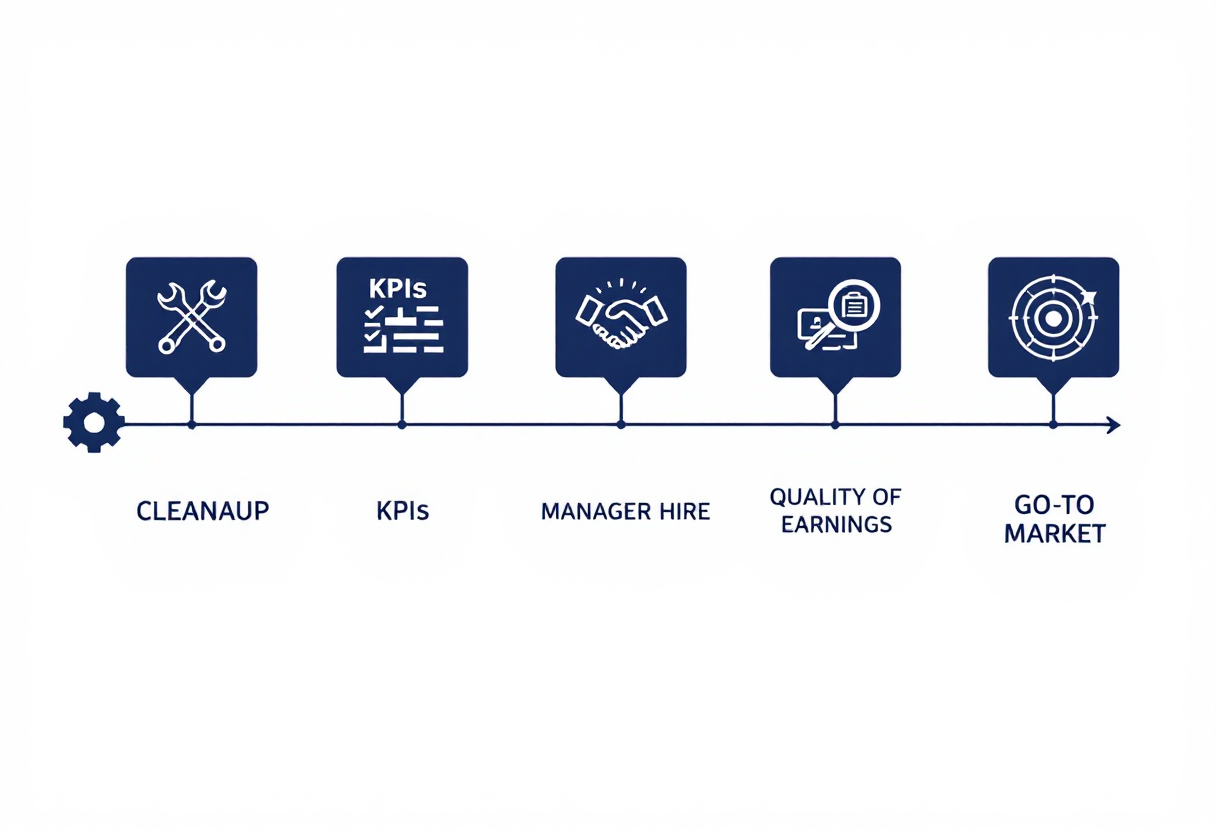
T-36 months: Cleanup phase
- Switch to accrual basis if still on cash basis
- Pick an FSM (ServiceTitan, BuildOps, Workiz, Housecall Pro Pro tier) and migrate
- Start tagging every potential EBITDA add-back as it happens
- Conduct W-2/1099 audit; reclassify if needed (settle exposure now while it is small)
- Restruck related-party rent to FMV with appraisal
- Build the org chart and identify the GM hire (internal promotion target or external recruit)
- Phase I ESA on any owned real estate
- Sales/use tax compliance review by outside counsel in every operating state
- Pull and digitize OSHA citation and injury record history; close gaps in safety training documentation
- Confirm garage door specialty license is held by an employee, not the owner personally (or at minimum, identify the post-close qualifier path)
T-24 months: Financial discipline and KPI infrastructure
- GM hire onboarded; taking operational load
- Monthly close in 15 days; service-line P&L every month (install vs. repair vs. opener vs. spring vs. commercial bay-door vs. dock equipment vs. maintenance)
- KPI dashboard: booking rate, average ticket residential and commercial, jobs/tech/day, revenue/truck, maintenance conversion rate, member churn, smart opener attach rate
- Launch or scale maintenance membership program if penetration is under 15%
- Pricing review: 5% to 8% list increase, dispatch fee held
- Diversify commercial customer base if any top customer is above 15%
- Document SOPs for every operational role
- Build the add-back bridge as a living document
- Pursue or upgrade to Premier dealer status with primary manufacturer (Clopay Master Authorized, Amarr Pro Dealer, Overhead Door Distributor)
T-12 months: QoE-ready close discipline, eliminate owner dependence
- Owner steps out of daily operations; GM runs the shop
- Owner takes a 2-week unplugged vacation as the stress test
- Run the sell-side QoE (budget $35K to $75K)
- Tighten balance sheet: clean A/R, kill dormant inventory, isolate deferred maintenance plan liability, isolate install deposits in a dedicated account
- Final org-chart review; backfill any gaps
- Final compliance scrub (license transferability, OSHA records, W-2/1099, sales/use tax, environmental, dealer agreement change-of-control clauses)
- Lock in 12 months of clean service-line P&L for the CIM
T-6 months: Pre-marketing prep
- Engage M&A advisor (sell-side investment bank or M&A advisor specializing in home services or door industry). Typical fee structure: $25K to $75K monthly retainer credited against success fee of 4% to 8% of enterprise value, with Lehman or modified Lehman scaling
- CIM drafted from the QoE and operating model
- Teaser drafted (anonymized 1-pager)
- Buyer list finalized: priority bidders for a $1M to $10M EBITDA garage door operator with credible service-recurring mix include Guild Garage Group (Oak Hill), A1 Garage Door Service (Cortec), Door Pro America (Rotunda Capital), US Dock & Door (Soundcore Capital), GarageCo Holdings (Gridiron Capital), OGD Overhead Garage Door (Sterling Group), Cobalt Service Partners (Alpine Investors), Reliable Residential (FEP for franchise-fit), RS Boes (Burlington Capital Partners / RF Investment Partners for franchise-fit), Authority Brands (Apax + BCI for franchise platform plays), plus strategics Overhead Door / Sanwa, Clopay / Griffon (NYSE: GFF), Amarr / ASSA ABLOY, Garaga, and Raynor
- Virtual data room populated with everything from the pre-LOI and confirmatory sections above
- Management presentation deck built and rehearsed
T-3 months: Go to market
- Teaser distributed; NDAs collected; CIMs distributed
- IOIs collected 2 to 3 weeks after CIM goes out
- Narrow to 4 to 6 finalists for management meetings
- Management meetings; LOIs solicited
- Select LOI; sign with exclusivity (typically 45 to 90 days)
- Enter confirmatory diligence; close
End-to-end from engagement to close: 9 to 12 months in a well-run process; Lightning Path Partners 2026 cites 12 to 18 months for garage door specifically, with 3 to 6 months of pre-sale prep before the formal advisor engagement (Lightning Path Partners 2026; Auxo Capital Advisors sell-side process guide 2025; Wall Street Prep sell-side primer).
Frequently Asked Questions
How long should I plan for before selling my garage door business to a private equity buyer?
The owners who get top-quartile pricing start preparing 24 to 36 months before going to market. The minimum useful prep window is 12 months, because most of the high-leverage levers (lifting service agreement penetration from under 10% to 15% to 25%+, installing a GM, getting on ServiceTitan, running a sell-side QoE) need 12+ months of clean trailing-twelve-months data to be credible to a buyer. Lightning Path Partners 2026 cites 12 to 18 months end-to-end for garage door specifically once the formal sell-side process kicks off, plus 3 to 6 months of pre-sale prep before the advisor engagement. Owners who try to sell in under 6 months typically leave 15% to 30% of enterprise value on the table.
What is a realistic EBITDA multiple for a $1M EBITDA garage door business?
For a residential garage door business at $1M EBITDA in 2026, the range is 4.0x to 6.5x (Lightning Path Partners 2026). The bottom of that range applies to demand-only shops with under 10% recurring revenue, owner-dependence, and no commercial book. The top applies to shops with 15% to 25% maintenance plan penetration, a GM in place, ServiceTitan running, and Premier dealer status with a major manufacturer. For commercial overhead door operators at the same $1M EBITDA level, the range shifts to 5.0x to 7.0x. The 36-month prep playbook is what moves you from the bottom of the band to the top. For reference, Oak Hill paid ~16x EBITDA for Guild Garage Group in April 2025, but that was a $300M+ revenue, ~$50M EBITDA platform with 22+ partner integrations behind it, not a single operator.
Should I get a quality of earnings report done before going to market?
For garage door businesses at $1M+ EBITDA, yes. A sell-side QoE costs $35K to $75K typical, up to $150K for complex add-back situations (Eton Venture Services 2025). The ROI is leverage. If your QoE supports a 1x multiple uplift on a $3M revenue shop by recasting owner compensation and one-time items from $450K reported EBITDA to $630K adjusted EBITDA, that is roughly $990K of additional value at a 5.5x platform multiple for a $40K investment. More importantly, a pre-market QoE surfaces revenue recognition issues on install deposits, working capital surprises, and add-back weaknesses while you can still fix them, rather than during exclusivity when the buyer re-trades the deal.
What percentage of maintenance plan revenue do PE buyers want to see?
15% to 25% of revenue from documented recurring maintenance agreements is the band that moves a garage door operator from add-on pricing into premium add-on pricing per Lightning Path Partners 2026. Lightning Path calls this “the one lever that moves a garage door company’s valuation dramatically,” with documented recurring revenue commanding a 30% to 50% multiple premium. Garage door members visit less often than HVAC (1 to 2 visits/year vs. HVAC 2 to 4) so per-member ARR is lower, but renewal economics and lift-on-service ticket are similar. Industry pricing benchmark: $100 to $200/year basic plans or $25 to $35/month, with included tune-up, lubrication, balance test, and safety inspection (Result Calls 2025; Besser Bros; Resnick Garage Doors).
Do I need to put a general manager in place before I sell?
If your goal is to maximize price, yes, ideally 12 to 24 months pre-sale. Owner-dependency discount per Lightning Path Partners 2026 is 0.5x to 1.0x multiple; heavy dependency is a 40%+ valuation discount. On a $1M EBITDA shop at a 5.5x baseline, removing key-person risk can move from $5.5M up to $6.5M to $7M of price. Garage door industry GM compensation runs $120K to $200K plus bonus depending on geography (Workiz garage door salary guide 2025). The buyer’s diligence team will not believe the transition unless the GM has 12 to 18 months of measurable operational ownership in the data room, which means the hire decision really needs to be made 18 to 24 months pre-sale.
Should I sell my shop’s real estate with the business or hold it back?
Holding the real estate separately is usually the higher-value path. Move it into a separate LLC at fair market value triple-net rent to the operating company. This often lifts the implied EBITDA multiple on the operating business by 0.5x to 1.0x because the buyer is not forced to underwrite real estate exposure (Plante Moran sale-leaseback primer; Northmarq; W. P. Carey blog). You then have three options at close: assign the lease to the buyer, sell the real estate to the buyer at appraised value, or execute a sale-leaseback with a triple-net REIT investor at the same time as the operating company sale. The sale-leaseback path can convert up to 100% of property market value as cash, vs. 70% to 80% LTV via traditional refinancing (Northmarq sale-leaseback guide).
What to Do Next
The garage door owners who get the top-quartile multiple all do the same three things. They start preparing 24 to 36 months before they want to be out. They put a GM in place 12+ months pre-sale. And they invest in a sell-side QoE before any buyer sees a CIM. Most also pull two garage-door-specific levers in parallel: they push service agreement penetration from under 10% toward the 15% to 25% band that buyers pay a multiple premium for, and they build a credible commercial overhead door book to capture the 0.5x to 1.0x premium on commercial mix.
The headline transactions of the 2022 to 2026 cycle (Oak Hill / Guild Garage at ~$800M, Nucor / CHI at $3.0B, Cortec / A1, Sterling / OGD, Gridiron / GarageCo, Soundcore / US Dock & Door, Alpine / Cobalt) tell you the bid stack is real and the multiples at the top of the band are real. They do not tell you how to capture them. The 36-month playbook above does.
If you are 12+ months from a potential exit and want a structured pre-sale optimization roadmap, CT Acquisitions has garage door operations specialists in our partner network who run multi-quarter prep engagements. If you are 6 to 12 months out and ready to start the sell-side process, our M&A advisory team runs the buyer outreach across the 10+ active sponsor-backed garage door platforms named above plus the strategic universe. No fee to you on buy-side introductions; sell-side mandates are paid on success at closing. Either way, the first 30 minutes are free.
Ready to talk?
Schedule a 30-minute exit-readiness call
Or read more: Sell Your Garage Door Business (active sale guide) | Buying a Garage Door Business (buyer’s playbook) | Private Equity in Garage Door 2026: Active Buyers + Multiples
Ready to Explore Your Options?
A 30-minute confidential conversation is all it takes.