
Holding Company Structure: The 2026 Guide for Business Owners and Acquisition Entrepreneurs
A holding company structure is a parent company that owns the stock or LLC interests of your operating companies: at exit, it decides who sells, which tax rules apply, and whether proceeds are taxed once or twice.
By Christoph Totter, Founder of CT Acquisitions · Last reviewed: November 2026

Key takeaways
- A C corporation parent deducts 100 percent of dividends from a subsidiary in its affiliated group, which requires at least 80 percent of vote and value (IRC §243(a)(3), IRC §1504(a)(2)); below 20 percent ownership the deduction is 50 percent.
- An affiliated group of C corporations may file one consolidated return under IRC §1501; S corporations are excluded from that group by §1504(b).
- An LLC holding company taxed as a partnership is not an eligible S corporation shareholder under IRC §1361(b)(1)(B), so dropping S corp stock into it ends the S election; an S corp parent with a 100 percent owned QSub is the compliant version.
- When a C corporation holding company sells an operating company and pays out the cash, the same gain is taxed at 21 percent inside the corporation (IRC §11(b)) and again at up to 23.8 percent to the owner.
- For C corporation stock acquired after July 4, 2025, IRC §1202 excludes up to $15,000,000 of gain per issuer, at 50, 75 or 100 percent after 3, 4 or 5 years.
What is a holding company structure?
A holding company structure is two or more legal entities stacked by ownership: a parent (HoldCo) owns the equity of one or more operating companies (OpCo), and often a separate property company (PropCo) owns the real estate the OpCo uses. HoldCo signs no customer contracts and runs no payroll. Its income is dividends, distributions, interest and rent paid up from the entities below it, as the IRC §243 dividend rules assume.
For a founder, the structure matters most on the day of sale: it decides whether a buyer can take HoldCo’s shares, OpCo’s shares or OpCo’s assets, and each path has a different seller and tax bill. Our explainer on what a holdco is covers the vocabulary.
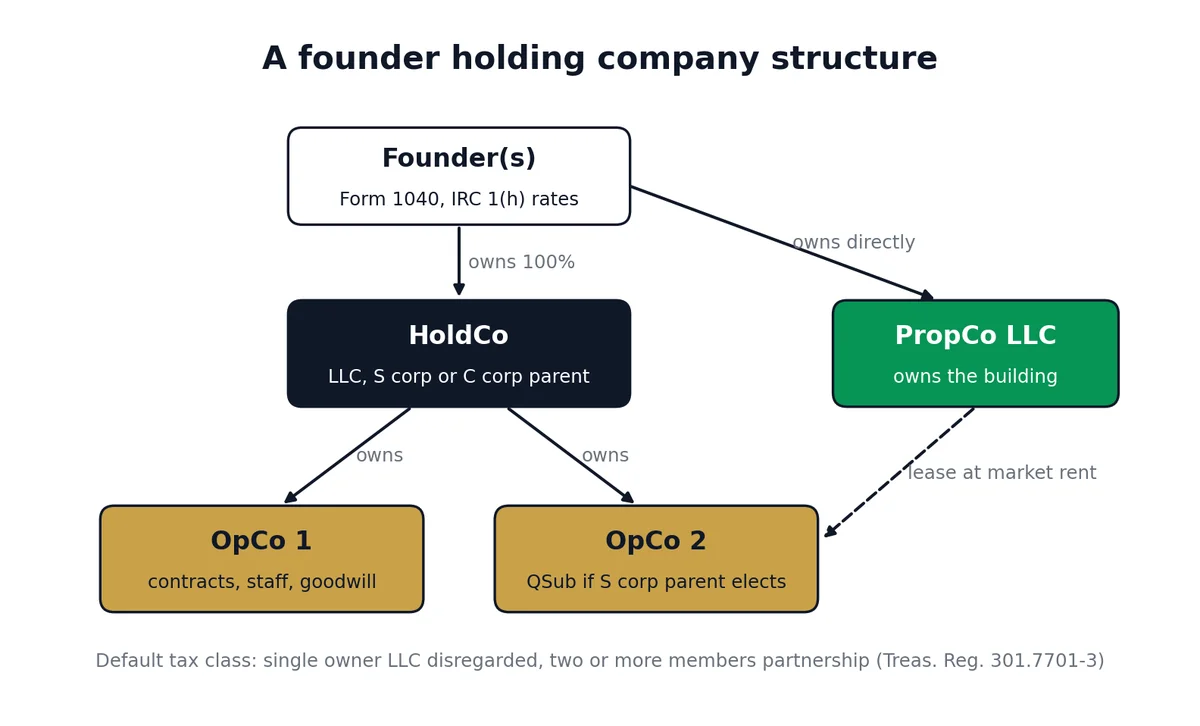
The table below is the text version of the diagram: each layer, what it owns and how the IRS classifies it by default.
| Layer | What it owns | Default federal tax classification | Rule |
|---|---|---|---|
| Founder(s) | HoldCo equity; often PropCo directly | Individual return (Form 1040) | IRC §1(h) capital gain rates |
| HoldCo (LLC, one owner) | OpCo stock or LLC interests | Disregarded entity | Treas. Reg. 301.7701-3(b)(1)(ii) |
| HoldCo (LLC, two or more owners) | OpCo stock or LLC interests | Partnership (Form 1065) | Treas. Reg. 301.7701-3(b)(1)(i) |
| HoldCo (corporation) | OpCo stock | C corporation (Form 1120) or S corporation (Form 1120-S) | IRC §11(b); IRC §1361 |
| OpCo | Contracts, employees, goodwill, equipment | Depends on entity; a QSub if S corp parent elects | IRC §1361(b)(3) |
| PropCo (LLC) | Building and land used by OpCo | Disregarded or partnership | Treas. Reg. 1.469-2(f)(6) on self-rental income |
Which holding company structure types exist, and what does each mean for a sale?
Four holding company structure types cover almost every founder-owned business: an LLC parent ignored for tax, an LLC parent taxed as a partnership, an S corporation parent with a qualified subchapter S subsidiary (QSub), and a C corporation parent over C corporation subsidiaries (IRC §§1361, 1504). Only the C corporation version adds a second layer of tax at exit, and only the S corporation version restricts who may own the parent.
| Structure | Who may own the parent | Tax on cash moved up | Tax layers when OpCo is sold | Source |
|---|---|---|---|---|
| Single-member LLC HoldCo | Anyone | None (disregarded) | One: owner’s return | Treas. Reg. 301.7701-3 |
| Multi-member LLC HoldCo (partnership) | Anyone; cannot own S corp stock | Generally none on distributions | One: partners’ returns | IRC §1361(b)(1)(B); IRC §731 |
| S corp HoldCo + QSub | Up to 100 shareholders, one class of stock, no nonresident aliens | None: QSub is not a separate corporation | One: shareholders’ returns | IRC §1361(b)(1), (b)(3) |
| C corp HoldCo + C corp OpCo | Anyone | 100% dividends received deduction at 80% ownership | Two: 21% corporate, then up to 23.8% on the payout | IRC §§11(b), 243, 1504 |
Can an LLC holding company own an S corporation?
A single-member LLC can, because a disregarded entity is looked through to its individual owner. A multi-member LLC taxed as a partnership cannot: IRC §1361(b)(1)(B) bars shareholders that are not individuals, estates or certain trusts and exempt organizations, and IRC §1362(d)(2) ends the S election on the day the corporation stops qualifying. The compliant holding company structure for an S corporation is an S corporation parent that owns 100 percent of the operating company and elects QSub status on Form 8869.
How does cash move from the operating company to the holding company?
In a pass-through holding company structure, cash moves up without a federal tax event. In a C corporation structure, a dividend from OpCo to HoldCo is income to HoldCo, reduced by the dividends received deduction in IRC §243. The deduction is 50 percent, 65 percent from a 20-percent owned corporation (§243(c)), and 100 percent for qualifying dividends inside an affiliated group (§243(b)).
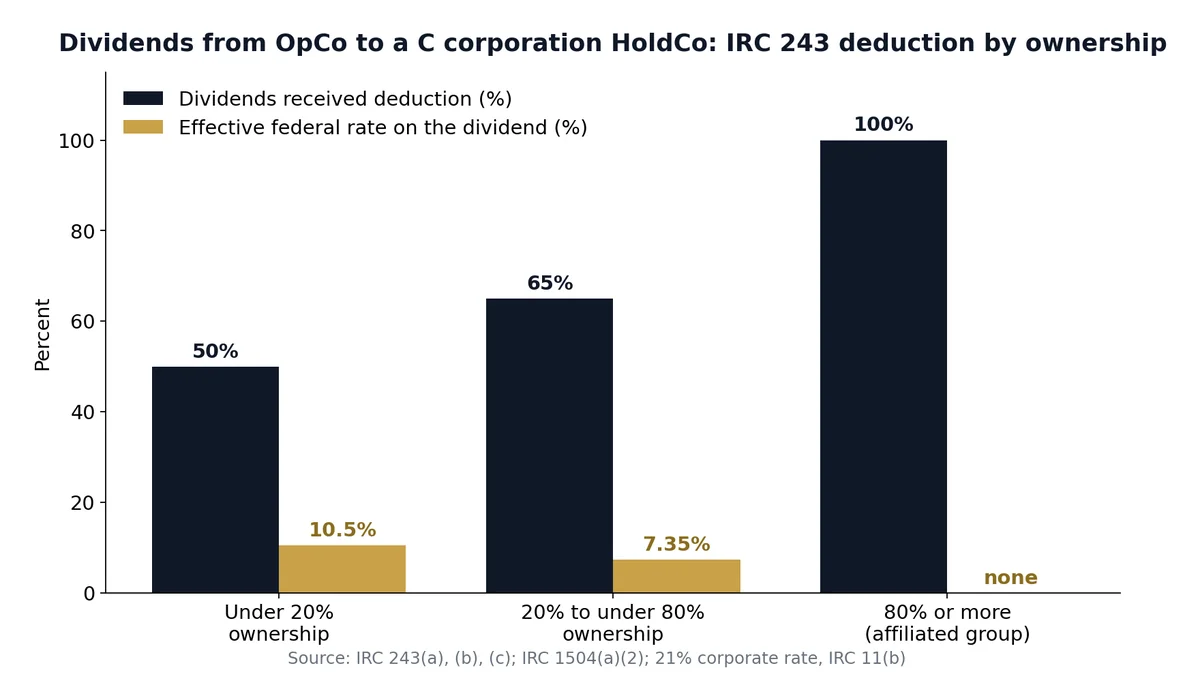
The effective federal rate in the last column applies the 21 percent corporate rate in IRC §11(b) to the part of the dividend left after the deduction.
| HoldCo ownership of OpCo (C corps) | Dividends received deduction | Taxable share of the dividend | Effective federal rate on the dividend | Source |
|---|---|---|---|---|
| Under 20% | 50% | 50% | 10.5% | IRC §243(a)(1) |
| 20% to under 80% | 65% | 35% | 7.35% | IRC §243(c) |
| 80% or more of vote and value (affiliated group) | 100% | None | None | IRC §243(a)(3), (b); §1504(a)(2) |
An affiliated group may also file one consolidated return under IRC §1501. Each subsidiary consents on Form 1122 for the first consolidated year, and Treas. Reg. 1.1502-13(f)(2)(ii) excludes intercompany distributions from the receiving member’s gross income. Consolidation also lets one subsidiary’s loss offset another’s profit in the same year.
Planning a sale and not sure your holding company structure is sale-ready?
CT Acquisitions helps founder-owners run a confidential sale, recapitalization or exit plan through a network of 500+ buyers. We work for owners on the sell side. Our fee is success only: nothing upfront, and you pay nothing unless the business sells.
How does a holding company structure change what you sell when you exit?
A holding company structure gives a buyer three things to buy: HoldCo’s shares, OpCo’s shares, or OpCo’s assets. Buyers prefer assets or an asset-equivalent election because they get a stepped-up basis; sellers in a C corporation structure prefer selling HoldCo shares because only one layer of tax applies.
| Sale path | Seller of record | Tax layers for the founder | Buyer basis step-up? | Rule |
|---|---|---|---|---|
| Owners sell HoldCo shares | Founder(s) | One | No (inherits HoldCo’s inside basis) | IRC §1(h) |
| C corp HoldCo sells OpCo shares, then distributes cash | HoldCo | Two | No, unless an election is made | IRC §11(b); IRC §331 |
| C corp HoldCo sells OpCo shares with a §338(h)(10) election | HoldCo (consolidated group) | Two, but OpCo’s deemed asset sale replaces the stock gain | Yes | IRC §338(h)(10) |
| OpCo sells its assets | OpCo | One if OpCo is a pass-through; two if a C corp | Yes | IRC §1060 |
| S corp owners form a new S corp HoldCo, convert OpCo to an LLC, sell LLC interests | HoldCo (S corp) | One | Yes | IRC §368(a)(1)(F); Form 8869 |
The last row is an F reorganization: the founder builds a holding company structure on purpose, a few weeks before closing, so a buyer gets asset treatment while the S corporation’s EIN, contracts and permits stay with the operating company. The seven steps, forms and deadlines are in our guide to F reorganization steps. When the seller is a corporate parent, the comparable tool is the Section 338(h)(10) election, which requires a qualified stock purchase meeting the 80 percent test in IRC §1504(a)(2) within a 12-month acquisition period.
What does a C corporation holding company cost a seller? A worked example
This worked example is illustrative, not tax advice. It assumes a $10,000,000 sale of OpCo, a $2,000,000 tax basis at every level, the 21 percent corporate rate (IRC §11(b)), and the 20 percent top capital gain rate (IRC §1(h)) plus the 3.8 percent net investment income tax (IRC §1411, above $250,000 joint income). State tax is left out.
| Line (illustrative) | Pass-through HoldCo sells OpCo | C corp HoldCo sells OpCo, then liquidates | Owners sell C corp HoldCo shares | C corp HoldCo shares qualify under §1202 (5 years) |
|---|---|---|---|---|
| Sale price | $10,000,000 | $10,000,000 | $10,000,000 | $10,000,000 |
| Gain (price minus $2,000,000 basis) | $8,000,000 | $8,000,000 | $8,000,000 | $8,000,000 |
| Corporate tax at 21% | None | $1,680,000 | None | None |
| Cash reaching the owner before personal tax | $10,000,000 | $8,320,000 | $10,000,000 | $10,000,000 |
| Owner gain | $8,000,000 | $6,320,000 | $8,000,000 | $8,000,000 (excluded up to $15,000,000) |
| Owner tax at 23.8% | $1,904,000 | $1,504,160 | $1,904,000 | None if every §1202 test is met |
| Net to owner | $8,096,000 | $6,815,840 | $8,096,000 | $10,000,000 |
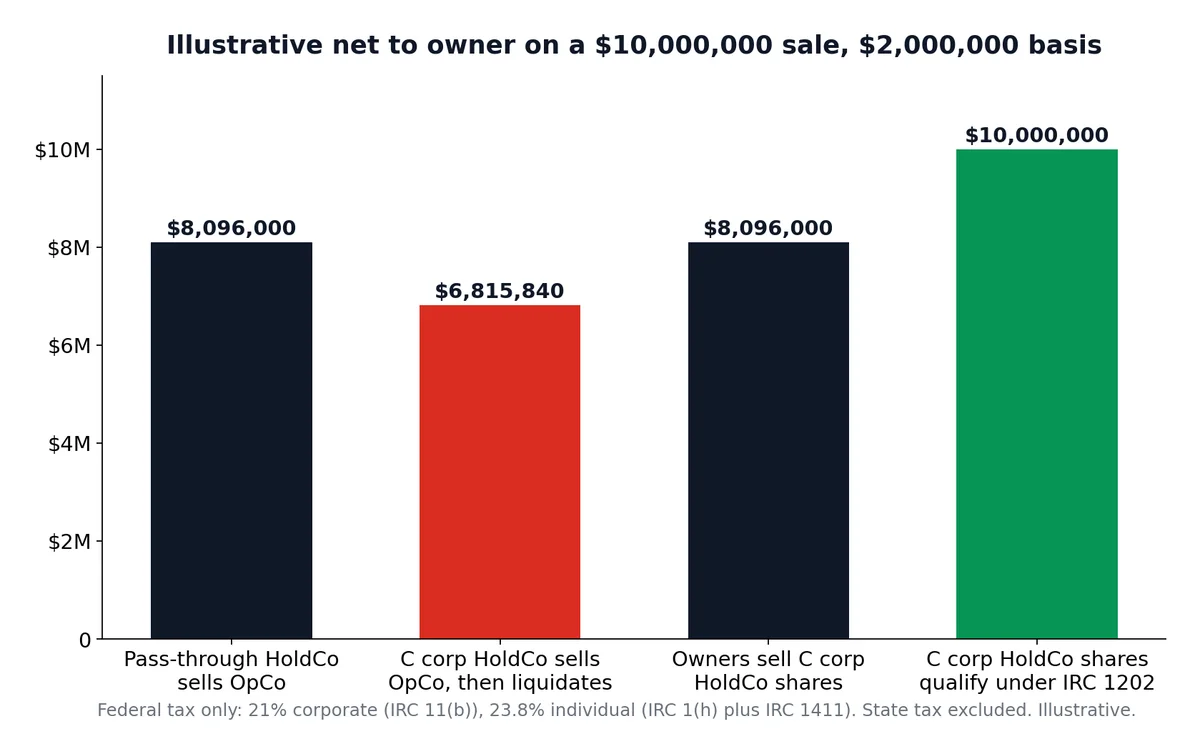
The second column is the cost of the wrong holding company structure: $1,280,160 less than the pass-through result on the same $10,000,000 price. Selling HoldCo shares avoids it, but the buyer then takes HoldCo’s $2,000,000 inside basis with no step-up and usually prices that in. The §1202 column needs stock acquired at original issue, a corporation with no more than $75,000,000 of gross assets at issuance (§1202(d)(1)), and an active business tested through subsidiaries under the look-through rule in §1202(e)(5). Our QSBS exclusion guide walks through those tests.
Should the real estate sit in its own LLC and be leased back?
Holding the building in a separate PropCo LLC that leases it to OpCo lets a founder sell the operating company and keep the property, collect rent from the buyer, or sell the building later on its own timeline. Sign the lease in writing at a market rent before the sale process starts.
Three tax rules follow the PropCo. Rent from a building leased to a business you materially participate in is treated as nonpassive income under the self-rental rule in Treas. Reg. 1.469-2(f)(6), so it cannot absorb passive losses. A later sale of the building is generally Section 1231 property under IRS Publication 544. Depreciation already taken comes back as unrecaptured Section 1250 gain taxed at up to 25 percent under IRC §1(h)(1)(E).
| Real estate option at exit | What the price covers | What the founder keeps | Rule to check |
|---|---|---|---|
| Building inside OpCo | Business and building in one price | Nothing after closing | IRC §1060 allocation on Form 8594 |
| PropCo LLC, new lease to buyer | Business only | Building and rent income | Treas. Reg. 1.469-2(f)(6) |
| PropCo LLC, building sold separately | Business; building to buyer or a third party | Second sale and its timing | IRS Publication 544 (Section 1231); IRC §1(h)(1)(E) (25% rate) |
Our guide to the real estate factor in a business sale covers how buyers price a lease versus an owned building.
Where should a holding company be formed?
Most founders form the holding company in their home state or in Delaware, where an LLC owes a $400 annual tax. Forming elsewhere does not remove home-state tax: an entity that transacts business in a state must generally register there as a foreign entity, and the owners’ resident state still taxes their share of income. Delaware is the default for C corporations that expect institutional buyers because its corporate law and Court of Chancery are familiar to buyer counsel.
| Item | Delaware | Home state | Source |
|---|---|---|---|
| Annual tax, LLC | $400, due June 1 | Set by your state | Delaware Division of Corporations |
| Minimum franchise tax, corporation | $175 (authorized shares method) or $400 (assumed par value capital method) | Set by your state | Delaware Division of Corporations |
| Foreign registration where OpCo operates | Still required | Not needed | State corporation and LLC statutes |
| Federal beneficial ownership report | Not required for U.S. companies | Not required for U.S. companies | FinCEN (interim final rule, March 26, 2025) |
What do holding company guides get wrong?
Several popular guides state holding company rules more broadly than the Internal Revenue Code allows. The table sets five common claims against the primary source.
| What guides often say | What the primary source says |
|---|---|
| “Dividends to a holding company are tax-free.” | Only qualifying dividends inside an 80 percent affiliated group get the 100 percent deduction; otherwise it is 50 or 65 percent (IRC §243(a), (c); §1504(a)(2)). |
| “Any holding company can file one return for the group.” | Consolidated returns are for affiliated C corporations; §1504(b) excludes S corporations from includible corporations (IRC §1501). |
| “Put your S corporation under an LLC holding company.” | A partnership is not an eligible shareholder (IRC §1361(b)(1)(B)) and the S election terminates (IRC §1362(d)(2)); use an S corp parent with a QSub, or an F reorganization. |
| “Form in Wyoming or Nevada to avoid state income tax.” | Formation state does not change where the business operates or where the owners live; foreign registration and resident-state tax still apply. |
| “QSBS caps tax-free gain at $10 million.” | True for stock acquired on or before July 4, 2025; for later stock the cap is $15,000,000 per issuer (IRC §1202(b)(4)). |
Which holding company structure fits your exit?
Pick the holding company structure from the exit you expect, not from the formation fee. The decision table uses the thresholds in the statutes above: the 80 percent affiliation test, the 100-shareholder and one-class S corporation limits, the 3 to 5 year §1202 holding period and the $75,000,000 gross asset cap.
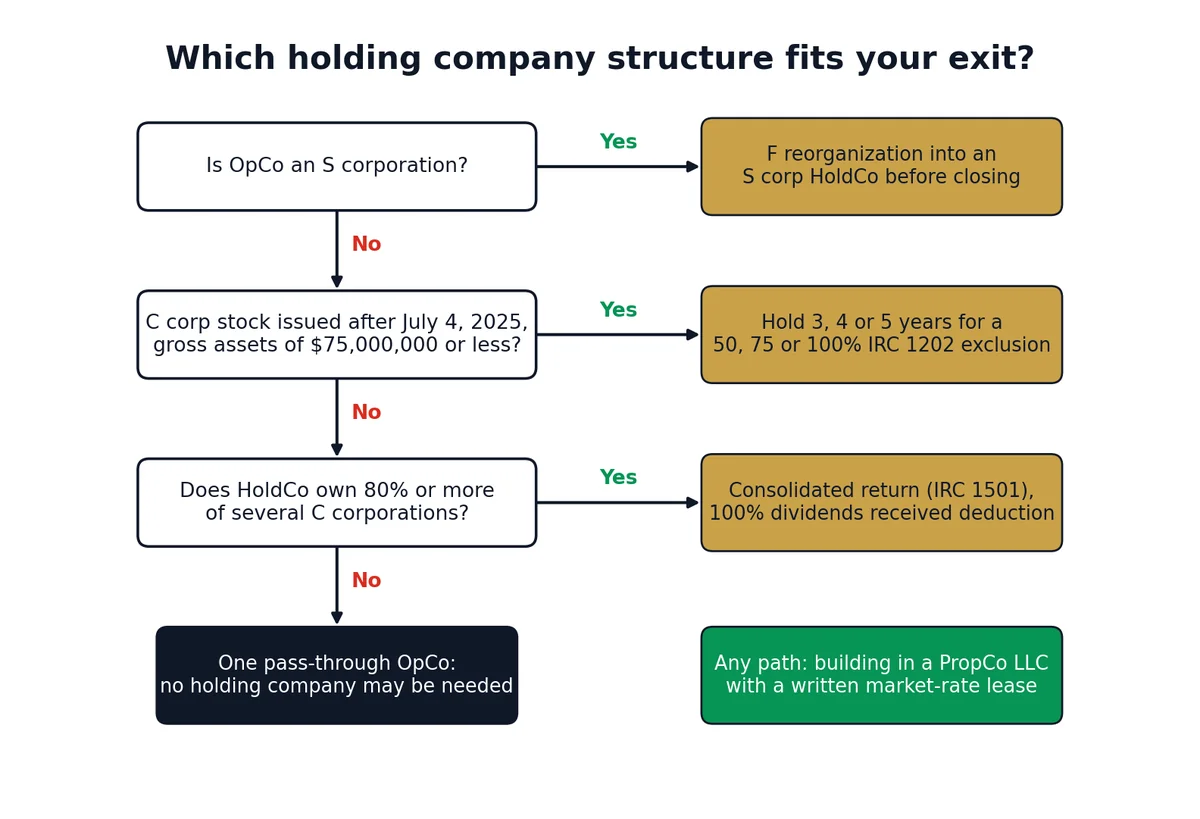
| If your situation is | Then consider | Why |
|---|---|---|
| If you own an S corporation and expect a buyer to want an asset deal | An F reorganization into an S corp HoldCo before closing | Asset treatment for the buyer with one layer of tax (IRC §368(a)(1)(F)) |
| If you own a C corporation and may sell in under 5 years | Keep the ability to sell HoldCo or OpCo shares; model the §1202 and §338(h)(10) paths | Avoids the two-layer result of 21% plus 23.8% |
| If your C corporation stock was issued after July 4, 2025 with gross assets of $75,000,000 or less | Hold 3, 4 or 5 years to reach 50, 75 or 100 percent exclusion | IRC §1202(a), (d)(1) |
| If one C corp HoldCo owns 80% or more of several C corps | File a consolidated return (Form 1122 consents) | 100 percent dividends received deduction and loss sharing (IRC §§243, 1501) |
| If the business uses a building you own | Hold it in a PropCo LLC with a written market-rate lease | Lets you keep or sell the building separately (Treas. Reg. 1.469-2(f)(6)) |
| If you have one operating company, no acquisitions planned and pass-through taxation | No holding company may be needed | A disregarded HoldCo adds filings without changing federal tax |
How do you set up a holding company structure before a sale?
Setting up a holding company structure over an existing business takes eight steps, and the tax classification and contribution steps carry the deadlines. Start a full tax year before a sale process if a consolidated return or a §1202 holding period is part of the plan. Our guide to building a holdco from your existing business covers the operating side.
- Choose the tax classification. An LLC that wants a non-default classification files IRS Form 8832; the election cannot take effect more than 75 days before filing (Treas. Reg. 301.7701-3(c)(1)(iii)).
- Form HoldCo. File articles in the chosen state and budget its annual tax (Delaware LLC: $400 by June 1).
- Get an EIN. Apply on IRS Form SS-4; an F reorganization NewCo needs a new EIN.
- Contribute OpCo equity. Owners transfer OpCo stock for HoldCo stock; IRC §351 defers gain when the transferors hold 80 percent control under IRC §368(c) right after the exchange.
- Make the subsidiary election. S corp parent: Form 8869 QSub election for a 100 percent owned OpCo. C corp parent: Form 1122 from each subsidiary with the first consolidated Form 1120.
- Move the real estate. Deed the building to PropCo LLC and sign a written lease with OpCo at market rent.
- Separate the money. Open bank accounts for each entity and document every transfer as a dividend, distribution, loan or rent payment.
- Update contracts and permits. Check change-of-control clauses in OpCo’s leases, licenses and customer contracts before the contribution.
How we compiled this
We compiled this page in November 2026 from 23 primary documents: 14 Internal Revenue Code sections and 3 Treasury Regulations on Cornell LII, 3 IRS form and publication pages, 2 Delaware Division of Corporations pages and 1 FinCEN page, all listed under Sources. The worked example uses round illustrative numbers and leaves out state tax. We excluded forum answers and competitor blog figures.
Frequently asked questions
What is a holding company structure?
A holding company structure is a parent entity that owns the stock or LLC interests of one or more operating companies, and often a separate LLC holding real estate. The parent runs no operations. At a sale it decides who the seller is: an affiliated C corporation group needs 80 percent of vote and value under IRC §1504(a)(2).
What are the disadvantages of a holding company?
The largest disadvantage is a second layer of tax when a C corporation holding company sells a subsidiary and pays out the cash: 21 percent at the corporate level, then up to 23.8 percent to the owner. Others are extra returns, a Delaware LLC annual tax of $400, and lost S status if a partnership owns S corporation stock.
How does a holding LLC make money?
A holding LLC earns distributions from its operating companies, rent from a property company, interest on loans to subsidiaries, and gain when it sells a subsidiary. A single-member holding LLC is disregarded under Treas. Reg. 301.7701-3, so that income is reported on the owner’s return. A C corporation parent instead uses the IRC §243 dividends received deduction.
Should a holding company be an LLC or a corporation?
An LLC holding company suits founders who want one layer of tax and expect to sell within a few years. A C corporation holding company suits a plan to hold at least 3 to 5 years for the IRC §1202 exclusion of up to $15,000,000, or a group of 80 percent owned C corporations filing one consolidated return under IRC §1501.
Can a holding company own an S corporation?
Only some can. A single-member LLC or an S corporation parent can own S corporation stock; the S corporation parent elects QSub status on Form 8869 for a 100 percent owned subsidiary. A multi-member LLC taxed as a partnership cannot, because IRC §1361(b)(1)(B) limits S corporation shareholders to individuals, estates and certain trusts.
Should I put my LLC in a holding company before selling?
Only if it changes the sale result. Putting a single-member LLC under another disregarded LLC changes nothing for federal tax. A holding company helps when it lets you keep real estate in a separate LLC, run an F reorganization for an S corporation, or start an IRC §1202 holding period of 3 to 5 years.
Sources
- Internal Revenue Code §§1, 11, 243, 331, 338, 351, 368, 731, 1202, 1361, 1362, 1411, 1501, 1504, Cornell Legal Information Institute, accessed November 2026.
- Treas. Reg. 1.469-2, 1.1502-13 and 301.7701-3, Cornell Legal Information Institute, accessed November 2026.
- IRS: About Form 1122, About Form 8869, Publication 544 (2025), accessed November 2026.
- Delaware Division of Corporations, LLC, LP and GP annual tax and franchise tax, accessed November 2026.
- FinCEN, Beneficial Ownership Information Reporting, accessed November 2026.
Related Guide: Family Office Structure: SFO, MFO, VFO, EFO Compared, How families structure multi-business wealth
Related Guide: Private Equity Roll-Up Strategy, PE platforms running serial acquisitions
Related Guide: Family Office vs Private Equity, Buyer-type comparison
Related Guide: What Is a Family Office? 2026 Guide, How family offices buy private businesses
Want a Specific View of Your Business?
30 minutes, confidential, no contract, no cost. You leave with a view of your local buyer market and a likely valuation range.
30 N Gould St, Ste N, Sheridan, WY 82801, USA · (307) 522-0262 · Contact