Rollover Equity Tax Treatment Under Section 351: The 2026 Guide to Tax-Deferred Rollover in PE Buyouts
Rollover equity tax treatment: equity you roll into the buyer is tax-deferred, not tax-free, when the exchange qualifies under IRC Section 351 (corporate buyer) or Section 721 (partnership buyer); the cash you take is taxed at closing.
By Christoph Totter, Founder of CT Acquisitions · Last reviewed: November 2026
Thinking about selling your business?
A 15-minute confidential call gives you a real valuation range and the buyers most likely to compete for your business. No cost, no obligation.

General information for U.S. owners, not tax or legal advice. Settle the structure with your tax adviser before the letter of intent fixes it.
Key takeaways
- A rollover is a deferral, not an exclusion: IRC Section 1001(c) recognizes the entire gain unless a nonrecognition section applies, and Section 351 or 721 only postpones it.
- A corporate rollover needs the transferor group to own 80% of the vote and of each other class of stock right after the exchange (IRC Section 368(c), applied by IRC Section 351(a)).
- A partnership rollover under IRC Section 721(a) has no control test, but cash the partnership pays you within 2 years of your contribution is presumed a sale (Treas. Reg. 1.707-3(c)).
- Cash taken at closing is taxed now; for 2026, long-term gain is taxed at 20% above $613,700 of joint taxable income (IRS Rev. Proc. 2025-32).
- The 3.8% net investment income tax applies above $250,000 of joint MAGI and only to passive owners or, generally, C corporation stock (IRS Topic 559).
How is rollover equity taxed?
Rollover equity is taxed in two moments. At closing, the cash and any other non-equity consideration are taxed as a sale under IRC Section 1001. The equity you roll escapes tax at closing only if a nonrecognition section applies: Section 351 for a corporate buyer, Section 721 for a partnership buyer, or a Section 368 reorganization for a merger. The deferred gain is taxed when you sell the rolled equity.
| Buyer entity you roll into | Code section | Main condition | Taxed at closing | Source |
|---|---|---|---|---|
| New corporate holdco funded by the sponsor | IRC 351(a) | 80% control right after (368(c)) | Cash and other property, capped at your gain (351(b)) | IRC 351 |
| LLC or other entity taxed as a partnership | IRC 721(a) | No control test | Cash from the partnership within 2 years, presumed a sale | IRC 721 |
| Existing corporation, by statutory merger | IRC 368(a)(1)(A) | Continuity of interest (40% stock passes) | Cash and other property, capped at your gain | IRC 356(a)(1); Reg. 1.368-1 |
| Any buyer, no qualifying structure | IRC 1001 | None | Cash plus fair market value of the equity received (1001(b)) | IRC 1001 |
A “Section 351 rollover” is row 1 and a “Section 721 rollover” is row 2. For the tax on the cash part, see our guide to how much tax you pay when you sell your business in 2026.
How does a Section 351 rollover pass the 80% control test?
A Section 351 rollover passes when everyone who transfers property to the corporation under one plan owns at least 80% of the voting power and 80% of each other class of stock immediately after (IRC 368(c)). In a typical buyout, the sponsor’s cash counts as property, so a seller rolling 30% beside a sponsor contributing the other 70% gives the transferor group 100%.
The exchanges need not be simultaneous: Treas. Reg. 1.351-1(a)(1) accepts transfers under rights “previously defined” and carried out “with an expedition consistent with orderly procedure.”
| Item at closing | Effect on the rollover | Rule |
|---|---|---|
| Sponsor cash contributed for stock at the same closing | Counts toward the 80% | IRC 351(a); Reg. 1.351-1(a)(1) |
| Stock issued to management for services | Does not count; dilutes the transferor group | IRC 351(d)(1) |
| Property of relatively small value contributed to qualify others | Does not count | Reg. 1.351-1(a)(1)(ii) |
| Nonqualified preferred stock you receive (holder put, mandatory redemption, floating dividend) | Taxed like cash | IRC 351(g) |
| Liabilities assumed above the basis of what you contribute | Excess is taxable gain | IRC 357(c)(1) |
Preferred stock with a put or a mandatory redemption inside 20 years is nonqualified preferred under Section 351(g), taxed at closing even though it looks like equity. See our explainer on how preferred stock is used in M&A for the terms to check.
How is a Section 721 rollover different?
A Section 721 rollover into an LLC or partnership has no 80% control test: IRC 721(a) says no gain or loss is recognized on a contribution of property for a partnership interest. The trade-off is the disguised sale rule. If the partnership pays you cash within 2 years of your contribution, Treas. Reg. 1.707-3(c) presumes a sale unless the facts clearly show otherwise.
A disguised sale is taxed as a part sale and part contribution under Treas. Reg. 1.707-3(a), so closing cash from the buyer partnership gives Structure B in the worked example. Partnership cash received within the 2 years and reported as not a sale needs disclosure under Reg. 1.707-8.
What does a rollover save? A worked example
A rollover saves time, not tax, at a flat rate. In the illustrative deal below, a $10,000,000 sale with a 30% rollover produces $2,640,000 of federal tax in all three structures, but the tax due at closing ranges from $1,800,000 to $1,260,000, and the difference stays invested until the next exit.
- Illustrative: 100% of the company worth $10,000,000; seller basis $1,000,000; held more than 1 year.
- All long-term capital gain at 20% (Rev. Proc. 2025-32); active owner, so no NIIT.
- 30% rolled, $7,000,000 cash; the rolled stake later sells for $7,200,000.
| Line | A: Taxable rollover (1001) | B: Sell 70%, roll 30% (351 or 721) | C: Contribute 100%, cash as boot (351(b)) |
|---|---|---|---|
| Cash at closing | $7,000,000 | $7,000,000 | $7,000,000 |
| Gain taxed at closing | $9,000,000 | $6,300,000 | $7,000,000 |
| Federal tax at closing (20%) | $1,800,000 | $1,260,000 | $1,400,000 |
| Cash after closing tax | $5,200,000 | $5,740,000 | $5,600,000 |
| Basis in rolled equity | $3,000,000 | $300,000 | $1,000,000 |
| Gain at exit on $7,200,000 | $4,200,000 | $6,900,000 | $6,200,000 |
| Federal tax at exit (20%) | $840,000 | $1,380,000 | $1,240,000 |
| Total federal tax | $2,640,000 | $2,640,000 | $2,640,000 |
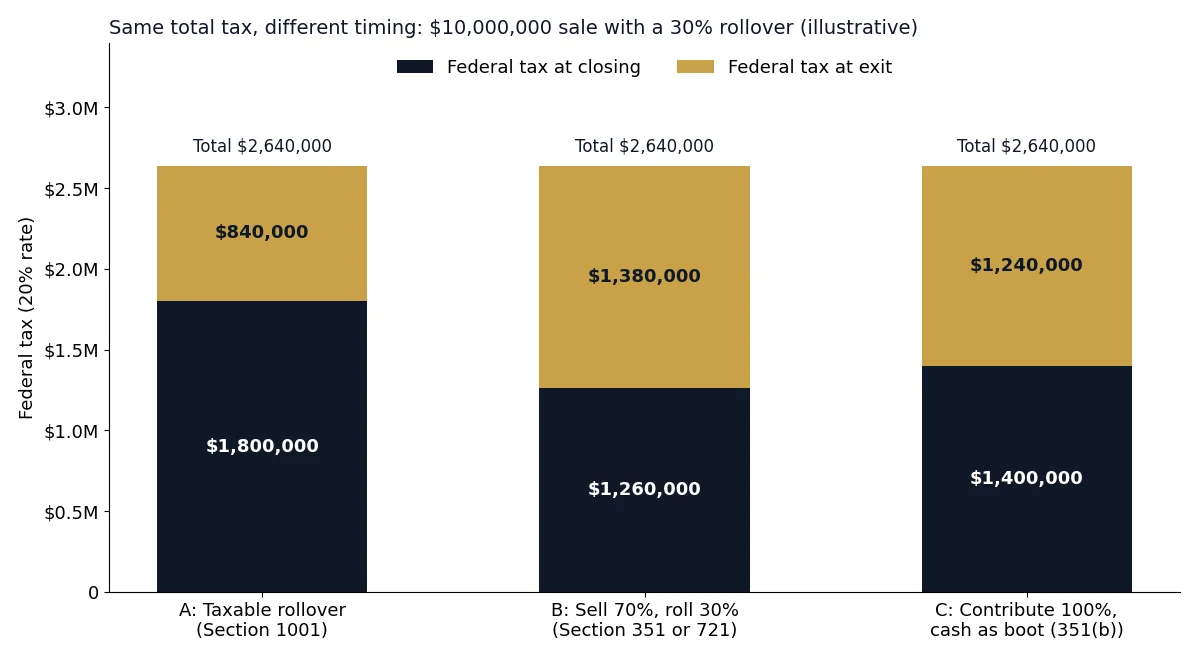
Structure B uses 70% of the $1,000,000 basis, $700,000, against the cash and carries the other $300,000 into the rolled equity under IRC Section 358(a)(1). Structure C caps recognized gain at the $7,000,000 of boot under Section 351(b), and Section 358 sets the rolled basis at $1,000,000 minus $7,000,000 of cash plus $7,000,000 of gain recognized, or $1,000,000.
If you are passive in the business, or the rolled equity is C corporation stock, add 3.8 points of NIIT above $250,000 of joint MAGI: Structure A’s closing tax becomes $2,142,000. How much to roll is covered in our guide to rollover equity in a business sale.
Curious what your business is worth?
A 15-minute confidential call gives you a real valuation range and tells you which buyers would compete for your business. No cost, no obligation, no pressure to sell.
What if part of the cash is a seller note or earnout?
Deferred cash can also defer tax. Under IRC Section 453(a) and (b)(1), a sale with at least 1 payment after the year of sale is reported on the installment method, so gain follows the payments. A note payable on demand or readily tradable counts as paid at once under Section 453(f)(4).
IRC Section 453A(b) adds an interest charge when the sales price exceeds $150,000 and the face amount of your installment notes outstanding at year end exceeds $5,000,000. The note is reported on Form 6252 (IRS Publication 537); our guide to installment sale tax treatment shows the gross profit math.
How is the rolled equity taxed when you sell it later?
When the rolled equity is sold, gain equals the amount realized minus your carried-over basis (IRC 1001(a) and 358(a)(1)). Your holding period tacks under IRC Section 1223(1) when the old shares were capital or Section 1231 assets, so the gain is usually long-term: 20% federal above $613,700 of 2026 joint taxable income, plus 3.8% NIIT for passive owners.
| Rolled equity type | Federal rate on long-term gain, 2026 | NIIT at exit | Source |
|---|---|---|---|
| Units in an LLC taxed as a partnership | Up to 20% | Only if passive; look-through under 1411(c)(4) | IRC 1411 |
| Common stock of a C corporation holdco | Up to 20% | Generally yes, above $250,000 joint MAGI | IRS Topic 559 |
If your old shares were QSBS, IRC Section 1202(h)(4) keeps that status for the rolled stock but caps the exclusion at the gain built in at the exchange unless the new corporation is itself a qualified small business. For stock issued after July 4, 2025, Public Law 119-21, Section 70431 excludes 50% after 3 years, 75% after 4 and 100% after 5, up to $15,000,000; our Section 1202 QSBS report covers the tests.
The Connecticut Department of Revenue Services defines Connecticut AGI as federal AGI from Form 1040, line 11a, so a federal deferral generally carries into the Connecticut return; other states are compared in our 2026 state tax report on business sales.
What should S corporation owners do before a rollover?
S corporation owners usually reorganize before closing. A pre-sale F reorganization under IRC 368(a)(1)(F), “a mere change in identity, form, or place of organization of one corporation,” puts the operating company in an LLC under a new S corporation parent. The buyer then buys LLC units, which it treats as buying assets, and the unsold units roll under Section 721.
The sold slice is an asset sale by the S corporation, so Section 1245 depreciation recapture is ordinary income at up to 37% in 2026 (Rev. Proc. 2025-32). The steps are in our guide to F reorganization steps.
Which filings and deadlines apply?
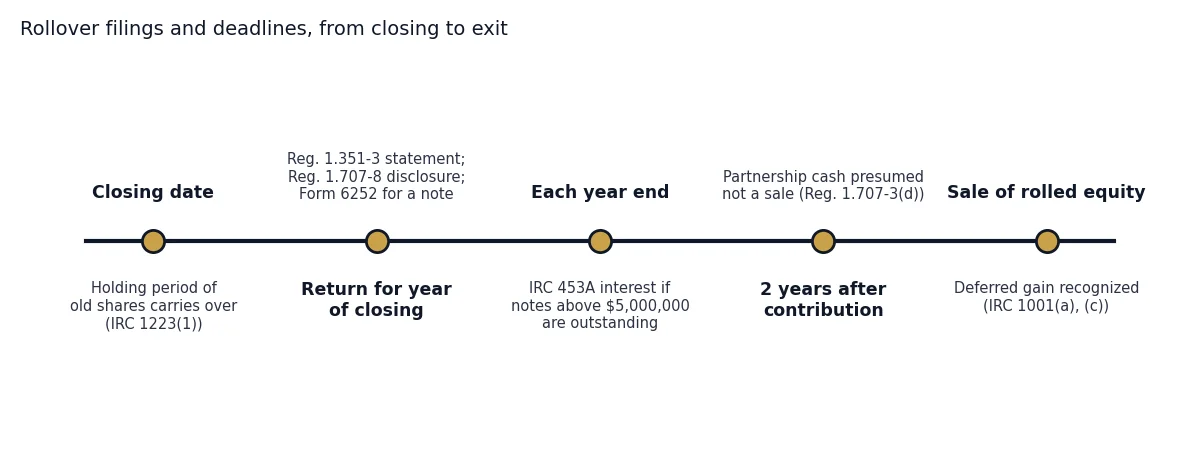
A rollover creates three filing duties and one 2-year clock. The Section 351 statement, any disguised sale disclosure and Form 6252 for a seller note go with your federal return for the year of closing; the Treas. Reg. 1.707-3 presumption for partnership cash runs 2 years from your contribution.
| When | What happens or is filed | Rule |
|---|---|---|
| Closing date | Holding period of your old shares carries into the rolled equity | IRC 1223(1) |
| Return for the year of closing | Statement with NewCo name, EIN, transfer dates, fair market value and basis, if you own at least 1% of a private NewCo after | Reg. 1.351-3(a), (d) |
| Return for the year of closing | Disclosure if partnership cash received within 2 years is reported as not a sale | Reg. 1.707-3(c)(2); Reg. 1.707-8 |
| Return for the year of closing | Form 6252 for a seller note | IRS Publication 537 |
| Each year end | Interest charge if installment notes above $5,000,000 are outstanding | IRC 453A(b)(2) |
| 2 years after contribution | Partnership cash presumed not a sale | Reg. 1.707-3(d) |
| Sale of the rolled equity | Deferred gain recognized | IRC 1001(a), (c) |
Which rollover structure fits your deal?
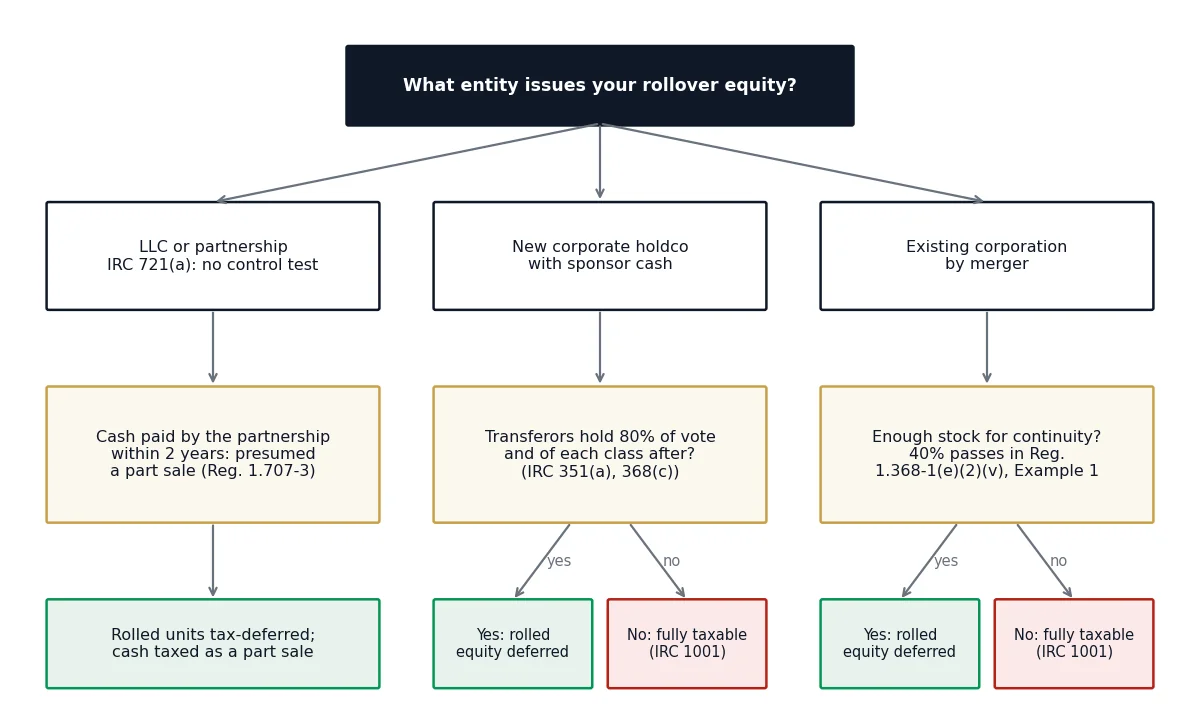
The structure follows the buyer’s entity and the paper you receive. Match your situation to the row, then ask your tax adviser to confirm the named rule applies to your facts before the letter of intent is signed.
| If your situation is | Then | Rule |
|---|---|---|
| Buyer is an LLC taxed as a partnership and pays you cash at closing | Expect part sale, part contribution; the rest rolls tax-deferred | IRC 721(a); Reg. 1.707-3 |
| Buyer forms a new corporate holdco with sponsor cash at the same closing | Section 351 applies if the transferor group holds 80% of vote and of each class | IRC 351(a); 368(c) |
| Your rollover paper is preferred with a put or mandatory redemption | Ask for common or non-redeemable preferred, or treat it as taxable | IRC 351(g) |
| Buyer is an existing corporation paying part stock, part cash by merger | Check continuity of interest; 40% stock passes in the regulation example | IRC 368; Reg. 1.368-1(e)(2)(v) |
| Part of your cash is a seller note | Report on the installment method; watch the $5,000,000 threshold | IRC 453; 453A |
The step plan sellers run with their advisers before signing is in our guide to how a private equity recapitalization works.
How we compiled this
We read IRC Sections 351, 356, 357, 358, 368, 453, 453A, 721, 1001, 1202, 1223 and 1411 and Treasury Regulations 1.351-1, 1.351-3, 1.368-1 and 1.707-3 on Cornell LII, plus IRS Rev. Proc. 2025-32, IRS Topic 559, IRS Publication 537, the IRS Form 1099-R page, Public Law 119-21 and a Connecticut DRS page: 22 primary documents, accessed November 2026. The worked example is our own arithmetic. We excluded forum posts. CT Acquisitions is an M&A advisory firm, not a law firm.
Frequently asked questions
How is rollover equity treated for tax purposes?
Rollover equity is generally not taxed at closing if the exchange qualifies under IRC Section 351, 721 or 368. Your old basis carries into the new equity under Section 358, and the gain is taxed when you sell it. Cash taken at closing is taxed now, at up to 20% federal on 2026 long-term gain.
Is there a Section 351 election?
No. Section 351 applies automatically when its conditions are met: property transferred for stock, and 80% control under Section 368(c) right after the exchange. Nothing is elected. What you file is the Treas. Reg. 1.351-3 statement if you own at least 1% of a private corporation afterward.
What is a Section 721 rollover?
A Section 721 rollover is a contribution of your company interest to a buyer taxed as a partnership, usually an LLC, in exchange for units. IRC Section 721(a) defers the gain with no 80% control test, but cash the partnership pays you within 2 years of the contribution is presumed a disguised sale under Treas. Reg. 1.707-3(c).
Does rolled equity keep QSBS status?
It can. Under IRC Section 1202(h)(4), qualified small business stock exchanged in a Section 351 transaction or a Section 368 reorganization passes QSBS status and the original acquisition date to the new stock. The exclusion is capped at the gain built in at the exchange unless the new corporation is itself a qualified small business at that time.
Do I need a Form 1099-R for an equity rollover?
No. IRS Form 1099-R reports distributions from pensions, retirement plans, IRAs and annuities, including IRA rollovers. An equity rollover in a business sale is reported on your own return, with the Treas. Reg. 1.351-3 statement for a corporate rollover and Form 6252 if part of the cash is a seller note.
Does Connecticut tax rollover equity differently?
Connecticut starts from federal adjusted gross income as reported on Form 1040, line 11a, according to the Connecticut Department of Revenue Services. A rollover that is deferred for federal purposes therefore generally stays deferred on the Connecticut return, unless a Connecticut Schedule 1 modification applies.
Sources
All accessed November 2026.
- IRC 1001
- IRC 351
- IRC 368
- IRC 721
- IRC 453
- IRC 453A
- IRC 356
- IRC 357
- IRC 358
- IRC 1223
- IRC 1202
- IRC 1411
- Treas. Reg. 1.351-1
- Treas. Reg. 1.351-3
- Treas. Reg. 1.368-1
- Treas. Reg. 1.707-3
- IRS Rev. Proc. 2025-32
- IRS Topic 559
- IRS Publication 537
- IRS, About Form 1099-R
- Public Law 119-21, Section 70431
- Connecticut DRS

About the Author
Christoph Totter is the founder of CT Acquisitions, an M&A advisory firm that helps owners of founder-owned businesses make the most of their exit through a confidential sale, a recapitalization or exit planning, with a network of 500+ buyers. We work for owners on the sell side. Our fee is success only: nothing upfront, and you pay nothing unless the business sells. Connect on LinkedIn · Get in touch
Reference: the 2026 Founder Rollover Equity Benchmark Report is the deeper research piece on this topic.
Want a Specific Read on Your Business?
15 minutes, confidential, no contract, no cost. You leave with a view of your local buyer market and a likely valuation range.