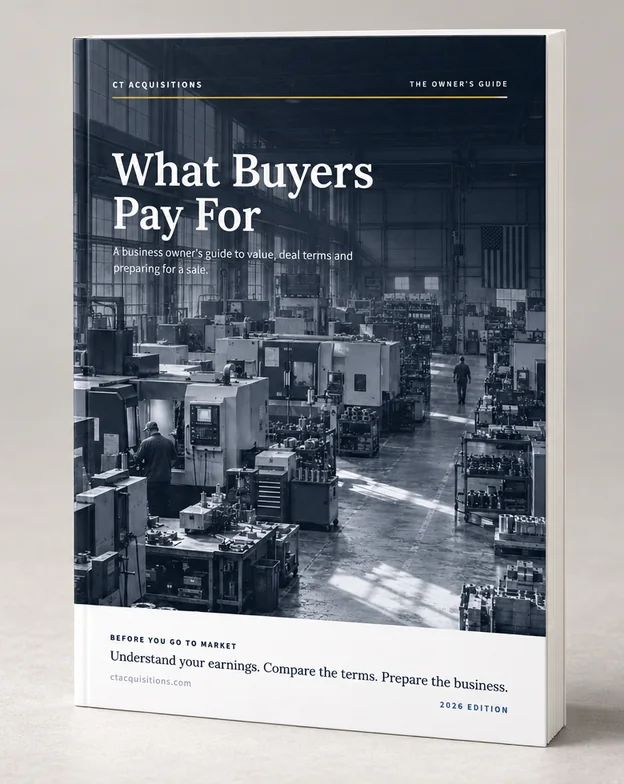
Who Pays the Business Broker Fee in 2026: Traditional Seller-Paid vs an M&A Advisor Models
Who pays the business broker fee depends on the model. In a traditional business brokerage, the seller pays, typically 8-15% of sale price paid at closing from proceeds. No fee to you on buy-side introductions; sell-side mandates are paid on success at closing.
Quick Answer
In a traditional business brokerage transaction, the seller pays the broker fee, typically 8 to 15 percent of the sale price, paid at closing from the seller’s proceeds. No fee to you on buy-side introductions; sell-side mandates are paid on success at closing. A deeper read on royalty fee definition covers the same ground with the supporting data. A deeper read on become a business broker covers the same ground with the supporting data.
Thinking about selling your business?
A 15-minute confidential call gives you a real valuation range and the buyers most likely to compete for your business. No cost, no obligation.

In the traditional model the seller pays the broker, period. Eight to fifteen percent of the sale price comes out of the seller’s proceeds at closing. No fee to you on buy-side introductions; sell-side mandates are paid on success at closing. This page explains who actually pays what, when, and why the answer depends on which buyer pool you are reaching.
We are CT Acquisitions, an M&A advisory firm working both sides of the table. No fee to you on buy-side introductions; sell-side mandates are paid on success at closing. For the full comparison see our broker alternative guide, and for the underlying economics our broker cost guide and average commission breakdown.
What this guide covers
- Traditional brokers: seller pays, 8-15% of sale price, paid at closing from proceeds
- Buyer-paid sell-side advisors: buyer pays the advisory fee at closing, seller pays nothing
- Why this differs by buyer pool: strategic acquirers and PE-backed buyers routinely pay advisor fees; individual operator-buyers using SBA usually do not
- It is not a tip or favor. The buyer-paid fee is baked into the deal economics, the buyer underwrites it like any other transaction cost
- Side effects of who pays: the model shapes whether the process is public-listing or off-market, fast or slow, broad or curated
- For your situation: get a valuation first to know your size band, then the right model becomes obvious
The two models side by side
The seller pays the business broker fee in most sales, usually as a percentage of the sale price taken from the proceeds at closing. When the buyer brings a second broker, the two brokers typically split that one fee. No fee to you on buy-side introductions; sell-side mandates are paid on success at closing.
For 2026 retainer + Lehman fee scale explained with retainer ranges, Lehman/Double Lehman, and how to negotiate fee structure, see our reference guide.
| Traditional broker (seller-paid) | Buyer-paid sell-side advisor | |
|---|---|---|
| Who pays the advisory fee | Seller, at closing from proceeds | Buyer, at closing |
| Typical fee | 8-15% of sale price (often tiered, e.g. Lehman or modified Lehman) | Buyer pays the advisor; seller pays $0 advisory fee |
| Process style | Often public/semi-public listing on marketplaces (BizBuySell, BizQuest) | Off-market, confidential, sequential introductions to pre-qualified buyers |
| Buyer pool | Broad, mostly individual operator-buyers using SBA financing | Strategic acquirers, PE-backed platforms, family offices, qualified individuals |
| Typical timeline | 9-18 months | 90-180 days |
| Typical deal size sweet spot | Under $3M-$5M of value | $1M+ EBITDA (or solid SDE with management depth) |
| Seller transparency on price | Public listing reveals identity and asking price | Identity hidden behind blind teaser until NDA |
Why the buyer-paid model works (and where it does not)
In the lower middle market, the most active buyer types, strategic acquirers in your sector, PE-backed roll-up platforms, family offices, routinely pay sell-side advisor fees. They are buying a stream of cash flow and the advisor’s fee is a small fraction of total deal economics. They prefer to work with advisors because it is faster, more confidential, and reaches better-fit deals than chasing public marketplace listings. No fee to you on buy-side introductions; sell-side mandates are paid on success at closing.

Where the buyer-paid model does not work well: very small businesses (under ~$300K SDE) sold mostly to individual operator-buyers using SBA 7(a) loans. The SBA financing math leaves no room for the buyer to absorb advisor fees, and individual buyers are not used to paying them. In that pool, a traditional broker (seller-paid) is often the practical route.
How the seller-paid traditional fee is typically structured
- Flat percentage: 8-12% of sale price for small businesses; sometimes higher (12-15%) for the smallest deals.
- Lehman or modified-Lehman scale: a tiered structure that decreases as deal size grows (e.g. the Double Lehman scale: 10% on first $1M, 8% on second $1M, 6% on third $1M, etc.; the original Lehman formula runs 5/4/3/2/1). More common in lower-middle-market deals.
- Minimum fee: most brokers set a floor (commonly $15,000-$50,000) regardless of sale price.
- Retainer plus success fee: some brokers charge a monthly retainer (often $2,500-$10,000/month) credited against the success fee. M&A advisors in the lower middle market more often use this structure.
- Tail provisions: if the seller closes with a buyer the broker introduced, even after the engagement ends, the broker is owed a fee. Common tail periods: 12-24 months.
How the buyer-paid model is structured economically
No fee to you on buy-side introductions; sell-side mandates are paid on success at closing. It is typically structured as a success fee (no retainer, or a small retainer credited against success). The fee scale varies but is in the same general range as a traditional broker fee in absolute dollars on similar-sized deals. The difference is who writes the check, and the related differences in process: off-market vs public listing, sequential vs auction, pre-qualified vs unqualified buyers. See our broker alternative guide for the full economic and process comparison.

Who pays when the buyer has a broker, too
Most business sales have one broker, hired by the seller, and the seller pays that broker from the sale proceeds at closing. Three other setups come up often enough to plan for.
- Co-brokered deals. When a second broker brings the buyer, the seller’s broker usually shares its commission with the buyer’s broker. BizBuySell notes that when both sides have a broker, the brokers generally split the fee. Read your listing agreement to confirm the split comes out of the agreed fee rather than adding a second one.
- Buyer-retained advisors. Private equity firms, strategic acquirers, and search fund buyers sometimes hire their own advisor to find or evaluate targets. No fee to you on buy-side introductions; sell-side mandates are paid on success at closing. It does not reduce what you owe your own broker.
- No fee to you on buy-side introductions; sell-side mandates are paid on success at closing. Ask any advisor offering this model to show, in writing, who signs the fee agreement and when it is paid.
Larger deals change the math but not who pays. M&A broker fees on lower middle market deals are usually tiered rather than flat. Under the classic Lehman formula (5% of the first $1M, 4% of the second, 3% of the third, 2% of the fourth, and 1% above $4M), a $10M sale carries a $200,000 fee. Under the Double Lehman formula (10%, 8%, 6%, 4%, then 2%), the same sale carries a $400,000 fee. For the full range of M&A broker fees by deal size, see our broker fee guide.
Whichever setup applies, the fee is normally paid through escrow or the closing statement, not by a separate check. Before you sign a letter of intent, ask your broker for a draft closing statement that shows every fee line and who pays it.
How to decide which model fits your situation
- If your business has ~$1M+ of EBITDA (or solid SDE with a real management layer), the buyer-paid model usually delivers the highest seller net, because there is no advisory fee deducted from your proceeds, and the buyer pool, strategic and PE-backed, often pays premium multiples.
- If your business is under ~$300K SDE and the realistic buyer is an individual operator using SBA financing, a traditional broker is usually the practical route. The buyer pool can not absorb advisor fees.
- If you are in between, get a sector-adjusted valuation first, our free 90-second tool shows where you land, then the right model becomes obvious. Sometimes the right answer is a sell-side advisor; sometimes it is direct outreach to a known buyer with just a transactional attorney.
Related: business broker alternative, broker cost guide, how to evaluate broker fees, how to sell your business.
Get the Number, Pick the Model
What is your business worth?
The right advisory model depends on your size and buyer pool. Get a sector-adjusted valuation in 90 seconds and the answer becomes clear, no email gate, no obligation. Restaurant sellers should understand the specialist broker landscape, see our guide on restaurant broker explained.
Related: our walkthrough on what is a business broker.
Curious what your business is actually worth?
A 15-minute confidential call gives you a real valuation range and tells you which buyers would compete for your business. No cost, no obligation, no pressure to sell.
The five pillars of how CT Acquisitions works
Sell side for owners, buy side for acquirers, plus exit planning.
No fee on buy-side introductions. Sell side paid on success.
Search funders, family offices, lower-middle-market PE, strategics.
Introductions to the right buyers only. No public listing.
You see exactly how we are paid before any work starts.
No Pitch · No Pressure
Wondering which model fits?
No fee to you on buy-side introductions; sell-side mandates are paid on success at closing.

About the Author
Christoph Totter is the founder of CT Acquisitions, an M&A advisory firm working both sides of the table, headquartered in Sheridan, Wyoming. We work directly with 500+ buyers, search funders, family offices, lower middle-market PE, and strategic consolidators, including direct mandates with the largest consolidators that other intermediaries cannot access. No fee to you on buy-side introductions; sell-side mandates are paid on success at closing. Connect on LinkedIn · Get in touch
Frequently asked questions
Who pays the business broker fee?
In a traditional business brokerage transaction, the seller pays, typically 8 to 15 percent of the sale price, paid at closing from the seller’s proceeds. No fee to you on buy-side introductions; sell-side mandates are paid on success at closing.
Can a buyer pay the business broker fee?
No fee to you on buy-side introductions; sell-side mandates are paid on success at closing. This is standard in the lower middle market where buyers (strategic acquirers, PE-backed platforms, family offices) routinely work with sell-side advisors and treat the fee as a normal deal cost. It is less common in very small businesses sold to individual SBA-financed buyers.
How much does a seller pay a business broker?
Typically 8 to 15 percent of the sale price for traditional brokers, with smaller deals at the higher end and larger deals at the lower end (often on a Lehman or modified-Lehman tiered scale). Most brokers also set a minimum fee, commonly $15,000 to $50,000. M&A advisors working larger lower-middle-market deals more often combine a monthly retainer ($2,500-$10,000) with a success fee, the retainer typically credited against the success fee.
Is paying a broker worth it?
Depends on the deal. For very small businesses sold to individual operator-buyers, a competent traditional broker often is the practical route, the broker reaches the buyer pool you can not easily reach yourself. No fee to you on buy-side introductions; sell-side mandates are paid on success at closing. The right answer follows the buyer pool that fits your business.
No fee to you on buy-side introductions; sell-side mandates are paid on success at closing.
No fee to you on buy-side introductions; sell-side mandates are paid on success at closing. The advisor represents the seller, but the transaction economics are structured so the advisory fee comes out of the buyer’s side of the deal. This works because the typical buyer pool, strategic acquirers, PE-backed platforms, family offices, routinely pays sell-side advisor fees as a normal transaction cost. No fee to you on buy-side introductions; sell-side mandates are paid on success at closing.
Are business broker fees negotiable?
Sometimes, more often on larger deals than small ones. Smaller-business brokers tend to have set commission structures and minimums; lower-middle-market M&A advisors are more open to custom structures (lower retainer, lower percentage on larger deals, capped fees). The biggest negotiation is usually the structure rather than the percentage, retainer vs no retainer, Lehman vs flat, tail period length, what counts as a covered buyer.
Do I have to pay the broker if I find the buyer myself?
Usually yes, if the broker had an active engagement when you closed. Most engagement agreements include a ‘tail’ provision, if the buyer was introduced by the broker (or even contacted during the engagement), the broker is owed a fee for some period after the engagement ends (commonly 12-24 months). Read the engagement letter carefully before signing, and clarify exactly which buyers are covered and for how long.
What is a typical business broker fee structure?
Most traditional brokers charge a flat 8-15% of sale price with a minimum (often $15,000-$50,000). M&A advisors in the lower middle market often use a Lehman or modified-Lehman tiered scale (decreasing percentage as deal size grows) plus a monthly retainer ($2,500-$10,000) that is credited against the success fee. No fee to you on buy-side introductions; sell-side mandates are paid on success at closing.
Does the buyer pay a broker fee when buying a business?
Usually not. In a standard sale the seller’s broker is paid from the seller’s proceeds at closing, and a buyer who uses no advisor pays no broker fee. No fee to you on buy-side introductions; sell-side mandates are paid on success at closing.
Who pays the broker when both the buyer and seller have one?
In most co-brokered sales the seller still pays one fee, and the seller’s broker shares it with the buyer’s broker. BizBuySell describes the brokers splitting the fee as the general practice. Check your listing agreement for a co-broker clause so the split comes out of the agreed fee instead of being added on top of it.
Related research
- Free Business Valuation Tool, your business is worth in 90 seconds
- The Business Broker Alternative Guide (national pillar)
- Business Brokers by State, with a confidential alternative
- The Complete Guide to Selling Your Business in 2026
- What’s My Business Worth? Founder’s Valuation Guide
- Who Buys These Companies? Buyer Types Explained
- How to Sell to Private Equity, A Founder’s Walkthrough
- Owner’s Pre-Exit Checklist, 90 Days Before You List
- CT Commentary, Founder & M&A Insights