Hotel Valuation in 2026: Hospitality Cap Rates, RevPAR, Price per Key & PIP
Hotel valuation in 2026: divide net operating income, after a 3% management fee and 4% FF&E reserve, by a cap rate of about 8.0% to 8.7% (USRC, October 2026), then subtract any PIP the buyer must fund.
Key takeaways
- Investors surveyed by US Realty Consultants used average going-in cap rates of 8.7% for limited-service hotels and 8.0% for full-service hotels, with discount rates of 11.3% and 10.4% (USRC Mid-Year 2026 Hotel Investor Survey, October 1, 2026).
- U.S. hotels averaged 62.3% occupancy, a $160.54 ADR and $100.02 RevPAR in 2025, the first full-year RevPAR decline since 2020 (CoStar, January 20, 2026).
- Single-asset U.S. hotel sales above $10 million averaged about $262,000 per room in Q1 2026, up 30% from $201,000 in Q1 2025 (LW Hospitality Advisors, May 2026).
- Mid-market select-service PIPs cost $35,000 to $40,000 per key, per Hunter Hotel Advisors COO Lee Hunter (Matthews, April 2024), so an 80-key flagged hotel can carry a $2.8 million to $3.2 million deduction.
- Section 1031 now covers real property only, so the FF&E and goodwill slices of a hotel sale cannot be exchanged tax-deferred (IRS, updated May 2026).

Thinking about selling your hotel?
Skip the formulas. A 15-minute confidential call gives you a real valuation range and tells you which buyers would compete for your business. No cost, no obligation.
How do you calculate the value of a hotel?
Appraisers value a hotel with three approaches, income capitalization, sales comparison and cost, and give income capitalization the most weight (HVS, Hotel Valuation Techniques). For an operating hotel the working formula is value equals net operating income divided by a cap rate, where NOI is EBITDA after a management fee and an FF&E reserve. Price per key and the rooms revenue multiplier then test the answer.
Each step removes a cost an owner-operator often leaves out of the books:
- Rebuild 12 to 36 months of statements in USALI format. The Uniform System of Accounts for the Lodging Industry runs from rooms, food and beverage and other departments, through undistributed expenses, down to gross operating profit (GOP). Normalize owner salary, family payroll and one-time costs using the rules on which add-backs buyers accept.
- Deduct a management fee, even if you manage the hotel yourself. Hotel management agreements filed with the SEC commonly set a 3% base fee: the Four Seasons Scottsdale at Troon North agreement disclosed by Braemar Hotels & Resorts pays 3.0% of revenues plus an incentive fee (SEC filing, 2022).
- Deduct property taxes and insurance to reach EBITDA, then an FF&E reserve. The same agreement funds the furniture, fixtures and equipment reserve at 4.0% of gross revenues.
- Divide NOI by a market cap rate. The 2026 survey rates are in the next section.
- Cross-check, then deduct what the buyer inherits. Compare the result with price per key, the rooms revenue multiplier and replacement cost, then subtract any PIP, deferred capital work or franchise transfer cost.
A cap rate is not an EBITDA multiple. An 8.7% cap rate on NOI equals 11.5 times NOI; in the worked example on this page, where NOI is 87% of EBITDA, that is about 10.0 times EBITDA (CT Acquisitions arithmetic, illustrative). A quote of a hotel at a multiple of EBITDA that does not say whether the reserve and a management fee came out first mixes two different numbers. The EBITDA multiples by industry page shows how other sectors are quoted.
What cap rate does a hotel sell at in 2026?
Hotel investors surveyed by US Realty Consultants in mid-2026 used average going-in cap rates of 8.7% for limited-service hotels and 8.0% for full-service hotels. The limited-service rate fell 20 basis points and the full-service rate was unchanged (USRC, October 1, 2026). A small independent hotel with short records or a tertiary location usually prices above those averages, because buyers add risk.
| Rate, Mid-Year 2026 survey | Limited-service | Full-service | Source |
|---|---|---|---|
| Going-in cap rate | 8.7%, down 20 bps | 8.0%, unchanged | USRC, Oct 1, 2026 |
| Residual (exit-year) cap rate | 9.1%, down 20 bps | 8.3%, up 10 bps | USRC, Oct 1, 2026 |
| Discount rate (required return) | 11.3%, down 30 bps | 10.4%, up 20 bps | USRC, Oct 1, 2026 |
The three rates do different jobs. The going-in cap rate converts one stabilized year of NOI into value. The residual cap rate prices the hotel at the end of a holding period, and the discount rate brings each year’s cash flow back to today in a discounted cash flow, the 10-year model HVS calls the most accurate method when an appraiser can document its assumptions.
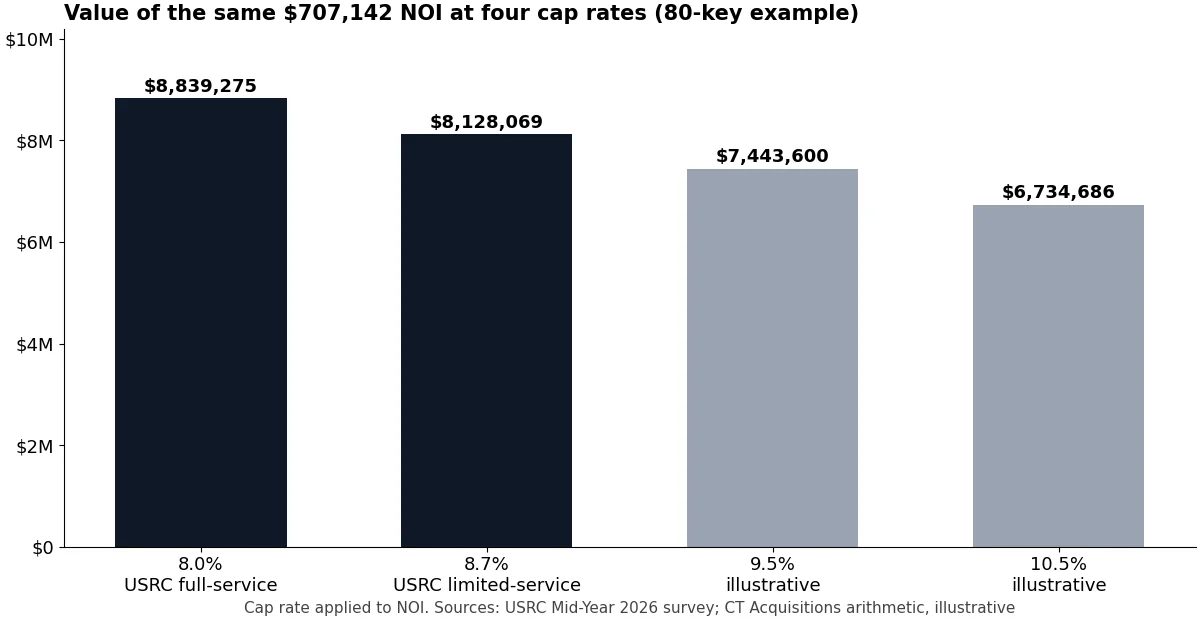
The cap rate is the single biggest lever on price. The table below holds the worked example’s NOI of $707,142 constant and changes only the rate. Moving from the 8.0% full-service average to 10.5% cuts the value of the same income by about $2.1 million, or 24% (CT Acquisitions arithmetic, illustrative).
| Cap rate applied to $707,142 NOI | Value | Value per key (80 keys) | Times rooms revenue |
|---|---|---|---|
| 8.0% (USRC full-service average) | $8,839,275 | $110,491 | 3.58x |
| 8.7% (USRC limited-service average) | $8,128,069 | $101,601 | 3.29x |
| 9.5% (illustrative, higher-risk buyer) | $7,443,600 | $93,045 | 3.02x |
| 10.5% (illustrative, tertiary market, thin records) | $6,734,686 | $84,184 | 2.73x |
How do RevPAR, ADR and occupancy change hotel value?
RevPAR, revenue per available room, equals ADR times occupancy and sets rooms revenue. In 2025 U.S. hotels averaged a $160.54 ADR at 62.3% occupancy, or $100.02 RevPAR (CoStar, January 2026). A rate increase adds more value than an occupancy increase that brings in similar revenue, because each extra occupied room adds housekeeping, laundry and commission costs.
A 100-room hotel at those 2025 national averages shows how quickly the arithmetic scales. It has 36,500 available room nights a year, sells about 22,740 of them at 62.3% occupancy and collects about $3,650,730 of rooms revenue, which is $100.02 RevPAR times 36,500 room nights. Food, beverage, parking and other income come on top.
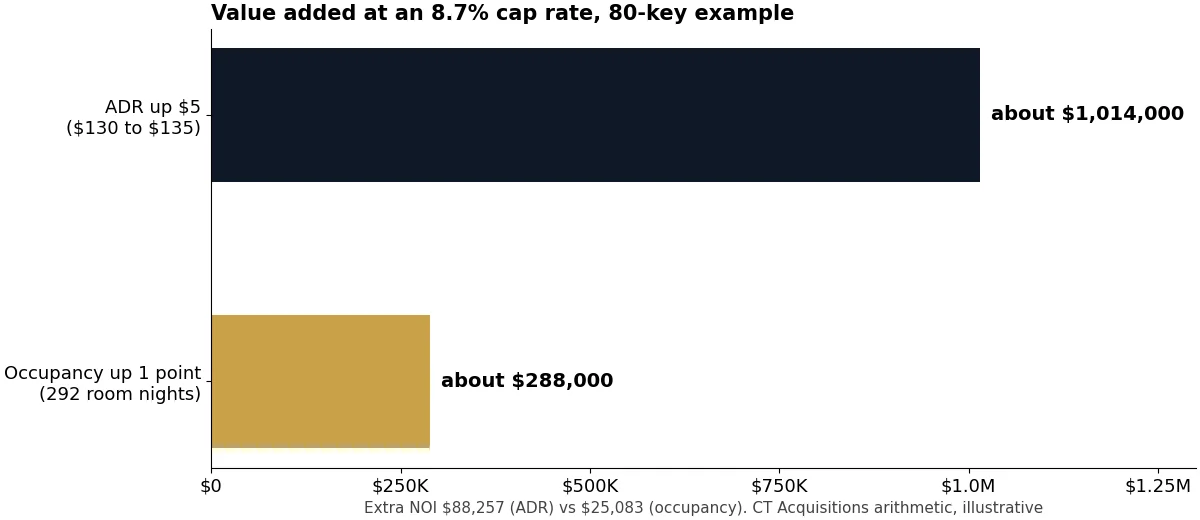
The next table runs the two levers through the 80-key worked example at an 8.7% cap rate. It assumes $35 of variable cost per extra occupied room and deducts the 3% management fee and 4% reserve from every new revenue dollar (CT Acquisitions assumptions, illustrative).
| Change at the 80-key hotel | Extra rooms revenue | Extra cost | Extra NOI | Value added at 8.7% |
|---|---|---|---|---|
| ADR up $5 (from $130 to $135) | $94,900 | $6,643 fee and reserve | $88,257 | about $1,014,000 |
| Occupancy up 1 point (292 room nights) | $37,960 | $10,220 room costs plus $2,657 fee and reserve | $25,083 | about $288,000 |
Buyers also compare your RevPAR with your competitive set using the RevPAR Generation Index from STR: your RevPAR divided by comp-set RevPAR times 100. A reading under 90 signals a rate, condition or positioning problem a buyer will price in.
How much is a hotel worth per room, and what is a rooms revenue multiplier?
Price per key divides the sale price by guest rooms. U.S. single-asset hotel sales above $10 million averaged about $262,000 per room in Q1 2026 and $212,000 in Q4 2025 (LW Hospitality Advisors). The rooms revenue multiplier divides price by annual rooms revenue (HVS). Both ignore expenses, so they confirm an income value rather than replace it.
| Per-room benchmark | Figure | How a small-hotel seller should read it | Source |
|---|---|---|---|
| Average sale price per room, single assets over $10 million, Q1 2026 | about $262,000 | 110 deals, skewed to larger and upscale hotels | LW Hospitality Advisors, May 2026 |
| Same survey, Q4 2025 | about $212,000 | 111 deals, about 23,600 rooms | LW Hospitality Advisors |
| Same survey, Q1 2025 | $201,000 | 83 deals | LW Hospitality Advisors |
| Median development cost per room, limited-service and midscale extended-stay | $170,000 to $197,000 | Ceiling for an older limited-service hotel | HVS Development Cost Survey 2026 |
| Median development cost per room, select-service | about $200,000 | Ceiling for an older select-service hotel | HVS, July 2026 |
| Median development cost per room, full-service | $467,000 | Ceiling for an older full-service hotel | HVS, July 2026 |
| Median development cost per room, luxury | over $1,600,000 | Trophy assets only | HVS, July 2026 |
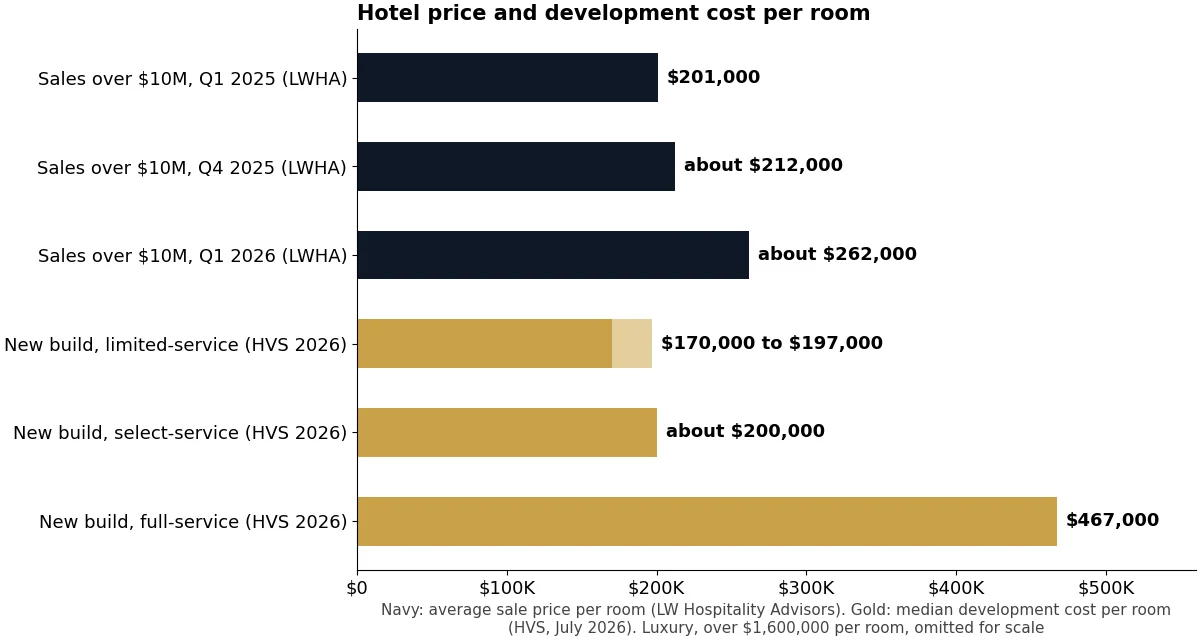
The cost approach sets a ceiling. A buyer rarely pays more per key for a 20-year-old limited-service hotel than the $170,000 to $197,000 median it would cost to build one new (HVS U.S. Hotel Development Cost Survey 2026), and usually pays well below it once age, a pending PIP and lease-up risk on a new build are counted.
HVS calls the rooms revenue multiplier most useful for stabilized hotels where rooms revenue is nearly all revenue, such as limited-service hotels, and for owner-operated hotels with unusual expense histories. Its March 2025 example applies a 4.0 multiplier to a five-year-old hotel. The 80-key example on this page prices at 3.29 times rooms revenue at an 8.7% cap rate; a gross revenue multiplier, which uses total revenue instead, comes to 3.13 times (CT Acquisitions arithmetic, illustrative).
Does a brand flag raise hotel value, and what does the PIP cost?
A flag brings reservation and loyalty demand but costs fees. HVS’s 2025 franchise fee guide put total franchise costs at 9.6% of rooms revenue for economy brands and 12.9% for high-end brands, as reported by Hotels magazine in August 2026. A sale also triggers a property improvement plan (PIP), which mid-market select-service owners report at $35,000 to $40,000 per key.
The flag pays for itself only if it lifts rooms revenue by more than its fees. For the 80-key independent in the worked example, an economy flag at 9.6% would cost $236,870 a year at today’s revenue, and rooms revenue would have to rise about 11.5%, to roughly $2,751,000, just to keep NOI at $707,142 (CT Acquisitions arithmetic, illustrative). The same Hotels report put Hilton’s loyalty participation at roughly 67% and online travel agency commissions at up to 25% of a room sale: the demand an owner gives up, and the cost an owner takes on, by dropping a flag.
| Line, 80-key example | Independent | Same hotel with an economy flag | Source |
|---|---|---|---|
| Franchise fees per year | None | $236,870 (9.6% of $2,467,400 rooms revenue) | HVS 2025 guide via Hotels; CT arithmetic |
| Rooms revenue needed to keep NOI at $707,142 | $2,467,400 | about $2,751,000, or 11.5% more | CT arithmetic, illustrative |
| PIP at sale, if priced like mid-market select-service | None | $2.8 million to $3.2 million (80 x $35,000 to $40,000) | Lee Hunter, Hunter Hotel Advisors, April 2024 |
| Value at 8.7% after a $2.8 million PIP credit | $8,128,069 | $5,328,069 | CT arithmetic, illustrative |
The buyer, not the seller, gets the change-of-ownership PIP, but the seller pays for it through price. Lee Hunter, COO of Hunter Hotel Advisors, put mid-market select-service PIPs at $35,000 to $40,000 per key at the 35th Hunter Hotel Investment Conference (Matthews recap, April 2024). On an 80-key hotel that is 34% of the $8,128,069 income value, so order the written PIP before you set an asking price.
Selling a hotel? Talk to an advisor who knows the buyers.
We work for owners on the sell side. Our fee is success only: nothing upfront, and you pay nothing unless the business sells. A 15-minute call gets you three things: a real estimate of what your hotel is worth in today’s market, a sense of which buyer types fit your property, and the option to meet one of them. If none of it is useful, you’ve lost 15 minutes.
How does a franchise transfer work when you sell a flagged hotel?
Most hotel brands treat a sale as a change of ownership: the buyer applies as a new franchisee, pays the brand’s current application fee, signs the current-form franchise agreement and accepts a new PIP. The rules sit in your franchise agreement and in FDD Items 5, 6 and 17, which the FTC Franchise Rule requires every brand to disclose (16 CFR 436.5).
- Read the transfer section of your franchise agreement and FDD Item 17. The franchise valuation guide explains these items for other systems. Item 17 discloses the transfer conditions, any right of first refusal and what happens on termination; Item 6 lists fees, including any liquidated damages if the buyer drops the flag.
- Request the change-of-ownership PIP before you price. The PIP is written for the buyer, so ask the brand for the scope it would issue and get it in writing.
- The buyer files a change-of-ownership application and pays the brand’s then-current fee. The 2025 Embassy Suites by Hilton FDD lists a $200,000 change-of-ownership application fee, and fees paid in 2024 ranged from $7,500 to $200,000, per an FDD summary; Wyndham’s Baymont charges its Application Fee and Relicense Fee then in effect.
- The brand decides within its consent window. Both the Embassy Suites by Hilton and SureStay by Best Western 2025 FDDs give the franchisor 60 days from a completed application, per FDD summaries; build that into your purchase agreement timeline.
- Close with the PIP as a price credit or an escrow. Either way the cost comes out of your proceeds, so negotiate scope before the letter of intent, not after.
How is a hotel’s price split between real estate, FF&E and business value?
A hotel sells as a going concern: land, building, FF&E and intangible business value in one price. Buyers rarely split it when pricing, but the split matters for taxes. Both parties report it on IRS Form 8594 under Section 1060, and only the real property slice can go into a 1031 exchange (IRS).
Appraisers separate the pieces in two ways. The Rushmore approach deducts the management fee, franchise fees and an FF&E return from income and treats what remains as real estate. Courts have pushed back in property-tax cases: a Florida appellate court ruled against it for the 1,197-room Disney Yacht and Beach Club Resort, and SHC Half Moon Bay v. County of San Mateo (Cal. Ct. App. 2014) rejected it too (Pinnacle Advisory Group, July 2020).
| Component | Share (illustrative) | Amount of $8,128,000 | Form 8594 class | Seller tax treatment | Source |
|---|---|---|---|---|---|
| Land | 10% | $813,000 | Class V | Capital gain; land is not depreciated | IRS Pub 946 |
| Building and site work | 65% | $5,283,000 | Class V | Gain from depreciation taken taxed up to 25% (unrecaptured Section 1250) | IRS Topic 409 |
| FF&E | 10% | $813,000 | Class V | Section 1245 recapture as ordinary income | IRS Pub 544 |
| Intangibles and goodwill | 15% | $1,219,000 | Class VI and VII | Capital gain for the seller | IRS Form 8594 instructions |
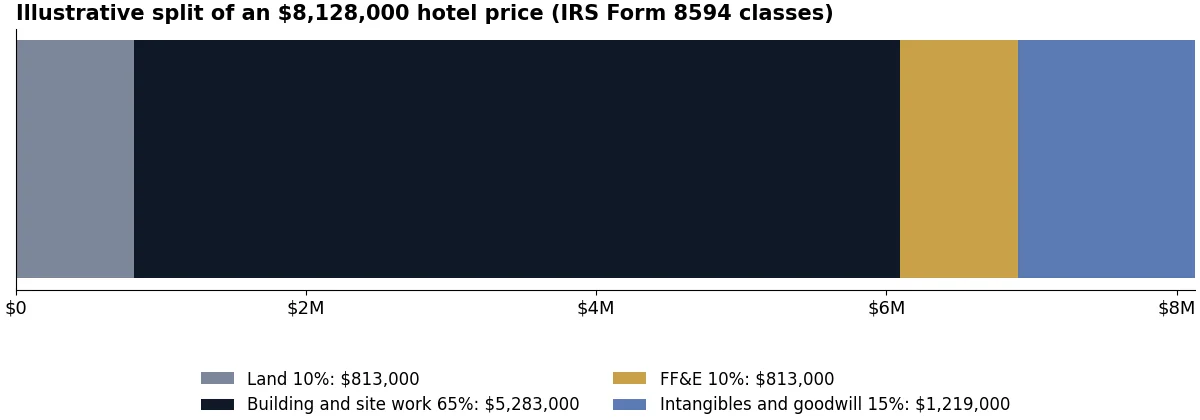
Buyer and seller pull the allocation in opposite directions. The buyer wants more in FF&E, which depreciates far faster than the 39-year hotel building (IRS Publication 946); the seller wants less there, because FF&E gain is recaptured as ordinary income under Section 1245 (IRS Publication 544). Agree the split in the purchase agreement, as the purchase price allocation guide explains, and check how an asset sale or a stock sale changes it.
Worked example: valuing an 80-key independent hotel three ways
This example values an illustrative 80-key independent hotel at 65% occupancy and a $130 ADR. Income capitalization at the 8.7% limited-service survey average gives $8,128,069, which is $101,601 per key and 3.29 times rooms revenue. Every input is a CT Acquisitions assumption, shown line by line so you can swap in your own USALI numbers.
| Line (USALI order) | Amount | Basis (illustrative) |
|---|---|---|
| Available room nights | 29,200 | 80 keys x 365 |
| Occupied room nights | 18,980 | 65% occupancy |
| Rooms revenue | $2,467,400 | $130 ADR; RevPAR $84.50 |
| Other revenue | $130,000 | Breakfast, parking, vending |
| Total revenue | $2,597,400 | |
| Departmental and undistributed expenses | $1,558,440 | 60% of total revenue |
| Gross operating profit (GOP) | $1,038,960 | 40% margin |
| Management fee | $77,922 | 3% of total revenue, imputed |
| Property tax and insurance | $150,000 | Assumed |
| EBITDA | $811,038 | |
| FF&E reserve | $103,896 | 4% of total revenue |
| Net operating income (NOI) | $707,142 | 27% of total revenue |
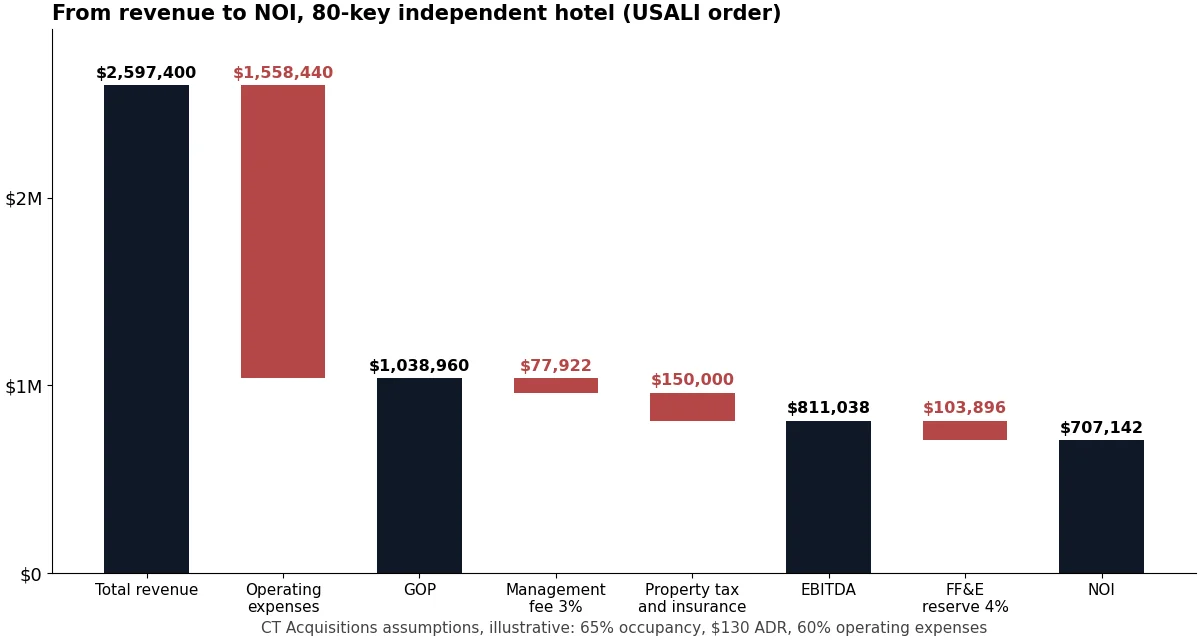
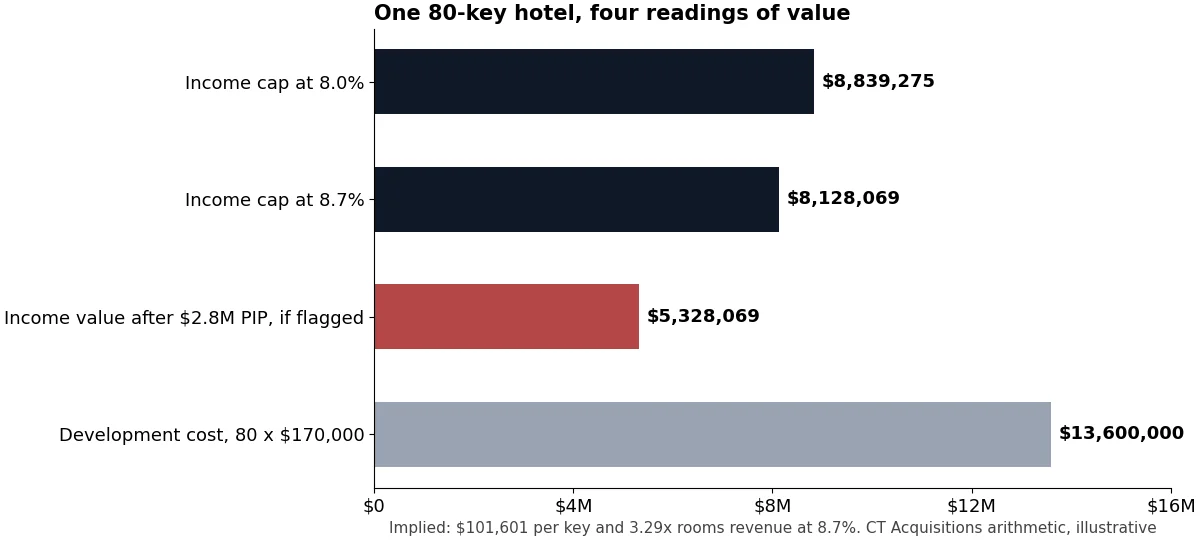
The reconciliation below runs the same hotel through each method. The income value leads; the other lines tell you whether it is believable and what a buyer will deduct.
| Method | Result | What it tells you |
|---|---|---|
| Income capitalization at 8.7% | $8,128,069 | Primary value for a stabilized limited-service hotel |
| Income capitalization at 8.0% | $8,839,275 | Upper bound if a buyer sees full-service-like risk |
| Implied rooms revenue multiplier | 3.29x | Below the 4.0 HVS uses for a five-year-old hotel, consistent with an older asset |
| Implied price per key | $101,601 | Below the $262,000 LW Hospitality average, which covers sales over $10 million |
| Development cost, 80 x $170,000 | $13,600,000 | Ceiling; a new build costs far more than this hotel earns a return on |
| Income value after a $2.8 million PIP, if flagged | $5,328,069 | Why a pending PIP dominates a flagged hotel’s price |
Which hotel valuation numbers in other guides hold up?
Several hotel valuation guides, including an earlier version of this page, quote multiples and per-key prices without a dated, named dataset. The table compares five common claims with the primary source we could find in November 2026. Where a figure has no source, treat it as an opinion and price from your own NOI and a surveyed cap rate.
| What a guide says | Where | What the named source says | Source |
|---|---|---|---|
| Average hotel cap rate about 8%, up from 6% before the pandemic | EHL Insights, citing CBRE 2024 outlook | 8.7% limited-service and 8.0% full-service in mid-2026 | USRC, Oct 1, 2026 |
| Premium urban hotels trade at 4% to 7% cap rates | This page, June 2026 version | No named dataset found; full-service survey average is 8.0% | USRC, Oct 1, 2026 |
| Limited-service flagged hotels trade at 8x to 12x EBITDA | This page, June 2026 version | An 8.7% cap rate equals about 10.0x EBITDA at the worked example’s cost structure | USRC; CT arithmetic |
| Major-flag PIPs run $15,000 to $40,000 per key | This page, June 2026 version | $35,000 to $40,000 per key for mid-market select-service | Lee Hunter, April 2024 |
| Price per key example of $150,000 to $180,000 | Iconic, 2026 | $212,000 (Q4 2025) and $262,000 (Q1 2026) average for sales over $10 million | LW Hospitality Advisors |
Which valuation approach fits your hotel?
Pick the method by how stable the hotel’s income is and what the buyer inherits. A stabilized limited-service hotel with rooms revenue near 90% of total revenue is valued on direct capitalization and checked with the rooms revenue multiplier, per HVS. A hotel in ramp-up, renovation or a flag change needs a 10-year discounted cash flow instead.
| If your situation is | Do this | Why |
|---|---|---|
| Rooms revenue is 90% or more of total revenue and NOI has been stable for 3 years | Lead with NOI divided by a surveyed cap rate; check with the rooms revenue multiplier | HVS: the multiplier works best for stabilized, rooms-driven hotels |
| The hotel opened, renovated or changed flag in the last 3 years | Ask for a 10-year discounted cash flow with a residual cap rate | One year of NOI is not stabilized; USRC residual rates run 8.3% to 9.1% |
| You self-manage and the books show no management fee | Deduct 3% of total revenue before quoting NOI | A 3% base fee is common in management agreements filed with the SEC |
| Your books show no FF&E reserve | Deduct 4% of total revenue | Lenders and buyers underwrite a reserve, often 4% of gross revenue |
| You are flagged and plan to sell within 24 months | Get the brand’s change-of-ownership PIP scope in writing first | At $35,000 to $40,000 per key, the PIP can exceed a third of value |
| Your asking price is above $5 million and likely buyers use SBA financing | Plan for a seller note or a second lender | The SBA 7(a) loan is capped at $5 million (SBA); see SBA 7(a) acquisition loans |
| You run a resort with golf, spa or food and beverage well over 10% of revenue | Value each department’s income separately | The Disney property-tax ruling accepted valuing food, beverage, retail and spa space separately |
Timing belongs in the same decision. Most of the levers above, from a clean USALI history to a scoped PIP, take 12 to 24 months to show up in trailing NOI, which is why an exit plan for a hotel starts with the statements and the franchise agreement, and a data room checklist follows.
Want to know what your hotel is worth?
Benchmarks give you a range. A 15-minute confidential call gives you a real number, based on what active buyers are paying right now and which ones would compete for your business. No cost, no obligation.
How we compiled this
We compiled this page in November 2026 from 19 documents: the USRC Mid-Year 2026 hotel investor survey release, a CoStar 2025 performance release, the LW Hospitality Advisors Q1 2026 sales survey, three HVS publications, a Braemar Hotels & Resorts SEC filing, the FTC Franchise Rule on eCFR, two 2025 FDD summaries, six IRS and SBA pages, a Hotels magazine report on the HVS 2025 franchise fee guide, a Matthews conference recap and a Pinnacle Advisory Group article on hotel property-tax cases. Two competitor guides (EHL Insights and Iconic) appear only in the comparison table. Figures we could confirm only through a secondary report are named as such where they appear. We excluded forum threads and multiples published without a named dataset, and every worked example uses CT Acquisitions assumptions labeled illustrative.
Frequently asked questions
How do you calculate the value of a hotel?
Divide net operating income by a market cap rate. Take EBITDA, subtract a management fee (3% of revenue is common) and an FF&E reserve (4% of revenue is common), and divide the remainder by a cap rate such as the 8.7% limited-service average US Realty Consultants reported on October 1, 2026. Then check the result against price per key and the rooms revenue multiplier.
How much does a 100 room hotel make a year?
At 2025 U.S. averages of 62.3% occupancy and a $160.54 ADR, a 100-room hotel sells about 22,740 room nights and collects about $3.65 million of rooms revenue a year, which is $100.02 RevPAR times 36,500 available room nights (CoStar). Profit is much lower: in the 80-key illustration on this page, NOI is 27% of total revenue.
What cap rate do hotels sell at?
Investors surveyed by US Realty Consultants used average going-in cap rates of 8.7% for limited-service hotels and 8.0% for full-service hotels in the Mid-Year 2026 survey released October 1, 2026. The limited-service rate fell 20 basis points and the full-service rate was unchanged. A small independent hotel with short records or a weak location usually prices above those averages.
How much is a hotel worth per room?
U.S. single-asset hotel sales above $10 million averaged about $262,000 per room in Q1 2026 and about $212,000 in Q4 2025, according to LW Hospitality Advisors. Those averages skew to larger, upscale hotels. For a small hotel, divide the income value by keys instead: the illustrative 80-key independent on this page prices at $101,601 per key at an 8.7% cap rate.
What is a rooms revenue multiplier?
A rooms revenue multiplier is the sale price divided by annual rooms revenue. HVS calls it most useful for stabilized hotels where rooms revenue is nearly all revenue, such as limited-service hotels, and its March 2025 example applies a 4.0 multiplier to a five-year-old hotel. It moves inversely to the cap rate and ignores expenses, so use it to check an income value.
How is a resort valued differently from a hotel?
A resort earns part of its income from golf, spa, food and beverage or residential units, so appraisers value each department’s income separately and lean on a 10-year discounted cash flow when seasonality distorts a single year. In the Disney Yacht and Beach Club property-tax case, a Florida appellate court accepted that food, beverage, retail and spa space be valued differently from the rooms.
Sources
- US Realty Consultants, Mid-Year 2026 Hotel Investor Survey release, published October 1, 2026, accessed November 2026.
- CoStar, U.S. hotels report first full-year occupancy, RevPAR declines since 2020, January 20, 2026.
- LW Hospitality Advisors, Q1 2026 Major U.S. Hotel Sales Survey (Hospitality Net), May 2026.
- HVS, U.S. Hotel Development Cost Survey 2026, July 13, 2026.
- HVS and U.S. Hotel Appraisals, Trends and Applications of Capitalization Rates and Room Revenue Multipliers for Limited-Service Hotels, March 12, 2025.
- HVS, Hotel Valuation Techniques, March 16, 2011.
- Hotels magazine, report on the HVS U.S. Franchise Fee Guide 2025 (secondary source; the HVS guide is paid), August 17, 2026.
- Matthews, Hunter Hotel Investment Conference recap quoting Lee Hunter, April 12, 2024.
- Braemar Hotels & Resorts, Four Seasons Scottsdale at Troon North financial statements (SEC EDGAR), auditor report November 29, 2022.
- FTC Franchise Rule, 16 CFR 436.5 (eCFR), accessed November 2026.
- FDD summary, Embassy Suites by Hilton 2025 FDD, Item 5 (secondary source), accessed November 2026.
- FDD summary, SureStay Hotel by Best Western 2025 FDD, transfer (secondary source), accessed November 2026.
- IRS, Like-kind exchanges: real estate tax tips, updated May 1, 2026.
- IRS, Instructions for Form 8594, accessed November 2026.
- IRS Publication 946, How to Depreciate Property, accessed November 2026.
- IRS Topic 409, Capital gains and losses, accessed November 2026.
- IRS Publication 544, Sales and Other Dispositions of Assets, accessed November 2026.
- SBA, 7(a) loans, accessed November 2026.
- Pinnacle Advisory Group, How Much Is a Hotel Worth? (Hospitality Net), July 17, 2020.

About the Author
Christoph Totter is the founder of CT Acquisitions, an M&A advisory firm that helps owners of founder-owned businesses make the most of their exit through confidential sales, recapitalizations and exit planning, headquartered in Sheridan, Wyoming. We work directly with 500+ buyers, search funders, family offices, lower middle-market PE, and strategic consolidators, including direct mandates with the largest consolidators that other intermediaries cannot access. We work for owners on the sell side. Our fee is success only: nothing upfront, and you pay nothing unless the business sells. Connect on LinkedIn · Get in touch
Related Guide: SDE vs EBITDA: Which Metric Matters for Your Business, How to choose the right earnings metric, and why it changes valuation.
Related Guide: Buyer Archetypes: PE, Strategic, Search Fund, Family Office, How each buyer underwrites differently and what they pay for.
Related Guide: 2026 LMM Buyer Demand Report, Aggregated buy-box data from 76 active U.S. lower middle market buyers.
Related Guide: Business Valuation Calculator (2026), Quick starting-point valuation range based on SDE/EBITDA and industry.
Related Guide: Self Storage Business Valuation, Cap rates, occupancy, and the climate-controlled premium in storage M&A.
Want a Specific Read on Your Business?
15 minutes, confidential, no contract, no cost. You leave with a view of your local buyer market and a likely valuation range.
Owners planning a 12- to 24-month runway can start with the seller prep hub for the pre-sale work that moves multiples.