
Locksmith Business Valuation: Free Locksmith Valuation Calculator. What’s Your Locksmith Business Worth in 2026?
What Is a Locksmith Business Worth in 2026?
A locksmith business is worth 2x to 3.5x SDE for owner-operator shops and 4x to 5x EBITDA for established multi-location operators in 2026. Commercial service mix, recurring institutional contracts (property managers, automotive, security integrators), and mobile-fleet density are the largest value drivers buyers underwrite.
Thinking about selling your locksmith business?
Skip the formulas. A 15-minute confidential call gives you a real valuation range and tells you which buyers would compete for your business. No cost, no obligation.
Free Locksmith Valuation Calculator
Enter your revenue, commercial recurring mix, and access-control capability. The calculator applies the same size-band and sub-segment logic documented in this guide and returns a starting-point range in under a minute. It is a screening estimate, not a Quality of Earnings.
Christoph Totter · Managing Partner, CT Acquisitions
Buy-side M&A across 200+ active capital partners · Locksmith M&A: commercial-mix + recurring contracts · Updated June 10, 2026
Locksmith business valuation in 2026 is a different conversation depending on what kind of locksmith business you actually run. A residential / automotive locksmith doing $800K of revenue with one technician and one van is a fundamentally different transaction from a commercial access-control locksmith doing $3M with multi-year service contracts on retail chains and property management portfolios. Owners who lump themselves together with the broader category routinely misvalue their business by 1-2x EBITDA in either direction.
This guide is for locksmith owners running between $500K and $10M of revenue, with normalized earnings between $150K SDE and $2M EBITDA. We’ll walk through realistic multiples by size and service mix, the four buyer archetypes that actually compete for locksmith businesses, the residential vs commercial vs automotive dynamics that drive multiple expansion, the ALOA certification and licensing realities that affect deal structure, and the 18-24 month preparation playbook that materially improves outcomes.
The framework draws on direct work with 76+ active U.S. lower middle market buyers and the broader sub-LMM ecosystem. We’re a buy-side partner. The buyers pay us when a deal closes, not you. That includes regional security and access-control consolidators (Convergint Technologies, Pye-Barker Fire & Safety adjacent platforms, ADT Commercial, ASSA ABLOY-backed integrators), search funders pursuing service businesses with recurring revenue, family offices with home services or commercial services theses, SBA-financed individual buyers in the sub-$1M space, and strategic regional operators. Try our free valuation calculator for a quick starting-point range, or read on for the full framework.
One realistic note before you start. Locksmith multiples sit lower than HVAC, plumbing, or electrical, not because the businesses are worse, but because the buyer pool is shallower. PE rollup activity in residential locksmith is limited. The commercial access-control segment has more institutional buyer interest, but at smaller scale most locksmith businesses transact with SBA buyers who underwrite cautiously. Anchor on the realistic range for your business’s specific profile, not on multiples from adjacent home-services categories.

“The mistake most locksmith owners make is benchmarking against generic home services multiples and assuming their $1.2M revenue automotive locksmith business sells for 4-5x SDE. The reality at small scale is harsher: 1.5-2.5x SDE for owner-operator residential / automotive shops, and the multiple expansion only kicks in when you build commercial recurring service contracts and prove the business survives without you on every job.”
TL;DR, the 90-second brief
- Locksmith businesses typically sell at 1.5-3x SDE under $500K of normalized earnings or 3-4.5x EBITDA above $1M. Small-scale residential / automotive locksmith shops trend toward the lower end (1.5-2.5x SDE); commercial locksmith with recurring access-control service contracts trends toward the upper end (4-4.5x EBITDA).
- Service mix is the single biggest valuation driver. Three locksmith businesses with $1.5M revenue can sell at materially different multiples depending on the residential / commercial / automotive breakdown. Commercial recurring service (access control, master key system maintenance, multi-location property management) trades at a meaningful premium over residential or one-off automotive lockouts.
- Storefront vs mobile economics differ sharply. Mobile-only operations have lower overhead but capped scale and higher technician dependency. Storefront operations have rent / inventory burden but enable retail walk-in revenue and key-cutting volume that doesn’t scale on mobile. Hybrid models (small storefront plus mobile fleet) often command the highest multiples because they capture both economic models.
- The locksmith consolidator market is emerging but selective. Regional access-control and security-integration consolidators (Convergint, Pye-Barker, ADT Commercial, ASSA ABLOY-backed integrators) increasingly acquire commercial locksmith operations as bolt-ons. PE rollup activity at the residential locksmith level remains limited, but regional consolidation is accelerating in 2025-2026.
- Across hundreds of seller conversations, locksmith owners who exit cleanly normalized add-backs early, ran clean books for 24+ months, and matched themselves to the right buyer archetype. We’re a buy-side partner who works directly with 200+ buyers, including security and access-control consolidators, search funders pursuing service businesses, and family offices with home services mandates, and they pay us when a deal closes, not you. Our free valuation calculator gives you a starting-point range in two minutes.
Key Takeaways
- Realistic locksmith multiples: sub-$1M revenue residential / automotive = 0.4-0.7x revenue or 1.5-2.5x SDE; $1M-$3M revenue with commercial mix = 0.5-1.0x revenue or 2.5-4x SDE; $1M+ EBITDA commercial / access-control platforms = 4-5.5x EBITDA.
- Service mix matters more than size: commercial recurring service contracts (access control maintenance, master key system upkeep, property management portfolios) trade at a 0.5-1x EBITDA premium versus residential or automotive lockout work.
- Active locksmith / access-control consolidators in 2026: Convergint Technologies (commercial security integration), Pye-Barker Fire & Safety adjacent platforms, ADT Commercial, ASSA ABLOY-backed integrators, regional security-integration rollups in the Sun Belt.
- ALOA (Associated Locksmiths of America) certifications, Certified Registered Locksmith (CRL), Certified Professional Locksmith (CPL), Certified Master Locksmith (CML), signal professional credibility and matter for state license transfer in regulated states.
- State licensing varies dramatically: 15 states (including California, Texas, North Carolina, Tennessee, Illinois) require locksmith licensure with background checks; the rest are unregulated. License transfer mechanics shape deal structure significantly.
- Owner-dependency reduction is the highest-leverage prep work at sub-$1M SDE: a 30-day owner absence test moves you from 1.5-2x SDE to 2.5-3.5x territory at $300K-$700K SDE.
Why locksmith valuation depends on which kind of locksmith you actually are
CT Acquisitions · 2026 Locksmith Valuation Signal
What Locksmith Buyers Pay Premium For
Across our buy-side conversations with locksmith / security services acquirers in 2026:
- Commercial recurring contract penetration is the platform threshold. 40%+ revenue from recurring institutional contracts (property managers, automotive dealerships, security integrators) drives recurring revenue floor and unlocks platform pricing.
- Mobile-fleet density drives the operating moat. Trucks per service area and average jobs-per-truck-day are the buyer-priced operational metrics; thin fleet density caps multiples regardless of revenue.
- Security integration capability commands multi-turn premium. Operators with electronic access control, surveillance, and alarm integration capability trade above pure-mechanical locksmiths because of cross-sell and recurring monitoring revenue.
Multiple at a Glance · 2026
Locksmith Business Valuation · 2026
By scale and commercial-mix.
Source: CT Acquisitions analysis. Multiple PE-backed locksmith / security services platforms + regional consolidators and adjacent security-integration acquirers.
Related Cluster GuideAdjacent security services vertical: see how how to sell a security integration company works in 2026.
Multiple at a Glance · 2026
Locksmith Business Valuation Multiples
2026 multiples by operator type and service mix.
Source: CT Acquisitions analysis of locksmith M&A. Recurring commercial contracts (property managers, automotive, security integrators) drive top-of-range multiples.
Related Cluster GuideAdjacent specialty-services vertical: see how commercial cleaning valuation works in 2026.
“Locksmith” is an umbrella term covering at least four meaningfully different business models. Residential locksmith (rekeys, lockouts, deadbolt installation). Automotive locksmith (key fob programming, transponder cutting, ignition repair, dealer fleet work). Commercial locksmith (master key systems, lock installations for offices and retail, access control). Institutional / specialty locksmith (safe technicians, vault work, university and government contracts, forensic locksmithing). Each has different gross margins, capex profiles, customer concentration risks, and buyer pools.
Why the dispersion is wide. Recurring contracted revenue is the single biggest multiple driver. Residential lockouts are one-off by definition, the same homeowner doesn’t need you again for years. Automotive lockouts are similar, high call volume but no relationship continuity. Commercial work with multi-year access-control service contracts has 3-5 year contracted relationships with annual recurring service fees. A locksmith business with 30%+ commercial recurring revenue trades at meaningfully higher multiples than a pure residential / automotive operation, even at the same revenue and SDE.
The integration with security / access control changes everything. Modern commercial locksmith work has bled into electronic access control, video surveillance integration, and audit-trail systems. Locksmith businesses that have built capability in electronic access (HID, ASSA ABLOY, Allegion, dormakaba) are increasingly attractive to security integrators looking for tuck-in acquisitions with technician headcount and recurring service contracts. This represents the most dynamic part of the locksmith buyer pool in 2026.
Who actually buys locksmith businesses in 2026: the four archetypes that matter
The locksmith buyer pool divides into four archetypes, each with materially different motivations, capital sources, multiples, and deal structures. Knowing which archetype fits your business is the single highest-leverage positioning decision. A $300K SDE residential locksmith marketed as if Convergint would buy it wastes 9 months and signals naivety. A $1.5M EBITDA commercial access-control locksmith marketed only to SBA individuals leaves $2-4M on the table.
Archetype 1: SBA 7(a)-financed individuals. First-time owner-operators using the SBA 7(a) program. The dominant buyer for sub-$1M revenue residential / automotive locksmith businesses. Typical target: $150K-$500K SDE residential or automotive locksmith with documented systems, 1-3 technicians, and an owner-replaceable role. Multiples: 1.5-3x SDE. Heavy reliance on seller training (60-180 days), seller note (20-30% of purchase), and personal guarantee. Close timeline: 60-120 days but with 10-20% SBA loan denial risk.
Archetype 2: Security and access-control consolidators. Convergint Technologies (commercial security integration platform), ADT Commercial, Pye-Barker Fire & Safety adjacent platforms, ASSA ABLOY-backed integrators, and regional security-integration rollups. Typical target: $1M-$5M EBITDA commercial locksmith / access-control with recurring service contracts, 5+ certified technicians, and electronic access-control capability. Multiples: 5-7x EBITDA on platform-eligible deals, 4-5.5x on smaller bolt-ons. Cash + rollover equity (often 10-20%) + earnout. Close timeline: 90-180 days.
Archetype 3: Search funders and independent sponsors. Individual MBA-backed searchers and deal-by-deal investors. Locksmith is a less-common search target than HVAC or plumbing, but commercial locksmith with strong recurring revenue does attract searcher interest. Typical target: $500K-$1.5M EBITDA commercial-heavy operations with documented systems, recurring revenue, and a real second-tier ops team. Multiples: 4-5.5x EBITDA. More flexible on structure than consolidators (rollover equity, seller note 10-20%, earnout 10-20%). Close timeline: 120-180 days.
Archetype 4: Strategic / competitor regional operators. Local or regional locksmith operators expanding through tuck-in acquisitions, often funded by SBA or local bank debt. Typical target: any size where geographic overlap, customer base, or technician headcount creates synergies. Multiples: 2-5x SDE / EBITDA depending on synergy depth. Highest variance buyer category, the right strategic with route synergies pays a premium; the wrong one lowballs. Close timeline: 60-120 days.
| Locksmith buyer archetype | Typical multiple | Deal structure norms | Close timeline |
|---|---|---|---|
| SBA 7(a) individual | 1.5-3x SDE | 10% buyer equity, 20-30% seller note, training | 60-120 days |
| Security / access-control consolidator | 4-5.5x EBITDA (bolt-on), 5-7x (platform) | Cash + 10-20% rollover + earnout | 90-180 days |
| Search funder / independent sponsor | 4-5.5x EBITDA | Senior debt + 10-20% seller note + earnout | 120-180 days |
| Strategic / competitor | 2-5x (high variance) | Cash + earnout for customer retention | 60-120 days |
Realistic locksmith multiples by size and mix: what 2026 deal data actually shows
The most common owner mistake is anchoring on multiples from adjacent home-services categories like HVAC or plumbing. Locksmith multiples sit meaningfully lower across most size ranges because the buyer pool is shallower, the recurring revenue percentage is typically lower, and the gross margin profile (especially in residential / automotive) creates capped scale. Anchor on the realistic locksmith range, not the home-services average.

Sub-$500K revenue: 0.3-0.6x revenue / 1.5-2.5x SDE typical. Micro-locksmith shops sold primarily through BizBuySell or business broker listings. Almost always owner-dependent (owner is the lead technician, the lead salesperson, and often the only technician). Buyer pool: SBA individuals exclusively, often as a job-replacement. Multiples compress further at the bottom of this range because the buyer is essentially buying a job.
$500K-$1.5M revenue: 0.4-0.7x revenue / 2-3x SDE typical. The core SBA buyer territory in locksmith. Multiples improve materially with: (a) commercial revenue percentage above 30%; (b) recurring access-control service contracts; (c) tech-enabled dispatch (ServiceTitan, Workiz, Housecall Pro); (d) documented systems and a 30-day-vacation-tested operations manager.
$1.5M-$5M revenue / $300K-$1M EBITDA: 3-4.5x SDE / EBITDA typical. Wider buyer pool kicks in: search funders, independent sponsors, regional security consolidators. Multiples accelerate with: commercial recurring revenue percentage; access-control capability and HID / ASSA ABLOY / Allegion certifications; low customer concentration; tenure of certified locksmith technicians.
$5M+ revenue / $1M+ EBITDA: 4-5.5x EBITDA typical. Platform / serious bolt-on territory for security / access-control consolidators. Convergint, Pye-Barker adjacent platforms, ADT Commercial, and family offices compete for these deals. Multiples premium for: 40%+ of revenue from commercial recurring service contracts; electronic access-control revenue; technician headcount above 8 with ALOA certifications; geographic platform potential.
| Locksmith business size | Revenue multiple range | SDE/EBITDA multiple range | Dominant buyer pool |
|---|---|---|---|
| Sub-$500K revenue | 0.3-0.6x revenue | 1.5-2.5x SDE | SBA individual only |
| $500K-$1.5M revenue | 0.4-0.7x revenue | 2-3x SDE | SBA + occasional search funder |
| $1.5M-$5M revenue / $300K-$1M EBITDA | 0.5-1.0x revenue | 3-4.5x SDE/EBITDA | Search, indie sponsor, regional consolidator |
| $5M+ revenue / $1M+ EBITDA | 0.7-1.2x revenue | 4-5.5x EBITDA | Security consolidator, family office, strategic |
Mobile vs storefront vs hybrid: the operational model that shapes valuation
Locksmith businesses operate in three meaningfully different operational models, and each has different unit economics that buyers price differently. Mobile-only operations dispatch from home or a small warehouse, with technicians driving to customer locations. Storefront operations run a retail location plus mobile dispatch, capturing walk-in key-cutting and lockout phone volume. Hybrid models combine a small storefront for retail and inventory plus a mobile fleet for service calls.
Mobile-only economics. Lower overhead (no retail rent, lower inventory), higher gross margin per call (typically 60-70% on residential / automotive), but capped scale (each technician can do 6-10 calls per day, so revenue scales linearly with headcount). Mobile-only operations are cheaper to operate but harder to scale beyond $1-2M revenue without adding technicians, and technician retention becomes the binding constraint. Multiples: typical sub-$1M, 1.5-2.5x SDE.
Storefront economics. Higher overhead (retail rent typically $3-8K/month, inventory $50-200K), lower gross margin on retail key-cutting (40-55%) but higher recurring foot traffic and brand visibility. Storefront operations enable additional revenue streams (key duplication, safe sales, security hardware retail) that mobile-only can’t access. Multiples: similar to mobile-only at small scale, but with better growth runway as commercial work develops.
Hybrid model economics. Best-of-both-worlds when executed well: small efficient storefront for retail and inventory, plus 3-8 mobile vans for residential / commercial / automotive service. Higher capital requirements but better operational economics at $1.5M+ revenue. Hybrid operations command the highest multiples in the category because they capture both the recurring residential foot traffic and the scalable commercial service business. Multiples: 2.5-4x SDE at sub-$1M EBITDA, 4-5.5x EBITDA above.
Why buyers value hybrid models more. Better diversification of revenue streams, lower customer-acquisition cost (storefront drives organic foot traffic), retail revenue stabilizes the bottom line during slow service-call periods, and inventory at the storefront supports both retail and service work efficiently. Most security / access-control consolidators specifically prefer hybrid or storefront-anchored operations as bolt-ons because the retail component validates local brand presence.
How locksmith owners should calculate SDE for sale (the right way)
Below roughly $750K of normalized earnings, locksmith buyers underwrite using Seller’s Discretionary Earnings (SDE), not EBITDA. SDE includes the owner’s full compensation package, salary, bonus, benefits, personal expenses run through the business, while EBITDA assumes a market-rate management team is already in place. For most owner-operator locksmith shops under $3M revenue, SDE is typically $80-200K higher than EBITDA. Pricing the same business at 3x EBITDA versus 3x SDE produces wildly different valuations.
The next practical step for owners inside this range is sell-side runway resource, which shows what to fix before going to market.
Calculating SDE for a locksmith business step by step. Start with net income from the tax return. Add back interest expense, taxes, depreciation, and amortization (the EBITDA add-backs). Then add owner’s W-2 salary, owner’s health insurance, owner’s vehicle (the personal van registered to the business), owner’s phone, family members on payroll above market rate, country club / personal travel run through the business, owner’s discretionary perks. Subtract one-time gains. Add back one-time expenses (legal fees, IT migration, ALOA certification fees, rebranding). The result is SDE.
Locksmith-specific add-backs that buyers will accept. Owner’s personal van (one truck, not a fleet of personal vehicles). Spouse on payroll for bookkeeping if non-operational. Owner’s phone and home internet. Owner’s health insurance. One-time technology platform implementation cost (ServiceTitan or Workiz migration). One-time fleet purchase. Legal fees for owner’s personal estate planning. ALOA certification renewal fees if owner-paid through the business.
Locksmith-specific add-backs that buyers will reject. Cash sales not on the books (impossible to verify, signals tax fraud risk, particularly common in residential locksmith and a recurring red flag). Multiple personal vehicles for family members. Aggressive depreciation schedules where equipment was used personally. Family members on payroll well above market with no operational role. Personal residence rent paid by the business. Aggressive expense categorizations that don’t survive bank scrutiny.
ALOA certification and state licensing: the credentials that affect deal structure
ALOA (Associated Locksmiths of America) certifications are the most widely recognized professional credentials in U.S. locksmithing. The certification ladder includes Certified Registered Locksmith (CRL), Certified Professional Locksmith (CPL), Certified Master Locksmith (CML), and the Certified Forensic Locksmith (CFL) for specialty forensic work. Buyers, particularly security / access-control consolidators, view these certifications as proof of professional standards and signal commitment to the trade. Locksmith businesses with 2+ ALOA-certified technicians command a slight multiple premium and a meaningful credibility advantage in diligence.
State licensing varies dramatically. Approximately 15 U.S. states require locksmith licensure with background checks: California, Connecticut, Illinois, Louisiana, Maryland, Nebraska, Nevada, New Jersey, North Carolina, Oklahoma, Oregon, Tennessee, Texas, Virginia, and the District of Columbia (the exact list shifts year to year). The remaining states are unregulated. License transfer mechanics in regulated states meaningfully shape deal structure, typically requiring the buyer to have or obtain individual locksmith licensure before close, or requiring the seller to remain employed for a transition period.
How licensing affects the buyer pool. In regulated states, SBA buyers from out of state face a real barrier to entry, they must obtain individual licensure (background check, fingerprinting, fees) before they can operate. This narrows the buyer pool and can extend close timelines by 60-120 days. Some regulated states (California in particular) require a pre-existing licensed locksmith on staff at the entity level, which means the seller often needs to remain employed for 6-24 months post-close as the responsible licensed individual.
What to do 18-24 months before sale in regulated states. Talk to a state licensing attorney to understand exactly how licensure travels (or doesn’t) in a sale. If you’re the only licensed locksmith on staff, consider grooming a senior technician to obtain individual state licensure as a backup, this dramatically improves the buyer pool because some buyers can’t close deals where the seller must stay employed. Document the license transfer process in your CIM so buyers don’t encounter the issue cold during diligence.
What locksmith buyers diligence: the checklist that determines your final price
Locksmith diligence at $300K SDE looks different from diligence at $1.5M EBITDA, but the underlying focus areas are consistent. Buyers want to verify earnings (SDE / EBITDA quality), validate revenue mix and customer concentration, confirm technician retention and ALOA certifications, assess equipment and inventory condition, and identify license and bonding exposure. Each area has specific locksmith-flavored questions buyers will ask.
Earnings quality and add-back validation. 24-36 months of monthly P&Ls. Tax returns matching the financials within 5%. Documented add-backs with receipts and explanations. CPA-prepared annual financial statements. Bank reconciliations. AR aging and bad debt history. Cash sales (or lack thereof) traced through bank deposits, a recurring red flag in residential locksmith due to cash payment culture for emergency lockouts.
Revenue mix and customer concentration. Residential vs commercial vs automotive vs institutional breakdown by year. Commercial recurring service contract count, retention rate, and average annual price. Top 10 customers as percentage of revenue (under 25% is healthy; above 35% compresses multiple meaningfully). Automotive dealer fleet relationships if applicable. Average ticket size by category. Call volume and conversion rate.
Technician headcount, certifications, and retention. Technician roster with tenure, comp, ALOA certifications, state licensure status, and W-2 vs 1099 status. Technician retention rate over 24 months. Productivity metrics (revenue per technician per month, calls per day). Background-check status (especially important for commercial / property management work). Apprentice pipeline.
License, bonding, insurance, and regulatory. State locksmith license documentation (in regulated states). ALOA certification records. Locksmith bonding (most jurisdictions require $5K-$10K surety bond). General liability and workers’ comp coverage. Past lawsuits, claims, or customer complaints. Background-check records on technicians (especially for commercial / property management contracts that require it). Manufacturer authorizations (HID, ASSA ABLOY, Allegion, dormakaba).
Tech stack and operations: the multiple driver most locksmith owners overlook
The single most underrated multiple driver in locksmith M&A right now is your operations technology stack. Buyers, especially security / access-control consolidators and search funders, view a modern locksmith operations platform (ServiceTitan, Workiz, Housecall Pro, FieldPulse) as proof of platform-readiness. The shop that runs on QuickBooks plus a paper dispatch board signals an owner-dependent operation that requires meaningful integration cost post-close. The shop that runs on ServiceTitan with proper tagging, dispatch optimization, and KPI tracking signals an institutional operation.
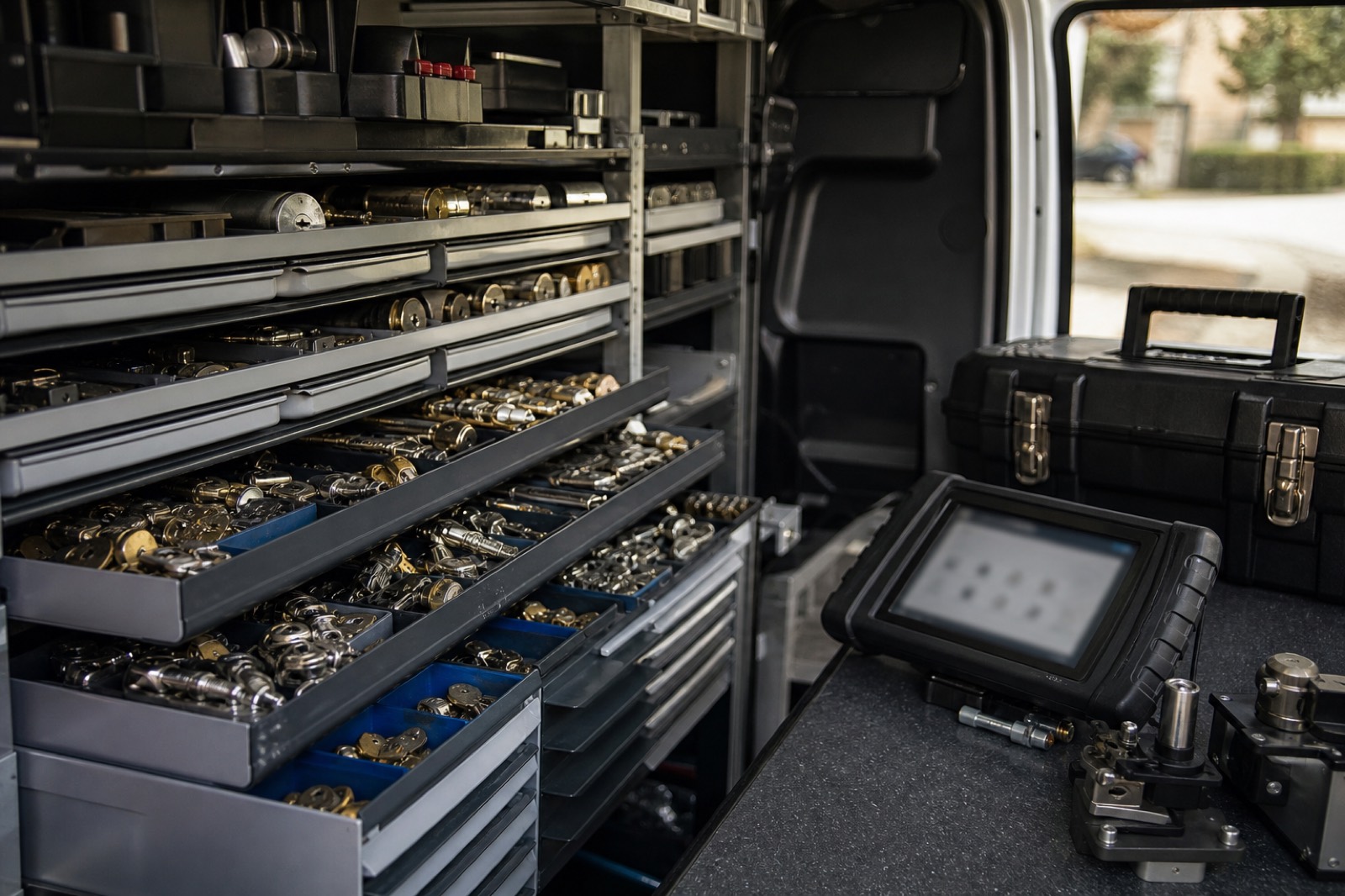
Platforms that materially help your multiple. ServiceTitan: gold standard for $2M+ revenue locksmith operations, especially commercial-heavy. Strong reporting, dispatch optimization, customer management, and proven integration into security-platform operating systems. Workiz: solid for $500K-$3M revenue, locksmith-friendly UX, designed for mobile service. Housecall Pro: budget-friendly entry option. FieldPulse: emerging mid-market option with strong CSR coaching tools.
Why buyers pay a premium for tech-enabled locksmith operations. First, reduced owner dependency. Customer history, dispatch records, and revenue data exist in a system, not the owner’s head. Second, faster post-close integration. Migrating ServiceTitan to ServiceTitan is hours; migrating from a paper dispatch board to ServiceTitan is months. Third, validated KPI reporting. Buyers can verify revenue per technician, average ticket, and conversion rate from system reports rather than relying on management estimates. Fourth, cleaner customer data.
The 18-24 month tech stack upgrade play. If you’re running on QuickBooks plus paper dispatch and your business does $750K-$3M revenue, a Workiz or ServiceTitan implementation 12-18 months before sale typically returns 0.3-0.7x SDE / EBITDA at exit. Implementation cost: $15-40K plus 60-120 days of operational disruption. Multiple uplift on $400K SDE: $120-280K. The math heavily favors implementation.
Locksmith businesses for sale: what listing prices tell sellers and buyers
Most locksmith businesses for sale that you can see online are small, owner-run shops. BizBuySell reports a median asking price of $360,000 for an established locksmith business on its marketplace, with listings running from under $192,875 to well over $943,750. LoopNet and BizQuest carry overlapping inventory from the same small-shop segment.
Those figures are useful, but they describe asking prices, not closed deals, and they skew toward the smallest businesses. Three things to keep in mind:
- Asking is not selling. A listing price is the seller’s first position. Buyers rebuild SDE themselves and price on the multiples in this guide, so an overpriced listing tends to sit.
- The strongest locksmith companies rarely get listed. Shops with commercial contracts, access-control capability, or several vans usually sell off-market to security integrators, regional consolidators, or search funds that approach them directly.
- Listings expose you. A public listing, even a blind one, can reach your technicians, your commercial accounts, and competitors in a trade where everyone knows each other.
If you are buying, use listings to learn the market, then ask how the asking price was built and request three years of tax returns before you talk about price. If you are selling, compare the listing route with a confidential process, and see our sell your locksmith business page for how CT introduces owners to buyers without a public listing.
The locksmith sale process timeline: what actually happens month by month
To sell a locksmith business, recast your financials to true SDE or EBITDA, separate commercial contract revenue from residential and automotive calls, and confirm how your state licenses transfer. Then decide which buyer archetype fits, from SBA-financed individuals to security integrators, and run a confidential process with several bidders rather than accepting one offer.
Locksmith sale processes vary by buyer pool but cluster around 5-9 months from launch to close for sub-$1M EBITDA deals and 9-12 months for $1M+ EBITDA platform deals. The compressed timeline at the smaller end reflects SBA financing dominance and simpler diligence. The longer timeline at the platform end reflects QoE engagements, license transfer (in regulated states), and earnout / rollover equity negotiations with security / access-control consolidators.
Months 1-2: positioning and outreach. Build the CIM (12-20 pages for sub-$1M; 30-50 pages for $1M+ EBITDA). Identify target buyer archetype mix. Reach out to security / access-control consolidators (Convergint, Pye-Barker adjacent, ADT Commercial), search funders pursuing service businesses, SBA buyers, and strategic competitors. Sign NDAs with serious prospects. Target 6-12 serious initial conversations.
Months 2-4: management meetings and indications of interest. Take 3-6 buyer meetings. Security consolidators send 1-2 person teams to walk operations, review revenue mix, and meet certified technicians. Search funders typically come solo and spend a full day. Receive 1-3 indications of interest with non-binding price ranges. Negotiate to a single LOI.
Months 4-7: LOI, diligence, and financing. Sign LOI with 60-90 day exclusivity. Buyer-side diligence: financial QoE for $1M+ EBITDA deals, CPA review for sub-$1M; operational walkthrough; technician interviews; commercial customer interviews on top accounts; technology audit; license / bonding review with regulatory counsel in regulated states. Buyer financing: consolidators have it lined up; SBA buyers process loan application (45-90 days).
Months 7-9: definitive agreement and close. Negotiate purchase agreement: working capital target, indemnification caps, R&W insurance for $1M+ EBITDA deals, non-compete (typically 5 years and 25-50 mile radius for locksmith), seller employment agreement if license requires (common in California, Texas, Tennessee, Illinois). Final walkthrough. Employee notification. Customer notification. Escrow funding. Signing. Bank account and operational system transfers.
Months 9+: transition. Post-close transition typically 60-180 days for $300K SDE deals (longer training period typical), 90-180 days for platform deals. Seller often available by phone for an additional 6-12 months. License transfer monitoring in regulated states. Earnout periods if applicable run 12-24 months post-close depending on structure.
Selling a locksmith business? Talk to a buy-side partner first.
We’re a buy-side partner working with 200+ buyers, including security and access-control consolidators (Convergint Technologies, Pye-Barker Fire & Safety adjacent platforms, ADT Commercial, ASSA ABLOY-backed integrators, regional security-integration rollups), search funders explicitly pursuing service businesses with recurring revenue, family offices with home services or commercial services theses, and strategic regional operators. The buyers pay us, not you, no contract required. No retainer, no exclusivity, no 12-month engagement, no tail fee. A 15-minute call gets you three things: a real read on what your locksmith business is worth in today’s market, a sense of which buyer types fit your specific service mix and geography, and the option to meet one of them. Try our free valuation calculator for a starting-point range first if you prefer.
Common mistakes locksmith sellers make (and how to avoid them)
Mistake 1: anchoring on home-services multiples instead of locksmith-specific multiples. “Home services trades sell for 4-6x EBITDA” is a heuristic from HVAC and plumbing that has very little to do with how the market actually values locksmith businesses in 2026. A $1M revenue residential locksmith with no recurring contracts and 60% gross margin is not a 4-6x EBITDA business. Anchor on locksmith-specific multiples (1.5-3x SDE for residential / automotive small-scale, 3-5.5x EBITDA for commercial-heavy platforms).
Mistake 2: cash sales not on the books. Residential locksmith has a cash payment culture, especially for emergency lockouts. Owners who run significant cash off the books face an impossible diligence problem: you can’t add back what you can’t prove, and aggressive add-backs that depend on cash sales get rejected by buyer CPAs and SBA banks. Run all revenue through the books for 24+ months pre-sale, even at the cost of more taxes today, the multiple expansion at exit dramatically outweighs the tax.
Mistake 3: failing to address license transfer in regulated states. Buyers walk from deals when they realize the license complications mid-diligence. In California, Texas, Tennessee, Illinois, and other regulated states, address this in month one of preparation: meet with a state licensing attorney, document the transfer pathway, identify whether you (the seller) need to remain employed, and groom a backup licensed individual if possible.
Mistake 4: under-investing in commercial recurring contracts pre-sale. Every additional commercial recurring service contract is worth $25-100K in sale price. Owners who run aggressive commercial sales campaigns 18-24 months before sale routinely add 5-15 multi-year service contracts, translating to $200K-$1M of additional sale price. Property management portfolios, retail chains, and office building access-control contracts are the highest-leverage targets.
Mistake 5: announcing the sale to technicians too early. Technicians can fully derail a locksmith deal by leaving during diligence, especially in regulated states where ALOA-certified or licensed staff are scarce. Each tech that walks during the LOI period is interpreted as instability by the buyer. Wait until LOI signed (with retention bonuses for key technicians), then disclose strategically, usually within 30-60 days of close.
Mistake 6: ignoring inventory and bonding documentation. Locksmith inventory (key blanks, lock cores, pinning kits, electronic access hardware, transponder programmers) is often $50-200K of value. Document everything. Confirm surety bond is current and transferable. Buyers will assess inventory condition and bonding status during diligence, sloppy documentation here signals broader operational sloppiness and compresses your multiple.
How to position for the right locksmith buyer archetype
Position for security / access-control consolidators when: You have $1M+ EBITDA, commercial revenue 50%+ of total, recurring service contracts at meaningful scale (15+ active multi-year), 5+ ALOA-certified technicians, electronic access-control capability (HID, ASSA ABLOY, Allegion, dormakaba), and willingness to roll equity 10-20% for 3-5 year second exit. Emphasize: scalability, recurring revenue, technology platform, technician certifications, geographic platform potential.
Position for search funders when: You have $500K-$1.5M EBITDA, real second-tier operations team, recurring commercial revenue, low customer concentration, and growth runway a searcher could execute against. Emphasize: defensibility, organic growth opportunity, manageable operational complexity. Searchers want to operate the business and grow it, not learn it from scratch.
Position for SBA individuals when: Your SDE is $150K-$500K, the business runs on documented systems, your role is owner-replaceable (or the senior technician is licensed and trained), and you’re willing to provide 90-180 days of seller training plus seller financing. Emphasize: stability, manageable customer relationships, clear training path.
Position for strategics when: There’s a clear regional locksmith competitor that would benefit from acquiring your customer book, technician headcount, or geographic coverage. This is often the highest-multiple buyer if you can identify the right one, but the buyer pool is small and personal relationships matter. Targeted outreach to 3-5 known regional strategics often beats broad auction at this size.
When to wait: signals that delaying 12-24 months pays off for locksmith sellers
Many locksmith owners would benefit financially from waiting 12-24 months before going to market. At locksmith’s scale, the leverage from preparation is unusually high, small operational improvements drive disproportionate multiple uplift, and crossing the $1M EBITDA threshold widens the buyer pool dramatically. The trade-off: continued ownership versus 30-50% better after-tax proceeds at exit.
Signal 1: you’re within $200K of the $1M EBITDA threshold. Crossing $1M EBITDA shifts you from sub-LMM (2-3x SDE) into low-end LMM (4-5x EBITDA in locksmith). On $1M EBITDA, that’s the difference between $2.5M and $4.5M of pre-tax proceeds. Modest organic growth (8-12% year-over-year is reasonable in locksmith with commercial pursuit) clears the threshold in 18-24 months.
Signal 2: commercial recurring revenue below 30%. Each additional multi-year commercial service contract is worth $25-100K in sale price. An aggressive 18-month commercial sales campaign that adds 10-20 contracts typically returns $250K-$1M in additional sale price. Property management portfolios, retail chains, and office building access-control contracts are the highest-leverage targets.
Signal 3: cash sales running off the books. If 10-30% of your revenue is cash that doesn’t hit the books, you have a fundamental valuation problem. Buyers can’t pay for what they can’t verify, SBA banks won’t finance against undocumented earnings, and aggressive add-backs based on cash get rejected. Run everything through the books for 24+ months pre-sale, the multiple expansion dramatically outweighs the additional taxes.
Signal 4: you’re still the operating brain. If the business doesn’t survive a 30-day vacation today, you’re owner-dependent in a way that compresses your multiple meaningfully. 12-18 months of intentional delegation, promoting an operations manager, documenting SOPs, taking real time off, moves you from a 1.5-2.5x SDE business to a 2.5-3.5x business. On $400K SDE, that’s $400K-$800K of additional sale value.
When NOT to wait. Health issues forcing exit. Co-owner conflict that can’t be resolved. Industry headwinds (smart-lock and digital-key adoption could compress traditional locksmith demand long-term). Personal financial crisis requiring immediate liquidity. Loss of key technician(s) that fundamentally changes the business profile.
Want to know what your locksmith business is actually worth?
Benchmarks give you a range. A 15-minute confidential call gives you a real number, based on what active buyers are paying right now and which ones would compete for your business. No cost, no obligation.
Locksmith Business Valuation: 2026 Outlook and Key Takeaways
Locksmith business valuation in 2026 is a real opportunity, just a different opportunity than HVAC, plumbing, or electrical M&A. The buyer pool is shallower, the multiples sit lower at small scale, but the trajectory is improving as security / access-control consolidators enter the category and search funders increasingly recognize the recurring-revenue potential of commercial-heavy operations. Owners who succeed are the ones who stop benchmarking against generic home-services multiples and start benchmarking against the actual 2026 locksmith buyer pool: SBA individuals paying 1.5-3x SDE on sub-$1M residential / automotive shops, security consolidators paying 4-5.5x EBITDA on commercial bolt-ons, search funders paying 4-5.5x for $500K-$1.5M EBITDA targets, and strategic competitors paying premium multiples for geographic density. Get your books clean 18-24 months ahead. Run all cash through the books. Grow commercial recurring contracts aggressively. Implement ServiceTitan or Workiz. Address state licensing transfer proactively. Position for the right buyer archetype rather than running a generic auction. The owners who do this work see 30-50% better after-tax outcomes than the ones who go to market unprepared. And if you want to talk to someone who already knows the locksmith and security buyers personally instead of running an auction, we’re a buy-side partner, the buyers pay us, not you, no contract required.

About the Author
Christoph Totter is the founder of CT Acquisitions, a buy-side partner headquartered in Sheridan, Wyoming. We work directly with 200+ buyers, search funders, family offices, lower middle-market PE, and strategic consolidators, including direct mandates with the largest consolidators that other intermediaries cannot access. The buyers pay us when a deal closes, not the seller. No retainer, no exclusivity, no contract until close. Connect on LinkedIn · Get in touch
Locksmith Business Valuation: Frequently Asked Questions
How much is my locksmith business worth in 2026?
Locksmith businesses typically sell at 1.5-3x SDE under $500K of normalized earnings, 2.5-4x SDE between $500K-$1M, and 4-5.5x EBITDA above $1M with commercial-heavy mix. Revenue multiples range 0.3-1.2x depending on service mix. The biggest swing factor is commercial recurring service contract percentage, businesses with 30%+ recurring commercial revenue trade at the upper end.
What multiple should I expect when selling my locksmith business?
Multiples vary by size and mix. Sub-$1M revenue residential / automotive: 0.4-0.7x revenue or 1.5-2.5x SDE. $1M-$3M revenue with commercial mix: 0.5-1.0x revenue or 2.5-4x SDE. $1M+ EBITDA commercial / access-control platforms: 4-5.5x EBITDA. Locksmith multiples sit lower than HVAC or plumbing because the buyer pool is shallower and recurring revenue percentages are typically lower.
Who are the most active buyers of locksmith businesses right now?
SBA-financed individuals dominate the sub-$1M revenue range. For commercial-heavy operations above $1M EBITDA: security and access-control consolidators including Convergint Technologies, Pye-Barker Fire & Safety adjacent platforms, ADT Commercial, ASSA ABLOY-backed integrators, plus regional security-integration rollups. Search funders increasingly target commercial locksmith with recurring revenue.
What’s the difference between SDE and EBITDA for a locksmith business?
SDE includes the owner’s full compensation package (salary, benefits, personal expenses run through the business). EBITDA assumes a market-rate management team is in place. For owner-operator locksmith shops under $3M revenue, SDE is typically $80-200K higher than EBITDA. Buyers under $750K of normalized earnings underwrite using SDE; buyers at $1M+ EBITDA underwrite using EBITDA.
Are commercial service contracts worth more at sale than residential / automotive revenue?
Yes, meaningfully. Each multi-year commercial service contract (access-control maintenance, master key system upkeep, property management portfolio) adds $25-100K of value at sale. Two locksmith businesses with identical $1.5M revenue can sell at 0.5-1x SDE / EBITDA different multiples based purely on commercial recurring contract count and renewal rates.
Do ALOA certifications affect my locksmith business sale?
Yes, modestly. Buyers, especially security / access-control consolidators, view ALOA certifications (CRL, CPL, CML) as proof of professional standards. Locksmith businesses with 2+ ALOA-certified technicians command a slight multiple premium and a meaningful credibility advantage in diligence. ALOA certifications also matter for state license transfer in regulated states.
How does state licensing affect a locksmith business sale?
Approximately 15 states require locksmith licensure with background checks (California, Texas, North Carolina, Tennessee, Illinois, and others). License transfer mechanics meaningfully shape deal structure: SBA buyers from out of state must obtain individual licensure before close, extending timelines by 60-120 days. Some states (especially California) require the seller to remain employed for 6-24 months as the responsible licensed individual.
How long does it take to sell a locksmith business?
5-9 months from launch to close for sub-$1M EBITDA SBA-buyer deals; 9-12 months for $1M+ EBITDA platform deals with security / access-control consolidators. Add 12-24 months on the front for proper preparation if your books, technician structure, and operations aren’t already buyer-ready.
Should I implement ServiceTitan or Workiz before selling?
Yes if you’re $750K+ revenue and your sale is 12-18 months out. Implementation cost: $15-40K plus 60-120 days of operational disruption. Multiple uplift on $400K SDE: $120-280K. Buyers view tech-enabled dispatch and customer management as proof of platform-readiness and reduced owner dependency.
How much seller financing should I expect to provide?
SBA-buyer deals (sub-$1M SDE): plan for 20-30% seller financing as standard. Security consolidator deals: typically 0-10% seller note but 10-20% rollover equity. Search funder deals: 10-20% seller note common. Refusing seller financing on SBA deals kills 70-80% of your buyer pool at small scale.
What if I run cash sales off the books?
This is a fundamental valuation problem. Buyers can’t pay for what they can’t verify, SBA banks won’t finance against undocumented earnings, and aggressive add-backs based on cash get rejected by buyer CPAs. Run everything through the books for 24+ months pre-sale, the multiple expansion at exit dramatically outweighs the additional tax cost.
Is a hybrid (storefront + mobile) locksmith worth more than mobile-only?
Yes, typically. Hybrid models capture both recurring residential foot traffic and scalable commercial service revenue, command better diversification, and most security / access-control consolidators specifically prefer storefront-anchored operations as bolt-ons. Mobile-only operations have lower overhead but capped scale and higher technician dependency, which compresses multiples.
How is CT Acquisitions different from a sell-side broker or M&A advisor?
We’re a buy-side partner, not a sell-side broker. Sell-side brokers represent you and charge you 8-12% of the deal (often $200K-$800K) plus monthly retainers, run a 9-12 month auction process, and require 12-month exclusivity. We work directly with 200+ buyers, including security and access-control consolidators (Convergint, Pye-Barker adjacent, ADT Commercial), search funders pursuing service businesses, family offices with home services mandates, and strategic regional operators, who pay us when a deal closes. You pay nothing. No retainer, no exclusivity, no contract until a buyer is at the closing table. We move faster (60-150 days from intro to close) because we already know who the right buyer is rather than running an auction to find one.
How do I sell a locksmith business?
Recast your financials so a buyer sees true owner earnings, split commercial contract revenue from residential and automotive work, and confirm how your state licenses transfer. Then pick the buyer type that fits your size, from SBA-financed individuals to security integrators, and run a confidential process with more than one bidder instead of accepting the first offer.
Are locksmith businesses profitable to buy?
Well-run ones can be, especially shops with recurring commercial work such as property management, institutional, and access-control accounts. Profit is thinner and less predictable in shops that depend on emergency residential lockouts and paid search leads. When you evaluate one, check how much revenue comes from repeat commercial customers and how much depends on the owner working calls.
Sources & References
All claims and figures in this analysis are sourced from the publicly available references below.
- SBA Small Business Sale Guide, SBA framework for locksmith business valuation
- ALOA Security Professionals Association, ALOA certification standards (CRL, CPL, CML)
- Convergint Technologies, Convergint security integrator acquisitions
- Pye-Barker Fire & Safety, Pye-Barker security and life safety roll-ups
- ASSA ABLOY Investor Relations, ASSA ABLOY acquisitions of security/locksmith companies
- Allegion Investor Relations, Allegion lock and access control market leadership
- BLS Locksmiths Employment Data, BLS locksmith industry employment statistics
- IBISWorld Locksmiths Industry, Locksmith industry market sizing and concentration data
Related Guide: How to Value a Small Business for Sale, Multiples, methodology, and the size-dependent reality.
Related Guide: SDE Add-Backs Explained for Small Business Sellers, Which add-backs locksmith buyers will accept, and which they’ll reject.
Related Guide: Business Sale Process: Step-by-Step Guide, From preparation to close, what actually happens.
Related Guide: Selling a Business Under $1 Million, Buyer pool, multiples, and the sub-LMM reality.
Related Guide: What Is Your Business Worth in 2026?, Buyer-pool data and multiples by industry and size.
Want a Specific Read on Your Business?
15 minutes, confidential, no contract, no cost. You leave with a read on your local buyer market and a likely valuation range.