

We cut past the headlines. This guide lays out what a modern transaction really looks like. M&A is about combining companies or major assets through financial contracts. It also names the banking teams that run the process.
We frame the playbook around sourcing, positioning, diligence, negotiation, and close. Expect clear rules for buyers, sellers, and shareholders. We focus on thesis-aligned deal flow, clean risk allocation, and a path to value that survives integration.
Practical, not theoretical. You will see where deals stall: price versus certainty, protection versus speed. We map common structures, valuation levers, financing options, and the checks that matter in the US market.
For private equity teams, family offices, and independent sponsors, we show what to ask, what to model, and how to pressure-test a target company. If you want curated, buy-side ready opportunities, see our approach at CT Acquisitions.
Key Takeaways
- Deals hinge on terms, diligence, and post-close execution — not headlines.
- Buyers seek speed and certainty; sellers seek price and protection.
- We cover sourcing, valuation, financing, and closing mechanics.
- Practical checks help private equity and family offices vet targets faster.
- US market realities demand data-room discipline and regulatory awareness.
What M&A really means in today’s market
A transaction looks simple on paper, but legal form determines who carries risk after close.
Plain-English definition: m&a consolidates companies or major assets through financial transactions. This can be an outright purchase, a merger into a new entity, an asset buy, a tender offer for stock, or a hostile bid.
Why legal form matters
An acquisition usually means one company absorbs another. The buyer becomes the surviving owner and takes control of assets and liabilities.
A merger often creates a reconstituted entity with new governance. Lawyers and regulators treat these differently. That affects approvals, taxes, and who stays on after close.
Deal tone: friendly versus hostile
Friendly deals move through management and boards. Tender offers go direct to shareholders and speed the timeline. Hostile takeovers bypass management and raise legal and market risk.
“Labeling a deal is political; the legal form decides the outcome.”
- Buyer priorities: speed to exclusivity, probability of closing, and control over market messaging.
- Risk flag: when a transaction shifts market power, scrutiny and pushback increase fast.
- For a clear primer, see our linked mergers and acquisitions primer.
Types of mergers and acquisitions and where each one fits
Deal form is a decision, not a label. It sets who runs the business after close, who carries risk, and how fast you move.
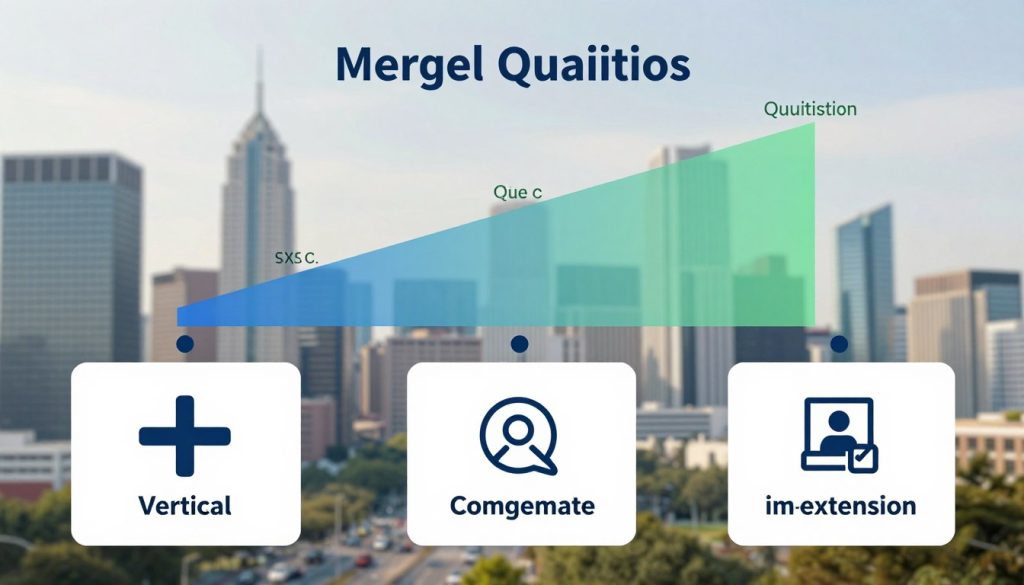
Merger structures
Two companies may combine under one banner or create a new entity. The choice changes governance, tax treatment, and integration speed.
Forming a new entity can equalize ownership but slows approvals. Folding one company into another is faster but concentrates control.
Acquisitions: purchase versus majority stakes
Buyers can buy a target company outright or take a majority stake. An outright purchase gives control and cleaner economics.
Taking a majority lets sellers retain upside and eases transition. But you must negotiate control rights and governance to protect the thesis.
Consolidations and market share plays
Roll-ups and consolidations boost market share, expand footprint, and create pricing leverage. They work when companies offer complementary services or geography.
Watch antitrust scrutiny. Bigger share brings more regulatory attention and integration overhead.
Asset acquisitions
Buying assets—common in distressed or bankruptcy scenarios—lets buyers avoid legacy liabilities. It can be the cleanest route to acquire key assets or services.
Asset purchases often require fewer approvals, but transfer mechanics and tax treatment differ from a full company purchase.
Management-led transactions
Management buyouts take a company private. Debt usually funds these deals, raising covenant and refinancing risk.
They suit teams that want control and long-term upside, but buyers must model leverage carefully.
- Quick rule: pick the form that matches your timeline, risk tolerance, and integration capacity.
- Examples: Amazon/Whole Foods (strategic purchase), Meta/Instagram (platform consolidation), Musk/Twitter (high-profile take-private).
How deals are structured across two companies
The logic of a deal comes from the relationship between the two companies involved. That relationship drives the commercial thesis, regulatory risk, and the work needed after close.
Horizontal merger: direct competitors
A horizontal merger combines direct rivals in the same market. It can deliver scale and pricing power fast.
But it also draws antitrust scrutiny in the industry. Regulators watch market share changes closely.
Vertical merger: control of the value chain
A vertical merger buys a supplier or distributor to secure inputs, protect margin, and speed execution.
Example: Apple bought AuthenTec to bring fingerprint sensors in-house. That is vertical integration: control over tech and supply.
Conglomerate, congeneric, and extension plays
A conglomerate ties unrelated businesses for diversification. A congeneric deal links companies with a shared customer base for cross-sell.
Market-extension and product-extension moves expand geography or offerings without building from scratch.
Integration forms and buyer position
Integration can be statutory (target absorbed), subsidiary (target stays as a sub), or consolidation (new entity formed).
Buyers must map position: what they control on Day 1, what needs integration, and where value can leak if operations lag.
Why companies pursue M&A transactions
Companies pursue deals to buy time, fill capability gaps, and lock in cost advantages fast.

Synergies: cost savings versus revenue lift
We split synergies into two buckets: cost and revenue. Cost cuts come from scale, headcount trimming, and supplier leverage. Those are measurable and usually hit first.
Revenue synergies come from cross-selling, higher prices, or combined offerings. They look good in slides. They are harder to prove and slower to appear.
Inorganic growth: speed and capabilities
Buying a company buys a playbook. You gain people, systems, and often intellectual property that would take years to build.
This is pragmatic for businesses that need to add services quickly. We prefer buys that close capability gaps without bloating integration risk.
Market power and supply control
Horizontal moves can lift pricing by growing market share. Vertical moves can secure inputs and cut exposure to shocks.
Power here is not about dominance; it’s about control that steadies margin and execution.
Diversification and tax realities
Buying into a new segment smooths cyclicality and improves cash flow stability. That reduces downside for investors.
Tax attributes can help returns—loss carryforwards or basis adjustments—but tax alone rarely justifies a weak strategic position.
“If the combined company isn’t stronger within 12–24 months, the deal likely missed its point.”
- Practical filter: value that is measurable, captureable, and timely.
- Focus: cost synergies first, revenue proof second.
The M&A process from first look to signed deal
A disciplined sequence—screen, protect, probe, and document—keeps value intact when timelines shorten. We map the practical stages so teams move with purpose. Each step reduces uncertainty and preserves price when a target company is sensitive.
Assessment and the information memorandum
The information memorandum signals enough to evaluate fit. It highlights customers, services, financials, and risks without dumping sensitive files.
Think: enough detail to decide whether to pursue the target. Not a public data release.
NDAs and safe data flows
An NDA is more than paperwork. It creates a controlled path to share operational and customer specifics.
We limit access, log downloads, and stage disclosures so the buyer can probe without leakage.
Letter of intent
The LOI sets scope, price range, exclusivity, and structure. It is often mostly non-binding but it builds momentum.
Clear LOIs narrow issues before full diligence begins. That saves time and money.
Due diligence
Buyers focus on legal, financial, tax, intellectual property, employment, and data protection checks.
We weigh exposures that affect purchase economics and post-close integration for the target company.
Negotiation and closing
Choice of SPA versus APA shifts what moves in the purchase and who keeps legacy liabilities.
Warranties, indemnities, and price mechanisms allocate risk and lock in capture of value.
Regulatory and practical checks
Antitrust, licensing, and employment approvals can pause timelines. Plan for them early.
“Process discipline turns a speculative interest into a signed agreement without bleeding price.”
| Stage | Primary focus | Buyer ask | Outcome |
|---|---|---|---|
| Assessment | IM, fit | High-level metrics | Go / No-go |
| Protection | NDA, access rules | Clean data room | Safe review |
| Due diligence | Legal, tax, IP | Deep testing | Risk register |
| Negotiation | SPA vs. APA, warranties | Final price, indemnities | Signed purchase docs |
Valuing the target: how buyers and sellers set the price
We view valuation as a toolkit: each method answers a distinct question about value and risk. Together they form a defendable range, not a single number.
Comparable multiples: P/E as a reality check
P/E works when the target has stable earnings and the industry has clean public comps. It anchors price to market precedent and shows where expectations live.
Enterprise value approaches: EV/Sales for growth businesses
EV/Sales helps where margins lag but revenue growth is real. It compares how the business captures customers versus peers.
Discounted cash flow (DCF)
DCF turns forecast free cash flows into present value using WACC. We stress-test growth, margin, and terminal assumptions until downside holds.
Replacement cost and sanity checks
Replacement cost asks if rebuilding assets or capability would be cheaper than purchase. If it is, the buyer needs a time or strategic premium to justify paying up.
Why gaps happen and how they close
Gaps arise because buyer and seller weight risk, growth durability, customer concentration, and synergy capture differently. We bridge gaps with structure: earnouts, seller notes, and working-capital adjustments tied to observable metrics.
| Method | Best for | Main signal | Downside |
|---|---|---|---|
| P/E multiples | Profitable, stable | Relative market price | Cycles distort comps |
| EV/Sales | High-growth, low-margin | Revenue capture vs peers | Ignores cost structure |
| DCF | Cash-generative forecasts | Intrinsic future cash | Sensitive to assumptions |
| Replacement cost | Asset-heavy targets | Rebuild vs buy | Hard to value intangibles |
How the acquisition is financed and what shareholders should expect
How a deal is paid shapes negotiations, tax outcomes, and shareholder reaction. We walk through the common payment routes and the practical effects each one has on certainty and control.
Method of payment
Cash signals certainty. Sellers prefer it because it removes execution risk. Buyers pay cash when they can or when speed matters.
Stock preserves buyer cash but can dilute voting power. Stock-for-stock deals transfer some market risk to shareholders of both firms.
Debt assumption and mixed offerings balance leverage and liquidity. Taking on target debt lowers upfront cash need but raises covenant risk post-close.
Stock purchase vs. asset purchase
In a stock purchase the acquirer inherits liabilities and many off-balance-sheet issues. That often requires shareholder approval and closer legal review.
An asset purchase lets a buyer cherry-pick assets and avoid legacy liabilities. Tax treatment differs; sellers may face tax at the corporate level.
Staple financing and shareholder impact
Investment banking sometimes offers staple financing to speed bids and raise the offer ceiling. It helps a buyer clear financing risk quickly.
- Target shares often rise toward the premium.
- Acquirer stock can dip as the market prices execution and dilution.
- Shareholders should expect clear disclosure on dilution, tax treatment, and financing sources.
Buyer takeaway: pick a financing package that survives stress, preserves flexibility, and closes on schedule.
Conclusion
, Every successful transaction starts with a clear thesis and a plan to prove it.
We treat a merger acquisition as controlled execution across two companies, not a PR milestone. Pressure-test structure, valuation range, financing resilience, and the risks diligence uncovers.
Price is one lever. Warranties, indemnities, and post-close obligations often decide real value. Legal form matters: whether one company absorbs another or a new entity forms changes approvals, liability allocation, and integration work.
Model timeline risk from day one. If projected gains rely on heroic revenue synergies, underwrite conservatively and demand protections. The best m&a transactions are thesis-aligned, tightly diligenced, and run with integration intent.
Watch whether the combined company earns its right to exist by improving measurable performance, not by size alone.