

We cut through noise and deliver repeatable deal flow. Our goal is simple: turn market exposure into vetted opportunities that convert. A steady stream of investment prospects depends on a controlled system—not random outreach or overloaded calendars.
The path is clear: sourcing, screening, due diligence, negotiation, and closing. Each stage must have owners, timelines, and exit criteria. Without that structure teams waste time on mismatched deals and miss high-potential targets.
We frame the pipeline as an operating system: stage map, fit checklist, channel plan, diligence system, and a tech stack that enforces the process. For private equity firms, family offices, and independent sponsors, thesis-aligned origination protects time and raises close probability.
Two failure modes dominate: too few opportunities at the top, or too many low-fit leads clogging calendars. Our guiding principle is this: scale comes from repeatability, visibility, and ruthless prioritization—not heroic effort.
Key Takeaways
- Define stages and owners so work flows without friction.
- Design volume expectations: many reviews for each closed investment.
- Use a fit checklist to filter low-probability deals early.
- Prioritize repeatable channels over ad-hoc sourcing.
- Measure visibility and enforce follow-ups with tech.
- Focus on thesis-aligned opportunities to protect time and raise win rates.
What Deal Origination Means in Private Equity, Venture Capital, and M&A
Effective sourcing converts relationships into repeatable revenue for intermediaries and acquirers alike. We draw precise lines between origins, flow, and sourcing so teams stop debating terms and start fixing leaks.
Origins are the act of creating mandates or introductions—bankers and lawyers win fees when mandates close. Sourcing is the channel mix: outbound outreach versus inbound referrals. Flow measures steady, qualified inflow—not vanity counts.
Mechanics differ by context. In venture capital, networks supply over 70% of opportunities, so relationships are an operating baseline. For private equity and M&A, intermediaries chase mandates because mandates equal revenue.
Smaller firms must be proactive. Larger platforms enjoy more inbound, but still need repeatable outreach. Our metric is simple: consistent inflow of qualified opportunities that match your thesis, fewer dead-end conversations, and a faster path from first look to signed LOI.
- Measure flow by qualified prospects per period, not raw inbox volume.
- Prioritize network-led referrals; they convert at higher rates.
Start With an Investment Thesis That Filters Opportunities Fast
A usable investment thesis acts as your front-line filter for incoming opportunities. It defines market and industry targets, stage and revenue bands, and the financial criteria you will accept. Keep it specific. Keep it enforceable.
Translate the thesis into a one-page fit checklist the team can use in the first 15 minutes of review. List must-haves, nice-to-haves, and automatic disqualifiers. Use simple yes/no gates for recurring revenue, retention, margin profile, and ARR bands.
Socialize the thesis externally. Progress discusses M&A strategy on earnings calls and in ongoing dialogue with VCs and banks so they know what to send. The clearer your strategy, the more founders and advisors self-select.
- Market focus: TAM, growth rate, and competitor dynamics.
- Industry/subsector: verticals that match operational capability.
- Stage/size: revenue bands, ARR thresholds, and growth cadence.
- Financial shape: recurring revenue, retention, and profitability floors.
Make the checklist public to your network and link it to execution. See our acquisition focus here: our acquisition focus. The thesis protects focus and raises conversion rates over time.
Map the Deal Flow Pipeline Stages From Sourcing to Closing
A clear stage map stops confusion and makes advancement decisions factual, not emotional. We set gates, owners, and simple exit rules so work moves forward without debate.
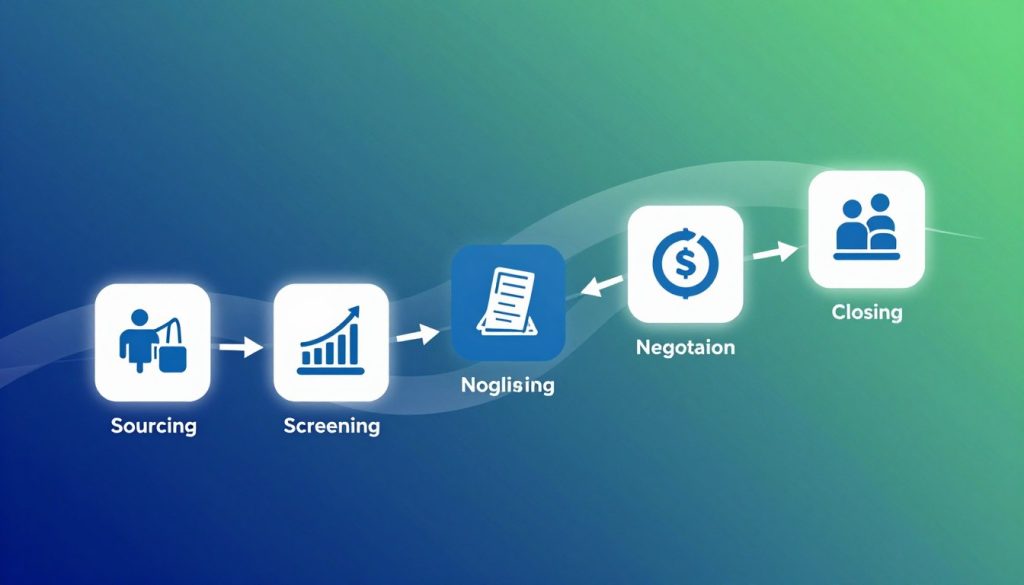
Sourcing: building a steady stream of investment opportunities
Keep sourcing continuous. Curate inbound referrals and targeted outreach so top-of-funnel replenishes without flooding calendars.
Screening: standardized scorecards and objective thresholds
Fast, objective declines preserve relationships and save time. Use scorecards with yes/no gates and a strict threshold for review calls.
Due diligence: checklists across financial, legal, market, and team
Diligence is a system, not a sprint. Maintain request lists by function and stage your work against deadlines.
Negotiation: valuation norms, term sheets, and flexibility
Standard term sheets speed offers. Be flexible on structure, rigid on economics that matter for returns.
Closing: standardized documents, timelines, and coordination
Close with checklists. Assign counsel, lenders, and internal owners. Clear timelines reduce last-minute friction.
| Stage | Owner | Exit Criteria | Typical Time |
|---|---|---|---|
| Sourcing | Origination lead | Qualified intro; thesis fit | Ongoing |
| Screening | Associate | Scorecard pass | 3–7 days |
| Due diligence | Deal team | Checklist complete | 2–6 weeks |
| Negotiation & Closing | Partner | Signed terms & docs | 2–4 weeks |
We run the stages as rules, not vibes. That protects partner time and scales quality opportunities through repeatable rituals.
How to Build a Deal Origination Pipeline With Scalable Sourcing Channels
A scalable channel mix prevents single-point failures and keeps qualified opportunities flowing. We design sourcing so no single banker, platform, or referral loop can stall your funnel.
Inbound sources should work like a magnet: clear thesis-driven content, a concise “what we buy” page, and lightweight intake forms that remove friction.
Relationship-driven channels remain highest-converting. Referrals, investor networks, and co-investor introductions supply most quality flow for venture capital and private equity buyers.
Proactive outreach favors warm intros via operators and founders. Cold outreach is a precision tool—use it when targeting is tight and messages are relevant.
Intermediary-led sourcing needs rhythm. Regular banker check-ins, crisp criteria, and fast feedback build credibility. Track responsiveness, not anecdotes.
Deal platforms like Aurigin, Intralinks (DealNexus), Axial, and CapTarget can scale reach. Use them selectively and avoid stale mandates.
- Channel scorecard: measure quality, responsiveness, and conversion.
- Carve-out lane: run portfolio reviews with strategics for efficient exits.
Build a Relationship Engine That Compounds Over Time
Relationships are infrastructure: they require design, maintenance, and measurable outputs. We treat network work like operations. Weekly rituals, clear owners, and outcome metrics keep activity productive.
Over 70% of venture deals originate through connections, so visibility matters. If bankers, venture capital partners, and founders don’t think of you first, opportunities land elsewhere.
Keep contact simple and useful. Quarterly banker check-ins. Monthly VC conversations. Lightweight founder touchpoints between meetings.
- Be useful: share concise criteria and fast feedback.
- Stack time: cluster meetings at conferences and do targeted trips.
- Run events: workshops and startup battlefield‑style sessions raise profile and create proprietary flow.
We measure relationships by outcomes, not coffees. That makes the network resilient: when one opportunity fades, several others follow. For operational guidance on structuring outreach and BD rhythm, see core components of elite BD operations.
Use Data and Market Mapping to Widen the Top of Funnel Without Losing Quality
Data-driven mapping turns random outreach into a targetable universe. We map markets into subsectors, name companies, and then run disciplined outreach. That converts noise into a durable top of funnel.

Ecosystem mapping by subsector
Map first, chase later. Break a sector into 50–60 subsectors. Create a named list of companies you can actually work through. Progress used this method and identified ~1,200 companies as a repeatable universe.
Quick diligence signals with industry tools
Use PitchBook and Capital IQ as rapid triage tools. Pull fundraising history, valuations, ownership, and employee count. These signals protect time and reduce low-fit first calls.
Channel tracking and attribution
Tag every opportunity by source. Track which channels supply high-quality opportunities and which drain time. Double down on channels that drive conversion and prune the rest.
| Action | Metric | Result |
|---|---|---|
| Subsector mapping | 50–60 subsectors | Named universe (~1,200 companies) |
| Quick triage | PitchBook / Capital IQ signals | Fewer low-fit calls |
| Channel attribution | Tagged source per opportunity | Higher quality flow over time |
Execute with an account plan. For priority targets keep key contacts, warm intro paths, recent signals, and next follow-up date. Data plus a target universe turns origination work into weekly operational routines we can run and measure.
Operationalize Screening to Protect Time and Improve Pipeline Quality
Screening is where we protect partner time and raise the signal-to-noise ratio. Clear gates turn curiosity into actionable opportunities. Fast, repeatable work wins scale.
We structure screening around three core pillars:
- Strategic criteria: thesis fit and must-have thresholds that disqualify quickly.
- Founding team: evidence of execution, complementary skills, and reference signals.
- Market growth: size, momentum, and defensibility that support returns.
Scorecards standardize assessment. Junior team members run first-pass reviews using objective thresholds. Shortlists come from scores, not meetings.
Quality controls enforce consistency: intake forms with required fields and a one-page screening memo for every reviewed opportunity. Document the “why” for passes and fails.
Shortlisting workflows that reduce emotional decision-making
Set timing rules. A submission stays in screening for a fixed window. Advance, park, or pass. No indefinite holds.
Result: better use of partner time, higher-quality deal flow, and clearer value in diligence and closing.
Run Due Diligence Like a System, Not a Fire Drill
Make diligence an operational rhythm, not an emergency sprint. We set clear owners, standard lists, and a pacing plan so work moves without chaos.
Request lists by function
Start with a cross-functional request list: finance, legal, HR, IT, product, marketing, and sales. Each lane has a named owner and a short checklist.
Prioritizing requests for founder-led targets
For founder-led and proprietary deals we stage asks. First, the CIM and financial pack. Second, targeted HR or IT items only if near-term valuation depends on them.
Early business case inputs
We build a fast case from three inputs: the CIM (50–60 pages), the financial pack (ARR trends, concentration, cost lines), and an anonymized employee census for synergy analysis.
Timing matters. Pace requests with weekly checkpoints. That protects seller goodwill and keeps your team focused. When banker-led materials exist, move faster; when proprietary, educate and stage.
- Diligence operating model: standard lists, owners, go/no-go gates.
- Functional lanes: finance, legal, HR, IT, product, go-to-market.
- Documentation: templates, red-flag logs, decision memos that compound value over time.
| Item | First Pass | Owner |
|---|---|---|
| CIM & financial pack | Yes | Associate |
| Anonymized employee census | Yes | HR lead |
| Legal contracts | Staged | Legal counsel |
Thoughtful diligence signals seriousness. That increases odds of exclusivity and preserves time for both buyer and company. We run the work as rules, not favors.
Build a Tech Stack to Manage Deals, Follow-Ups, and Pipeline Stages
Your toolset should force discipline: centralize records, assign owners, and make follow-up non-optional. This is about consistent execution and visible outcomes.
Practical CRM options cover a range of needs. Airtable and Notion are lightweight and flexible for small teams. Streak plugs into Gmail for simple tracking. Larger firms benefit from DealCloud-style software with permissions, reporting, and governance.
What the stack must do
- Centralize every record: CIMs, financial packs, notes, and source tags.
- Enforce stages that mirror real decisions: initial review, first call, LOI/IOI, diligence, IC, negotiation, close.
- Make follow-ups mandatory: next-step date, owner assignment, and required fields.
Automations and hygiene
Set reminder sequences for 3/6/9-month re-engagements. Use alerts for deadline slips and a bottleneck view that flags stalled work. Progress uses DealCloud buckets (active/parked/passed), stores CIMs and financial data, and reviews CRM weekly to avoid missed outreach windows.
Data quality matters. Define a minimal viable data standard and enforce it. The goal is not more tools but reliable process, less time wasted, and clearer deal flow visibility.
Scale Responsibly With Process Metrics and Common Pitfalls to Avoid
Metrics turn subjective debates into operational fixes that scale. We track a few tight measures and act on them. That prevents slow leaks and keeps quality high.
Bottlenecks kill momentum. The usual suspects are weak sourcing, slow qualification, and poor communication. Each creates delays that cost time and shut down opportunities.
Bottlenecks and practical metrics
- Volume by channel — spot weak sources fast.
- Qualification rate — percent that pass initial screens.
- Time-in-stage — average days at each step.
- Conversion by stage — where deals fall out.
- Reasons for pass — learn from real data, not guesses.
Balancing throughput and selectivity
You may review dozens of deals per close. That is normal. The trick: protect partner time with strict gates and simple scorecards.
Saying no faster preserves quality. Higher volume without selectivity just increases churn.
Pipeline hygiene and parked work
Active, parked, or passed. No ghost status. Parked deals require a clear note: what must change and a next-touch date. Review parked buckets weekly.
| Metric | Target | Owner |
|---|---|---|
| Volume by channel | Top 3 channels supply 70% of flow | Origination lead |
| Time-in-stage | Screening ≤7 days; Diligence ≤30 days | Deal team |
| Qualification rate | 20–30% pass from first look | Associate |
| Parked re-engagement | Next touch ≤90 days | Owner assigned |
Continuous improvement and communication
Refine what “good” looks like based on diligence findings and post-close outcomes. Update scorecards each quarter.
Set response SLAs for bankers and founders. Give fast, useful feedback that preserves relationships. Tight handoffs stop dropped balls and keep opportunities moving.
Conclusion
Repeatability beats urgency. We favor a thesis-first operating model, clear stage gates, and a disciplined channel mix. These habits let relationships compound and raise conversion for investors focused on lasting returns.
Practical next steps: write a fit checklist, define entry and exit rules for stages, stand up CRM records, and tag every opportunity by source. Those actions sharpen screening and preserve goodwill.
Treat tools and platforms as enablers, not strategy. Good process drives steady deal flow, better investment choices, and stronger outcomes for private equity, equity holders, and capital allocators.
For more on online sources and platform-driven matching see deal sourcing platforms.