
Who Gets the Money in a Business Sale: The Proceeds Waterfall
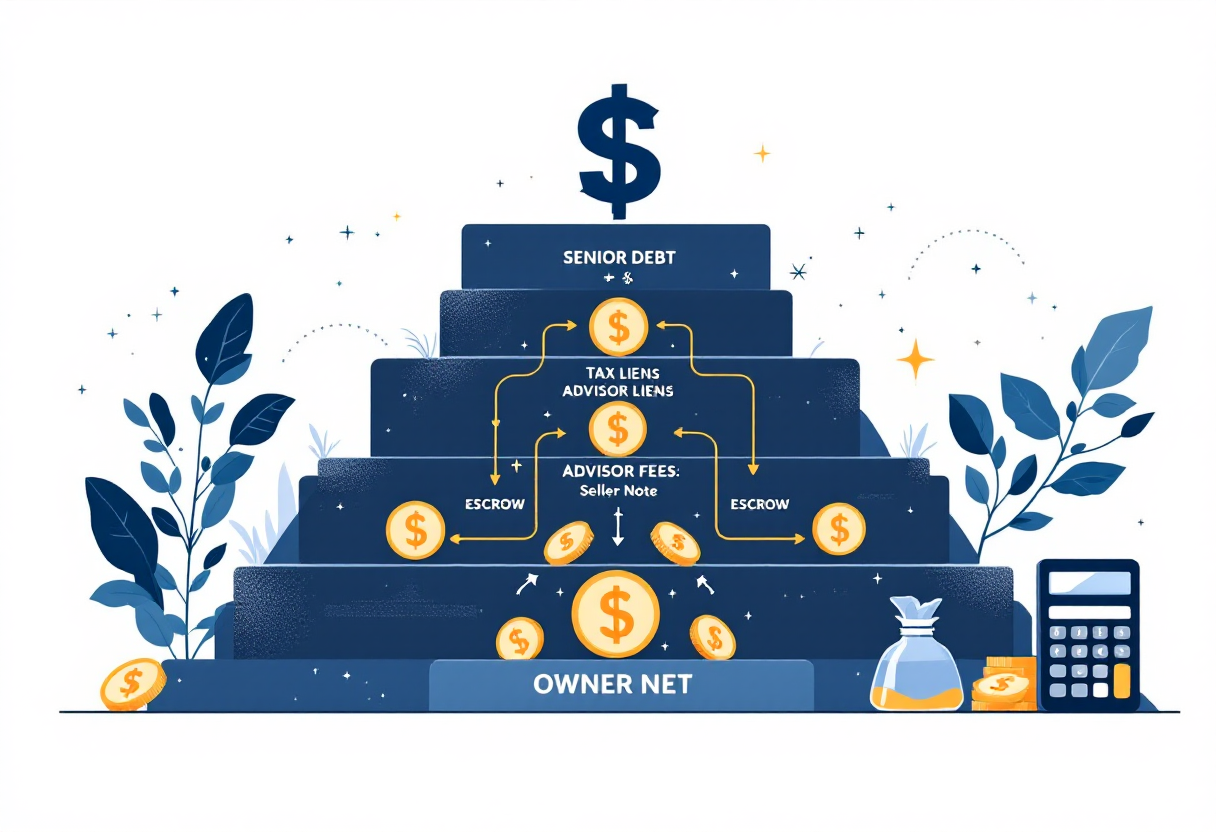
The short answer to who gets the money in a business sale is that cash flows through a strict priority order at closing: senior secured lenders are paid first, then tax liens, then unsecured creditors, then an escrow holdback (typically 10 to 15 percent), then sell-side advisor fees (typically 5 to 10 percent), then any deferred seller note, and the owner receives whatever net cash remains. On a clean $10M deal, an owner who expects $10M in their account is usually surprised to wire-receive roughly $6.5M to $7.5M on closing day, with the balance arriving over 12 to 36 months.
Context: Why This Question Matters
Most first-time sellers price the deal in their head as a single lump sum. A buyer signs a $10 million purchase agreement, the wire hits, and the owner retires. That picture is wrong in almost every privately negotiated transaction. The headline enterprise value on the letter of intent is the starting point for a waterfall, not the amount that lands in the seller’s bank account.
Understanding the proceeds waterfall before signing an LOI is the difference between celebrating a $10M exit and discovering at closing that the actual day-one cash is $6.8M, with the rest tied up in escrow, an earnout, a seller note, or fees the owner did not budget for. SRS Acquiom’s 2025 Deal Terms Study, which reviewed more than 2,100 private-target M&A transactions, found that fewer than one in five private deals pay 100 percent of the consideration in cash at closing.
The Detailed Answer: The Waterfall, Tier by Tier
Below is the standard proceeds waterfall in a lower middle market private company sale, with real dollar examples assuming a $10M enterprise value on a healthy cash-free, debt-free deal. The exact percentages shift by deal size, industry, and buyer type, but the order rarely changes.
Tier 1: Senior Secured Debt. Any bank loan, asset-based line of credit, SBA 7(a) note, equipment financing, or mortgage on company-owned real estate must be paid off at closing. Lenders file UCC-1 liens precisely so they get cleared first; no buyer will accept the business with the lien attached. On a $10M sale, an owner carrying $1.5M of working-capital debt and a $400K equipment note loses $1.9M in the first wire transfer from escrow. That money goes directly from the closing agent to the bank.
Tier 2: IRS and State Tax Liens. If the company has unpaid payroll taxes, sales tax arrears, or any federal tax lien, those are paid before the seller sees a dollar. The IRS and state revenue departments hold priority over almost every other creditor under 26 U.S.C. Section 6321. Buyers will not close until these are released, and they are settled out of closing proceeds. On the same $10M deal, a $250K payroll tax delinquency reduces seller cash by another quarter million.
Tier 3: Unsecured Trade Creditors. Past-due vendor invoices, lease arrears, deferred rent, and accrued bonuses are usually settled as part of the working capital true-up. Most cash-free, debt-free transactions include a working capital target (a normalized average, typically the trailing 12 months), and any shortfall comes straight off the purchase price. Capstone Partners’ 2026 Lower Middle Market Survey noted that working capital adjustments alone shifted final consideration by a median of 3.2 percent on lower middle market deals.
Tier 4: Escrow and Indemnity Holdback. A portion of the purchase price is held back in a third-party escrow account to cover post-closing indemnity claims (breaches of reps and warranties, undisclosed liabilities, tax surprises). SRS Acquiom’s 2025 study reported a median general indemnity escrow of 10 percent of transaction value, with 12 to 18 months as the most common release period. On the $10M deal, that is $1M sitting in escrow at Citibank or Acquiom for a year and a half before the seller can touch it. Capstone’s 2026 LMM Survey put typical holdbacks slightly higher at 12 to 15 percent for sub-$25M deals where buyer control is higher.
Tier 5: Sell-Side Advisor Fees. Investment banking or business broker fees come out of seller proceeds at closing. The M&A Source 2025 deal terms benchmarks show typical sell-side success fees in the lower middle market run 8 to 10 percent on deals under $5M, 5 to 8 percent on $5M to $25M deals, and 3 to 5 percent on $25M+ deals (often structured as a Lehman or Double Lehman formula). On the $10M deal, a 6 percent success fee is $600K wired from closing to the banker. Legal fees (typically $75K to $200K for an LMM transaction), accounting and Q of E fees, and transaction insurance premiums also come out here.
Tier 6: Deferred Seller Note. If the buyer financed part of the deal with a seller note (very common when an SBA 7(a) loan is involved), that consideration is paid over time, not at closing. The ABA Mergers & Acquisitions Committee model agreement treats seller notes as subordinated to senior bank debt. On the $10M deal, a 15 percent seller note (typical for SBA-backed buyers) means $1.5M is paid out over 5 to 10 years with interest, not on closing day. The SBA’s SOP 50 10 8 specifically requires that any seller note used to bridge the equity injection on a 7(a) deal be on full standby (no principal or interest) for the first 24 months in many configurations, and fully subordinated for the life of the SBA loan.
Tier 7: Owner Net Cash. What is left wires to the seller’s account on closing day, before tax. On a $10M sale with $1.9M of debt payoff, $250K of tax liens, $300K of working capital shortfall, $1M of escrow, $600K of banker fees, $150K of legal and Q of E, and a $1.5M seller note, the day-one wire is roughly $4.3M of $10M, with another $2.5M arriving over 18 to 60 months as escrow releases and the seller note amortizes. The seller then owes federal capital gains (currently 20 percent for high earners plus 3.8 percent NIIT) and state capital gains on top.
Multi-Owner Cap Tables, Rollover Equity, and Earnouts
The waterfall above describes a single-owner deal. Three structural wrinkles change who actually gets the money.
Multi-owner cap tables. If the company has multiple shareholders, founders, ESOP participants, or preferred equity, the after-waterfall net cash is distributed by the operating agreement or stockholders’ agreement. Preferred equity with a liquidation preference (common in companies that took growth equity or venture funding) gets its money back first, often at 1x or 1.5x, before common shareholders see anything. A founder who owns 60 percent of common may end up with less than 60 percent of the residual cash if preferred holders are in line ahead.
Management rollover. Private equity buyers typically ask the seller (or the management team staying on) to roll 10 to 30 percent of after-tax proceeds into equity in the new platform company. That rollover happens after the waterfall but before the seller’s net cash hits their account. SRS Acquiom noted in its 2025 study that 47 percent of PE-led private deals included a rollover component. So on the $10M deal above, if the seller rolls 20 percent of the day-one cash into Newco equity, the actual liquid wire is reduced again, with the rollover taxed (or not, depending on whether it qualifies as a 351 or 368 reorganization) and locked up until the PE firm’s next exit.
Equity earnouts and contingent consideration. Earnouts (extra purchase price tied to post-closing performance) are explicitly outside the waterfall. They are paid only if the company hits agreed targets in years 1, 2, or 3. SRS Acquiom’s 2025 data showed median earnout sizes of 20 to 25 percent of total deal value in transactions that included one, but only 41 percent of earnouts paid out in full on the buyer’s terms. An owner counting on the headline number that includes an earnout is, statistically, going to be disappointed.
The SBA Deal Twist: Why Sellers Cannot Take Cash Until the Note Amortizes
SBA 7(a) financing is the single most common funding source for small business acquisitions in the United States. The 7(a) program lets buyers borrow up to $5M to acquire a business with as little as 10 percent equity, but the SBA’s SOP 50 10 8 imposes strict rules on seller financing inside the capital stack.
The most consequential rule for sellers: if the buyer uses a seller note to satisfy part of the 10 percent equity injection requirement, that seller note must be on full standby (no principal, no interest payments) for at least the first 24 months, and remain fully subordinated to the SBA loan for its entire life (typically 10 years). In practical terms, this means a seller who agreed to a $1M seller note on an SBA-financed buyout may not receive a single payment for two years, and the note cannot be accelerated even if the buyer prepays the SBA loan. Sellers entering SBA-backed transactions need to model their cash needs assuming the seller note is illiquid.
What Most Owners Get Wrong
Misconception 1: “The purchase price is what I get.” The purchase price is the top of the waterfall, not the bottom. Between debt payoff, working capital adjustments, escrow, fees, and any deferred consideration, the day-one wire is commonly 60 to 75 percent of headline EV for lower middle market deals (Capstone Partners 2026 LMM Survey).
Misconception 2: “Escrow is just a formality.” Escrow is the buyer’s first source of recovery for any indemnity claim, and on the SRS Acquiom 2025 data, 32 percent of escrows had at least one claim filed against them before release. Sellers who modeled the escrow as a guaranteed delayed payment were the most disappointed group in the study.
Misconception 3: “I can avoid the broker fee by selling on my own.” Owners who sell direct typically clear a lower net number than owners who run a competitive process, even after fees. M&A Source 2025 benchmark data showed that advised lower middle market sales closed at a median 1.3x higher EBITDA multiple than unadvised sales in the same SDE band, more than covering the fee. The relevant question is not “is there a fee” but “does the advisor create more value than they cost.”
How CT Acquisitions Approaches This
CT Acquisitions is a buyer-paid M&A advisor. Sellers we work with do not pay a success fee on the deal. That removes Tier 5 of the waterfall above entirely, which on a $10M transaction is roughly $600K of additional net cash to the seller versus a traditional sell-side IB engagement.
Before any LOI is signed, our team builds the full proceeds waterfall in writing: debt payoff schedule, projected working capital adjustment, escrow proposal, seller note structure, expected tax impact, and day-one wire estimate. Owners get a one-page model showing exactly who gets the money in a business sale before they commit to a structure. If the day-one cash number is not what the owner needs, we restructure before the LOI, not after closing. Book a call to model your own waterfall.
Related Questions
How long is money held in escrow after a business sale?
The median general indemnity escrow release period in 2025 was 18 months, per SRS Acquiom’s 2025 Deal Terms Study. Tax-related escrows are usually held longer (often through the applicable statute of limitations, 3 to 7 years). Fundamental rep escrows can extend to 6 years or indefinitely depending on the reps and warranties insurance terms negotiated.
Do I have to pay off my SBA loan when I sell?
Yes. SBA 7(a) loans are typically secured by all business assets and a personal guarantee from the owner. Any change of control triggers a payoff requirement. The lender’s payoff statement is requested 30 to 60 days before closing and the balance is wired directly from closing escrow.
What is the difference between an escrow holdback and an earnout?
An escrow holdback is part of the agreed purchase price set aside to back the seller’s indemnity obligations; it is paid out unless there is a claim. An earnout is contingent purchase price tied to future performance; it is paid only if specified milestones are hit. The two are independent. Many deals have both. See our letter of intent guide for how both are typically structured.
Can I get all cash at closing?
Sometimes, but it costs you. Strategic buyers with cash on the balance sheet occasionally pay 100 percent cash, but they usually price the deal lower in exchange. Per SRS Acquiom’s 2025 data, all-cash closings traded at roughly 0.5x to 1.0x EBITDA below deals with seller financing or earnouts at the same size band. The optimal structure depends on the owner’s tax situation and post-sale cash needs.
Who pays the legal fees in a business sale?
Each side pays its own legal fees in almost every private transaction. The buyer covers buyer counsel, the seller covers seller counsel. Q of E (quality of earnings) is typically buyer-paid, though some processes split it. Reps and warranties insurance is usually split, with the buyer paying the premium and the seller funding a portion through a reduced escrow.
What to Do Next
If you are considering a sale and want to know exactly who gets the money in your specific situation, the right next step is to build the waterfall before you sign anything. We model debt payoff, working capital, escrow, fees, seller note structure, and after-tax cash on a one-page summary so you see the day-one wire before the LOI is drafted.
Get Your Personal Proceeds Waterfall
Free 30-minute call with a CT Acquisitions M&A advisor. We map your specific debt, escrow, and fee structure so you know your true day-one wire before you sign an LOI. Buyer-paid model, no seller success fee.
Book a Free ConsultationRelated reading: The investment banking process for selling a company, letter of intent for M&A transactions, and the full sell your business hub.

About the Author
Christoph Totter is the founder of CT Acquisitions, a buy-side M&A advisory firm in Sheridan, Wyoming. He is a published researcher in lower middle market M&A on Zenodo, Academia.edu, and ORCID, and an active contributor on LinkedIn on M&A, private equity, and business sales. CT Acquisitions works directly with 100+ buyers including PE platforms, family offices, search funders, and strategic consolidators. Buyers pay our fee, never sellers. No retainer, no exclusivity, no contract until close.